Project: Build a URL Shortener with Lambda, API Gateway and DynamoDB (Source Code)
Like bit.ly or WhatsApp short links: a tiny code opens a long URL. Build it with API Gateway, Lambda and DynamoDB — same stack as the Notes project. Download the zip, deploy in ap-south-1, test redirects, then clean up.
In this chapter
- Design shortCode PK and click counter
- Create table, IAM, Lambda, HTTP API
- POST /shorten and GET /{code} redirect
- Verify with curl and clean up
1. Everyday example first
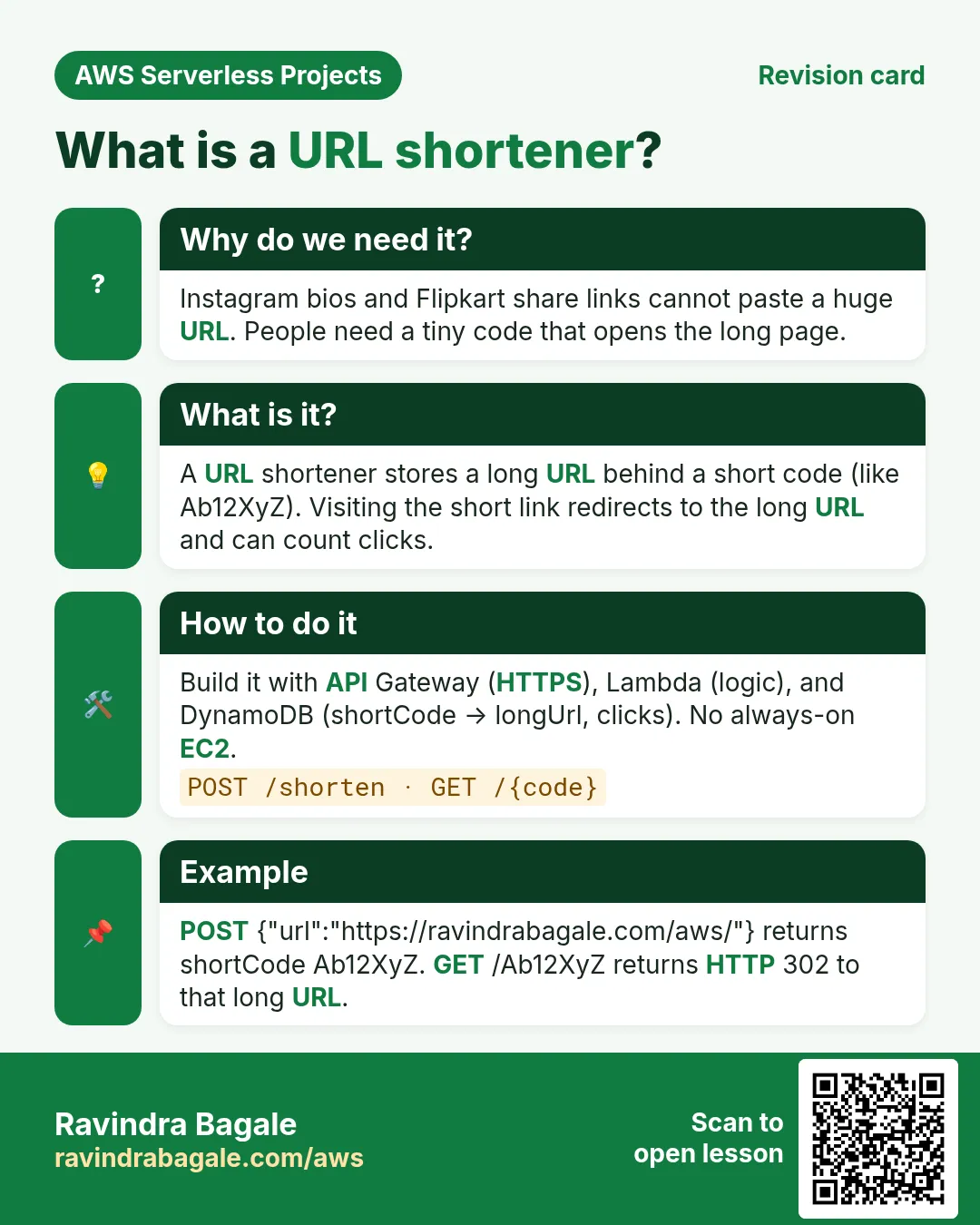
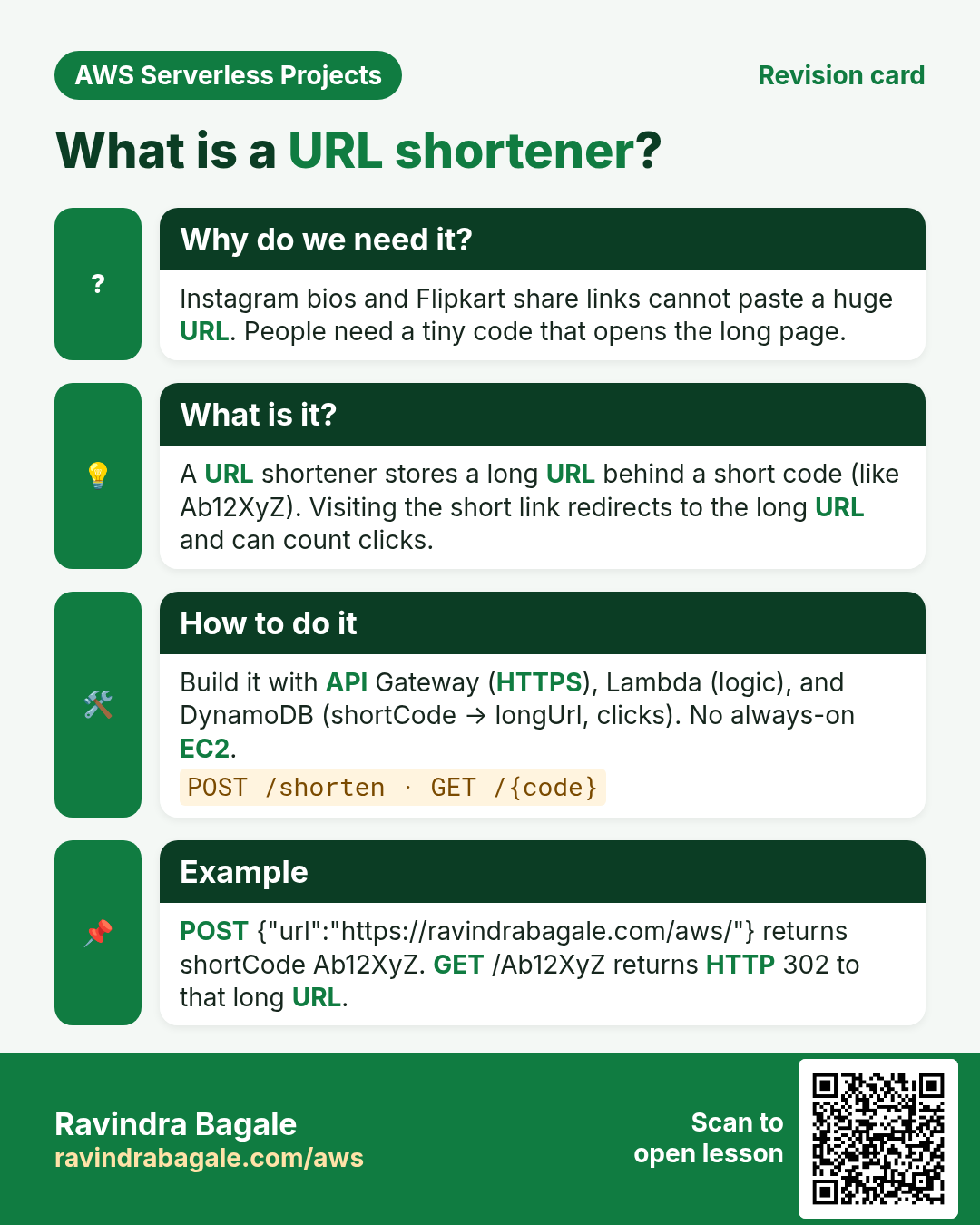
Instagram bio and Flipkart share links cannot paste a huge URL. A shortener stores the long URL, returns a 7-character code, and on each visit redirects and counts clicks. No EC2.
HTTP API to Lambda to DynamoDB table with PK shortCode, attributes longUrl and clicks. POST creates. GET returns 302 and ADD clicks.
Download: url-shortener-app.zip — Python handler.py (boto3 built-in), sample IAM.
2. Architecture
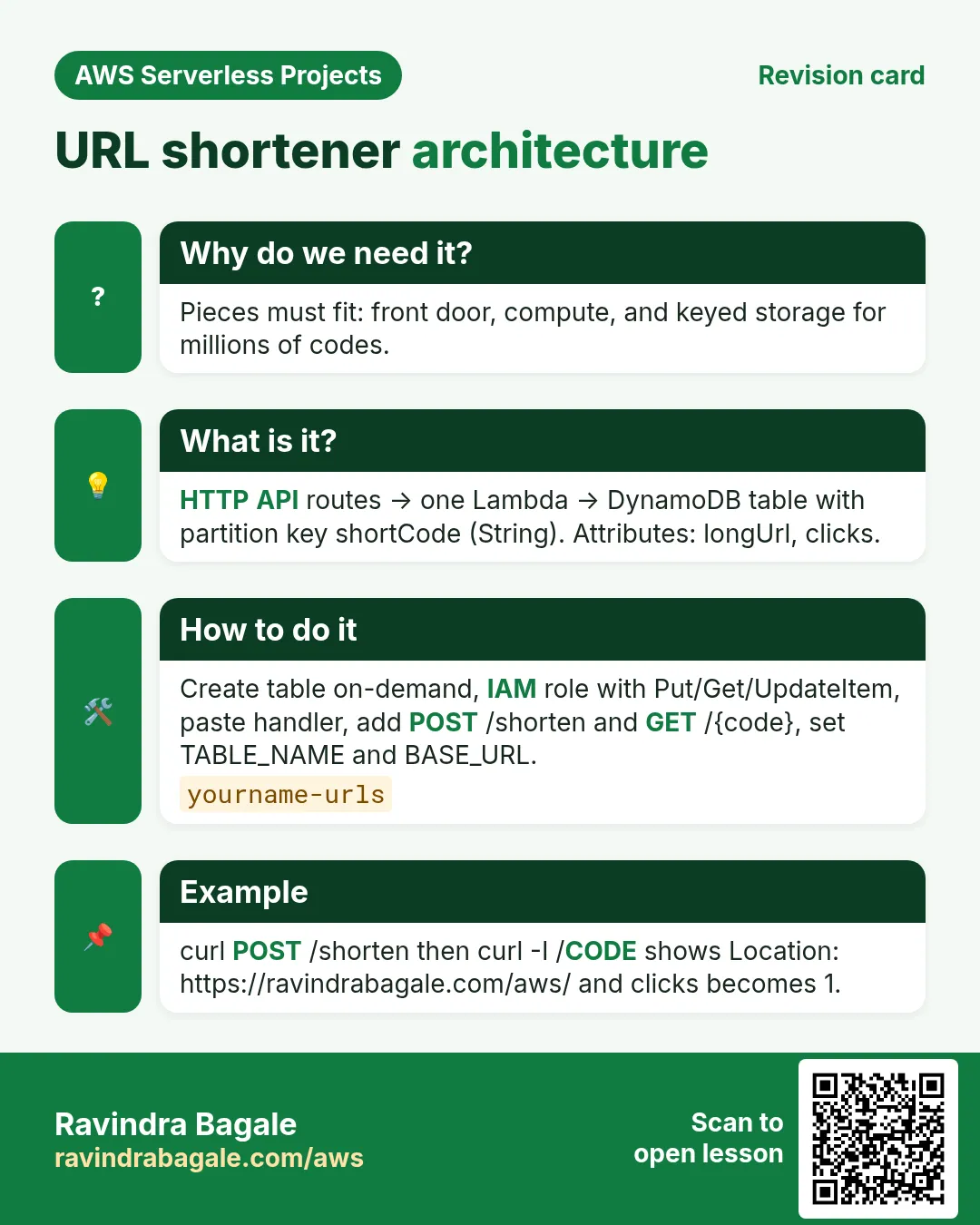
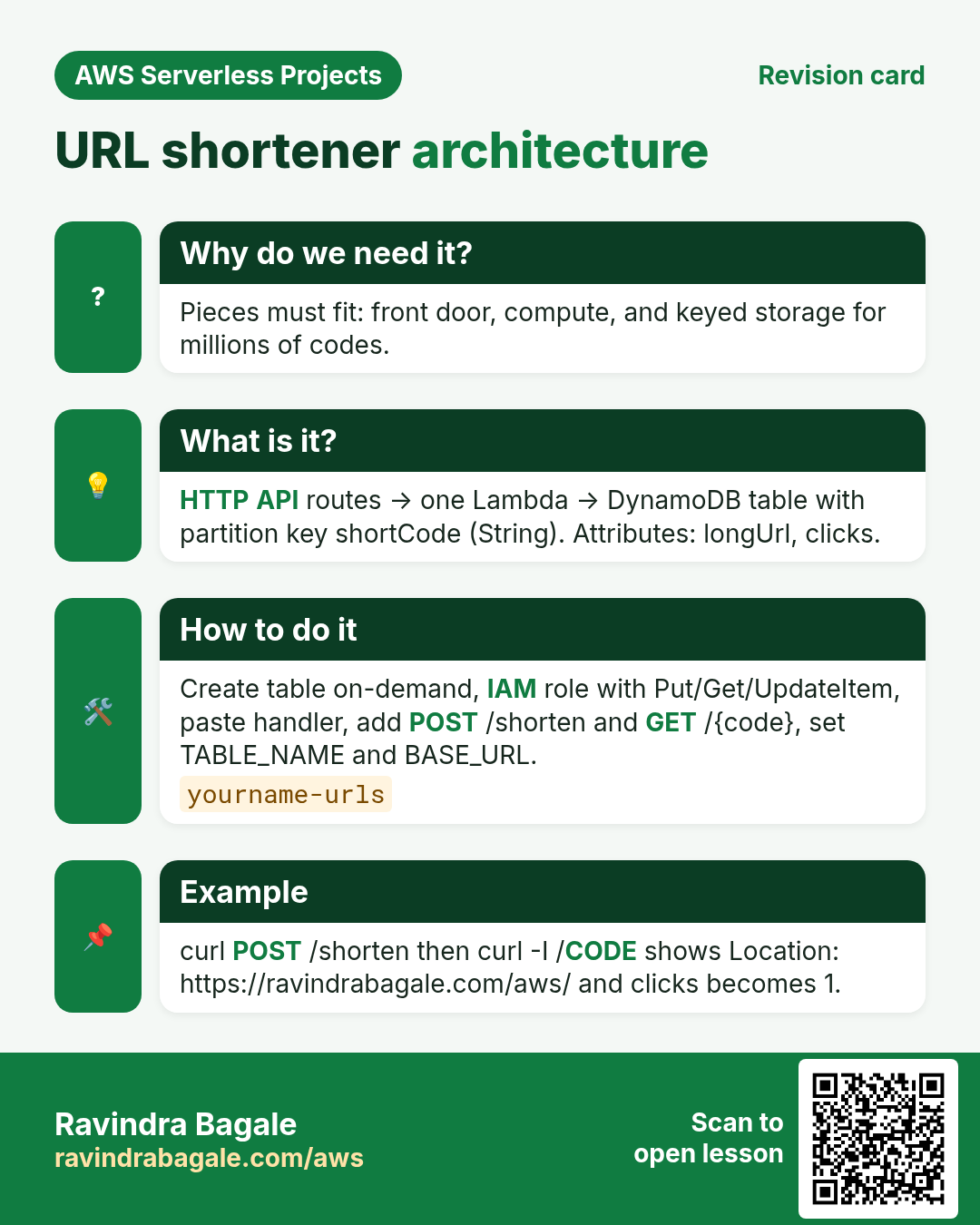
Start with the two jobs this application must perform. The create request sends a long address and gets a new short code. The open request sends just that short code and needs the original address back. A route is the combination of an HTTP method and a path that API Gateway uses to choose where to send the request. Here both routes call Lambda, the service running the Python handler. The handler decides whether to save or look up an item in DynamoDB.
Read a sample item as three named values. shortCode=Ab12XyZ identifies it, longUrl=https://example.com/lesson stores the destination, and clicks=0 starts the count. The code is the partition key, the value supplied to find that item directly. A visitor who opens /Ab12XyZ does not need to know the table name or the destination. A code that does not exist has no address to redirect to and should produce a missing-code response.
| Piece | Service | Why |
|---|---|---|
| API | API Gateway HTTP API | HTTPS + CORS |
| Logic | Lambda Python 3.12 | boto3 included |
| Data | DynamoDB on-demand | Keyed by shortCode |
3. Lab: deploy click by click
Region ap-south-1. Replace yourname.
A. DynamoDB
Before configuring any service, write two sample requests on paper. For POST /shorten, the input is {"url":"https://example.com/report"}. The reply should contain a code and a usable short address. A new item holds that code, the destination and an initial click count. For GET /Ab12XyZ, there is no JSON body to submit. The value after the slash is the key the code must look up.
Now walk through a missing key. The handler searches its table and gets no stored item. A redirect in this case would send the visitor to an invented address. The appropriate response is a not-found status. This gives you two lab checks: test a code you own and a made-up code that was never stored. The successful create test exercises a write; one open request tests a read and a counter update.
TABLE_NAME is a Lambda environment variable, which is configuration supplied to the program at runtime. It connects the handler to the table you created without changing the Python source. Compare that name with the table named in the role policy. If the name is wrong, changing the route alone will not fix storage.
- Create table
yourname-urls. PKshortCode(String). On-demand. No sort key. - Wait until Active.
B. IAM role
- Create role for Lambda. Attach
AWSLambdaBasicExecutionRole. Nameyourname-urls-role. - Inline policy from the zip: PutItem, GetItem, UpdateItem on that table only. Replace ACCOUNT_ID.
C. Lambda
- Create function
yourname-urls-api, Runtime Python 3.12, existing role. - Paste
lambda/handler.py. Handlerhandler.lambda_handler. - Env
TABLE_NAME=yourname-urls. Memory 256 MB, timeout 10 s. Deploy.
D. HTTP API
- Create HTTP API
yourname-urls-http, integrate the Lambda. - Routes:
POST /shorten,GET /{code}. - CORS origin
*, methods GET,POST,OPTIONS. - Copy Invoke URL as
API_BASE. Set Lambda envBASE_URL=API_BASE(no slash). Deploy again.
E. Test
Save the code from the create response before testing the open route. A 201 is the HTTP status for a created resource. On the next request, 302 tells the client to redirect and the Location header supplies the address. Headers are response information separate from the body. Inspect them with the command below, then check the click field for that same code in the table. These are two independent checks.
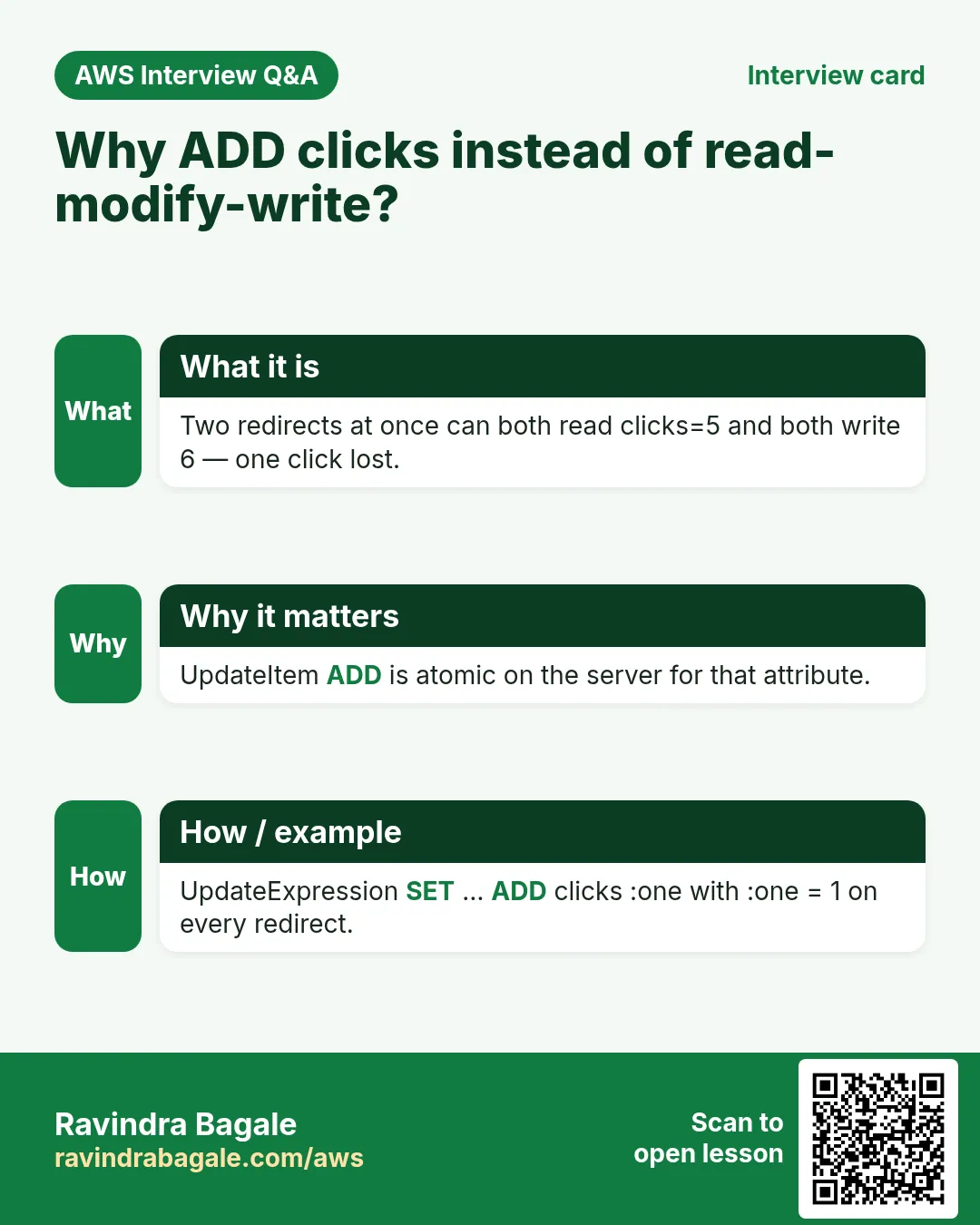
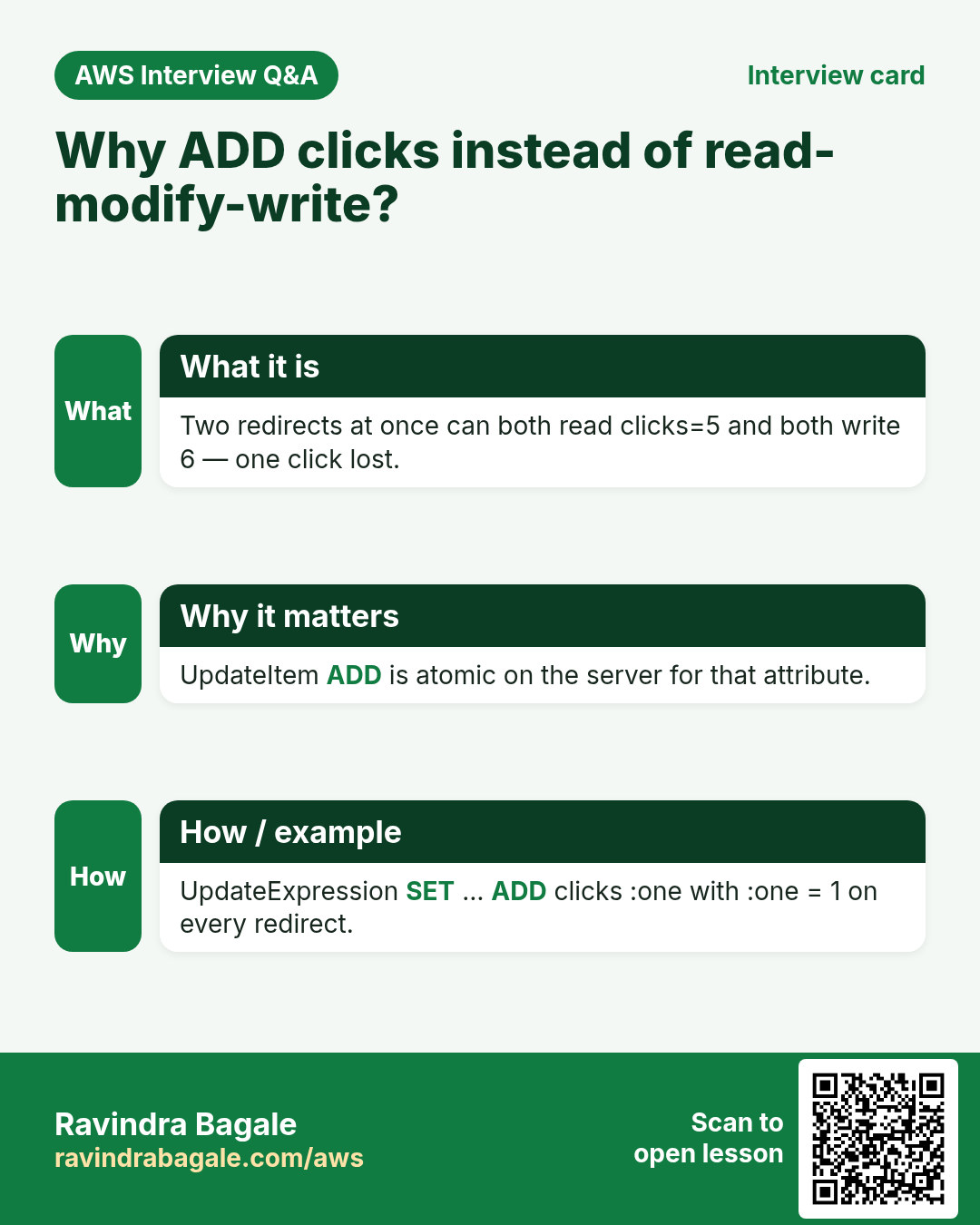
Imagine two visitors arrive when the count is 7. If two workers each read 7 and later write 8, one visit is lost. With DynamoDB’s numeric ADD, each update increments the stored value in the service. Two successful updates add two to the original count. This counts successful redirect processing requests, not individual people.
curl -s -X POST "$API_BASE/shorten" -H 'content-type: application/json' \
  -d '{"url":"https://ravindrabagale.com/aws/"}'
curl -sS -D - -o /dev/null "$API_BASE/YOURCODE"
Expect 201 JSON with shortCode, then 302 Location to the long URL. DynamoDB clicks should be at least 1.
Use a fresh short code and issue one GET. Look for 302 and the expected Location in the response headers, then read clicks on that short-code row. -D - shows the headers and -o /dev/null discards the body. The command leaves redirect following off, so it checks the API response without requesting the destination.
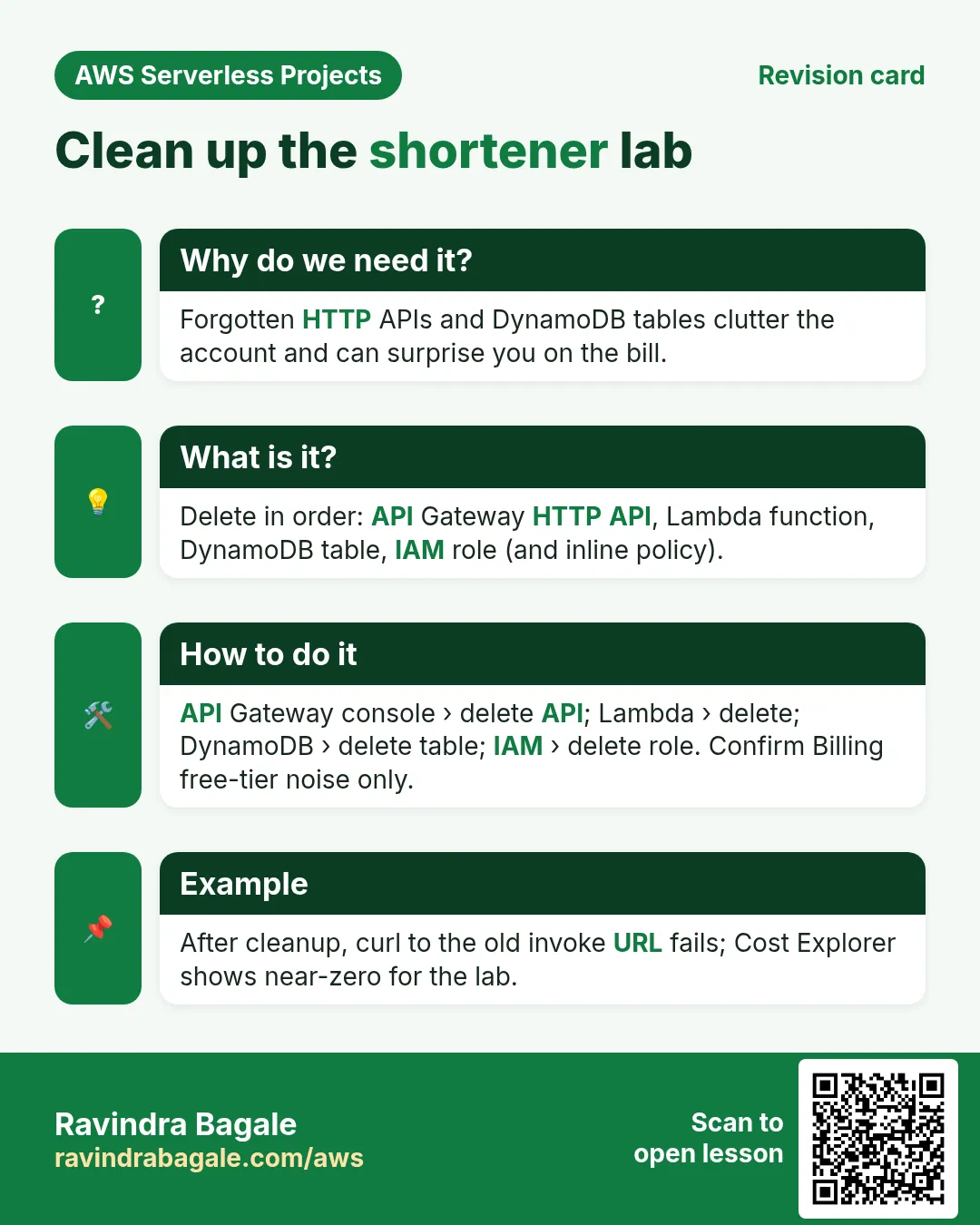
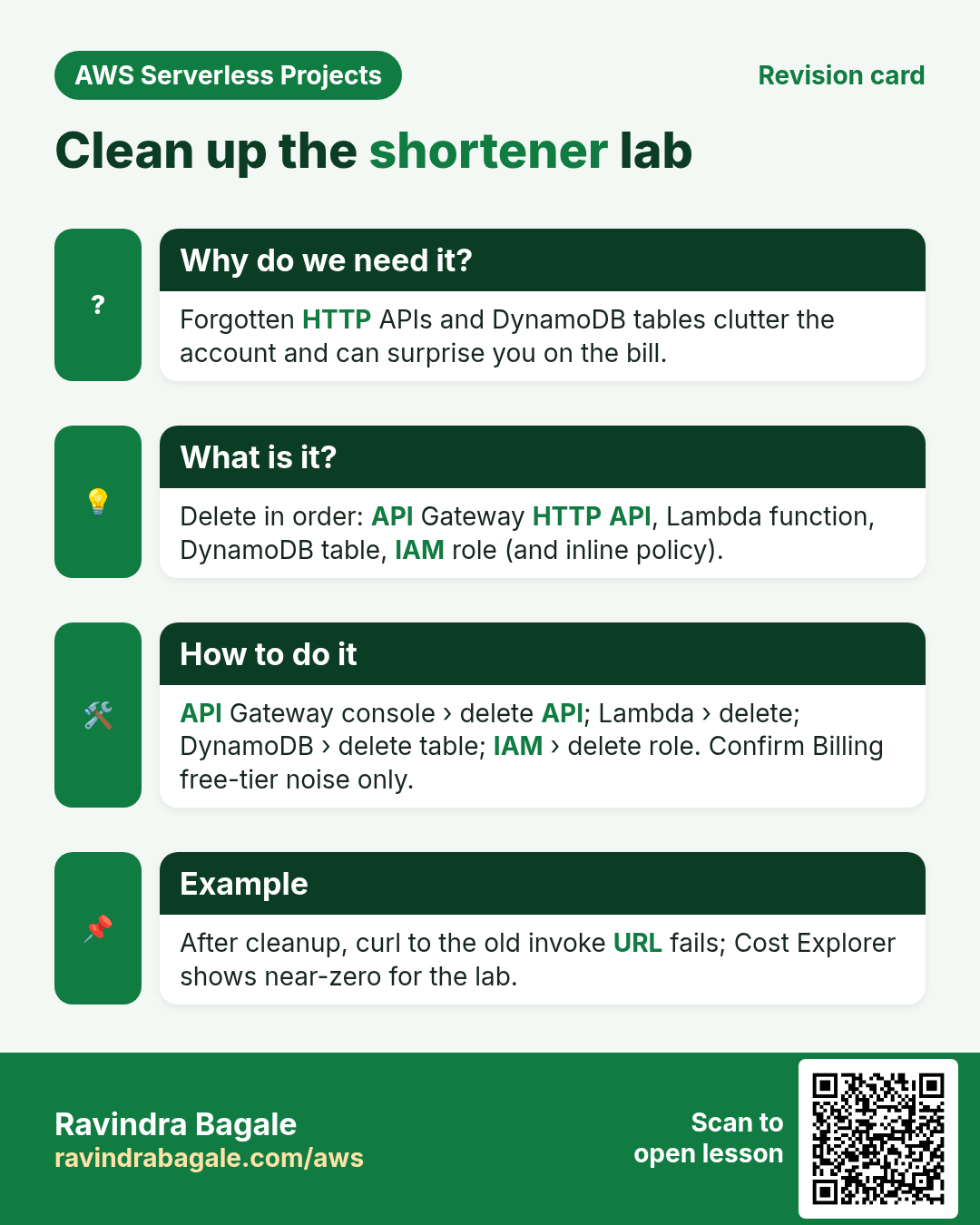
Cleanup
- Delete HTTP API, Lambda, DynamoDB table, IAM role.
- Check Billing for tiny / free-tier charges only.
4. Interview angles
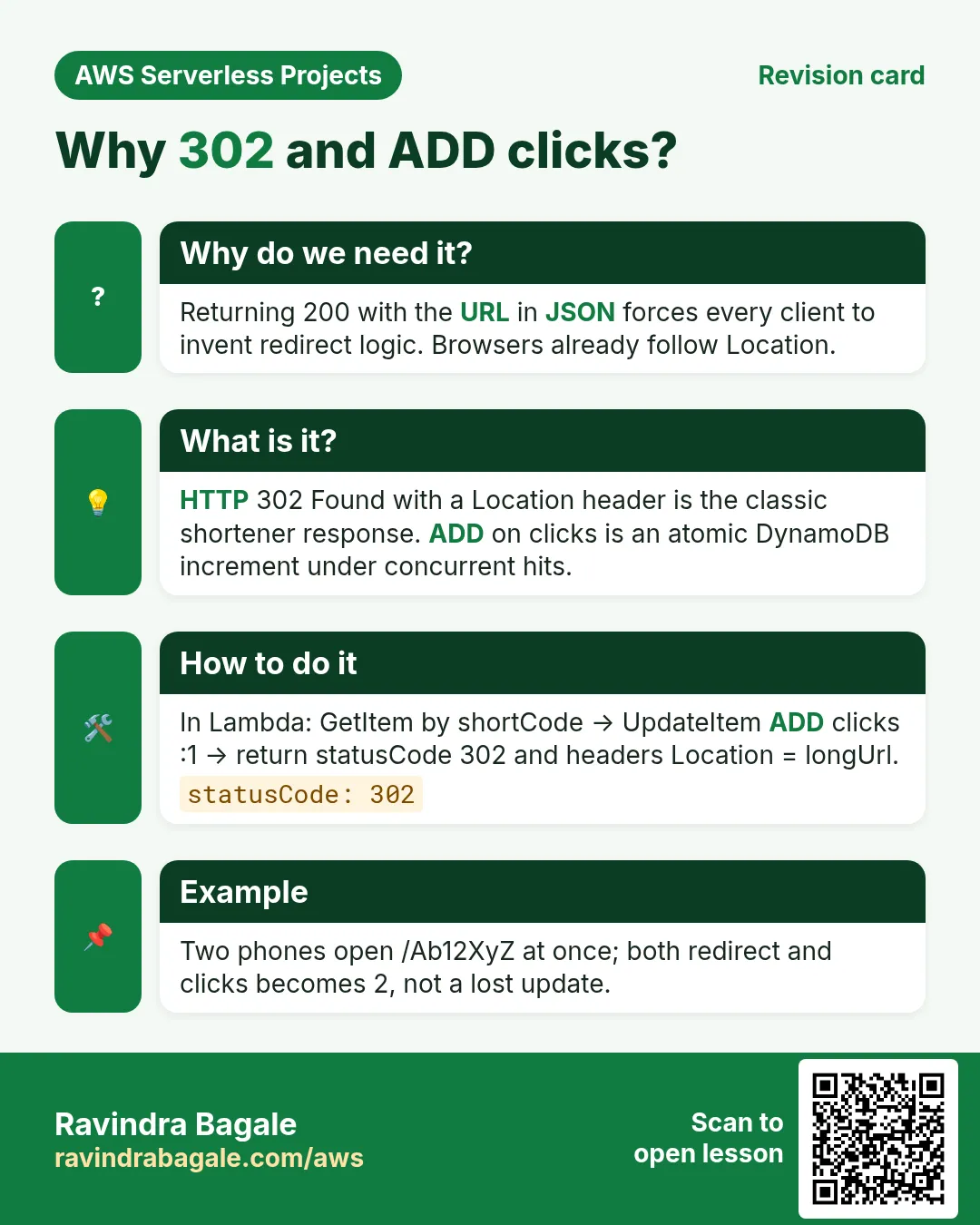
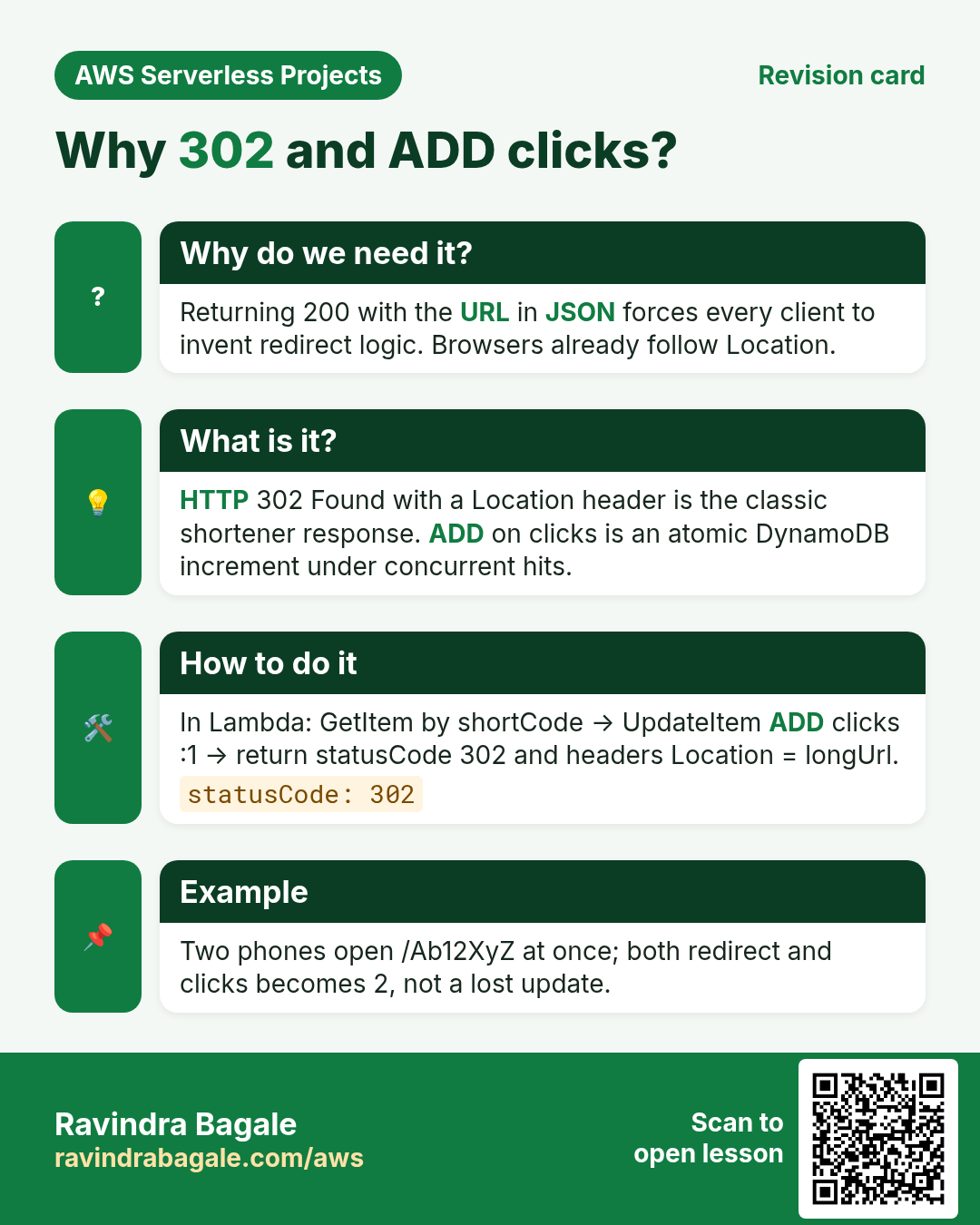
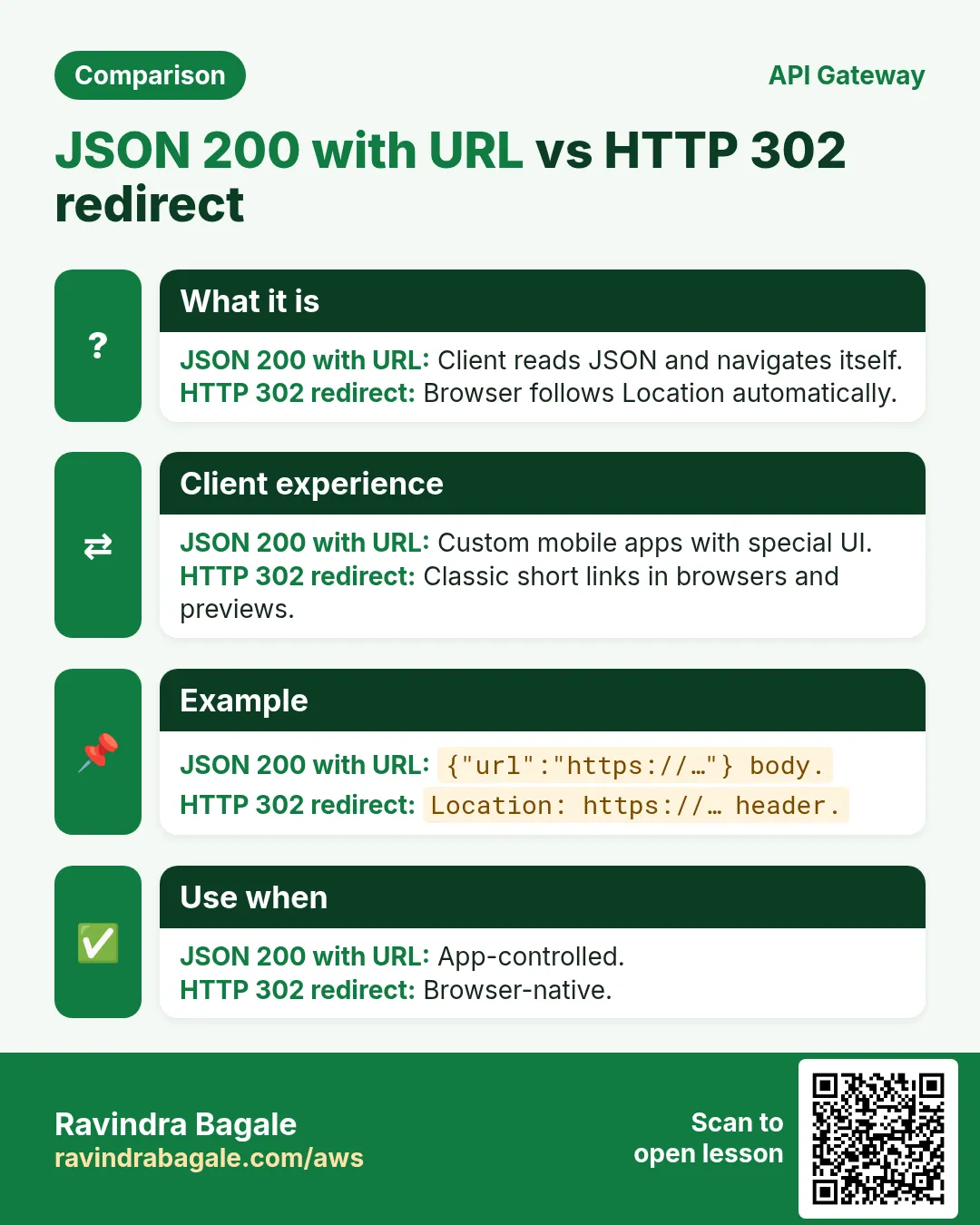
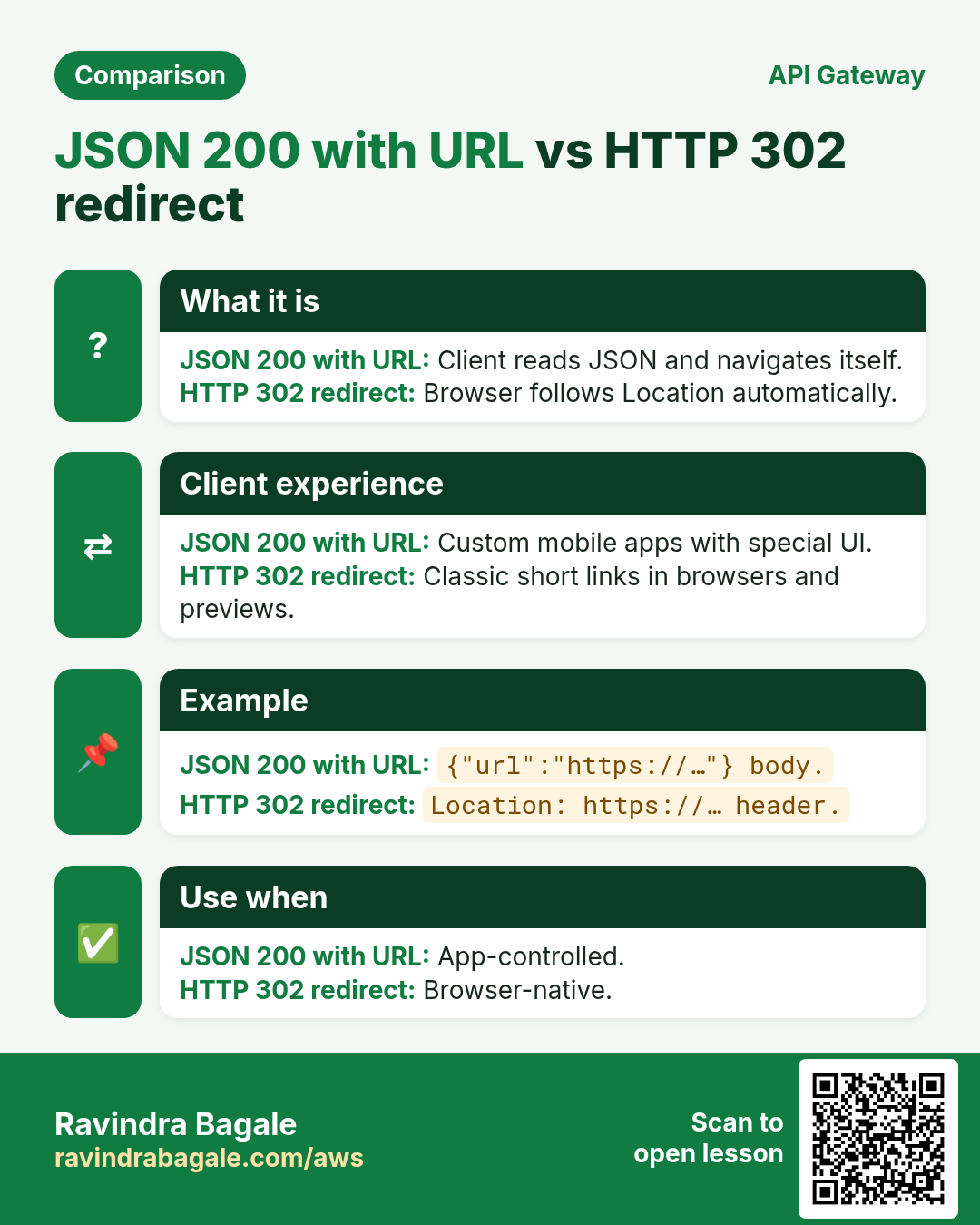
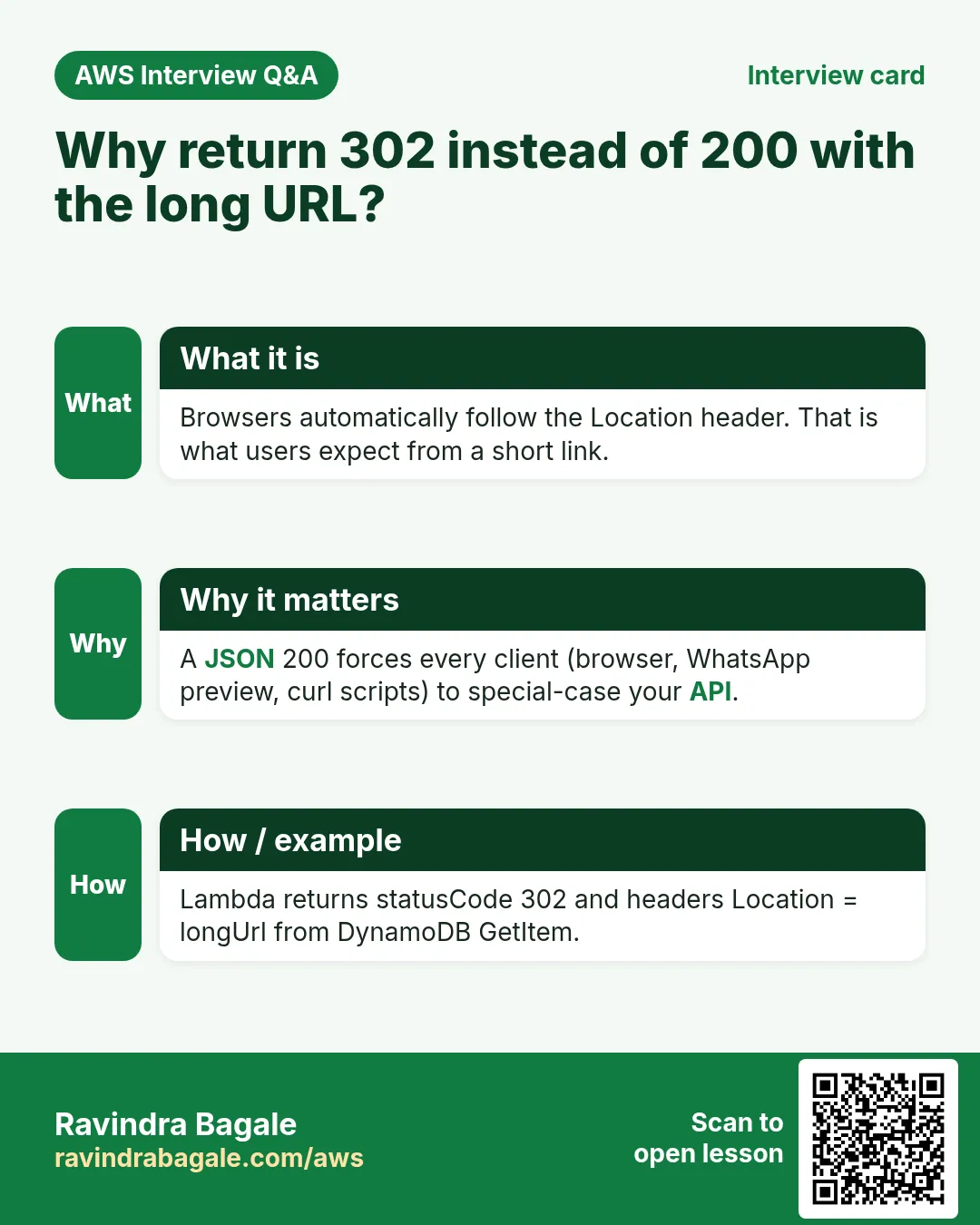
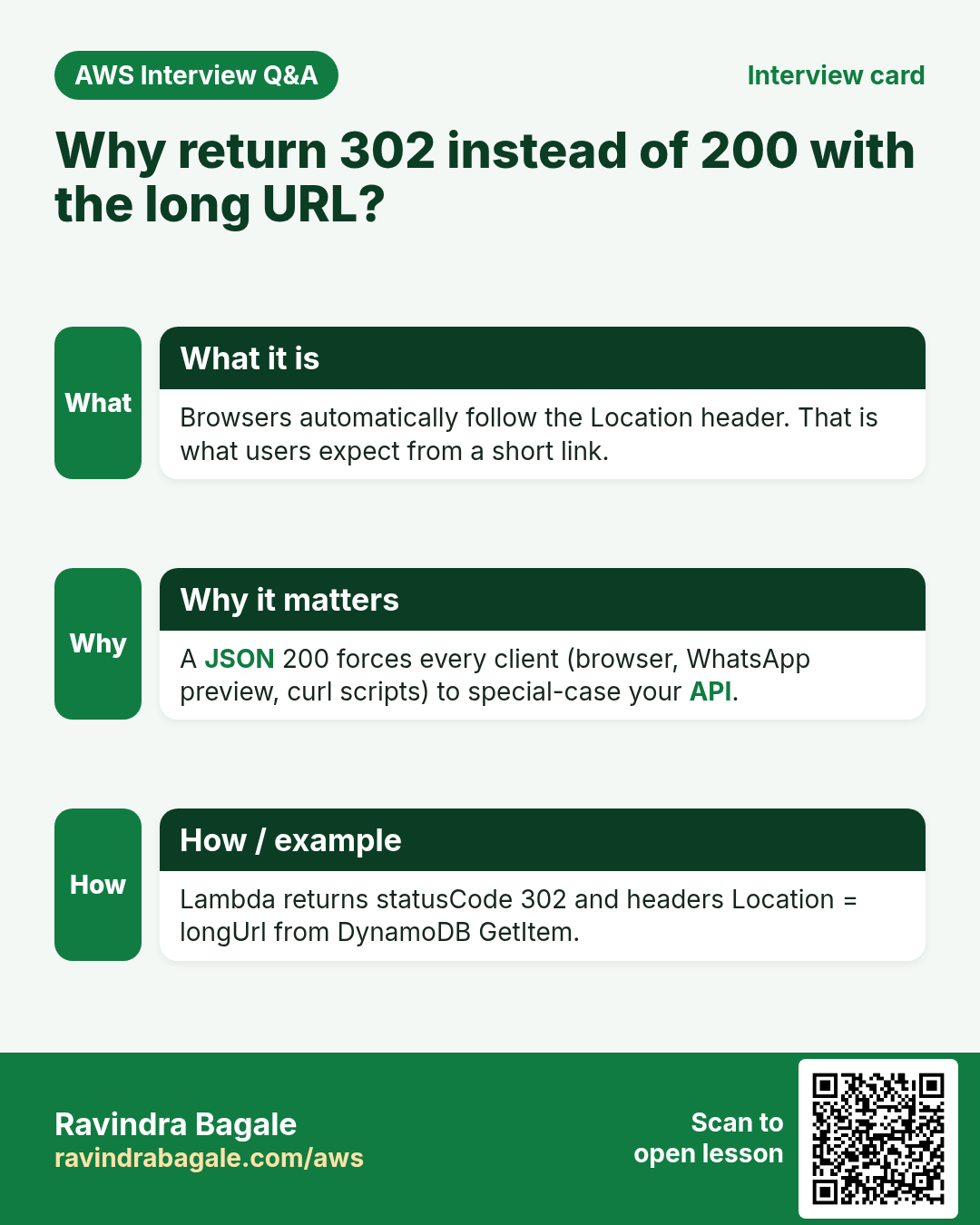
Q. Why 302 not 200 with URL in body?
Browsers follow Location; that is a shortener.
Q. Why ADD clicks?
Atomic under concurrent redirects.
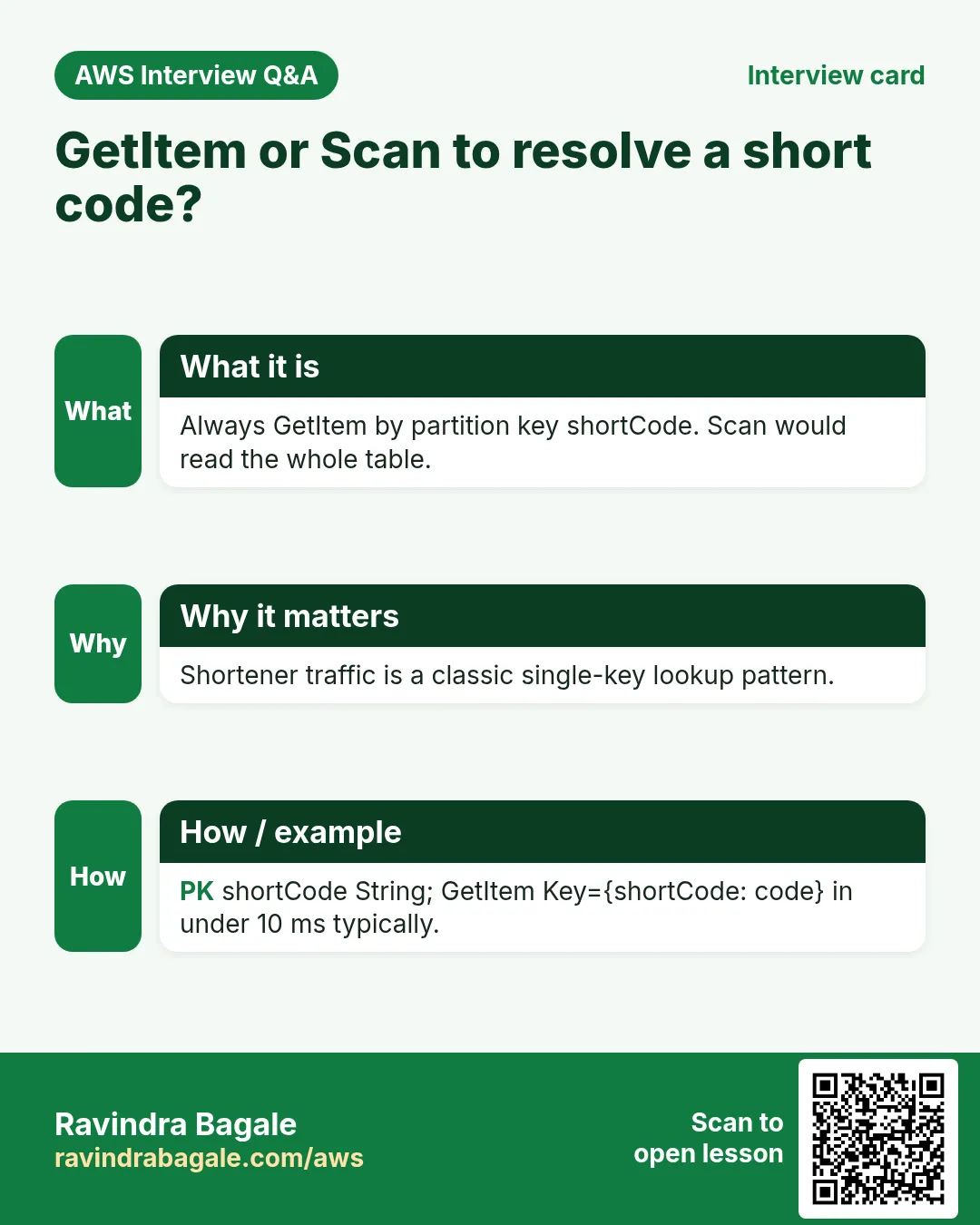
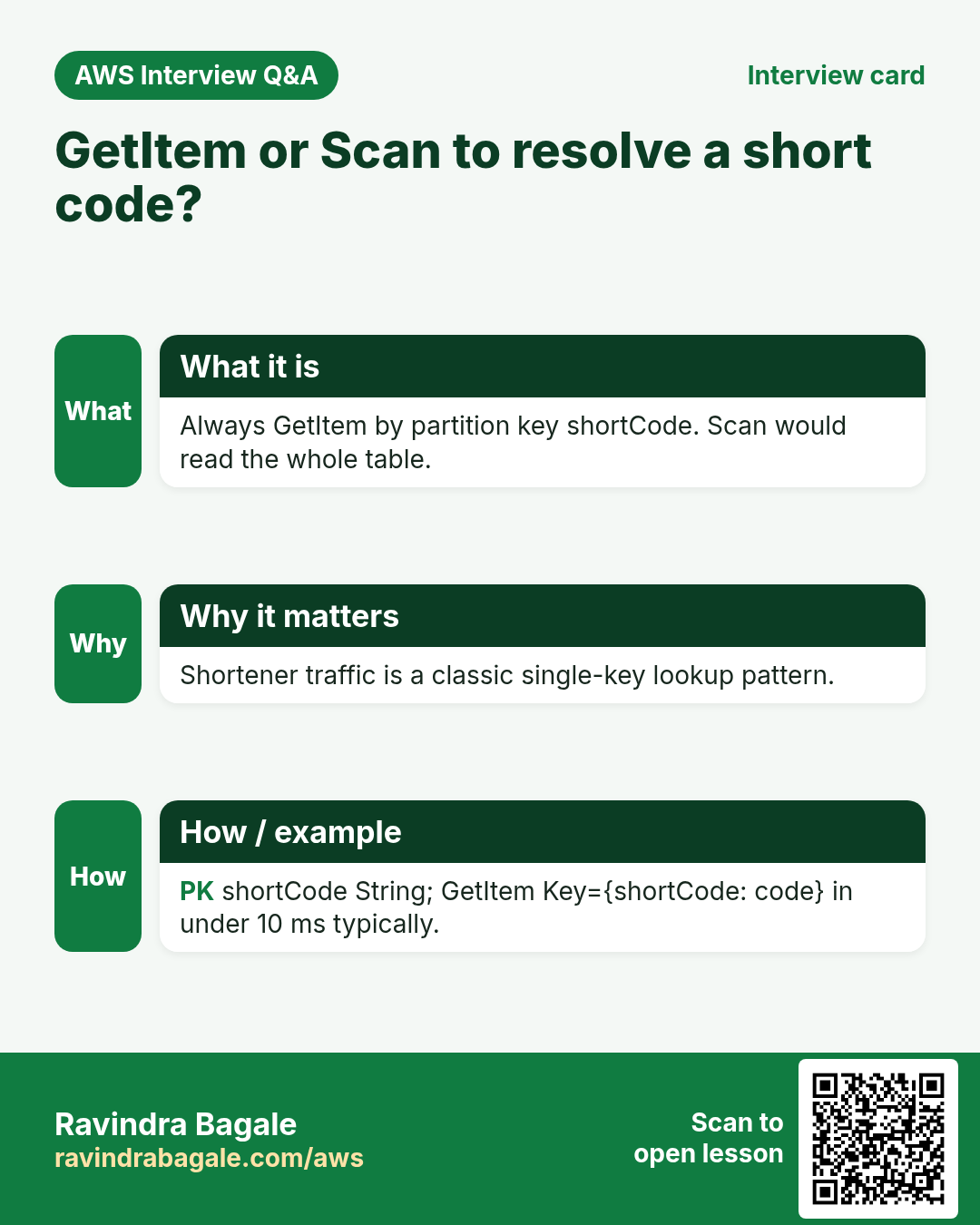
Q. GetItem vs Scan for redirect?
Always GetItem by PK.
Q. Custom domain?
ACM + API custom domain or CloudFront.
Q. Cleanup list?
API, Lambda, table, role.
Try at home
- Add GET /stats/{code} returning clicks without redirect.
- Allow only https URLs.
In short
- Shortener = HTTP API + Lambda + DynamoDB.
- POST creates; GET redirects and counts.
- Least-privilege IAM.
- Clean up.
Follow the redirect, then verify the row
Run the lab with a synthetic HTTPS destination. Capture the generated short code, inspect the 302 and Location without following it, then check the click counter on the same row. In the Python archive the entry point is handler.lambda_handler.
Interview check What happens if two randomly generated IDs match?
Create the mapping with an attribute_not_exists condition and retry with a fresh candidate after a conditional conflict. The simple archive does not include that protection. Keep both routes private in a lab, and plan destination validation, abuse handling and expiration before creating a public shortener.
Practise this chapter
Interview questions and answers
How would you demonstrate that both the URL mapping and the click counter worked?
I would create a mapping and note the short code, request that code without following the redirect, then check the 302 and Location header. I would read the same DynamoDB item to verify the counter. Checking only the redirect cannot establish that the table update succeeded.
Check your understanding
Choose an answer, then compare your reasoning with the explanation.
Practice Tasks
Practice checks run in your browser. They check the answer for this exercise; they do not create resources or connect to your AWS account.
About this scenarioLisboa Tiles is a ceramic tiles business in Lisbon. João Silva looks after its IT and cloud work. They count money in EUR and run their AWS resources in the eu-west-1 Region. In the tasks below you do real jobs for them using what this lesson teaches. All names, account IDs, IP addresses and numbers are made up for practice.
0 / 12
Easy List functions
See which functions exist in this Region.
List the Lambda functions in eu-west-1.
- Read the task and decide which AWS service it is about.
- Write aws, then the service name, then the operation (the action word).
- Add each needed flag (--name) followed by its value from the task.
- Flags can be in any order. Click Check answer.
Medium Invoke a function
Invoke runs the function now and saves its answer in a file.
Invoke lisboatiles-orders-fn and save the response to out.json.
- Read the task and decide which AWS service it is about.
- Write aws, then the service name, then the operation (the action word).
- Add each needed flag (--name) followed by its value from the task.
- Flags can be in any order. Click Check answer.
Medium Trust policy for a Lambda role
The trust policy says WHO may take the role.
Write a trust policy that lets lambda.amazonaws.com assume the role.
- Start with { "Version": "2012-10-17", "Statement": [ ... ] }.
- In each statement write Effect, Action and Resource.
- Give only what the task needs (least privilege).
- Use double quotes and commas correctly. Click Check answer.
Medium Put an item
DynamoDB JSON shows the type of each value: S for string, N for number.
Put an item into lisboatiles-orders with orderId "o-101" (string) and amount 2500 (number).
- Read the task and decide which AWS service it is about.
- Write aws, then the service name, then the operation (the action word).
- Add each needed flag (--name) followed by its value from the task.
- Flags can be in any order. Click Check answer.
Medium Change timeout and memory
More memory also gives more CPU; timeout stops runaway runs.
Set lisboatiles-orders-fn to timeout 30 seconds and memory 512 MB.
- Read the task and decide which AWS service it is about.
- Write aws, then the service name, then the operation (the action word).
- Add each needed flag (--name) followed by its value from the task.
- Flags can be in any order. Click Check answer.
Medium Let a function write logs
Without these actions, Lambda logs never appear in CloudWatch.
Allow logs:CreateLogGroup, logs:CreateLogStream, logs:PutLogEvents on arn:aws:logs:*:*:* only.
- Start with { "Version": "2012-10-17", "Statement": [ ... ] }.
- In each statement write Effect, Action and Resource.
- Give only what the task needs (least privilege).
- Use double quotes and commas correctly. Click Check answer.
Hard Let S3 call your function
A resource-based permission is needed before S3 can invoke the function.
Add permission statement s3invoke to lisboatiles-orders-fn so s3.amazonaws.com can call lambda:InvokeFunction from bucket arn:aws:s3:::lisboatiles-uploads.
- Read the task and decide which AWS service it is about.
- Write aws, then the service name, then the operation (the action word).
- Add each needed flag (--name) followed by its value from the task.
- Flags can be in any order. Click Check answer.
Hard Quick-create an HTTP API for Lambda
Quick create builds an HTTP API, a default route and stage pointing at your function.
Create an HTTP API named lisboatiles-api whose target is arn:aws:lambda:eu-west-1:101273714098:function:lisboatiles-orders-fn.
- Read the task and decide which AWS service it is about.
- Write aws, then the service name, then the operation (the action word).
- Add each needed flag (--name) followed by its value from the task.
- Flags can be in any order. Click Check answer.
Hard Create a Lambda function
Lambda needs the code zip, a runtime, a handler name and an execution role.
Create function lisboatiles-orders-fn: runtime python3.12, handler app.handler, role arn:aws:iam::101273714098:role/lambda-basic, code in function.zip.
- Read the task and decide which AWS service it is about.
- Write aws, then the service name, then the operation (the action word).
- Add each needed flag (--name) followed by its value from the task.
- Flags can be in any order. Click Check answer.
Hard Set environment variables
Keep settings like table names out of the code.
Set the environment variable TABLE=lisboatiles-orders on lisboatiles-orders-fn.
- Read the task and decide which AWS service it is about.
- Write aws, then the service name, then the operation (the action word).
- Add each needed flag (--name) followed by its value from the task.
- Flags can be in any order. Click Check answer.
Hard Invoke with a JSON payload
In CLI v2, raw JSON needs --cli-binary-format raw-in-base64-out.
Invoke lisboatiles-orders-fn with payload {"orderId":"o-101"} (raw JSON) and save the reply in out.json.
- Read the task and decide which AWS service it is about.
- Write aws, then the service name, then the operation (the action word).
- Add each needed flag (--name) followed by its value from the task.
- Flags can be in any order. Click Check answer.
Hard Lambda GB-seconds
Lambda bills memory × time.
1,000,000 invocations, 512 MB memory, 200 ms each. How many GB-seconds?
- Write down the numbers the task gives you.
- Work it out step by step on paper.
- Type only the final answer in the box.
- Click Check answer.
Revision, comparison and interview cards
Revise this lesson in a few minutes. Save the cards on your phone or download them as PNG files. The QR code on each card opens this lesson.
More cards: Ravi Sir's Cards.