Amazon CloudFront and WAF: CDN, HTTPS and Web Firewall Explained
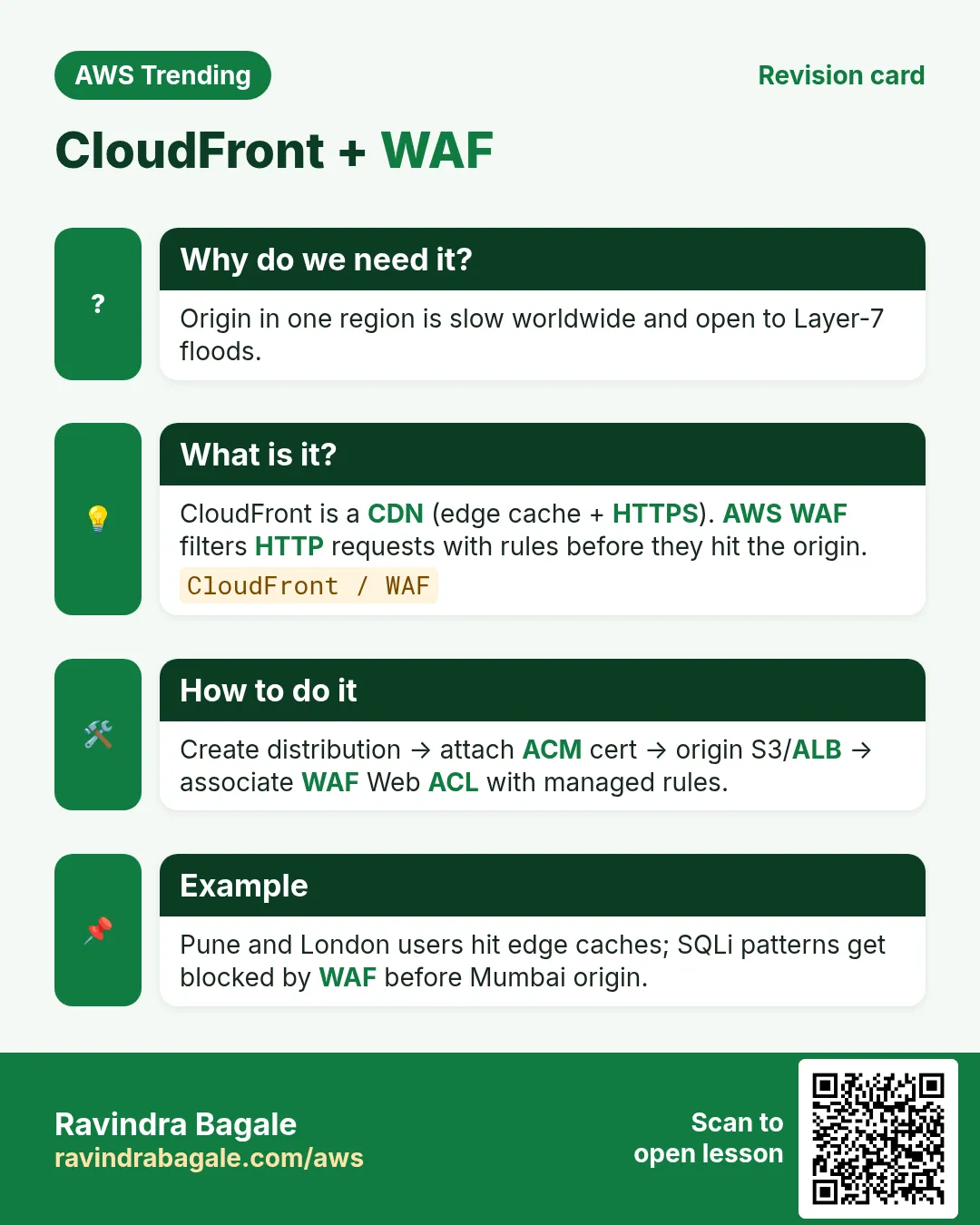
Your website is in Mumbai S3, but a user in Europe waits. CloudFront copies popular files to edge locations closer to users. WAF sits in front to block common web attacks and noisy bots. CDN for speed; WAF for punches you do not want.
In this chapter
- Why CDN + WAF together
- CloudFront distributions, origins, behaviors
- HTTPS certificates and price classes
- AWS WAF rules and Bot Control basics
- Lab, errors, FAQ, interview
1. Everyday example first
An education site launches a PDF exam guide. Without CloudFront every download hits the origin. With CloudFront, the first reader warms the edge; the next thousand are cheap and fast. WAF rate rules stop a scraper from downloading the whole library.
2. Why CloudFront and WAF?
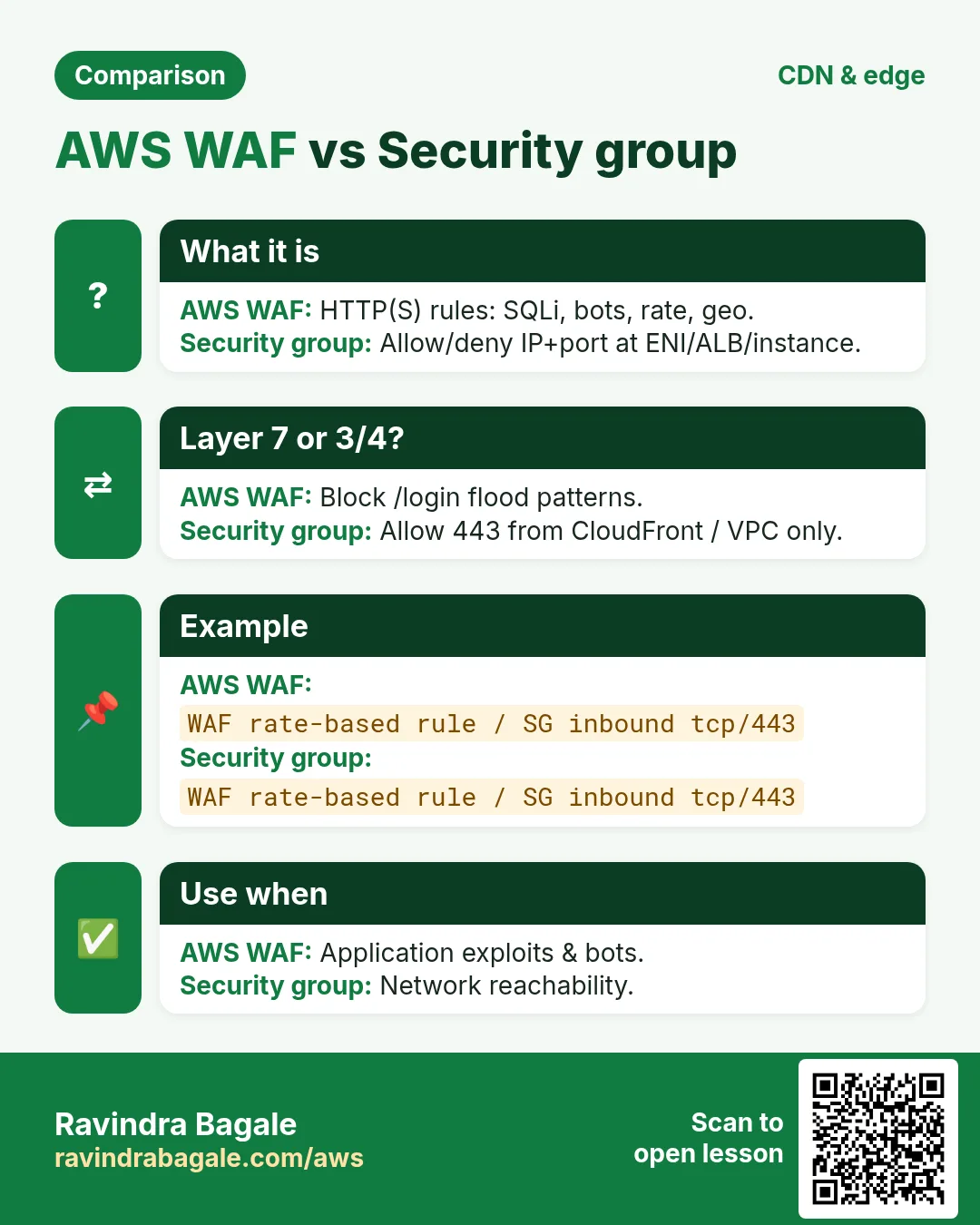
Latency and DDoS/L7 abuse are different problems. CloudFront shortens distance and absorbs some volumetric noise. WAF inspects HTTP and applies managed or custom rules. Most public apps want both.
3. What is CloudFront?
Imagine a college page with a public logo and a private report. CloudFront can receive a request at an edge location. An origin is the system that supplies a response when needed, such as an S3 bucket or load balancer. A cache key describes which requests may share a cached response. The logo can be shared across users when the behavior permits it. A private report needs a design that keeps one user’s response from being reused for another. Draw edge, cache and origin, then trace the logo’s first load and a later hit.
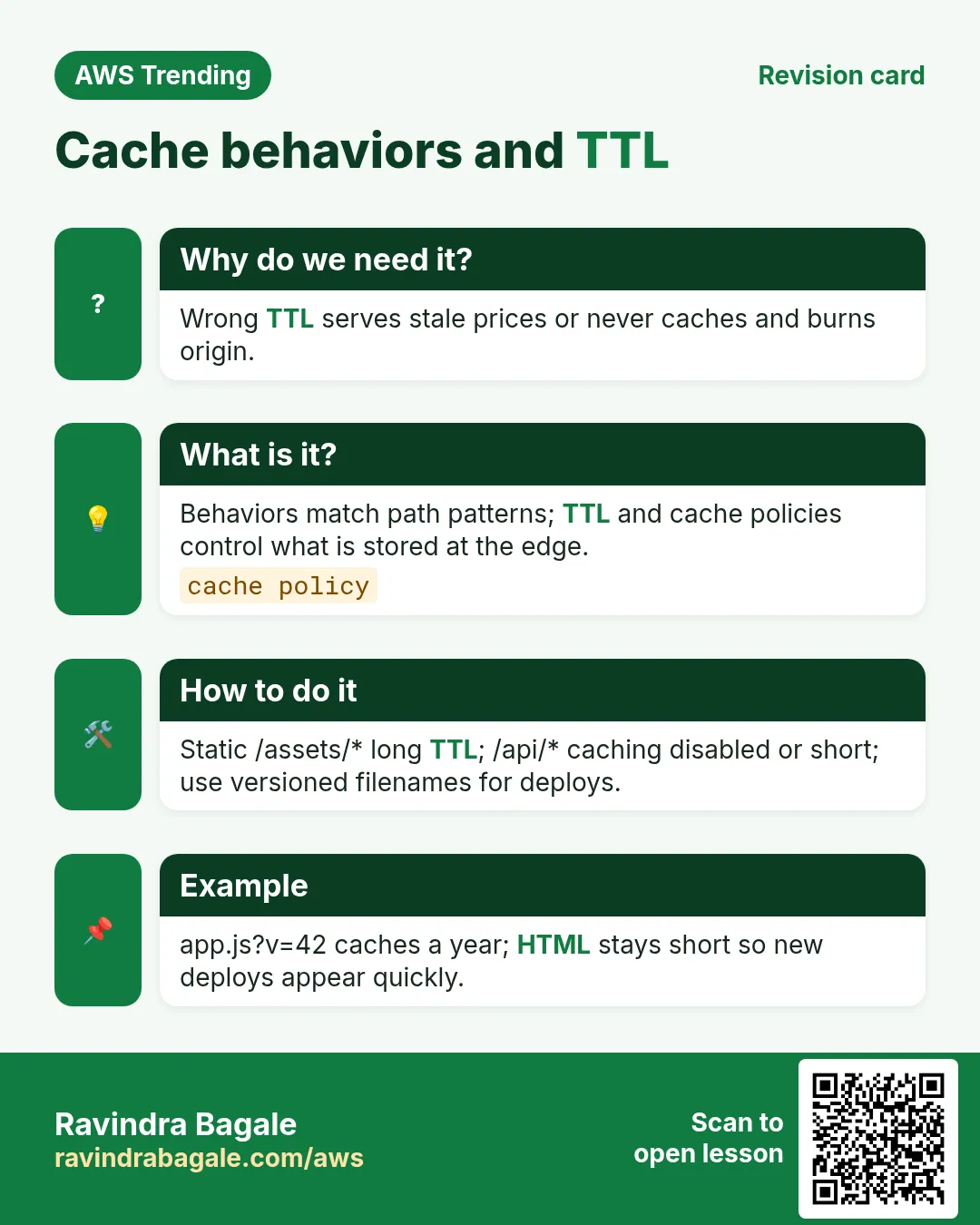
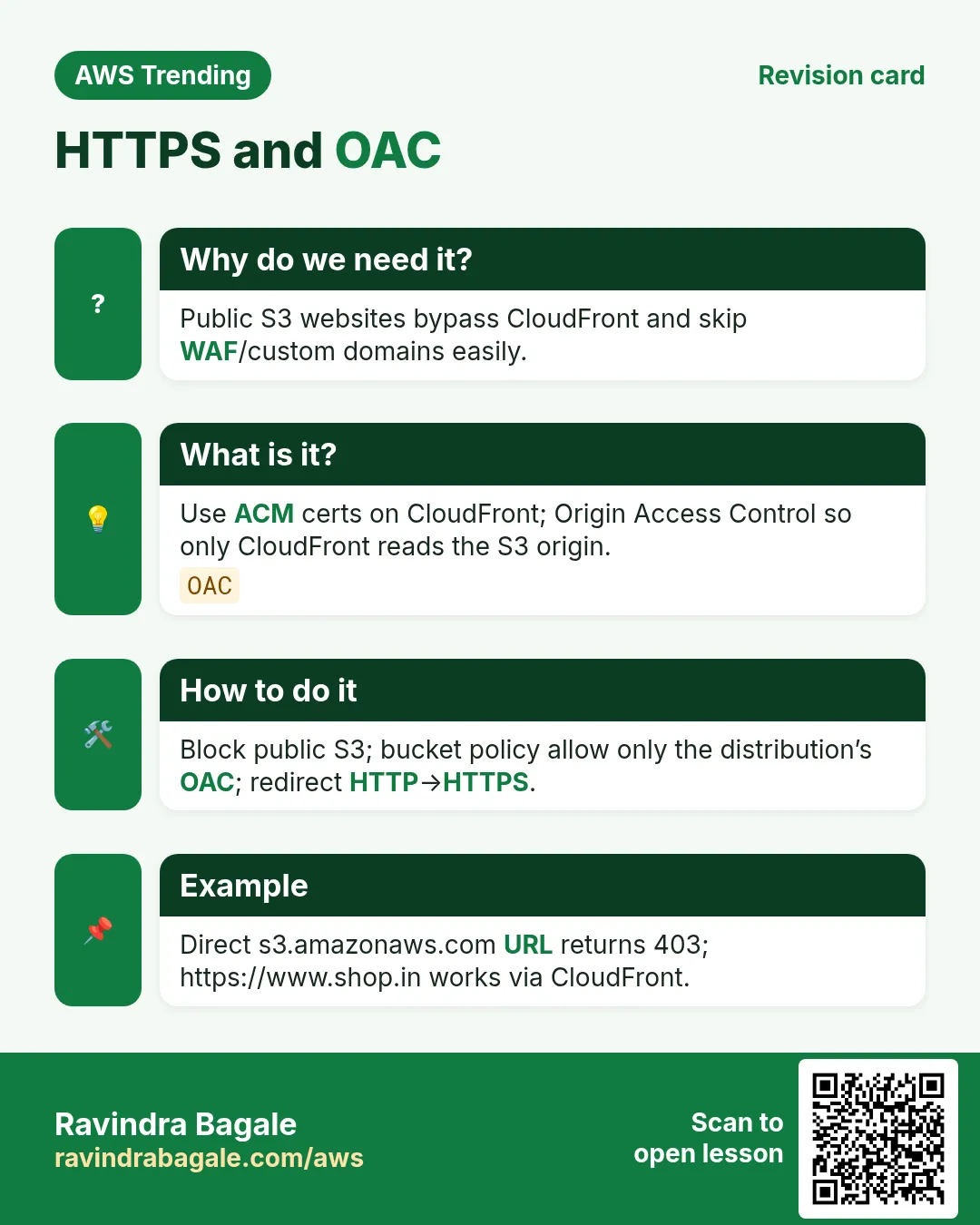
A distribution points to origins (S3, ALB, custom). Behaviors map path patterns to cache policies and origin request policies. Viewers can be forced to HTTPS with ACM certificates (usually us-east-1 for CloudFront).
| Piece | Role |
|---|---|
| Distribution | The CDN config unit |
| Origin | Where content lives |
| Behavior | Path → cache/origin rules |
| WAF Web ACL | Rules attached to distribution |
4. How to set up (checklist)
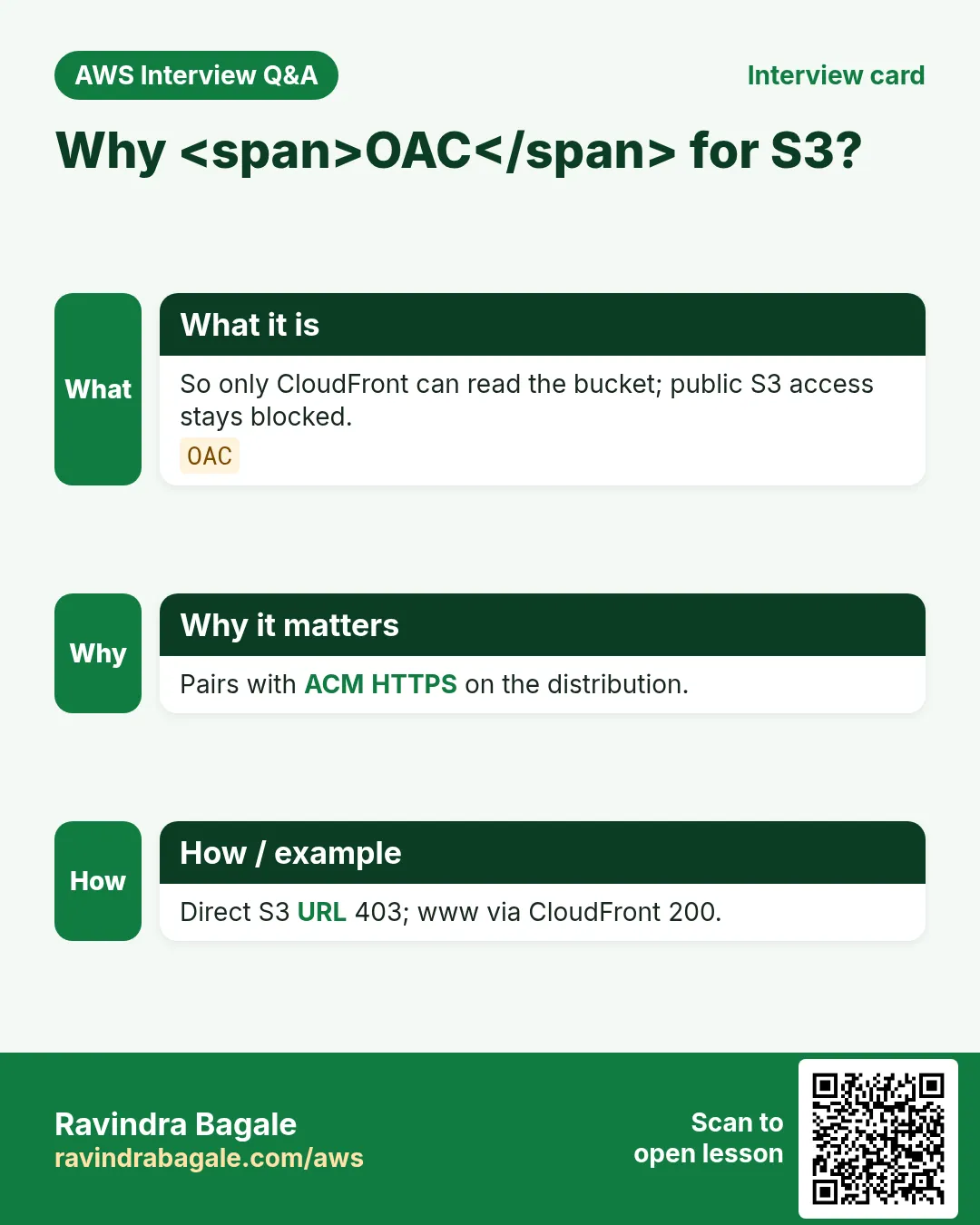
Decide which origin you have before setting access permissions. For a private S3 REST origin, CloudFront can use Origin Access Control to sign origin requests. CloudFront can still serve the intended public URL while direct bucket access stays blocked. WAF rules evaluate the HTTP request at the supported resource you associate with them. A rule that blocks a request changes whether it reaches the app. Cache configuration changes whether an allowed response can be served from the edge.
- Create ACM cert in us-east-1 for your domain.
- Create distribution; origin = S3 REST or ALB.
- Redirect HTTP to HTTPS; TLS 1.2+.
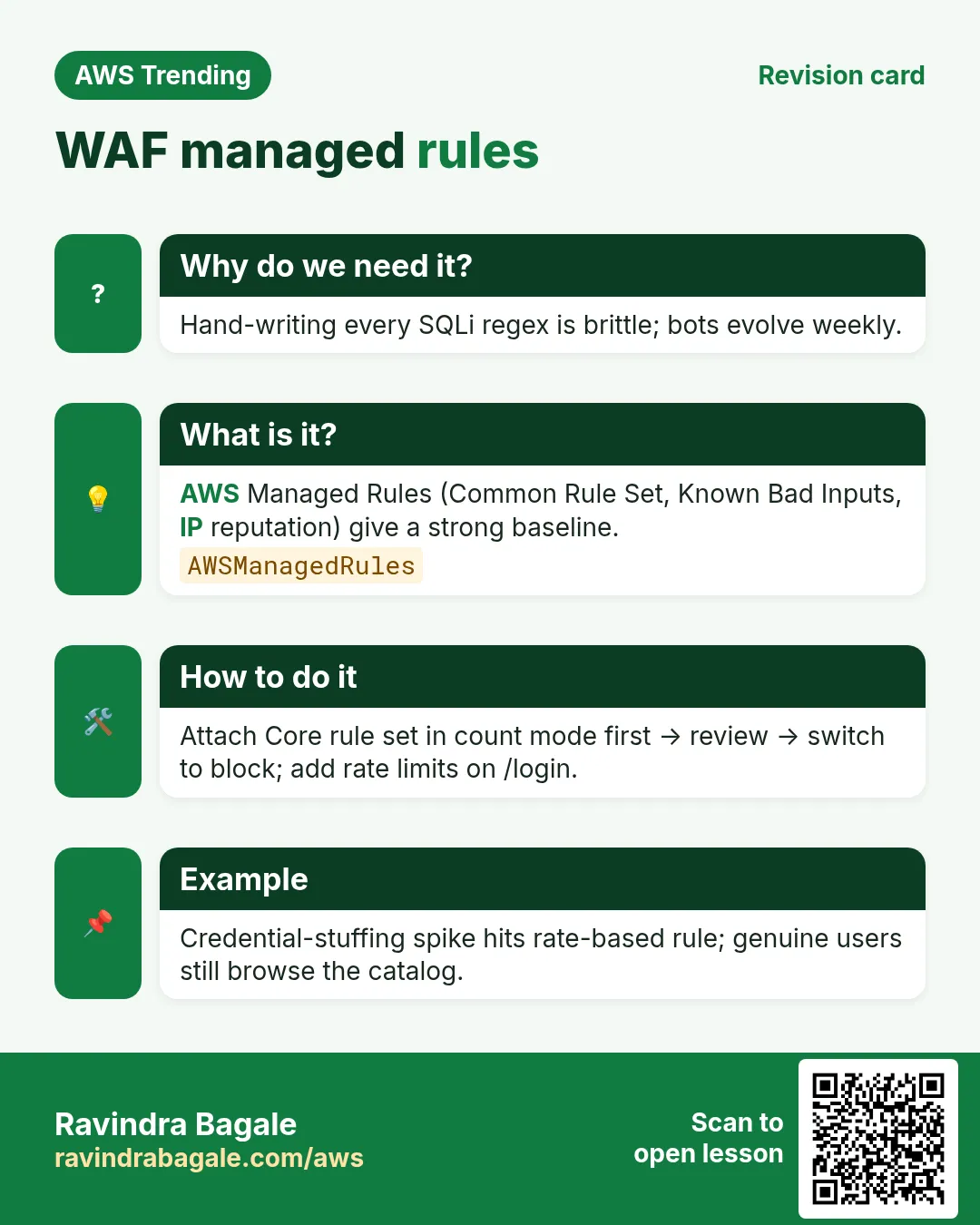
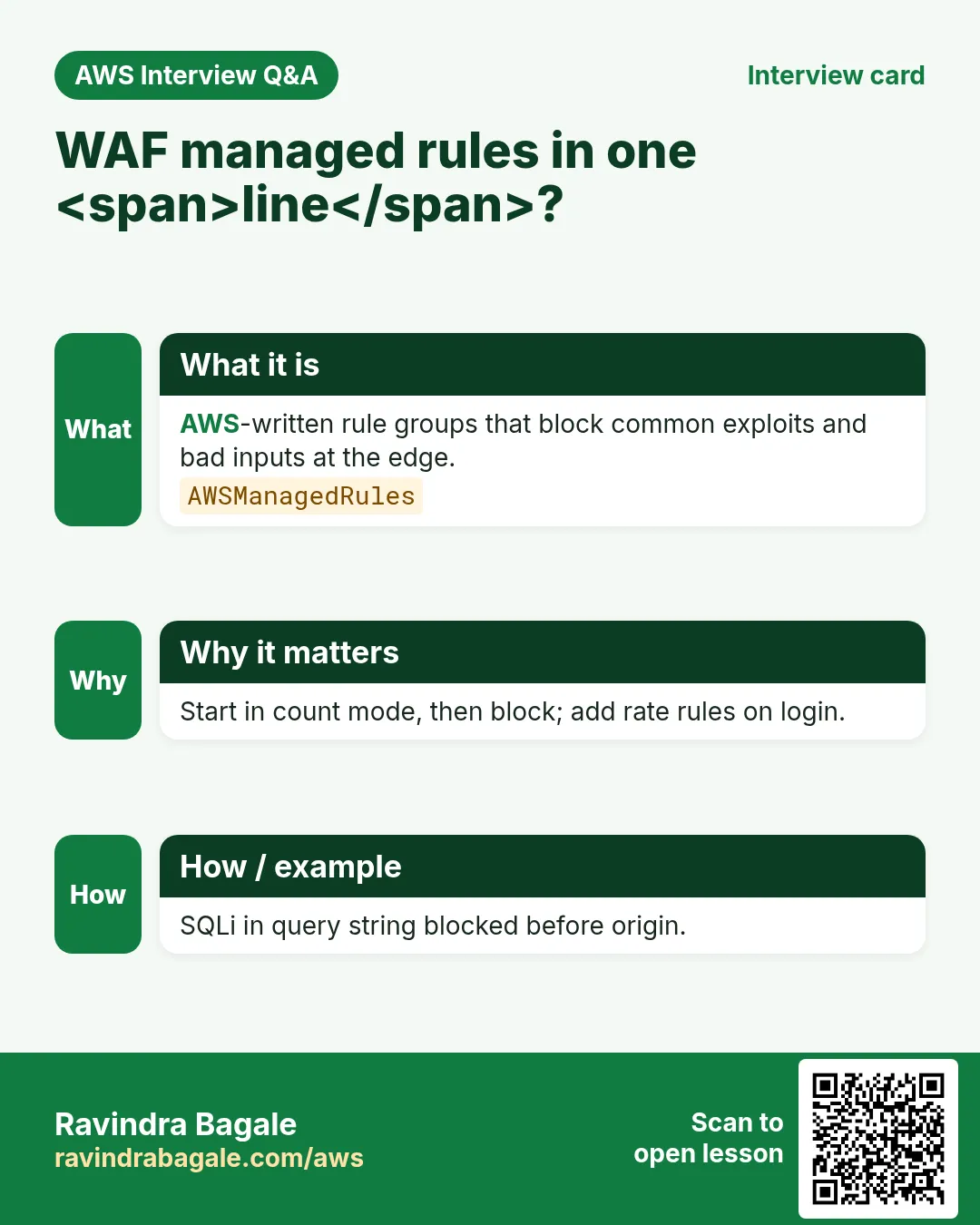
- Attach AWS WAF Web ACL with AWS managed core rule set.
- Add rate-based rule for login paths.
- Enable access logs to S3 for forensics.
# Cache mental model
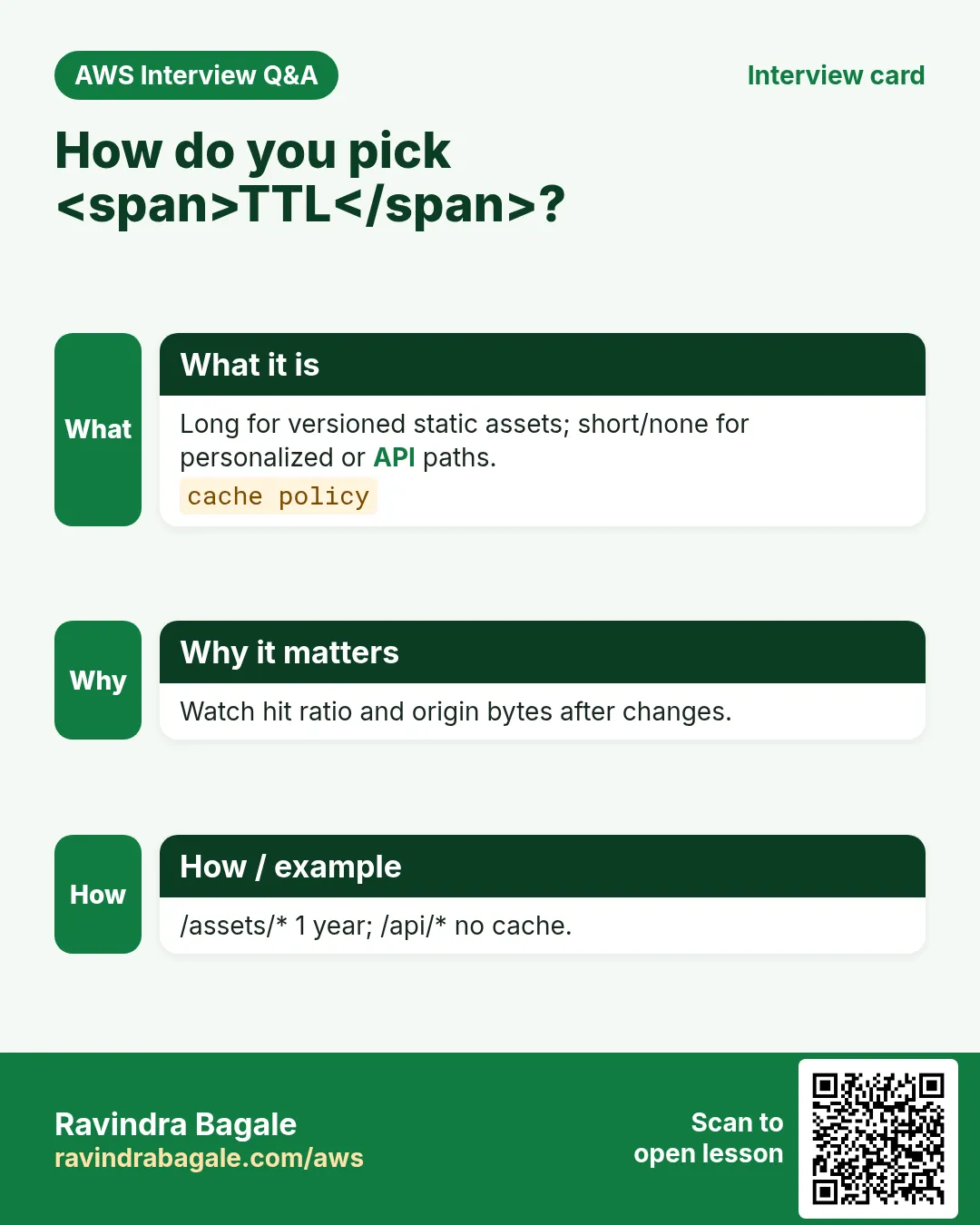
# /static/*  → long TTL, compress, query strings ignored
# /api/*     → CachingDisabled, forward headers carefully
# /login     → WAF rate limit + no cache
5. Industries
- Media: video/image edges
- Fintech portals: WAF on login + CDN for static
- Gov sites: managed rules + logging
- SaaS marketing sites: price class to control cost
6. Lab: design behaviors on paper + console tour
On paper, write a path for your example logo and a path for a user-specific report. For each, name the selected origin, whether the response may be cached across users, and what HTTP result you expect for an unauthorized request. If you examine a sandbox distribution in the console, verify that the behavior path matches the origin you drew and that direct origin access behaves as intended.
Do this in ap-south-1 (Mumbai) unless your org forbids it. Set a budget alert first.
- List three path patterns for a sample app.
- Open CloudFront console (read-only) and note price classes.
- Open WAF console; read AWSManagedRulesCommonRuleSet description.
- Write which paths should CachingDisabled.
- Sketch IAM for log bucket.
Cleanup (stop billing)
- If you created a test distribution, disable then delete.
- Delete test Web ACL if empty.
7. Common errors and fixes
Each row is a real mistake students and juniors hit. Read the fix before you panic.
| Error / symptom | Fix |
|---|---|
| ACM cert in Mumbai for CloudFront | CloudFront needs us-east-1 cert. |
| S3 website endpoint + OAC confusion | Prefer S3 REST + OAC. |
| Cached HTML forever after deploy | Version assets; invalidate carefully. |
| WAF blocks legitimate traffic | Tune; count mode first. |
| Choosing price class by name alone | Check which edge geographies it covers, then compare price and observed latency. |
| No WAF on API via CloudFront | Attach Web ACL. |
| Forwarded all cookies → low cache hit | Forward only needed cookies. |
| Origin SG closed to CloudFront | Use managed prefix lists / OAC patterns. |
| Logged PII in query strings | Redact; avoid tokens in query. |
| Single origin no failover | Add secondary origin group. |
8. Troubleshooting checklist
- 403 from S3: OAC/bucket policy.
- Cert not listed: wrong ACM region.
- WAF 403: check sampled requests.
- High origin traffic: cache policy too strict.
- DNS not pointing to distribution domain.
- HTTP/2 or TLS issues: security policy.
9. FAQ
Q. CloudFront vs ALB only?
ALB is regional; CloudFront is global edge.
Q. Is WAF enough vs Shield?
WAF=L7 rules; Shield=DDoS; often combine.
Q. Invalidations cost?
Yes after free tier — prefer versioned objects.
Q. Bot Control?
Advanced WAF feature for bots — costs extra.
Q. Can WAF protect API Gateway?
Yes — associate Web ACL.
10. Interview Q&A
Q. What does CloudFront do?
CDN that caches at edges and fronts origins.
Q. Origin Access Control?
Lets CloudFront fetch private S3 securely.
Q. Why us-east-1 ACM?
CloudFront global cert store requirement.
Q. WAF rule types?
Managed, custom, rate-based, Bot Control.
Q. Cache hit ratio low?
Review TTLs, query strings, cookies, headers.
Q. Defense in depth?
Shield + WAF + least privilege origin.
11. Tips in English, Marathi and Hindi
Ravindra Bagale's Tip (EN)
Version static filenames (app.a1b2.js). Invalidations are a tax on poor naming.
Ravindra Bagale's Tip (MR)
Static filenames version करा. Invalidation = poor naming tax.
Tip (HI)
Static फाइल नाम version करो — invalidation खराब नामकरण का टैक्स है।
Try at home
- curl -I a CDN URL and read cache headers (x-cache).
- List five WAF managed rule groups from docs titles.
- Draw Viewer → Edge → Origin with WAF box.
In short
- CloudFront = CDN edges + origins + behaviors.
- WAF = HTTP rules on the distribution.
- HTTPS certs for CF usually from us-east-1 ACM.
- Tune cache and WAF with logs, not guesses.
Revision, interview and comparison cards
Revise this lesson in a few minutes. Save the cards on your phone or download them as PNG files. The QR code on each card opens this lesson.
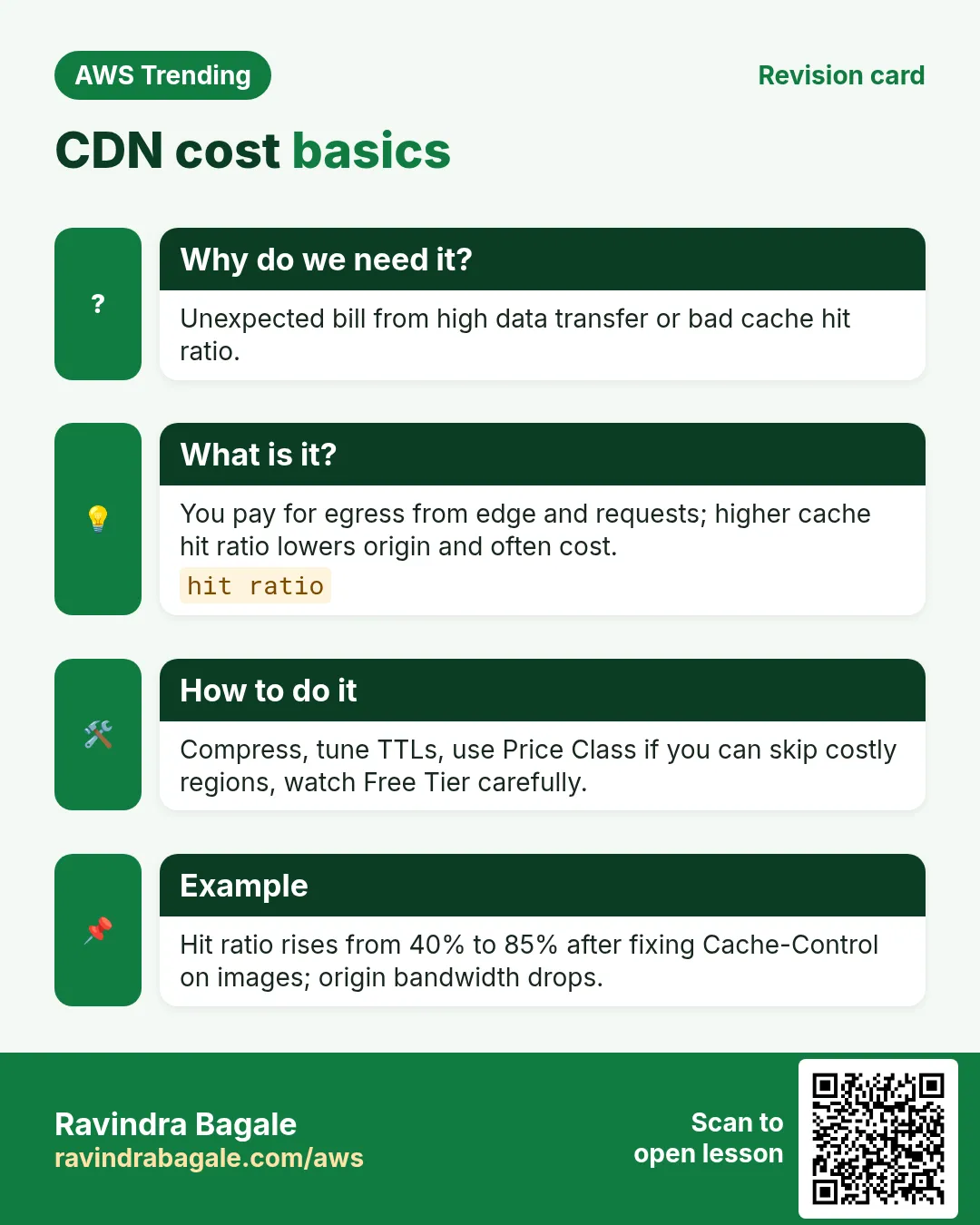
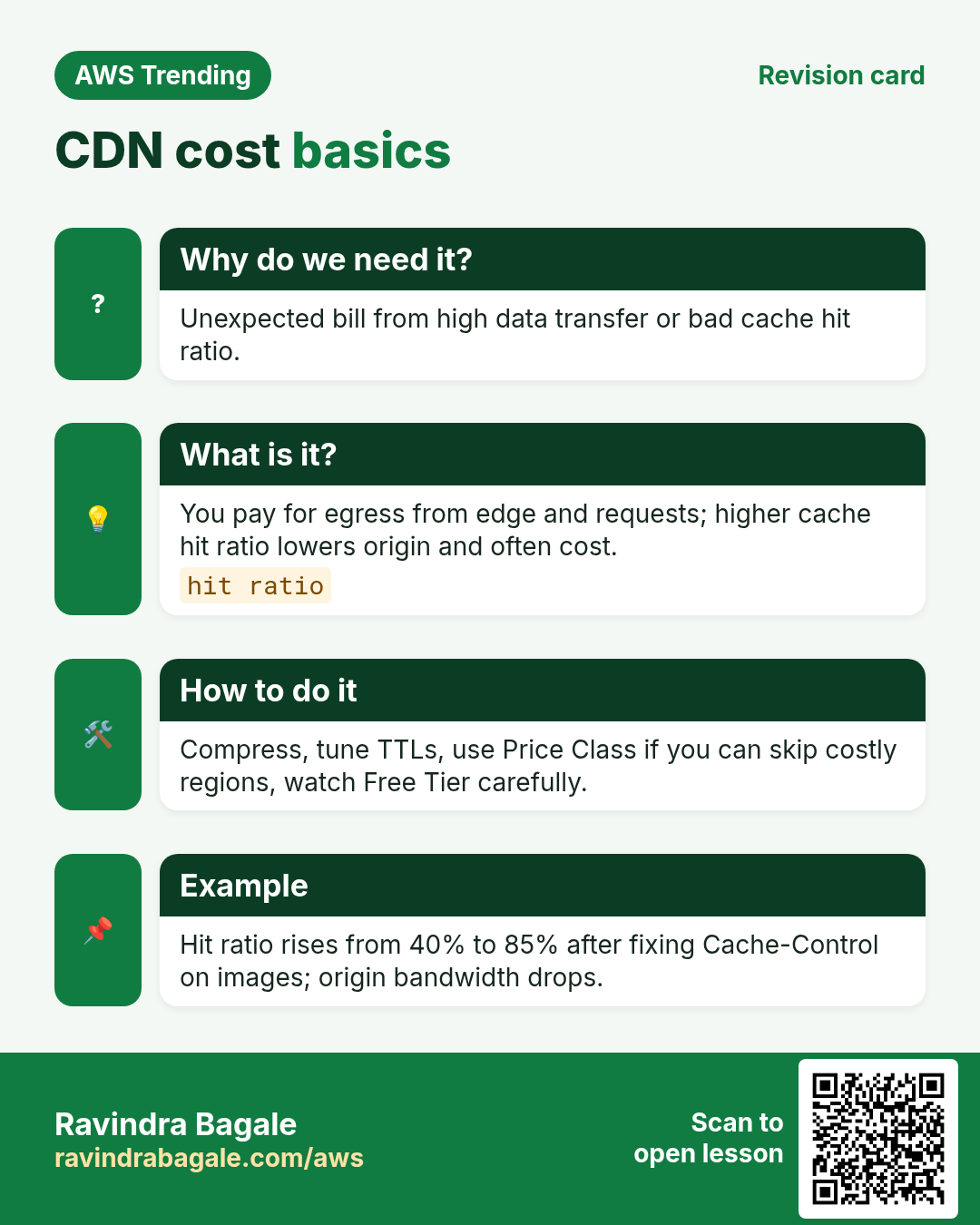
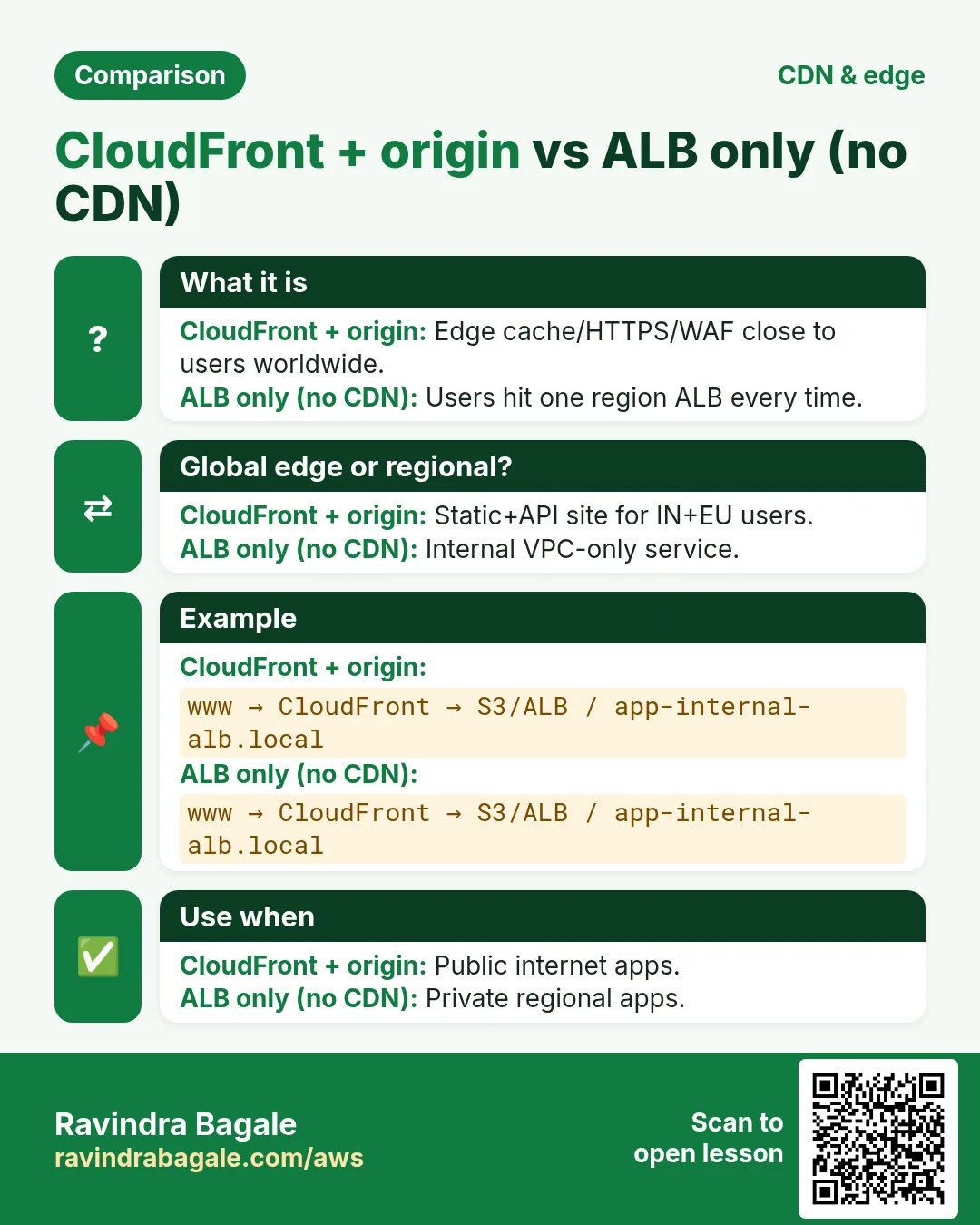
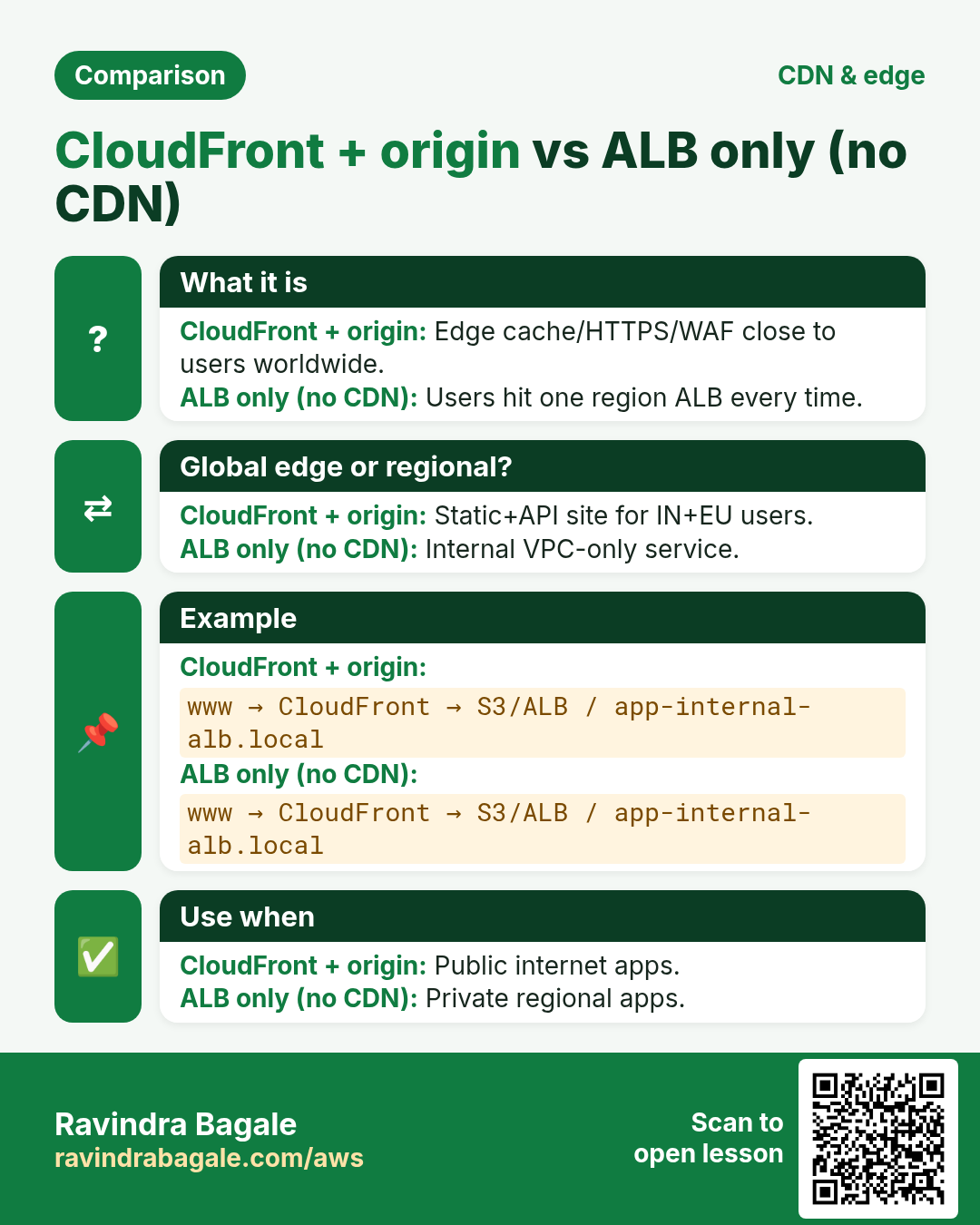
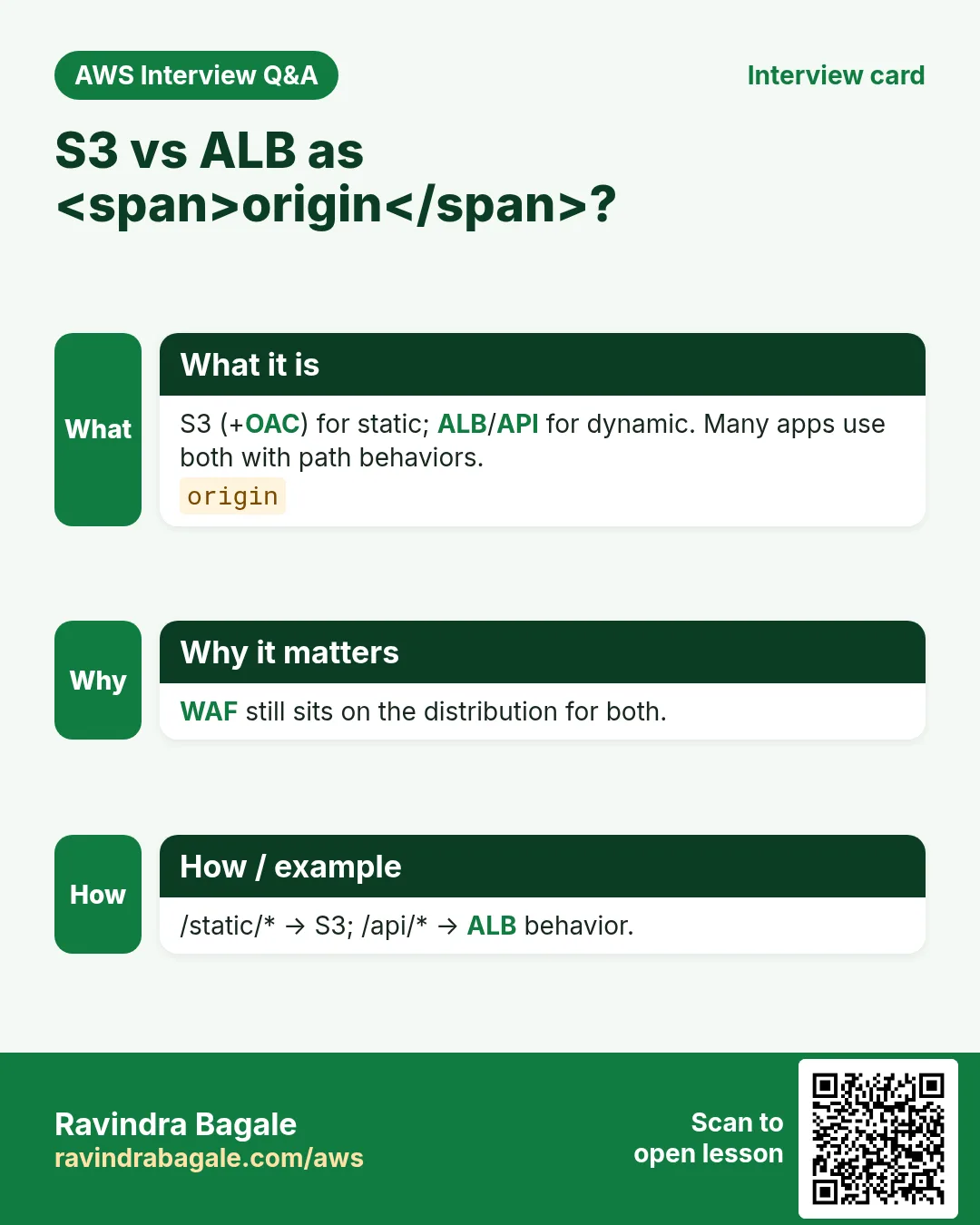
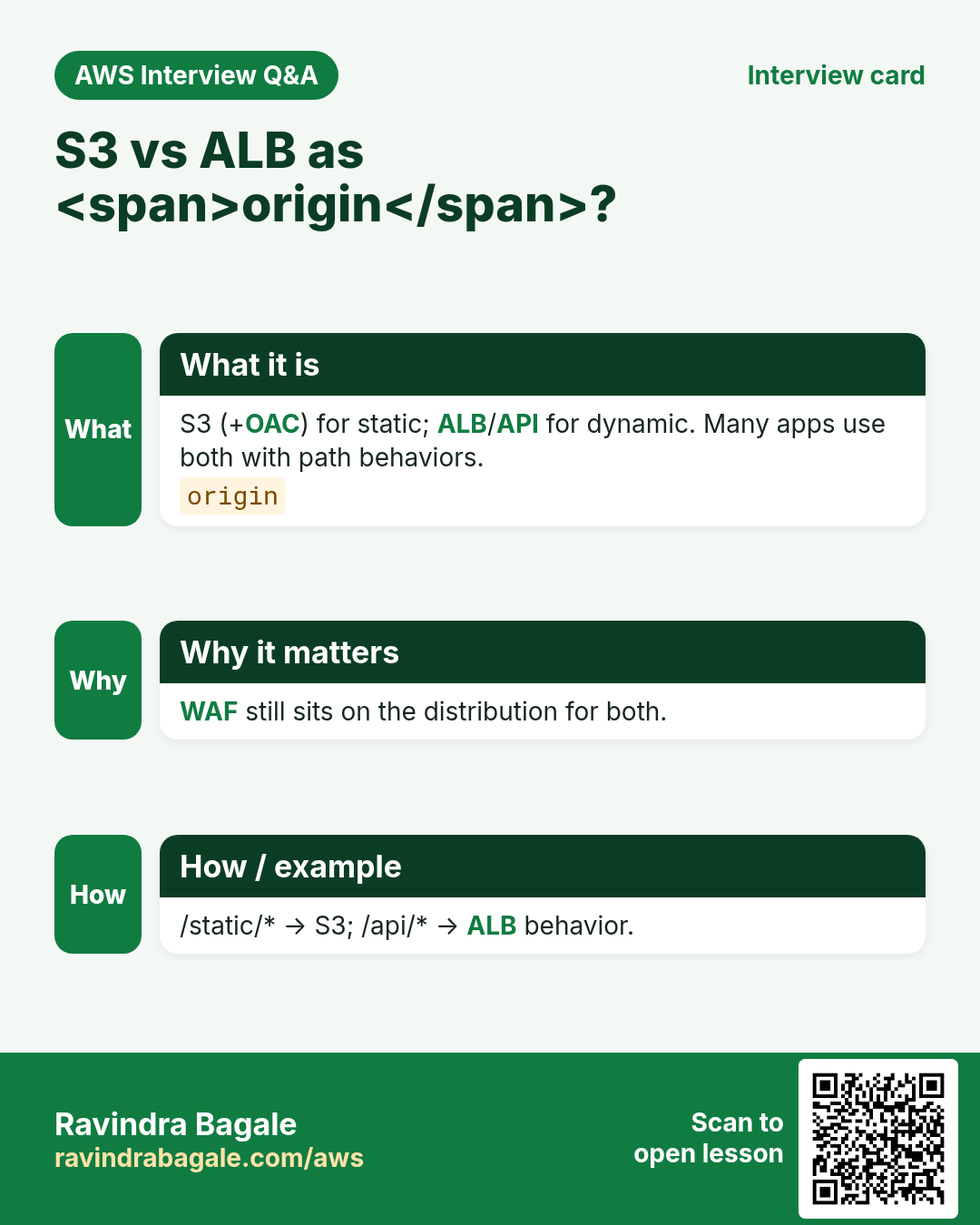
More cards: Ravi Sir's Cards.
Practise this chapter
Interview questions and answers
How can CloudFront return a public URL backed by a bucket that rejects direct public access?
Use CloudFront with a suitable S3 REST origin and Origin Access Control. Let the origin accept the intended CloudFront requests while keeping direct bucket reads restricted. Test both URLs so you can show which path provides access without sharing the origin.
Check your understanding
Choose an answer, then compare your reasoning with the explanation.
Practice Tasks
Practice checks run in your browser. They check the answer for this exercise; they do not create resources or connect to your AWS account.
About this scenarioMilan Furniture is a furniture business in Milan. Giulia Rossi looks after its IT and cloud work. They count money in EUR and run their AWS resources in the eu-south-1 Region. In the tasks below you do real jobs for them using what this lesson teaches. All names, account IDs, IP addresses and numbers are made up for practice.
0 / 16
Easy List distributions
See CDNs.
List CloudFront distributions.
- Read the task and decide which AWS service it is about.
- Write aws, then the service name, then the operation (the action word).
- Add each needed flag (--name) followed by its value from the task.
- Flags can be in any order. Click Check answer.
Easy List web ACLs CLOUDFRONT
Scope CLOUDFRONT.
List web ACLs with scope CLOUDFRONT.
- Read the task and decide which AWS service it is about.
- Write aws, then the service name, then the operation (the action word).
- Add each needed flag (--name) followed by its value from the task.
- Flags can be in any order. Click Check answer.
Easy List tags for distribution
Cost allocate CDN.
List tags for arn:aws:cloudfront::126154182628:distribution/E123EXAMPLE.
- Read the task and decide which AWS service it is about.
- Write aws, then the service name, then the operation (the action word).
- Add each needed flag (--name) followed by its value from the task.
- Flags can be in any order. Click Check answer.
Easy List origin bucket objects
Check origin objects.
List objects in bucket milanfurniture-origin.
- Read the task and decide which AWS service it is about.
- Write aws, then the service name, then the operation (the action word).
- Add each needed flag (--name) followed by its value from the task.
- Flags can be in any order. Click Check answer.
Easy Pick the certificate Region
A CloudFront distribution needs an ACM certificate for its viewer hostname. Enter the Region code where you request that certificate.
- Read the situation and identify what you need to decide.
- Work through the relevant concept or calculation.
- Enter only the requested term or number.
- Check your answer, then read the explanation.
Easy WAF is L7 — enter 7
Layer 7.
Which OSI layer does WAF mainly filter? Enter 7.
- Write down the numbers the task gives you.
- Work it out step by step on paper.
- Type only the final answer in the box.
- Click Check answer.
Easy Upgrade a viewer request
You want a browser requesting an HTTP page to automatically retry at its HTTPS URL. Which CloudFront viewer protocol policy should you select?
- Read the situation and identify what you need to decide.
- Work through the relevant concept or calculation.
- Enter only the requested term or number.
- Check your answer, then read the explanation.
Medium Get distribution
Inspect origins.
Get distribution E123EXAMPLE.
- Read the task and decide which AWS service it is about.
- Write aws, then the service name, then the operation (the action word).
- Add each needed flag (--name) followed by its value from the task.
- Flags can be in any order. Click Check answer.
Medium Get web ACL
See rules.
Get web ACL Name lab Id abcd Scope CLOUDFRONT.
- Read the task and decide which AWS service it is about.
- Write aws, then the service name, then the operation (the action word).
- Add each needed flag (--name) followed by its value from the task.
- Flags can be in any order. Click Check answer.
Medium List certs us-east-1
CF certs region.
List certificates.
- Read the task and decide which AWS service it is about.
- Write aws, then the service name, then the operation (the action word).
- Add each needed flag (--name) followed by its value from the task.
- Flags can be in any order. Click Check answer.
Medium Allow WAF logging write
Forensics.
Allow logs:CreateLogStream on arn:aws:logs:eu-south-1:126154182628:log-group:/aws/waf/*.
- Start with { "Version": "2012-10-17", "Statement": [ ... ] }.
- In each statement write Effect, Action and Resource.
- Give only what the task needs (least privilege).
- Use double quotes and commas correctly. Click Check answer.
Medium Behavior JSON
Path to cache policy.
JSON PathPattern /static/* TTL 86400.
- Start from the top-level keys the task names.
- Indent child keys with 2 spaces (no tabs).
- Fill in each property with the value from the task.
- Click Check answer. Key order does not matter.
Medium Price classes roughly 3
Cost control.
About how many CloudFront price class choices are commonly discussed (enter 3)?
- Write down the numbers the task gives you.
- Work it out step by step on paper.
- Type only the final answer in the box.
- Click Check answer.
Hard Create invalidation
Clear stale HTML carefully.
Create invalidation on E123EXAMPLE for path /index.html.
- Read the task and decide which AWS service it is about.
- Write aws, then the service name, then the operation (the action word).
- Add each needed flag (--name) followed by its value from the task.
- Flags can be in any order. Click Check answer.
Hard Deny non-CloudFront S3 get sketch
Bucket not public.
Deny s3:GetObject on arn:aws:s3:::milanfurniture-origin/* (Effect Deny).
- Start with { "Version": "2012-10-17", "Statement": [ ... ] }.
- In each statement write Effect, Action and Resource.
- Give only what the task needs (least privilege).
- Use double quotes and commas correctly. Click Check answer.
Hard Rate rule JSON
Login abuse.
JSON Limit 100 Path /login.
- Start from the top-level keys the task names.
- Indent child keys with 2 spaces (no tabs).
- Fill in each property with the value from the task.
- Click Check answer. Key order does not matter.