Multi-Region Serverless Architecture Patterns Explained
Multi-region serverless means users still check out when ap-south-1 hiccups — or when latency to another continent hurts. It is Route 53/health checks, data replication choices, idempotent writes, and a rehearsed failover — not just copying a SAM stack twice.
In this chapter
- Name active-active vs active-passive
- Pick data patterns (Global Tables vs async)
- Wire DNS health checks thoughtfully
- State RPO/RTO with product
- Avoid split-brain writes
1. Everyday example: festival traffic + one AZ scare
Rohan in Pune (INR) serves India from ap-south-1. Leadership asks for ap-southeast-1 for SEA users and DR. Copying Lambdas is easy; copying correct stock counts without double-sell is the hard part.
DNS failover: Route 53 health checks (console/CLI). Data: DynamoDB and DynamoDB Global Tables. Compute stays Lambda per region.
2. Why multi-region?
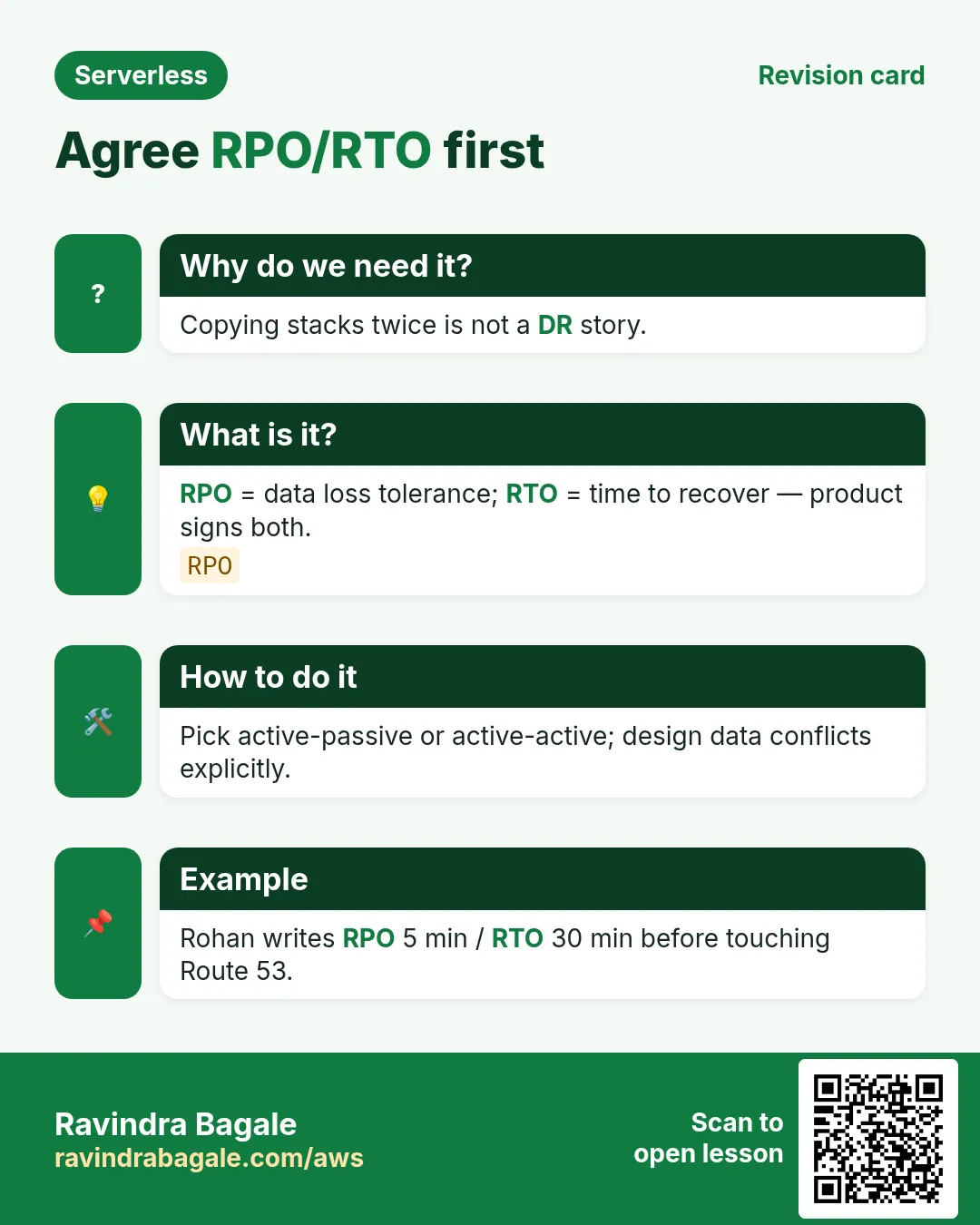
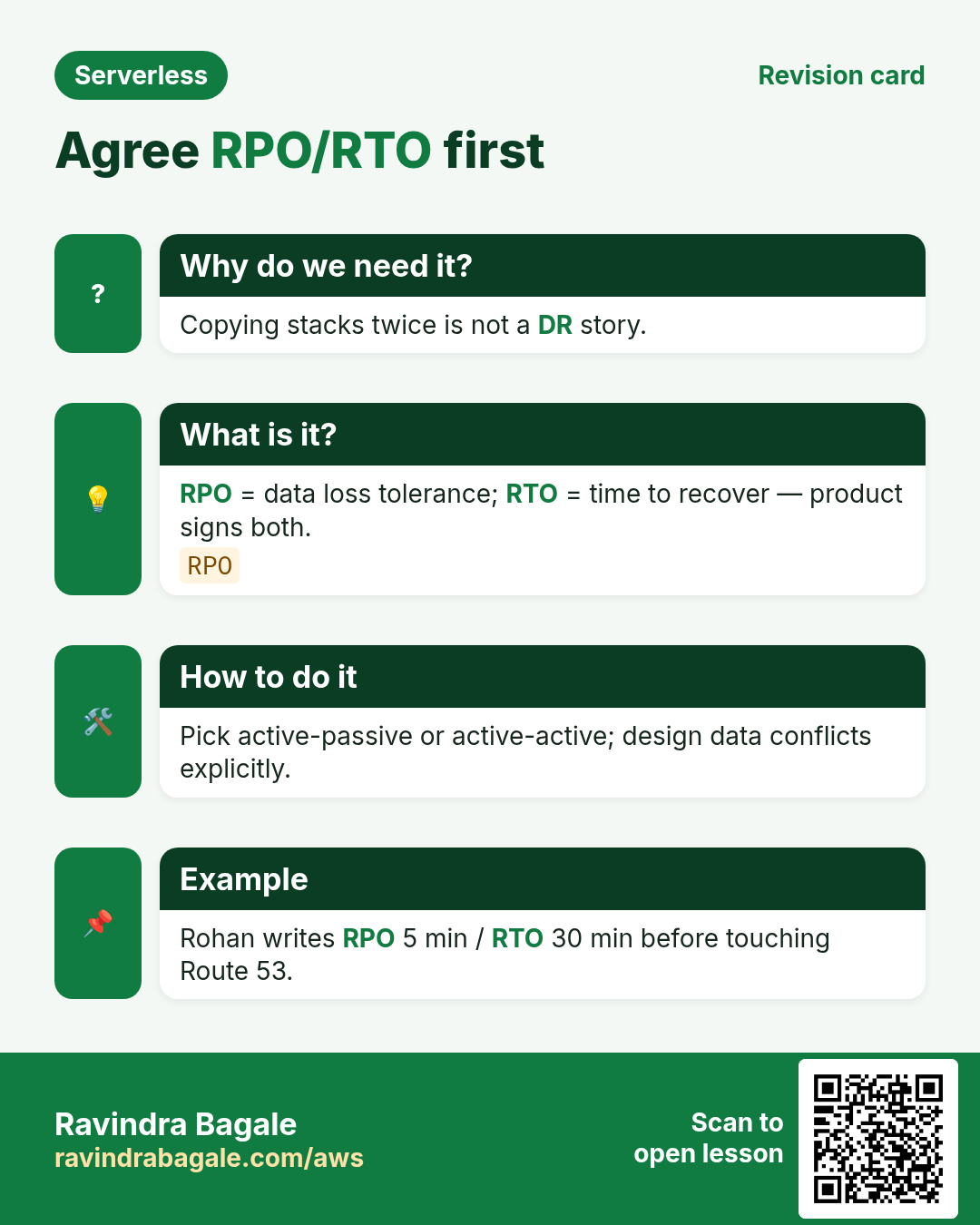
Single-region is fine until compliance, latency, or a regional event hurts revenue. Multi-region without a data story creates silent corruption. Agree RPO (how much data loss) and RTO (how fast back) with product first.
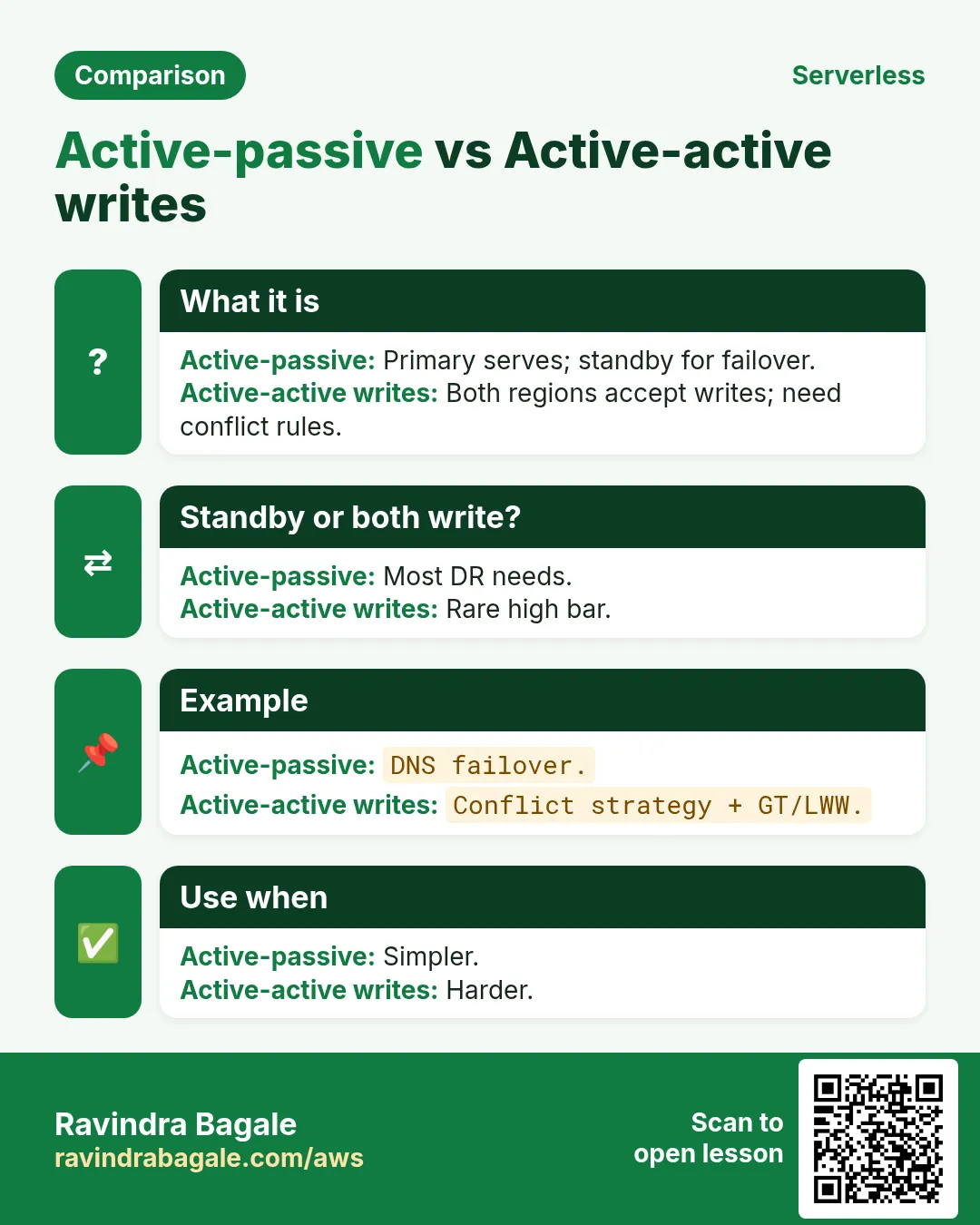
Active-passive = warm standby; fail over DNS. Active-active = both serve traffic; needs conflict rules. Global Tables = multi-region DynamoDB replication. Stateless Lambdas deploy in each region.
3. Vertical diagram
4. How: pattern table
| Pattern | When | Hard part |
|---|---|---|
| Active-passive | DR / compliance cold-ish | Health check + data lag |
| Active-active read | Read-heavy global | Cache invalidation |
| Active-active write | Rare; high bar | Conflict resolution |
| Pilot light | Cost-sensitive DR | Bring-up time vs RTO |
5. Commands
List hosted zones (DNS inventory)
aws route53 list-hosted-zones --query 'HostedZones[].{N:Name,Id:Id}' --output tableMeaning: Know where failover records would live.
Describe a DynamoDB table stream/replica feel
aws dynamodb describe-table --region ap-south-1 --table-name Orders \
  --query 'Table.{S:TableStatus,R:Replicas,Stream:StreamSpecification}'
Meaning: Check replicas if Global Tables in play.
Health check list
aws route53 list-health-checks --query 'HealthChecks[].{Id:Id,Type:HealthCheckConfig.Type}' --output tableMeaning: Empty list = no automated DNS failover yet.
Lambda same name other region?
aws lambda get-function --function-name checkout-api --region ap-southeast-1 2>&1 | head -5Meaning: Confirm twin deploy exists before claiming DR.
6. Data and idempotency
- Prefer append-only events with deterministic ids.
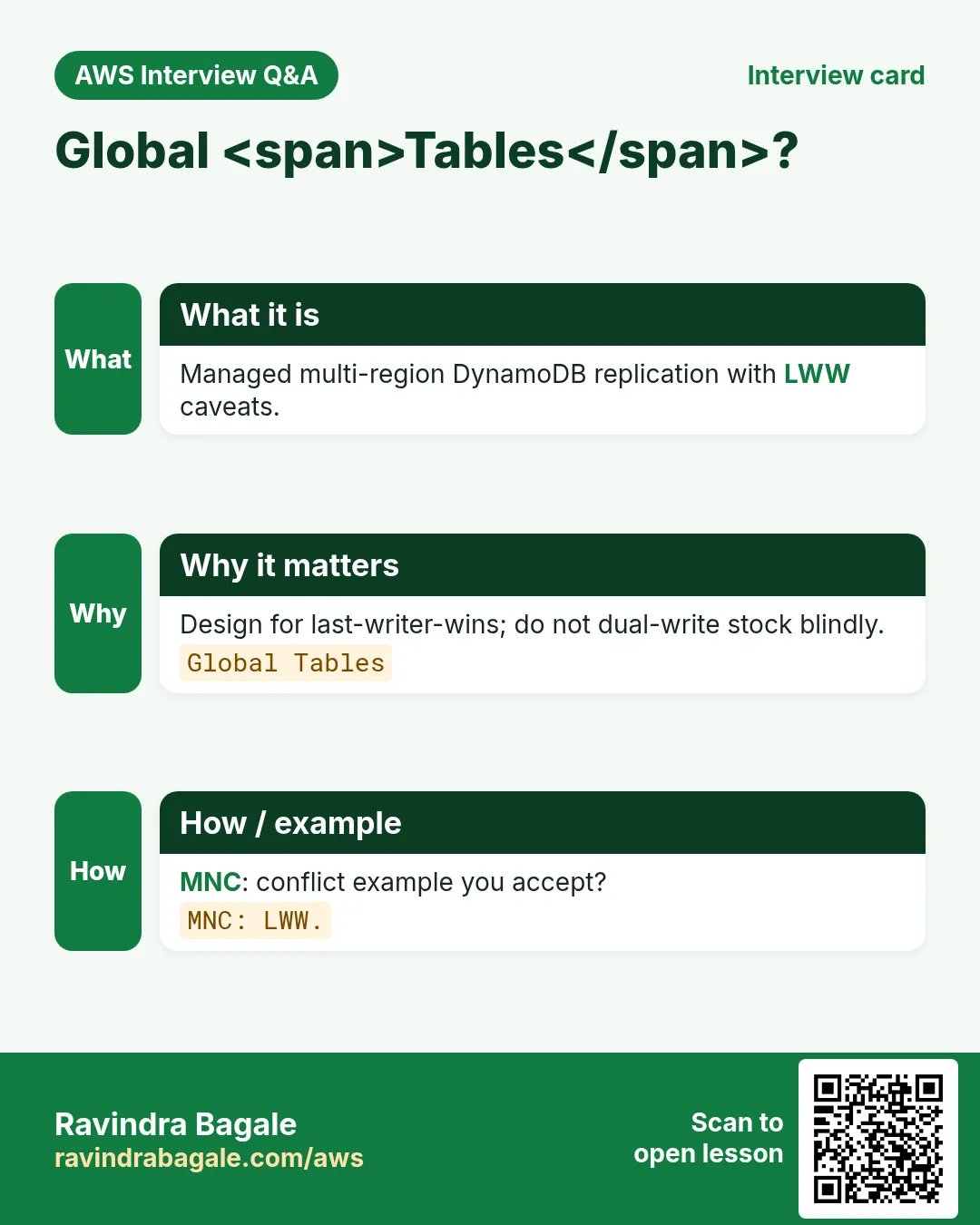
- For DynamoDB global tables with MREC, design for last-writer-wins reconciliation. If you are considering MRSC for conflicting writes, verify Region support and its replication model and feature limitations first.
- Never assume sticky sessions across regions.
- Secrets and parameters replicated or fetched per region.
- Warm concurrency separately per region.
7. Industries
- Fintech (Aisha, Lagos, NGN): active-passive with strict ledger replay.
- Ecommerce (Rohan, Pune, INR): Global Tables for carts carefully; stock = hard.
- Media (Kenji, Osaka, JPY): read replicas / regional caches for assets.
- SaaS (Priya, Bengaluru, INR): tenant pin to home region + DR.
- Travel (Mei, Singapore, SGD): latency-based routing for booking reads.
8. Lab
9. Lab - design on paper first
Do this in ap-south-1 (Mumbai) unless your org forbids it. Set a budget alert first.
- Write RPO and RTO in one sentence with product.
- List what must replicate vs rebuild.
- Sketch DNS failover + one health check target.
- Name the idempotency key for cross-region orders.
Cleanup (stop billing)
- Do not flip prod DNS in lab.
- Delete any lab health checks.
10. Same pattern across industries
- Fintech (Aisha, Lagos): payment webhooks → SQS → Lambda; never block the bank callback thread.
- Ecommerce (Rohan, Pune): checkout API on API Gateway+Lambda; inventory fan-out on SNS.
- Healthcare (Mei, Singapore): appointment SMS via SNS; PHI stays in DynamoDB with fine-grained IAM.
- EdTech (Diego, São Paulo): nightly cleanup EventBridge → Lambda on student drafts.
- Logistics (Fatima, Casablanca): package scan events on EventBridge bus; Step Functions for customs saga.
- Media (Kenji, Osaka): S3 upload → Lambda thumbnails; fan-out to moderation + CDN invalidate.
- SaaS multi-tenant (Priya, Bengaluru): Cognito groups + DynamoDB partition per tenant.
- Gov portal (Omar, Amman): strangler fig — peel one PDF form route per sprint to Lambda.
11. Troubleshooting checklist
- Confirm region (ap-south-1 vs us-east-1 for CloudFront/ACM quirks).
- Check CloudWatch Logs for the function name and request id.
- Verify IAM execution role allows the API you call.
- For async: check DLQ depth and SQS age of oldest message.
- For APIs: curl -v and compare status, CORS headers, body.
- For workflows: open Step Functions execution event history.
- Re-read the linked deep chapter before reinventing a service.
- If cost spikes: check concurrency, retries, and provisioned capacity.
12. Common errors and fixes
Each row is a real mistake students and juniors hit. Read the fix before you panic.
| Error / symptom | Fix |
|---|---|
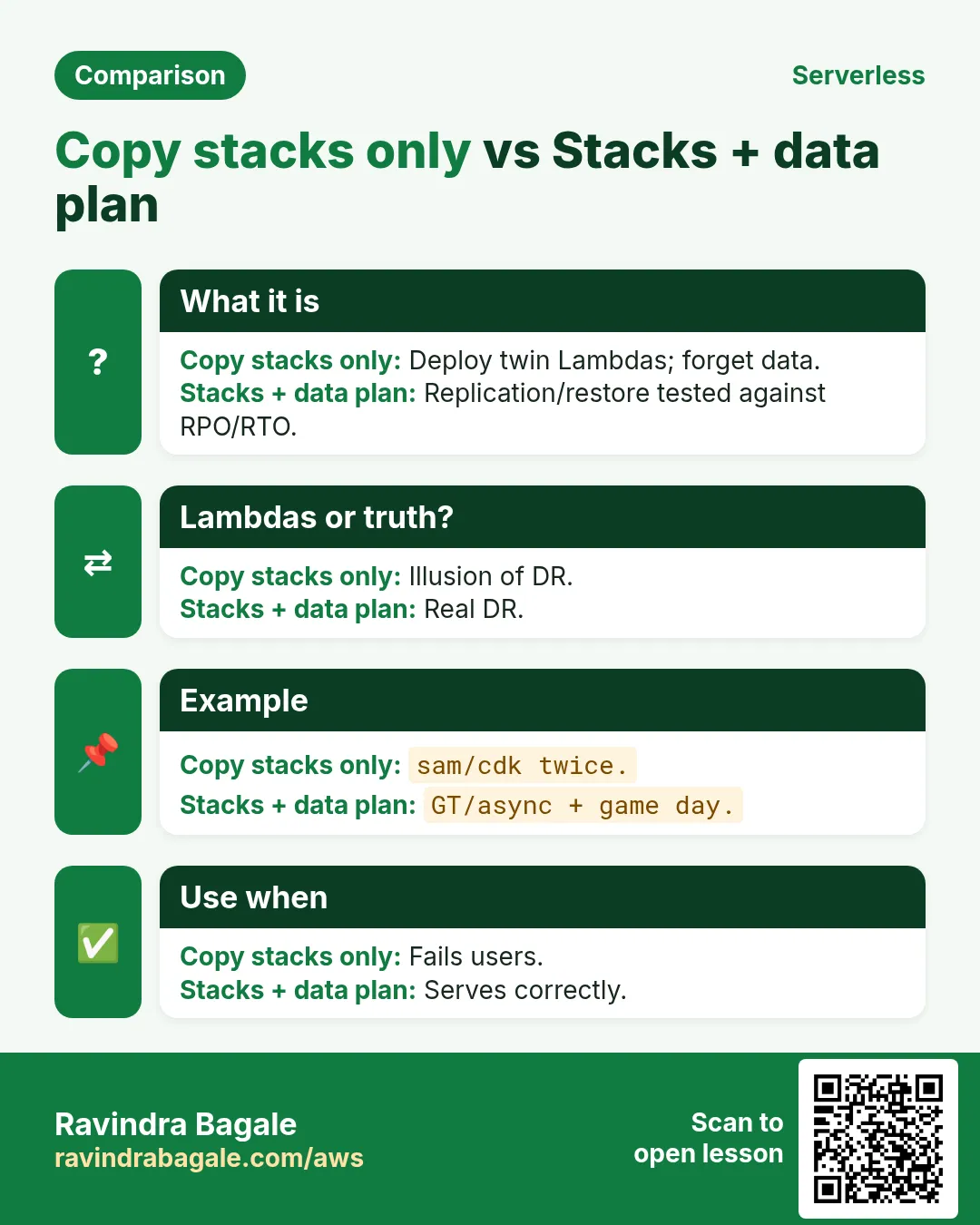
| Copied stack, forgot data | Plan replication or restore; test it. |
| Active-active stock double-sell | Single writer or strong conflict rules. |
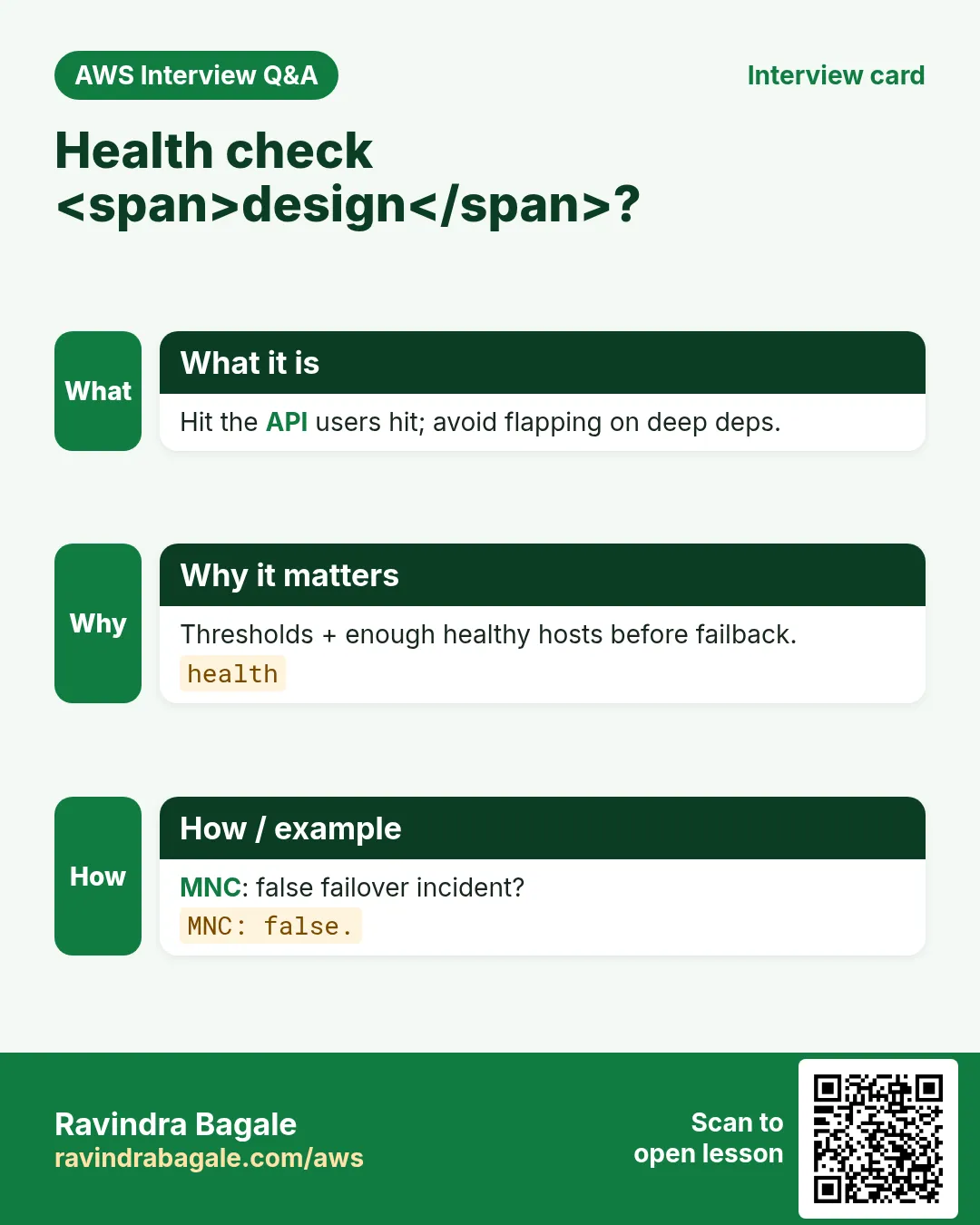
| Health check on deep dependency | Check the API users hit; avoid false failovers. |
| No runbook | Write and rehearse failover steps. |
| Secrets only in primary | Replicate or create per region. |
| Ignoring eventual consistency | UX and retries tolerate lag. |
| Same IAM role ARN assumptions | Roles are regional; pipelines deploy both. |
| Never tested failover | Game day quarterly. |
| RTO fantasy | Measure restore; set honest RTO. |
13. FAQ
Q. Is multi-region required?
Only if product/compliance/latency demands — cost is real.
Q. Global Tables vs Streams+Lambda copy?
GT managed; custom = more control/complexity.
Q. What about Aurora Global?
Great for relational; different chapter — still need app failover.
Q. Pilot light vs warm standby?
Pilot = minimal; warm = almost ready — cost vs RTO.
Q. Link Route 53?
amazon-route-53-dns-routing-health-checks-and-failover-basics.
14. Interview Q&A (Beginner / Mid / Senior + MNC)
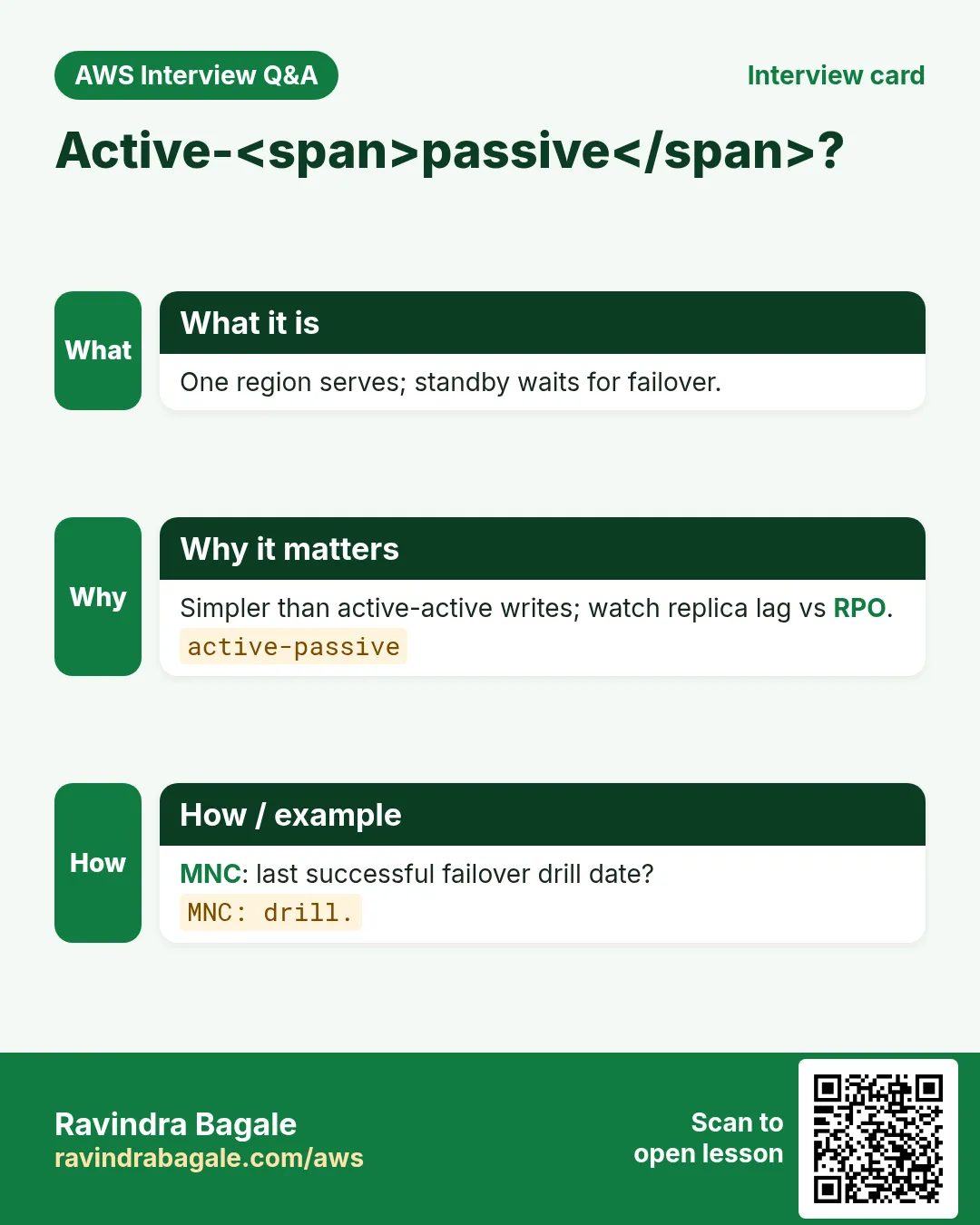
Q. Beginner: active-passive?
One region serves; other waits for failover.
Q. Beginner: RPO/RTO?
Data loss tolerance / time to recover.
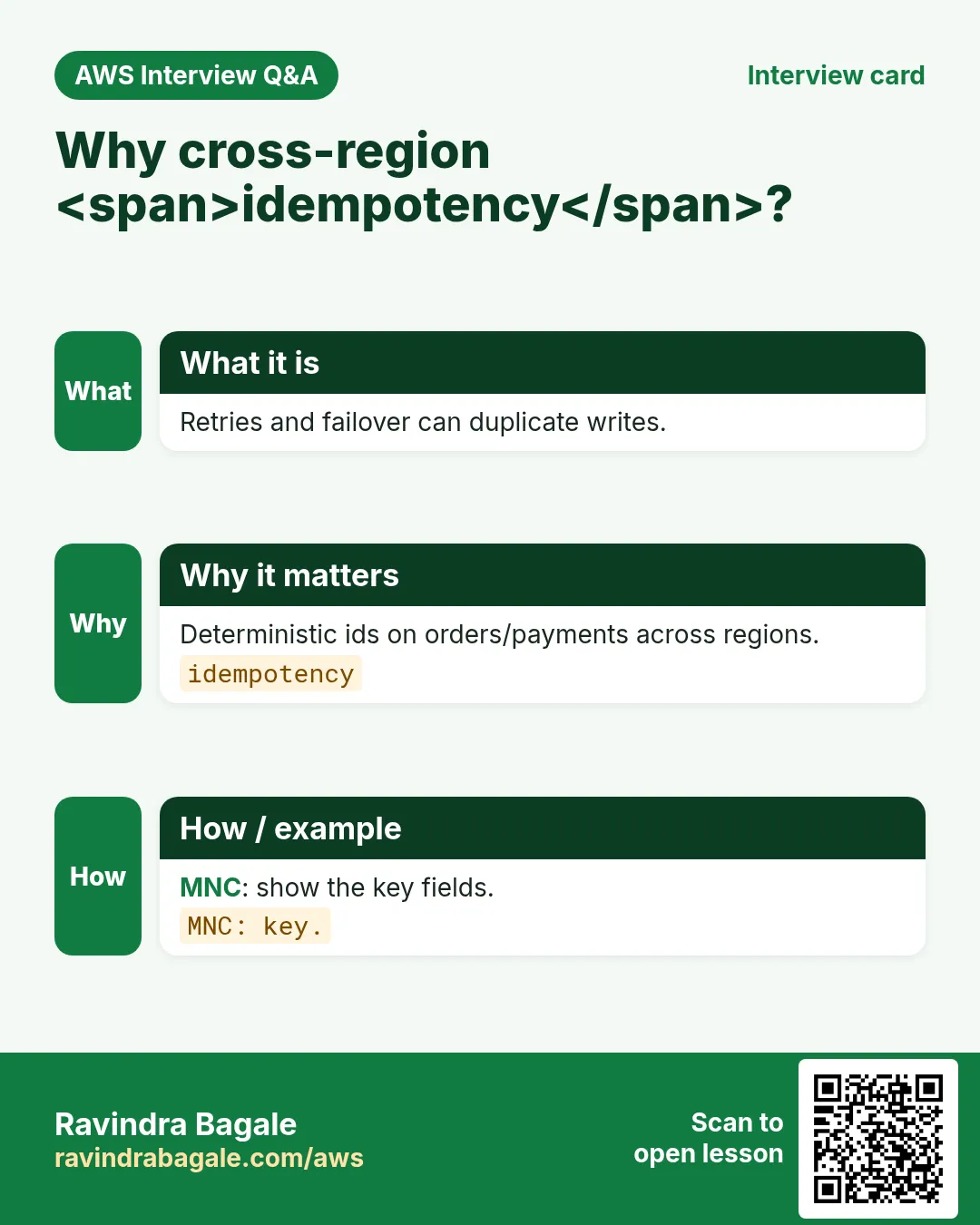
Q. Mid: why idempotency multi-region?
Retries and failover can duplicate writes.
Q. Mid: health check design?
Check user-visible endpoint; sensible thresholds.
Q. Senior: conflict strategy?
LWW, CRDTs, or single-writer regions.
Q. MNC: evidence?
Game-day reports, RPO/RTO signed, DNS change tickets.
15. Tips in English, Marathi and Hindi
Ravindra Bagale's Tip (EN)
Agree RPO/RTO, pick data truth, automate DNS carefully, rehearse — then claim multi-region.
Ravindra Bagale's Tip (MR)
RPO/RTO, data truth, DNS, rehearse — मग multi-region claim.
Tip (HI)
RPO/RTO, data truth, DNS, rehearse — फिर multi-region claim।
Try at home
- Write RPO and RTO one-liners.
- List health checks in the account.
In short
- Start from a real story, then name the AWS services.
- Link existing chapters — do not copy their labs.
- Design for failure: retries, DLQ, idempotency, rollback.
- Measure before you buy provisioned concurrency or multi-region.
16. Architecture decision checklist
- Write the user journey in five bullets with no AWS names.
- Mark each step sync (user waits) or async.
- Name failure mode: retry, DLQ, compensate, or alert-only.
- Name the idempotency key for every write.
- Pick data store from access patterns (link DynamoDB modeling).
- Estimate monthly cost at 1x and 10x traffic (USD and INR).
- Confirm account concurrency and service quotas in ap-south-1.
- Decide auth: Cognito, IAM, Lambda authorizer, or none.
- Name on-call and which CloudWatch alarm pages them.
- Link the deep chapter you will not rewrite.
- Only then open console or IaC.
17. Copy-paste quick commands (read-only first)
# Region and identity
aws configure get region
aws sts get-caller-identity

# Lambda landscape
aws lambda list-functions --region ap-south-1 --max-items 20 \
  --query 'Functions[].{N:FunctionName,R:Runtime,T:Timeout,M:MemorySize}' --output table
aws lambda get-account-settings --region ap-south-1

# API Gateway (HTTP APIs)
aws apigatewayv2 get-apis --region ap-south-1 --query 'Items[].{N:Name,Id:ApiId,Ep:ProtocolType}' --output table

# Queues and topics
aws sqs list-queues --region ap-south-1
aws sns list-topics --region ap-south-1 --query 'Topics[].TopicArn'

# Event buses and state machines
aws events list-event-buses --region ap-south-1
aws stepfunctions list-state-machines --region ap-south-1 --query 'stateMachines[].name'

# DynamoDB tables (names only)
aws dynamodb list-tables --region ap-south-1
Run these in a sandbox account. Prefer read-only IAM while learning.
18. More industry and stack stories
- Fintech (Aisha, Lagos, NGN): bank webhooks must return 200 fast — SQS absorbs spikes; ledger Lambda is idempotent on paymentId.
- Ecommerce (Rohan, Pune, INR): Black Friday — API Gateway throttle + SQS order intake; SNS fans inventory, email, analytics.
- Healthcare (Mei, Singapore, SGD): appointment reminders via SNS SMS; PHI only in DynamoDB with condition keys.
- EdTech (Diego, São Paulo, BRL): EventBridge nightly cleanup of draft quizzes; Lambda timeout 30s, not 15 min.
- Logistics (Fatima, Casablanca, MAD): package scans on custom EventBridge bus; Step Functions customs saga.
- Media (Kenji, Osaka, JPY): S3 → Lambda thumbnails; never write thumbs to the watched prefix.
- SaaS (Priya, Bengaluru, INR): Cognito groups + DynamoDB PK tenantId; one Lambda authorizer for all routes.
- Gov (Omar, Amman, JOD): strangler — peel one PDF form route per sprint from the monolith.
- Startup (Sofia, Sofia, EUR): start with Function URL for demos; move to HTTP API when partners need JWT.
- Retail (Luis, Mexico City, MXN): store POS sync via SQS FIFO when order matters; Standard when it does not.
- Python: handlers thin; put domain logic in plain modules for unit tests without Lambda.
- Node: prefer async/await; never block the event loop on sync DNS.
- Java: SnapStart for cold starts; keep dependencies lean.
- .NET: AspNetCoreServer for low-traffic tenants; watch package size.
- Go: single static binary; great for SQS workers.
- PHP: keep Laravel queues on ECS; Lambda for S3/webhooks glue.
19. Glossary (short)
| Term | Meaning |
|---|---|
| Cold start | First invoke pays init; later invokes reuse the env |
| Idempotency | Same request twice → same effect |
| DLQ | Dead-letter queue for failed messages |
| Choreography | Services react to events; no central conductor |
| Orchestration | Central workflow (Step Functions) directs steps |
| Fan-out | One event → many consumers |
| Fan-in | Many branches join before next step |
| Strangler fig | Peel routes from monolith gradually |
| Saga | Distributed tx via steps + compensations |
| Provisioned concurrency | Keep N envs warm; you pay for ready capacity |
20. Practice: explain out loud
- 60 seconds: everyday story for multi-region serverless.
- 60 seconds: sync vs async with a checkout example.
- 60 seconds: when you refuse Lambda.
- 60 seconds: DLQ + idempotency in one breath.
- Record once; cut fillers; record again.
21. Safe lab hygiene
- Tag every lab resource with owner and expiry date.
- Set a monthly AWS Budget alarm in INR or USD before experiments.
- Prefer read-only commands first; mutate in a sandbox account.
- Delete queues, APIs, tables you created — DynamoDB and APIGW leave footprints.
- Never put production secrets in env vars or screenshots.
- Do not enable provisioned concurrency for a hello-world.
22. How this chapter links others
- Compute depth: Lambda.
- HTTP edge: API Gateway.
- Data modeling: DynamoDB.
- Messaging: SQS/SNS.
- Events: EventBridge.
- Workflows: Step Functions.
- Project chapters (build-*): worked assemblies — link, do not paste.
23. Myths to drop
| Myth | Reality |
|---|---|
| Serverless means zero servers | Servers exist; you do not manage them |
| Always cheaper than EC2 | Steady high load can favor EC2/Savings Plans |
| No Ops needed | You own IAM, data, alarms, cost, incidents |
| One Lambda per app is fine | Bounded contexts scale better |
| Queues are optional decoration | Queues are the load leveler and blast-radius wall |
24. Error budget thinking for serverless
If your monthly error budget is 0.1% on checkout, a fan-out that retries aggressively can burn the budget with duplicate emails while money stays correct. Separate business correctness SLOs from notification SLOs.
- Write two SLOs: money-correct and notify-delivered.
- Retries on money path: bounded + idempotent.
- Retries on notify path: best-effort + DLQ.
- Page humans on money DLQ; ticket on notify DLQ.
25. Regional notes (ap-south-1)
- Build labs in Mumbai (ap-south-1) unless your org mandates elsewhere.
- Some services launch first in us-east-1 — check feature availability.
- Data residency for INR fintech may require in-region only.
- Latency to end users in India usually favors ap-south-1.
26. Naming conventions that save incidents
# Suggested prefixes
# Lambda:  pay-intake-prod, pay-worker-prod
# SQS:     pay-orders.fifo / pay-orders-dlq
# SNS:     pay-order-events
# EB bus:  pay.domain
# SFN:     pay-refund-saga
# DDB:     pay-orders-prod
Include env (dev/stage/prod) and domain. Future you grepping CloudWatch will thank present you.
27. Pre-mortems (ten minutes)
- Imagine tomorrow headline: double charge in AED. What broke?
- Imagine DLQ depth 50,000 after a bad deploy. How do you drain?
- Imagine Cognito outage. Do APIs fail closed or serve read-only?
- Write answers in the runbook before go-live.
28. Currency and locale in examples
Rotate currencies in designs: INR, USD, EUR, AED, NGN, BRL, JPY, SGD. Rotate names: Aisha, Rohan, Mei, Diego, Fatima, Kenji, Priya, Omar, Sofia, Luis. This keeps mental models global — not one-country samples.
29. Worked story: SEA latency + Mumbai primary
- Product sets RPO 5 min, RTO 30 min.
- Active-passive ap-southeast-1 with GT for read models.
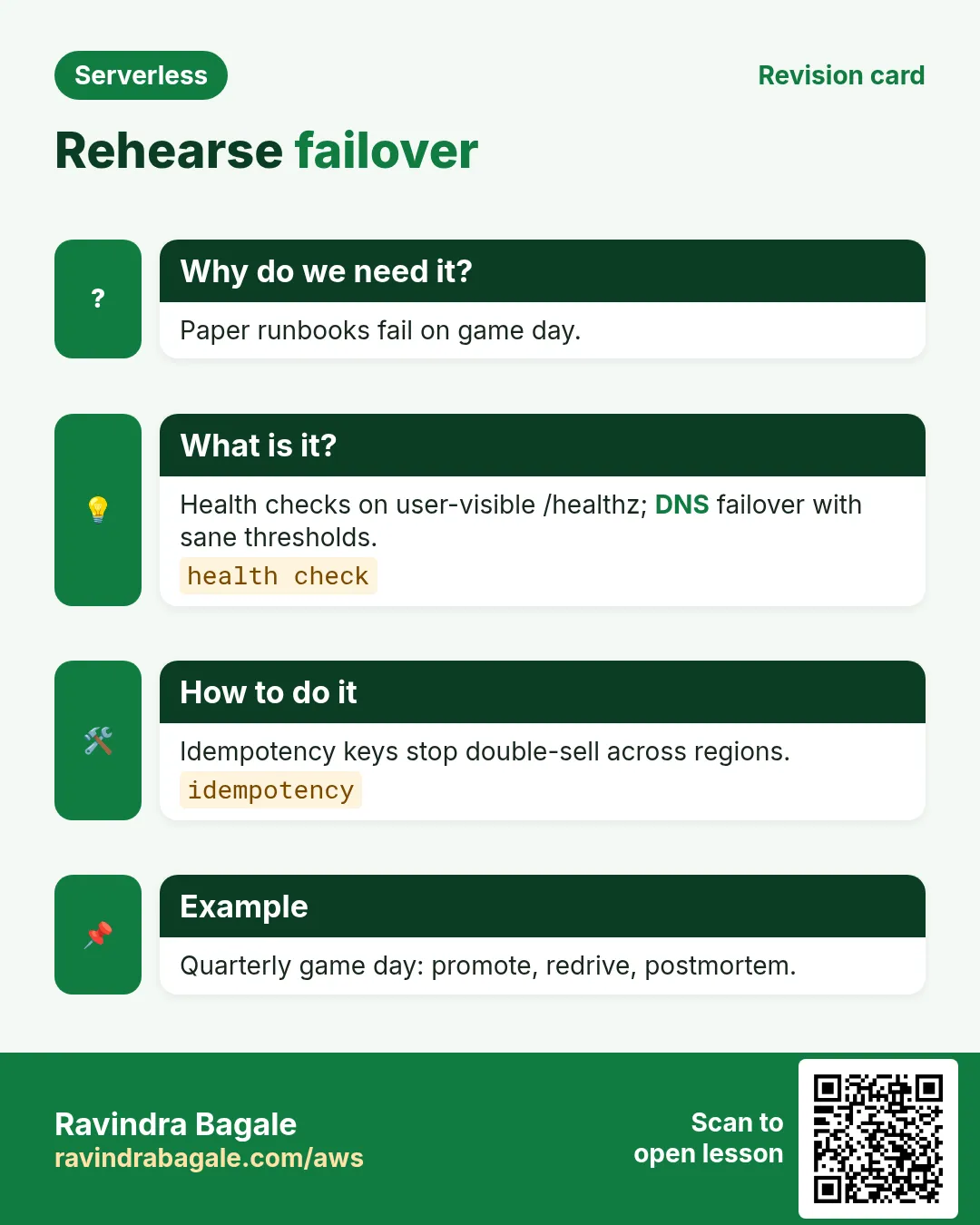
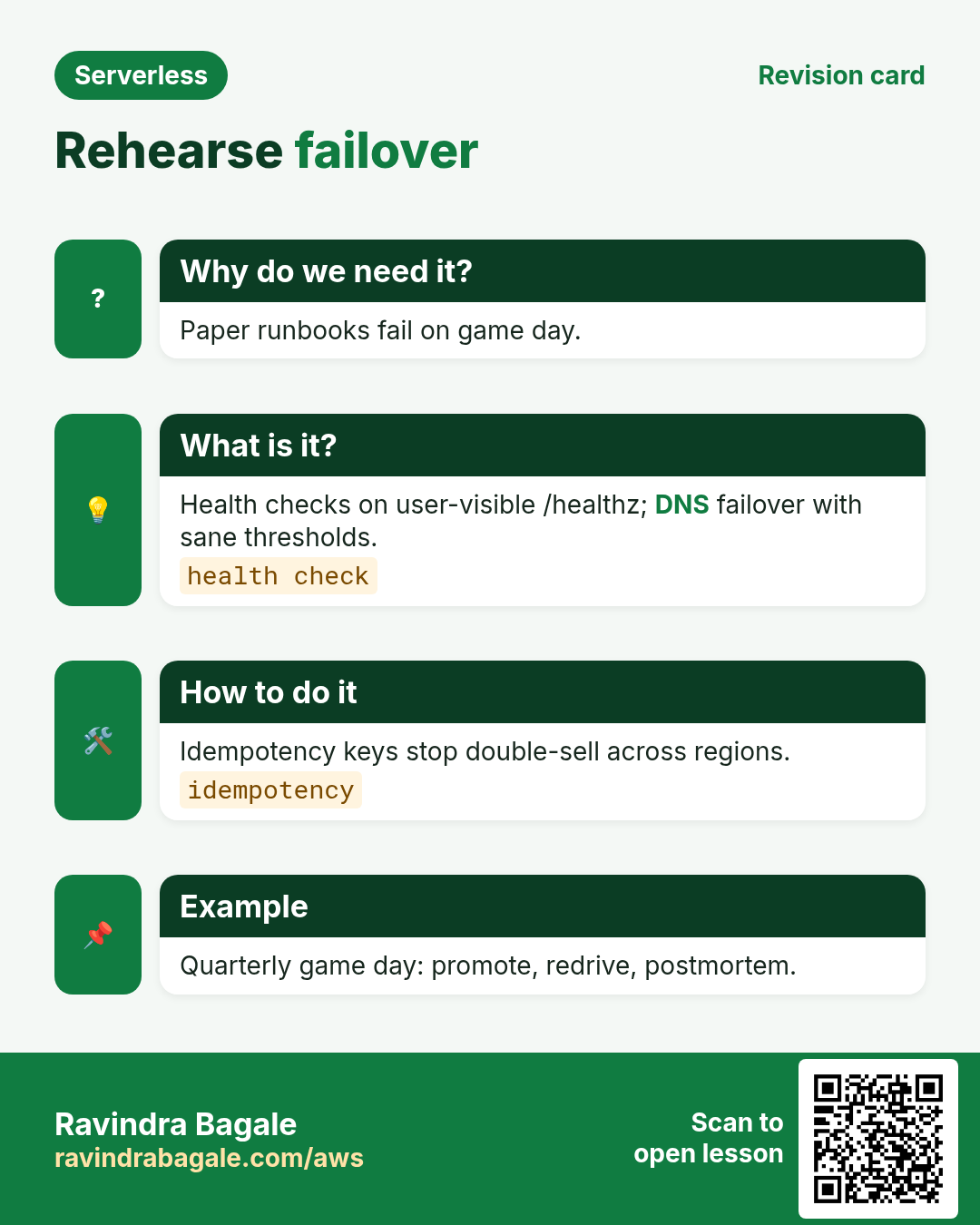
- Route 53 failover + health on /healthz.
- Game day: promote, redrive, postmortem.
30. Anti-patterns
- Two regions writing stock without rules.
- Failover never rehearsed.
- Copying prod data to DR without encryption/access review.
Revision, interview and comparison cards
Revise this lesson in a few minutes. Save the cards on your phone or download them as PNG files. The QR code on each card opens this lesson.
More cards: Ravi Sir's Cards.
Practice Tasks
Practice checks run in your browser. They check the answer for this exercise; they do not create resources or connect to your AWS account.
About this scenarioAmravati Agro Market is a agriculture business in Amravati. Anjali Thakre looks after its IT and cloud work. They count money in INR and run their AWS resources in the ap-south-1 Region. In the tasks below you do real jobs for them using what this lesson teaches. All names, account IDs, IP addresses and numbers are made up for practice.
0 / 16
Easy Calculate the observed recovery point gap
An outage begins at 12:20. The latest committed record you can verify in the recovered database is from 12:14. How many minutes separate the recovery point from the interruption? Enter a number.
- Read the situation and identify what you need to decide.
- Work through the relevant concept or calculation.
- Enter only the requested term or number.
- Check your answer, then read the explanation.
Easy Measure time to verified service recovery
The disruption begins at 14:00. At 14:08 you first verify that a customer can complete the core operation again. How many minutes elapsed? Enter a number.
- Read the situation and identify what you need to decide.
- Work through the relevant concept or calculation.
- Enter only the requested term or number.
- Check your answer, then read the explanation.
Easy Identify how the regions share normal production traffic
Mumbai serves all normal requests. Singapore is prepared but does not serve ordinary production traffic until failover. What deployment pattern is this?
- Read the situation and identify what you need to decide.
- Work through the relevant concept or calculation.
- Enter only the requested term or number.
- Check your answer, then read the explanation.
Easy Identify a deployment that serves in both Regions
Two Regions both serve live production requests during normal operation. Neither waits as a standby. Name this deployment pattern.
- Read the situation and identify what you need to decide.
- Work through the relevant concept or calculation.
- Enter only the requested term or number.
- Check your answer, then read the explanation.
Easy Choose multi-Region DynamoDB table replication
Your architecture calls for DynamoDB table replicas in multiple AWS Regions with the ability to read and write in each replica Region. Name the DynamoDB feature.
- Read the situation and identify what you need to decide.
- Work through the relevant concept or calculation.
- Enter only the requested term or number.
- Check your answer, then read the explanation.
Easy Predict the authoritative failover answer
Route 53 failover routing has a primary and secondary record. The configured health evaluation now considers the primary unhealthy and the secondary healthy. Which record should Route 53 return for a fresh authoritative answer?
- Read the situation and identify what you need to decide.
- Work through the relevant concept or calculation.
- Enter only the requested term or number.
- Check your answer, then read the explanation.
Easy Identify the conflict rule for MREC replicas
Two Regions concurrently replace the same item on a DynamoDB global table configured for multi-Region eventual consistency. Name its conflict resolution strategy.
- Read the situation and identify what you need to decide.
- Work through the relevant concept or calculation.
- Enter only the requested term or number.
- Check your answer, then read the explanation.
Medium Monitor a meaningful path to readiness
The secondary Region’s /hello route returns 200 even when its database credentials are invalid. What kind of health check should verify an authorized read through the actual API and its required dependency before the region is considered ready?
- Read the situation and identify what you need to decide.
- Work through the relevant concept or calculation.
- Enter only the requested term or number.
- Check your answer, then read the explanation.
Medium Identify the value that survives a retry
An order request mutates state in Region A but the response is lost. The same operation is retried through Region B. What stable request value should be carried across both attempts to identify the same business operation?
- Read the situation and identify what you need to decide.
- Work through the relevant concept or calculation.
- Enter only the requested term or number.
- Check your answer, then read the explanation.
Medium Check whether data recovery fits the time target
The secondary Region already has the function code. Restoring data alone takes 50 minutes, but the recovery time objective is 15 minutes. By how many minutes does the restore alone exceed the target? Enter a number.
- Read the situation and identify what you need to decide.
- Work through the relevant concept or calculation.
- Enter only the requested term or number.
- Check your answer, then read the explanation.
Medium Rehearse failover before an emergency
The team plans a controlled exercise that switches traffic, verifies recovery time, checks restored data and rehearses rollback using an approved test plan. What is this kind of exercise called?
- Read the situation and identify what you need to decide.
- Work through the relevant concept or calculation.
- Enter only the requested term or number.
- Check your answer, then read the explanation.
Medium Recognize a minimally running recovery site
Critical data services are already running in the recovery Region. The rest of the stack is deployed or started only during recovery, leaving the recovery Region unable to serve production requests beforehand. Which DR strategy is this?
- Read the situation and identify what you need to decide.
- Work through the relevant concept or calculation.
- Enter only the requested term or number.
- Check your answer, then read the explanation.
Medium RPO RTO lines
Agree.
YAML: rpo_minutes: 5 and rto_minutes: 30.
- Start from the top-level keys the task names.
- Indent child keys with 2 spaces (no tabs).
- Fill in each property with the value from the task.
- Click Check answer. Key order does not matter.
Medium List hosted zones
DNS inventory.
List Route 53 hosted zones
- Read the task and decide which AWS service it is about.
- Write aws, then the service name, then the operation (the action word).
- Add each needed flag (--name) followed by its value from the task.
- Flags can be in any order. Click Check answer.
Hard Choose who owns writes for one inventory item
Two Regions read the last unit of SKU T-42 from an MREC global table and could reserve it at once. Your chosen design routes all reservations for that SKU to one designated writer Region. Name that write pattern.
- Read the situation and identify what you need to decide.
- Work through the relevant concept or calculation.
- Enter only the requested term or number.
- Check your answer, then read the explanation.
Hard Keep credentials available in the recovery Region
The recovery application reads from AWS Secrets Manager in its own Region. You need an approved copy of the primary Region’s secret available there before failover. Which Secrets Manager feature accomplishes this?
- Read the situation and identify what you need to decide.
- Work through the relevant concept or calculation.
- Enter only the requested term or number.
- Check your answer, then read the explanation.