AWS CLI CloudFront Commands: Create a Distribution and Invalidate Cache
We serve files fast worldwide: a CloudFront distribution in front of a private S3 bucket, config updates with ETag, cache invalidation, then disable and delete.
In this chapter
- Origin access control
- Create a distribution
- Bucket policy for CloudFront
- Invalidate the cache
- Update, disable and delete
1. The big picture: local milk booths
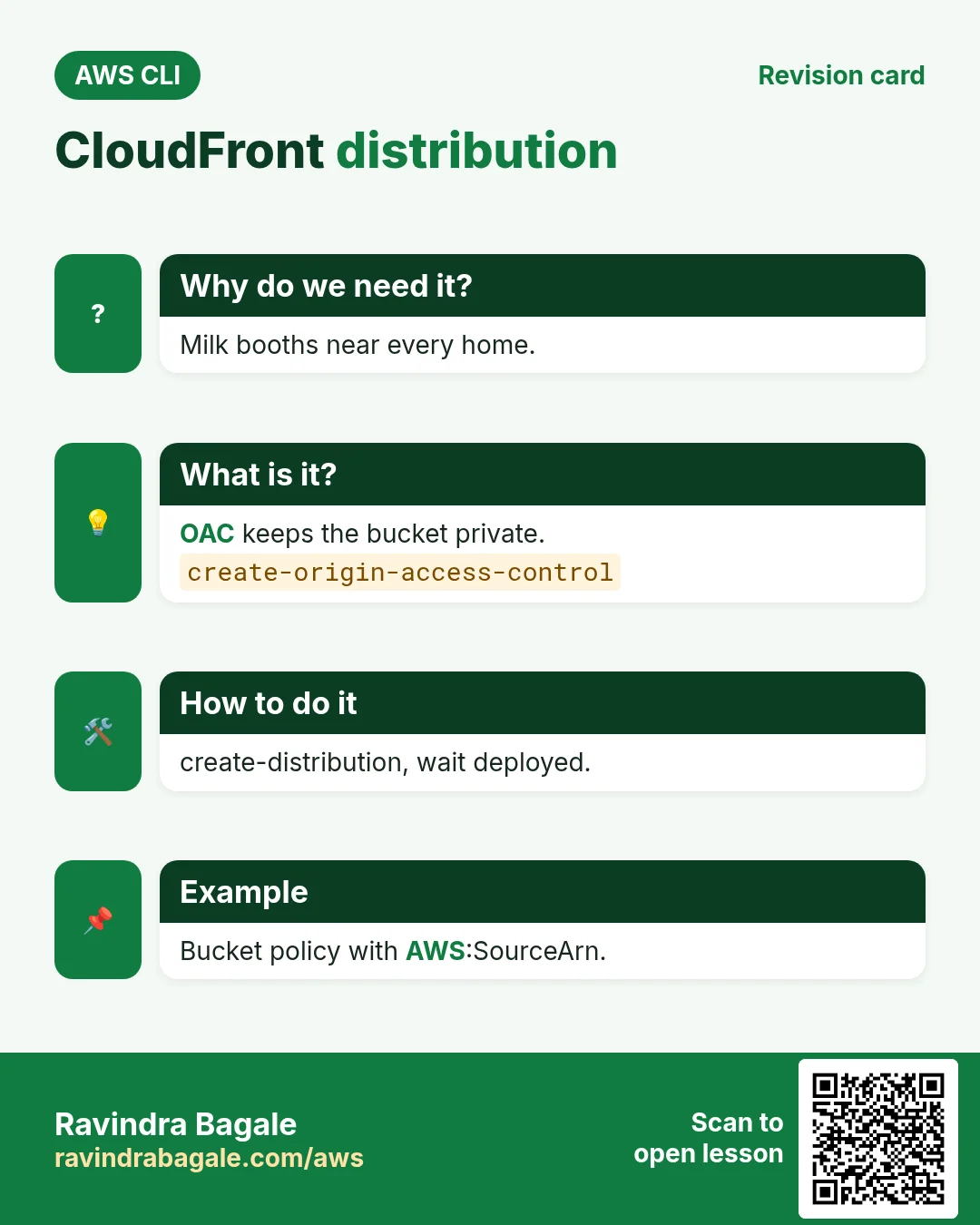
The dairy is far, so milk is kept in small booths in every area. CloudFront keeps copies of your files at edge locations near users, and only goes to the origin (S3) when a copy is missing or old.
Commands are in aws cloudfront. It is global; updates and deletes need the current ETag as --if-match.
2. Origin access control
The bucket should stay private; only CloudFront may read it.
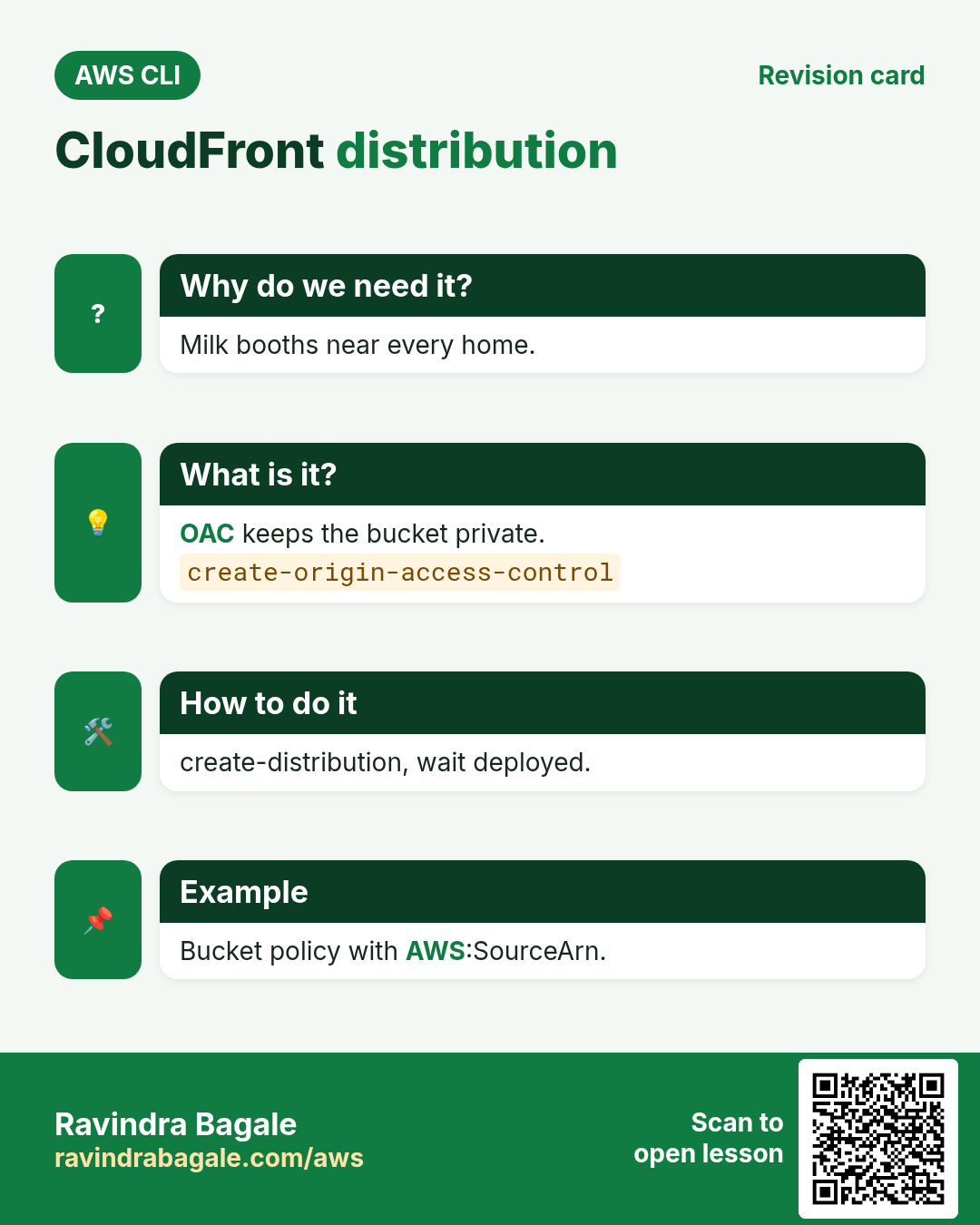
An OAC signs CloudFront requests to S3. The bucket policy then allows cloudfront.amazonaws.com for your distribution only.
Choose the S3 bucket’s regular origin for this private design. An S3 static website endpoint is configured as a custom origin and does not support OAC. Test the same harmless object through CloudFront and directly through S3 as an unauthenticated viewer. The CloudFront path should work after deployment and policy setup, while the direct private object request should be denied.
- Create the OAC.
OAC=$(aws cloudfront create-origin-access-control --origin-access-control-config Name=cli-oac,SigningProtocol=sigv4,SigningBehavior=always,OriginAccessControlOriginType=s3 --query OriginAccessControl.Id --output text)
echo $OAC
Expected output:
E2QWRUHAPOMQZL3. Create the distribution
Users in Delhi and London should both load the site quickly over HTTPS.
A distribution config lists origins, a default cache behavior, viewer protocol policy and a default root object. CallerReference must be unique.
- Write the config.
cat > dist.json <<J
{"CallerReference":"cli-$(date +%s)","Comment":"cli site","Enabled":true,"DefaultRootObject":"index.html",
 "Origins":{"Quantity":1,"Items":[{"Id":"s3","DomainName":"cli-site-bucket.s3.ap-south-1.amazonaws.com","OriginAccessControlId":"$OAC","S3OriginConfig":{"OriginAccessIdentity":""}}]},
 "DefaultCacheBehavior":{"TargetOriginId":"s3","ViewerProtocolPolicy":"redirect-to-https","CachePolicyId":"658327ea-f89d-4fab-a63d-7e88639e58f6"}}
J
Expected output:
(no output means success)- Create and wait.
D=$(aws cloudfront create-distribution --distribution-config file://dist.json --query Distribution.[Id,DomainName] --output text)
echo $D
aws cloudfront wait distribution-deployed --id ${D%%[[:space:]]*}
Expected output:
E1ABCDEF234567 d111111abcdef8.cloudfront.net4. Bucket policy and test
Follow the two requests in the private-origin design. A viewer opens the distribution hostname and asks for the practice object. CloudFront uses the origin configuration to fetch from the regular S3 bucket endpoint. Origin Access Control supplies a signed origin request and the bucket policy grants that distribution the relevant read. The viewer does not gain permission to read the S3 bucket directly.
Save the distribution ID, hostname, exact object key and bucket name. Wait for the distribution deployment before testing. The distribution test should show the file content; the direct unauthenticated S3 test should fail if the object is private. If both fail, inspect distribution deployment and the policy’s exact source distribution; if the direct request succeeds, inspect the bucket’s exposure before calling the architecture complete.
Without the policy CloudFront gets 403 from S3.
Allow s3:GetObject to the cloudfront service principal, with AWS:SourceArn equal to your distribution ARN.
- Apply the policy.
ID=E1ABCDEF234567
cat > bp.json <<J
{"Version":"2012-10-17","Statement":[{"Effect":"Allow","Principal":{"Service":"cloudfront.amazonaws.com"},"Action":"s3:GetObject","Resource":"arn:aws:s3:::cli-site-bucket/*","Condition":{"StringEquals":{"AWS:SourceArn":"arn:aws:cloudfront::111122223333:distribution/$ID"}}}]}
J
aws s3api put-bucket-policy --bucket cli-site-bucket --policy file://bp.json
Expected output:
(no output means success)- Test.
curl -sI https://d111111abcdef8.cloudfront.net/ | grep -iE "^HTTP|x-cache"Expected output:
HTTP/2 200
x-cache: Miss from cloudfront- Test again (from cache).
curl -sI https://d111111abcdef8.cloudfront.net/ | grep -i x-cacheExpected output:
x-cache: Hit from cloudfront5. Invalidate, update, disable
The CloudFront distribution sends a request to its origin when it needs a fresh copy, then can reuse a cached copy at an edge location. The cache behavior and headers affect which responses are cached and how long. Uploading a replacement object at the same S3 key changes the origin first. A viewer can continue receiving the cached version until it expires or CloudFront invalidates that path.
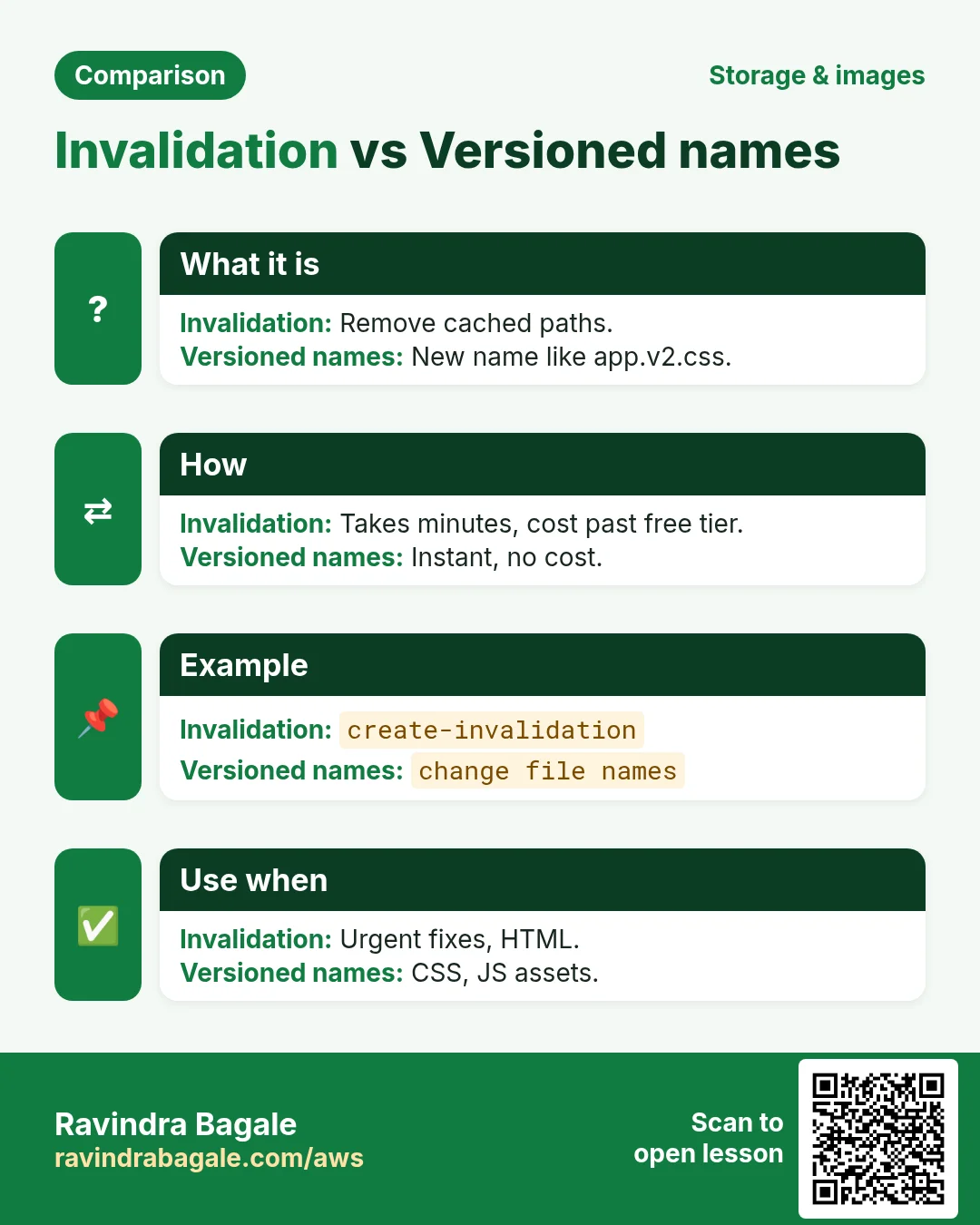
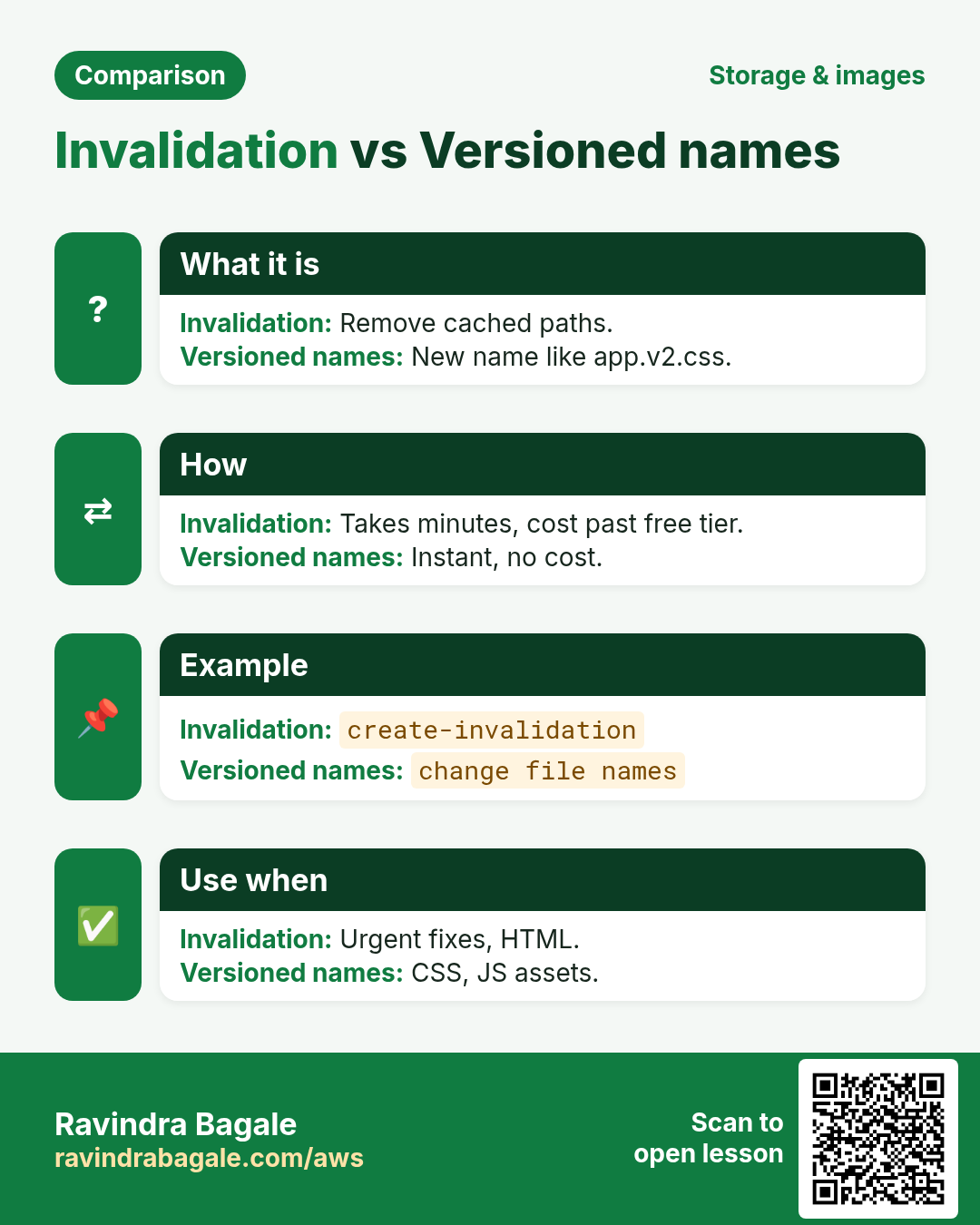
Write a small lab file with version v1 in its body, then update it to v2. Check the origin as an authorized user and compare the CloudFront response. Request invalidation of only the lab path, wait until completed, and try the distribution URL again. For versioned assets such as a new image release, a distinct file key can let old and new versions coexist without waiting for that invalidation.
You uploaded a new index.html but users still see the old one; later you want to change or remove the distribution.
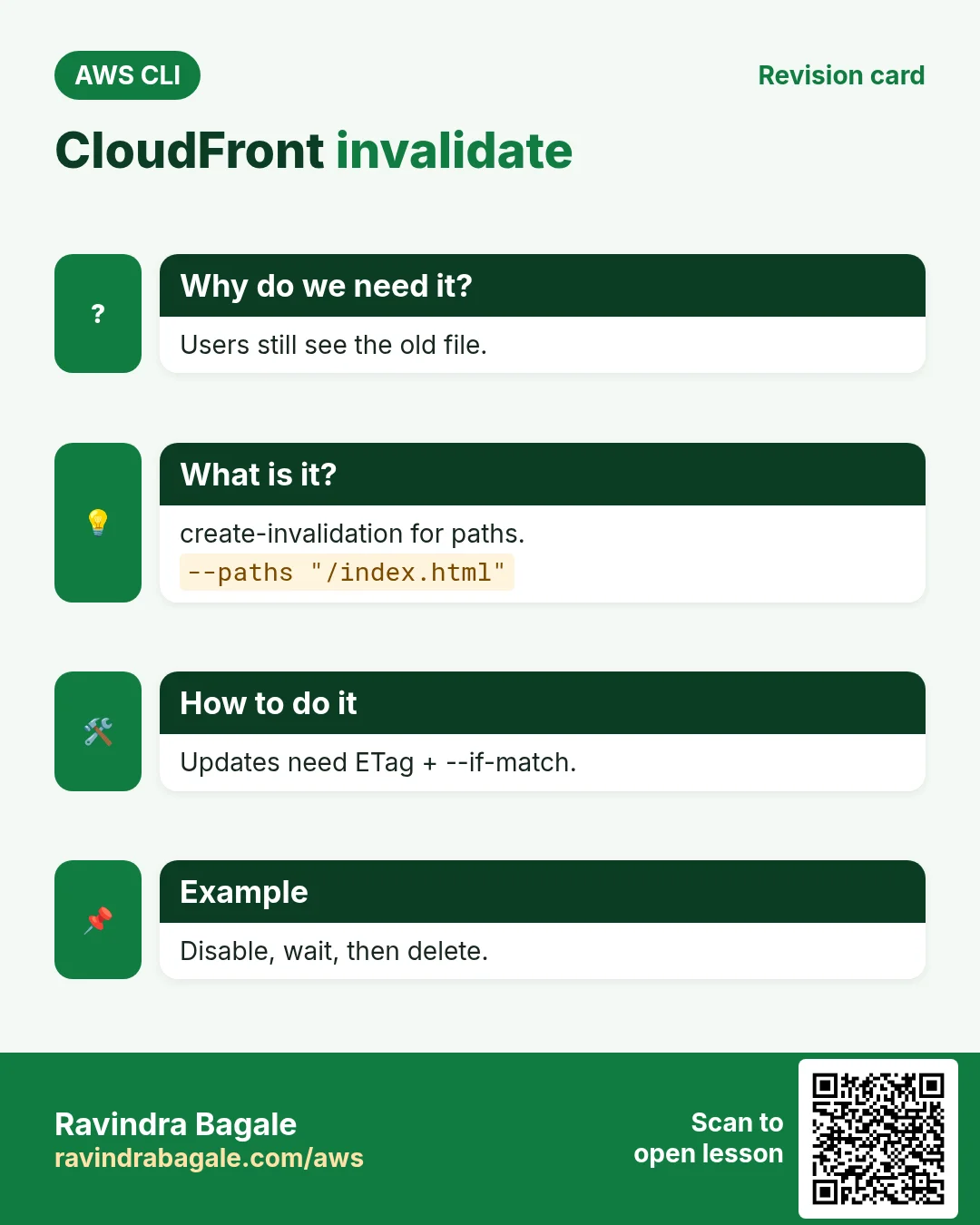
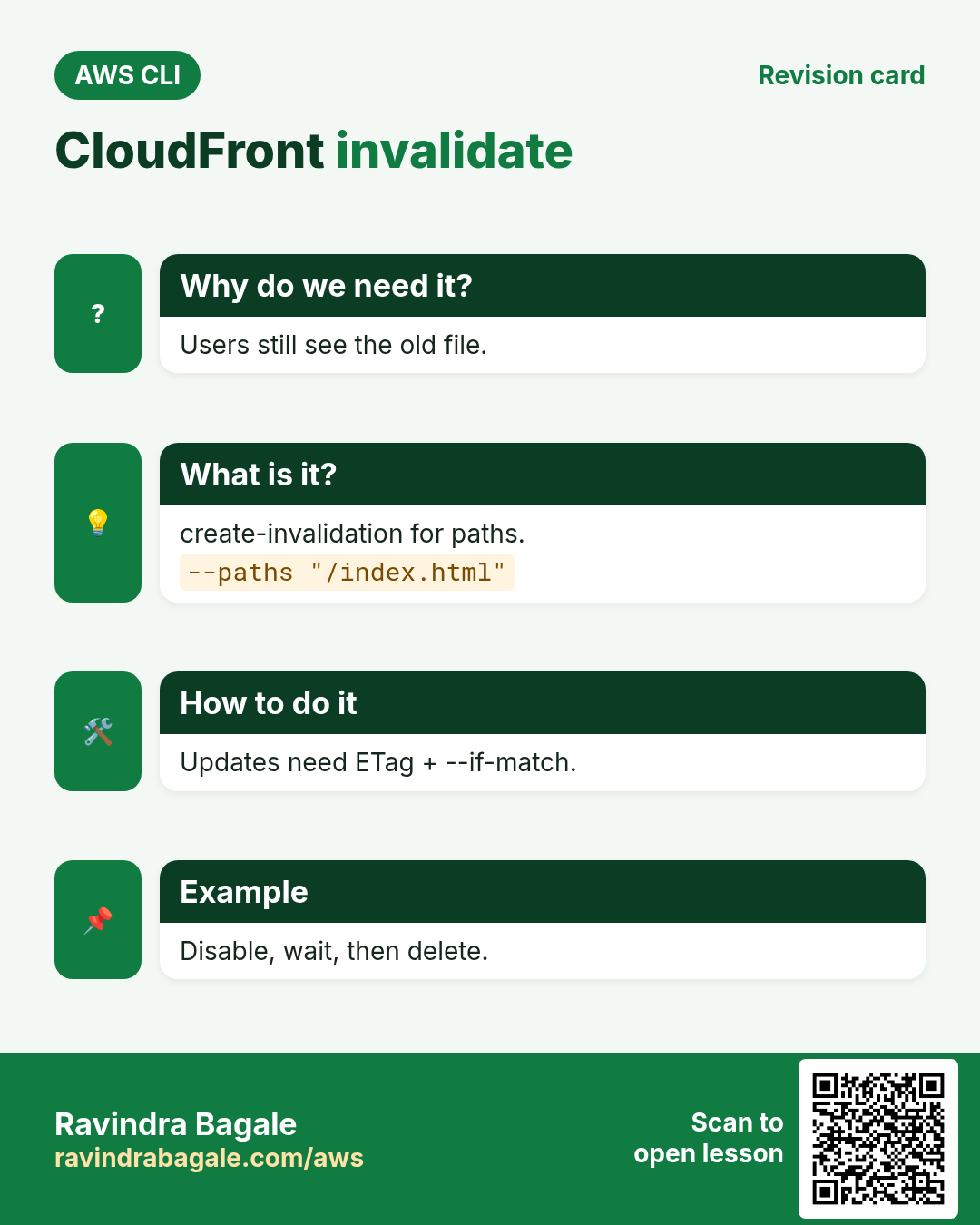
create-invalidation removes cached paths. update-distribution needs the full config and the ETag from get-distribution-config.
- Invalidate.
aws cloudfront create-invalidation --distribution-id $ID --paths "/index.html" "/css/*" --query Invalidation.Status --output textExpected output:
InProgress- Get config and ETag, then disable.
aws cloudfront get-distribution-config --id $ID > cfg.json
E=$(jq -r .ETag cfg.json)
jq .DistributionConfig cfg.json | jq ".Enabled=false" > new.json
aws cloudfront update-distribution --id $ID --if-match $E --distribution-config file://new.json --query Distribution.Status --output text
Expected output:
InProgress6. Same action in Python, Node.js, Java, Go, .NET and PHP
Scripts start in the CLI. Apps call the same API through an SDK. Knowing both helps you move a tested command into real code.
Low-level CLI commands expose service operations. A high-level command or an automatically paginated list can make multiple requests. For example, aws cloudfront create-invalidation --distribution-id $ID --paths "/*" maps to the Invalidate API.
Same action (Invalidate) from code. Set the intended profile and Region for the SDK. Provider support and precedence can differ by SDK, and an explicit client setting can override defaults.
| Stack | Code |
|---|---|
| Python (boto3) | boto3.client("cloudfront").create_invalidation(DistributionId=id,InvalidationBatch={"Paths":{"Quantity":1,"Items":["/*"]},"CallerReference":str(time.time())}) |
| Node.js (v3) | await cf.send(new CreateInvalidationCommand({DistributionId:id,InvalidationBatch:{Paths:{Quantity:1,Items:["/*"]},CallerReference:Date.now().toString()}})); |
| Java (v2) | cf.createInvalidation(r -> r.distributionId(id).invalidationBatch(b -> b.callerReference(""+System.currentTimeMillis()).paths(p -> p.quantity(1).items("/*")))); |
| Go (v2) | c.CreateInvalidation(ctx, &cloudfront.CreateInvalidationInput{DistributionId: aws.String(id), InvalidationBatch: batch}) |
| .NET | await cf.CreateInvalidationAsync(new CreateInvalidationRequest{DistributionId=id,InvalidationBatch=batch}); |
| PHP | $cf->createInvalidation(["DistributionId"=>$id,"InvalidationBatch"=>$batch]); |
7. Clean up so nothing keeps costing
Lab resources left running cost money and can be a security risk.
Delete in reverse order: children first, then parents.
- Wait for the disabled state to deploy.
aws cloudfront wait distribution-deployed --id $IDExpected output:
(no output means success)- Delete with the new ETag.
E=$(aws cloudfront get-distribution --id $ID --query ETag --output text)
aws cloudfront delete-distribution --id $ID --if-match $E
Expected output:
(no output means success)- Delete the OAC.
E=$(aws cloudfront get-origin-access-control --id $OAC --query ETag --output text)
aws cloudfront delete-origin-access-control --id $OAC --if-match $E
Expected output:
(no output means success)- Verify.
aws cloudfront list-distributions --query "DistributionList.Items[?Id=='$ID']"Expected output:
[]Ravindra Bagale's Tip
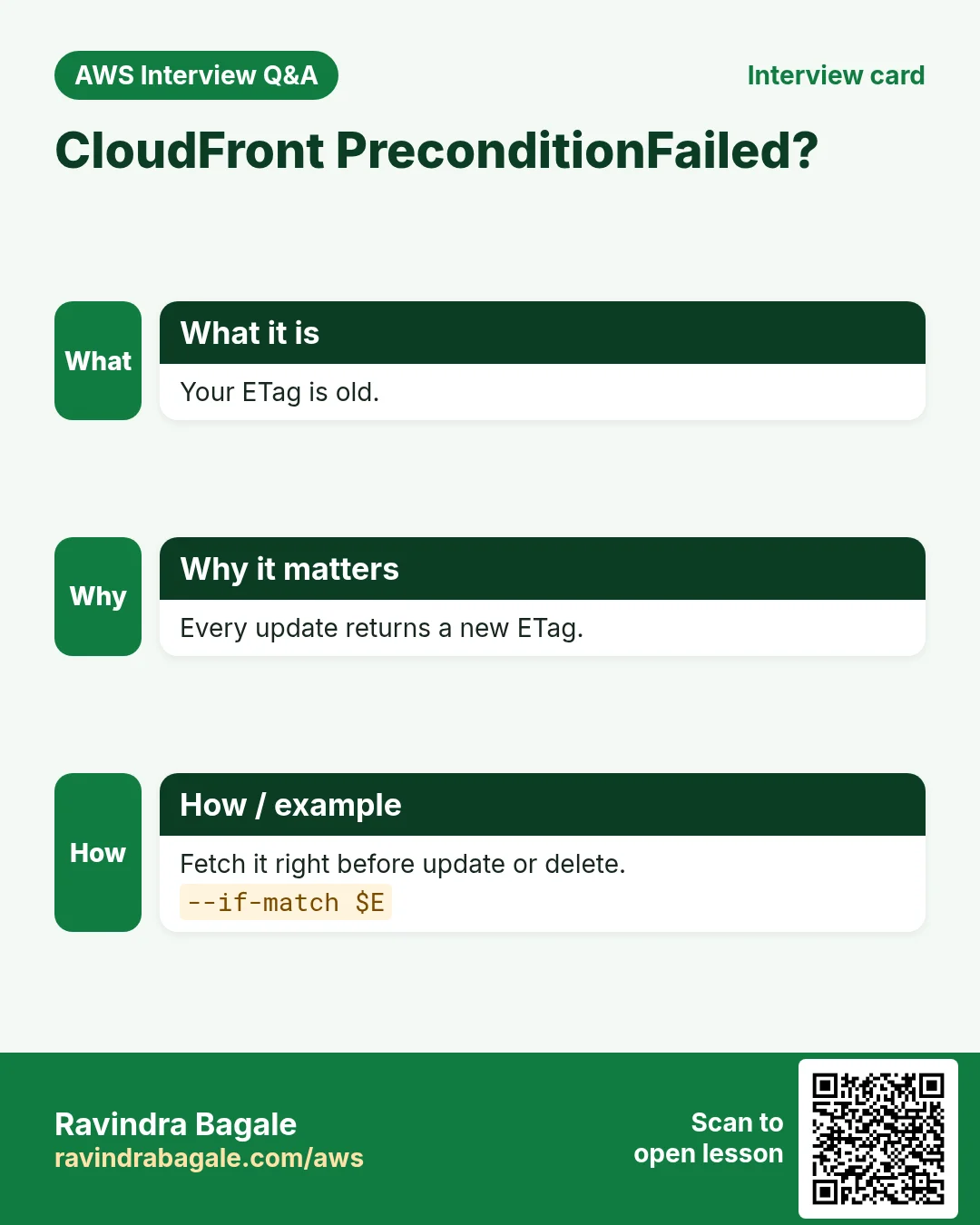
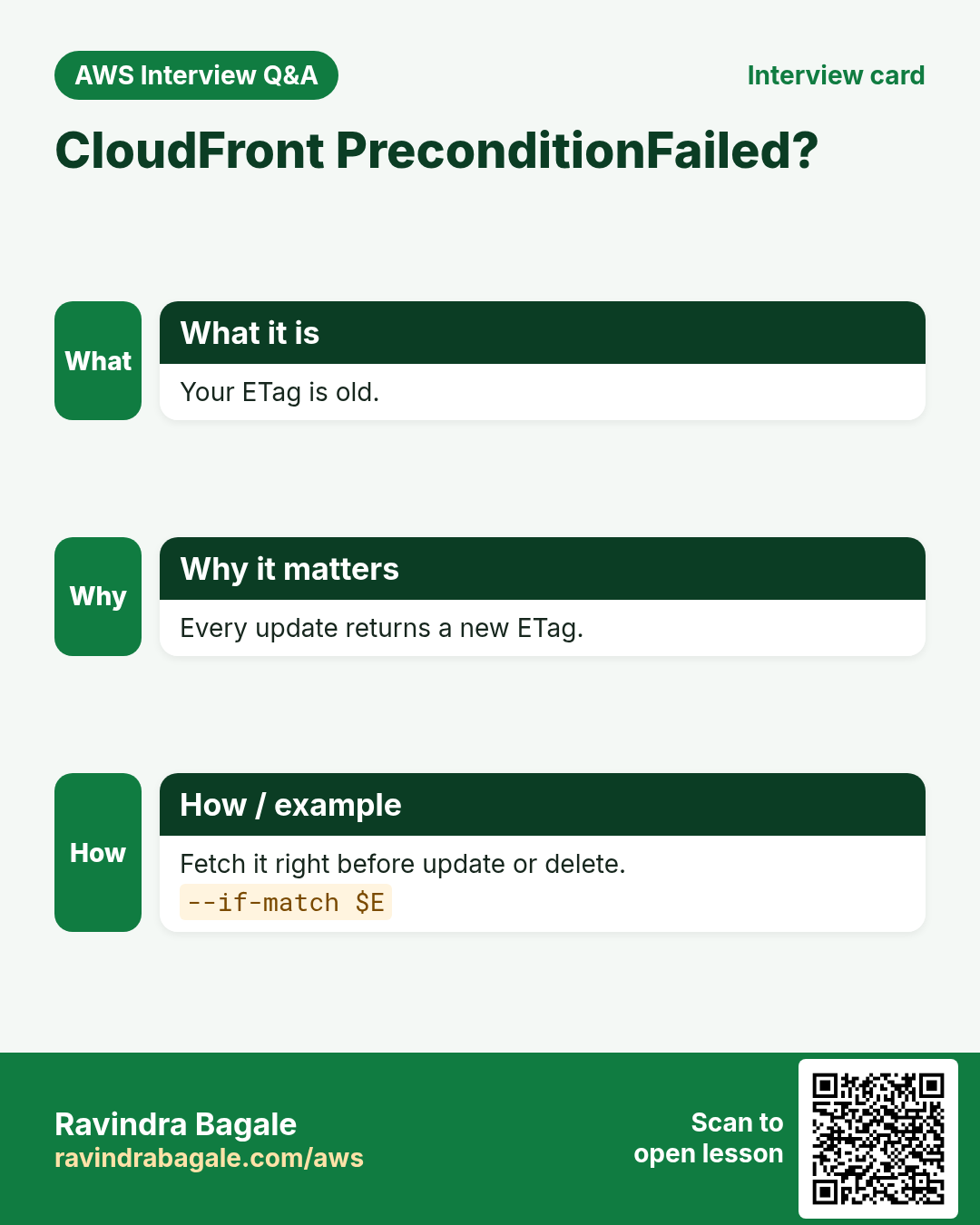
"PreconditionFailed" means your ETag is old. Every update returns a new ETag, so fetch it again right before each update or delete.
8. Interview questions and answers
Q. What is an edge location?
A CloudFront site near users that caches content.
Q. OAC vs public bucket?
OAC keeps the bucket private and lets only your distribution read it.
Q. Why --if-match?
Optimistic locking with the ETag so two people do not overwrite each other.
Q. How to show new files immediately?
create-invalidation for the paths, or use versioned file names.
Q. Why disable before delete?
CloudFront only deletes distributions that are disabled and deployed.
Try at home
- Put an index.html in a private bucket and serve it through CloudFront over HTTPS.
- Change the file, invalidate it and confirm the new version.
In short
- OAC keeps S3 private.
- create-distribution.
- Bucket policy with SourceArn.
- create-invalidation.
- ETag + --if-match.
Use one file to compare origin and edge behavior
Replace an object in the test origin, fetch the viewer URL, then use a targeted invalidation if necessary. Wait for invalidation status and check cache headers. Keep a versioned file name for long-lived immutable assets.
Interview check Does invalidation delete the S3 object?
No. It evicts matching cached objects from CloudFront; a new fetch still retrieves from the configured origin when needed.
Practise this chapter
Interview questions and answers
How do you tell an origin permission problem from an outdated edge response?
I would verify the exact object through an authorized origin read, then try the intended CloudFront path. An older successful response may be cached, while a fresh failure points to origin access or behavior settings. I would inspect that specific path before invalidating or changing permissions.
Check your understanding
Choose an answer, then compare your reasoning with the explanation.
Practice Tasks
Practice checks run in your browser. They check the answer for this exercise; they do not create resources or connect to your AWS account.
About this scenarioNairobi Ride is a transport business in Nairobi. Wanjiru Kamau looks after its IT and cloud work. They count money in KES and run their AWS resources in the af-south-1 Region. In the tasks below you do real jobs for them using what this lesson teaches. All names, account IDs, IP addresses and numbers are made up for practice.
0 / 10
Easy List distributions
Find the distribution ID and domain name.
List all CloudFront distributions.
- Read the task and decide which AWS service it is about.
- Write aws, then the service name, then the operation (the action word).
- Add each needed flag (--name) followed by its value from the task.
- Flags can be in any order. Click Check answer.
Easy How many addresses in a /16?
Picking a VPC size needs this count.
Nairobi Ride plans the VPC 10.205.0.0/16. How many IP addresses does it hold in total?
- Write down the numbers the task gives you.
- Work it out step by step on paper.
- Type only the final answer in the box.
- Click Check answer.
Easy Port for SSH
Security group rules need the right port.
Which TCP port must the security group open for SSH?
- Write down the numbers the task gives you.
- Work it out step by step on paper.
- Type only the final answer in the box.
- Click Check answer.
Medium Clear the CloudFront cache
After a deploy, invalidate so visitors get the new files now, not after the TTL.
Invalidate all paths (/*) on distribution E2QWRUHAPOMQZL.
- Read the task and decide which AWS service it is about.
- Write aws, then the service name, then the operation (the action word).
- Add each needed flag (--name) followed by its value from the task.
- Flags can be in any order. Click Check answer.
Hard Create a distribution from a config file
The full config (origins, behaviors, certificate) is easiest to keep in JSON.
Create a CloudFront distribution from dist.json.
- Read the task and decide which AWS service it is about.
- Write aws, then the service name, then the operation (the action word).
- Add each needed flag (--name) followed by its value from the task.
- Flags can be in any order. Click Check answer.
Hard Invalidate two paths
Invalidating only what changed is cheaper and faster.
On E2QWRUHAPOMQZL, invalidate /index.html and /css/site.css.
- Read the task and decide which AWS service it is about.
- Write aws, then the service name, then the operation (the action word).
- Add each needed flag (--name) followed by its value from the task.
- Flags can be in any order. Click Check answer.
Hard Bucket policy for CloudFront OAC
With OAC, only your CloudFront distribution may read the private bucket.
Allow the service cloudfront.amazonaws.com to s3:GetObject on nairobiride-site/*, only when aws:SourceArn equals arn:aws:cloudfront::104591109902:distribution/E2QWRUHAPOMQZL.
- Start with { "Version": "2012-10-17", "Statement": [ ... ] }.
- In each statement write Effect, Action and Resource.
- Give only what the task needs (least privilege).
- Use double quotes and commas correctly. Click Check answer.
Hard Create an Origin Access Control
OAC lets only CloudFront read your private S3 bucket.
Create an origin access control from oac.json.
- Read the task and decide which AWS service it is about.
- Write aws, then the service name, then the operation (the action word).
- Add each needed flag (--name) followed by its value from the task.
- Flags can be in any order. Click Check answer.
Hard Request a free certificate for CloudFront
CloudFront only uses ACM certificates from us-east-1. DNS validation renews automatically.
Request a certificate for nairobiride.co.ke and www.nairobiride.co.ke with DNS validation, in us-east-1.
- Read the task and decide which AWS service it is about.
- Write aws, then the service name, then the operation (the action word).
- Add each needed flag (--name) followed by its value from the task.
- Flags can be in any order. Click Check answer.
Hard Make a CloudFront signed URL
Signed URLs let only paying users watch a video, for a limited time.
Sign https://d111.cloudfront.net/course/intro.mp4 with key pair ID K2JCJMDEHXQW5F, private key private_key.pem, expiring 2026-12-31.
- Read the task and decide which AWS service it is about.
- Write aws, then the service name, then the operation (the action word).
- Add each needed flag (--name) followed by its value from the task.
- Flags can be in any order. Click Check answer.
Revision, comparison and interview cards
Revise this lesson in a few minutes. Save the cards on your phone or download them as PNG files. The QR code on each card opens this lesson.
More cards: Ravi Sir's Cards.