Project: Build a Contact Form API with Lambda, DynamoDB and SNS (Source Code)
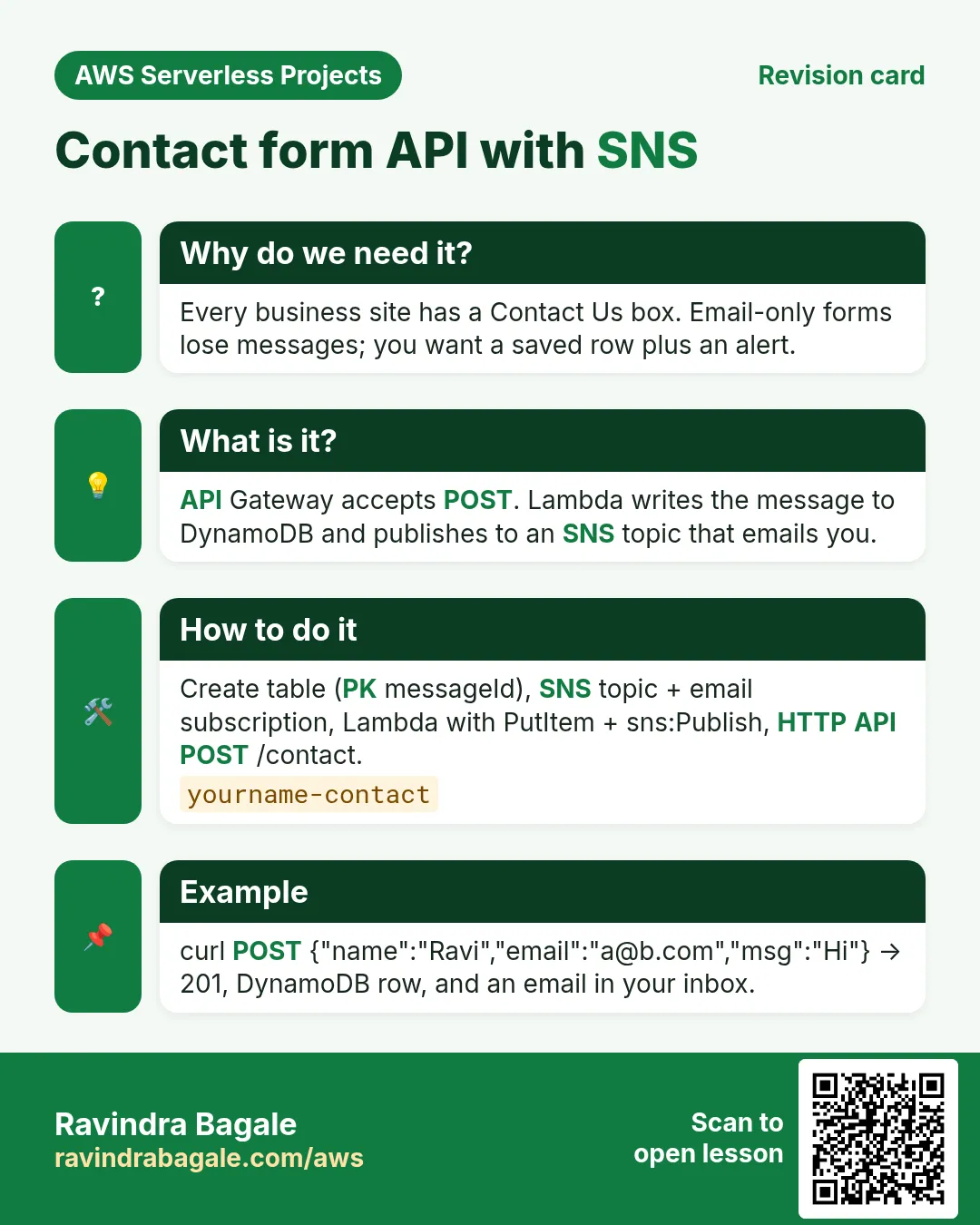
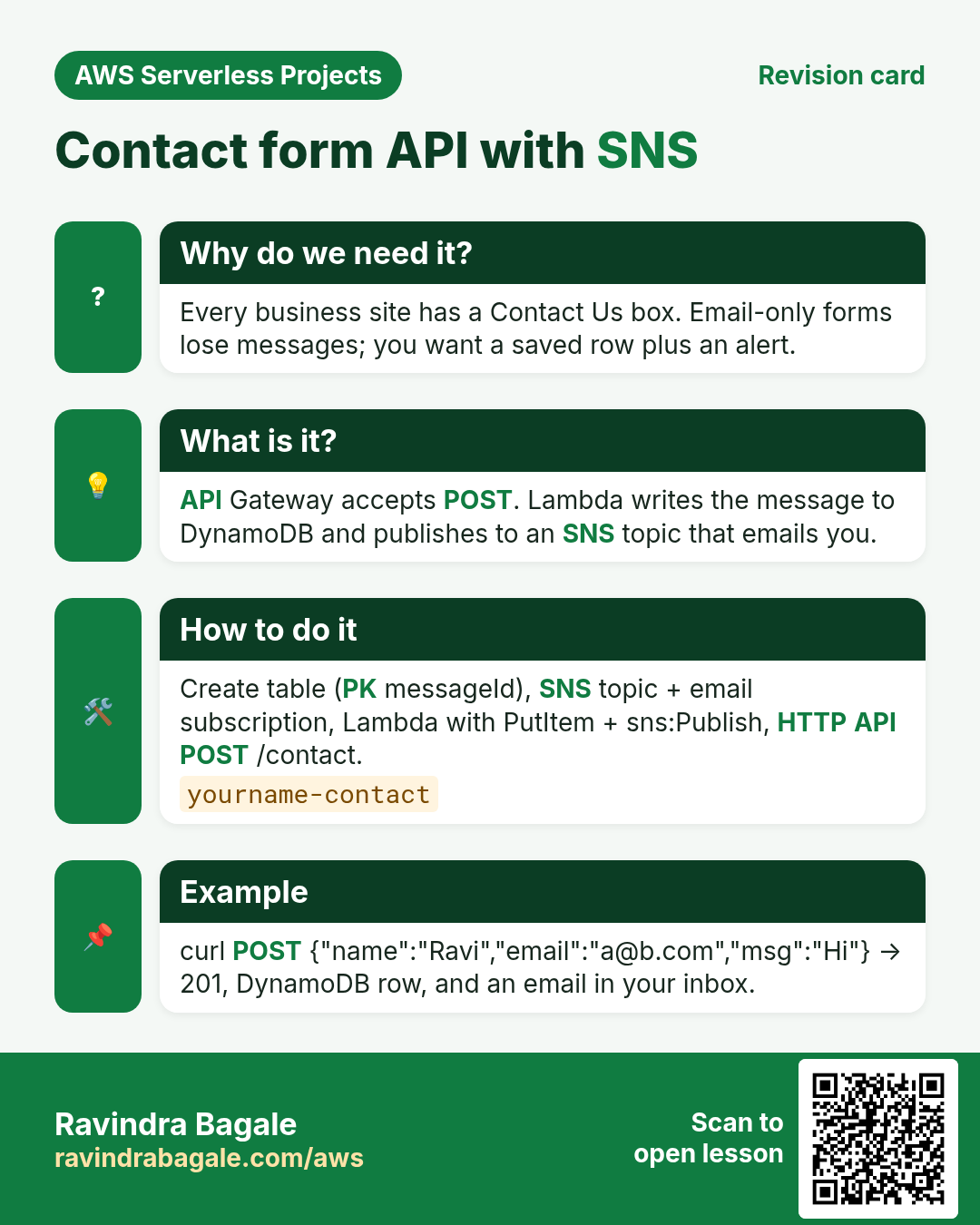
Every business site has a Contact form. Save the message in DynamoDB and email yourself with SNS — serverless, region ap-south-1.
In this chapter
- Wire contact POST API
- Persist in DynamoDB
- SNS email alert
- Test and clean up
1. Everyday example
A coaching-class site: visitor sends name, email, message. You want the row saved and a mail ping — without an EC2 running all night.
POST /contact → Lambda → PutItem + sns.publish to a topic with your email subscribed.
Download: contact-form-api.zip
2. Lab
Region ap-south-1.
A. DynamoDB + SNS
Picture one synthetic form submission as a named record such as messageId=lab-001 with a sender and text. A DynamoDB item is one such record. The table is the durable copy the team can review later. The SNS topic is a named channel used to publish alerts. An email subscription tells SNS where to send alerts from that channel, and the recipient confirms it before the topic can use the address.
Choose permissions for two separate jobs. The function needs to write contacts to one table and publish to one topic. A human viewing later needs the ability to read the relevant records. Keep the table and alert topics private and use classroom-only messages so students never put real contact data into practice logs or notifications.
- Table
yourname-contacts, PKmessageIdString, on-demand. - SNS topic
yourname-contact-alerts. Email subscription → confirm in inbox.
B. IAM + Lambda
- Role: basic logs + zip inline (PutItem + sns:Publish on that topic).
- Function
yourname-contact-api, Python 3.12, handler.py. Env TABLE_NAME, TOPIC_ARN. Deploy.
C. API + test
POST sends the form fields to the API as JSON, a text format of named values. Following the response, use the returned messageId to look up the exact row in DynamoDB. Check the email separately. If the row exists but an alert never arrives, confirm the topic subscription and look for a publish error. Sending the same form again can make another row, so first keep the ID and investigate which step already completed.
If the direct API test succeeds but a hosted form cannot call it, the browser may be blocking the cross-origin request. An origin is the page’s scheme, host and port. CORS controls which origins the browser allows to interact with the API. A permissive lab CORS setting does not give callers permission to read saved contacts.
- HTTP API POST /contact → Lambda. CORS *. Copy API_BASE.
curl -s -X POST "$API_BASE/contact" -H 'content-type: application/json' \
  -d '{"name":"Riya","email":"riya@example.com","message":"Need AWS batch timing"}'
Expect {"ok":true,"messageId":"..."}, then email + DynamoDB row.
Cleanup
- Delete API, Lambda, table, SNS subscription and topic, IAM role.
- Remove the topic so lab mail does not keep arriving.
3. Interview
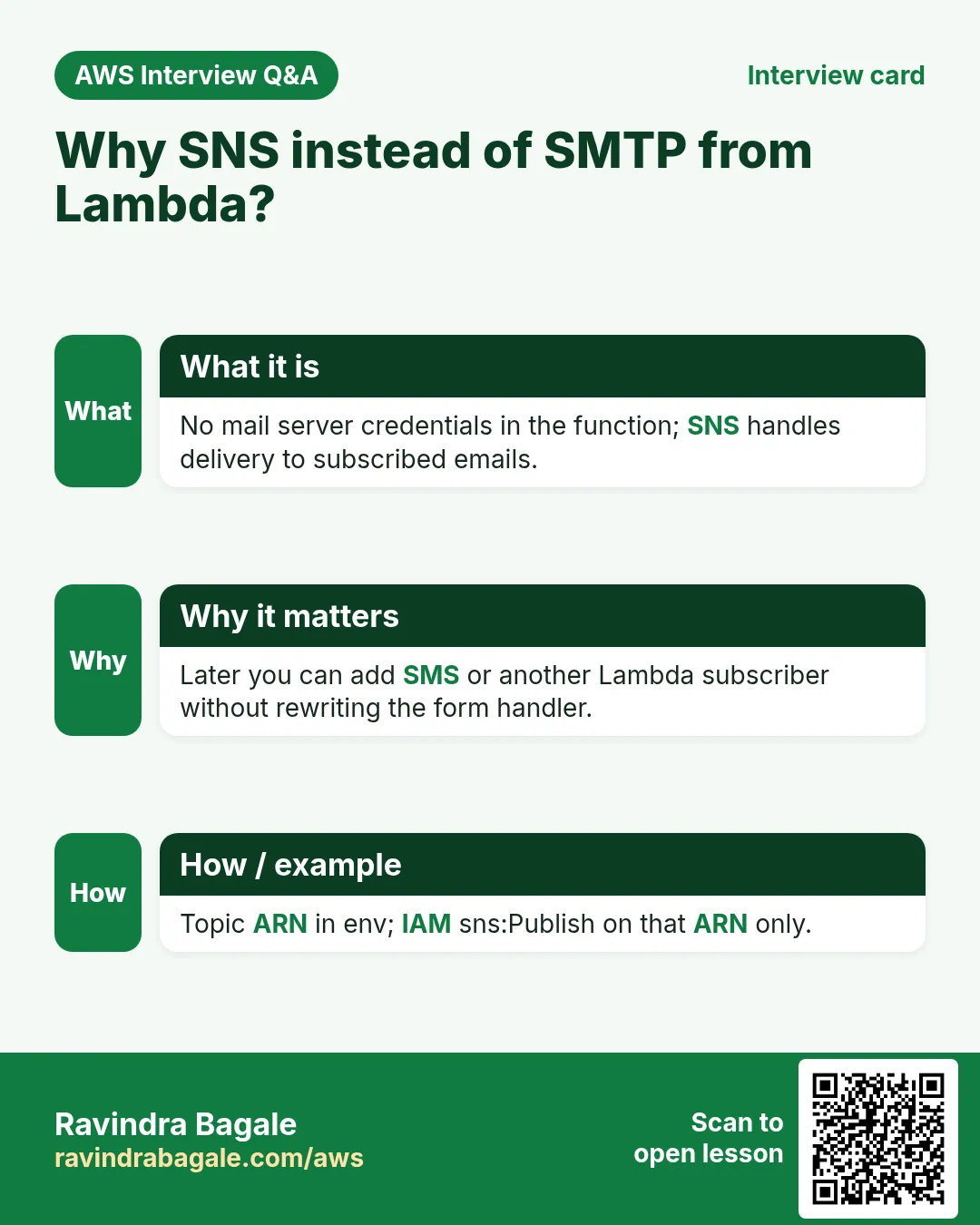
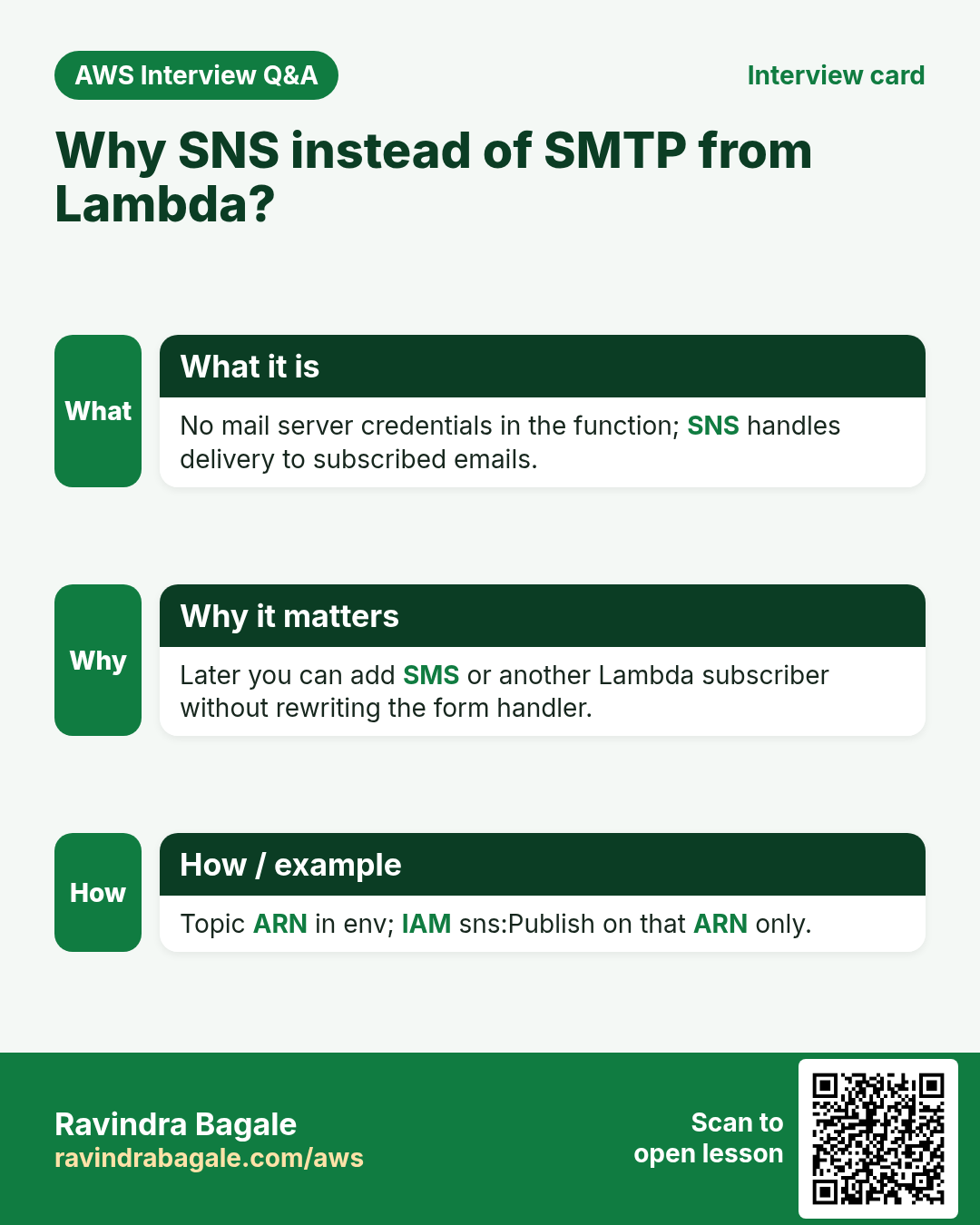
Q. Why SNS not SES here?
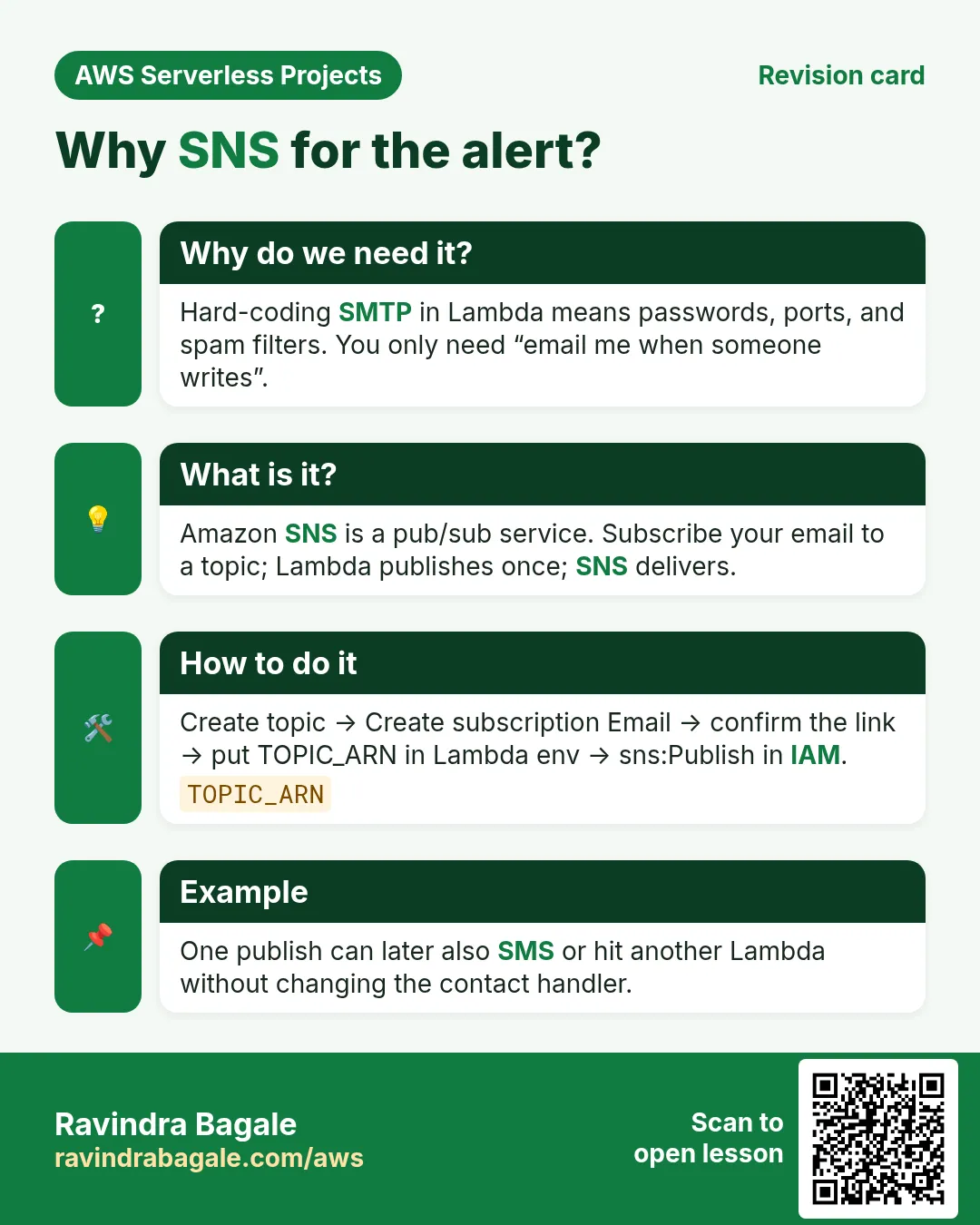
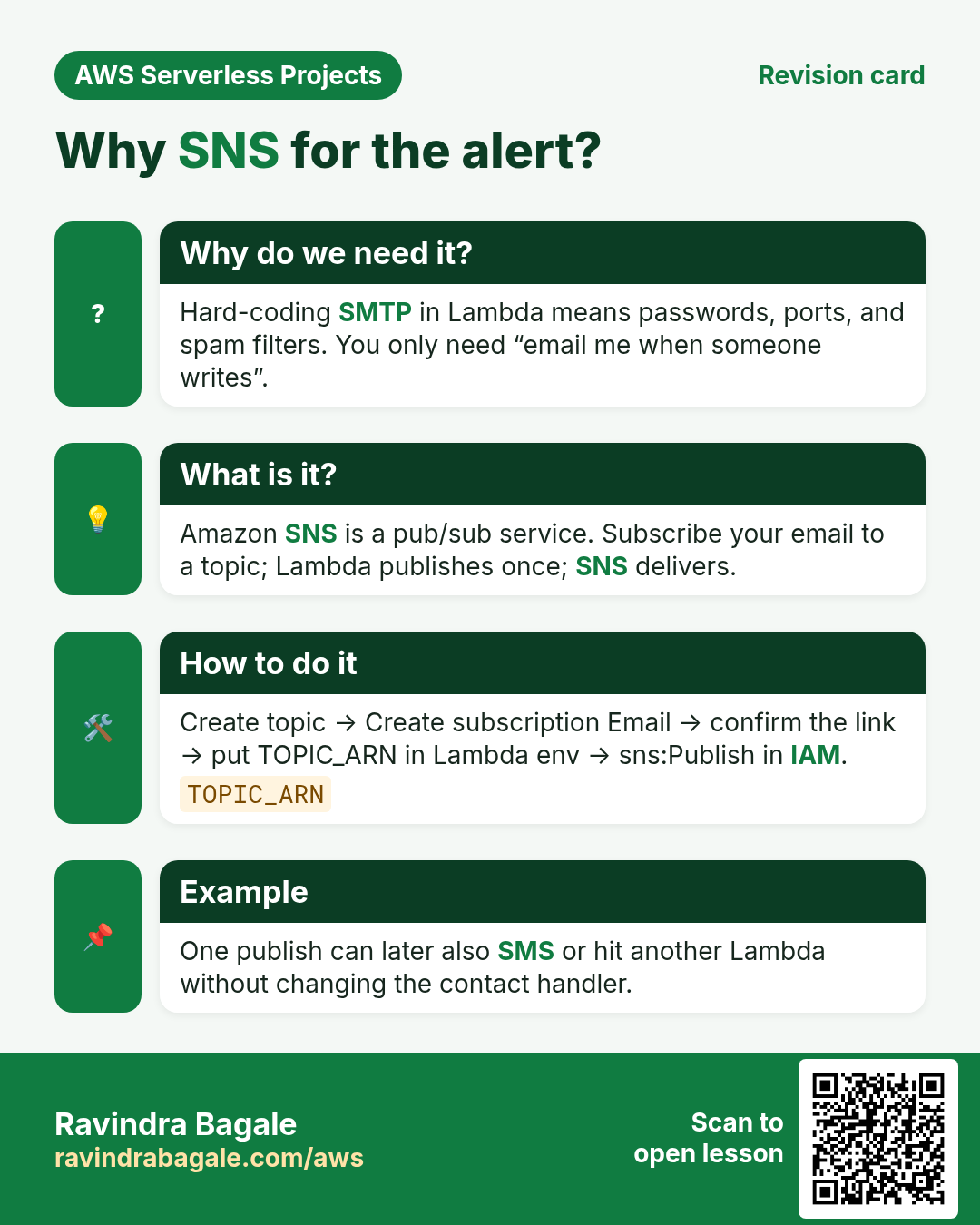
One alert email: SNS is enough. SES for branded bulk (sandbox).
Q. CORS why?
Browser page origin differs from API.
Q. PII?
Messages are personal — tight IAM, delete lab data.
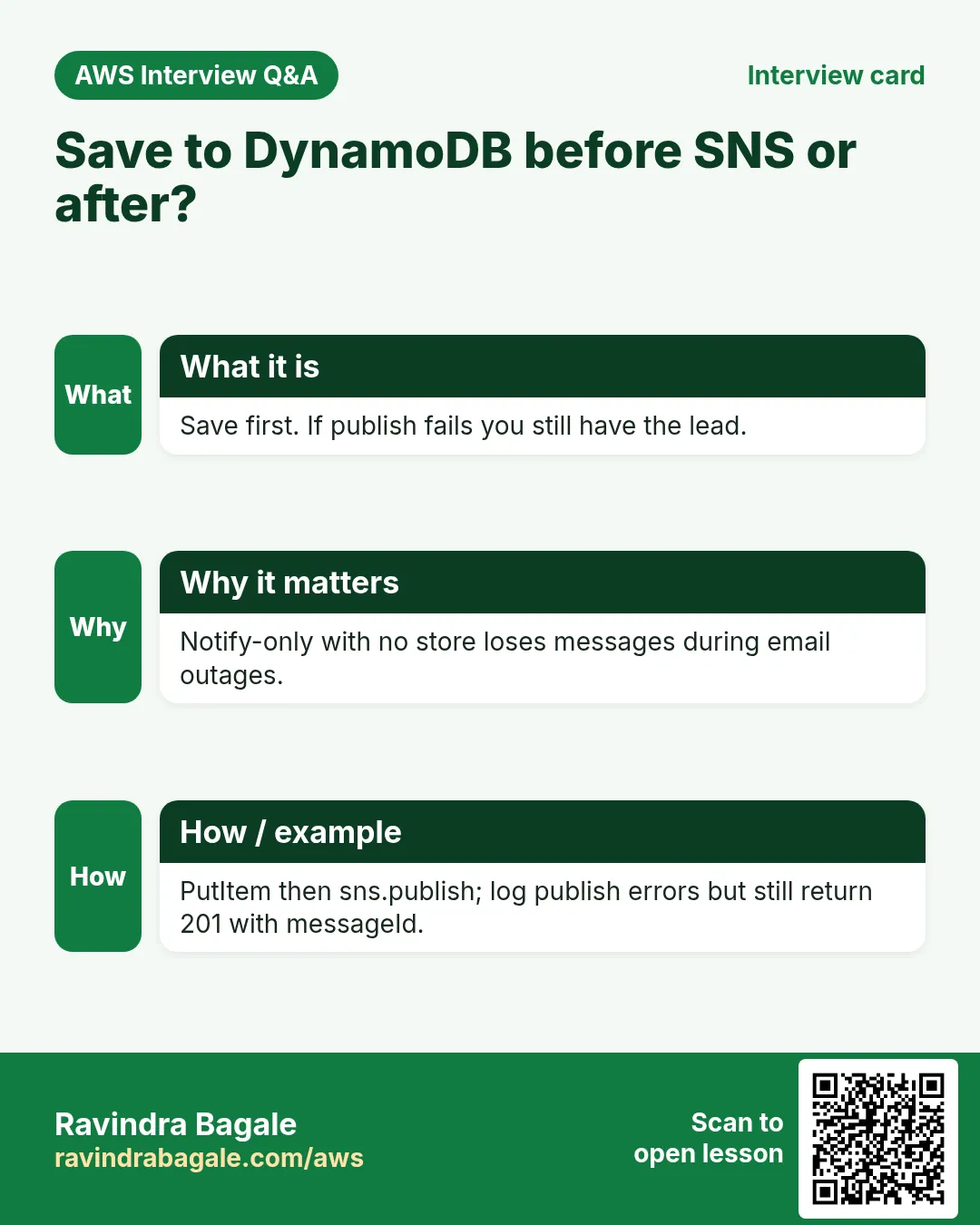
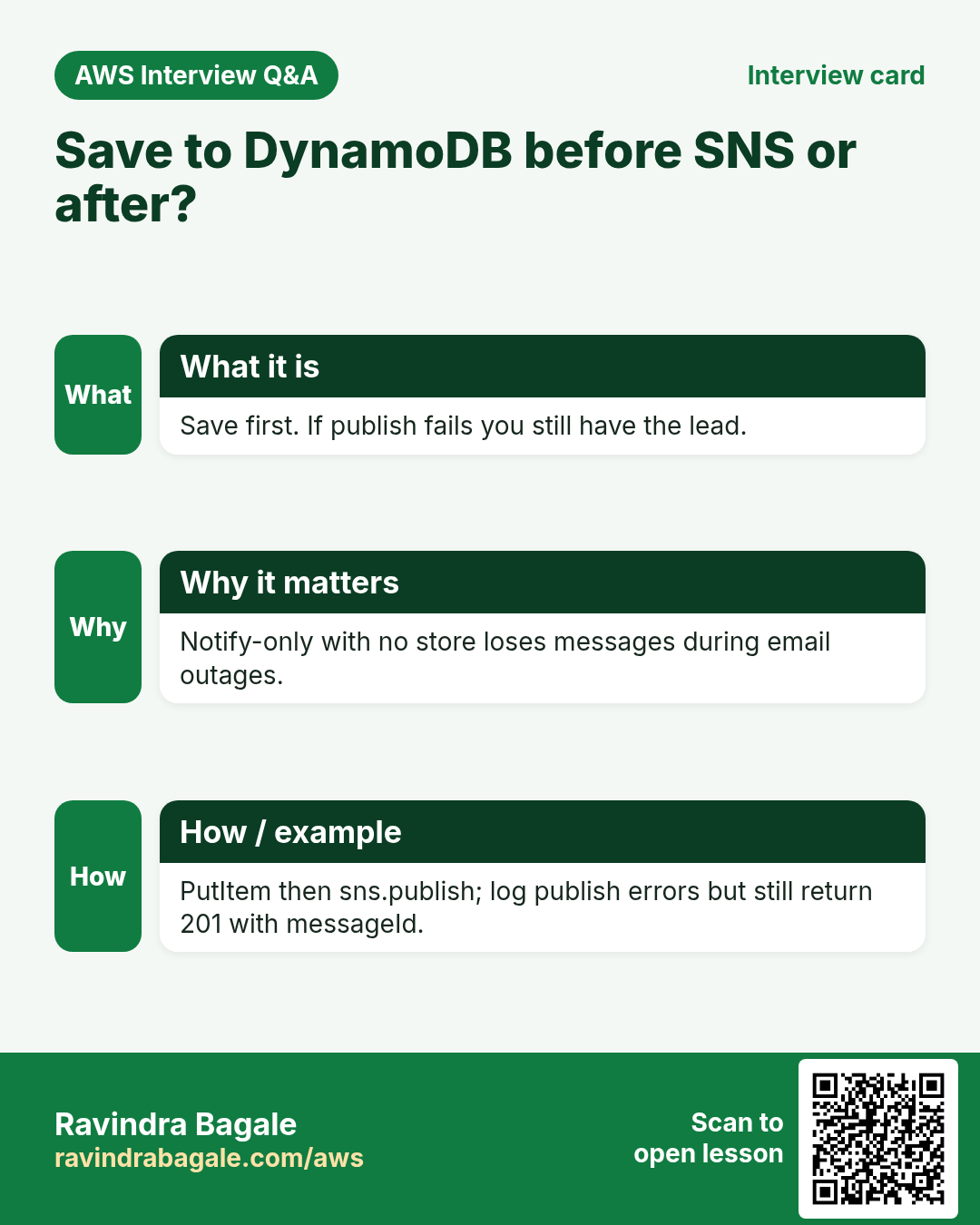
Q. If SNS fails after PutItem?
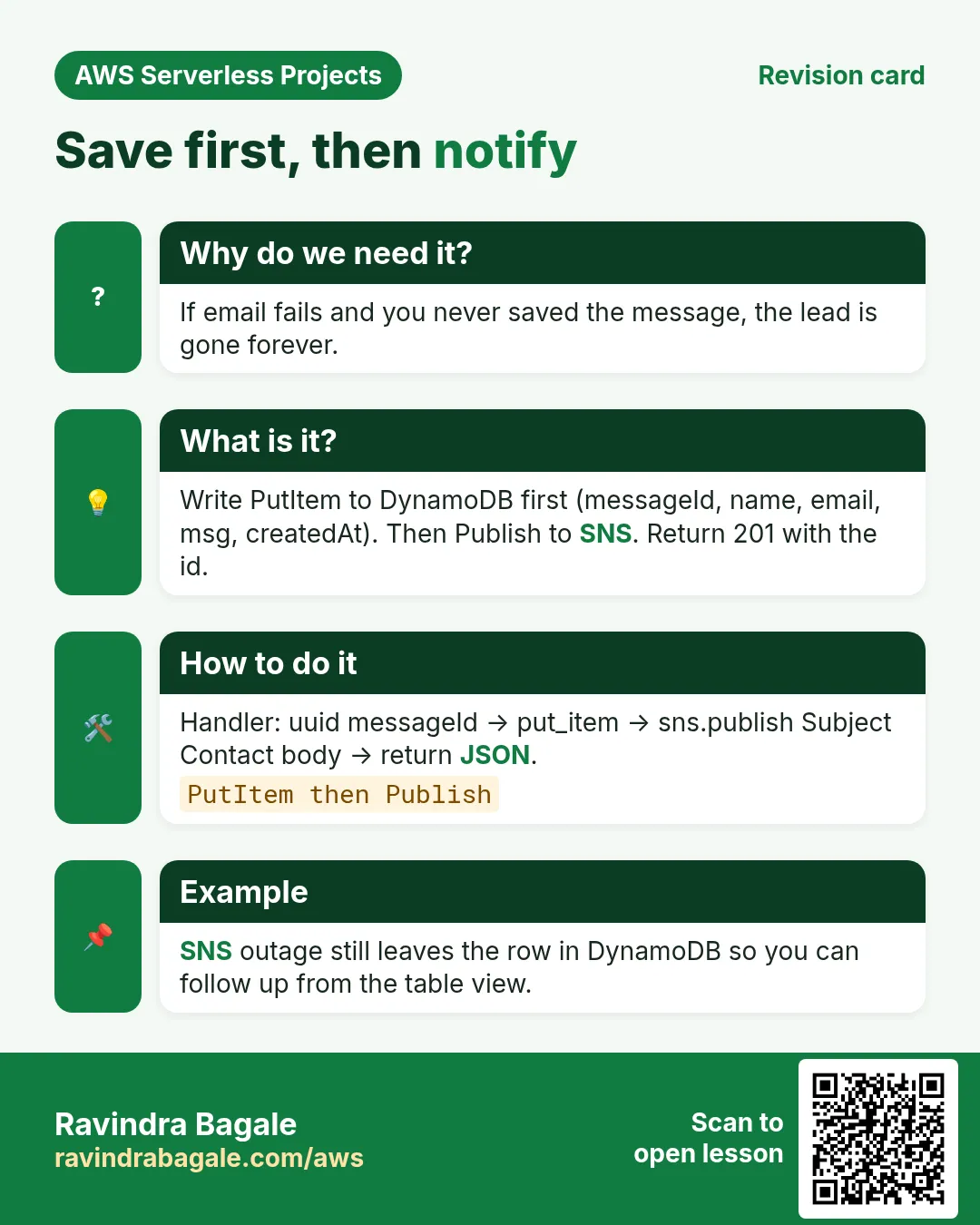
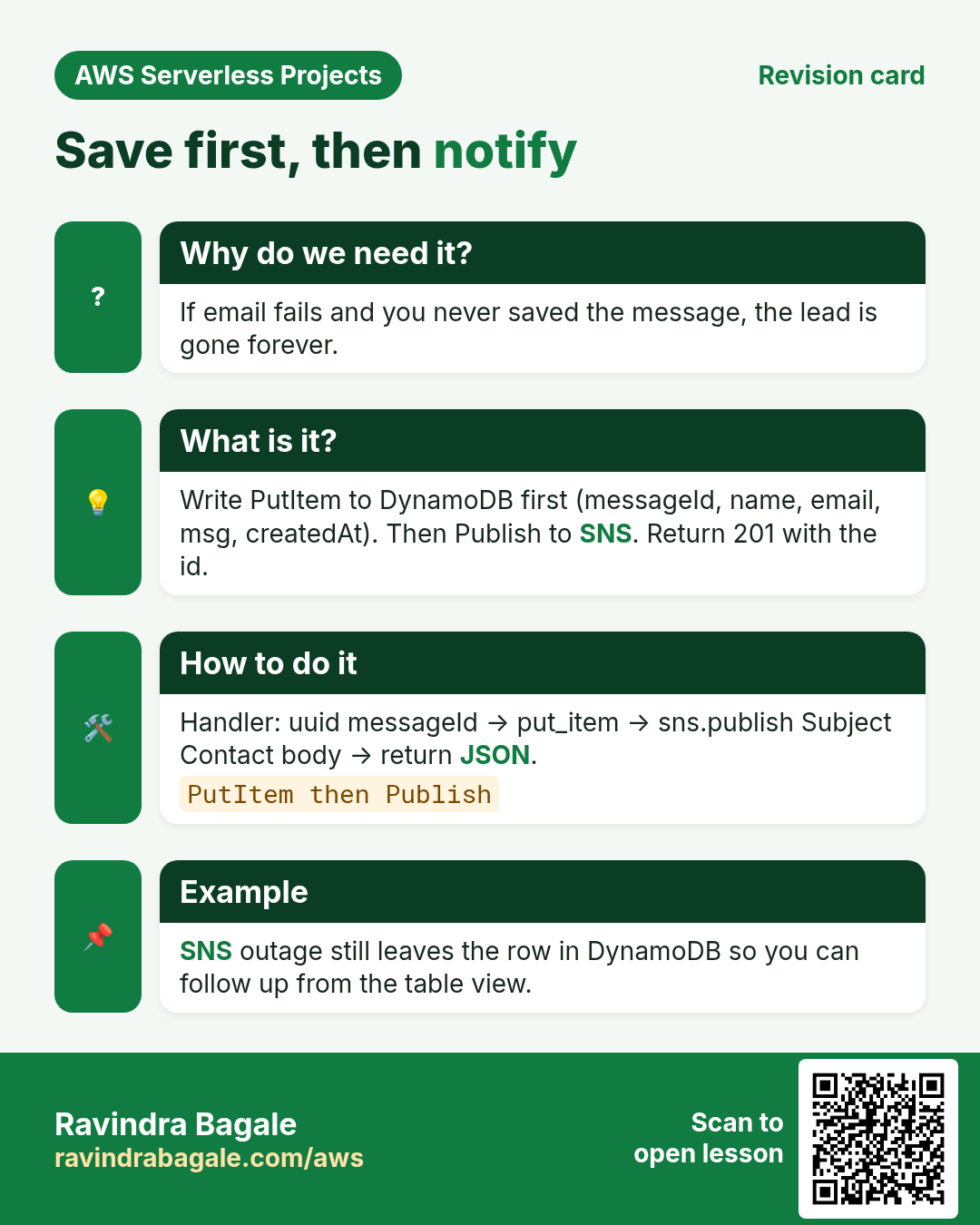
Lab order saves first; production uses outbox/transactions.
Q. Cleanup?
API, Lambda, table, topic, role.
Try at home
- Add a honeypot field; reject if filled.
- Design a private admin GET route. For this HTTP API, choose IAM or a JWT authorizer and limit which callers can read messages. Use synthetic data for the test.
In short
- Contact = API GW + Lambda + DynamoDB + SNS.
- Confirm SNS email.
- Validate input.
- Clean up.
Check storage and delivery separately
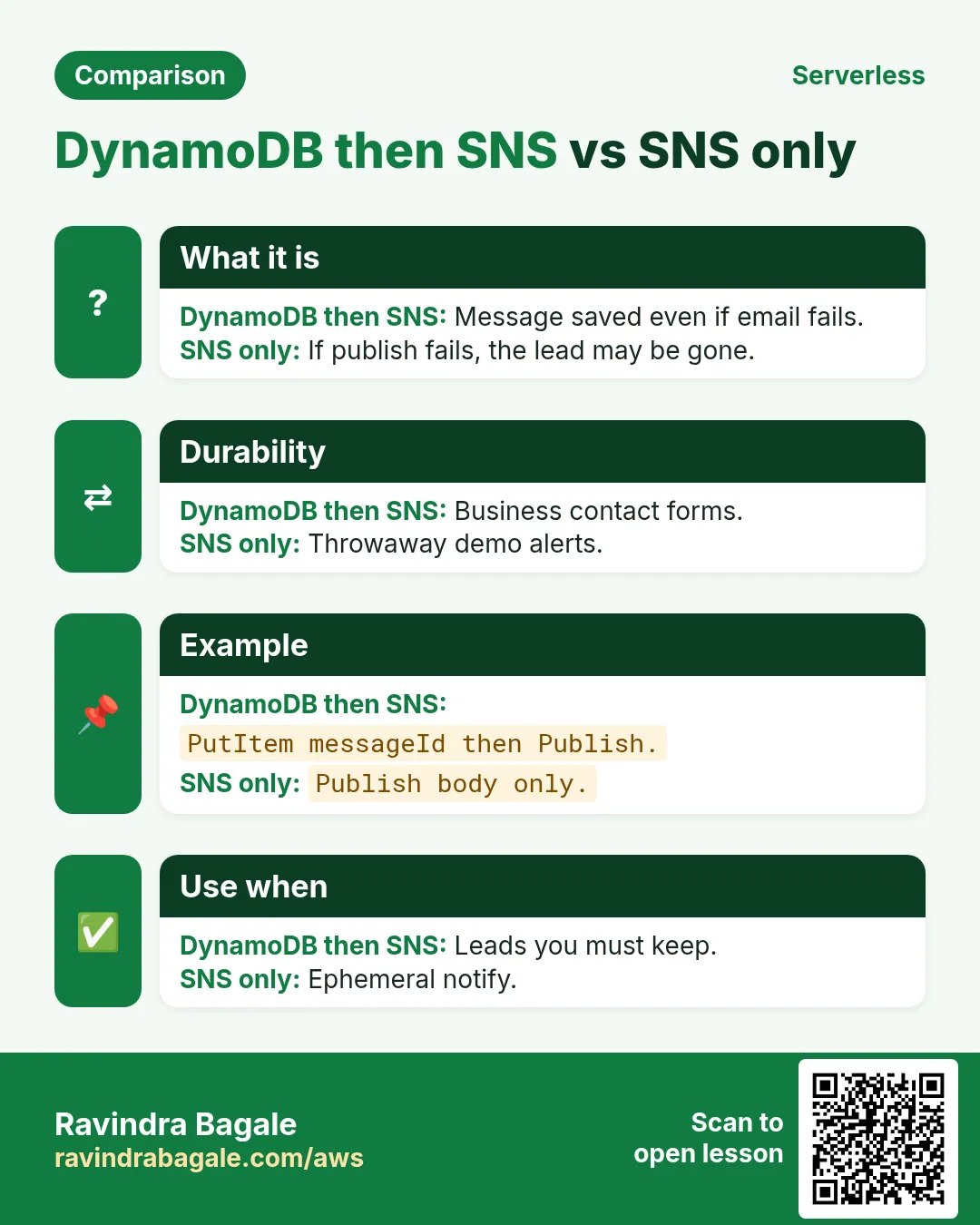
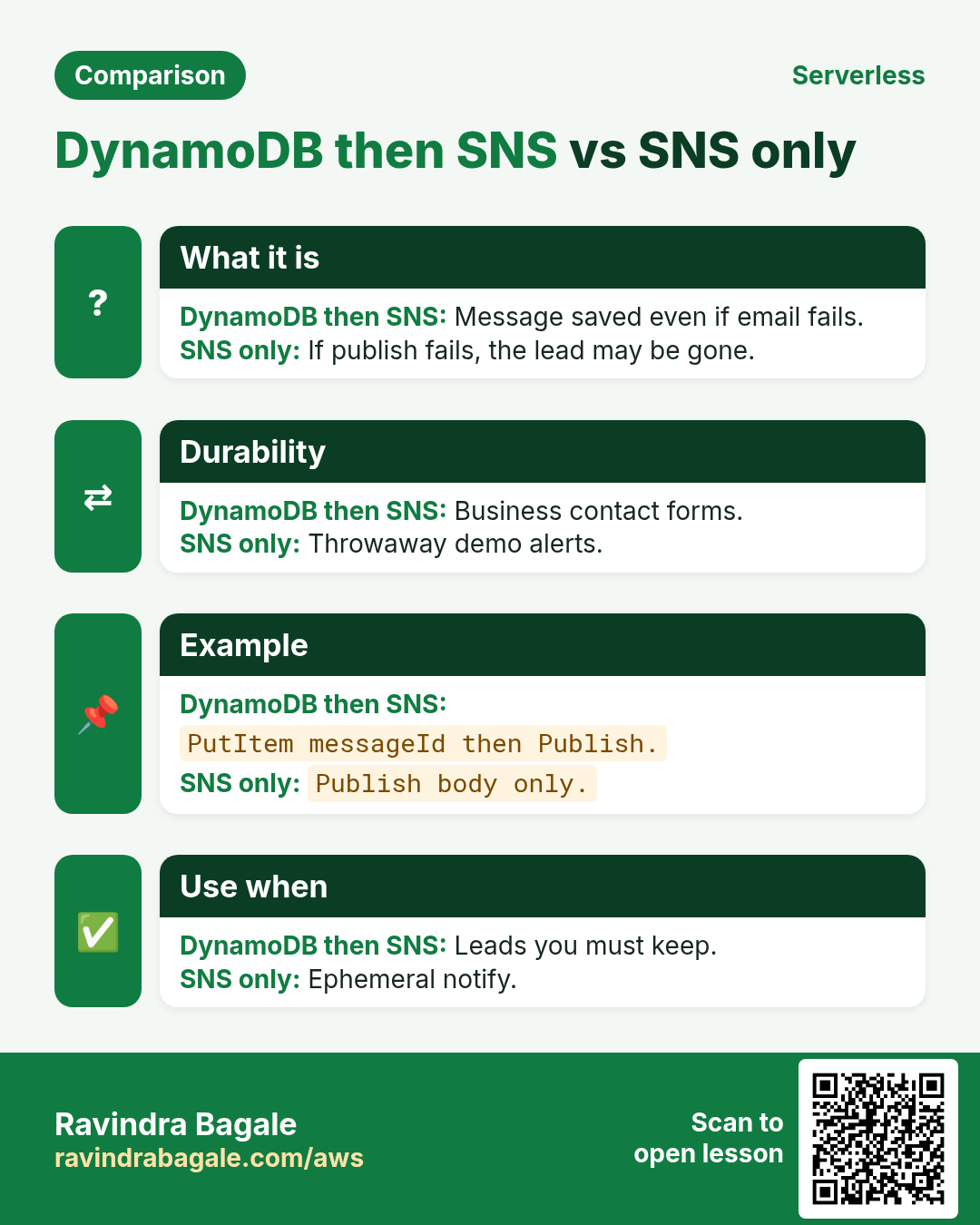
Confirm the SNS topic subscription, send one synthetic contact message, then trace messageId in DynamoDB and the matching topic notification. A stored row proves storage, not delivery. If a retry follows a failed publish, check for a duplicate row. Configure the Python handler as handler.lambda_handler.
Interview check What would prevent duplicate contacts when the caller retries?
Accept a stable idempotency key, record immutable intake once, and dispatch notifications through a durable retry path. Treat the database write and topic publish as separate operations. Avoid forwarding real personal data in this lab.
Practise this chapter
Interview questions and answers
Why should a contact form record a message ID before it tries to send an alert?
The ID ties the API response, saved record and alert together. If the record is stored and the alert fails, the team can diagnose the alert without blindly resubmitting the contact. A durable retry design can dispatch the alert without creating another contact row.
Check your understanding
Choose an answer, then compare your reasoning with the explanation.
Practice Tasks
Practice checks run in your browser. They check the answer for this exercise; they do not create resources or connect to your AWS account.
About this scenarioNashik Vineyards is a wine and farming business in Nashik. Meera Joshi looks after its IT and cloud work. They count money in INR and run their AWS resources in the ap-south-1 Region. In the tasks below you do real jobs for them using what this lesson teaches. All names, account IDs, IP addresses and numbers are made up for practice.
0 / 12
Easy List functions
See which functions exist in this Region.
List the Lambda functions in ap-south-1.
- Read the task and decide which AWS service it is about.
- Write aws, then the service name, then the operation (the action word).
- Add each needed flag (--name) followed by its value from the task.
- Flags can be in any order. Click Check answer.
Medium Invoke a function
Invoke runs the function now and saves its answer in a file.
Invoke nashikvine-orders-fn and save the response to out.json.
- Read the task and decide which AWS service it is about.
- Write aws, then the service name, then the operation (the action word).
- Add each needed flag (--name) followed by its value from the task.
- Flags can be in any order. Click Check answer.
Medium Trust policy for a Lambda role
The trust policy says WHO may take the role.
Write a trust policy that lets lambda.amazonaws.com assume the role.
- Start with { "Version": "2012-10-17", "Statement": [ ... ] }.
- In each statement write Effect, Action and Resource.
- Give only what the task needs (least privilege).
- Use double quotes and commas correctly. Click Check answer.
Medium Put an item
DynamoDB JSON shows the type of each value: S for string, N for number.
Put an item into nashikvine-orders with orderId "o-101" (string) and amount 2500 (number).
- Read the task and decide which AWS service it is about.
- Write aws, then the service name, then the operation (the action word).
- Add each needed flag (--name) followed by its value from the task.
- Flags can be in any order. Click Check answer.
Medium Change timeout and memory
More memory also gives more CPU; timeout stops runaway runs.
Set nashikvine-orders-fn to timeout 30 seconds and memory 512 MB.
- Read the task and decide which AWS service it is about.
- Write aws, then the service name, then the operation (the action word).
- Add each needed flag (--name) followed by its value from the task.
- Flags can be in any order. Click Check answer.
Medium Let a function write logs
Without these actions, Lambda logs never appear in CloudWatch.
Allow logs:CreateLogGroup, logs:CreateLogStream, logs:PutLogEvents on arn:aws:logs:*:*:* only.
- Start with { "Version": "2012-10-17", "Statement": [ ... ] }.
- In each statement write Effect, Action and Resource.
- Give only what the task needs (least privilege).
- Use double quotes and commas correctly. Click Check answer.
Hard Let S3 call your function
A resource-based permission is needed before S3 can invoke the function.
Add permission statement s3invoke to nashikvine-orders-fn so s3.amazonaws.com can call lambda:InvokeFunction from bucket arn:aws:s3:::nashikvine-uploads.
- Read the task and decide which AWS service it is about.
- Write aws, then the service name, then the operation (the action word).
- Add each needed flag (--name) followed by its value from the task.
- Flags can be in any order. Click Check answer.
Hard Create a Lambda function
Lambda needs the code zip, a runtime, a handler name and an execution role.
Create function nashikvine-orders-fn: runtime python3.12, handler app.handler, role arn:aws:iam::107079156755:role/lambda-basic, code in function.zip.
- Read the task and decide which AWS service it is about.
- Write aws, then the service name, then the operation (the action word).
- Add each needed flag (--name) followed by its value from the task.
- Flags can be in any order. Click Check answer.
Hard Set environment variables
Keep settings like table names out of the code.
Set the environment variable TABLE=nashikvine-orders on nashikvine-orders-fn.
- Read the task and decide which AWS service it is about.
- Write aws, then the service name, then the operation (the action word).
- Add each needed flag (--name) followed by its value from the task.
- Flags can be in any order. Click Check answer.
Hard Invoke with a JSON payload
In CLI v2, raw JSON needs --cli-binary-format raw-in-base64-out.
Invoke nashikvine-orders-fn with payload {"orderId":"o-101"} (raw JSON) and save the reply in out.json.
- Read the task and decide which AWS service it is about.
- Write aws, then the service name, then the operation (the action word).
- Add each needed flag (--name) followed by its value from the task.
- Flags can be in any order. Click Check answer.
Hard Lambda GB-seconds
Lambda bills memory × time.
1,000,000 invocations, 512 MB memory, 200 ms each. How many GB-seconds?
- Write down the numbers the task gives you.
- Work it out step by step on paper.
- Type only the final answer in the box.
- Click Check answer.
Hard Connect an SQS queue to Lambda
An event source mapping makes Lambda poll the queue and process messages in batches.
Create an event source mapping from queue arn:aws:sqs:ap-south-1:107079156755:nashikvine-orders to nashikvine-orders-fn with batch size 10.
- Read the task and decide which AWS service it is about.
- Write aws, then the service name, then the operation (the action word).
- Add each needed flag (--name) followed by its value from the task.
- Flags can be in any order. Click Check answer.
Revision, comparison and interview cards
Revise this lesson in a few minutes. Save the cards on your phone or download them as PNG files. The QR code on each card opens this lesson.
More cards: Ravi Sir's Cards.