AWS Well-Architected Framework: Six Pillars Explained for Beginners
Architecture arguments get emotional: someone wants more servers, someone wants less cost. The AWS Well-Architected Framework gives six pillars and questions so teams review calmly — like a health checkup for the cloud, not a blame meeting.
In this chapter
- Why structured reviews beat gut feel
- Six pillars in plain words
- How to run a lightweight WAR
- Trade-offs for Indian startups
- Lab checklist, errors, FAQ, interview
1. Everyday example first
A 12-person SaaS in Bengaluru runs one big EC2, no backups, root keys on laptops. A Well-Architected review surfaces Reliability and Security gaps before the first big customer audit. They leave with a 30-day fix list, not a rewrite fantasy.
2. Why Well-Architected?
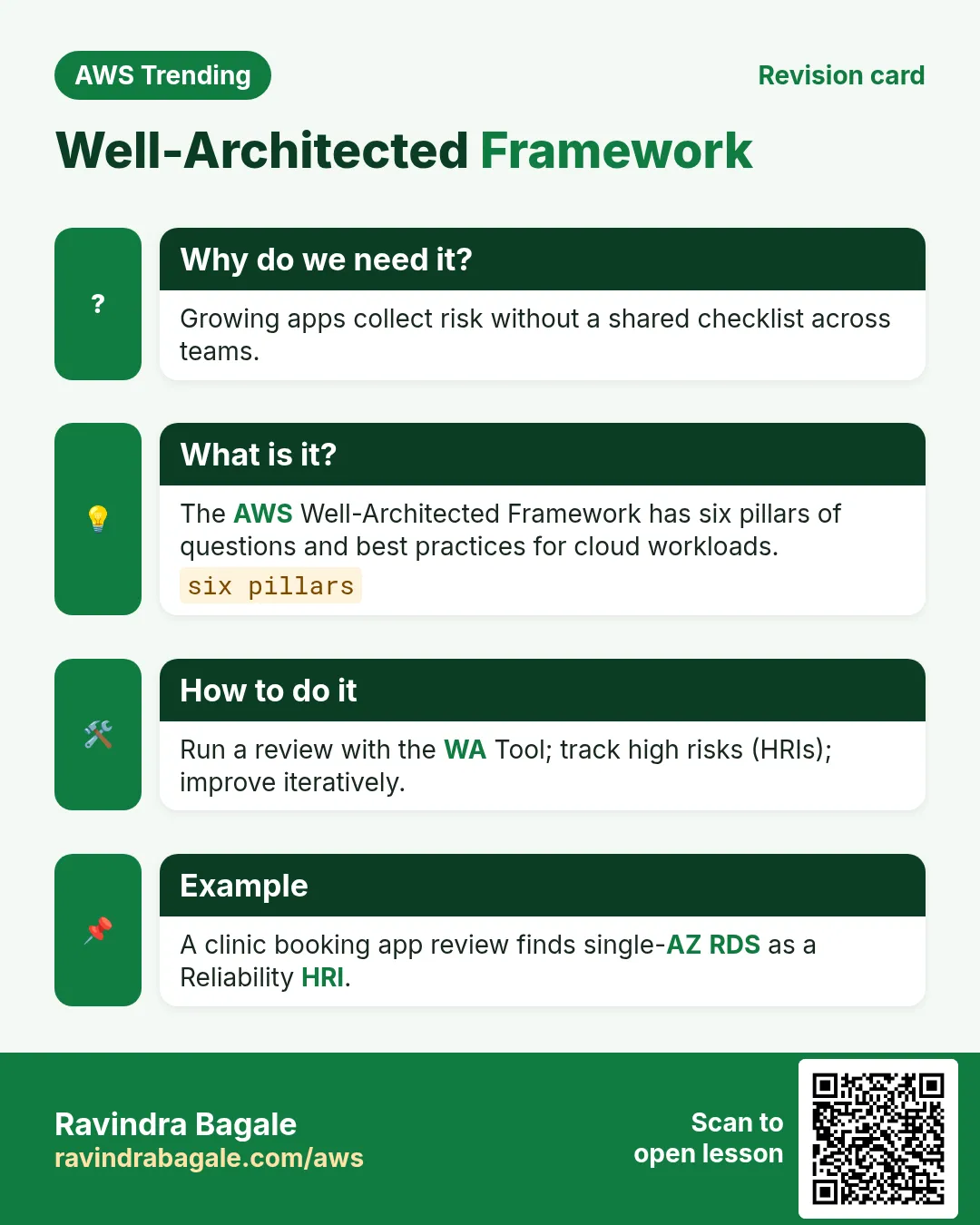
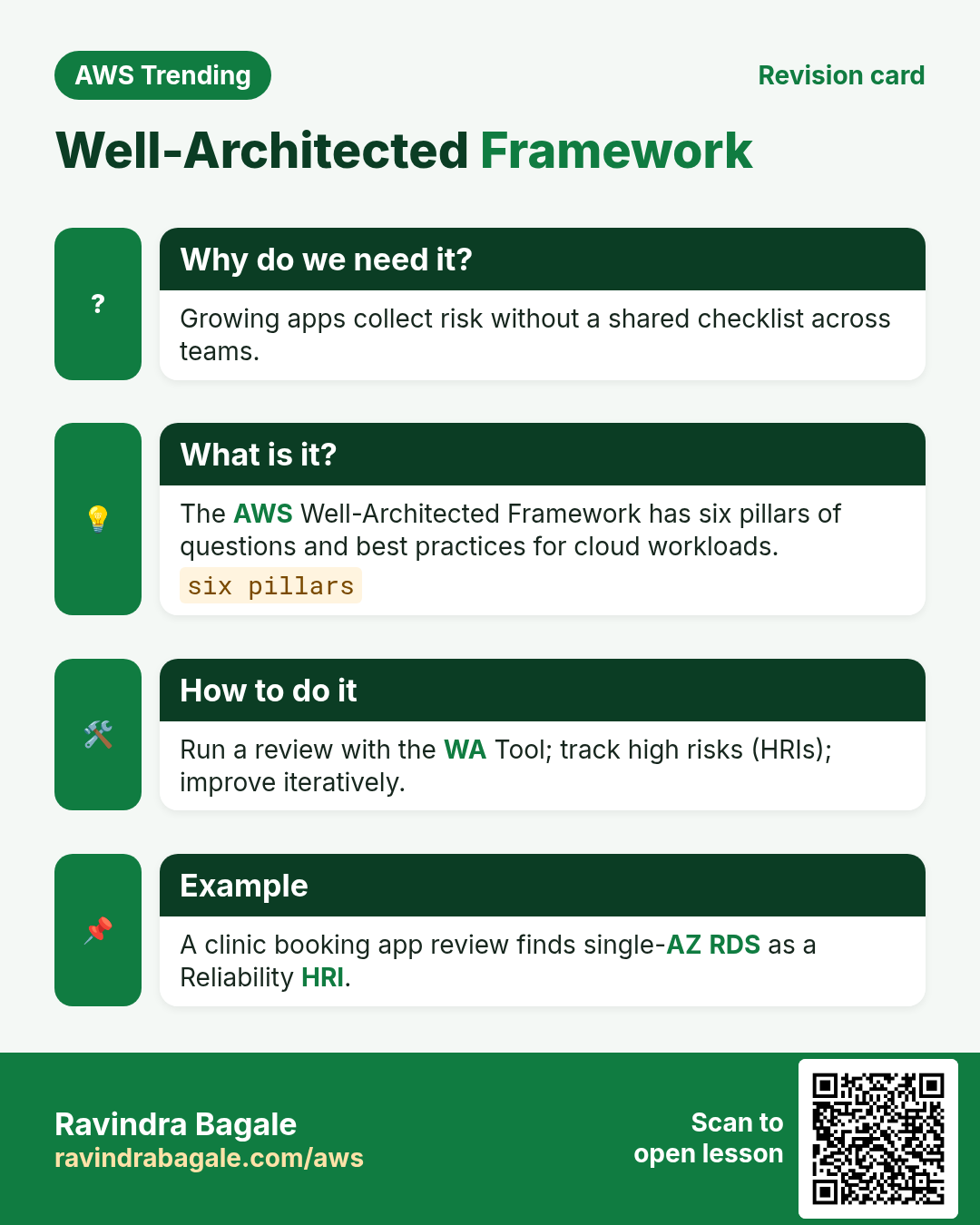
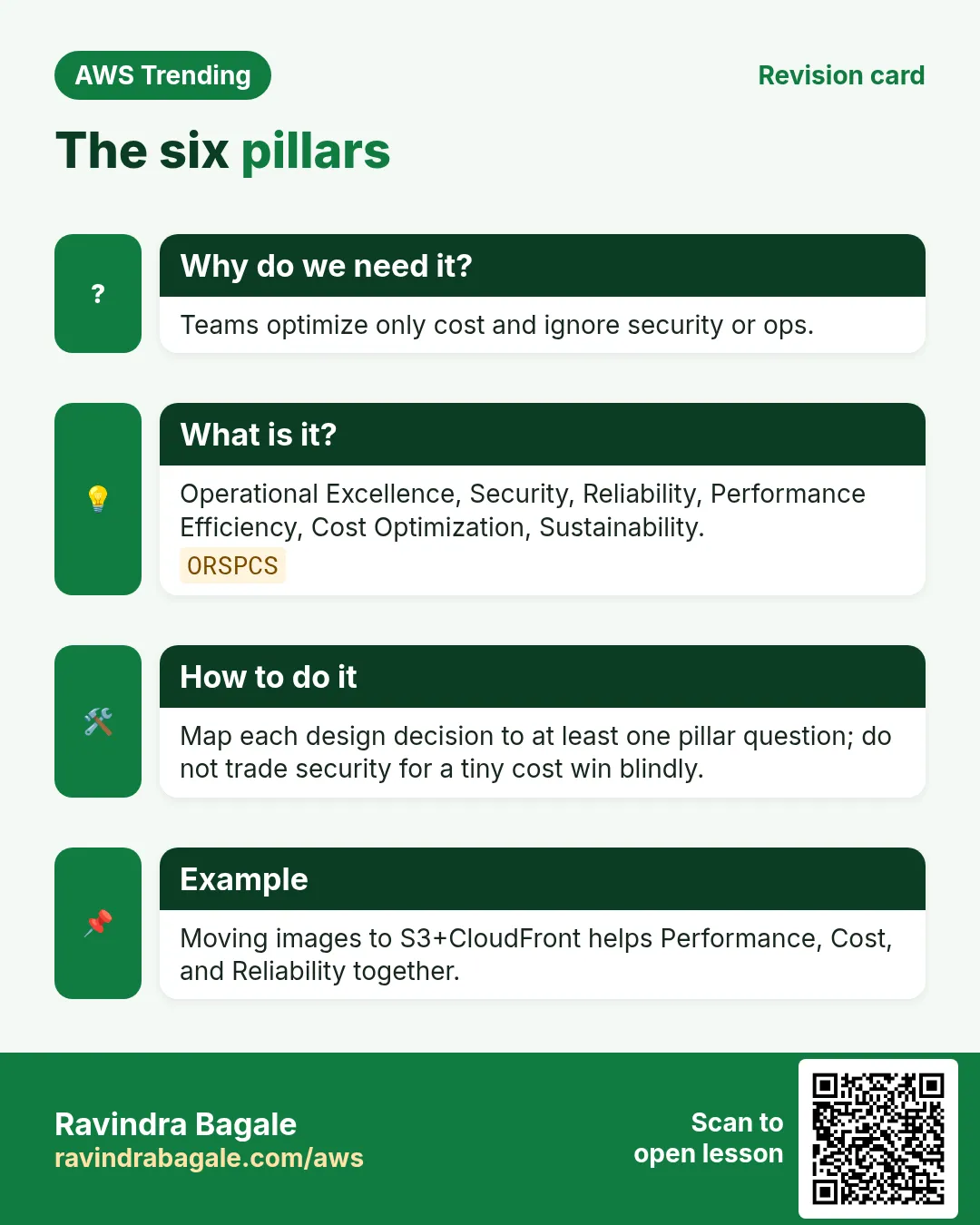
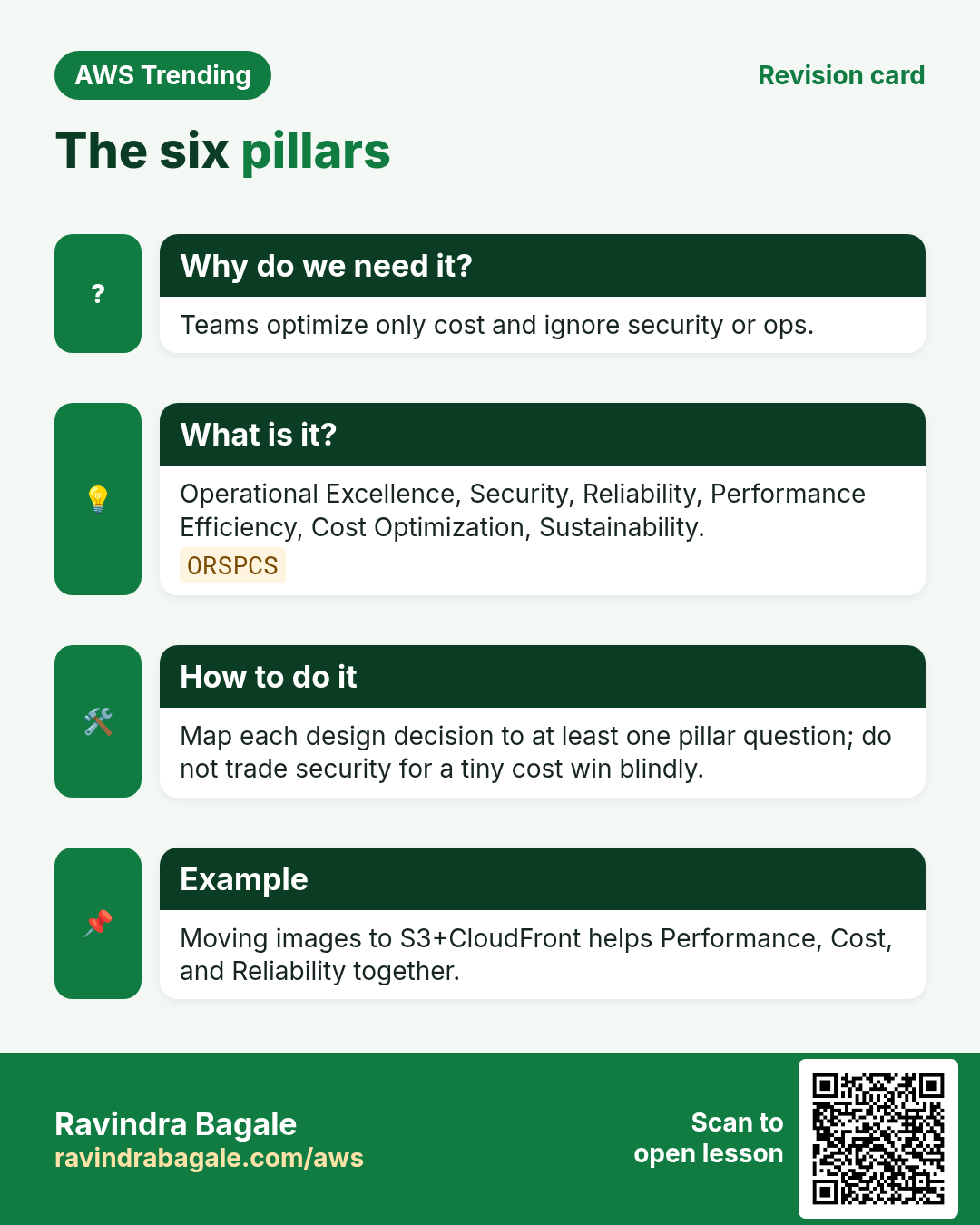
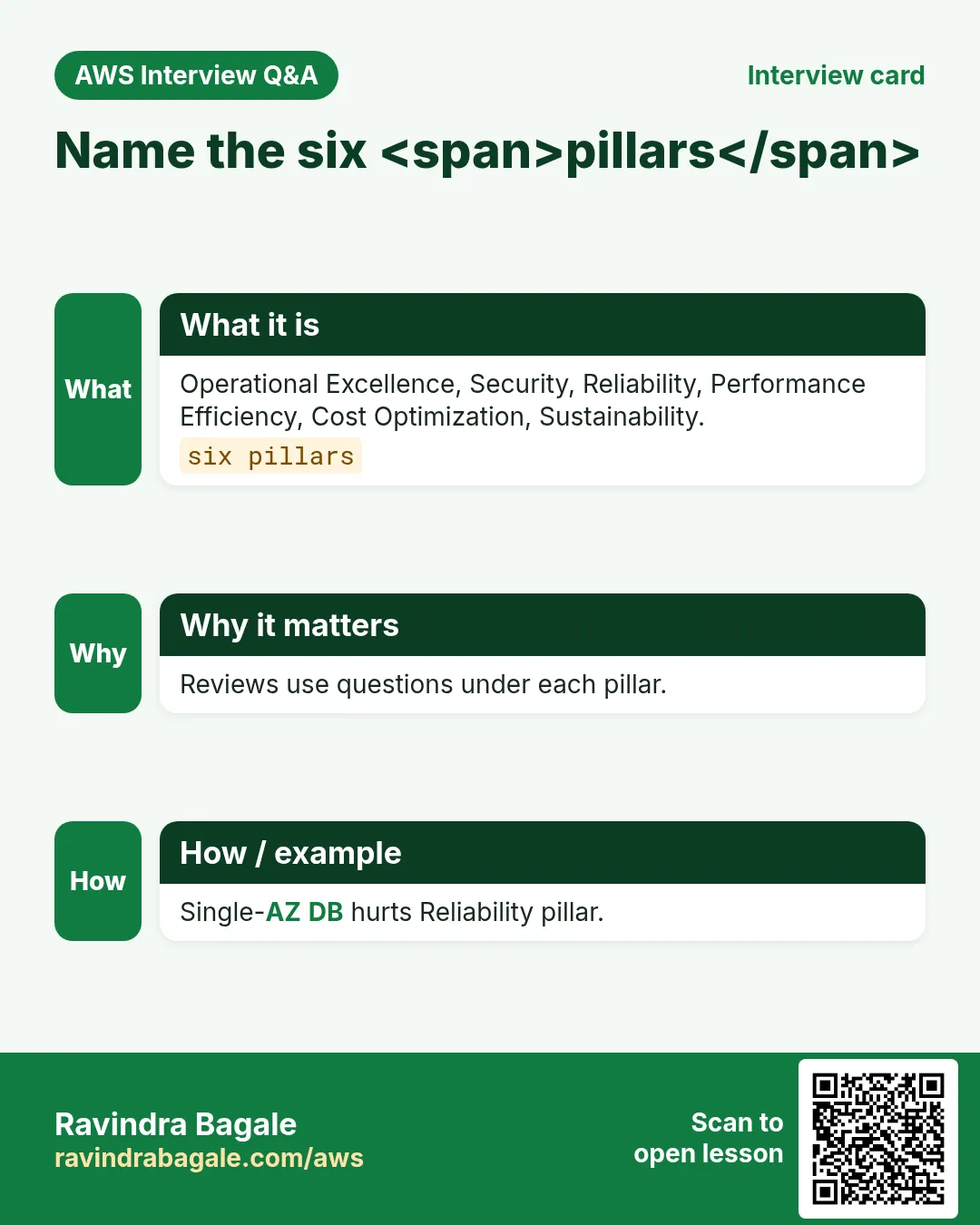
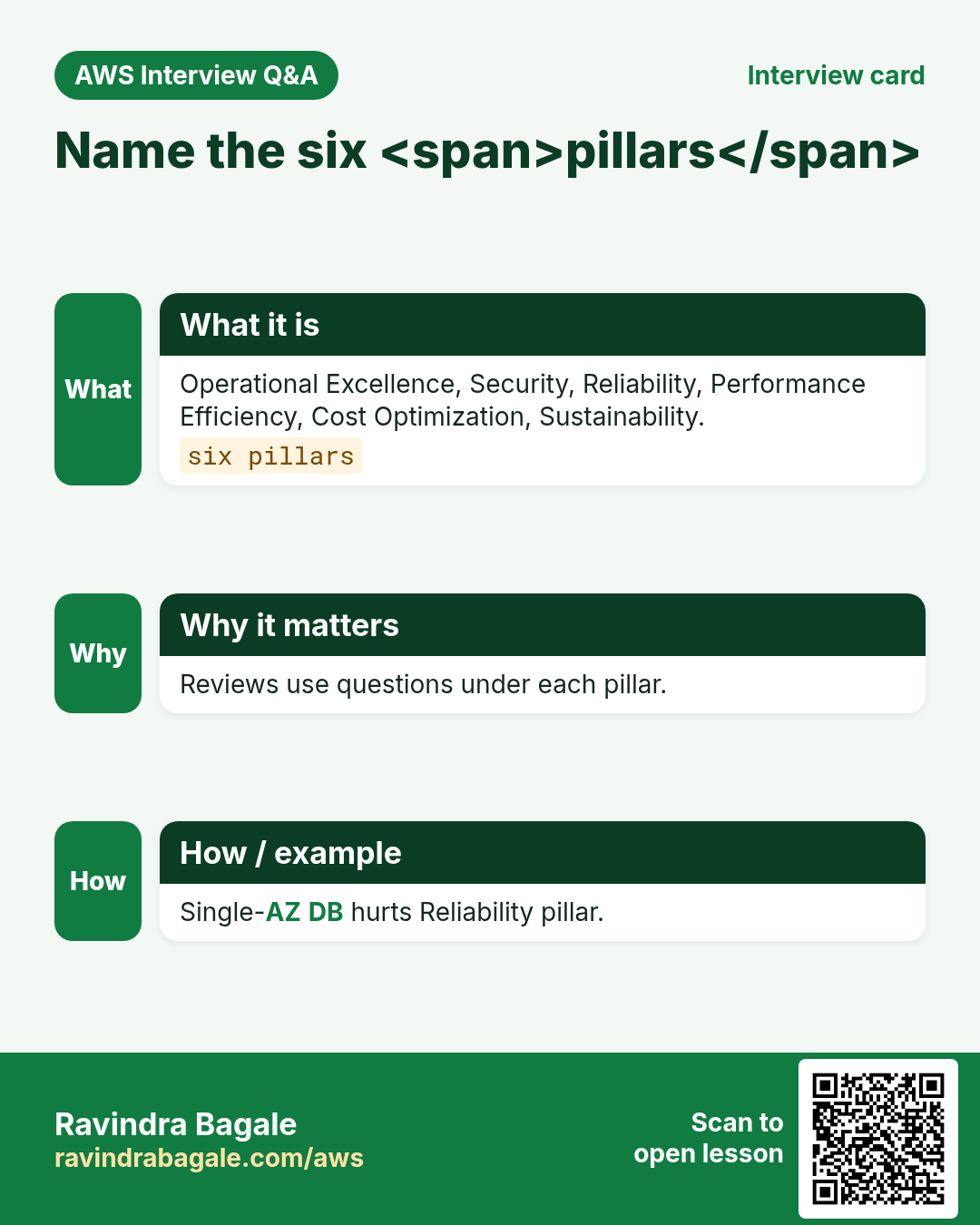
Without a shared checklist, every review is opinion. The framework standardizes questions across Operational Excellence, Security, Reliability, Performance Efficiency, Cost Optimization, and Sustainability.
3. What are the six pillars?
Pick one project, such as a college event registration site. People expect it to stay available on opening day and want their details kept private. Turn the six pillars into questions about this design. Who deploys it and checks errors? Who reads the form data? How do you recover a lost registration? What changes under peak load? Which resources cost money when idle? Which resources can be removed without affecting the site? Write one observation for each before choosing a risk to work on.
| Pillar | Plain question |
|---|---|
| Operational Excellence | Can we run and improve this safely? |
| Security | Who can do what, and is data protected? |
| Reliability | How do we fail and recover? |
| Performance Efficiency | Are we using the right resources? |
| Cost Optimization | Are we only paying for value? |
| Sustainability | Can we reduce waste and energy? |
4. How to run a lightweight WAR
A review entry should let another person verify the concern. Instead of writing “backups needed,” describe the project’s data, the last restore evidence and what would happen if the storage went away. Give the improvement a next action, owner and expected proof. A good task might say that a classmate restores one sample registration to an isolated environment and measures time to the first successful read. At the next review, compare the proof with the risk that was originally recorded.
- Pick one workload (not the whole company).
- Bring builder + security + cost owner (even if same person wears three hats).
- Answer pillar questions honestly; mark High/Med risks.
- Create a 30/60/90 day improvement backlog.
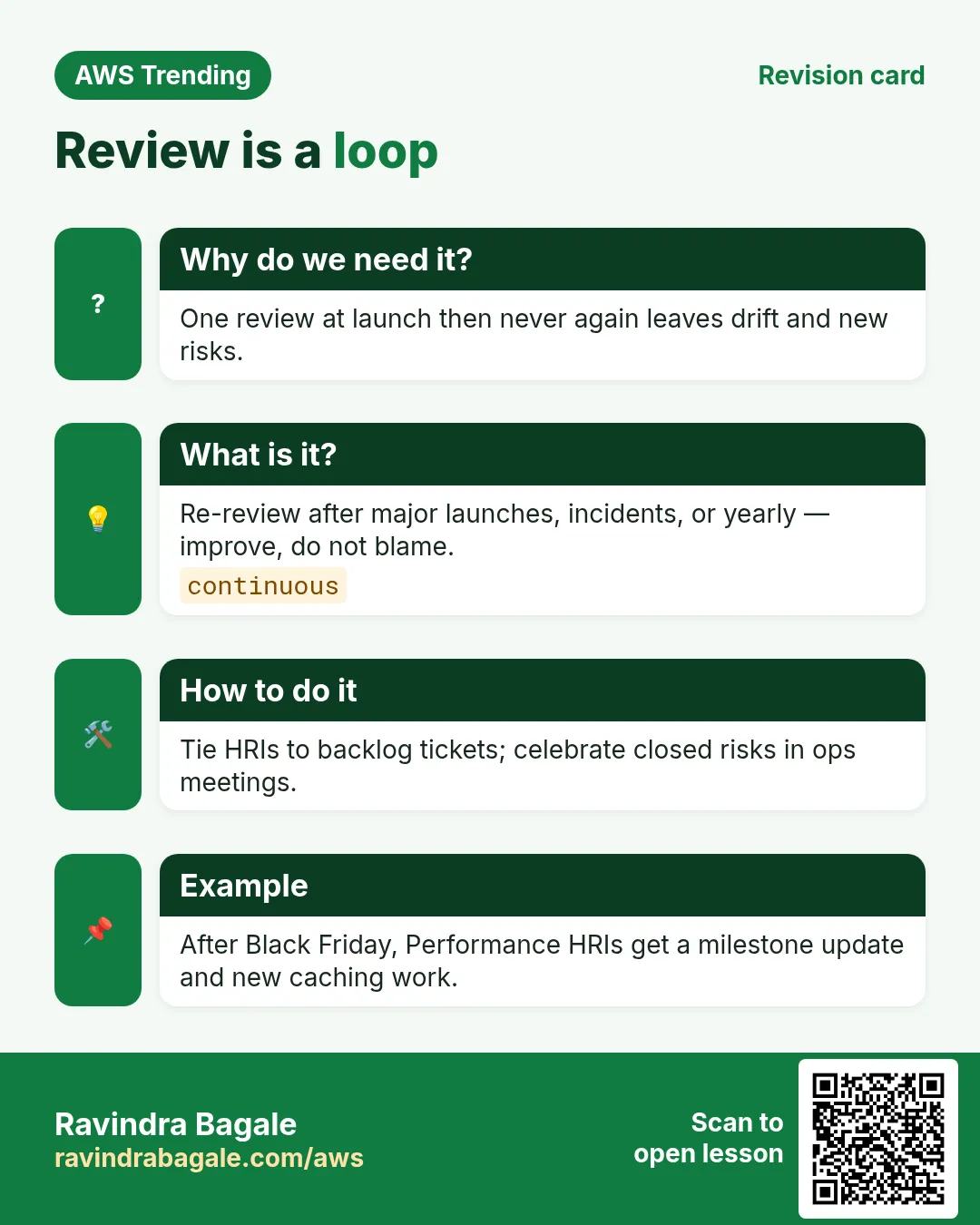
- Revisit after big launches.
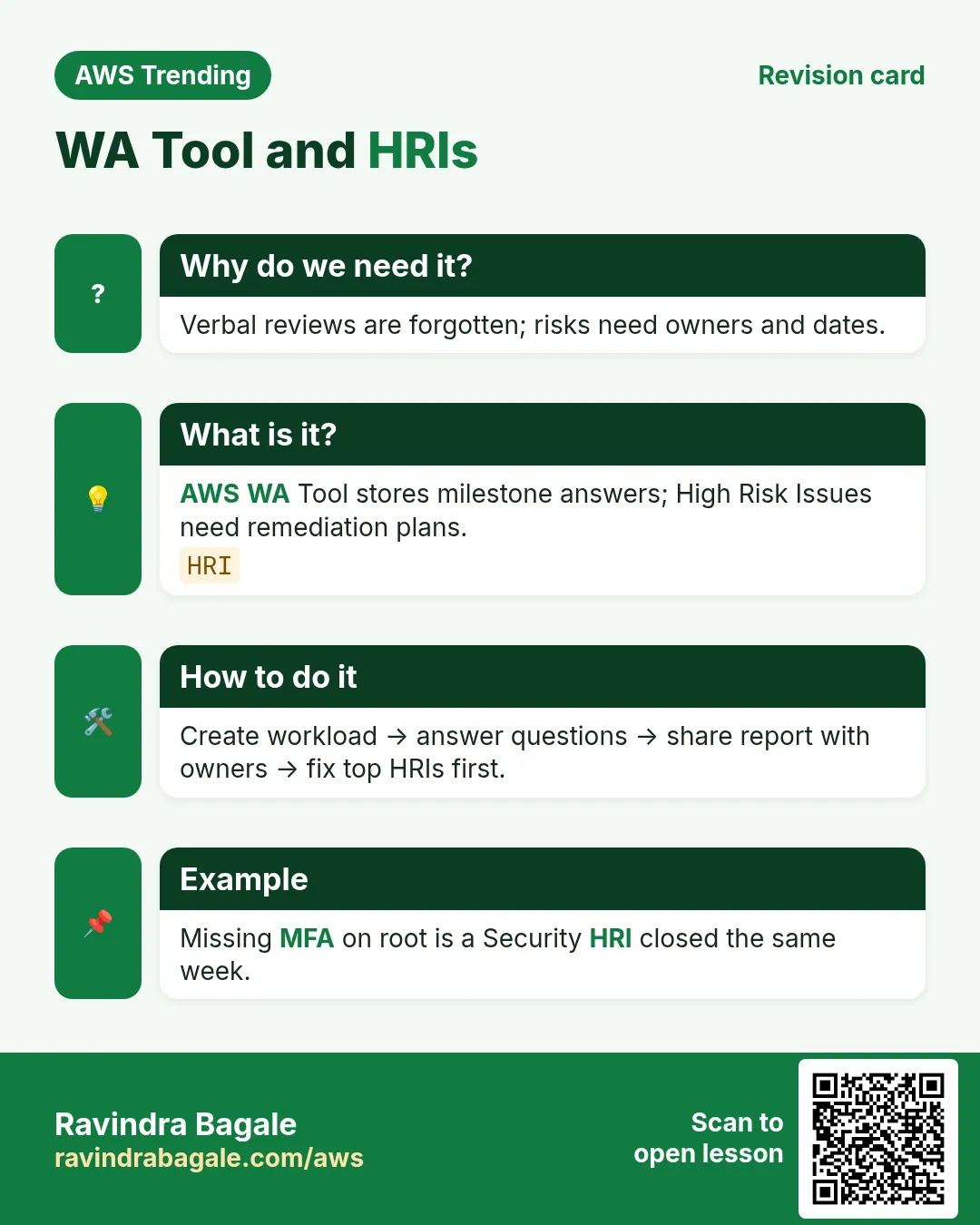
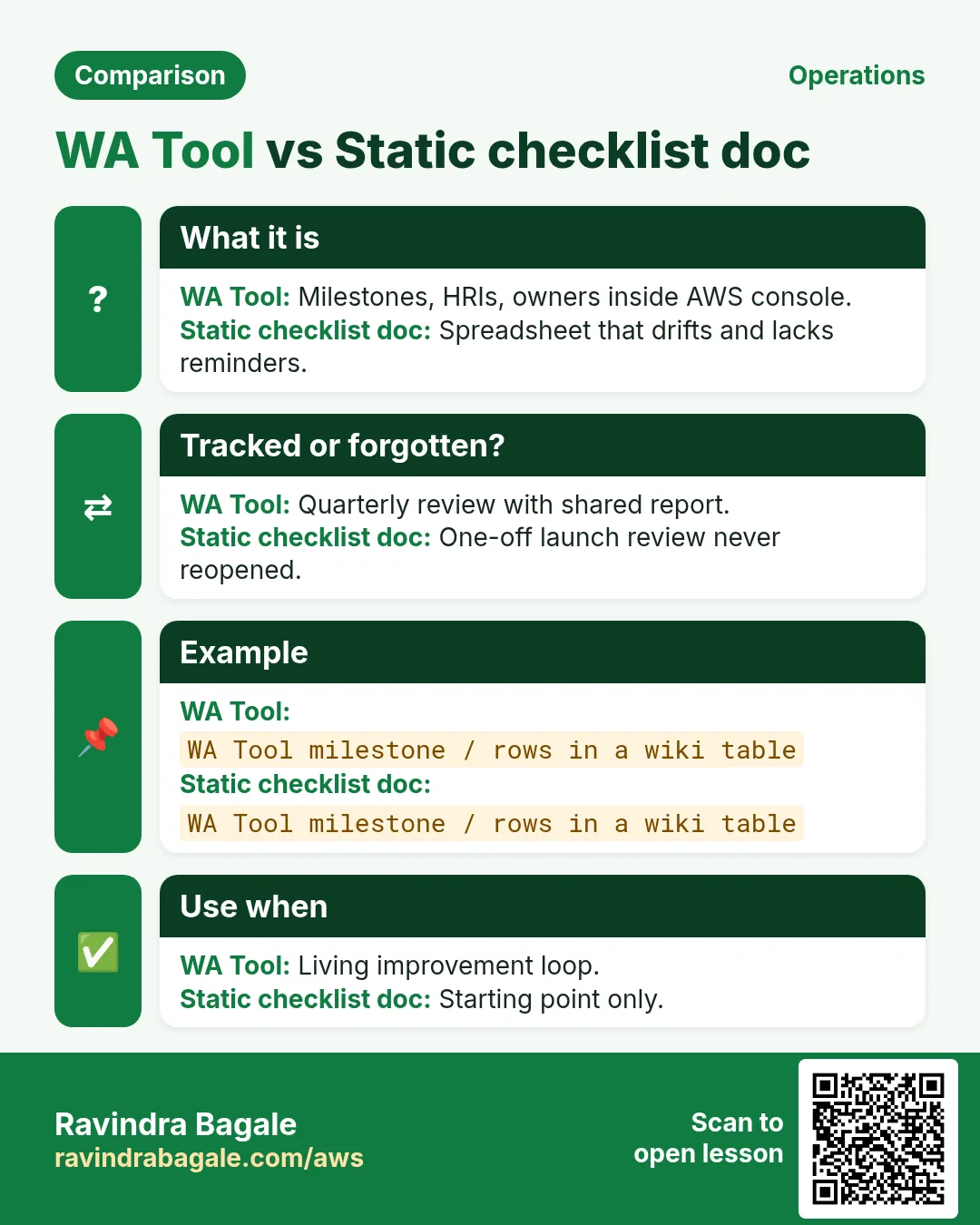
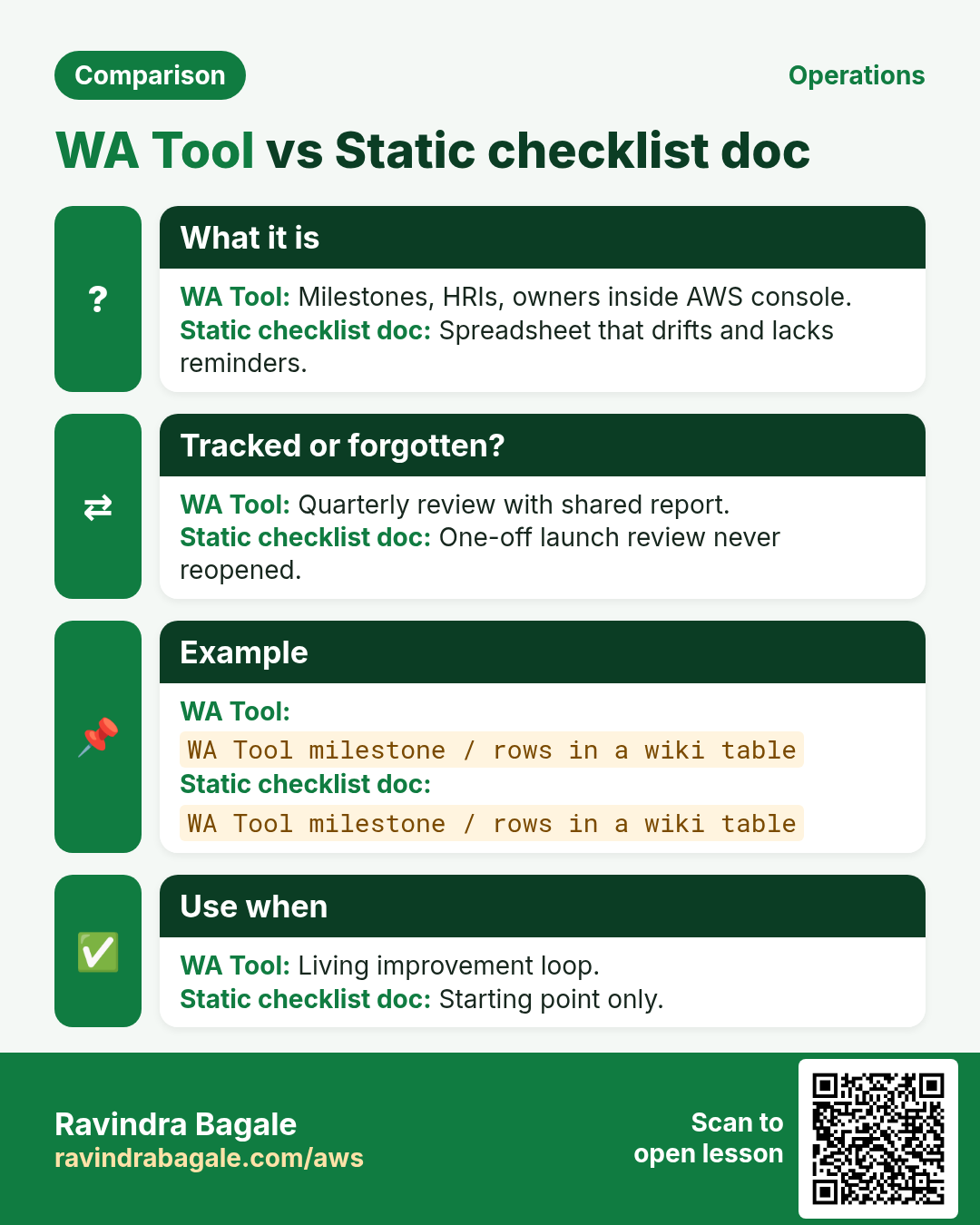
- Optional: AWS Well-Architected Tool in console to track.
# Sample risk card
# Pillar: Reliability
# Question: How do you back up data?
# Risk: High — single EC2 disk, no tested restore
# Fix (30d): automated EBS snapshots + restore drill
5. Industries
- BFSI: Security + Reliability heavy before audits
- Healthcare: Security + OE runbooks
- E-commerce: Performance + Cost around festivals
- Public sector: documentation for every exception
6. Lab: mini review on a personal project
Choose a small project and write a paragraph describing its users and the outcome that matters. Pick two pillars, record one fact and one unanswered question per pillar, and plan one low-risk improvement. The exercise succeeds when another student can point to the affected workload, read the evidence and tell how they will check the improvement.
Do this in ap-south-1 (Mumbai) unless your org forbids it. Set a budget alert first.
- Name the workload in one sentence.
- Score each pillar 1–5 gut feel.
- Write three High risks with owners.
- Pick one 48-hour fix (e.g., enable MFA, snapshot).
- Schedule a 30-day revisit note in calendar.
Cleanup (stop billing)
- No AWS cleanup if paper-only.
- If you opened WA Tool, delete the sample workload.
7. Common errors and fixes
Each row is a real mistake students and juniors hit. Read the fix before you panic.
| Error / symptom | Fix |
|---|---|
| Boiling the ocean — review all apps at once | One workload per session. |
| Only security team attends | Include builders who operate it. |
| Risks with no owners | Every High risk needs a name. |
| Ignoring Cost pillar | Cost is a pillar — not optional. |
| Paper review never becomes tickets | Export to backlog same day. |
| Copying AWS sample answers blindly | Answer for YOUR architecture. |
| No evidence (diagrams, runbooks) | Attach links in WA Tool notes. |
| Treating WAR as audit blame | Blameless; focus on risks. |
| Never revisiting after launch | Re-review on major change. |
| Skipping Sustainability entirely | At least measure idle waste. |
8. Troubleshooting checklist
- Team defensive → start with wins, then risks.
- No diagrams → draw C4 container view first.
- Too many High risks → timebox top five.
- Tool access → IAM wa: permissions.
- Unclear workload boundary → define users and data stores.
- Action items stale → weekly 15-min triage.
9. FAQ
Q. Is WAR mandatory?
Not always, but buyers and partners often ask.
Q. Does AWS charge for the Tool?
The Tool itself is free; resources are not.
Q. Six or five pillars?
Six — Sustainability added; learn current set.
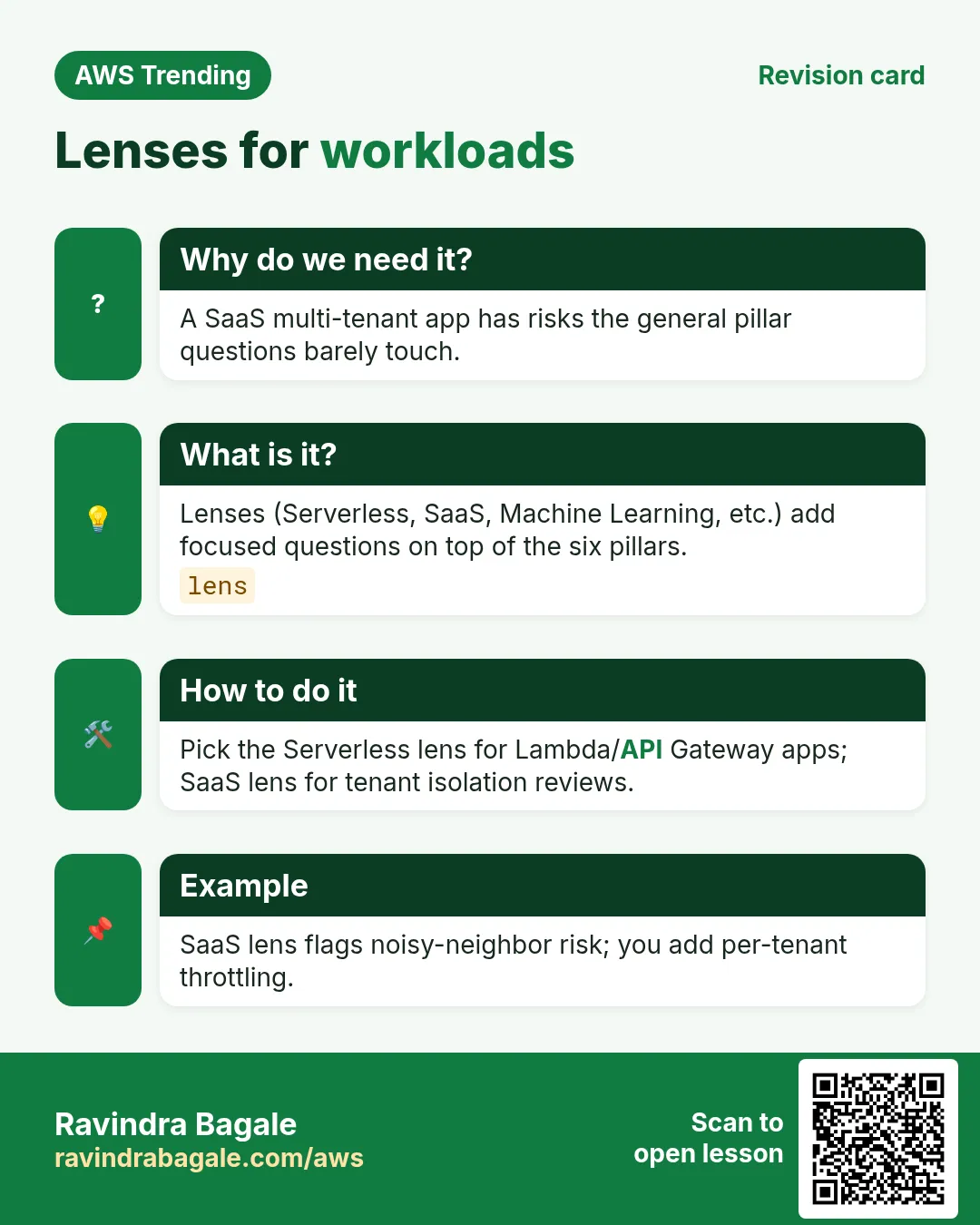
Q. Lenses?
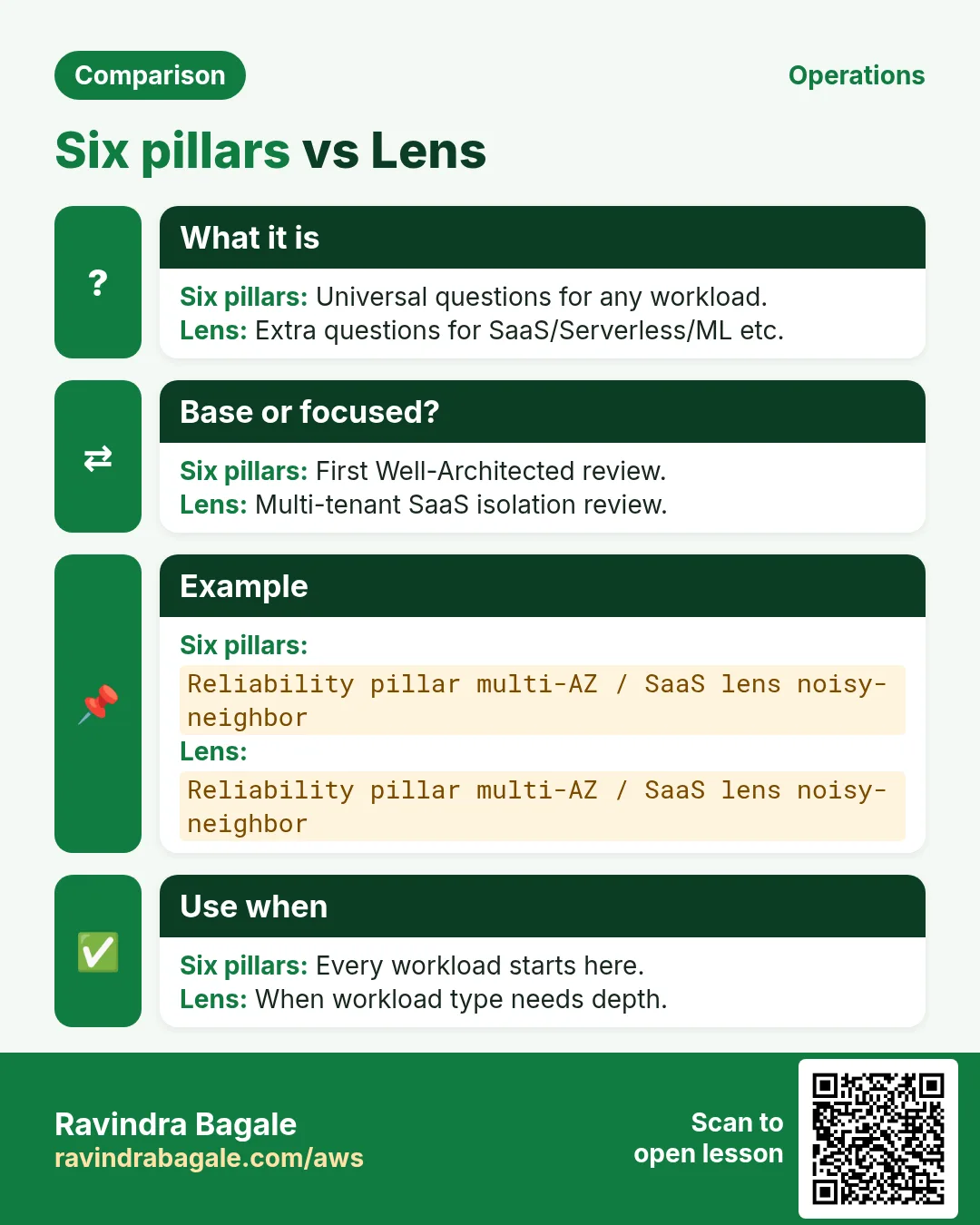
Industry/tech overlays with extra questions.
Q. Replace ISO audits?
No — complementary.
10. Interview Q&A
Q. Name the six pillars.
OE, Security, Reliability, Performance Efficiency, Cost Optimization, Sustainability.
Q. What is a workload?
A set of components that deliver business value.
Q. High risk example?
Single AZ prod DB without tested backup.
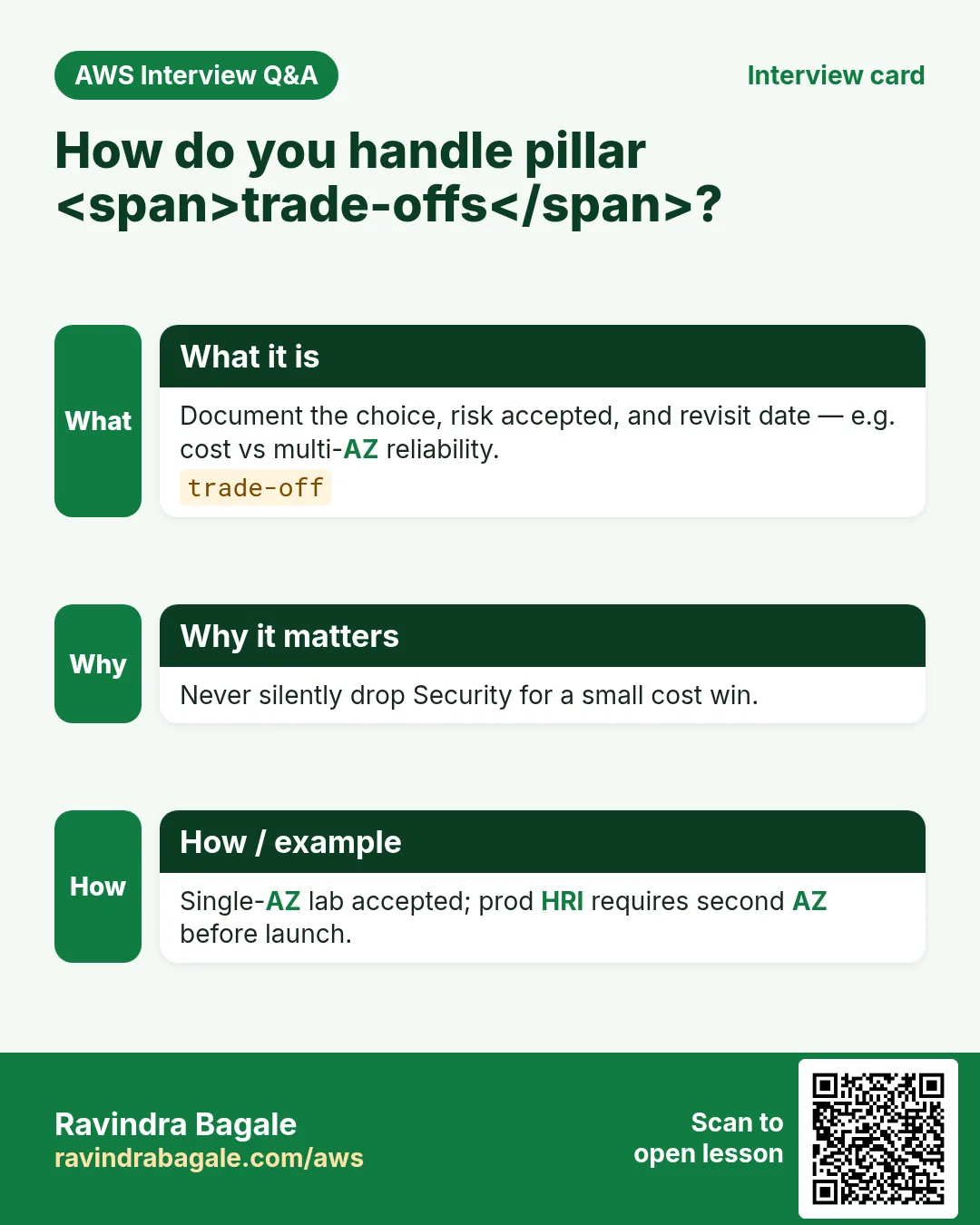
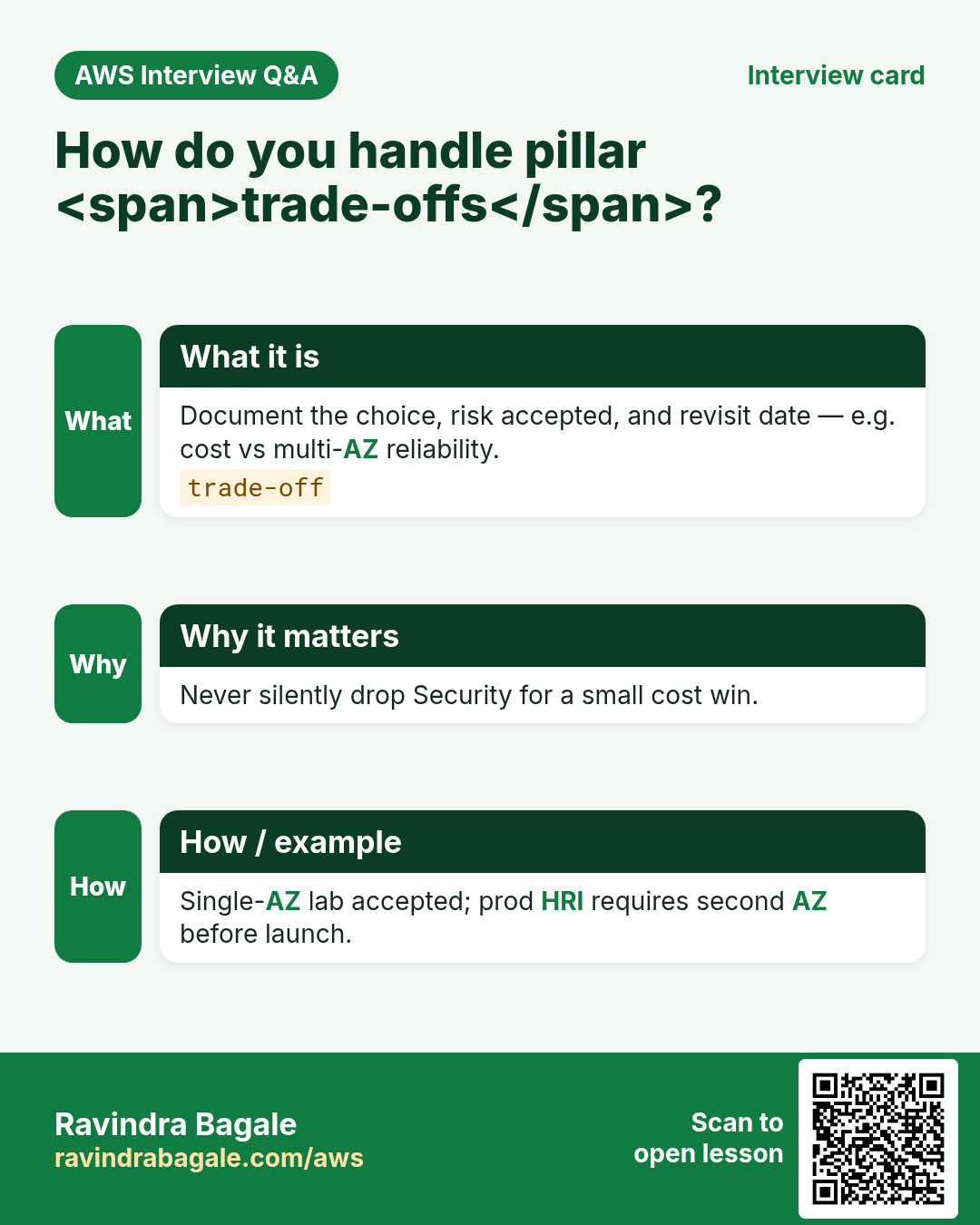
Q. How do you trade cost vs reliability?
Document RTO/RPO and buy only what meets them.
Q. What is the WA Tool?
Console tool to record answers and risks.
Q. First 30 days after WAR?
Fix High security/reliability items with owners.
11. Tips in English, Marathi and Hindi
Ravindra Bagale's Tip (EN)
A review that creates no tickets is a book club. End with owners and dates.
Ravindra Bagale's Tip (MR)
Tickets नसलेली review = book club. Owners + dates.
Tip (HI)
बिना टिकट की review किताब क्लब है — owners और dates के साथ खत्म करो।
Try at home
- Print six pillar names and stick near monitor.
- Do a 20-minute review on a college project.
- Write one Sustainability win (turn off idle labs).
In short
- Well-Architected = six pillars + questions.
- Review one workload; rank risks; assign owners.
- Use 30/60/90 plans, not rewrite fantasies.
- Revisit after major launches.
Revision, interview and comparison cards
Revise this lesson in a few minutes. Save the cards on your phone or download them as PNG files. The QR code on each card opens this lesson.
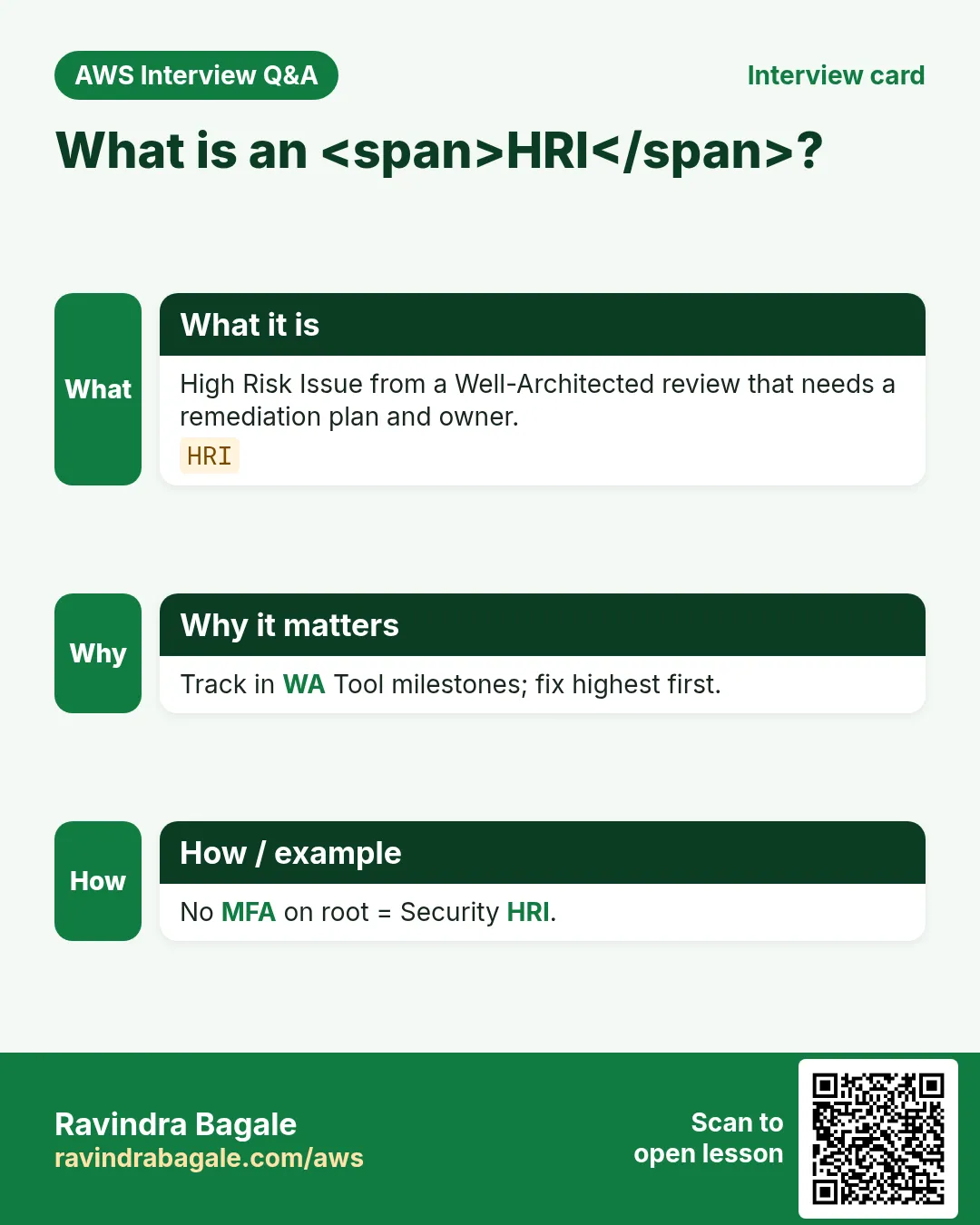
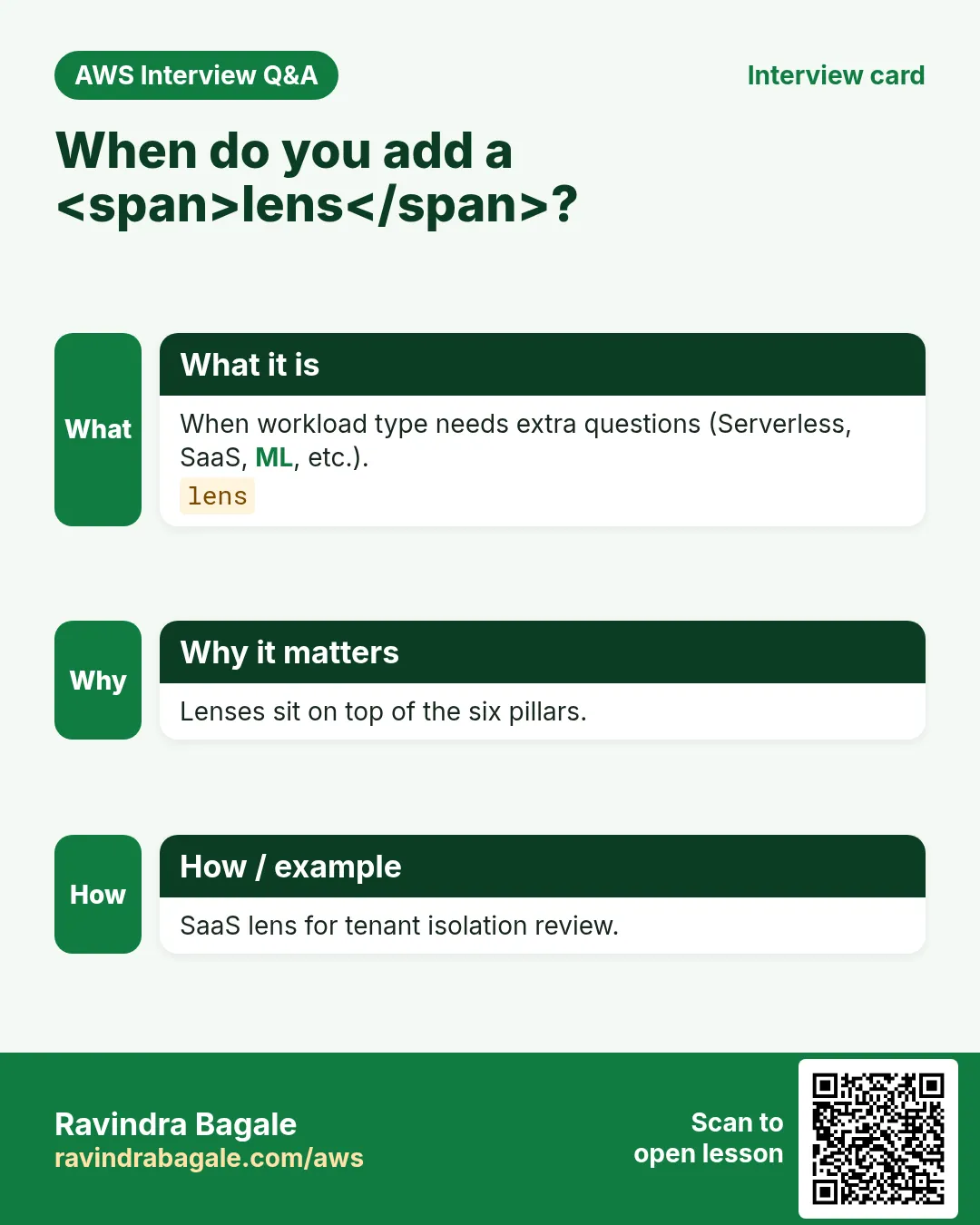
More cards: Ravi Sir's Cards.
Practise this chapter
Interview questions and answers
How do you turn a Well-Architected finding into useful work?
Choose the workload and explain the user impact. Record current evidence, an improvement, an owner and a check that proves the risk was reduced. For example, replace “backups needed” with a documented restore test that measures the first successful read of a sample record.
Check your understanding
Choose an answer, then compare your reasoning with the explanation.
Practice Tasks
Practice checks run in your browser. They check the answer for this exercise; they do not create resources or connect to your AWS account.
About this scenarioAhmednagar Sugar Co-op is a sugar co-operative business in Ahilyanagar. Balasaheb Pawar looks after its IT and cloud work. They count money in INR and run their AWS resources in the ap-south-1 Region. In the tasks below you do real jobs for them using what this lesson teaches. All names, account IDs, IP addresses and numbers are made up for practice.
0 / 16
Easy List stack tags via CFN
Evidence for reviews.
Describe stack nagarsugar-app.
- Read the task and decide which AWS service it is about.
- Write aws, then the service name, then the operation (the action word).
- Add each needed flag (--name) followed by its value from the task.
- Flags can be in any order. Click Check answer.
Easy Describe trail
Security evidence.
Describe trail lab-trail.
- Read the task and decide which AWS service it is about.
- Write aws, then the service name, then the operation (the action word).
- Add each needed flag (--name) followed by its value from the task.
- Flags can be in any order. Click Check answer.
Easy List alarms
Ops excellence.
Describe CloudWatch alarms.
- Read the task and decide which AWS service it is about.
- Write aws, then the service name, then the operation (the action word).
- Add each needed flag (--name) followed by its value from the task.
- Flags can be in any order. Click Check answer.
Easy List MFA devices for user
Security basics.
List MFA devices for user nagarsugar-admin.
- Read the task and decide which AWS service it is about.
- Write aws, then the service name, then the operation (the action word).
- Add each needed flag (--name) followed by its value from the task.
- Flags can be in any order. Click Check answer.
Easy Pillar count
Six pillars.
How many Well-Architected pillars?
- Write down the numbers the task gives you.
- Work it out step by step on paper.
- Type only the final answer in the box.
- Click Check answer.
Easy Apply the lesson: scenario 6
A review assesses one application and its supporting resources together. In Well-Architected terminology, what is this unit of review?
- Read the situation and identify what you need to decide.
- Work through the relevant concept or calculation.
- Enter only the requested term or number.
- Check your answer, then read the explanation.
Easy Apply the lesson: scenario 7
A major architecture change has shipped. Should you revisit the Well-Architected review or assume the earlier findings remain sufficient? Answer revisit or assume.
- Read the situation and identify what you need to decide.
- Work through the relevant concept or calculation.
- Enter only the requested term or number.
- Check your answer, then read the explanation.
Medium Describe budget
Cost pillar.
Describe budget monthly-lab in account.
- Read the task and decide which AWS service it is about.
- Write aws, then the service name, then the operation (the action word).
- Add each needed flag (--name) followed by its value from the task.
- Flags can be in any order. Click Check answer.
Medium List backup vaults
Reliability backups.
List backup vaults.
- Read the task and decide which AWS service it is about.
- Write aws, then the service name, then the operation (the action word).
- Add each needed flag (--name) followed by its value from the task.
- Flags can be in any order. Click Check answer.
Medium Describe config recorders
OE / compliance.
Describe configuration recorders.
- Read the task and decide which AWS service it is about.
- Write aws, then the service name, then the operation (the action word).
- Add each needed flag (--name) followed by its value from the task.
- Flags can be in any order. Click Check answer.
Medium Read-only CFN
Reviewers need read.
Allow cloudformation:DescribeStacks Resource *.
- Start with { "Version": "2012-10-17", "Statement": [ ... ] }.
- In each statement write Effect, Action and Resource.
- Give only what the task needs (least privilege).
- Use double quotes and commas correctly. Click Check answer.
Medium Risk card JSON
WAR output.
JSON Pillar Reliability Severity High.
- Start from the top-level keys the task names.
- Indent child keys with 2 spaces (no tabs).
- Fill in each property with the value from the task.
- Click Check answer. Key order does not matter.
Medium Sample RTO hours classroom
Reliability metric.
Sample classroom RTO target in hours (enter 4)?
- Write down the numbers the task gives you.
- Work it out step by step on paper.
- Type only the final answer in the box.
- Click Check answer.
Hard Describe instances
Performance / reliability inventory.
Describe instances with tag Project=nagarsugar.
- Read the task and decide which AWS service it is about.
- Write aws, then the service name, then the operation (the action word).
- Add each needed flag (--name) followed by its value from the task.
- Flags can be in any order. Click Check answer.
Hard Deny leave org
Org safety.
Deny organizations:LeaveOrganization on *.
- Start with { "Version": "2012-10-17", "Statement": [ ... ] }.
- In each statement write Effect, Action and Resource.
- Give only what the task needs (least privilege).
- Use double quotes and commas correctly. Click Check answer.
Hard 30-60-90 JSON
Backlog structure.
JSON d30 snapshots d60 multi-az d90 chaos.
- Start from the top-level keys the task names.
- Indent child keys with 2 spaces (no tabs).
- Fill in each property with the value from the task.
- Click Check answer. Key order does not matter.