How to Host a Static Website on S3 with CloudFront, HTTPS (ACM) and Route 53
In S3 Bucket Policy Examples we learned to lock buckets down. Now we open one carefully to the world: a static website on S3, then the production way with CloudFront, Origin Access Control (OAC), a free ACM certificate for HTTPS and a Route 53 alias for your domain.
In this chapter
- Why a static site does not need a server
- S3 website hosting: index, error page, website endpoint
- Why CloudFront + OAC beats a public bucket
- HTTPS with ACM (us-east-1) and a Route 53 alias
- Deploying from React, Angular, Vue, Hugo
1. A bakery story
A bakery wants a simple website: menu, photos, phone number. Renting a server means paying every hour, patching Linux and worrying about traffic on Diwali. But the pages never change per visitor. They are just files.
Files belong in S3. Put HTML, CSS, JS and images in a bucket and S3 serves them. Cost: a few rupees a month.
2. S3 static website hosting
A plain bucket returns files by exact key. Websites need "/" to show index.html and a friendly 404 page. Website hosting adds that.
| Setting | Value | Why |
|---|---|---|
| Static website hosting | Enable | Turns on the website endpoint |
| Index document | index.html | Shown for / and for every folder |
| Error document | error.html | Shown on 404 |
| Block Public Access | Off (this bucket only) | The website endpoint has no signing; it needs public read |
| Bucket policy | Public GetObject (example 1 of the previous chapter) | Lets visitors read |
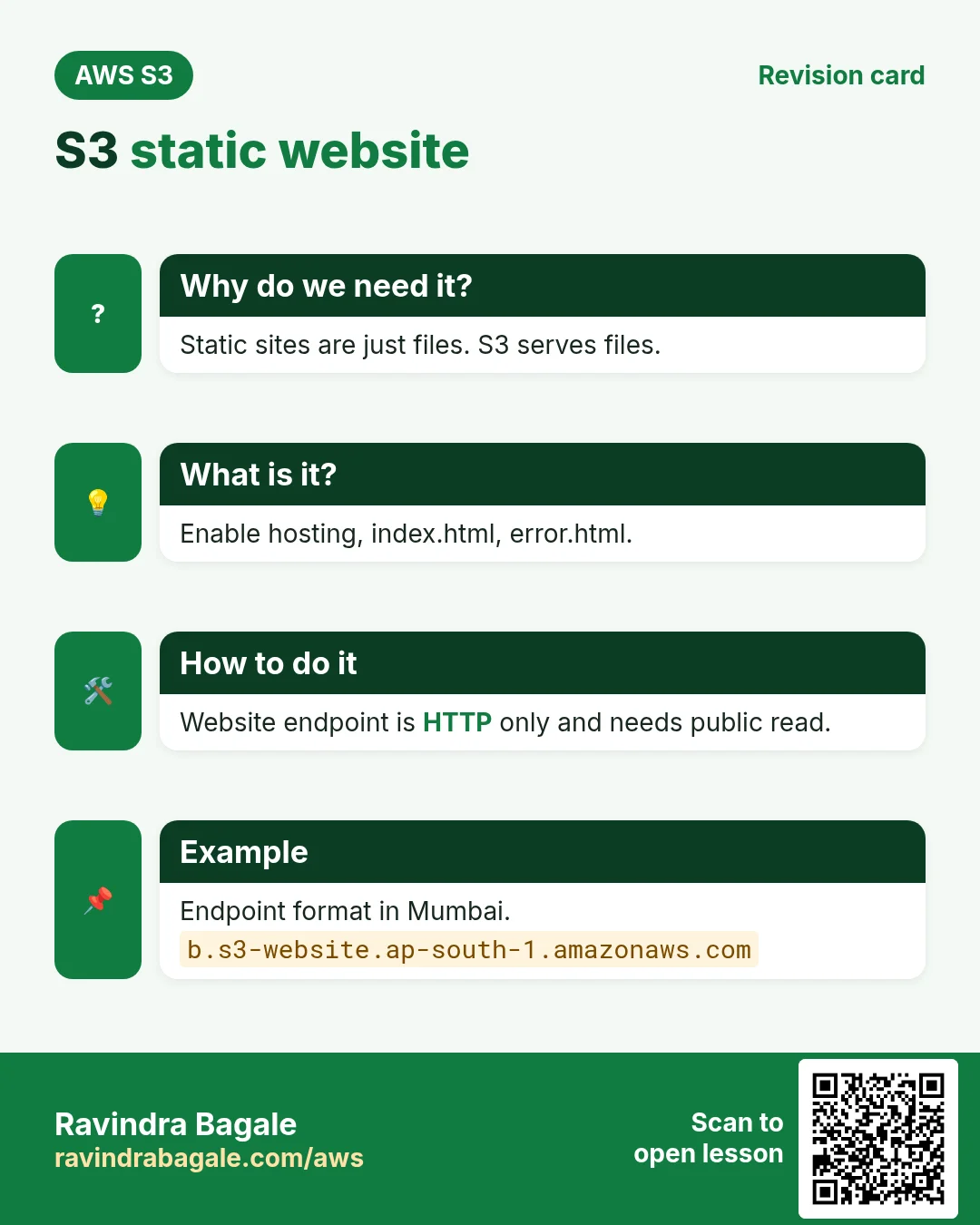
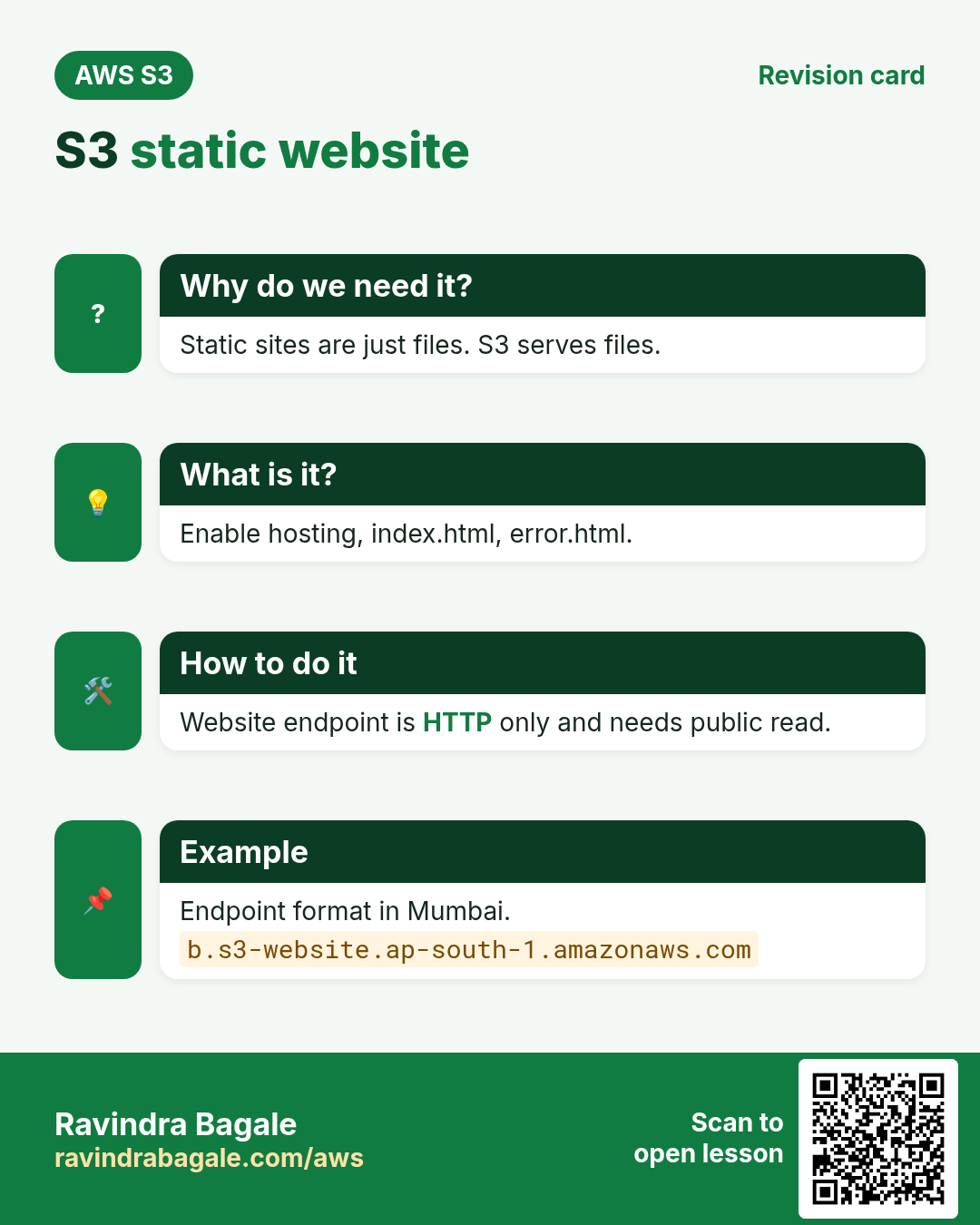
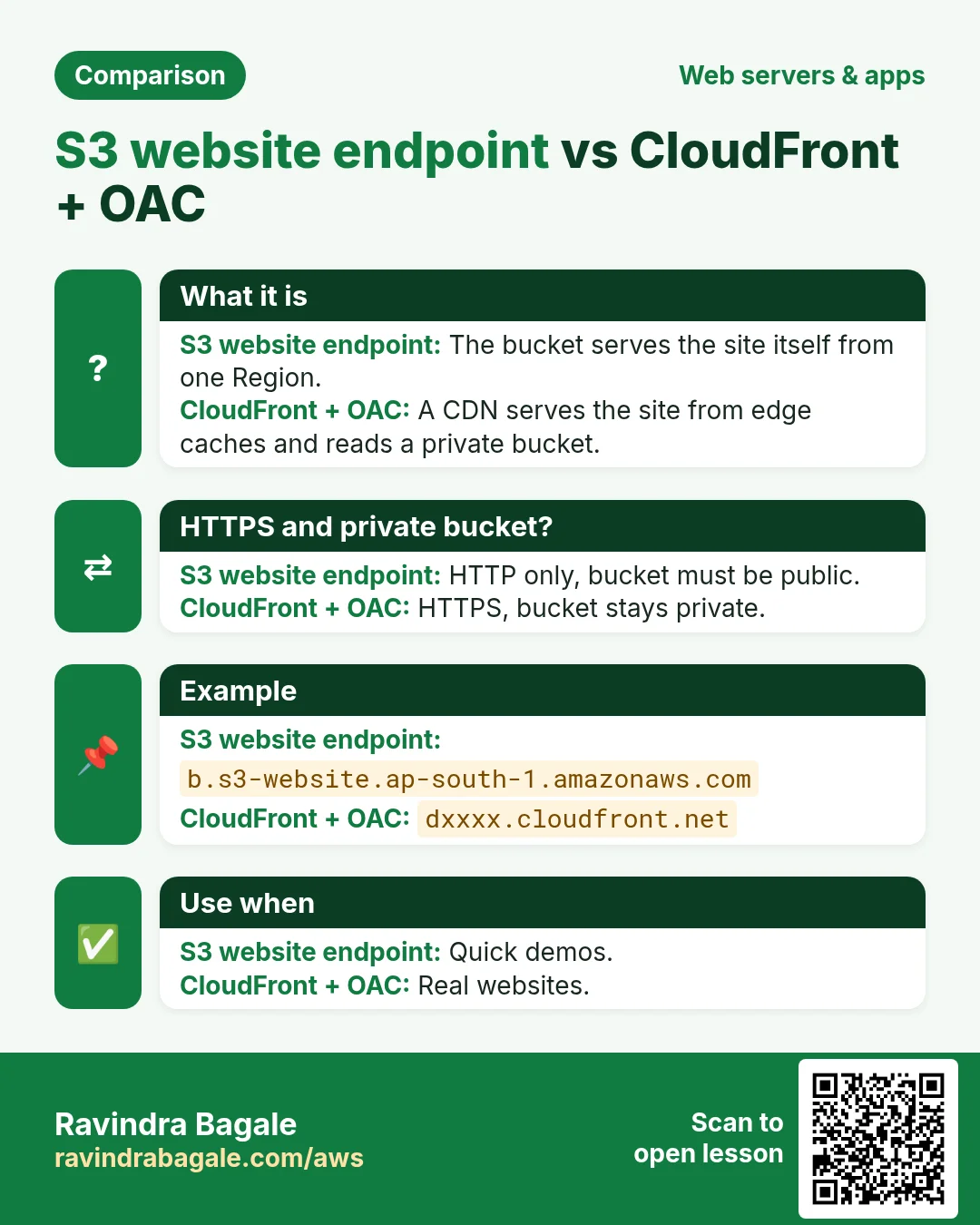
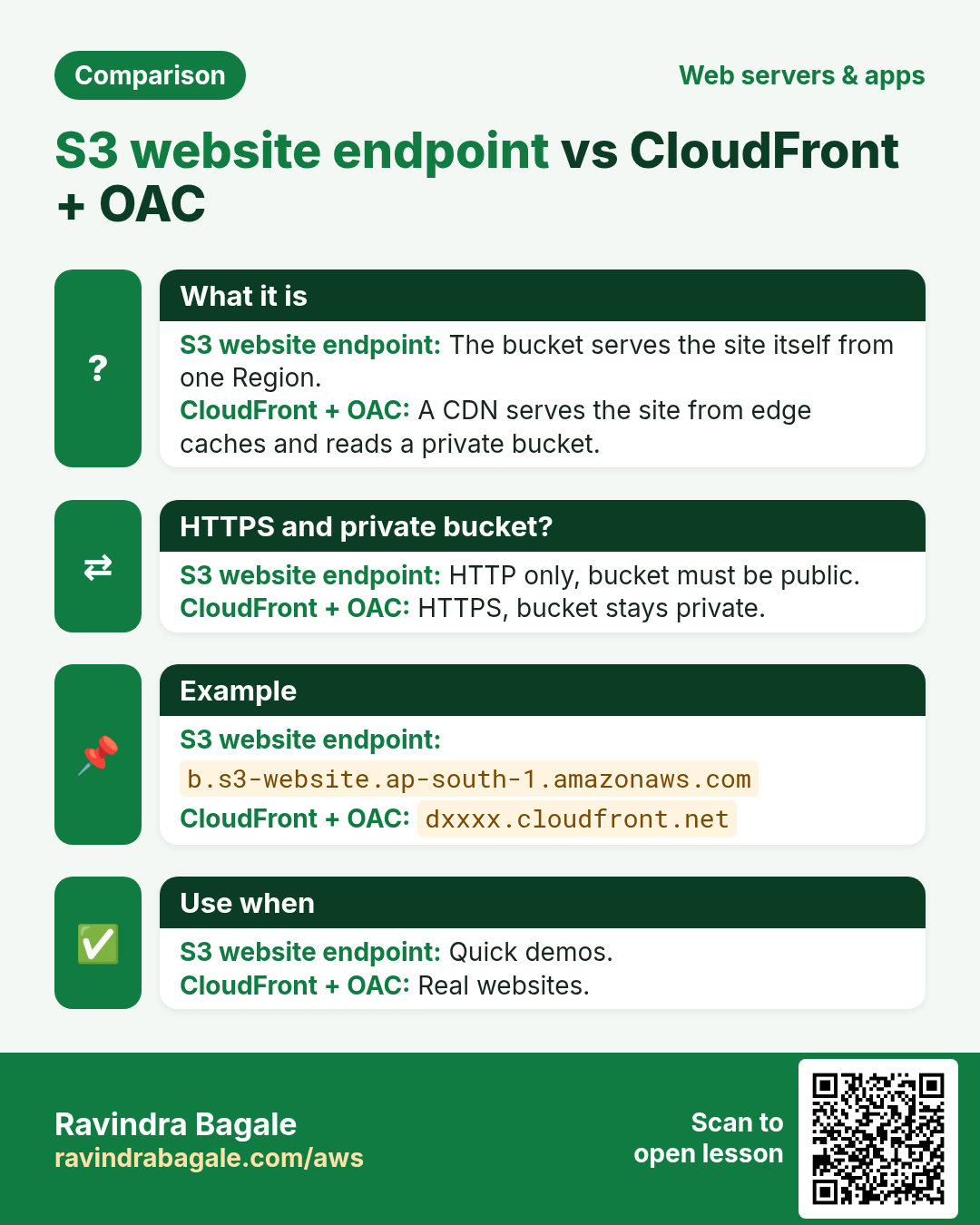
Endpoint for ap-south-1: http://bucket.s3-website.ap-south-1.amazonaws.com. Some older Regions use a dash, like s3-website-us-east-1. The website endpoint is HTTP only. That is the main reason we add CloudFront.
3. CloudFront with Origin Access Control
Follow the bakery visitor and the private bucket request separately
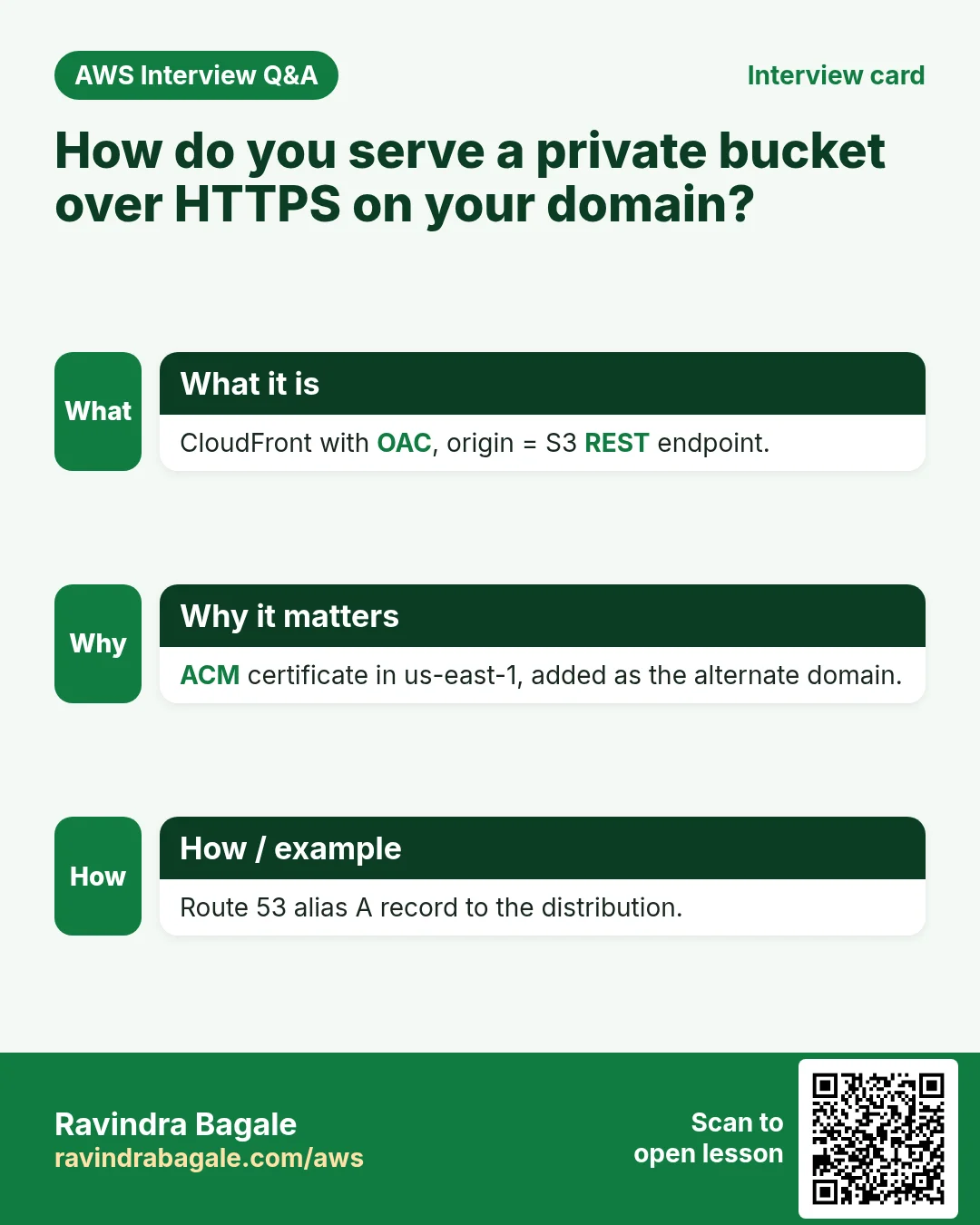
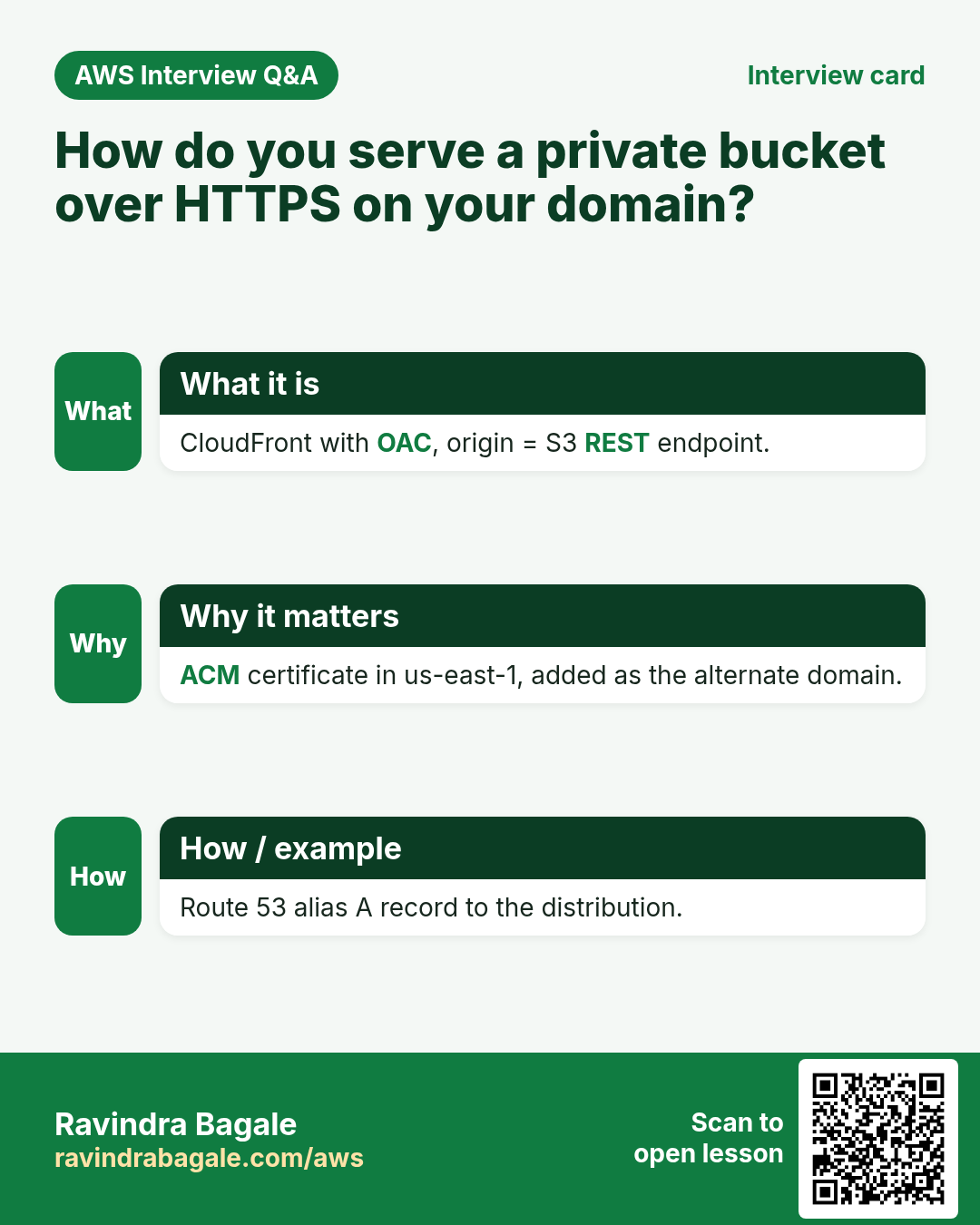
In the CloudFront version, a visitor enters the bakery’s HTTPS address. They connect to CloudFront, which serves an eligible cached page or requests it from the origin. Origin Access Control lets CloudFront sign its request to the private S3 bucket. Use the S3 bucket’s REST origin for this path. A public S3 website endpoint is a different origin type and cannot use OAC.
Test a page through the distribution, then try an unsigned direct S3 request for the same object. The first path should show the page. The direct public request should fail for this private lab bucket. If both fail, check the selected origin name, the bucket policy and the distribution’s status before changing public access settings.
Without CloudFront: no HTTPS, the bucket must be public, and a visitor in London waits for Mumbai. CloudFront fixes all three.
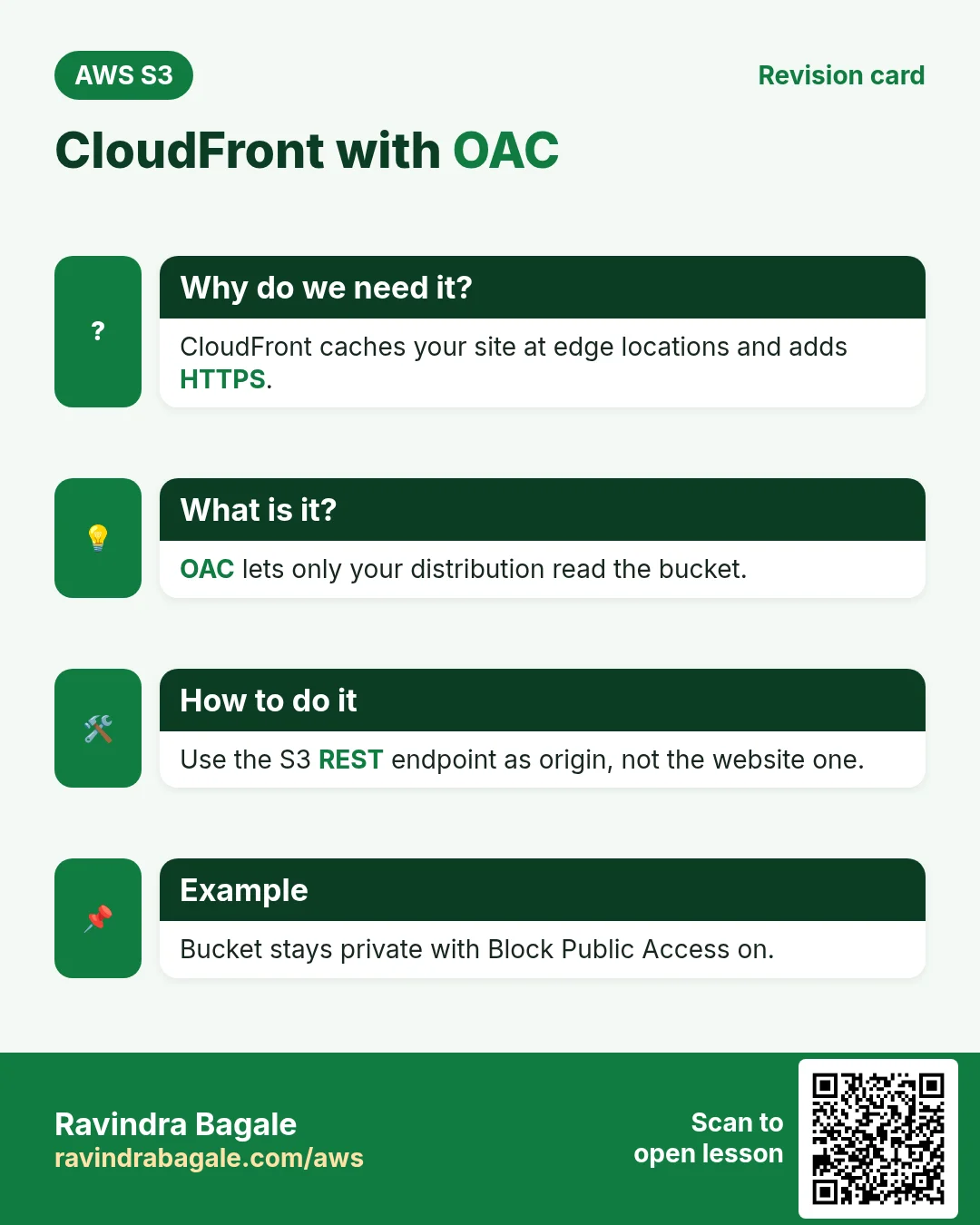
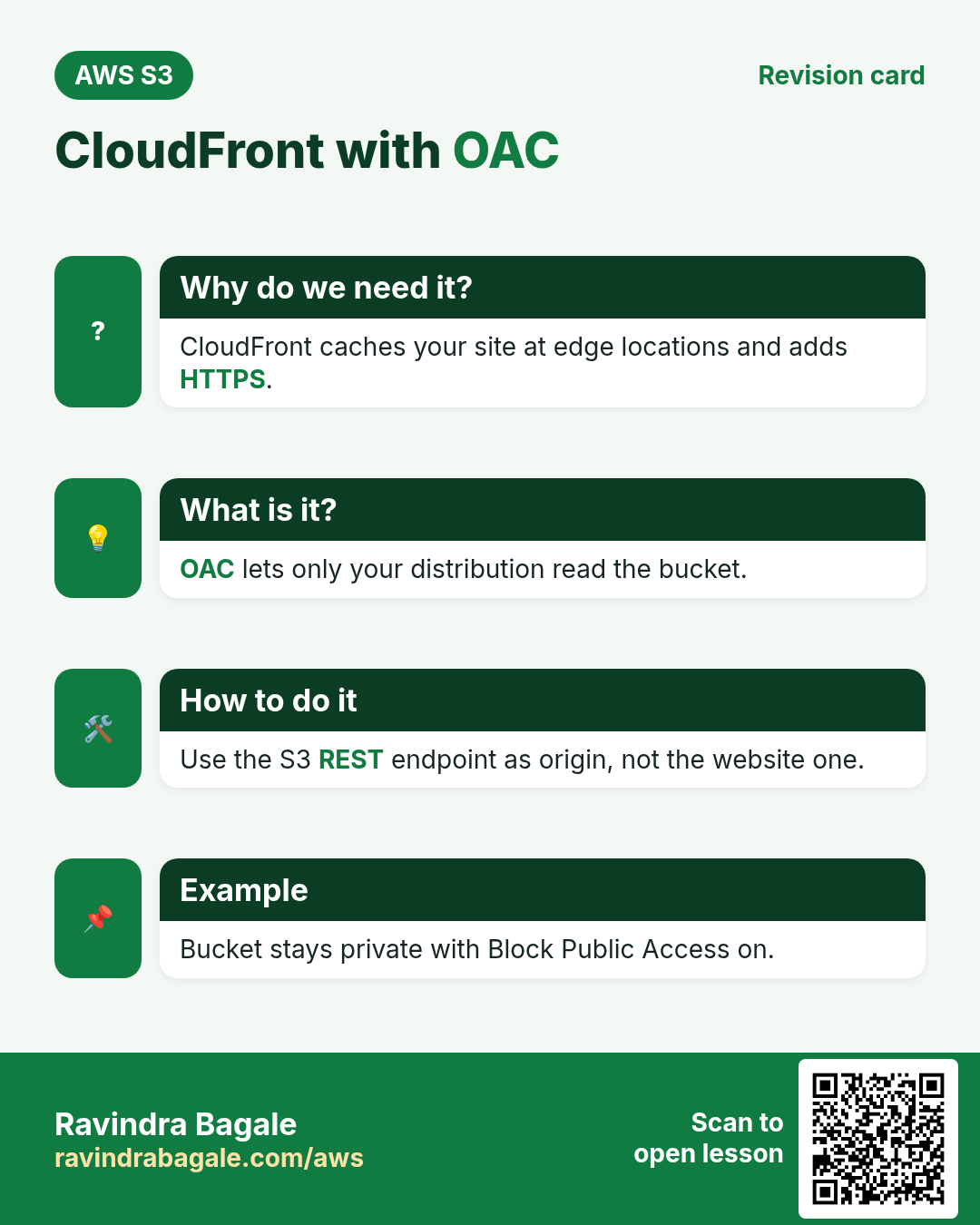
CloudFront is AWS's CDN with hundreds of edge locations that cache your files near users. OAC lets only your distribution read the bucket, so the bucket stays fully private with Block Public Access on.
| Point | S3 website endpoint | CloudFront + OAC |
|---|---|---|
| HTTPS | No | Yes, ACM free cert |
| Bucket public | Yes | No |
| Speed worldwide | One Region | Edge cache |
| Origin to choose | - | S3 REST endpoint (bucket.s3.ap-south-1.amazonaws.com), not the website endpoint |
Ravindra Bagale's Tip
OAC only works with the S3 REST endpoint. With OAC, set "Default root object" = index.html in CloudFront. Subfolder index pages need a CloudFront Function, or build tools that output folder/index.html links.
4. HTTPS with ACM and Route 53
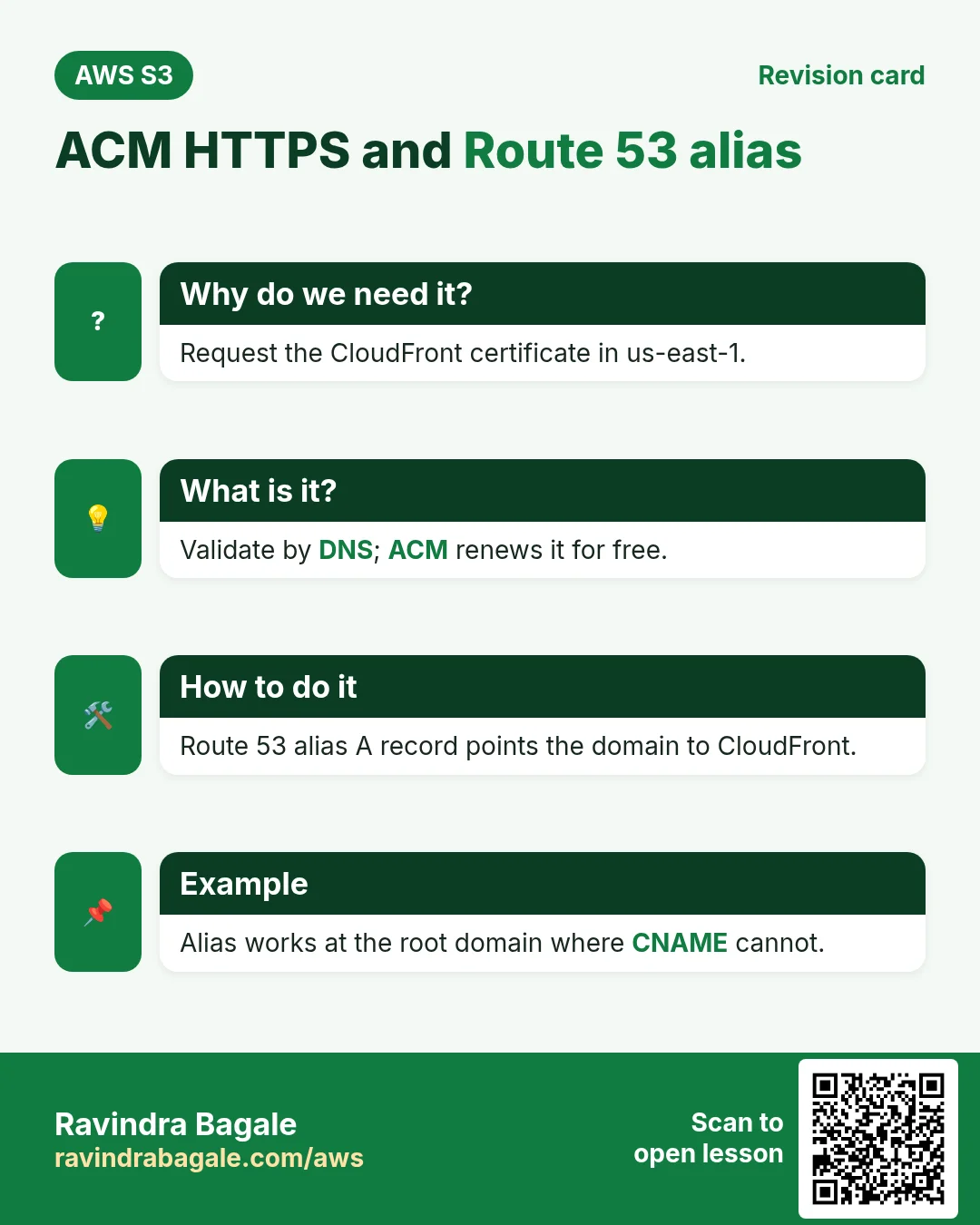
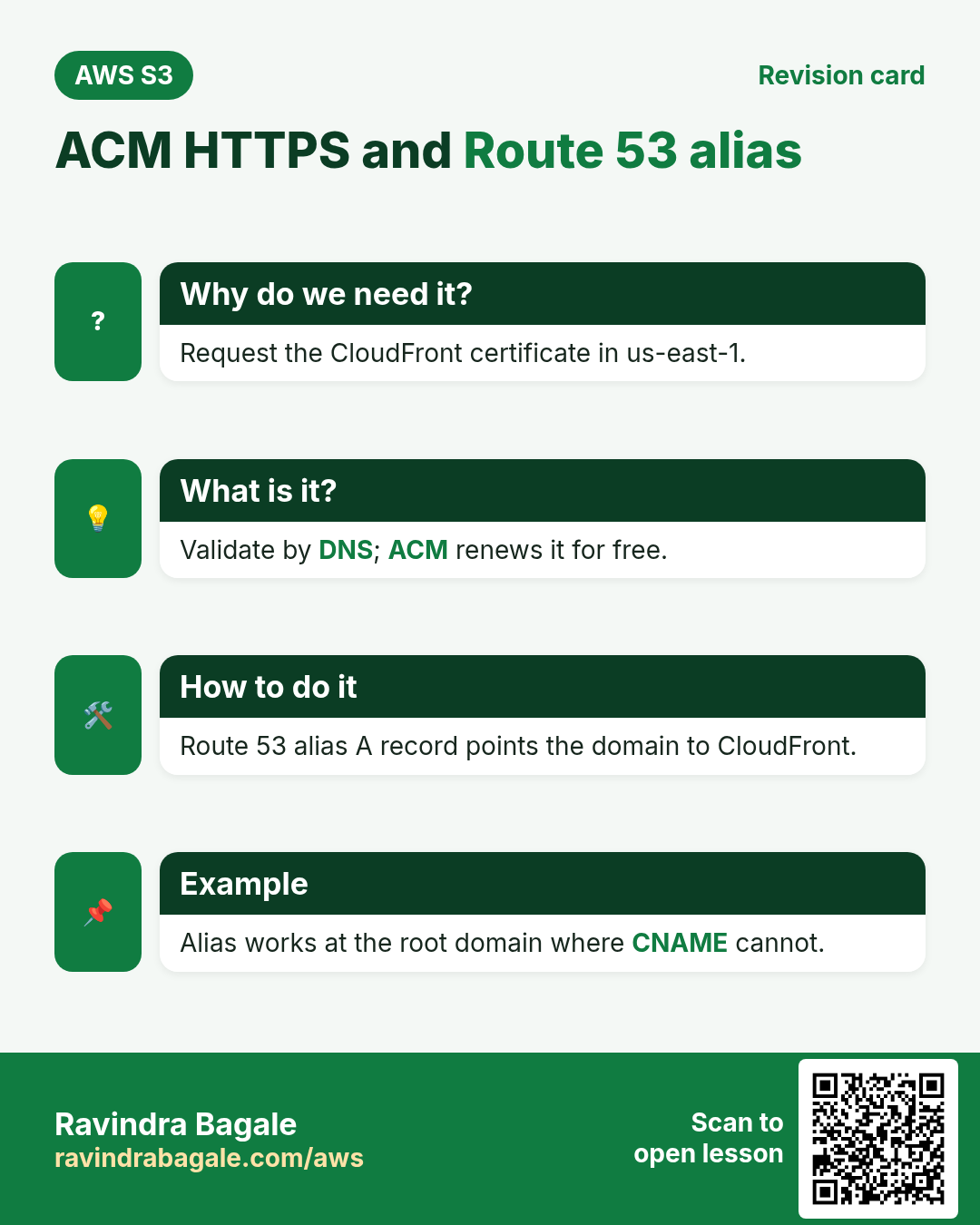
Browsers mark HTTP sites "Not secure". ACM gives free public certificates that renew automatically.
- The certificate for CloudFront must be requested in us-east-1 (N. Virginia), whatever Region your bucket is in.
- Validate by DNS: ACM gives a CNAME; with Route 53 one click creates it.
- Add the domain under "Alternate domain names (CNAMEs)" in CloudFront.
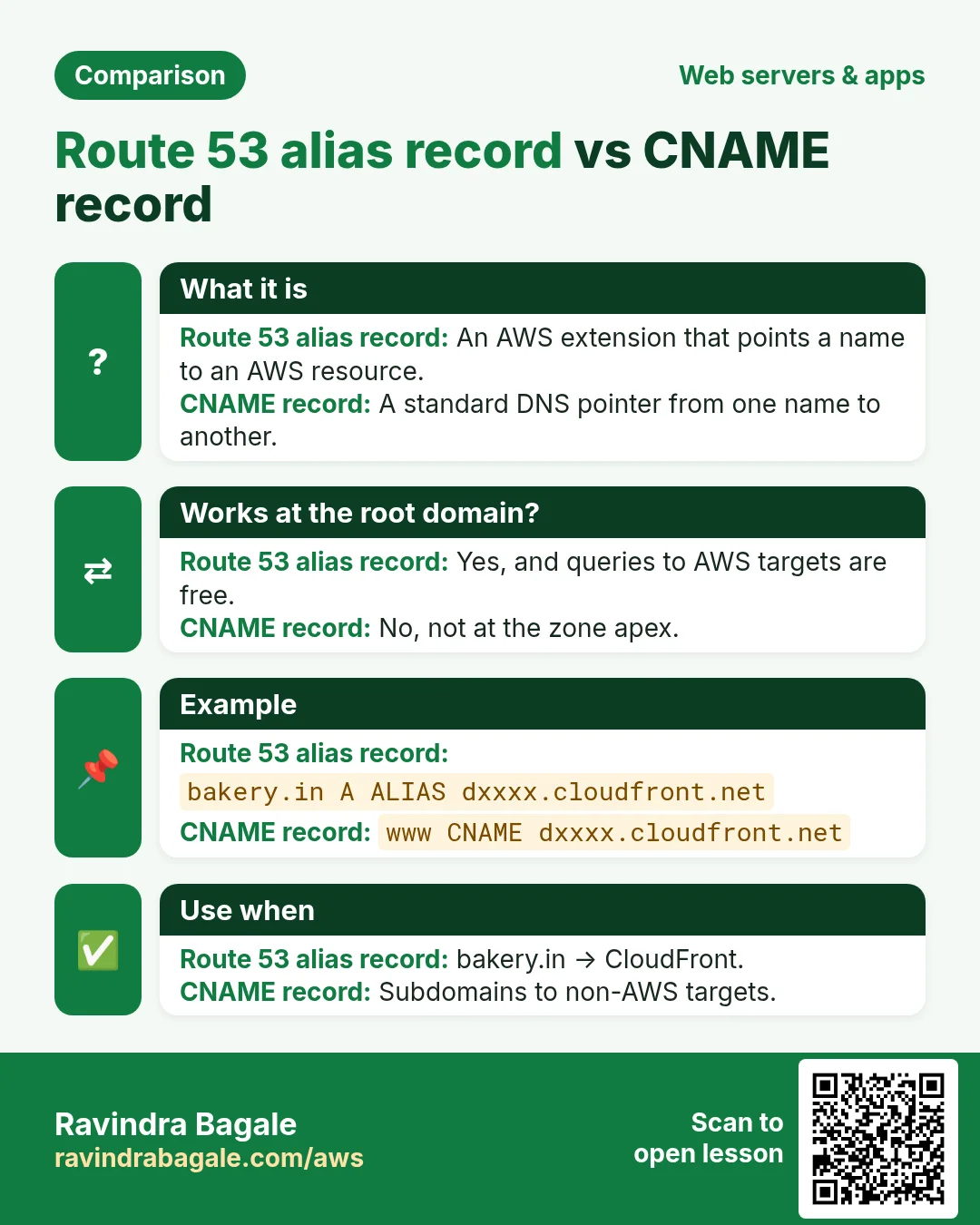
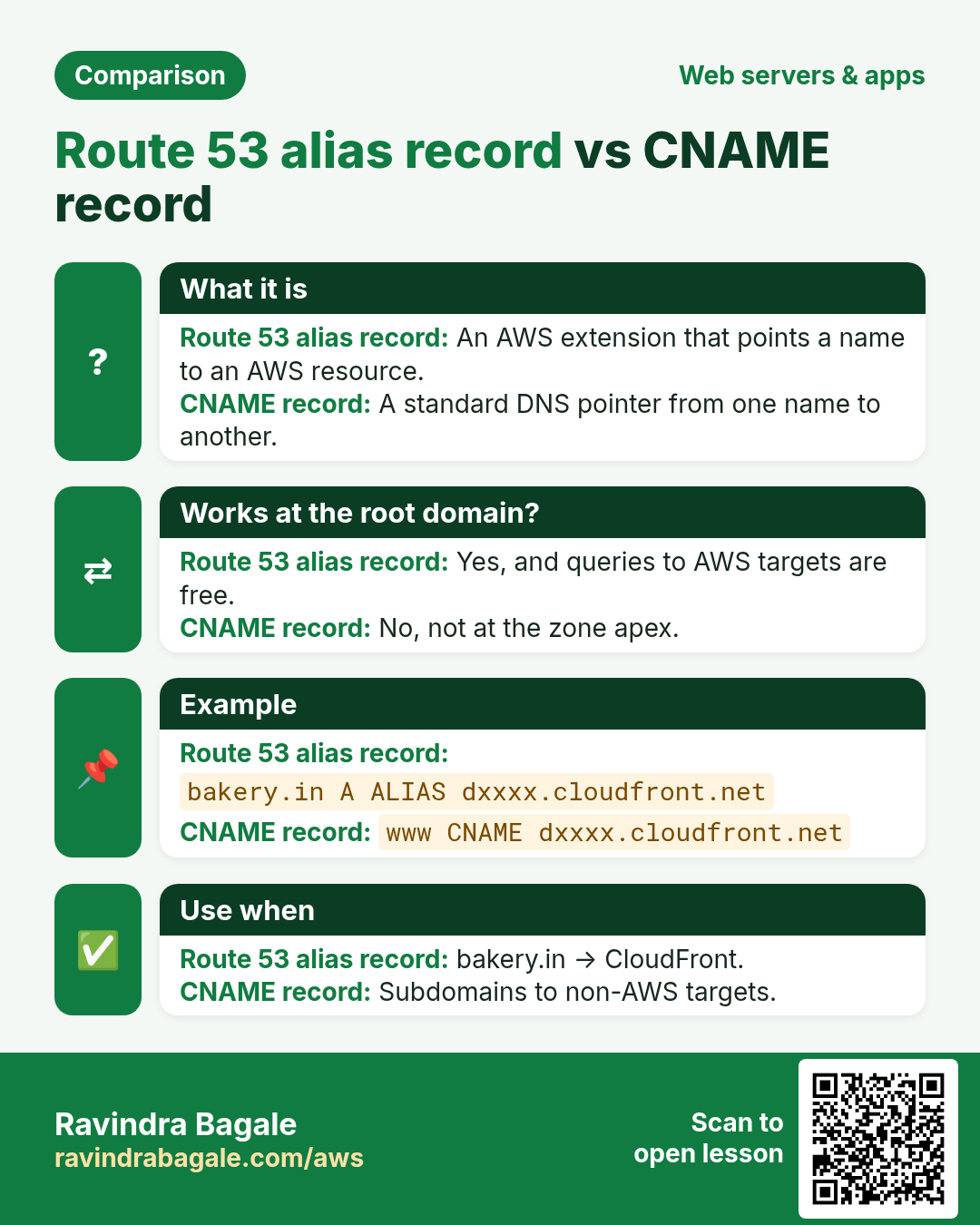
- In Route 53 create an A record, Alias = yes, target the distribution. Alias works at the root (bakery.in) where CNAME cannot, and alias queries to AWS targets are free.
5. Deploy from any stack
Find which layer failed before adding a custom error page
For a simple static bakery site, make sure the deployed files contain index.html and a known image. Request both separately through CloudFront. Check the HTML path, the actual image key and their status codes. If CloudFront shows a permission error for all files, diagnose the origin path and policy first.
A single-page app can need a fallback for a browser route such as /menu/today, because that path may not exist as an actual S3 object. Avoid treating every 403 as an intentional route rewrite. A missing origin permission or image can otherwise be hidden behind a successful-looking HTML response. Keep one expected page, one known asset and one deliberately missing path in the test.
| Stack | Build | Upload |
|---|---|---|
| React (Vite) | npm run build → dist/ | aws s3 sync dist/ s3://b --delete |
| Angular | ng build → dist/app/browser | aws s3 sync dist/app/browser s3://b --delete |
| Vue | npm run build → dist/ | aws s3 sync dist/ s3://b --delete |
| Next.js (export) | output:"export", next build → out/ | aws s3 sync out/ s3://b --delete |
| Hugo | hugo → public/ | aws s3 sync public/ s3://b --delete |
| Plain HTML | - | aws s3 sync ./site s3://b |
After each deploy: aws cloudfront create-invalidation --distribution-id E123 --paths "/index.html". Why: CloudFront caches; invalidation fetches the new file. Hashed asset names (app.3f9a.js) avoid invalidating everything.
SPA routing (React Router): in CloudFront › Error pages, map 403 and 404 to /index.html with response 200.
6. Lab: part A website endpoint, part B CloudFront + OAC + HTTPS
Part A: S3 website
- Create files:
echo "<h1>Bakery</h1>" > index.html; echo "<h1>Not found</h1>" > error.html. - Create bucket
yourname-bakery-sitein ap-south-1. Uncheck Block all public access, tick the acknowledgement. aws s3 cp index.html s3://yourname-bakery-site/; aws s3 cp error.html s3://yourname-bakery-site/.- Properties › Static website hosting › Edit › Enable, Index = index.html, Error = error.html › Save.
- Permissions › Bucket policy: public GetObject on
arn:aws:s3:::yourname-bakery-site/*. curl http://yourname-bakery-site.s3-website.ap-south-1.amazonaws.com/. Expected: <h1>Bakery</h1>./nopegives Not found.
Part B: make it private behind CloudFront
- Delete the bucket policy, disable website hosting, turn Block all public access back on.
- (If you own a domain) ACM, Region us-east-1 › Request public certificate ›
www.yourdomain.com› DNS validation › Create records in Route 53. Wait for "Issued". - CloudFront › Create distribution › Origin domain =
yourname-bakery-site.s3.ap-south-1.amazonaws.com(not the website one). - Origin access = Origin access control settings › Create new OAC (Sign requests).
- Viewer protocol policy = Redirect HTTP to HTTPS. Default root object =
index.html. WAF = do not enable (lab). - (Domain) Alternate domain name =
www.yourdomain.com, Custom SSL certificate = the ACM cert. Create. - Copy the policy CloudFront shows and paste it into the bucket policy. It allows
cloudfront.amazonaws.comwithAWS:SourceArn= your distribution. - Wait for Deployed.
curl -I https://dxxxx.cloudfront.net/. Expected:HTTP/2 200,x-cacheheader. - Verify private:
curl -I https://yourname-bakery-site.s3.ap-south-1.amazonaws.com/index.html. Expected: 403. - (Domain) Route 53 › hosted zone › Create record › www, A, Alias on, Alias to CloudFront distribution. Open https://www.yourdomain.com.
Cleanup
- Delete the Route 53 record. CloudFront › Disable, wait, then Delete.
aws s3 rb s3://yourname-bakery-site --force. Delete the ACM cert if unused.
Common errors and fixes
These are synthetic practice situations. Diagnose the signal before changing a resource; no infrastructure changes are needed to read this guide.
The home page works, but a nested page does not.
CloudFront’s default root object handles the distribution root; it does not automatically turn every directory path into that directory’s index.html. Compare the requested path with the exact S3 key. A static build may need explicit links or deliberate routing logic.
OAC is attached, but the origin still returns 403.
Confirm that the origin is the S3 REST endpoint, not the website endpoint, and inspect the distribution-scoped bucket permission and object key. With SSE-KMS objects, the key permission matters too. Do not disable public-access protection to mask an OAC configuration problem.
A missing image returns the home page with status 200.
A blanket SPA error fallback can hide missing assets and real permission failures. Inspect the response body and Content-Type, not just the status. Decide which navigation paths need an HTML fallback and which missing files should remain errors.
Practical FAQ: decisions during real work
Does a browser padlock prove the origin connection is HTTPS?
No. Viewer-to-CloudFront and CloudFront-to-origin are separate connections. An S3 website endpoint remains HTTP-only even behind an HTTPS viewer URL. For a private S3 REST origin, OAC with always-sign requests provides the intended authenticated HTTPS origin path.
Will an S3 bucket run my PHP or Node server?
No. This architecture serves built HTML, CSS, JavaScript and other objects. Browser JavaScript can call an API, but server-side application code needs a separate compute/API service. Uploading source files is not the same as deploying a running backend.
Does CloudFront invalidation clear a visitor’s browser cache?
No. It removes matching CloudFront cached copies, not copies already held by browsers or corporate caches. Use deliberately chosen browser cache headers and new asset names when content changes; then verify what URL the updated HTML actually requests.
7. Interview questions
Q. Does the S3 website endpoint support HTTPS?
No, HTTP only. Use CloudFront for HTTPS.
Q. What is OAC?
Origin Access Control: CloudFront signs requests to S3 so only the distribution can read a private bucket. It replaces the older OAI.
Q. Which Region for a CloudFront ACM certificate?
us-east-1, always.
Q. Why alias and not CNAME for bakery.in?
A CNAME is not allowed at the zone apex; an alias A record is, and AWS alias queries are free.
Q. Users see the old page after deploy. Why?
CloudFront cache. Create an invalidation or use hashed file names.
Try at home
- Deploy a React build to S3 + CloudFront and fix deep links with the 403/404 → index.html rule.
- Compare curl -I timings from the website endpoint and CloudFront.
In short
- Static sites are files; S3 serves files.
- Website endpoint = HTTP only and needs a public bucket.
- CloudFront + OAC keeps the bucket private and adds HTTPS and caching.
- ACM cert for CloudFront lives in us-east-1.
- Route 53 alias A record points the domain at CloudFront.
Practise this chapter
Check your understanding
Choose an answer, then compare your reasoning with the explanation.
Practice Tasks
Practice checks run in your browser. They check the answer for this exercise; they do not create resources or connect to your AWS account.
About this scenarioSahyadri Clinic is a healthcare business in Satara. Dr. Anil Deshmukh looks after its IT and cloud work. They count money in INR and run their AWS resources in the ap-south-1 Region. In the tasks below you do real jobs for them using what this lesson teaches. All names, account IDs, IP addresses and numbers are made up for practice.
0 / 12
Easy List distributions
Find the distribution ID and domain name.
List all CloudFront distributions.
- Read the task and decide which AWS service it is about.
- Write aws, then the service name, then the operation (the action word).
- Add each needed flag (--name) followed by its value from the task.
- Flags can be in any order. Click Check answer.
Easy Read-only access to one bucket
Least privilege: give only the actions and the bucket the job needs.
Write an identity policy that lets the user read objects (s3:GetObject) only in bucket sahyadriclinic-data.
- Start with { "Version": "2012-10-17", "Statement": [ ... ] }.
- In each statement write Effect, Action and Resource.
- Give only what the task needs (least privilege).
- Use double quotes and commas correctly. Click Check answer.
Medium Clear the CloudFront cache
After a deploy, invalidate so visitors get the new files now, not after the TTL.
Invalidate all paths (/*) on distribution E2QWRUHAPOMQZL.
- Read the task and decide which AWS service it is about.
- Write aws, then the service name, then the operation (the action word).
- Add each needed flag (--name) followed by its value from the task.
- Flags can be in any order. Click Check answer.
Medium Bucket policy for a public website
A static website bucket must let everyone read its files.
Write a bucket policy that lets anyone (*) do s3:GetObject on every object in sahyadriclinic-site.
- Start with { "Version": "2012-10-17", "Statement": [ ... ] }.
- In each statement write Effect, Action and Resource.
- Give only what the task needs (least privilege).
- Use double quotes and commas correctly. Click Check answer.
Medium Sync a website folder to S3
sync uploads only new or changed files and can remove deleted ones.
Sync the local folder ./site to s3://sahyadriclinic-web/ and delete files in S3 that are no longer in ./site.
- Read the task and decide which AWS service it is about.
- Write aws, then the service name, then the operation (the action word).
- Add each needed flag (--name) followed by its value from the task.
- Flags can be in any order. Click Check answer.
Medium Turn a bucket into a website
Static website hosting serves index.html and an error page straight from S3.
Enable static website hosting on s3://sahyadriclinic-web with index.html as the index page and error.html as the error page.
- Read the task and decide which AWS service it is about.
- Write aws, then the service name, then the operation (the action word).
- Add each needed flag (--name) followed by its value from the task.
- Flags can be in any order. Click Check answer.
Medium List and read one bucket
ListBucket works on the bucket ARN; GetObject works on object ARNs.
Allow s3:ListBucket on bucket sahyadriclinic-data and s3:GetObject on all its objects. Nothing else.
- Start with { "Version": "2012-10-17", "Statement": [ ... ] }.
- In each statement write Effect, Action and Resource.
- Give only what the task needs (least privilege).
- Use double quotes and commas correctly. Click Check answer.
Hard Create a distribution from a config file
The full config (origins, behaviors, certificate) is easiest to keep in JSON.
Create a CloudFront distribution from dist.json.
- Read the task and decide which AWS service it is about.
- Write aws, then the service name, then the operation (the action word).
- Add each needed flag (--name) followed by its value from the task.
- Flags can be in any order. Click Check answer.
Hard Bucket policy for CloudFront OAC
With OAC, only your CloudFront distribution may read the private bucket.
Allow the service cloudfront.amazonaws.com to s3:GetObject on sahyadriclinic-site/*, only when aws:SourceArn equals arn:aws:cloudfront::102103063049:distribution/E2QWRUHAPOMQZL.
- Start with { "Version": "2012-10-17", "Statement": [ ... ] }.
- In each statement write Effect, Action and Resource.
- Give only what the task needs (least privilege).
- Use double quotes and commas correctly. Click Check answer.
Hard Request a free certificate for CloudFront
CloudFront only uses ACM certificates from us-east-1. DNS validation renews automatically.
Request a certificate for sahyadriclinic.in and www.sahyadriclinic.in with DNS validation, in us-east-1.
- Read the task and decide which AWS service it is about.
- Write aws, then the service name, then the operation (the action word).
- Add each needed flag (--name) followed by its value from the task.
- Flags can be in any order. Click Check answer.
Hard Invalidate two paths
Invalidating only what changed is cheaper and faster.
On E2QWRUHAPOMQZL, invalidate /index.html and /css/site.css.
- Read the task and decide which AWS service it is about.
- Write aws, then the service name, then the operation (the action word).
- Add each needed flag (--name) followed by its value from the task.
- Flags can be in any order. Click Check answer.
Hard Create an Origin Access Control
OAC lets only CloudFront read your private S3 bucket.
Create an origin access control from oac.json.
- Read the task and decide which AWS service it is about.
- Write aws, then the service name, then the operation (the action word).
- Add each needed flag (--name) followed by its value from the task.
- Flags can be in any order. Click Check answer.
Revision, comparison and interview cards
Revise this lesson in a few minutes. Save the cards on your phone or download them as PNG files. The QR code on each card opens this lesson.
More cards: Ravi Sir's Cards.