DynamoDB Global Tables: Multi-Region Replication Explained
Multi-region is a product decision, not a checkbox. Amman travel lead Omar Haddad and Osaka engineer Kenji Watanabe said: We turned on Global Tables for inventory — two regions sold the same seat. Catalog reads love replicas; contended inventory needs sticky writes. Hot partitions still hurt in every region: hot partitions.
In this chapter
- Explain Global Tables simply
- Choose sticky writes vs multi-writer
- Describe replicas and conflicts (LWW)
- Industry map
- Lab mindset + cleanup
1. Everyday example: shared family calendar
Two phones edit the same event — last save wins (LWW). Dinner reservation for one table cannot be double-booked casually. Meera keeps clinic slot writes in one region; website content replicas everywhere.
2. Vertical steps
3. Purpose
Users far away need low-latency reads. DR goals may need a warm region. But every multi-writer item risks conflicts and double-sells.
4. Overview
Global Tables replicate a DynamoDB table across Regions. With multi-Region eventual consistency (MREC), concurrent updates to the same item use last-writer-wins reconciliation. Multi-Region strong consistency (MRSC) is a separate option in supported Regions. A write can fail if the item is already being modified in another Region, and MRSC does not support TTL or transactions. Decide which mode matches your access patterns before creating the table. You still design keys; replicas copy the pain of hot partitions too.
5. Steps
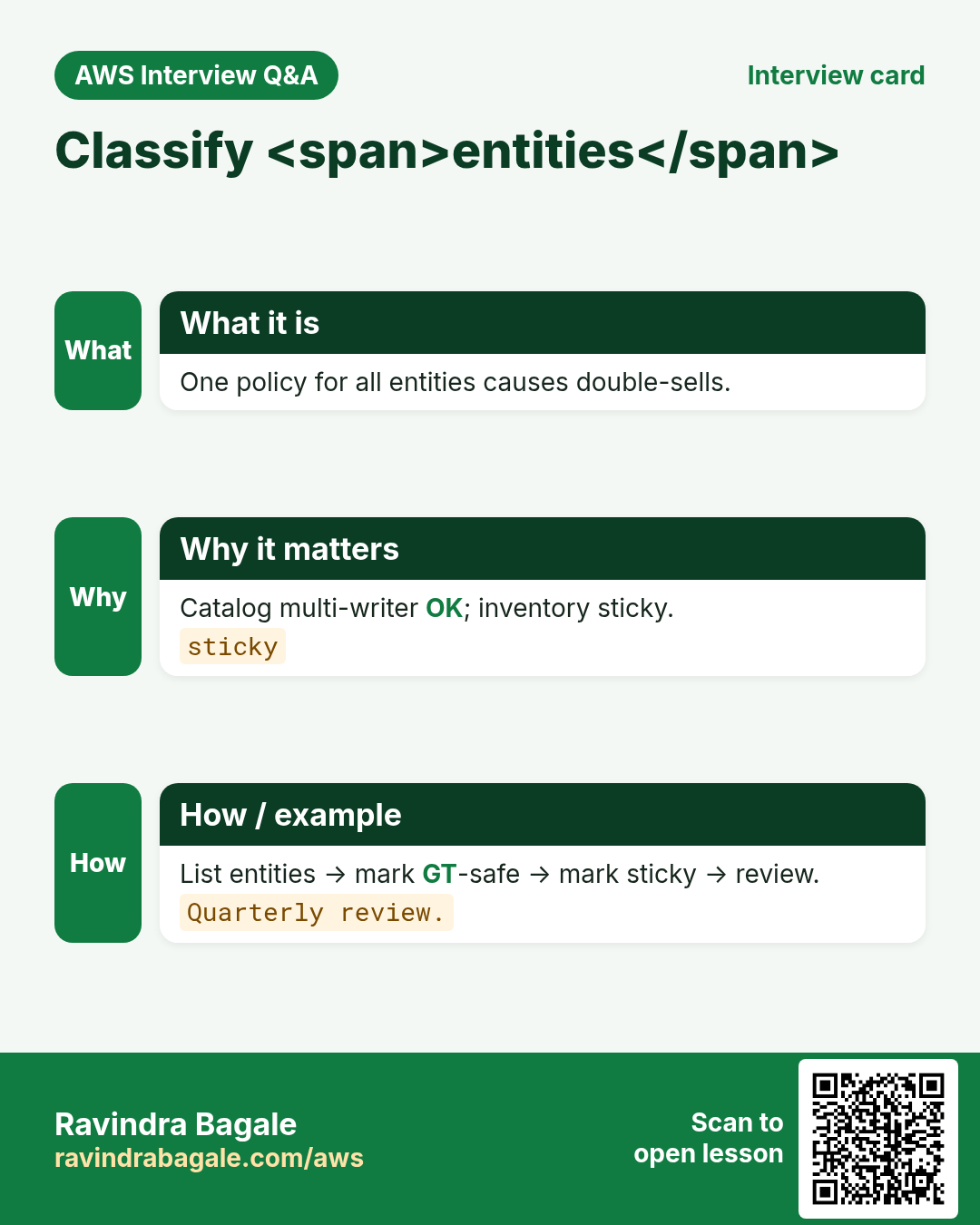
- List which entities are multi-writer safe (catalog) vs sticky (inventory).
- Pick regions for users and DR.
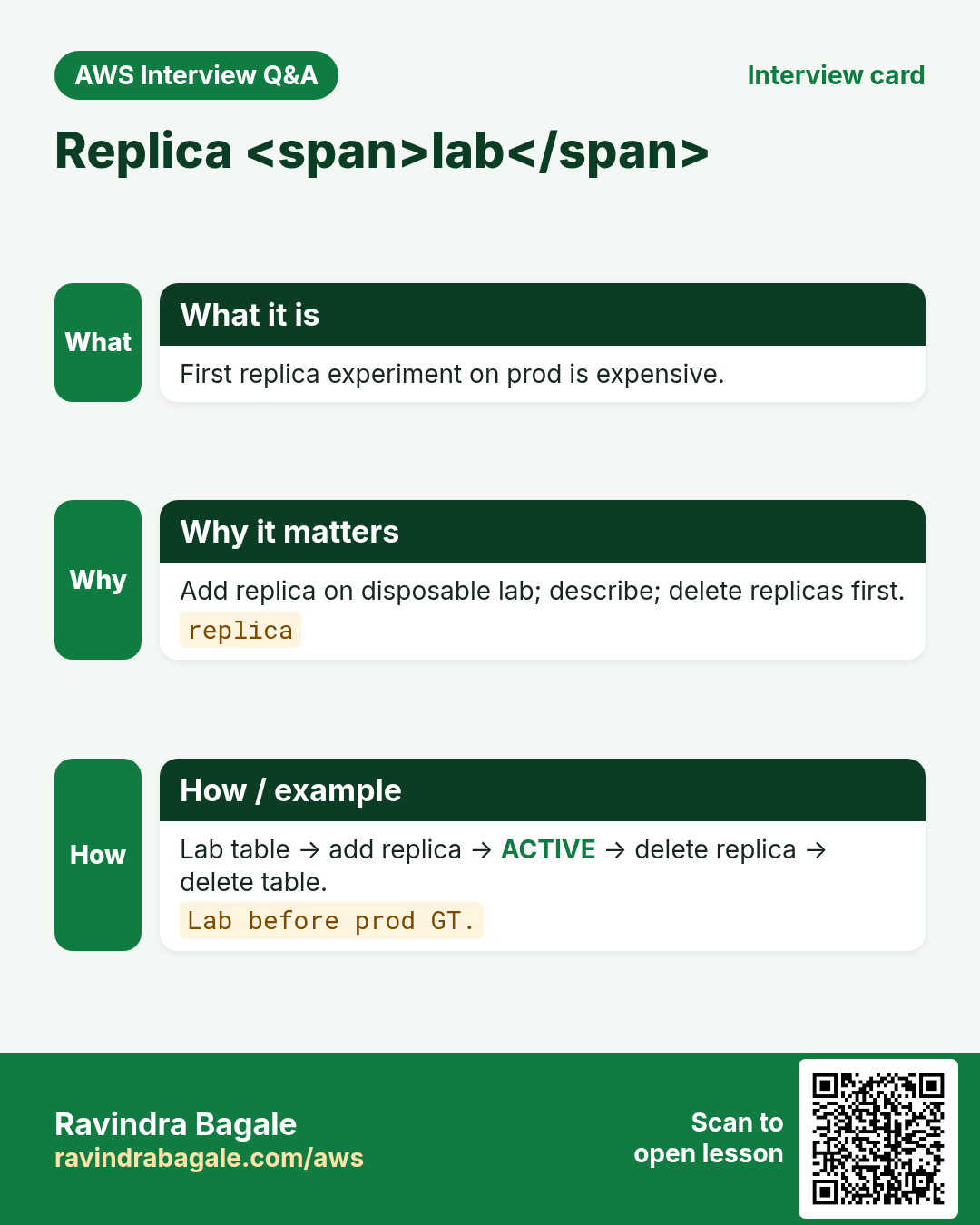
- Add replicas; wait ACTIVE.
- Route writes: sticky for contended stock/seats.
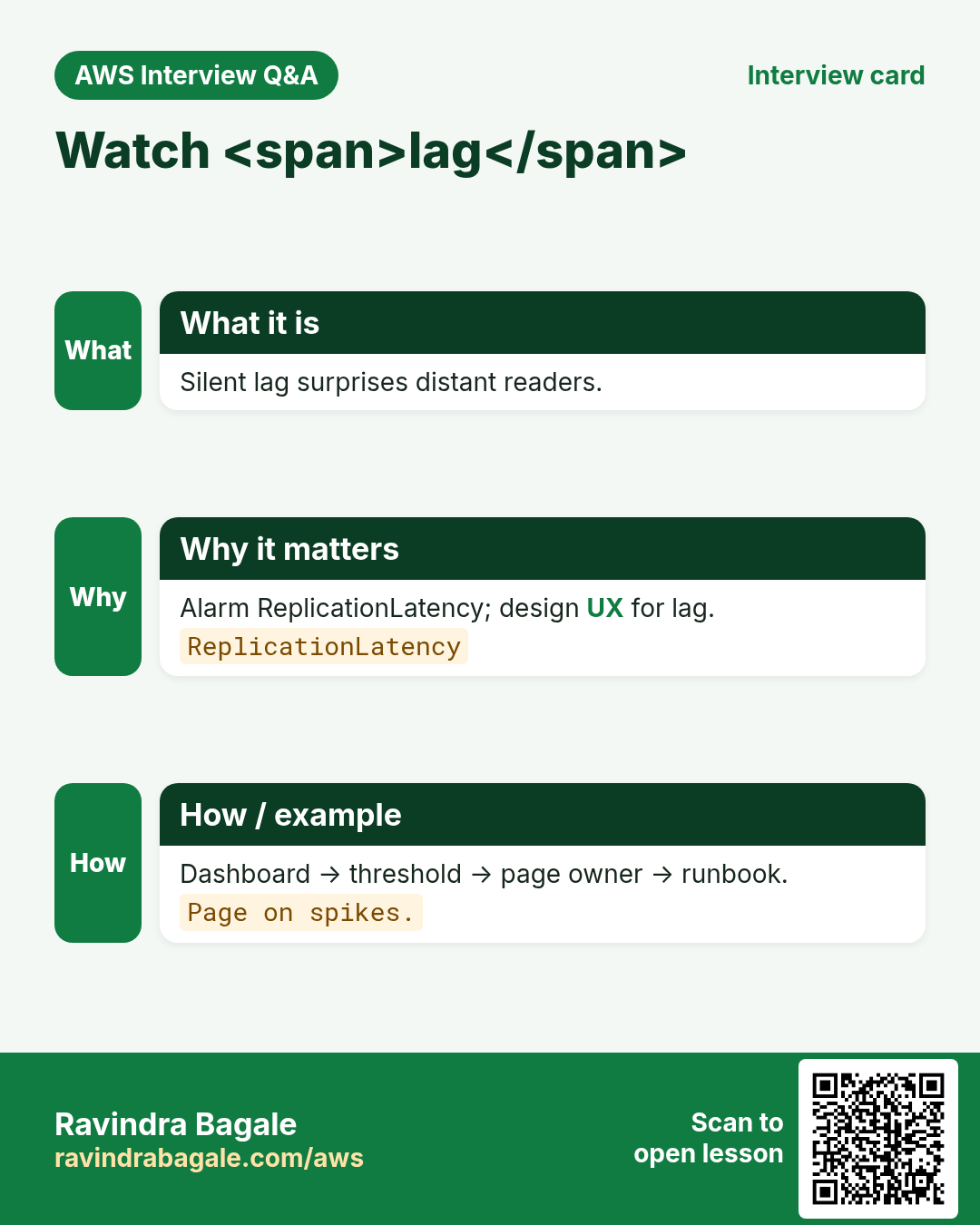
- Monitor ReplicationLatency and conflicts.
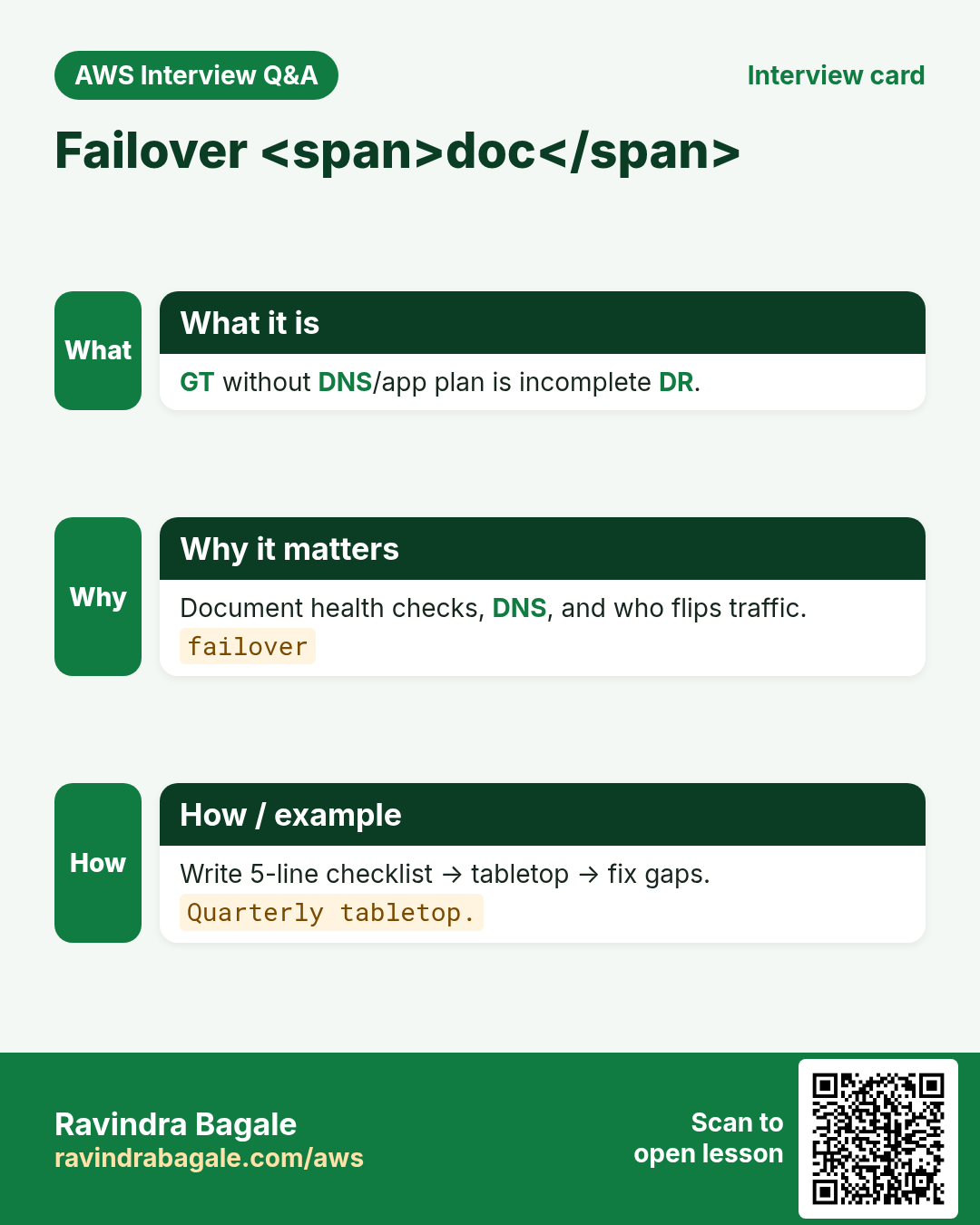
- Document failover: DNS/app region shift.
6. Commands with output and meaning
# Inspect replicas (API varies by setup)
aws dynamodb describe-table --table-name ShopApp \
  --query 'Table.{Name:TableName,Replicas:Replicas,Status:TableStatus}'
# Meaning: see Regions; Status ACTIVE before traffic.
# Add replicas only on disposable lab tables — each region bills writes.
describe-table shows replica list. Add replicas only on labs first — each region bills writes.
7. Industry stories
- Travel (Omar): catalog GT; seat inventory sticky home region.
- Media (Priya): read-heavy article metadata multi-region.
- Fintech (Elena): ledgers single-region; reporting async export.
- Gaming (Carlos): player profiles GT; wallet single-region.
- Retail (Aisha): store catalog GT; warehouse stock sticky.
- SaaS (Omar): tenant config GT; billing single-region.
8. Lab
- On paper: split CartLite entities into GT-safe vs sticky.
- If account allows: tiny lab table + one replica; describe; delete replicas then table.
- Else: write failover checklist only — still valid lab.
Cleanup (stop billing)
- Delete lab resources you created.
- Confirm with describe that names are gone.
9. Ops checklist before you ship
- Confirm TTL attribute name and units (epoch seconds).
- Decide soft-delete vs hard-delete vs archive-to-S3.
- Enable PITR on any table you cannot rebuild from source.
- Document RPO/RTO and who runs restore drills.
- If multi-region: pick write stickiness and conflict rules.
- If DAX: prove cache-miss path and warm-up plan.
- Tag Owner + Expiry on every lab resource.
- Budget alert in the account before load tests.
10. Copy-paste DynamoDB CLI starters (batch 2)
export AWS_DEFAULT_REGION=ap-south-1

# TTL status
aws dynamodb describe-time-to-live --table-name ShopApp

# PITR / continuous backups
aws dynamodb describe-continuous-backups --table-name ShopApp

# On-demand backup
aws dynamodb create-backup --table-name ShopApp --backup-name lab-shop-$(date +%Y%m%d)

# List backups
aws dynamodb list-backups --table-name ShopApp

# Global table description (v2)
aws dynamodb describe-table --table-name ShopApp --query 'Table.Replicas'
11. More industry stories
- Retail (Aisha Khan, Dubai): TTL clears abandoned carts; soft-delete keeps 30-day undo.
- Bank (Lucas Meyer, Berlin): PITR on ledger table; restore drill every quarter.
- Travel (Omar Haddad, Amman): Global Tables for catalog reads; inventory writes sticky.
- Gaming (Carlos Rivera, Mexico City): DAX for hot profile Gets; never cache money ledgers.
- Social (Priya Nair, Kochi): adjacency edges for follows; sparse GSI for unread inbox.
- IoT (Mei Lin, Shenzhen): device#day PK + TTL 14 days; rollups to S3.
12. Glossary (batch 2)
| Term | Meaning |
|---|---|
| TTL | Time to Live — attribute with epoch seconds; DynamoDB deletes later |
| Soft delete | Flag deleted=true; item remains until TTL/archive |
| PITR | Point-in-time recovery — continuous backups window |
| Global Table | Multi-region replicated DynamoDB table |
| LWW | Last-writer-wins conflict resolution on replicas |
| DAX | DynamoDB Accelerator — in-memory cache cluster |
| Adjacency list | Edge items modeling relationships in one table |
| Fan-out | Write once; push copies to many feeds/inboxes |
13. Practice: explain out loud
- 60s: TTL vs soft-delete vs S3 archive.
- 60s: PITR vs on-demand backup.
- 60s: when Global Tables help and hurt.
- 60s: DAX consistency trade-off.
- 60s: CartLite checkout keys in one breath.
- 60s: follow edge vs feed item.
- Record once; cut filler; record again.
14. Safe lab hygiene
- Use ap-south-1 labs with a budget alert.
- Prefix lab tables with lab- and your initials.
- Delete replicas, DAX clusters, and backups you created for labs.
- Never enable Global Tables on production without a write plan.
- Tag every resource Owner + Expiry.
- Export/import labs can create large S3 bills — delete prefixes.
15. How this set links other chapters
- Data modeling — keys we reuse in projects.
- Transactions — checkout and seat patterns.
- Streams + Lambda — fan-out and CDC.
- CRUD survey — short TTL note we deepen.
- What Is DynamoDB? — intro.
16. Delete / archive decision pad
| Need | Prefer | Why |
|---|---|---|
| Undo 7-30 days | Soft-delete flag | User restore |
| Hard expiry, no read | TTL attribute | Auto delete later |
| Compliance keep cold | Export/archive to S3 | Cheap long store |
| Mistake recovery | PITR / backup | Table-level restore |
17. Ten oral drill questions
- What units does DynamoDB TTL use?
- Does TTL delete instantly?
- PITR window typical length?
- Global Tables conflict default?
- When sticky writes matter?
- DAX vs API Gateway cache?
- Cart PK for a shopper?
- Order lines under which PK?
- Follow edge SK example?
- Unread inbox sparse GSI idea?
18. RPO / RTO mini workshop
- Write the worst data loss you can accept (RPO) in minutes.
- Write how long restore may take (RTO) before business pain.
- Map: on-demand backup vs PITR vs multi-region replica.
- Schedule a restore drill on a lab table this month.
- Name the person who runs the drill.
19. Cost watch list (batch 2)
- PITR storage and on-demand backup storage.
- Global Tables: replicated WCUs in every region.
- DAX node hours even at idle.
- Export to S3 + S3 storage + Athena later.
- Streams + Lambda still bill during TTL deletes.
20. Project Definition of Done
- Access patterns written and peer-reviewed.
- Sample items drawn for happy path + one failure.
- Lab table created, exercised, deleted (or tagged Expiry).
- At least one conditional write or transaction exercised.
- Cleanup commands pasted in your notes.
- One interview answer recorded out loud.
21. Cross-links inside this batch
- TTL hygiene → Backup/PITR for “oops” recovery.
- Global Tables → sticky writes from capacity/hot lessons.
- DAX → only after Query shapes are correct.
- P1 CartLite reuses modeling + transactions.
- P2 Social reuses adjacency + Streams ideas.
22. Quick self-check (yes/no)
- I can explain TTL delay vs instant DeleteItem.
- I know when soft-delete beats hard delete.
- I can start PITR and say what restore costs in time.
- I can name one reason NOT to use Global Tables.
- I know DAX does not fix a bad partition key.
- I can sketch CartLite USER# and ORD# keys.
- I can sketch a follow edge item.
- I delete lab replicas/DAX/backups the same day.
23. Common errors and fixes
Each row is a real mistake students and juniors hit. Read the fix before you panic.
| Error / symptom | Fix |
|---|---|
| GT for double-sell stock | Sticky writes. |
| Ignore LWW | Design conflicts. |
| Hot PK + GT | Fix keys first. |
| No latency monitor | Watch ReplicationLatency. |
| Prod first try | Lab first. |
| Forget regional cost | Budget each region. |
| DNS not planned | Failover runbook. |
| Txn across regions casually | Know limits. |
| Assume strong global consistency | Replicated/eventual across regions. |
24. Troubleshooting checklist
- Replica Creating: wait/IAM.
- Conflict surprises: review LWW + sticky.
- Throttle in one region: hot key local.
- High bill: replicated WCUs.
- App reads stale: expect replication lag.
25. FAQ
Q. Should I always use a single table?
Often yes for related access patterns; not a religion. Separate tables are fine for unrelated domains or different capacity/security needs.
Q. Do I still need RDS?
Yes for heavy joins, multi-row SQL reports, and strong relational constraints. See the intro DynamoDB vs RDS chapter.
Q. Is Scan evil?
Scan is a tool for rare admin jobs and small tables. Design so hot paths use Query/GetItem.
Q. Where are Put/Get command details?
In the CRUD survey, CLI and SDK chapters — this deep set links them instead of copying.
Q. Always need GT?
No — single region often enough.
Q. LWW safe for seats?
Usually no — sticky or carefully designed.
Q. Fixes hot partitions?
No — replicas copy the heat.
Q. Link modeling?
Yes — keys still matter.
26. Interview Q&A
Q. (B) Global Table?
Multi-region replicated DynamoDB table.
Q. (B) Default conflict?
Last-writer-wins per item.
Q. (M) Sticky writes?
Send contended writes to one region.
Q. (M) Catalog vs inventory?
Catalog multi-writer OK; inventory careful.
Q. (S/MNC) DR with GT?
Warm replica + app/DNS failover plan.
Q. (MNC) Cost surprise?
Writes replicated — pay in each region.
27. Tips in English, Marathi and Hindi
Ravindra Bagale's Tip (EN)
Replicate reads freely; treat contended writes like cash.
Ravindra Bagale's Tip (MR)
Reads free-ish; contended writes = cash.
Tip (HI)
Read replicate ठीक; contested write को cash समझो।
Try at home
- Classify 5 entities: GT-safe vs sticky.
- Write a 5-line failover checklist.
- Re-read hot partitions chapter one page.
In short
- GT = multi-region replicas.
- LWW conflicts — design sticky where needed.
- Hot keys hurt every region.
- Lab first; watch replicated cost.
Revision, interview and comparison cards
Revise this lesson in a few minutes. Save the cards on your phone or download them as PNG files. The QR code on each card opens this lesson.
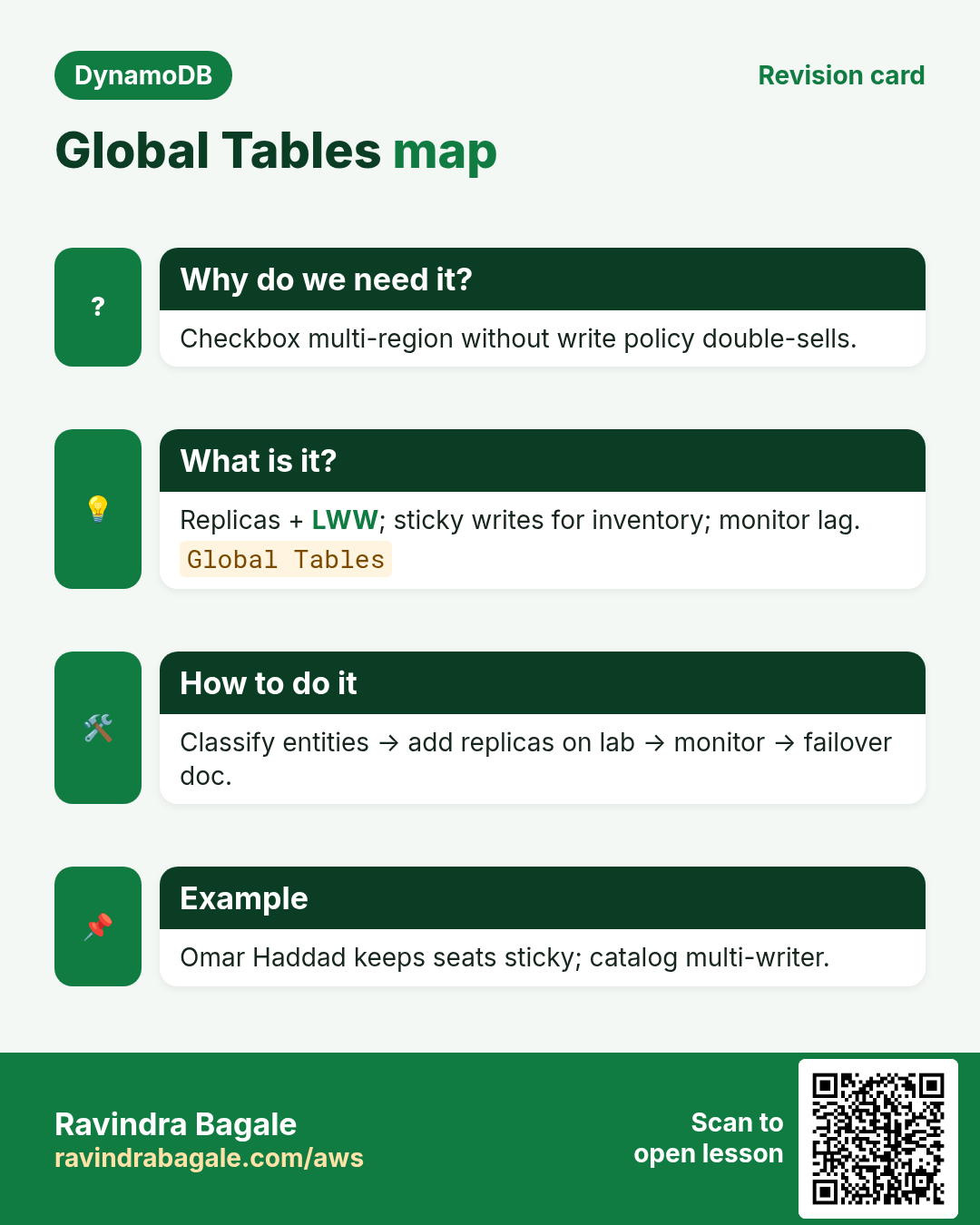
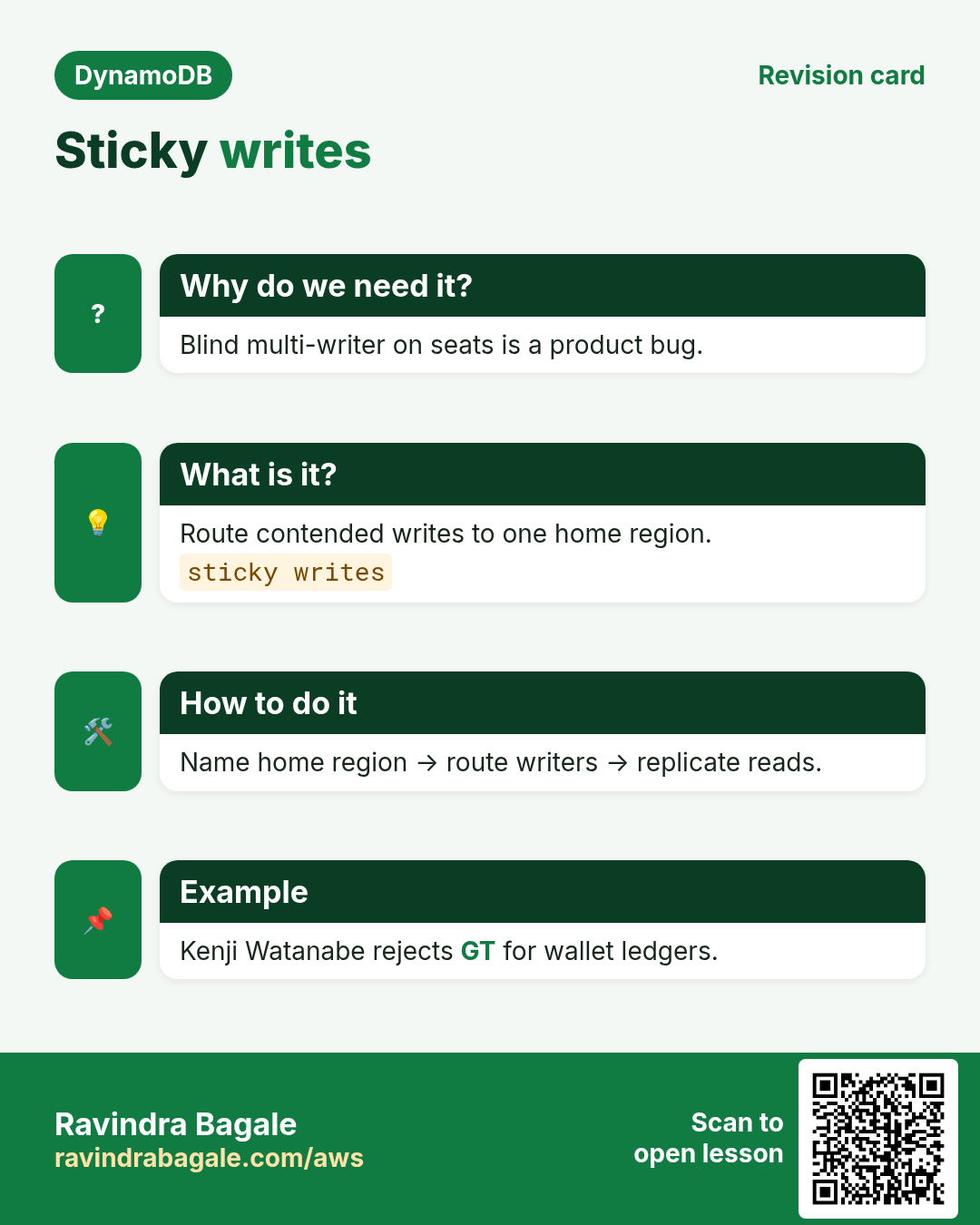
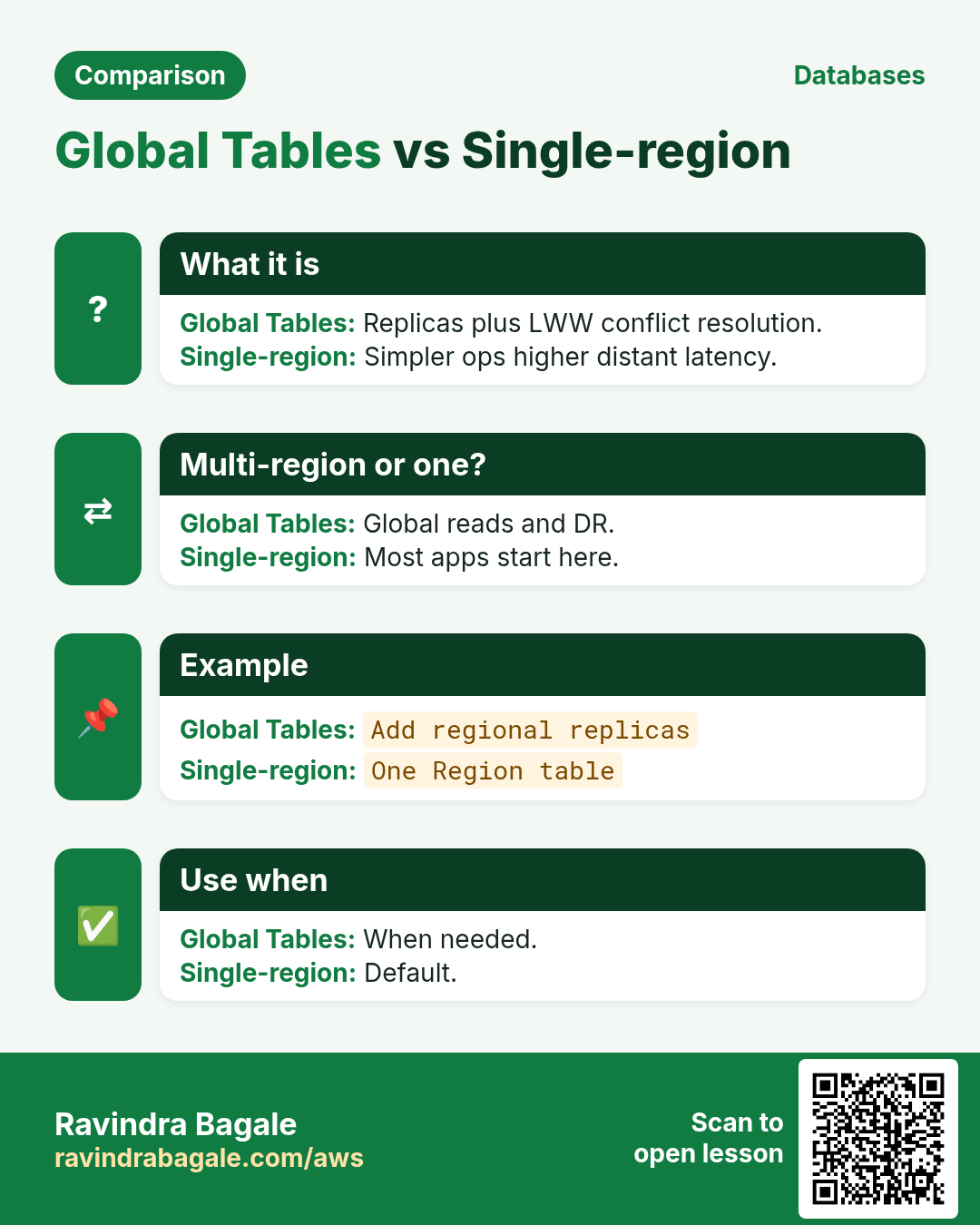
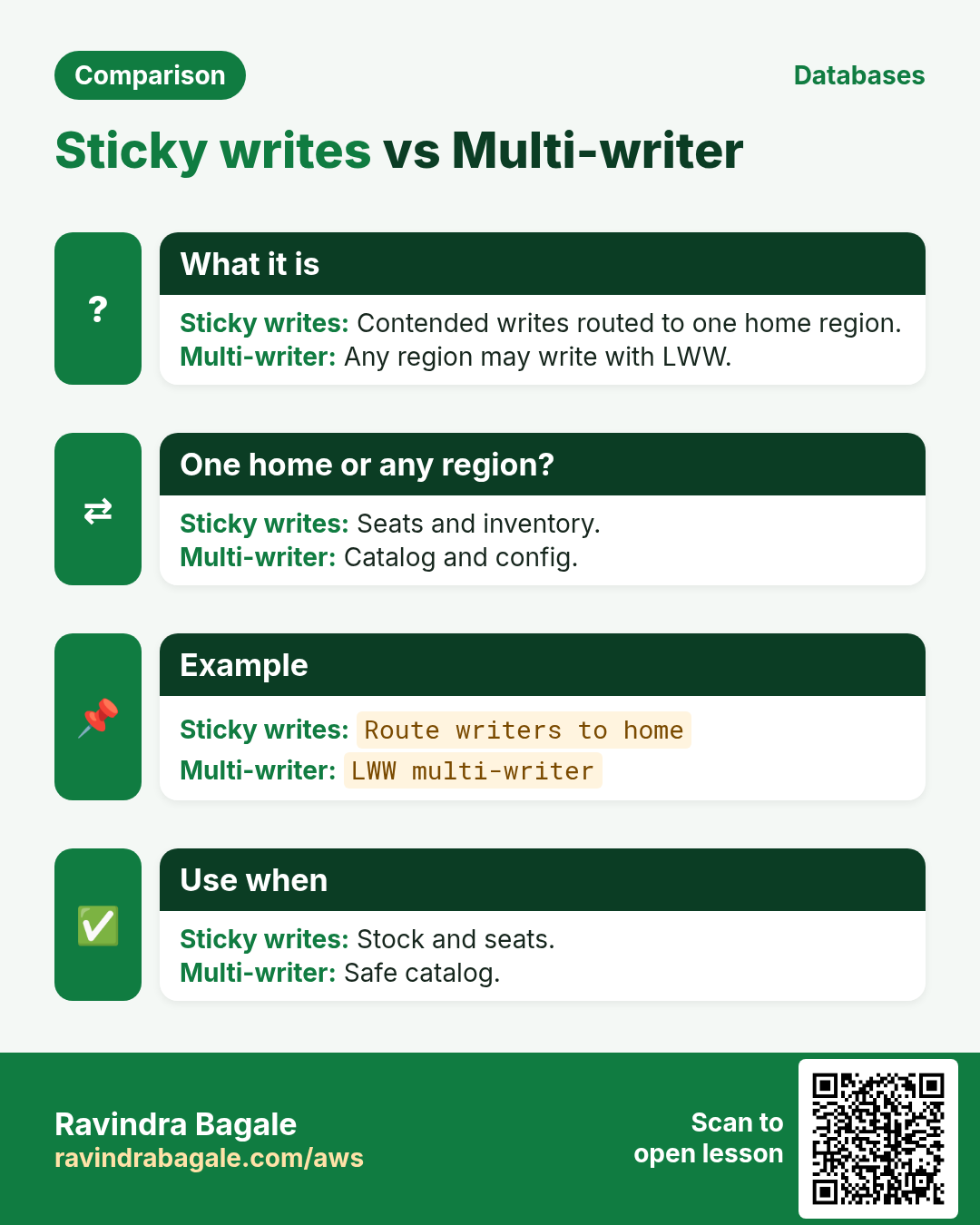
More cards: Ravi Sir's Cards.
Practice Tasks
Practice checks run in your browser. They check the answer for this exercise; they do not create resources or connect to your AWS account.
About this scenarioLondon Legal LLP is a law business in London. Oliver Hughes looks after its IT and cloud work. They count money in GBP and run their AWS resources in the eu-west-2 Region. In the tasks below you do real jobs for them using what this lesson teaches. All names, account IDs, IP addresses and numbers are made up for practice.
0 / 16
Easy Read from a second Region
A product catalogue must be readable in Mumbai and Singapore from a DynamoDB replica in each Region. Name the DynamoDB feature.
- Read the situation and identify what you need to decide.
- Work through the relevant concept or calculation.
- Enter only the requested term or number.
- Check your answer, then read the explanation.
Easy Choose a global-table conflict model
Enter 1 for MREC or 2 for MRSC. Which mode can reject simultaneous writes to the same item in two Regions with ReplicatedWriteConflictException?
- Read the situation and identify what you need to decide.
- Work through the relevant concept or calculation.
- Enter only the requested term or number.
- Check your answer, then read the explanation.
Easy Keep an item’s writes within one decision point
One seat is contested and the MREC replica in each Region can accept writes. To avoid two independent buyers both seeing FREE, how many home Regions should receive writes for this particular seat?
- Read the situation and identify what you need to decide.
- Work through the relevant concept or calculation.
- Enter only the requested term or number.
- Check your answer, then read the explanation.
Easy Diagnose slow writes on a single item key
After adding a regional replica, updates still concentrate on one popular session key. What capacity problem does that access pattern create?
- Read the situation and identify what you need to decide.
- Work through the relevant concept or calculation.
- Enter only the requested term or number.
- Check your answer, then read the explanation.
Easy Describe table replicas
CLI.
Describe table ShopApp
- Read the task and decide which AWS service it is about.
- Write aws, then the service name, then the operation (the action word).
- Add each needed flag (--name) followed by its value from the task.
- Flags can be in any order. Click Check answer.
Easy Entity split YAML
Classify.
YAML: catalog: multi-writer, inventory: sticky.
- Start from the top-level keys the task names.
- Indent child keys with 2 spaces (no tabs).
- Fill in each property with the value from the task.
- Click Check answer. Key order does not matter.
Easy Prevent a double booking in MREC
A class uses MREC global tables. You want all writes for each contested seat to go through one home Region. Name the routing approach taught here.
- Read the situation and identify what you need to decide.
- Work through the relevant concept or calculation.
- Enter only the requested term or number.
- Check your answer, then read the explanation.
Medium Name the reconciliation in an MREC catalogue
Two Regions send different display captions for the same product item. The app accepts whichever version MREC’s reconciliation keeps. Name that conflict rule.
- Read the situation and identify what you need to decide.
- Work through the relevant concept or calculation.
- Enter only the requested term or number.
- Check your answer, then read the explanation.
Medium Count Regions storing each replicated update
A global table has replicas in Mumbai, Singapore and Sydney. After a successful write, how many Regions store that logical item update including the origin?
- Read the situation and identify what you need to decide.
- Work through the relevant concept or calculation.
- Enter only the requested term or number.
- Check your answer, then read the explanation.
Medium Observe asynchronous replica lag
Which CloudWatch metric for MREC global tables reports the time for a change to replicate to another Region?
- Read the situation and identify what you need to decide.
- Work through the relevant concept or calculation.
- Enter only the requested term or number.
- Check your answer, then read the explanation.
Medium Change the application entry point
The standby API works in another Region, but users are still sent to the failed Region by the application hostname. What layer’s routing must also change?
- Read the situation and identify what you need to decide.
- Work through the relevant concept or calculation.
- Enter only the requested term or number.
- Check your answer, then read the explanation.
Medium Failover checklist YAML
List.
YAML list checks with dns and health.
- Start from the top-level keys the task names.
- Indent child keys with 2 spaces (no tabs).
- Fill in each property with the value from the task.
- Click Check answer. Key order does not matter.
Hard Check a second Region’s state before tests
You added a replica to the disposable table. What DynamoDB replica status should you wait for before using it to run lab traffic?
- Read the situation and identify what you need to decide.
- Work through the relevant concept or calculation.
- Enter only the requested term or number.
- Check your answer, then read the explanation.
Hard Pick global read consistency
Your design must read the latest committed item from another Region and can accept the restrictions of DynamoDB’s stronger mode. Name that global-table mode.
- Read the situation and identify what you need to decide.
- Work through the relevant concept or calculation.
- Enter only the requested term or number.
- Check your answer, then read the explanation.
Hard Scope a design to its real requirement
An app has no regional failover requirement and only serves users from one AWS Region. How many Regions are necessary for that minimal deployment?
- Read the situation and identify what you need to decide.
- Work through the relevant concept or calculation.
- Enter only the requested term or number.
- Check your answer, then read the explanation.
Hard Redistribute writes rather than add a replica
You identify an item family that receives too many writes under one key. Which modelling technique adds multiple key suffixes to spread independent writes?
- Read the situation and identify what you need to decide.
- Work through the relevant concept or calculation.
- Enter only the requested term or number.
- Check your answer, then read the explanation.