Create Your First AWS Lambda Function Step by Step
In What Is AWS Lambda? you met the idea. Now you build a real function end to end: console clicks, the same logic in five languages, a test event, CloudWatch logs, and the IAM execution role with a clear why.
In this chapter
- Create a function in the Lambda console
- Write the same handler in Python, Node.js, Java, .NET and Go
- Use test events and read CloudWatch Logs
- Understand the execution role and basic permissions
- Change memory, timeout and environment variables
1. A story: one discount calculator, five teams
Five teams in one company — Python, Node, Java, .NET, Go — all need the same rule: price in, discount out. Instead of five always-on servers, they share one Lambda pattern. Each team ships its own runtime. The trigger and the IAM role stay the same shape.
2. The execution role — why Lambda needs IAM
Separate who can invoke the function from what its code can do
Ravi may be allowed to open the console and test a discount function. When the function runs, it uses its own execution role for AWS activity such as sending logs. Ravi’s administrator permissions are not handed to the running function. Conversely, granting the function permission to write a log does not let a random browser invoke it.
Draw a permissions arrow into the function for the approved invoker and another arrow out to CloudWatch Logs for the execution role. If your test returns the correct discount but you cannot see a log, check the log destination, Region and the execution role’s permission before changing the project user’s sign-in.
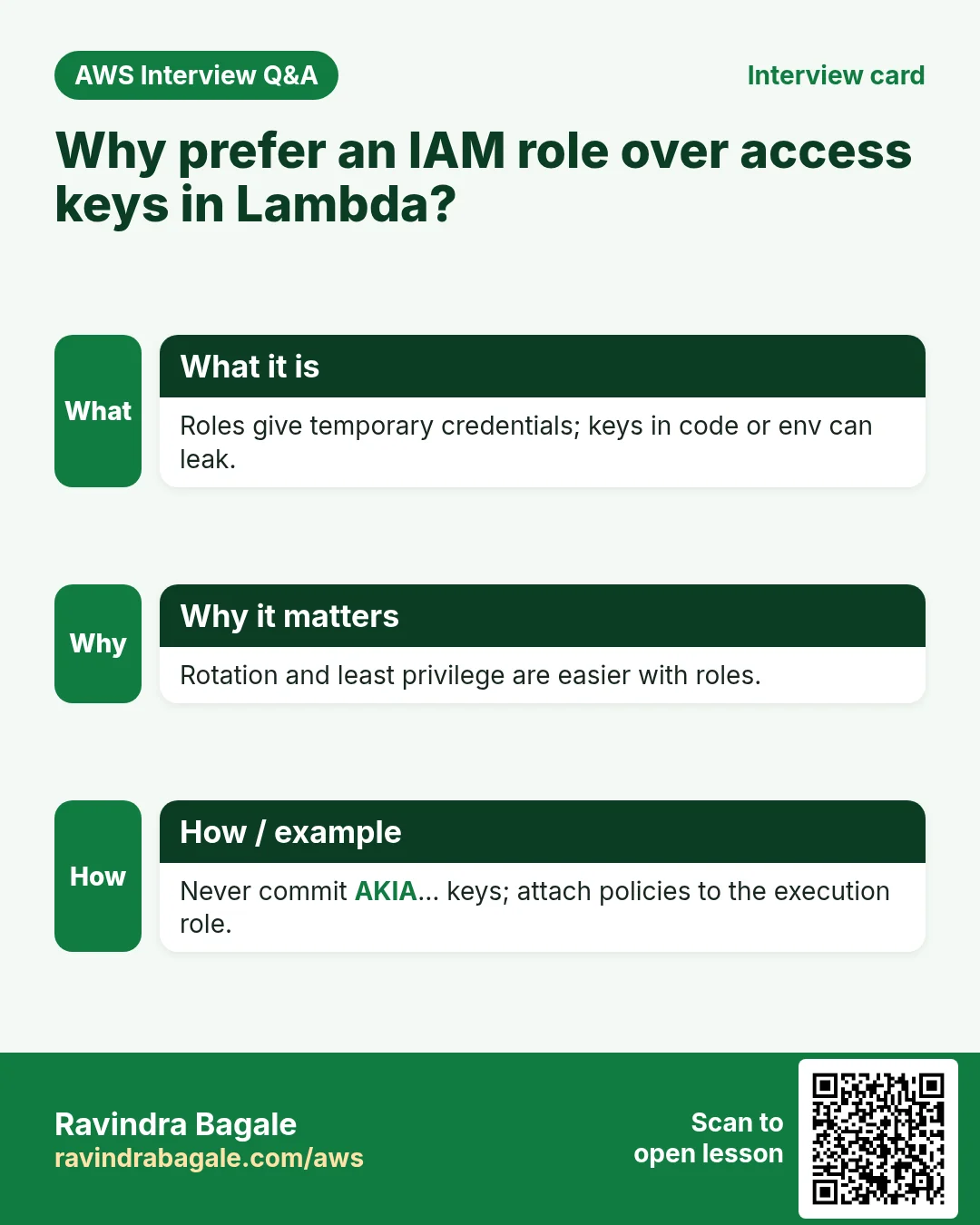
Your code often calls AWS: write logs, read S3, put DynamoDB items. Lambda must prove it is allowed. Access keys inside code leak. A role does not.
An execution role is an IAM role that Lambda assumes when your function runs. Trust policy: lambda.amazonaws.com may call sts:AssumeRole. Permissions policy: what the code may do. The AWS managed policy AWSLambdaBasicExecutionRole allows creating log groups and writing log streams — without it, even a Hello function looks "broken" because logs never appear.
Ravindra Bagale's Tip
Add only the extra permissions you need (S3 read, DynamoDB write). Never attach AdministratorAccess to a Lambda role.
3. Handler shape in five languages
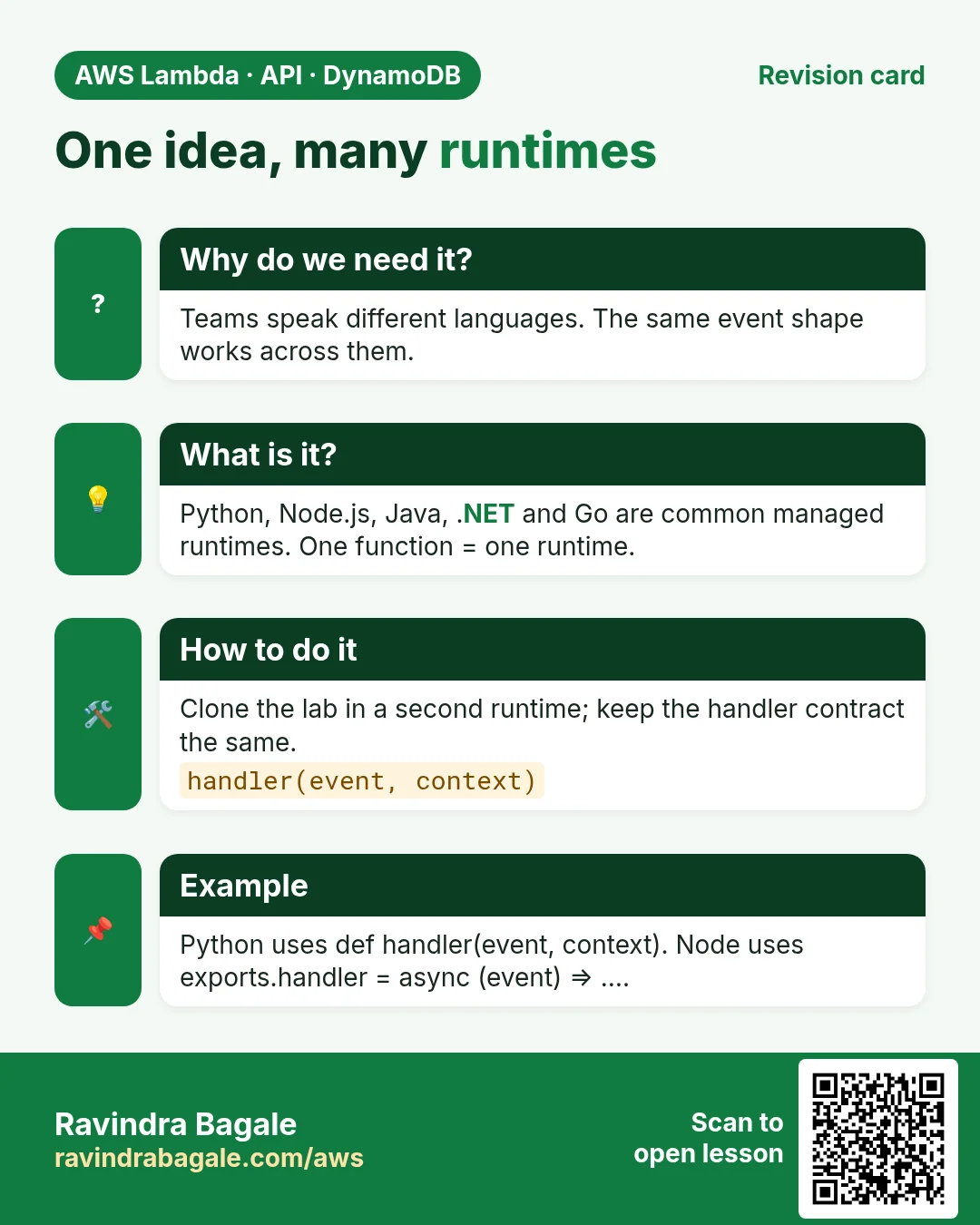
Every runtime has a handler: a function AWS calls with the event and a context object. Below, each snippet returns {"total": price * (1 - discount)}.
Python 3.12
import json
def lambda_handler(event, context):
    price = float(event["price"])
    discount = float(event.get("discount", 0.1))
    return {"total": round(price * (1 - discount), 2)}
Node.js 24.x
exports.handler = async (event) => {
  const price = Number(event.price);
  const discount = Number(event.discount ?? 0.1);
  return { total: Math.round(price * (1 - discount) * 100) / 100 };
};
Java 17 (handler class)
package example;
import java.util.Map;
import com.amazonaws.services.lambda.runtime.Context;
import com.amazonaws.services.lambda.runtime.RequestHandler;
public class Discount implements RequestHandler<Map<String, Object>, Map<String, Object>> {
  public Map<String, Object> handleRequest(Map<String, Object> e, Context c) {
    double price = ((Number) e.get("price")).doubleValue();
    double discount = e.containsKey("discount") ? ((Number) e.get("discount")).doubleValue() : 0.1;
    return Map.of("total", Math.round(price * (1 - discount) * 100.0) / 100.0);
  }
}
.NET 8 (C#)
using Amazon.Lambda.Core;
[assembly: LambdaSerializer(typeof(Amazon.Lambda.Serialization.SystemTextJson.DefaultLambdaJsonSerializer))]
namespace Discount;
public class Function {
  public Dictionary<string, double> FunctionHandler(Dictionary<string, double> e, ILambdaContext ctx) {
    var price = e["price"]; var discount = e.GetValueOrDefault("discount", 0.1);
    return new Dictionary<string, double> { ["total"] = Math.Round(price * (1 - discount), 2) };
  }
}
Go 1.x
package main
import ("context"; "github.com/aws/aws-lambda-go/lambda")
type In struct { Price float64 `json:"price"`; Discount float64 `json:"discount"` }
type Out struct { Total float64 `json:"total"` }
func Handle(ctx context.Context, e In) (Out, error) {
  d := e.Discount; if d == 0 { d = 0.1 }
  return Out{Total: e.Price * (1 - d)}, nil
}
func main() { lambda.Start(Handle) }
4. Lab: discount function in the console (Python)
Test a normal event and a malformed event
In your test event, set a price of 1000 and a discount of 0.10. In this calculator a discount is a fraction, so 0.10 means ten percent and the expected result is 900. Read the test response and record the request’s log entry. This checks both the desired input shape and the computation.
Then test a missing discount using only synthetic data. Does the handler return the intended validation message or an unexpected error? If validation is not implemented, note what must be checked before publishing the API. A green invocation with an incorrect number is still a logic problem.
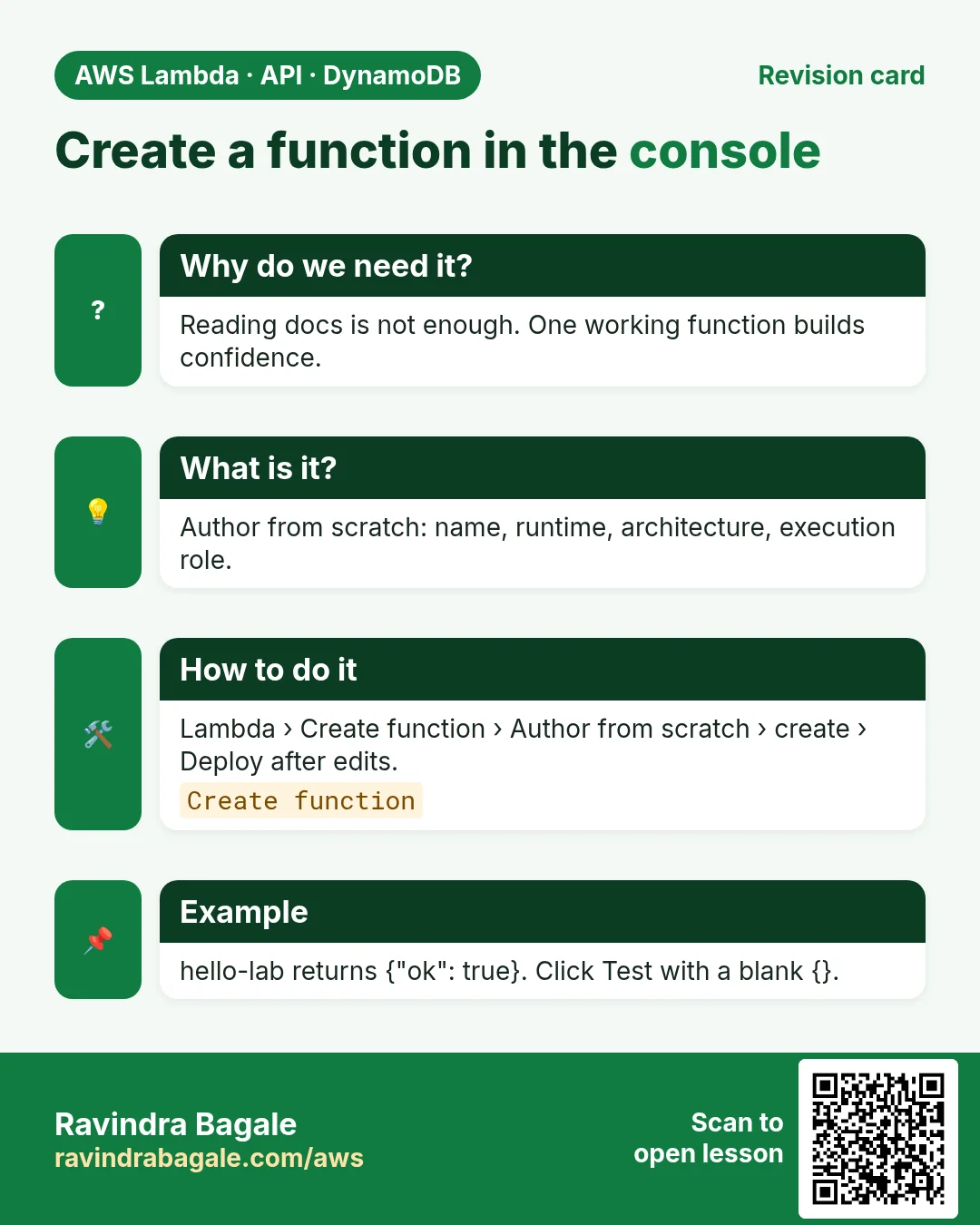
- Lambda → Create function → Author from scratch. Name:
discount-lab. Runtime: Python 3.12. Create a new role with basic Lambda permissions. - Paste the Python handler above → Deploy.
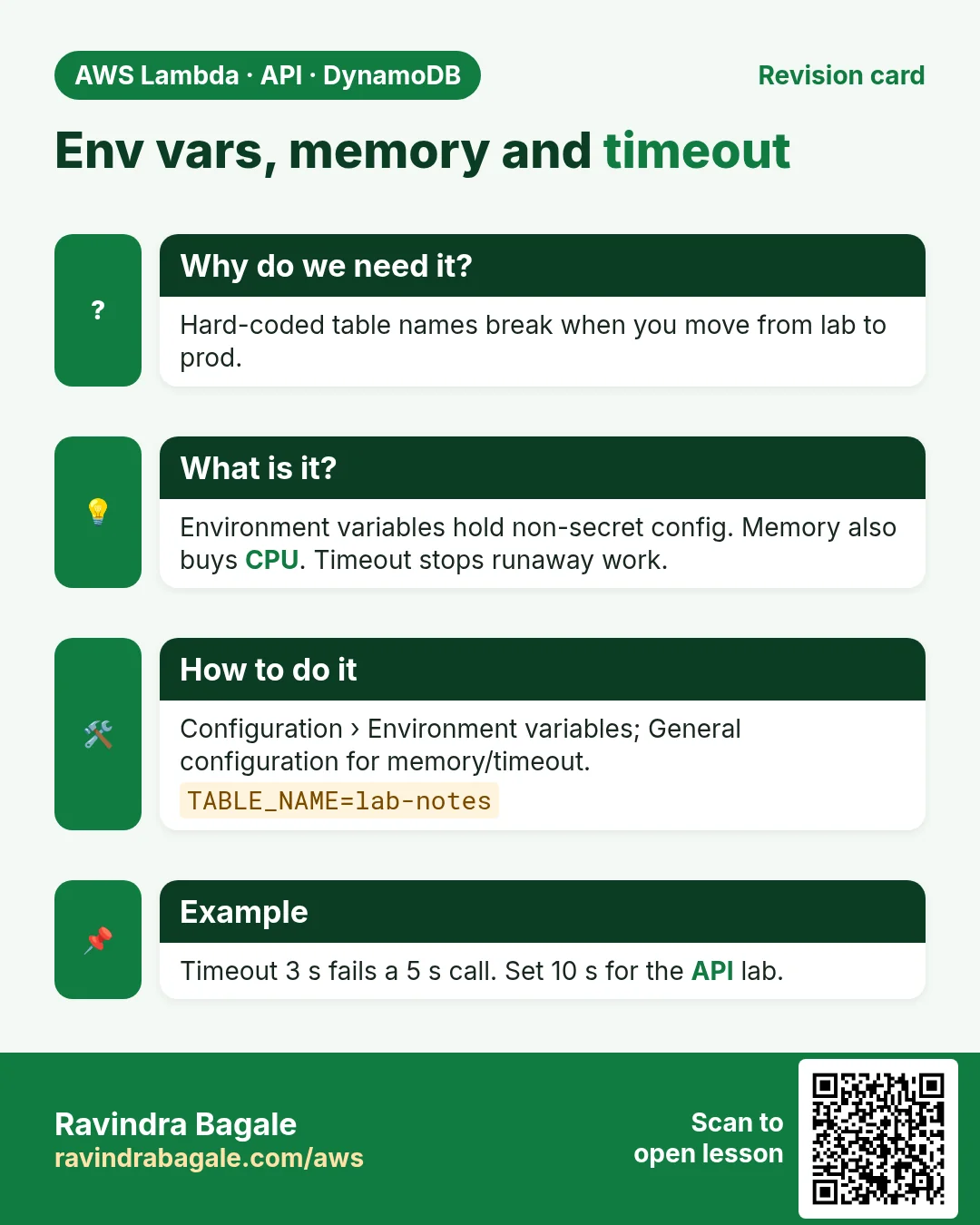
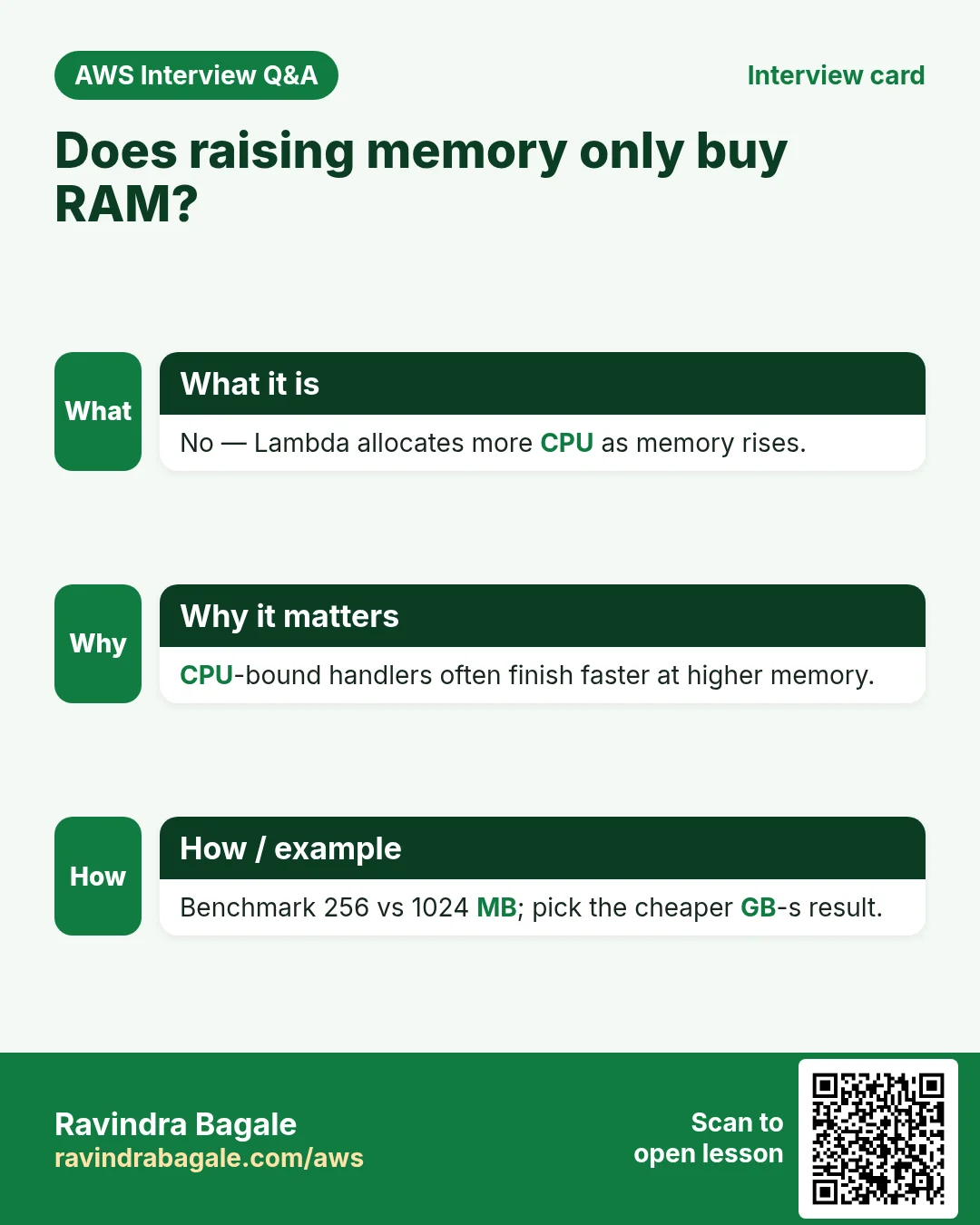
- Configuration → General configuration → Edit → Memory 256 MB, Timeout 10 s → Save. Why: imports and JSON need a little headroom.
- Configuration → Environment variables → Edit → Add
DEFAULT_DISCOUNT=0.1→ Save. Optional: read it withos.environ["DEFAULT_DISCOUNT"]. - Test → Create event name
ten-percentwith JSON:
{"price": 1000, "discount": 0.1}- Test. Expected return:
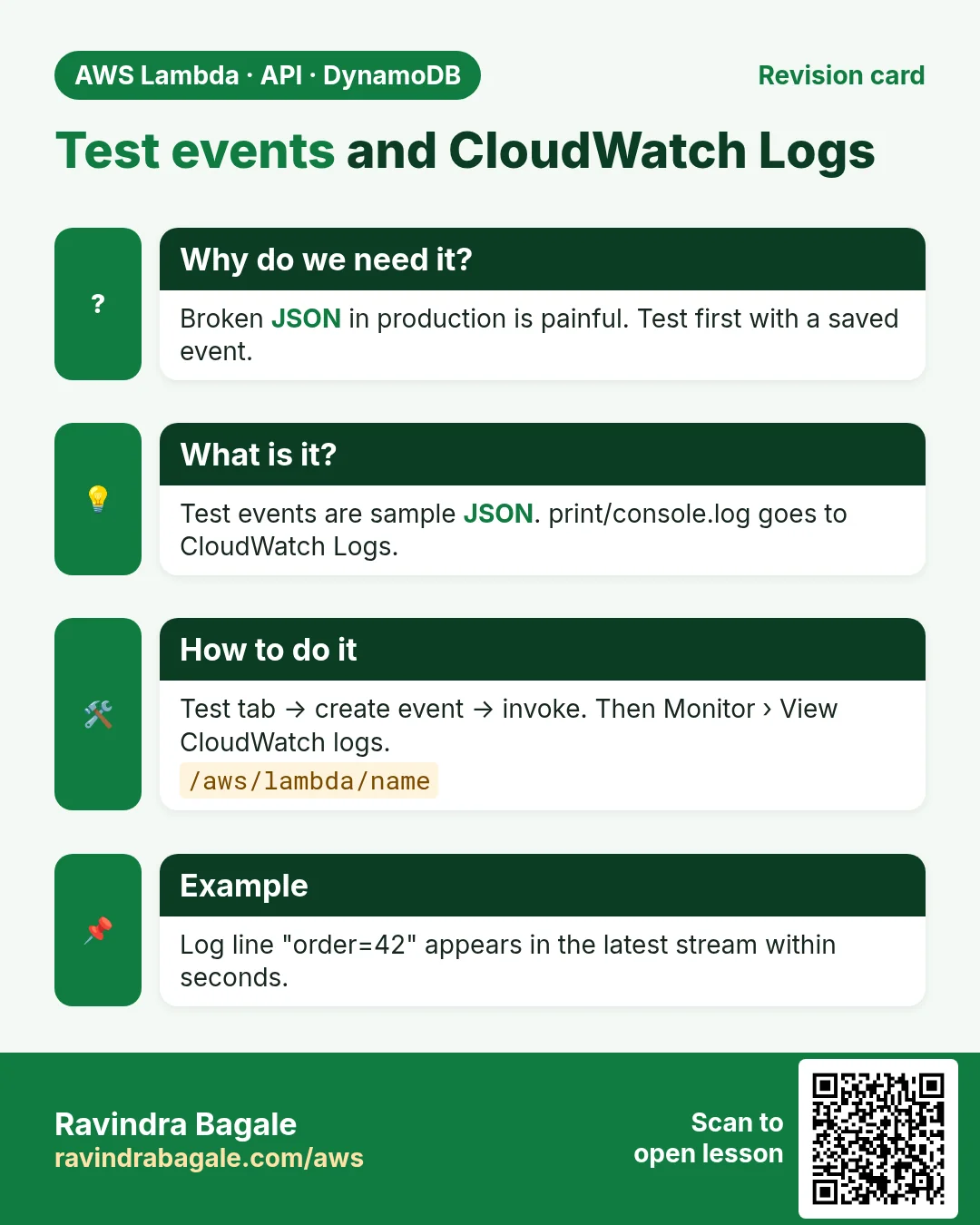
{"total": 900.0}. Note billed duration in the result pane. - Monitor → View CloudWatch logs → open the latest stream → confirm REPORT line with Duration and Memory Size.
- Configuration → Permissions → click the role name → confirm it has
AWSLambdaBasicExecutionRole. Why: that is how logs are allowed.
Same test via AWS CLI
aws lambda invoke --function-name discount-lab   --payload '{"price":500,"discount":0.2}' --cli-binary-format raw-in-base64-out out.json   --region ap-south-1 && cat out.json
# Expected: {"total": 400.0}
Cleanup
- Delete function
discount-lab. - IAM → Roles → delete its execution role if unused.
Common errors and fixes
These are synthetic practice situations. Diagnose the signal before changing a resource; no infrastructure changes are needed to read this guide.
Renaming the Python file produces HandlerNotFound or an import error.
The handler setting combines the module file name and function name. For a file called app.py containing lambda_handler, the setting is app.lambda_handler. Compare the deployed package layout, runtime settings and spelling before changing IAM permissions.
The CLI reports StatusCode 200, so the calculation is assumed successful.
The Invoke API status describes the invocation request, not whether the function logic succeeded. Inspect FunctionError when present and the returned payload saved in out.json. Then compare the actual result with the input; transport success is not the same as a correct discount.
Changing DEFAULT_DISCOUNT has no effect.
An environment variable does not automatically replace a literal value in the code. The shown basic Python handler still uses its coded default unless you explicitly read the variable. Check the deployed code path, not just whether the setting exists in the console.
Practical FAQ: decisions during real work
Where did my return value go if I cannot see it in the logs?
A synchronous return is sent to the invoking client or shown in the test result. It is not automatically your own application log line. Python print or logging writes explicit diagnostic output; keep secrets and complete real requests out of those logs.
Why should a calculator test include zero and missing discount separately?
A supplied zero means no discount; an omitted value means apply your chosen default. Different language examples can implement these cases differently. Write down the intended rule and compare outputs before calling implementations equivalent.
Will an async invocation return the calculated total to the caller?
No. An asynchronous invocation accepts an event for later processing, and the handler’s returned value is discarded. If the caller needs the total immediately, it needs a suitable synchronous request path. An accepted event is not the completed calculation.
5. Interview questions
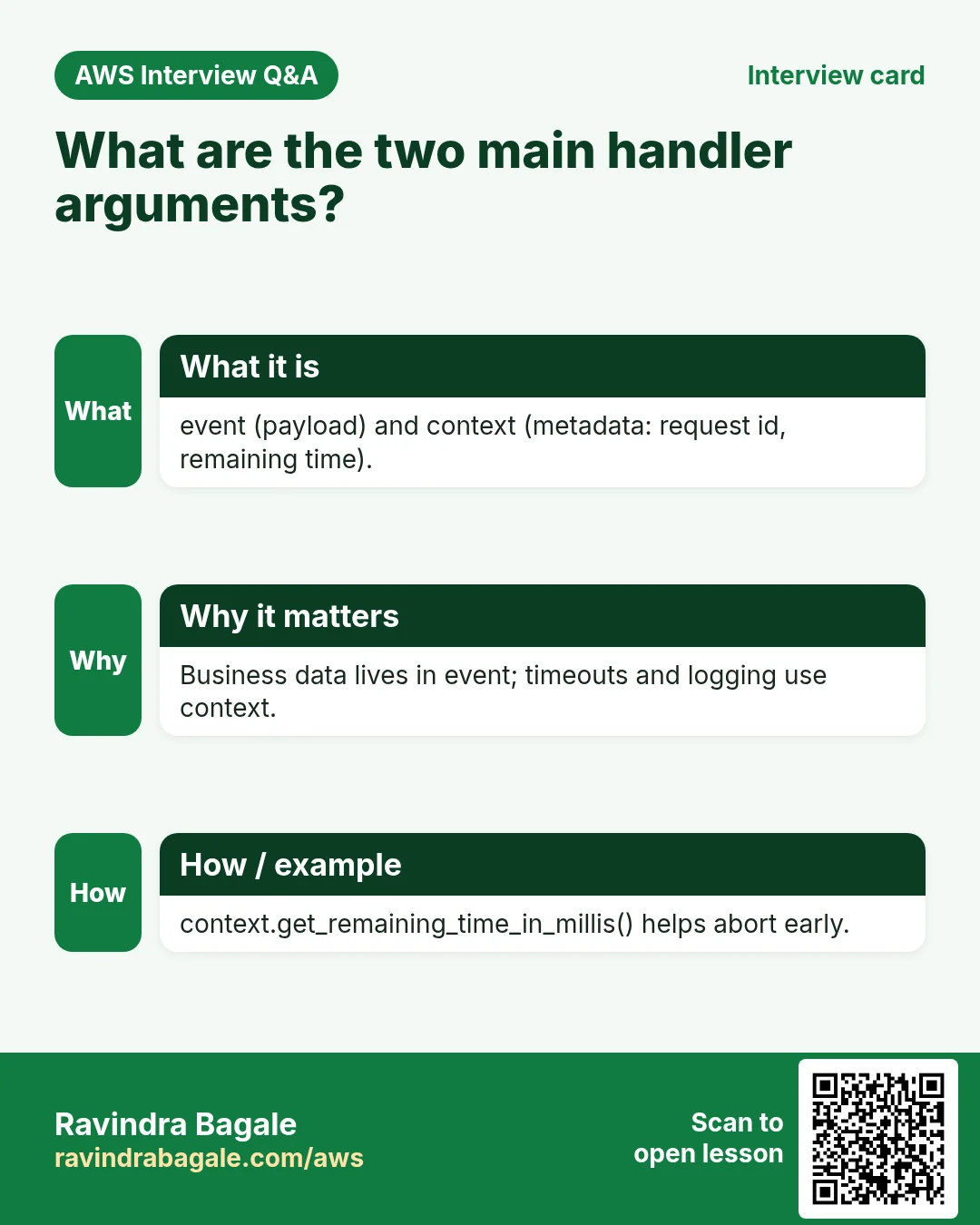
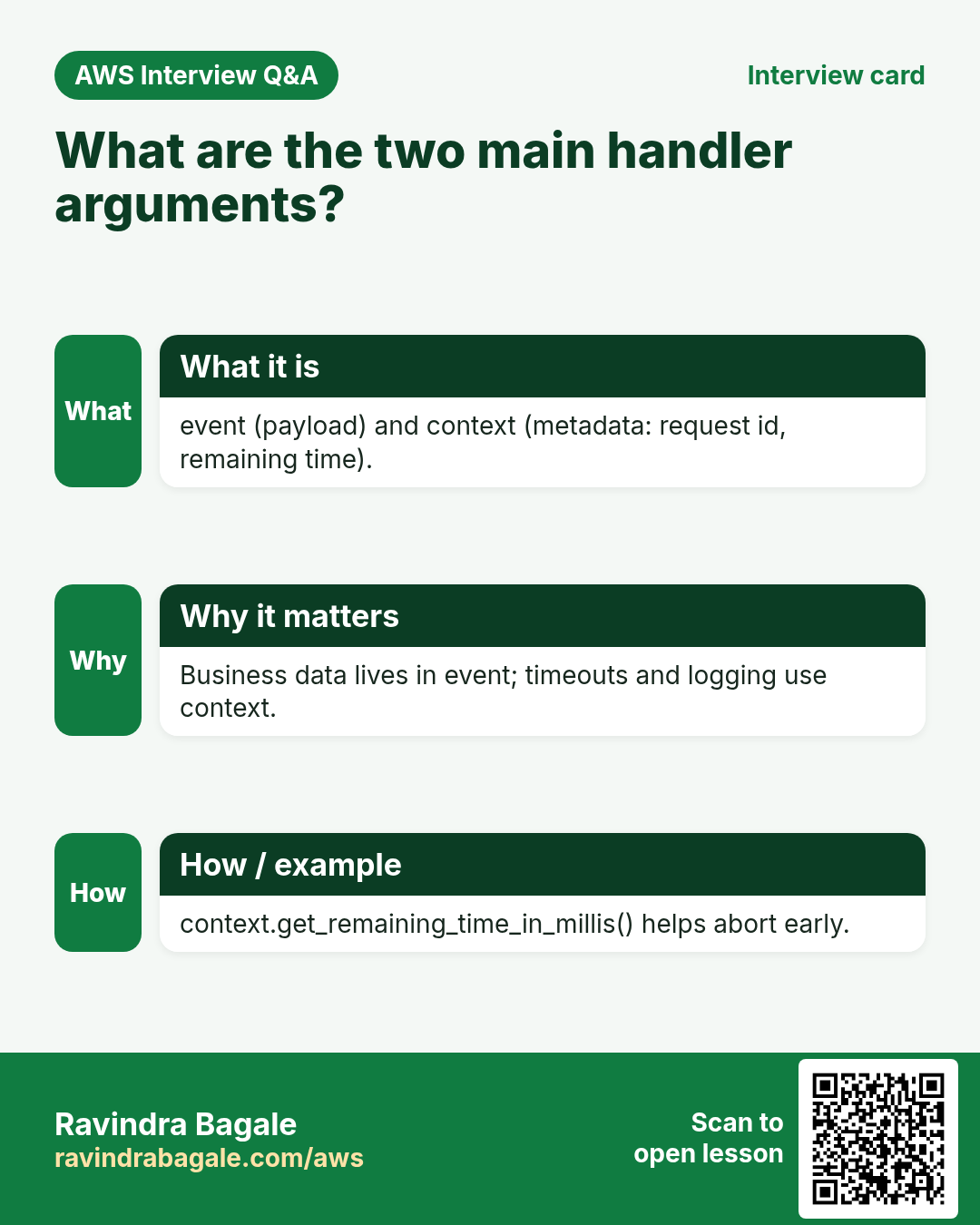
Q. What does the handler receive?
The event (input JSON) and a context object (request id, remaining time, memory).
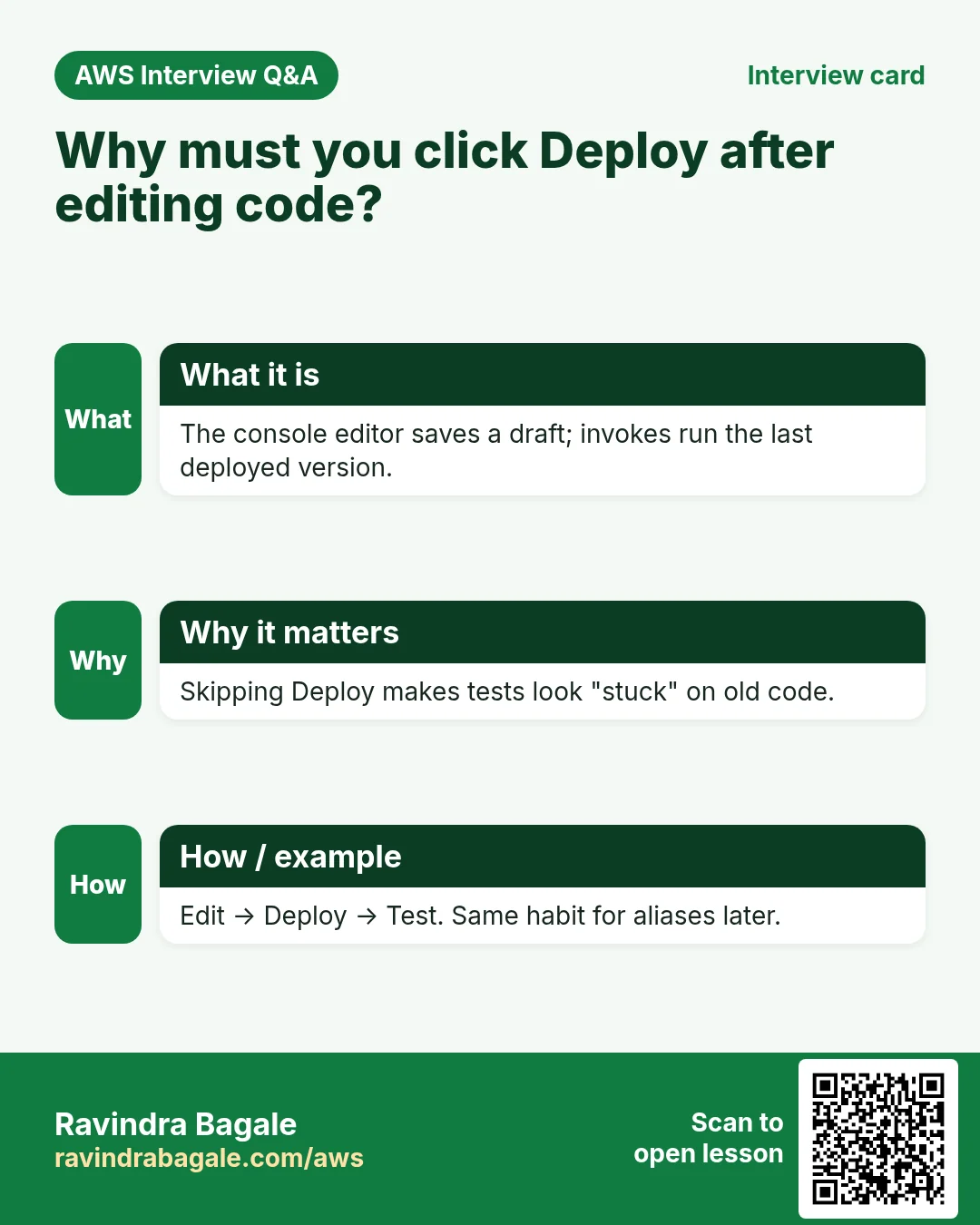
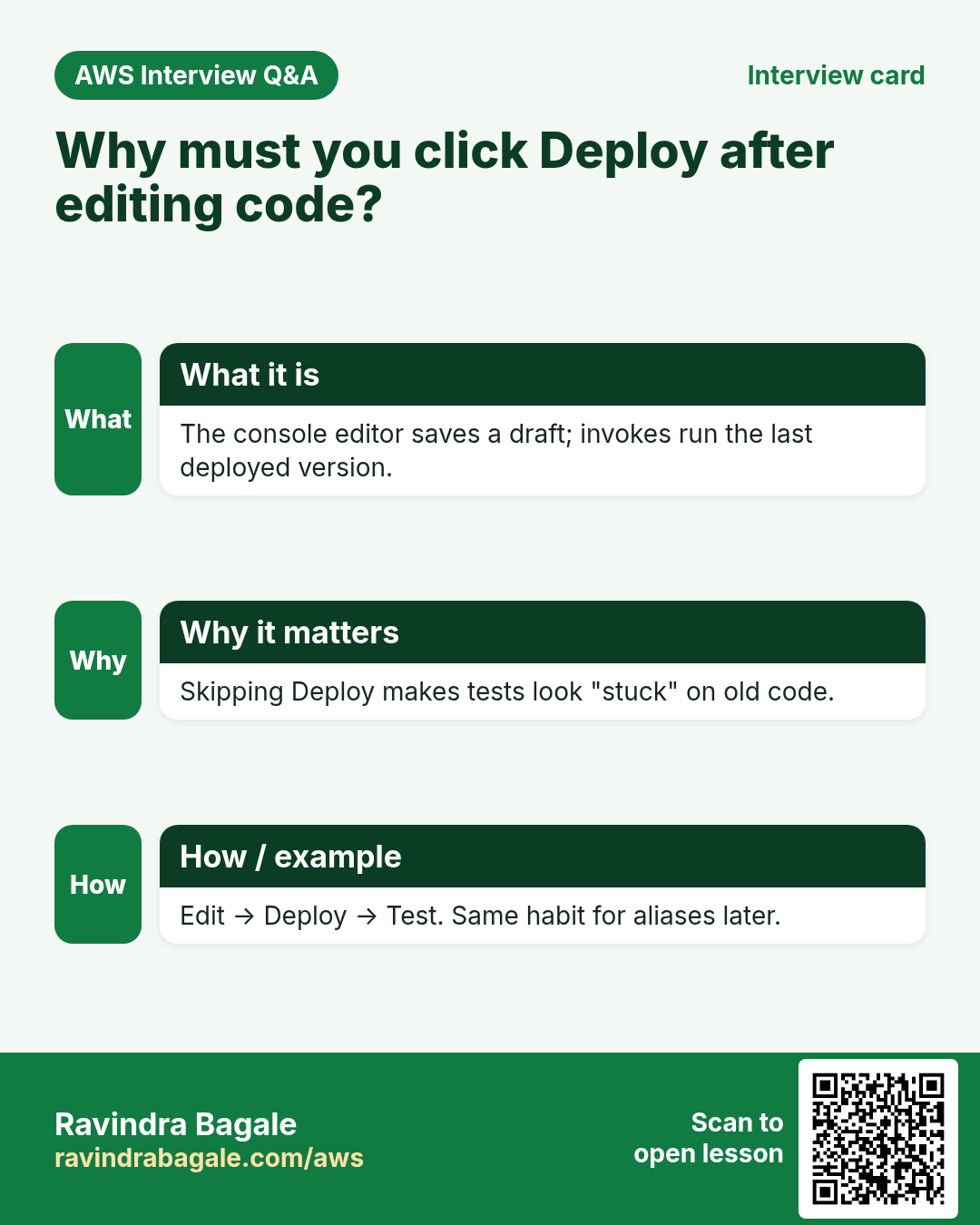
Q. Why Deploy after editing code in the console?
Console edits sit in a draft until you Deploy; tests run the deployed version.
Q. What does AWSLambdaBasicExecutionRole allow?
Creating log groups and writing log streams in CloudWatch Logs.
Q. How do you pass config without hard-coding?
Environment variables on the function, or SSM Parameter Store / Secrets Manager for secrets.
Q. Can one function use two runtimes?
No. One function = one runtime. Make a second function for another language.
Try at home
- Recreate discount-lab in Node.js 24.x and invoke with the CLI.
- Add an IAM permission for s3:ListBucket on a test bucket and list it from the function.
In short
- Create function → write handler → Deploy → Test → check logs.
- Execution role = trust Lambda + permissions your code needs.
- Same logic ports across Python, Node, Java, .NET, Go.
- Memory, timeout and env vars are first knobs to turn.
Worked example: test the same handler with a valid and bad event
When a calculation is wrong, first ask whether the function ran with the data you intended. Pick a supported runtime and run two saved console test events against your own learner function.
- Build a valid event using the same keys and types as the sample above. Calculate the expected discount on paper, invoke the handler and compare the returned value against your expected result.
- Remove one required input or use the wrong type. Record the actual error or response. Add input validation if the handler assumes the types are correct. Rerun both events after the change.
- If the handler never runs, check the configured module and exported function name against the deployment package. If it runs but cannot call another AWS service, check the execution role and the resource it is trying to reach.
Interview question: does the execution role decide who is allowed to invoke the function?
The execution role gives the function its AWS permissions while it runs. The invoking identity or service needs its own permission to invoke the function. They protect two different actions.
Practise this chapter
Check your understanding
Choose an answer, then compare your reasoning with the explanation.
Practice Tasks
Practice checks run in your browser. They check the answer for this exercise; they do not create resources or connect to your AWS account.
About this scenarioSangli Turmeric Traders is a spice trading business in Sangli. Dattatray Chavan looks after its IT and cloud work. They count money in INR and run their AWS resources in the ap-south-1 Region. In the tasks below you do real jobs for them using what this lesson teaches. All names, account IDs, IP addresses and numbers are made up for practice.
0 / 12
Easy List functions
See which functions exist in this Region.
List the Lambda functions in ap-south-1.
- Read the task and decide which AWS service it is about.
- Write aws, then the service name, then the operation (the action word).
- Add each needed flag (--name) followed by its value from the task.
- Flags can be in any order. Click Check answer.
Medium Invoke a function
Invoke runs the function now and saves its answer in a file.
Invoke sanglihaldi-orders-fn and save the response to out.json.
- Read the task and decide which AWS service it is about.
- Write aws, then the service name, then the operation (the action word).
- Add each needed flag (--name) followed by its value from the task.
- Flags can be in any order. Click Check answer.
Medium Trust policy for a Lambda role
The trust policy says WHO may take the role.
Write a trust policy that lets lambda.amazonaws.com assume the role.
- Start with { "Version": "2012-10-17", "Statement": [ ... ] }.
- In each statement write Effect, Action and Resource.
- Give only what the task needs (least privilege).
- Use double quotes and commas correctly. Click Check answer.
Medium Change timeout and memory
More memory also gives more CPU; timeout stops runaway runs.
Set sanglihaldi-orders-fn to timeout 30 seconds and memory 512 MB.
- Read the task and decide which AWS service it is about.
- Write aws, then the service name, then the operation (the action word).
- Add each needed flag (--name) followed by its value from the task.
- Flags can be in any order. Click Check answer.
Medium Let a function write logs
Without these actions, Lambda logs never appear in CloudWatch.
Allow logs:CreateLogGroup, logs:CreateLogStream, logs:PutLogEvents on arn:aws:logs:*:*:* only.
- Start with { "Version": "2012-10-17", "Statement": [ ... ] }.
- In each statement write Effect, Action and Resource.
- Give only what the task needs (least privilege).
- Use double quotes and commas correctly. Click Check answer.
Medium Follow logs live
aws logs tail --follow is like tail -f for CloudWatch Logs.
Follow the log group /aws/lambda/sanglihaldi-orders-fn live.
- Read the task and decide which AWS service it is about.
- Write aws, then the service name, then the operation (the action word).
- Add each needed flag (--name) followed by its value from the task.
- Flags can be in any order. Click Check answer.
Hard Create a Lambda function
Lambda needs the code zip, a runtime, a handler name and an execution role.
Create function sanglihaldi-orders-fn: runtime python3.12, handler app.handler, role arn:aws:iam::126983531579:role/lambda-basic, code in function.zip.
- Read the task and decide which AWS service it is about.
- Write aws, then the service name, then the operation (the action word).
- Add each needed flag (--name) followed by its value from the task.
- Flags can be in any order. Click Check answer.
Hard Set environment variables
Keep settings like table names out of the code.
Set the environment variable TABLE=sanglihaldi-orders on sanglihaldi-orders-fn.
- Read the task and decide which AWS service it is about.
- Write aws, then the service name, then the operation (the action word).
- Add each needed flag (--name) followed by its value from the task.
- Flags can be in any order. Click Check answer.
Hard Invoke with a JSON payload
In CLI v2, raw JSON needs --cli-binary-format raw-in-base64-out.
Invoke sanglihaldi-orders-fn with payload {"orderId":"o-101"} (raw JSON) and save the reply in out.json.
- Read the task and decide which AWS service it is about.
- Write aws, then the service name, then the operation (the action word).
- Add each needed flag (--name) followed by its value from the task.
- Flags can be in any order. Click Check answer.
Hard Lambda GB-seconds
Lambda bills memory × time.
1,000,000 invocations, 512 MB memory, 200 ms each. How many GB-seconds?
- Write down the numbers the task gives you.
- Work it out step by step on paper.
- Type only the final answer in the box.
- Click Check answer.
Hard Connect an SQS queue to Lambda
An event source mapping makes Lambda poll the queue and process messages in batches.
Create an event source mapping from queue arn:aws:sqs:ap-south-1:126983531579:sanglihaldi-orders to sanglihaldi-orders-fn with batch size 10.
- Read the task and decide which AWS service it is about.
- Write aws, then the service name, then the operation (the action word).
- Add each needed flag (--name) followed by its value from the task.
- Flags can be in any order. Click Check answer.
Hard Let S3 call your function
A resource-based permission is needed before S3 can invoke the function.
Add permission statement s3invoke to sanglihaldi-orders-fn so s3.amazonaws.com can call lambda:InvokeFunction from bucket arn:aws:s3:::sanglihaldi-uploads.
- Read the task and decide which AWS service it is about.
- Write aws, then the service name, then the operation (the action word).
- Add each needed flag (--name) followed by its value from the task.
- Flags can be in any order. Click Check answer.
Revision, comparison and interview cards
Revise this lesson in a few minutes. Save the cards on your phone or download them as PNG files. The QR code on each card opens this lesson.
More cards: Ravi Sir's Cards.