Event-Driven Serverless: Choreography vs Orchestration Explained
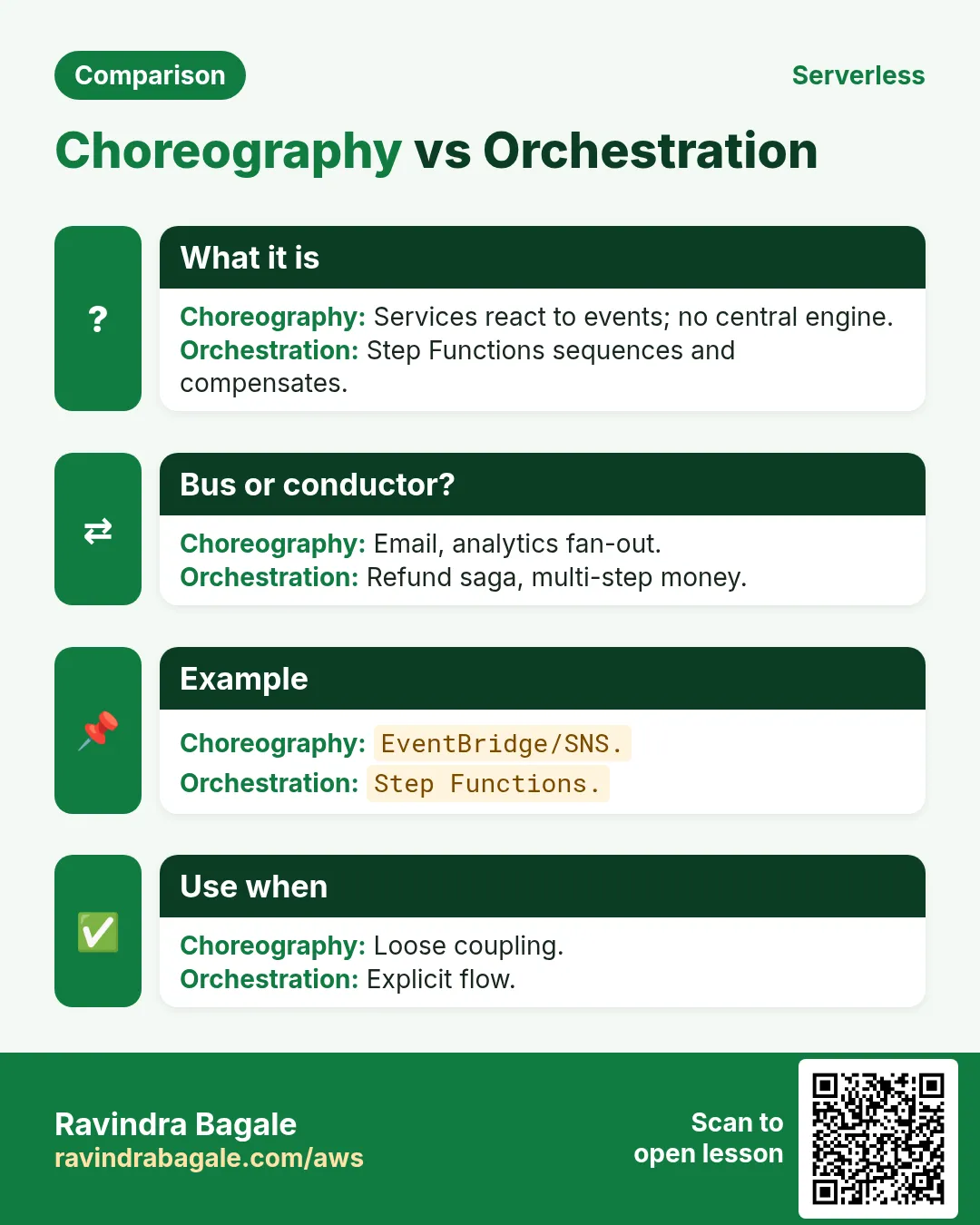
At a wedding, either every relative reacts when they hear the dhol (choreography), or one stage manager cues each act (orchestration). Event-driven serverless uses both. This chapter helps you pick: EventBridge/SNS reactions vs Step Functions as the conductor — and how to avoid spaghetti events.
In this chapter
- Explain choreography vs orchestration with a wedding story
- Place EventBridge/SNS vs Step Functions on a decision table
- Spot spaghetti events and missing ownership
- Design one order-flow both ways on paper
- Link EventBridge and Step Functions chapters
1. Everyday example: wedding cues
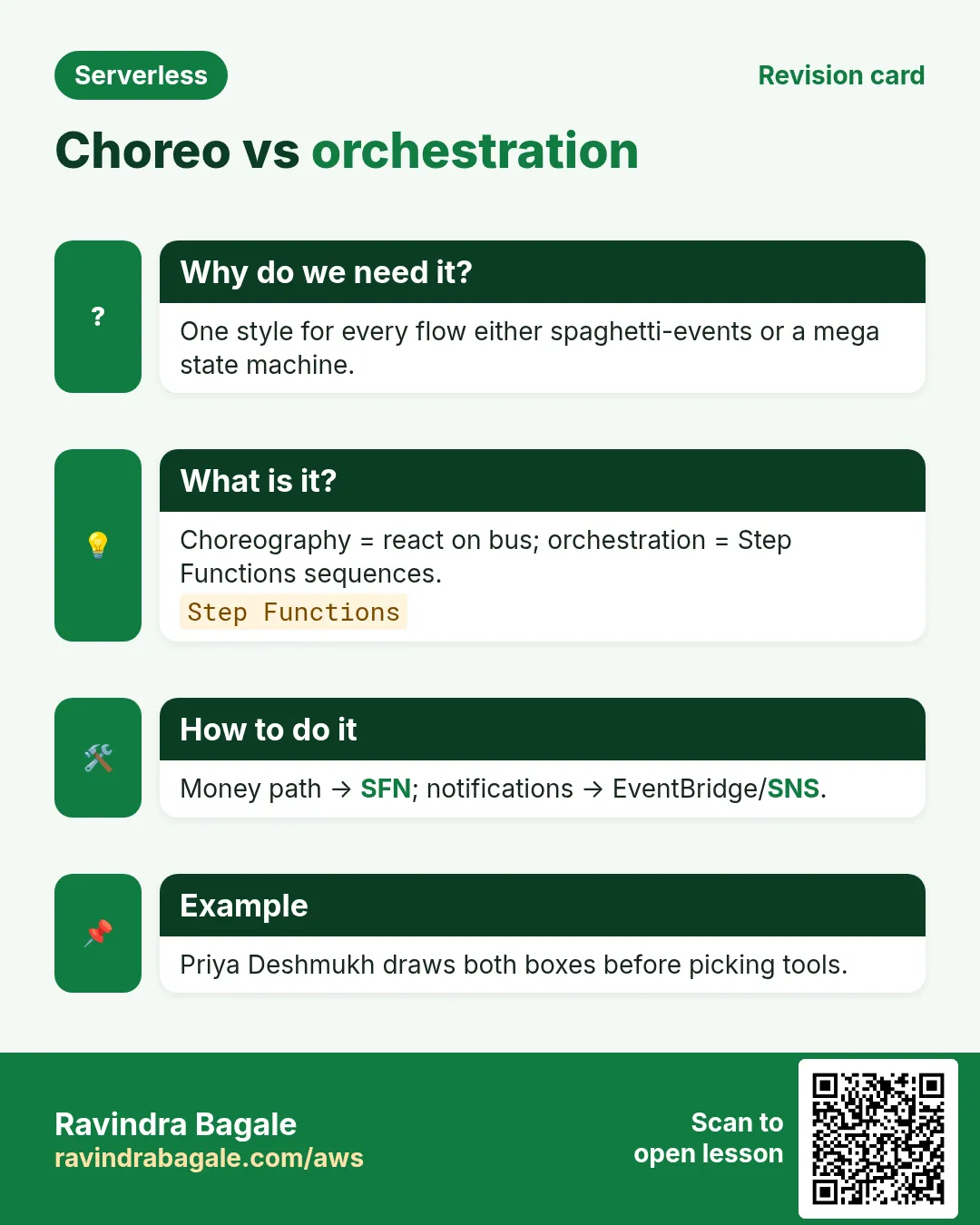
When the dhol starts, the photographer shoots, the caterer plates, the DJ fades talk music — nobody waits for a central WhatsApp from the host for each micro-step. That is choreography. When the host needs the pheras exactly after the vows, a stage manager sequences it. That is orchestration. Diego in São Paulo models order-paid the same way: inventory and email can react to an event; refund+stock rollback wants a visible workflow.
Deep service chapters: EventBridge, Step Functions, SQS/SNS. This page is the decision layer.
2. Why the distinction matters
If everything is choreography, nobody sees the whole story when a step fails at 2 AM. If everything is orchestration, every small notification becomes a state machine you hate to change. Grown systems mix both.
Choreography: producers emit events; consumers subscribe; no central brain. Orchestration: a workflow engine tells each step when to run and what to do on failure.
3. Vertical comparison
4. Decision table
| Question | Prefer choreography | Prefer orchestration |
|---|---|---|
| Many independent reactions? | Yes — SNS/EventBridge | No |
| Need one visible timeline? | Maybe not | Yes — Step Functions |
| Need compensations / saga? | Hard — invent correlation | Built-in patterns |
| Team owns one small side effect? | Subscribe and go | Central team owns flow |
| Audit for regulators? | Need good log design | Execution history helps |
5. How to design an order-paid flow both ways
Choreography sketch
- Order service emits OrderPaid on EventBridge bus.
- Inventory rule → Lambda reserve stock.
- Email rule → Lambda send receipt (INR/BRL).
- Analytics rule → firehose/Lambda.
- Each consumer owns retries + DLQ.
Orchestration sketch
- API returns 202 and StartExecution on state machine.
- Task ReserveStock → Task Charge → Task Email.
- Catch on Charge → Task ReleaseStock.
- One execution ARN in support tickets.
List event buses
aws events list-event-buses --region ap-south-1Meaning: Default bus always exists; custom buses isolate domains.
List state machines
aws stepfunctions list-state-machines --region ap-south-1 --query 'stateMachines[].{N:name,A:stateMachineArn}'Meaning: See what orchestrations already exist before adding another.
6. Spaghetti events — symptoms and fixes
| Symptom | Fix |
|---|---|
| Everyone listens to almost every event | Event storms |
| No owner for an event schema | No owner |
| Silent fail in one consumer | Silent fail |
| Circular events A→B→A | Cycles |
| Cannot answer where is my order | Where is order? |
7. Worked mini-examples
Python: choose mode
def mode(needs_saga, many_side_effects, need_timeline):
    if needs_saga or need_timeline:
        return "orchestrate"
    if many_side_effects:
        return "choreograph"
    return "either"
print(mode(True, True, False))
print(mode(False, True, False))
Output: orchestrate / choreograph. Meaning: saga/timeline push you to Step Functions.
EventBridge rule shape (concept)
{
  "source": ["shop.orders"],
  "detail-type": ["OrderPaid"],
  "detail": {"currency": ["INR", "BRL"]}
}
Meaning: filter early so the inventory Lambda never wakes for EUR-only analytics noise.
8. Lab: paper both designs + read-only console
Do this in ap-south-1 (Mumbai) unless your org forbids it. Set a budget alert first.
- Draw choreography for OrderPaid with three consumers.
- Draw orchestration with one compensation.
- Console: EventBridge rules count (read-only).
- Console: one state machine definition preview if any.
- Write which design you pick for refunds and why.
Cleanup (stop billing)
- No creates required; delete any bus/rule you added.
- Delete lab state machines.
9. Hybrid: the usual adult answer
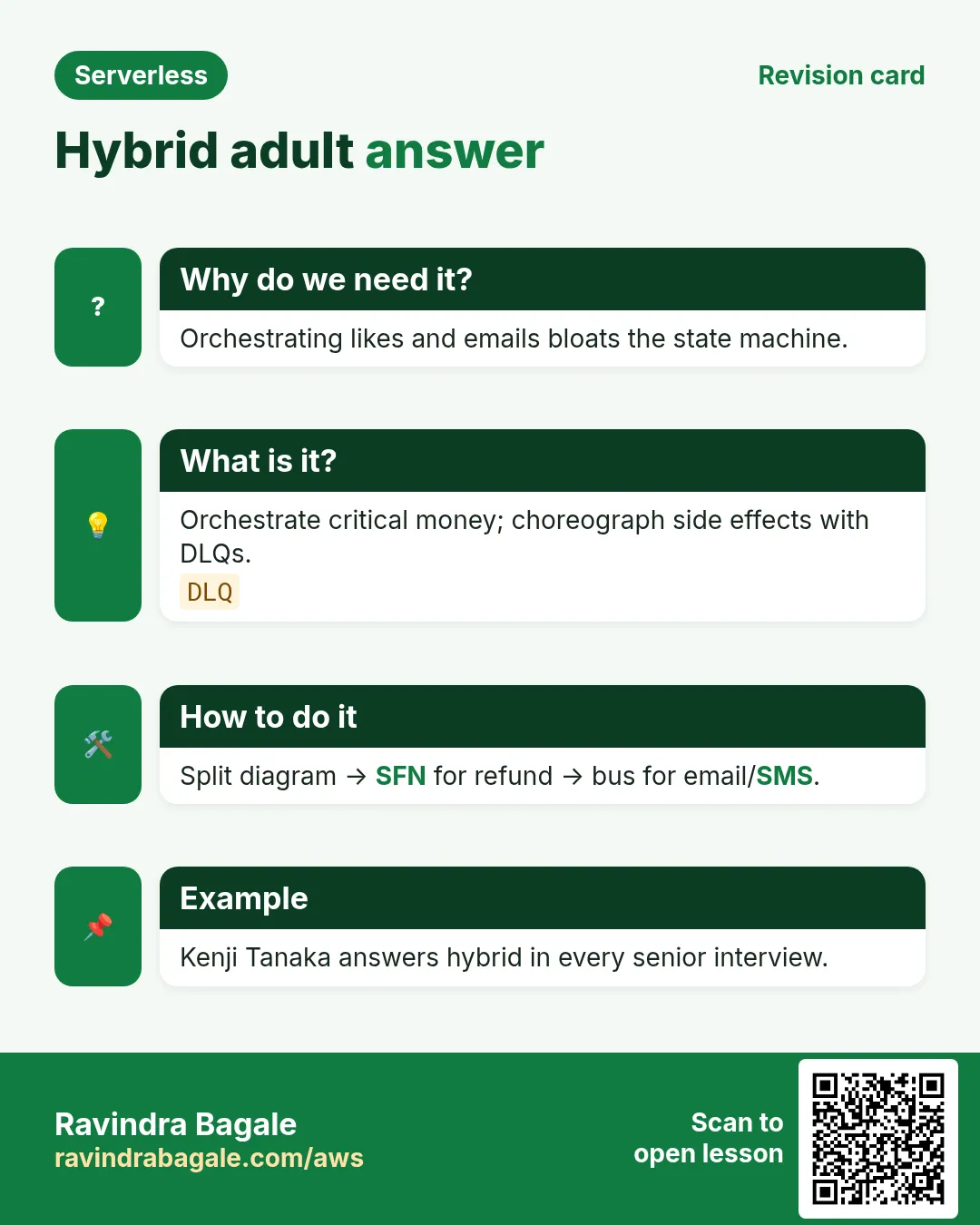
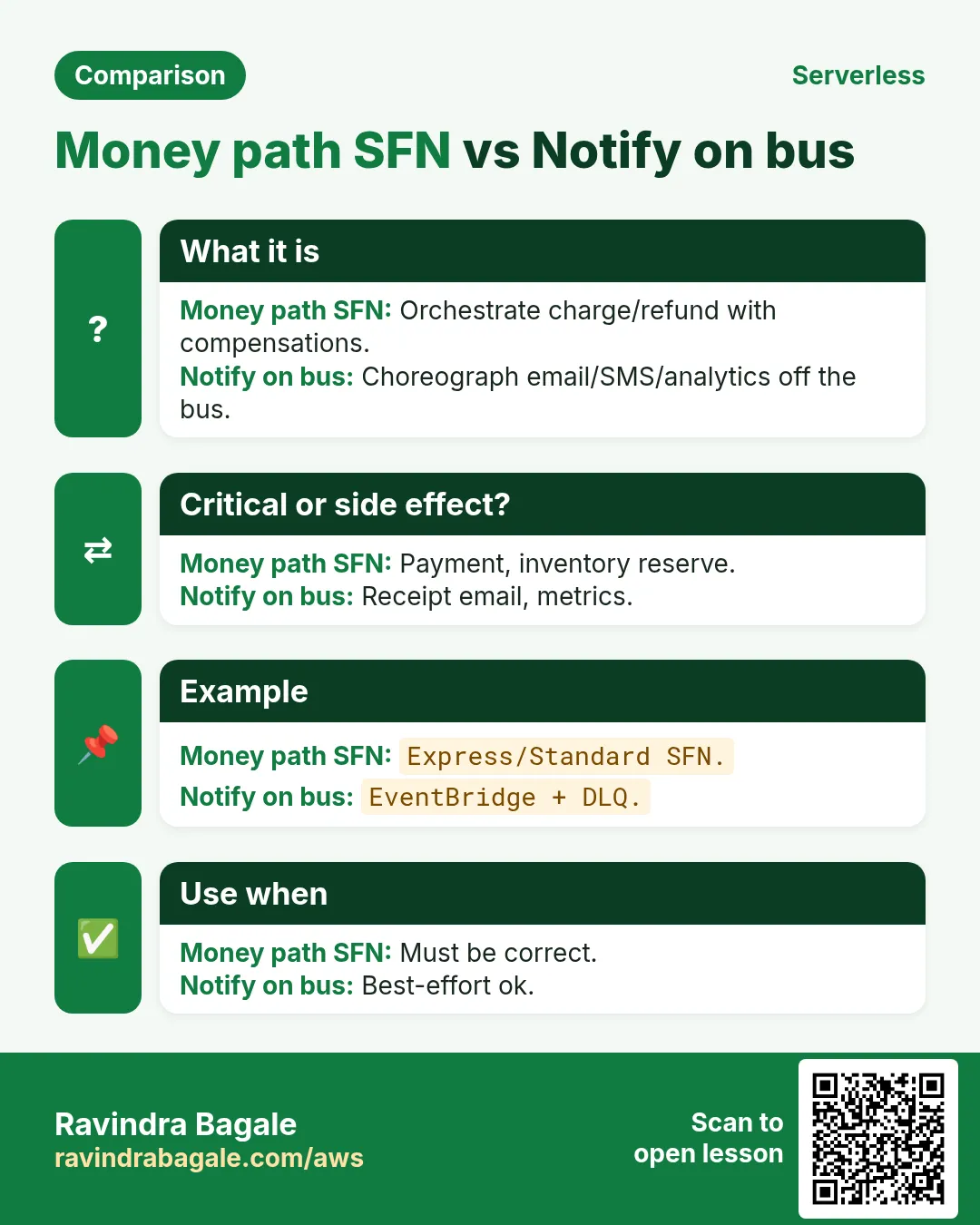
Orchestrate the money path (pay, reserve, refund). Choreograph the fan-out notifications (email, push, analytics). Fatima in Casablanca does exactly that for customs: saga in Step Functions, notifications on a bus.
10. Per-concept commands
Put a sample event (sandbox)
aws events put-events --region ap-south-1 --entries '[{
  "Source":"shop.orders","DetailType":"OrderPaid",
  "Detail":"{"orderId":"o-1","currency":"INR"}"}]'
Meaning: Only in sandbox; watch which rules fire.
Describe a state machine
aws stepfunctions describe-state-machine --state-machine-arn $ARN --region ap-south-1 --query 'definition' --output text | headMeaning: Read definition before changing.
11. Same pattern across industries
- Fintech (Aisha, Lagos): payment webhooks → SQS → Lambda; never block the bank callback thread.
- Ecommerce (Rohan, Pune): checkout API on API Gateway+Lambda; inventory fan-out on SNS.
- Healthcare (Mei, Singapore): appointment SMS via SNS; PHI stays in DynamoDB with fine-grained IAM.
- EdTech (Diego, São Paulo): nightly cleanup EventBridge → Lambda on student drafts.
- Logistics (Fatima, Casablanca): package scan events on EventBridge bus; Step Functions for customs saga.
- Media (Kenji, Osaka): S3 upload → Lambda thumbnails; fan-out to moderation + CDN invalidate.
- SaaS multi-tenant (Priya, Bengaluru): Cognito groups + DynamoDB partition per tenant.
- Gov portal (Omar, Amman): strangler fig — peel one PDF form route per sprint to Lambda.
12. Troubleshooting checklist
- Confirm region (ap-south-1 vs us-east-1 for CloudFront/ACM quirks).
- Check CloudWatch Logs for the function name and request id.
- Verify IAM execution role allows the API you call.
- For async: check DLQ depth and SQS age of oldest message.
- For APIs: curl -v and compare status, CORS headers, body.
- For workflows: open Step Functions execution event history.
- Re-read the linked deep chapter before reinventing a service.
- If cost spikes: check concurrency, retries, and provisioned capacity.
13. Common errors and fixes
Each row is a real mistake students and juniors hit. Read the fix before you panic.
| Error / symptom | Fix |
|---|---|
| All notifications as SFN states | Emit event; let email subscribe. |
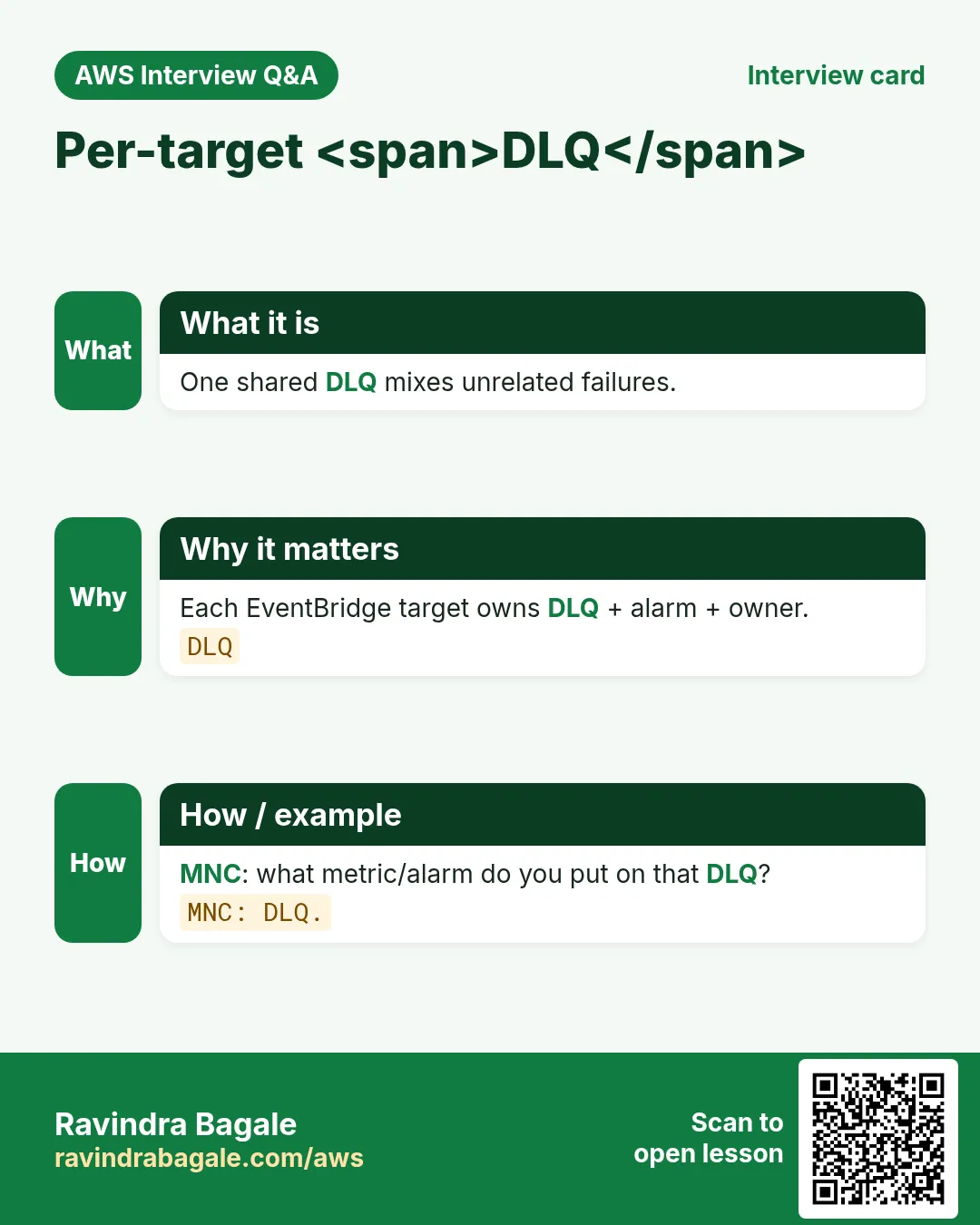
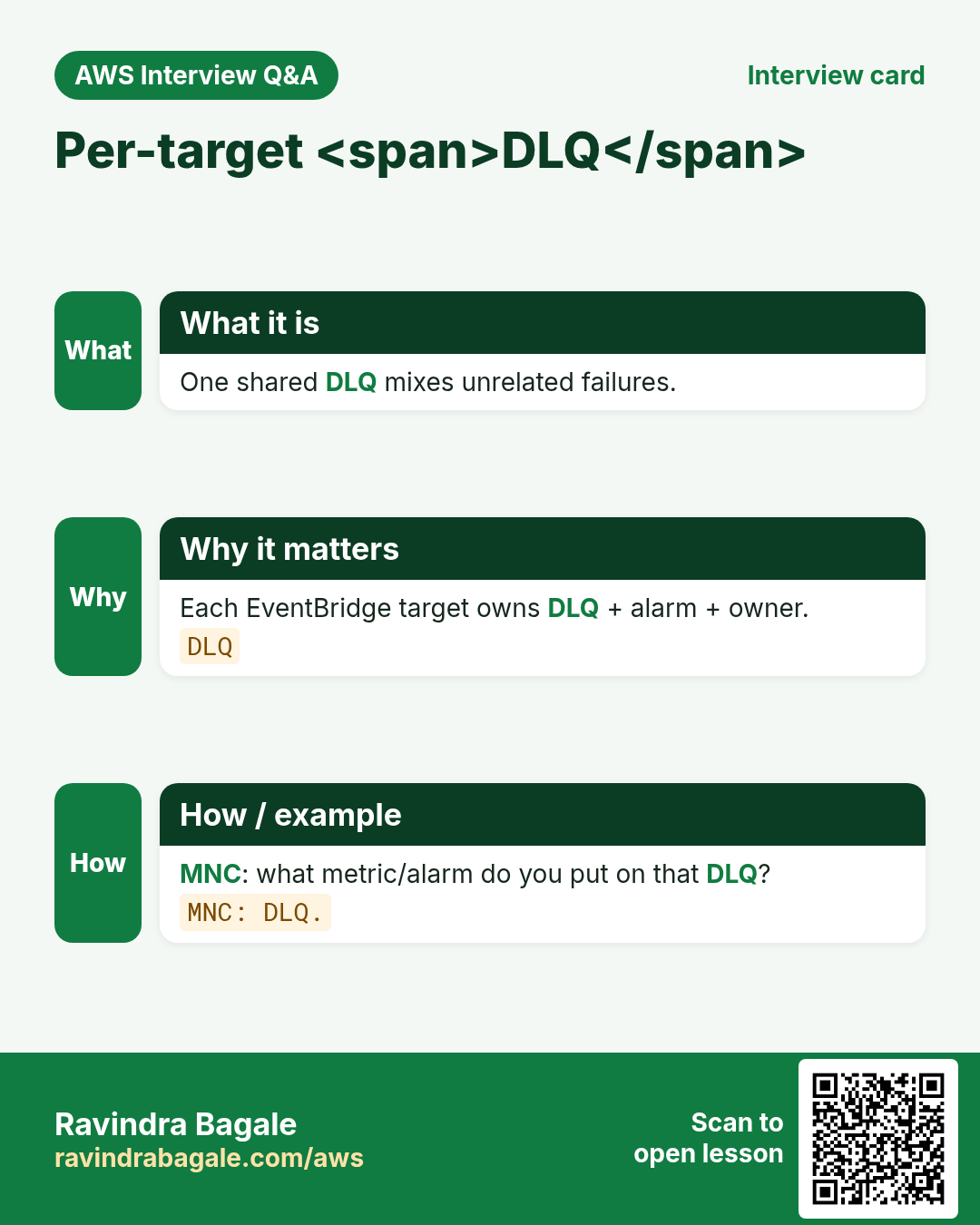
| No DLQ on EventBridge targets | Add SQS DLQ per target. |
| Unversioned event payloads | Add version field; consumers tolerate. |
| Circular event storm | Break with orchestration or redesign. |
| Using SNS when you need content filters + buses | Prefer EventBridge for rich filters. |
| Mega state machine for everything | Split by domain. |
| Ignoring execution history costs | Log levels; short retention where OK. |
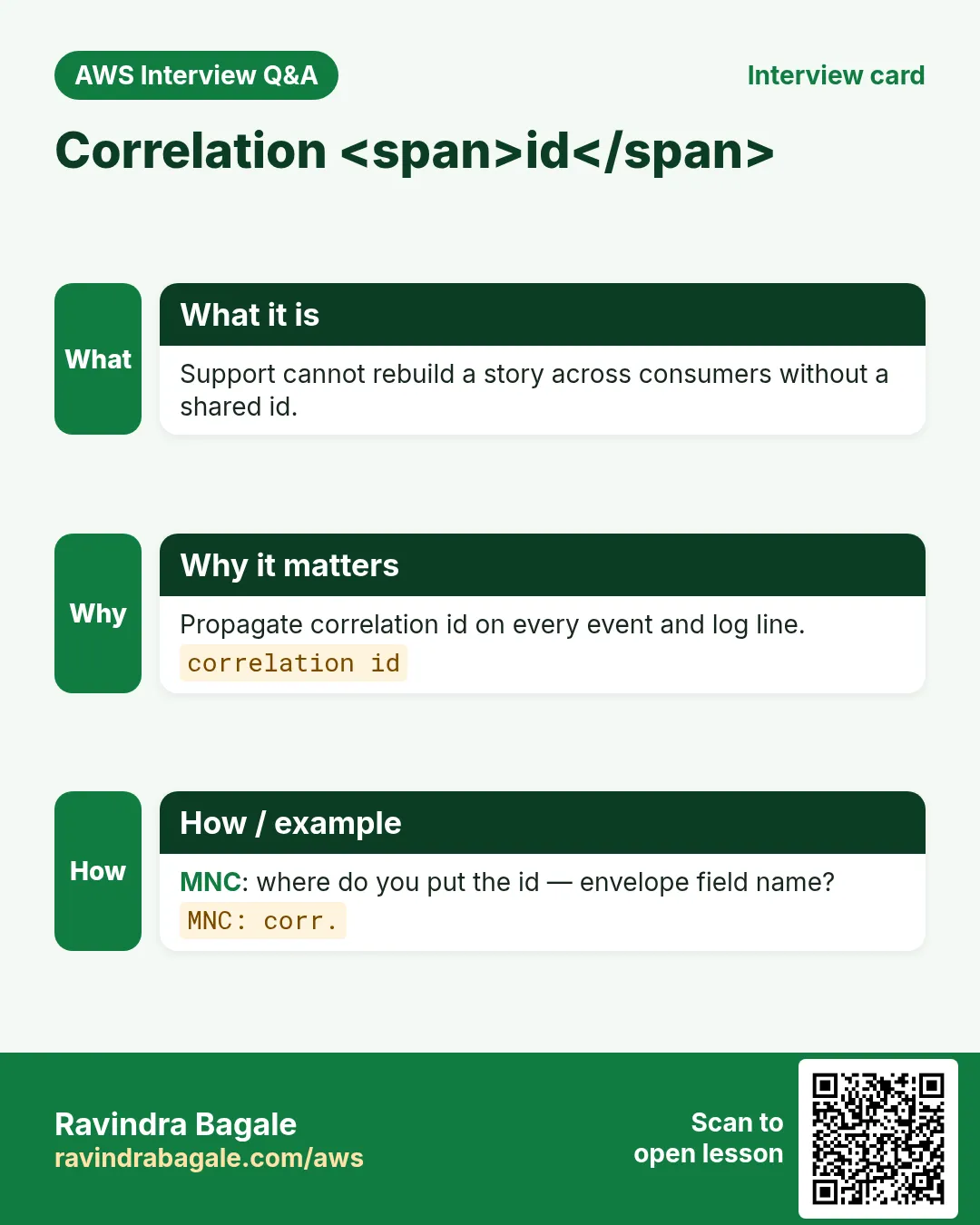
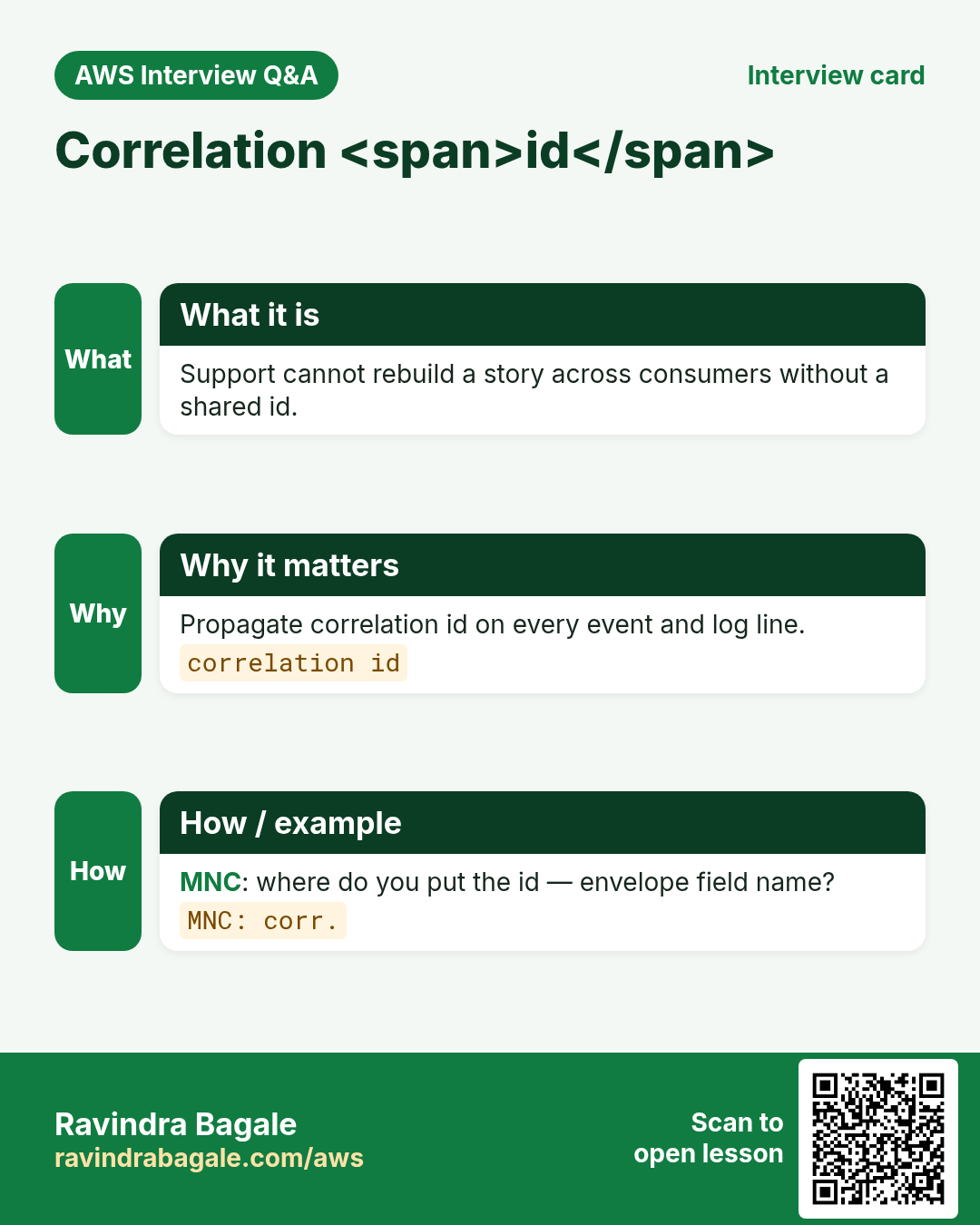
| No correlation id in choreography | Pass orderId everywhere. |
| Assuming at-least-once never duplicates | Idempotent consumers. |
| Editing prod rules without dry-run | Stage bus first. |
14. FAQ
Q. Is EventBridge better than SNS?
Different: EB has rich filters/buses/archive; SNS is simple fan-out/SMS.
Q. Is Step Functions expensive?
Pay per transition; fine for business flows; not for millions of tiny ticks.
Q. Can I mix both?
Yes — normal.
Q. What about SQS?
Buffer between; works under both styles.
Q. Where is the order workflow project?
build-order-workflow — orchestration example.
Q. Choreography testing?
Contract tests per consumer + replay from archive.
15. Interview Q&A (Beginner / Mid / Senior + MNC)
Q. Beginner: choreography in one line?
Services react to events without a central conductor.
Q. Beginner: orchestration?
A workflow engine sequences steps.
Q. Mid: when SFN over EB?
Saga, compensations, single timeline.
Q. Mid: DLQ ownership?
Each target owns its DLQ and alarm.
Q. Senior: prevent event spaghetti?
Schema ownership, versioning, filters, domain buses.
Q. MNC: audit story?
SFN history for money path; immutable logs for choreography side effects.
16. Tips in English, Marathi and Hindi
Ravindra Bagale's Tip (EN)
Orchestrate money; choreograph noise. Draw both before you pick.
Ravindra Bagale's Tip (MR)
Money = orchestrate; noise = choreograph. दोन्ही कागदावर.
Tip (HI)
पैसे orchestrate करें; notify choreograph करें। दोनों कागज़ पर बनाएं।
Try at home
- Pick one flow at work; label orchestrate vs choreograph.
- Name the event owner team.
In short
- Start from a real story, then name the AWS services.
- Link existing chapters — do not copy their labs.
- Design for failure: retries, DLQ, idempotency, rollback.
- Measure before you buy provisioned concurrency or multi-region.
17. Correlation and causation ids
In choreography, every event should carry orderId (correlation) and a unique eventId (causation chain). Support engineers paste one id and reconstruct the story across logs.
{"eventId":"e-9f","orderId":"o-1","type":"OrderPaid","currency":"AED","version":1}18. When to introduce a custom bus
- Domain isolation: payments vs marketing.
- Different archive/replay policies.
- Least-privilege put-events per team.
19. Step Functions patterns cheat sheet
| Pattern | Use |
|---|---|
| Task + Retry + Catch | Most Lambda tasks |
| Parallel | Fan-out inside orchestration |
| Map | Process array with capped concurrency |
| Wait | Callbacks, human delay, SLA pause |
| Choice | Branch on currency or risk score |
20. Architecture decision checklist
- Write the user journey in five bullets with no AWS names.
- Mark each step sync (user waits) or async.
- Name failure mode: retry, DLQ, compensate, or alert-only.
- Name the idempotency key for every write.
- Pick data store from access patterns (link DynamoDB modeling).
- Estimate monthly cost at 1x and 10x traffic (USD and INR).
- Confirm account concurrency and service quotas in ap-south-1.
- Decide auth: Cognito, IAM, Lambda authorizer, or none.
- Name on-call and which CloudWatch alarm pages them.
- Link the deep chapter you will not rewrite.
- Only then open console or IaC.
21. Copy-paste quick commands (read-only first)
# Region and identity
aws configure get region
aws sts get-caller-identity

# Lambda landscape
aws lambda list-functions --region ap-south-1 --max-items 20 \
  --query 'Functions[].{N:FunctionName,R:Runtime,T:Timeout,M:MemorySize}' --output table
aws lambda get-account-settings --region ap-south-1

# API Gateway (HTTP APIs)
aws apigatewayv2 get-apis --region ap-south-1 --query 'Items[].{N:Name,Id:ApiId,Ep:ProtocolType}' --output table

# Queues and topics
aws sqs list-queues --region ap-south-1
aws sns list-topics --region ap-south-1 --query 'Topics[].TopicArn'

# Event buses and state machines
aws events list-event-buses --region ap-south-1
aws stepfunctions list-state-machines --region ap-south-1 --query 'stateMachines[].name'

# DynamoDB tables (names only)
aws dynamodb list-tables --region ap-south-1
Run these in a sandbox account. Prefer read-only IAM while learning.
22. More industry and stack stories
- Fintech (Aisha, Lagos, NGN): bank webhooks must return 200 fast — SQS absorbs spikes; ledger Lambda is idempotent on paymentId.
- Ecommerce (Rohan, Pune, INR): Black Friday — API Gateway throttle + SQS order intake; SNS fans inventory, email, analytics.
- Healthcare (Mei, Singapore, SGD): appointment reminders via SNS SMS; PHI only in DynamoDB with condition keys.
- EdTech (Diego, São Paulo, BRL): EventBridge nightly cleanup of draft quizzes; Lambda timeout 30s, not 15 min.
- Logistics (Fatima, Casablanca, MAD): package scans on custom EventBridge bus; Step Functions customs saga.
- Media (Kenji, Osaka, JPY): S3 → Lambda thumbnails; never write thumbs to the watched prefix.
- SaaS (Priya, Bengaluru, INR): Cognito groups + DynamoDB PK tenantId; one Lambda authorizer for all routes.
- Gov (Omar, Amman, JOD): strangler — peel one PDF form route per sprint from the monolith.
- Startup (Sofia, Sofia, EUR): start with Function URL for demos; move to HTTP API when partners need JWT.
- Retail (Luis, Mexico City, MXN): store POS sync via SQS FIFO when order matters; Standard when it does not.
- Python: handlers thin; put domain logic in plain modules for unit tests without Lambda.
- Node: prefer async/await; never block the event loop on sync DNS.
- Java: SnapStart for cold starts; keep dependencies lean.
- .NET: AspNetCoreServer for low-traffic tenants; watch package size.
- Go: single static binary; great for SQS workers.
- PHP: keep Laravel queues on ECS; Lambda for S3/webhooks glue.
23. Glossary (short)
| Term | Meaning |
|---|---|
| Cold start | First invoke pays init; later invokes reuse the env |
| Idempotency | Same request twice → same effect |
| DLQ | Dead-letter queue for failed messages |
| Choreography | Services react to events; no central conductor |
| Orchestration | Central workflow (Step Functions) directs steps |
| Fan-out | One event → many consumers |
| Fan-in | Many branches join before next step |
| Strangler fig | Peel routes from monolith gradually |
| Saga | Distributed tx via steps + compensations |
| Provisioned concurrency | Keep N envs warm; you pay for ready capacity |
24. Practice: explain out loud
- 60 seconds: everyday story for choreography vs orchestration.
- 60 seconds: sync vs async with a checkout example.
- 60 seconds: when you refuse Lambda.
- 60 seconds: DLQ + idempotency in one breath.
- Record once; cut fillers; record again.
25. Safe lab hygiene
- Tag every lab resource with owner and expiry date.
- Set a monthly AWS Budget alarm in INR or USD before experiments.
- Prefer read-only commands first; mutate in a sandbox account.
- Delete queues, APIs, tables you created — DynamoDB and APIGW leave footprints.
- Never put production secrets in env vars or screenshots.
- Do not enable provisioned concurrency for a hello-world.
26. How this chapter links others
- Compute depth: Lambda.
- HTTP edge: API Gateway.
- Data modeling: DynamoDB.
- Messaging: SQS/SNS.
- Events: EventBridge.
- Workflows: Step Functions.
- Project chapters (build-*): worked assemblies — link, do not paste.
27. Myths to drop
| Myth | Reality |
|---|---|
| Serverless means zero servers | Servers exist; you do not manage them |
| Always cheaper than EC2 | Steady high load can favor EC2/Savings Plans |
| No Ops needed | You own IAM, data, alarms, cost, incidents |
| One Lambda per app is fine | Bounded contexts scale better |
| Queues are optional decoration | Queues are the load leveler and blast-radius wall |
28. Error budget thinking for serverless
If your monthly error budget is 0.1% on checkout, a fan-out that retries aggressively can burn the budget with duplicate emails while money stays correct. Separate business correctness SLOs from notification SLOs.
- Write two SLOs: money-correct and notify-delivered.
- Retries on money path: bounded + idempotent.
- Retries on notify path: best-effort + DLQ.
- Page humans on money DLQ; ticket on notify DLQ.
29. Regional notes (ap-south-1)
- Build labs in Mumbai (ap-south-1) unless your org mandates elsewhere.
- Some services launch first in us-east-1 — check feature availability.
- Data residency for INR fintech may require in-region only.
- Latency to end users in India usually favors ap-south-1.
30. Naming conventions that save incidents
# Suggested prefixes
# Lambda:  pay-intake-prod, pay-worker-prod
# SQS:     pay-orders.fifo / pay-orders-dlq
# SNS:     pay-order-events
# EB bus:  pay.domain
# SFN:     pay-refund-saga
# DDB:     pay-orders-prod
Include env (dev/stage/prod) and domain. Future you grepping CloudWatch will thank present you.
31. Pre-mortems (ten minutes)
- Imagine tomorrow headline: double charge in AED. What broke?
- Imagine DLQ depth 50,000 after a bad deploy. How do you drain?
- Imagine Cognito outage. Do APIs fail closed or serve read-only?
- Write answers in the runbook before go-live.
32. Currency and locale in examples
Rotate currencies in designs: INR, USD, EUR, AED, NGN, BRL, JPY, SGD. Rotate names: Aisha, Rohan, Mei, Diego, Fatima, Kenji, Priya, Omar, Sofia, Luis. This keeps mental models global — not one-country samples.
Revision, interview and comparison cards
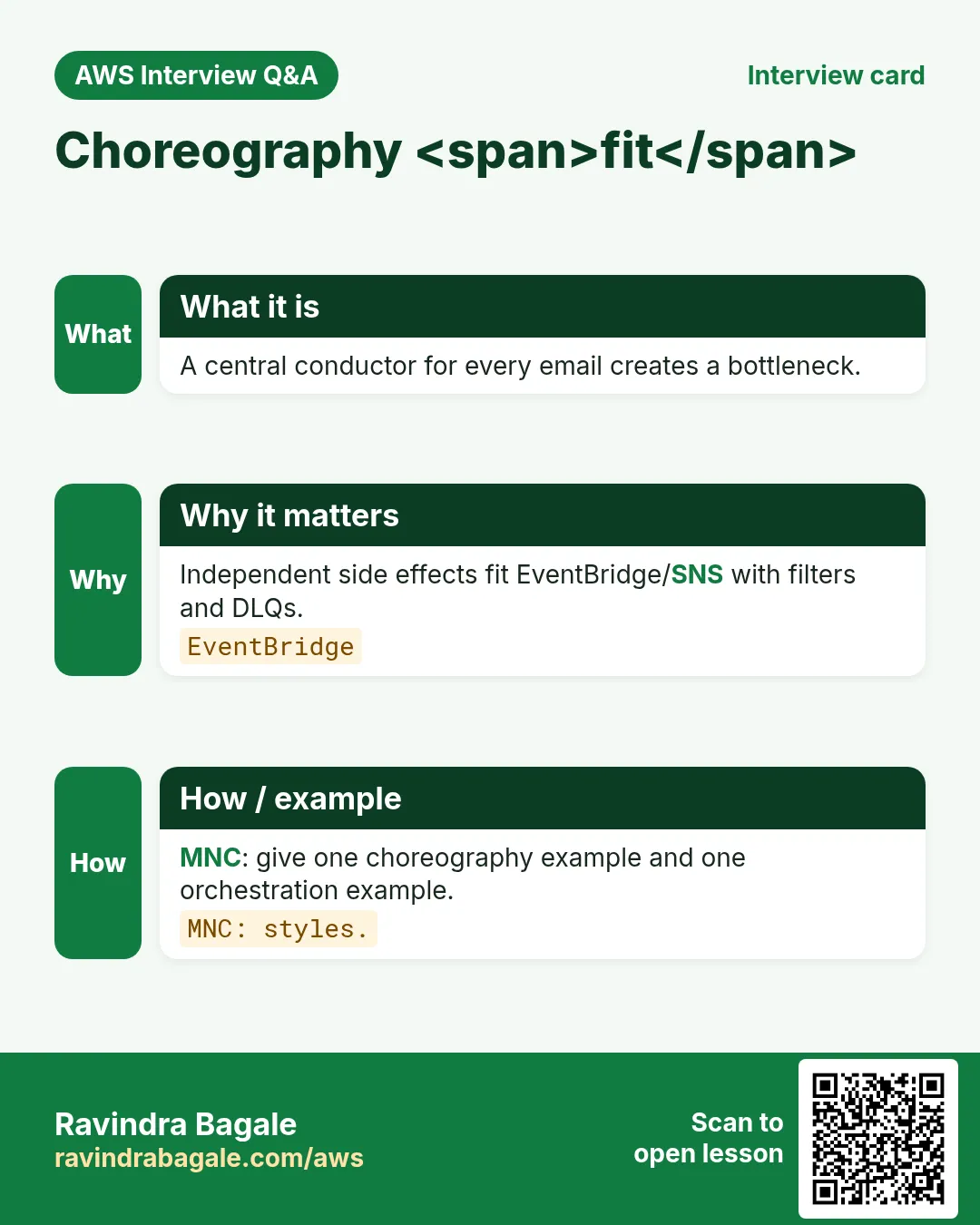
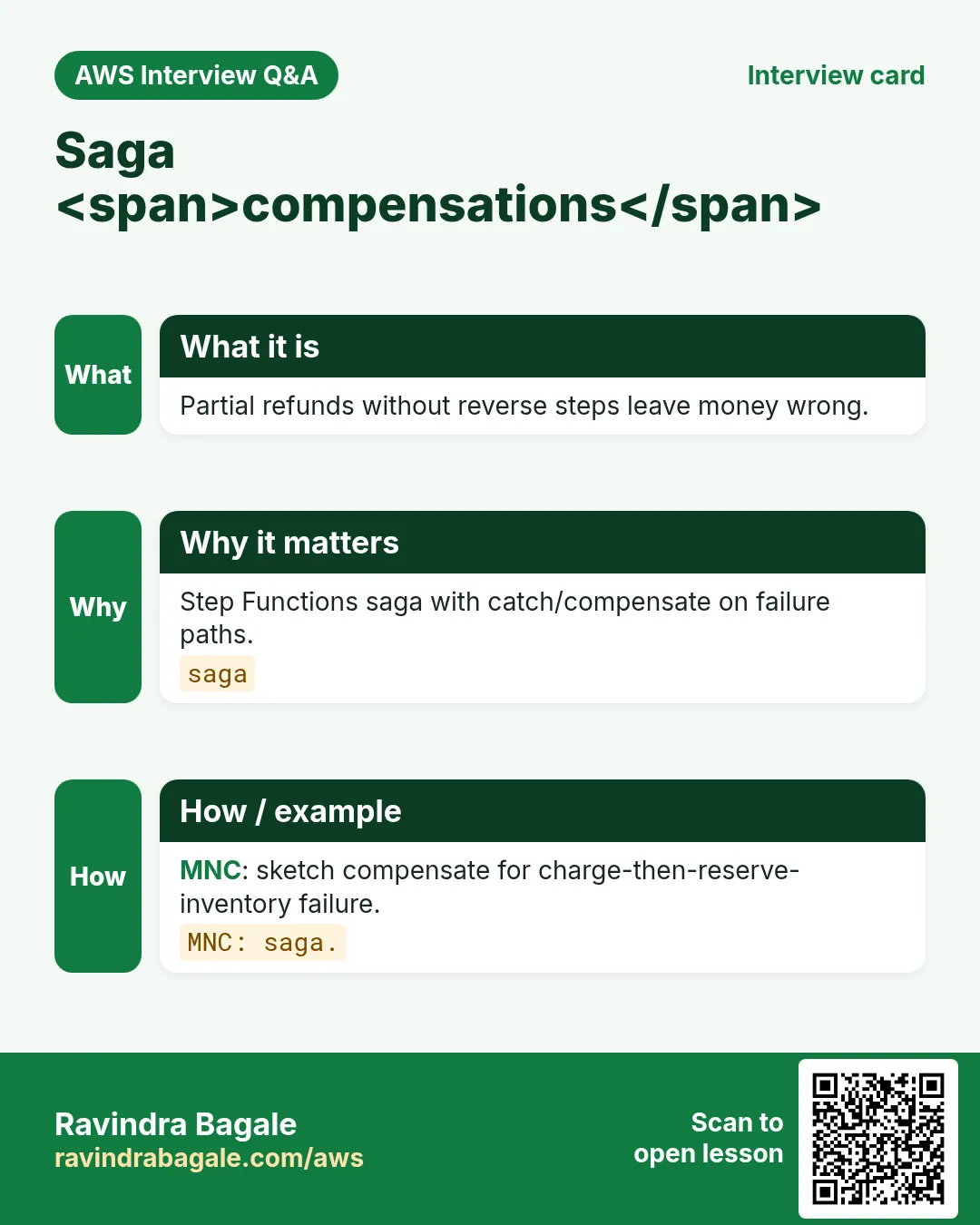
Revise this lesson in a few minutes. Save the cards on your phone or download them as PNG files. The QR code on each card opens this lesson.
More cards: Ravi Sir's Cards.
Practice Tasks
Practice checks run in your browser. They check the answer for this exercise; they do not create resources or connect to your AWS account.
About this scenarioLondon Legal LLP is a law business in London. Oliver Hughes looks after its IT and cloud work. They count money in GBP and run their AWS resources in the eu-west-2 Region. In the tasks below you do real jobs for them using what this lesson teaches. All names, account IDs, IP addresses and numbers are made up for practice.
0 / 16
Easy No central coordinator
Three services react independently to OrderPlaced. No central component tells each one what to do next. Name the coordination pattern.
- Read the situation and identify what you need to decide.
- Work through the relevant concept or calculation.
- Enter only the requested term or number.
- Check your answer, then read the explanation.
Easy Central coordination
A state machine invokes payment, inventory and shipping tasks and records execution status. Name the coordination pattern.
- Read the situation and identify what you need to decide.
- Work through the relevant concept or calculation.
- Enter only the requested term or number.
- Check your answer, then read the explanation.
Easy Pick an AWS workflow service
A refund workflow must retry a release and choose a compensation path after failure. Name the AWS workflow service suitable for explicit states.
- Read the situation and identify what you need to decide.
- Work through the relevant concept or calculation.
- Enter only the requested term or number.
- Check your answer, then read the explanation.
Easy Select an independent extension
A service emits OrderPlaced and separate email and analytics consumers subscribe without controlling the purchase sequence. Name the pattern.
- Read the situation and identify what you need to decide.
- Work through the relevant concept or calculation.
- Enter only the requested term or number.
- Check your answer, then read the explanation.
Easy List EventBridge rules
CLI.
List rules on default bus
- Read the task and decide which AWS service it is about.
- Write aws, then the service name, then the operation (the action word).
- Add each needed flag (--name) followed by its value from the task.
- Flags can be in any order. Click Check answer.
Easy Styles YAML
Map.
YAML: choreography: bus, orchestration: sfn.
- Start from the top-level keys the task names.
- Indent child keys with 2 spaces (no tabs).
- Fill in each property with the value from the task.
- Click Check answer. Key order does not matter.
Easy Reduce the matched delivery set
An event rule examines 200 events. Its pattern matches 30 and it has one target. How many events are eligible to invoke that target before retries?
- Read the situation and identify what you need to decide.
- Work through the relevant concept or calculation.
- Enter only the requested term or number.
- Check your answer, then read the explanation.
Medium Diagnose a tangled subscription graph
Each of five services subscribes to every other service's events without ownership or boundaries. What common term describes this hard-to-trace dependency graph?
- Read the situation and identify what you need to decide.
- Work through the relevant concept or calculation.
- Enter only the requested term or number.
- Check your answer, then read the explanation.
Medium Choose a rule-based AWS event bus
A design needs an AWS event bus, content-based rule matching, and an option to archive and replay. Which AWS service fits?
- Read the situation and identify what you need to decide.
- Work through the relevant concept or calculation.
- Enter only the requested term or number.
- Check your answer, then read the explanation.
Medium Follow one order across services
Logs from payment and shipping use the same caller-provided request identifier. What is that shared identifier normally called?
- Read the situation and identify what you need to decide.
- Work through the relevant concept or calculation.
- Enter only the requested term or number.
- Check your answer, then read the explanation.
Medium Identify the loop
A reacts to B and emits another event that causes B to repeat the same work. What risk do these reciprocal subscriptions create?
- Read the situation and identify what you need to decide.
- Work through the relevant concept or calculation.
- Enter only the requested term or number.
- Check your answer, then read the explanation.
Medium Hybrid YAML
Split.
YAML: money: sfn, notify: bus.
- Start from the top-level keys the task names.
- Indent child keys with 2 spaces (no tabs).
- Fill in each property with the value from the task.
- Click Check answer. Key order does not matter.
Hard Coordinate the critical path
Payment and reservation must follow explicit ordering. Email can be independent. Which pattern should coordinate the ordered payment and reservation path?
- Read the situation and identify what you need to decide.
- Work through the relevant concept or calculation.
- Enter only the requested term or number.
- Check your answer, then read the explanation.
Hard Preserve failed delivery
A bus target cannot receive an event even after the delivery retry policy is exhausted. What destination can retain the failed delivery for investigation?
- Read the situation and identify what you need to decide.
- Work through the relevant concept or calculation.
- Enter only the requested term or number.
- Check your answer, then read the explanation.
Hard Manage an event contract change
One team owns OrderPlaced and must introduce a breaking field change. What property should it update so consumers can choose the correct format?
- Read the situation and identify what you need to decide.
- Work through the relevant concept or calculation.
- Enter only the requested term or number.
- Check your answer, then read the explanation.
Hard Prove selective routing
Your test rule should accept order events only. You publish 12 order events and 8 payment events to one target. How many events should match?
- Read the situation and identify what you need to decide.
- Work through the relevant concept or calculation.
- Enter only the requested term or number.
- Check your answer, then read the explanation.