S3 Bucket Policy Project 5: Enforce HTTPS with aws:SecureTransport
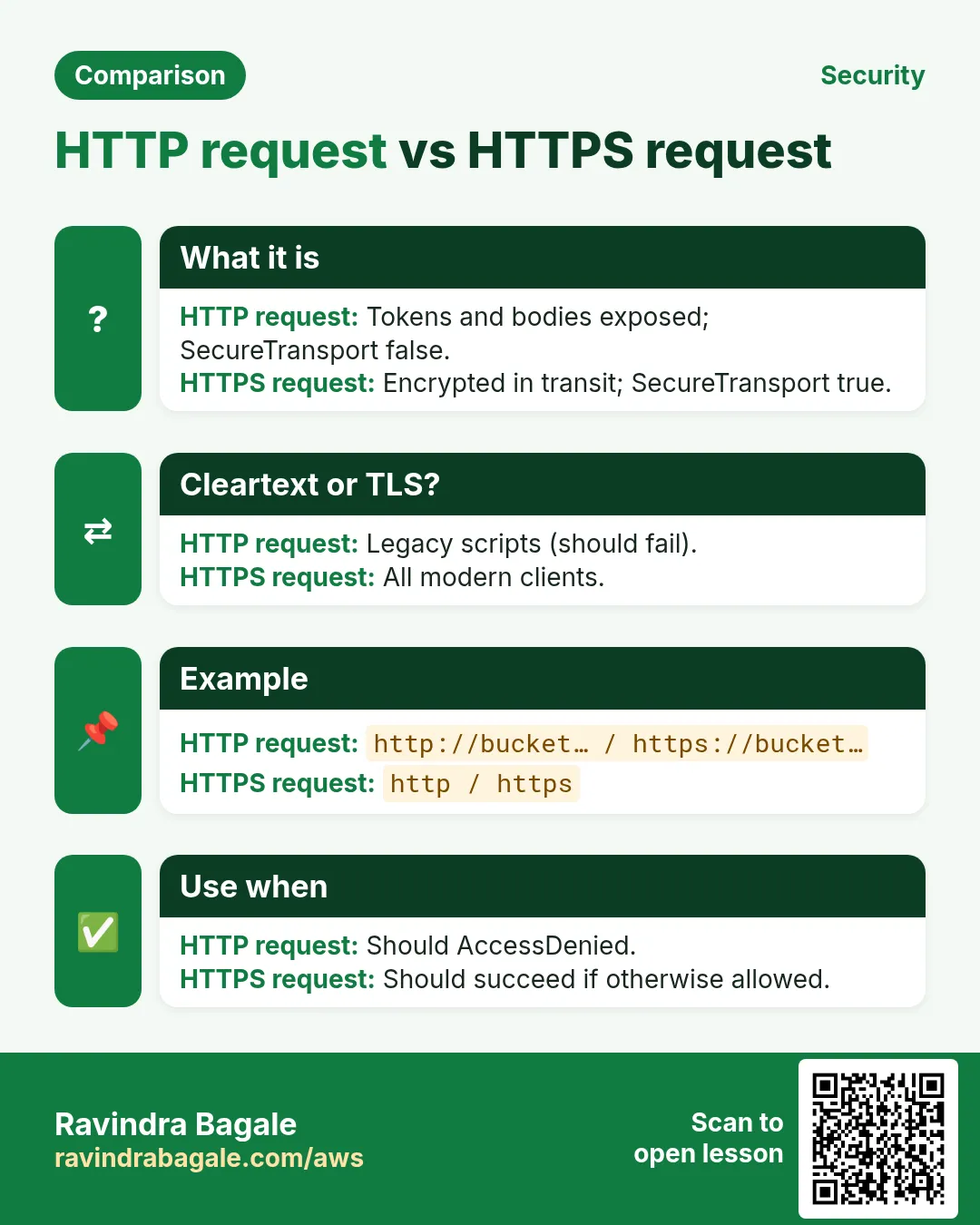
Compliance lead Gauri Sawant in Pune must prove every S3 call uses TLS. A single Deny when aws:SecureTransport is false blocks HTTP. Students still get surprised because browsers silently upgrade — so you test with curl http://.
In this chapter
- Why enforce HTTPS at the bucket
- What aws:SecureTransport means line by line
- How to test HTTP deny vs HTTPS allow with curl
- TLS version vs SecureTransport
- Interview answers
1. Everyday project story
Chennai hospital CIO Dr. Anil Krishnan and Frankfurt SaaS founder Jonas Becker both store customer uploads. Auditors ask: can anyone still speak plain HTTP to the bucket?
2. Why SecureTransport?
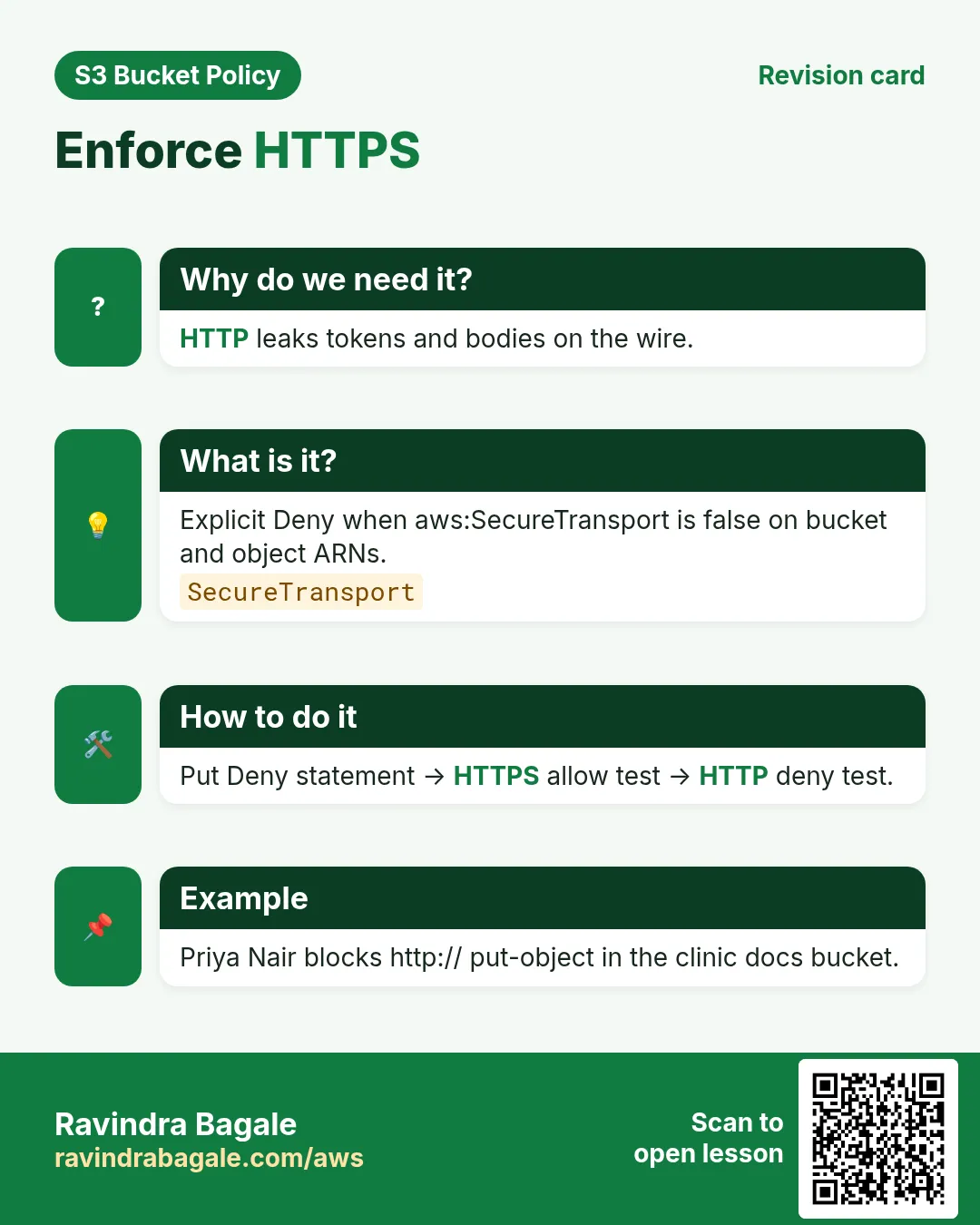
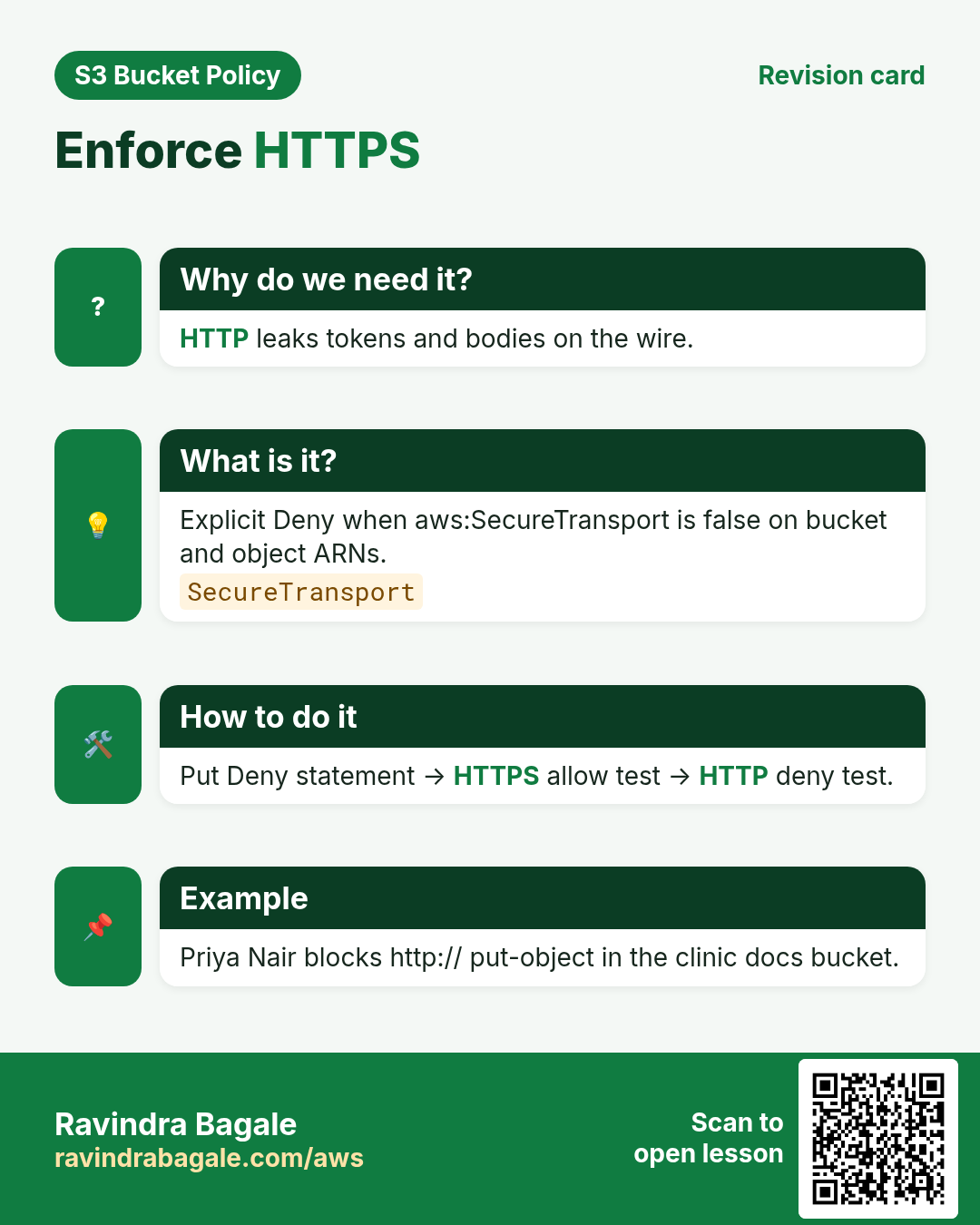
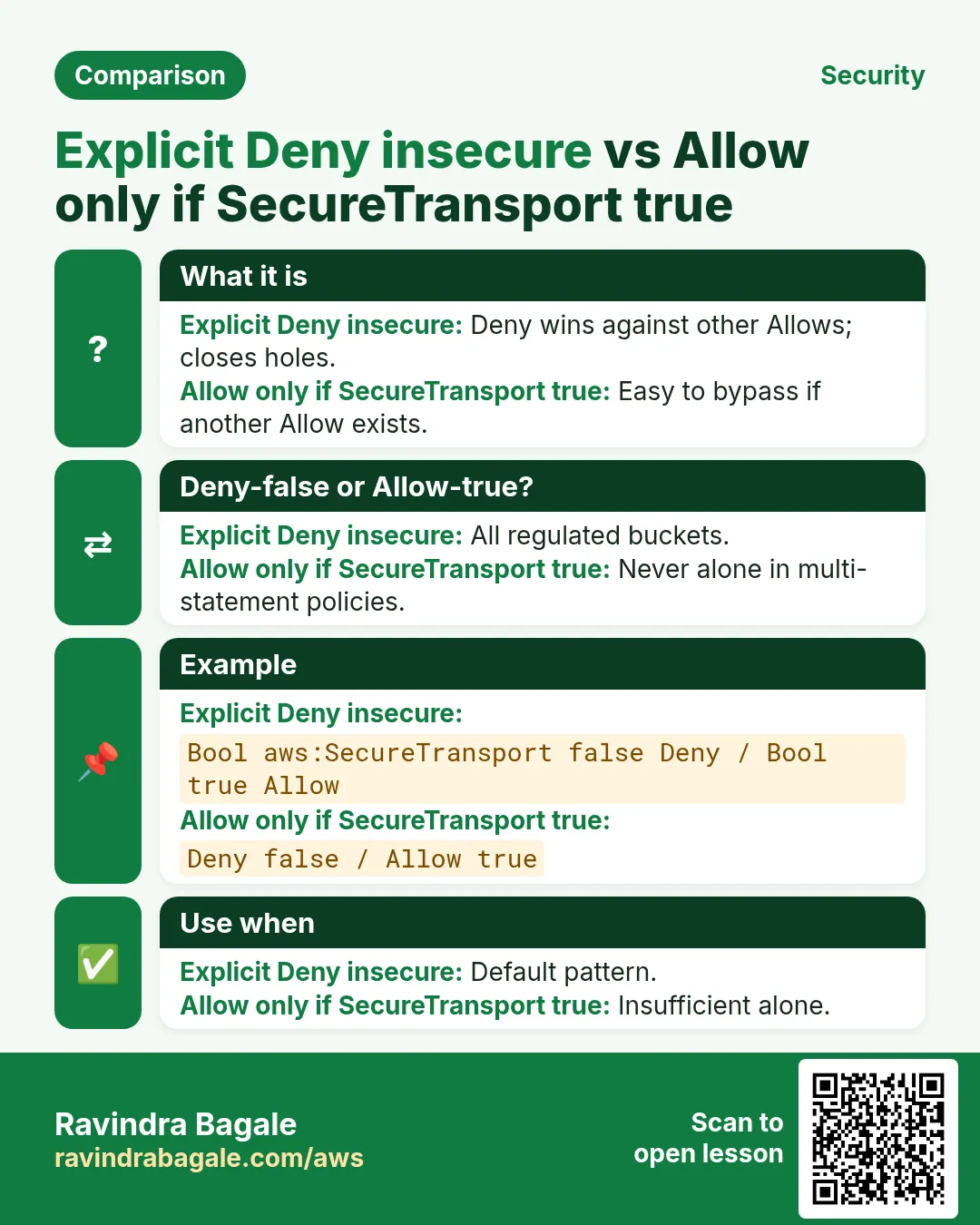
HTTP leaks credentials and data on the wire. Bucket policy can Deny any request where aws:SecureTransport is false — simple and effective.
- One Deny statement covers all principals
- Works with IAM users, roles, and anonymous
- Does not by itself pin TLS 1.2+ — that is separate
- Always prove with curl http not only a browser
3. What is the policy?
Separate permission, transport and encryption at rest
Gauri’s role may be allowed to read a particular object. The secure-transport condition asks whether the request uses HTTPS. A matching deny can block plain HTTP despite that role’s read permission. HTTPS protects bytes on the connection, while the bucket’s encryption setting protects stored data. These are different points in the object’s trip.
Trace an approved HTTPS request from your lab client. The transport deny should not match it. The client still needs its S3 permission. A rejected unsigned HTTP request alone might already lack any read grant, so use policy evaluation and the intended HTTPS client test together rather than treating one error code as proof of the transport condition.
{
  "Version": "2012-10-17",
  "Statement": [
    {
      "Sid": "DenyInsecureTransport",
      "Effect": "Deny",
      "Principal": "*",
      "Action": "s3:*",
      "Resource": [
        "arn:aws:s3:::rb-secure-uploads-ap-south-1",
        "arn:aws:s3:::rb-secure-uploads-ap-south-1/*"
      ],
      "Condition": {
        "Bool": { "aws:SecureTransport": "false" }
      }
    }
  ]
}
Line-by-line
- Sid DenyInsecureTransport — clear intent.
- Effect Deny — blocks matching requests.
- Principal * — everyone.
- Action s3:* — all S3 APIs.
- Resource bucket + /*.
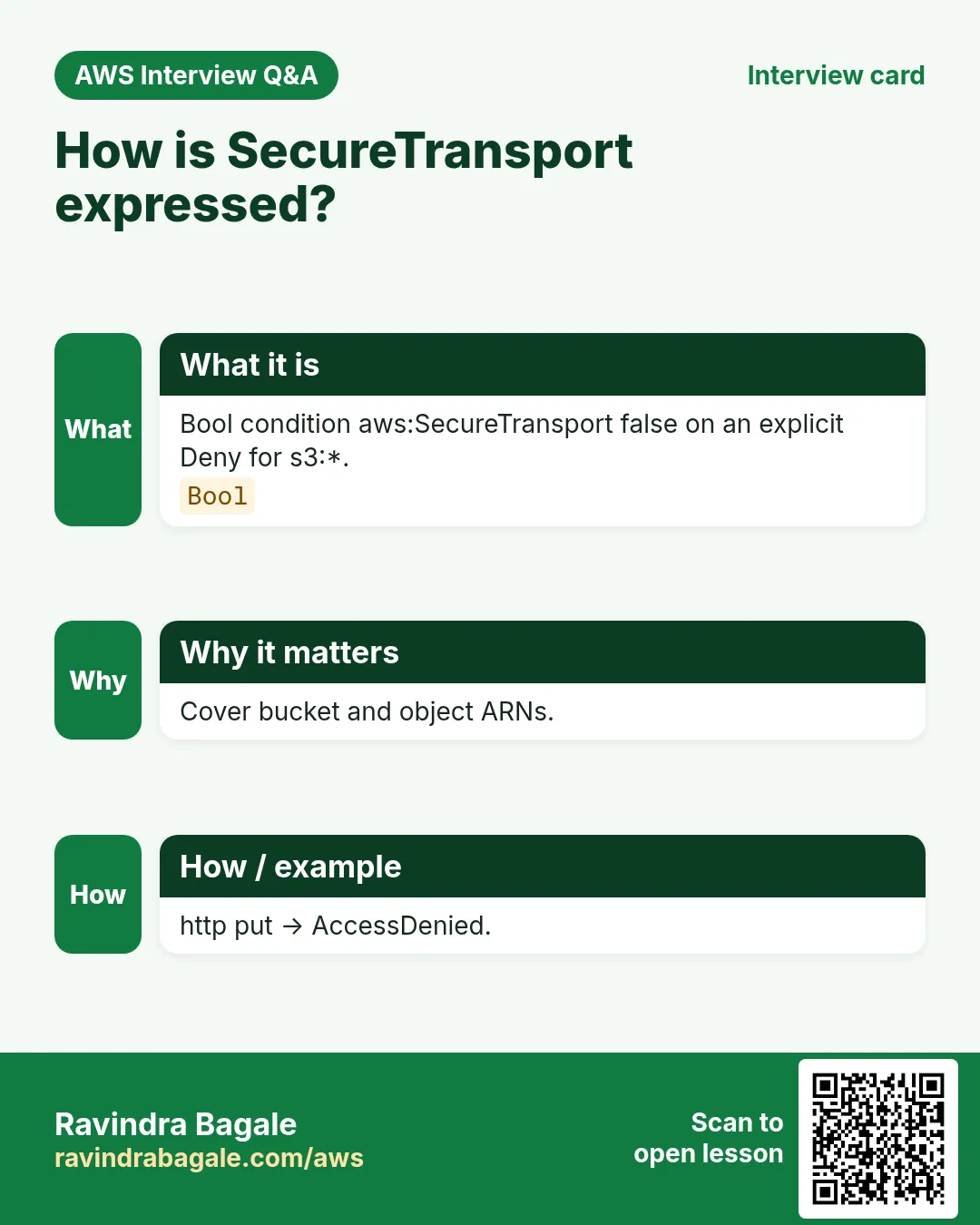
- Bool aws:SecureTransport false — fires only on non-TLS.
- Use this check for requests where S3 has the caller’s transport context. With service-to-service calls such as log delivery, AWS can redact network context. When extending a network-based deny to a bucket used by an AWS service, review the AWS example with
aws:PrincipalIsAWSServiceand test that service’s delivery separately. The service still needs its own allow.
4. CLI with output
aws s3api put-bucket-policy --bucket rb-secure-uploads-ap-south-1 --policy file://https-only.json
# (empty success)

echo secret > t.txt
aws s3 cp t.txt s3://rb-secure-uploads-ap-south-1/t.txt
# upload success over HTTPS CLI
5. Test allow and deny
# ALLOW — HTTPS
curl -s -o /dev/null -w "%{http_code}\n" -I \
  https://rb-secure-uploads-ap-south-1.s3.ap-south-1.amazonaws.com/t.txt
# 403 without public read is OK for private buckets; use signed HTTPS CLI for content:
aws s3 cp s3://rb-secure-uploads-ap-south-1/t.txt -   # works (HTTPS)

# An unsigned HTTP request to this private bucket can be denied even without the TLS rule.
# Do not send signed requests or credentials over HTTP to try to isolate the rule.
# Inspect the applied policy and confirm the expected Deny statement.
aws s3api get-bucket-policy --bucket rb-secure-uploads-ap-south-1 --query Policy --output text
# Look for aws:SecureTransport=false on the intended bucket and object ARNs.
6. TLS version note
SecureTransport only means “was TLS used?”. Pinning TLS 1.2+ is done via CloudFront security policies, load balancer policies, or S3 TLS settings where available — not this bool alone.
7. Multi-industry
Healthcare uploads (Chennai — Dr. Anil Krishnan), SaaS (Frankfurt — Jonas Becker), fintech KYC (Pune — Gauri Sawant), edtech assignments (Indore — Kavita Joshi).
8. AccessDenied debugging and Policy Simulator
When S3 returns AccessDenied, check in order: (1) Block Public Access, (2) matching bucket policy Deny, (3) missing IAM Allow, (4) KMS key policy, (5) VPC endpoint policy, (6) legacy ACL. IAM Policy Simulator can miss BPA/VPC/KMS — always re-test with real CLI from the real network path.
# Decode
aws s3api get-bucket-policy --bucket BUCKET --query Policy --output text | python3 -m json.tool
aws s3api get-public-access-block --bucket BUCKET
aws iam simulate-principal-policy --policy-source-arn ARN \
  --action-names s3:GetObject --resource-arns arn:aws:s3:::BUCKET/key.txt
aws cloudtrail lookup-events --lookup-attributes AttributeKey=EventName,AttributeValue=GetObject --max-items 5
9. Lab: HTTPS-only bucket
Compare an HTTPS success and the insecure request decision
Use an isolated test bucket and a synthetic object. Read it over HTTPS with the approved test identity and expect success. In your policy evaluation exercise, model the same permitted action with aws:SecureTransport false and expect the explicit deny. Avoid sending any real credentials through plain HTTP for the lesson.
If a production service writes to similar buckets, validate its own delivery path in a separate test first. Service-to-service calls can provide different network context. When finished, remove the disposable test resources and record the policy version you evaluated.
Do this in ap-south-1 (Mumbai) unless your org forbids it. Set a budget alert first.
- Create lab bucket; put DenyInsecureTransport.
- Upload with AWS CLI (HTTPS) — success.
- Attempt HTTP access; confirm Deny/AccessDenied.
- Show auditor the policy Sid and curl evidence.
Cleanup (stop billing)
- Delete policy and bucket.
- Remove lab objects first.
10. Common errors and fixes
Each row is a real mistake students and juniors hit. Read the fix before you panic.
| Error / symptom | Fix |
|---|---|
| AccessDenied but IAM Allow looks fine | Find explicit Deny in bucket policy or BPA blocking public. |
| Policy JSON rejected on put | Validate with python3 -m json.tool; no smart quotes; use file://. |
| Policy Simulator Allow, CLI Deny | Simulator skips some layers; retest with real CLI/role/network. |
| Wrong Resource ARN shape | GetObject needs arn:...:bucket/* ; ListBucket needs bare bucket ARN. |
| Condition key typo or wrong case | Keys like aws:SourceIp are case-sensitive. |
| Missing Principal on bucket policy | Resource-based policies require Principal; identity policies must omit it. |
| Account-level BPA overrides bucket | Account Block Public Access can still block public grants. |
| Encrypted object / KMS forgotten | SSE-KMS needs key policy + kms:Decrypt/GenerateDataKey. |
| Browser still “works” on http URL | Silent redirect to https — use curl -v http://. |
| Thought SecureTransport pins TLS1.2 | It does not — configure TLS policy elsewhere. |
11. Troubleshooting checklist
- Confirm region and endpoint hostname for the bucket.
- Print get-bucket-policy and get-public-access-block.
- Reproduce with a least-privilege lab IAM user.
- Binary-search Denies by commenting one Sid at a time in lab.
- Read CloudTrail errorCode and additionalEventData.
- If KMS involved, test key permissions separately.
- From VPC path: route to gateway prefix list + endpoint policy.
- Cleanup versioning/Object Lock labs carefully.
12. FAQ
Q. Is a bucket policy the same as an IAM policy?
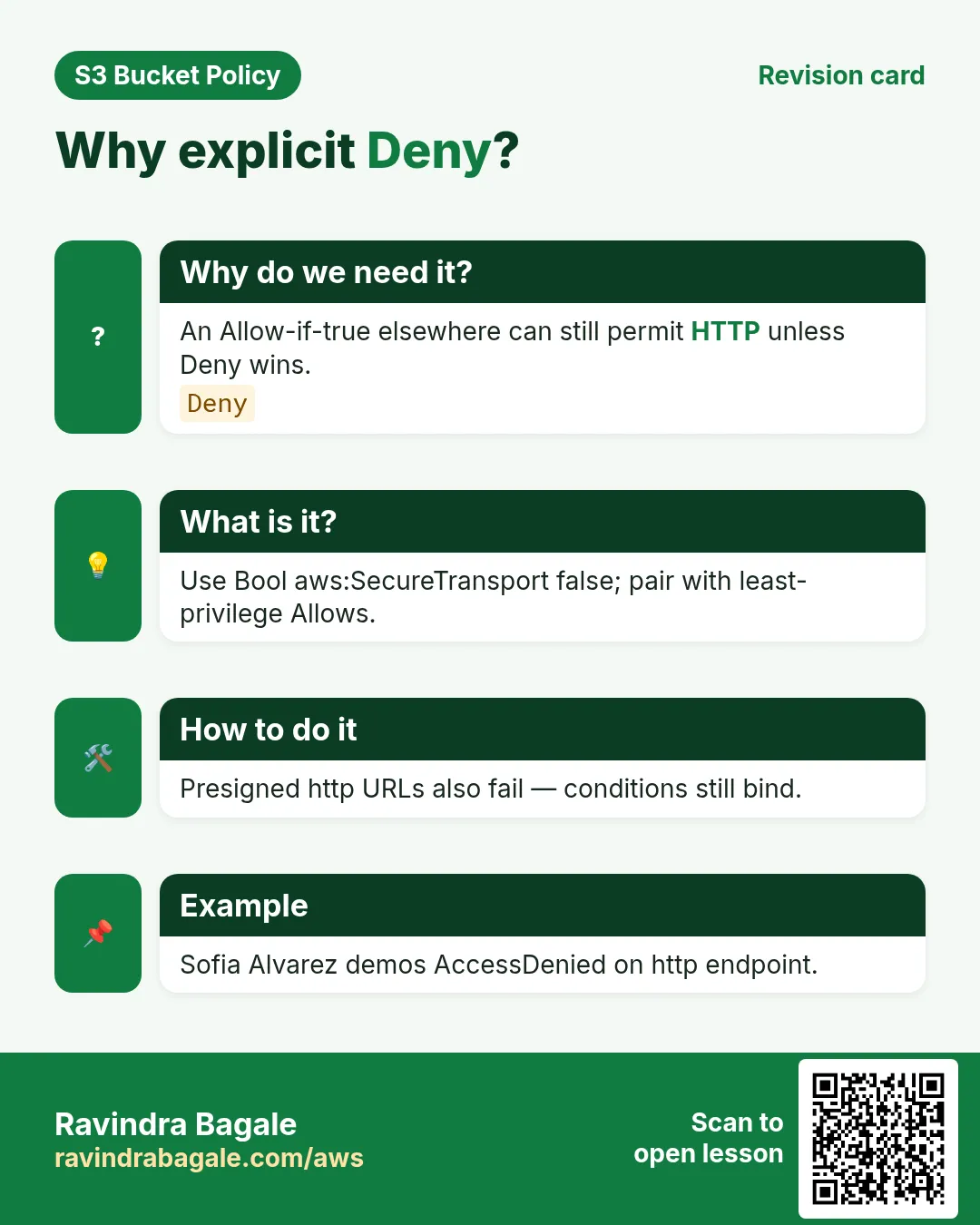
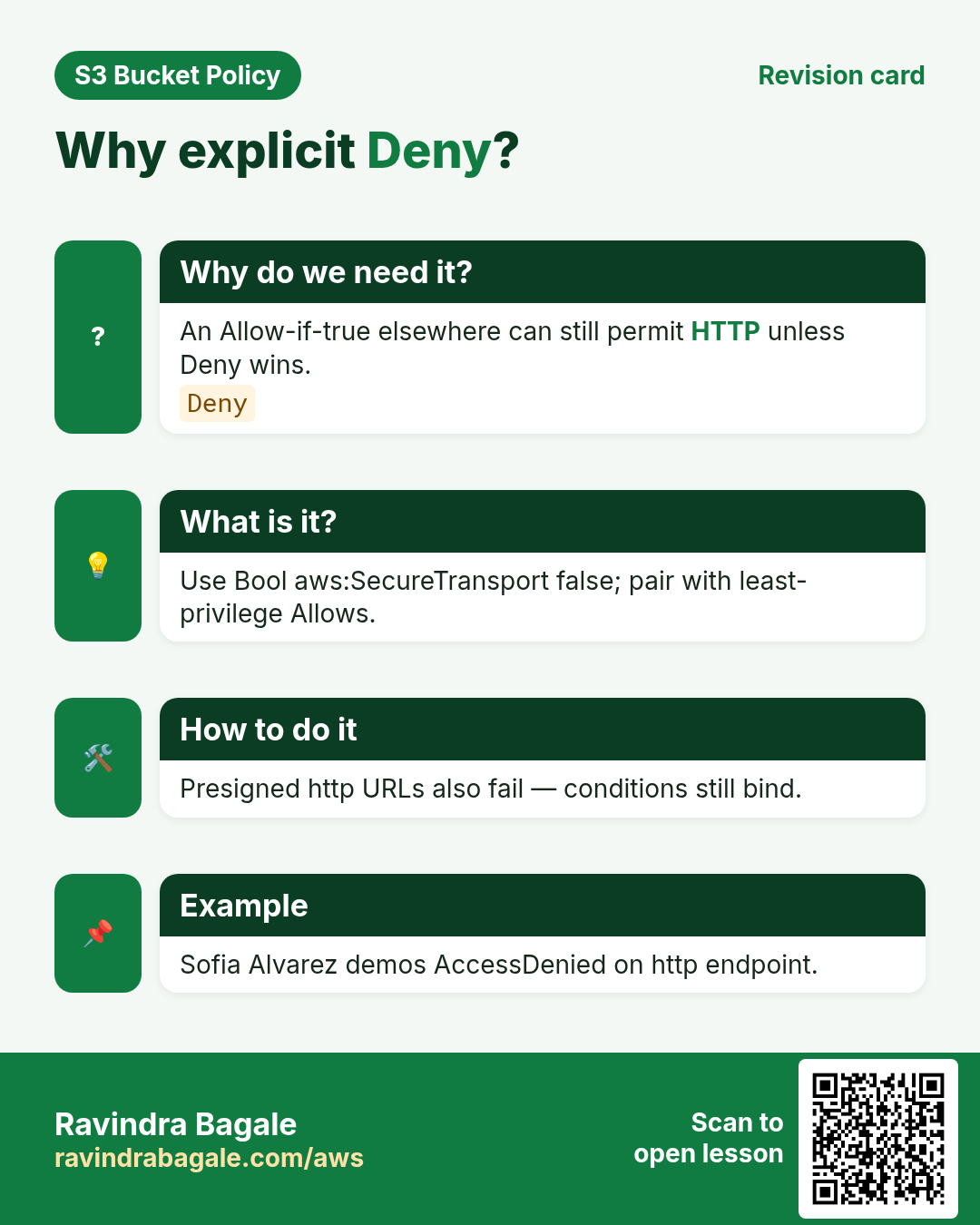
No. Bucket policy is resource-based on the bucket; IAM is identity-based. For same-account, either can Allow; explicit Deny wins; cross-account needs both.
Q. Do I still need ACLs in 2026?
Prefer Bucket owner enforced (ACLs off) + bucket policy. Some log deliveries still need canned ACL on Put.
Q. What is Block Public Access?
Switches that block public ACLs/policies at account or bucket. Disable only the minimum for a deliberate public design.
Q. How do you debug AccessDenied fast?
BPA → bucket policy → IAM → KMS → VPCe → CloudTrail. Never “fix” with Action *.
Q. Does this replace IAM?
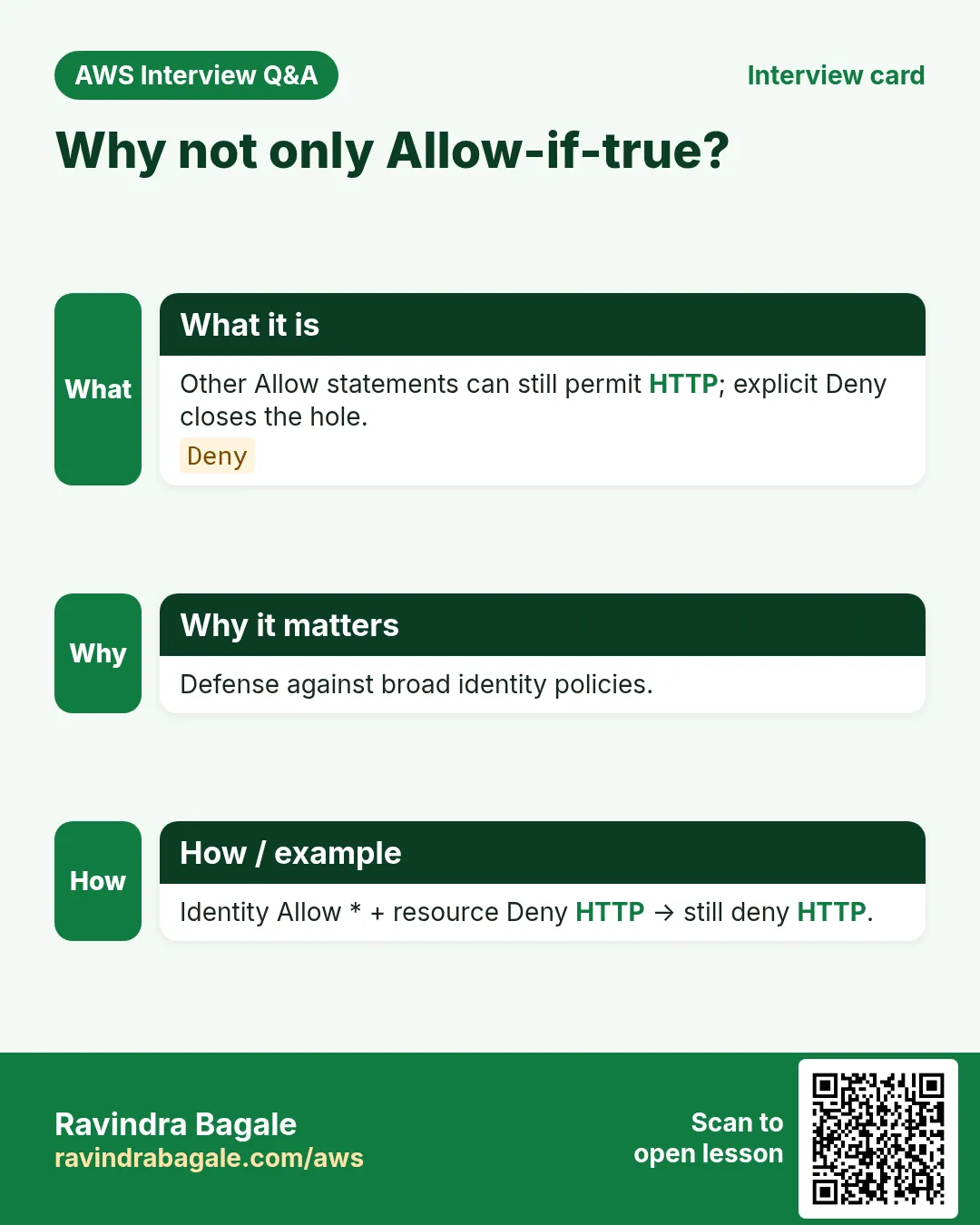
No — still need Allow; this only Denies HTTP.
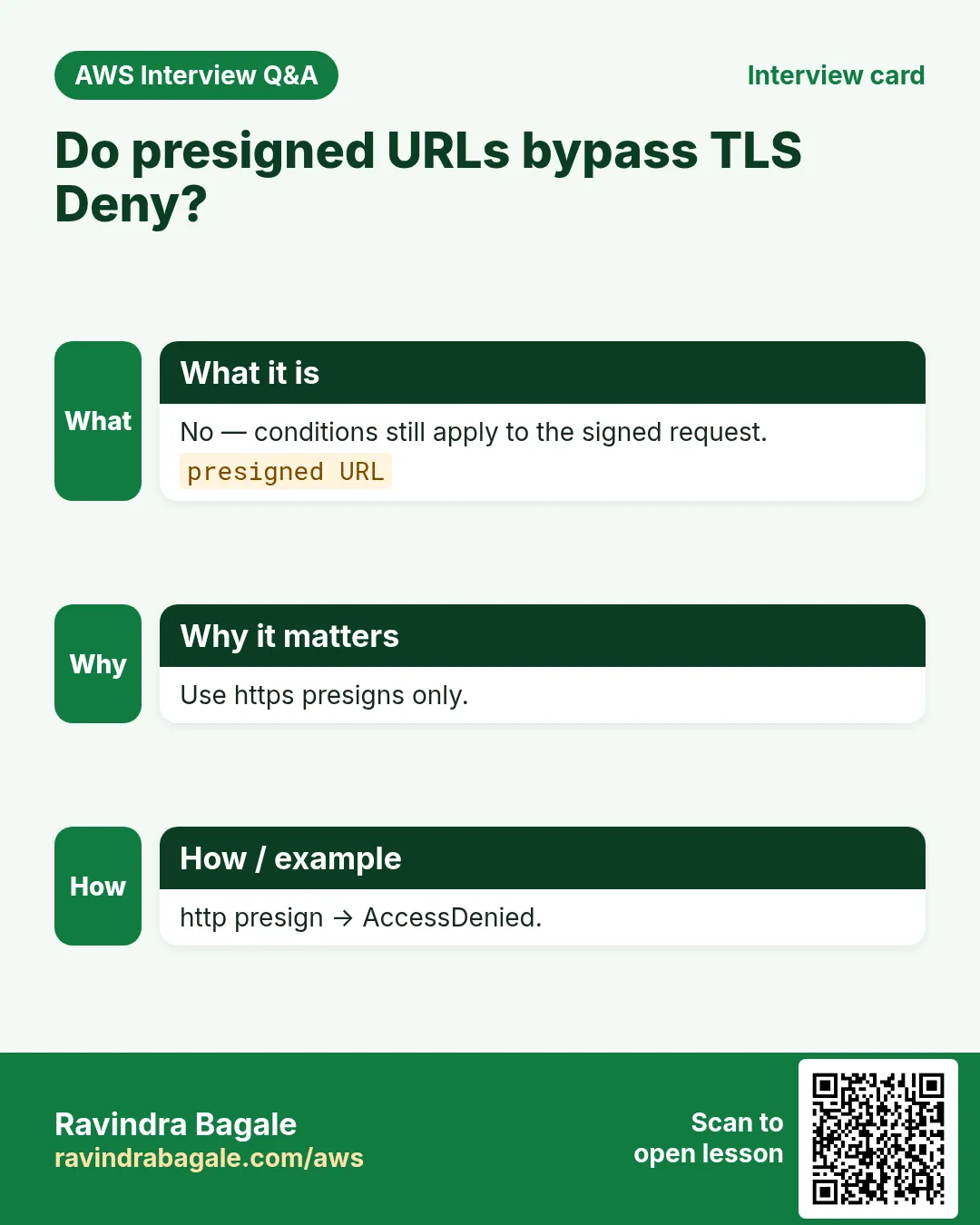
Q. Presigned HTTP URLs?
They fail under this Deny — generate https URLs.
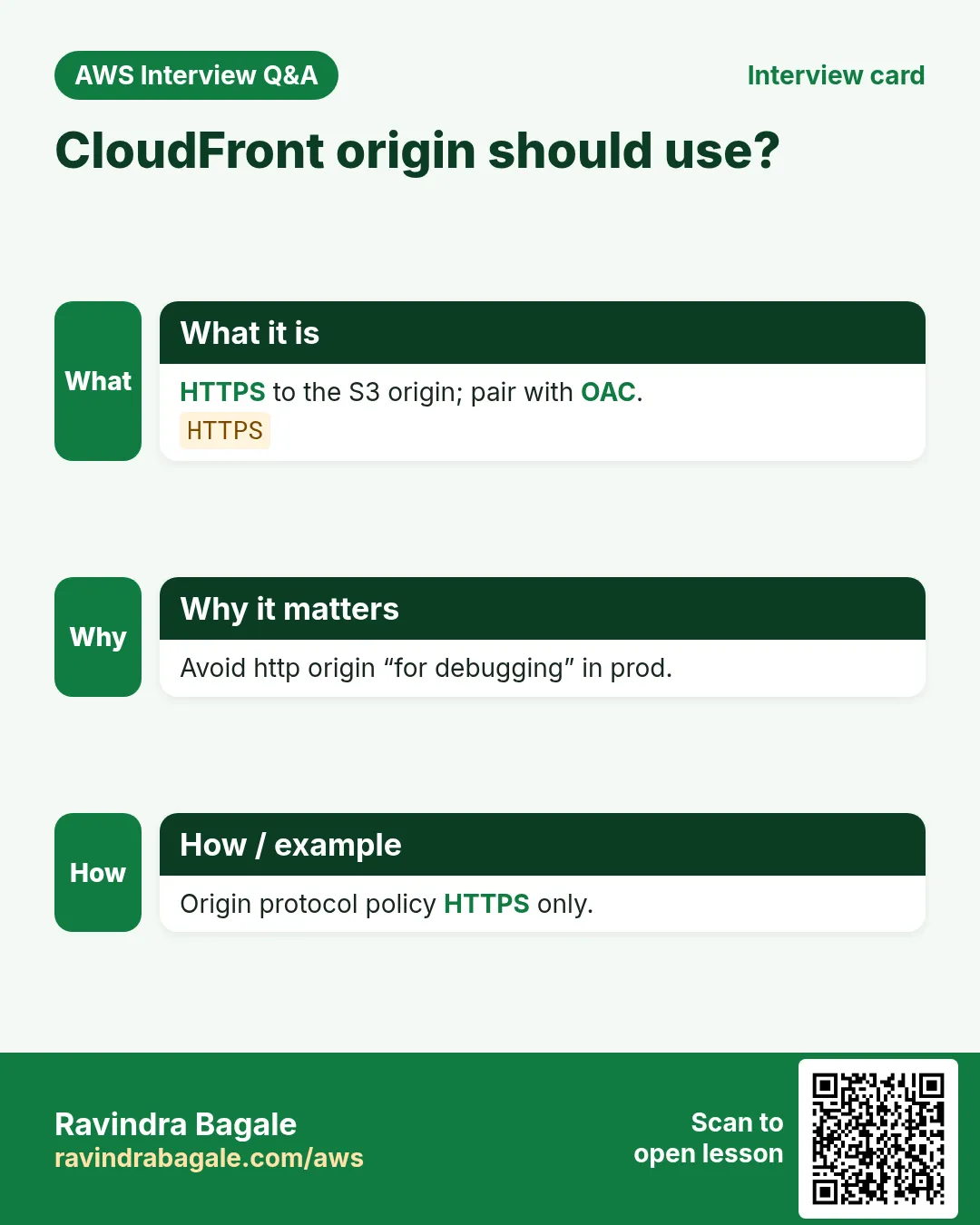
Q. CloudFront origin protocol?
Use HTTPS only to origin when possible.
Q. Cost of this policy?
Negligible — standard bucket policy.
13. Interview Q&A
Q. Condition for HTTPS-only S3?
Deny when aws:SecureTransport is false.
Q. TLS 1.0 still possible?
SecureTransport may still be true; pin versions separately.
Q. How to demo for audit?
CLI HTTPS success + HTTP AccessDenied evidence.
Q. Principal * Deny safe?
Yes for this pattern — only matches non-TLS.
Q. Interaction with public website?
Website endpoint is HTTP — conflicts; use CloudFront HTTPS.
Q. Bool value type?
String "false" / "true" in JSON policy.
14. Tips in English, Marathi and Hindi
Ravindra Bagale's Tip (EN)
Always keep a SecureTransport Deny on buckets that hold credentials-adjacent data — it is cheap insurance.
Ravindra Bagale's Tip (MR)
Credentials-adjacent buckets वर SecureTransport Deny — स्वस्त insurance.
Tip (HI)
संवेदनशील bucket पर SecureTransport Deny सस्ता बीमा है।
Try at home
- Apply policy; capture HTTPS allow + HTTP deny.
- Explain SecureTransport vs TLS version aloud.
- Add this Sid to an existing lab policy JSON.
In short
- Deny when aws:SecureTransport is false.
- Test with curl/CLI HTTP — not only browsers.
- TLS version pinning is separate.
- Still need IAM Allows.
- Conflicts with raw S3 HTTP website endpoint.
15. Policy design checklist before you save
- Write the business rule in one sentence (who can do what from where).
- Choose Allow vs Deny-unless consciously; remember explicit Deny wins.
- List every Resource ARN shape you need (bucket vs bucket/*).
- Name every Condition key exactly (case-sensitive).
- Decide BPA settings before put-bucket-policy.
- Plan the allow test and the deny test with expected HTTP/CLI codes.
- Plan cleanup (versioning, Object Lock, KMS schedules).
- Paste JSON through python3 -m json.tool before apply.
16. Policy Simulator walkthrough
IAM Policy Simulator is great for identity policies and a first pass on resource policies, but it can miss Block Public Access, VPC endpoint policies, and some KMS denials. Use it to catch typos, then always re-test with AWS CLI from the real network path (office IP, VPC, or CloudFront).
- Open IAM → Policy simulator → pick the user/role.
- Add action s3:GetObject / PutObject and the object ARN.
- If you use resource policies, include the bucket policy text where the tool allows.
- Note Allow/Deny; then run the matching CLI from the real path.
- If Simulator Allow but CLI Deny, check BPA, VPCe, KMS, and explicit Denies next.
17. Copy-paste runbook (print this)
# 0) Region + names
export AWS_REGION=ap-south-1
export BUCKET=rb-lab-$(date +%s)-ap-south-1

# 1) Create + show BPA
aws s3api create-bucket --bucket $BUCKET --region $AWS_REGION \
  --create-bucket-configuration LocationConstraint=$AWS_REGION
aws s3api get-public-access-block --bucket $BUCKET || true

# 2) Validate + apply policy
python3 -m json.tool policy.json >/dev/null
aws s3api put-bucket-policy --bucket $BUCKET --policy file://policy.json
aws s3api get-bucket-policy --bucket $BUCKET --query Policy --output text | python3 -m json.tool | head

# 3) Allow test + Deny test (fill per project)
# ... project-specific curls / aws s3 cp ...

# 4) Cleanup
aws s3 rm s3://$BUCKET --recursive || true
aws s3api delete-bucket-policy --bucket $BUCKET || true
aws s3api delete-bucket --bucket $BUCKET
18. Industry story bank (reuse the pattern)
Each project above uses one industry story. Use the same policy pattern in these other industries without rewriting the JSON from scratch — only change the bucket name, principal, and Condition values.
- Healthcare (Priya Nair, Apollo-style clinic): patient PDFs — prefer SSE-KMS + OrgID + MFA delete.
- Fintech (Arjun Mehta, UPI wallet): statements — office IP + SecureTransport + CloudFront OAC for the customer portal.
- EdTech (Sofia Alvarez, online course): course videos — CloudFront OAC only; never public ACLs.
- Logistics (Kenji Watanabe, fleet app): GPS dumps — VPC endpoint only from the private subnet runners.
- Media (Fatima Khan, newsroom): raw footage — Object Lock COMPLIANCE + deny delete.
- Retail (Lucas Meyer, D2C brand): product images — public read for /images/* only; deny everything else.
- SaaS (Ananya Iyer, B2B CRM): tenant exports — ${aws:username} or ${aws:PrincipalTag/tenant} prefixes.
- Government (Rahul Deshmukh, state portal): RTI archives — OrgID + MFA + Object Lock.
19. AccessDenied debugging flowchart
- Read the error code and the request ID. Save both.
- Confirm you are calling the right bucket and region.
- Check Block Public Access if the principal is * or a service that looks public.
- Decode the policy: is there an explicit Deny that matches? Deny wins.
- Check Condition keys: SecureTransport, SourceVpce, SourceIp, PrincipalOrgID, encryption headers.
- For KMS: does the key policy allow the caller? Bucket policy alone is not enough.
- For CloudFront: is OAC present and the distribution id matching?
- For VPC: are you really going through the endpoint (no public IP leak)?
- Simulate in IAM Policy Simulator, then re-test with CLI from the real path.
- Only then open a support case with the request id and a redacted policy.
20. What good looks like in a PR review
- Policy JSON validates and is indented.
- Every Statement has Sid, Effect, Action, Resource.
- No Principal:* with write actions unless BPA and a Deny fence exist.
- Allow test and Deny test are documented with expected output.
- Cleanup steps will not strand Object Lock or KMS keys.
Practise this chapter
Interview questions and answers
Why does secure transport not replace bucket policy and encryption at rest?
TLS protects data in transit. The policy controls who can do which operation, and stored-object encryption protects data at rest. Test a correctly authorized HTTPS request and inspect these controls separately.
Why test a service that writes logs when tightening network conditions?
AWS service-to-service requests can have different or redacted network context. Review the documented service requirements and confirm delivery in a test setup while keeping the intended restrictions for clients.
Check your understanding
Choose an answer, then compare your reasoning with the explanation.
Practice Tasks
Practice checks run in your browser. They check the answer for this exercise; they do not create resources or connect to your AWS account.
About this scenarioMilan Furniture is a furniture business in Milan. Giulia Rossi looks after its IT and cloud work. They count money in EUR and run their AWS resources in the eu-south-1 Region. In the tasks below you do real jobs for them using what this lesson teaches. All names, account IDs, IP addresses and numbers are made up for practice.
0 / 16
Easy Get HTTPS policy
Read Deny HTTP.
Get bucket policy milanfurniture-tls.
- Read the task and decide which AWS service it is about.
- Write aws, then the service name, then the operation (the action word).
- Add each needed flag (--name) followed by its value from the task.
- Flags can be in any order. Click Check answer.
Easy List TLS bucket
Over HTTPS.
List objects milanfurniture-tls.
- Read the task and decide which AWS service it is about.
- Write aws, then the service name, then the operation (the action word).
- Add each needed flag (--name) followed by its value from the task.
- Flags can be in any order. Click Check answer.
Easy Apply the lesson: scenario 3
A bucket explicitly denies requests when aws:SecureTransport is false. A permitted user sends HTTP. What error is expected?
- Read the situation and identify what you need to decide.
- Work through the relevant concept or calculation.
- Enter only the requested term or number.
- Check your answer, then read the explanation.
Easy Apply the lesson: scenario 4
The same bucket allows a user to read and denies only insecure transport. The user switches to HTTPS. Does this transport Deny match? Answer yes or no.
- Read the situation and identify what you need to decide.
- Work through the relevant concept or calculation.
- Enter only the requested term or number.
- Check your answer, then read the explanation.
Easy Head TLS bucket
Exists.
Head bucket milanfurniture-tls.
- Read the task and decide which AWS service it is about.
- Write aws, then the service name, then the operation (the action word).
- Add each needed flag (--name) followed by its value from the task.
- Flags can be in any order. Click Check answer.
Easy Get BPA TLS
BPA.
Get public access block milanfurniture-tls.
- Read the task and decide which AWS service it is about.
- Write aws, then the service name, then the operation (the action word).
- Add each needed flag (--name) followed by its value from the task.
- Flags can be in any order. Click Check answer.
Medium Put via HTTPS
Allow path.
Put object note.txt into milanfurniture-tls from ./note.txt.
- Read the task and decide which AWS service it is about.
- Write aws, then the service name, then the operation (the action word).
- Add each needed flag (--name) followed by its value from the task.
- Flags can be in any order. Click Check answer.
Medium Get via HTTPS
Allow read.
Get object note.txt from milanfurniture-tls.
- Read the task and decide which AWS service it is about.
- Write aws, then the service name, then the operation (the action word).
- Add each needed flag (--name) followed by its value from the task.
- Flags can be in any order. Click Check answer.
Medium Allow account Get/Put
Baseline.
Allow s3:GetObject and s3:PutObject for account root on milanfurniture-tls objects.
- Start with { "Version": "2012-10-17", "Statement": [ ... ] }.
- In each statement write Effect, Action and Resource.
- Give only what the task needs (least privilege).
- Use double quotes and commas correctly. Click Check answer.
Medium SecureTransport false JSON
Condition.
JSON aws:SecureTransport false.
- Start from the top-level keys the task names.
- Indent child keys with 2 spaces (no tabs).
- Fill in each property with the value from the task.
- Click Check answer. Key order does not matter.
Medium Apply the lesson: scenario 11
A presigned URL uses HTTP against a bucket that explicitly denies insecure transport. Does the signature bypass that Deny? Answer yes or no.
- Read the situation and identify what you need to decide.
- Work through the relevant concept or calculation.
- Enter only the requested term or number.
- Check your answer, then read the explanation.
Medium Apply the lesson: scenario 12
Which IAM condition operator is used to compare aws:SecureTransport with false?
- Read the situation and identify what you need to decide.
- Work through the relevant concept or calculation.
- Enter only the requested term or number.
- Check your answer, then read the explanation.
Medium Get encryption TLS
SSE.
Get bucket encryption milanfurniture-tls.
- Read the task and decide which AWS service it is about.
- Write aws, then the service name, then the operation (the action word).
- Add each needed flag (--name) followed by its value from the task.
- Flags can be in any order. Click Check answer.
Hard Deny when SecureTransport false
Force TLS.
Deny all s3 actions when aws:SecureTransport is false on milanfurniture-tls bucket and objects.
- Start with { "Version": "2012-10-17", "Statement": [ ... ] }.
- In each statement write Effect, Action and Resource.
- Give only what the task needs (least privilege).
- Use double quotes and commas correctly. Click Check answer.
Hard Prefer explicit Deny JSON
Deny wins.
JSON prefer_explicit_deny true.
- Start from the top-level keys the task names.
- Indent child keys with 2 spaces (no tabs).
- Fill in each property with the value from the task.
- Click Check answer. Key order does not matter.
Hard Delete TLS policy
Cleanup.
Delete bucket policy milanfurniture-tls.
- Read the task and decide which AWS service it is about.
- Write aws, then the service name, then the operation (the action word).
- Add each needed flag (--name) followed by its value from the task.
- Flags can be in any order. Click Check answer.
Revision, interview and comparison cards
Revise this lesson in a few minutes. Save the cards on your phone or download them as PNG files. The QR code on each card opens this lesson.
More cards: Ravi Sir's Cards.