Project: Build an OTP Notifier with Lambda, SNS and DynamoDB (Source Code)
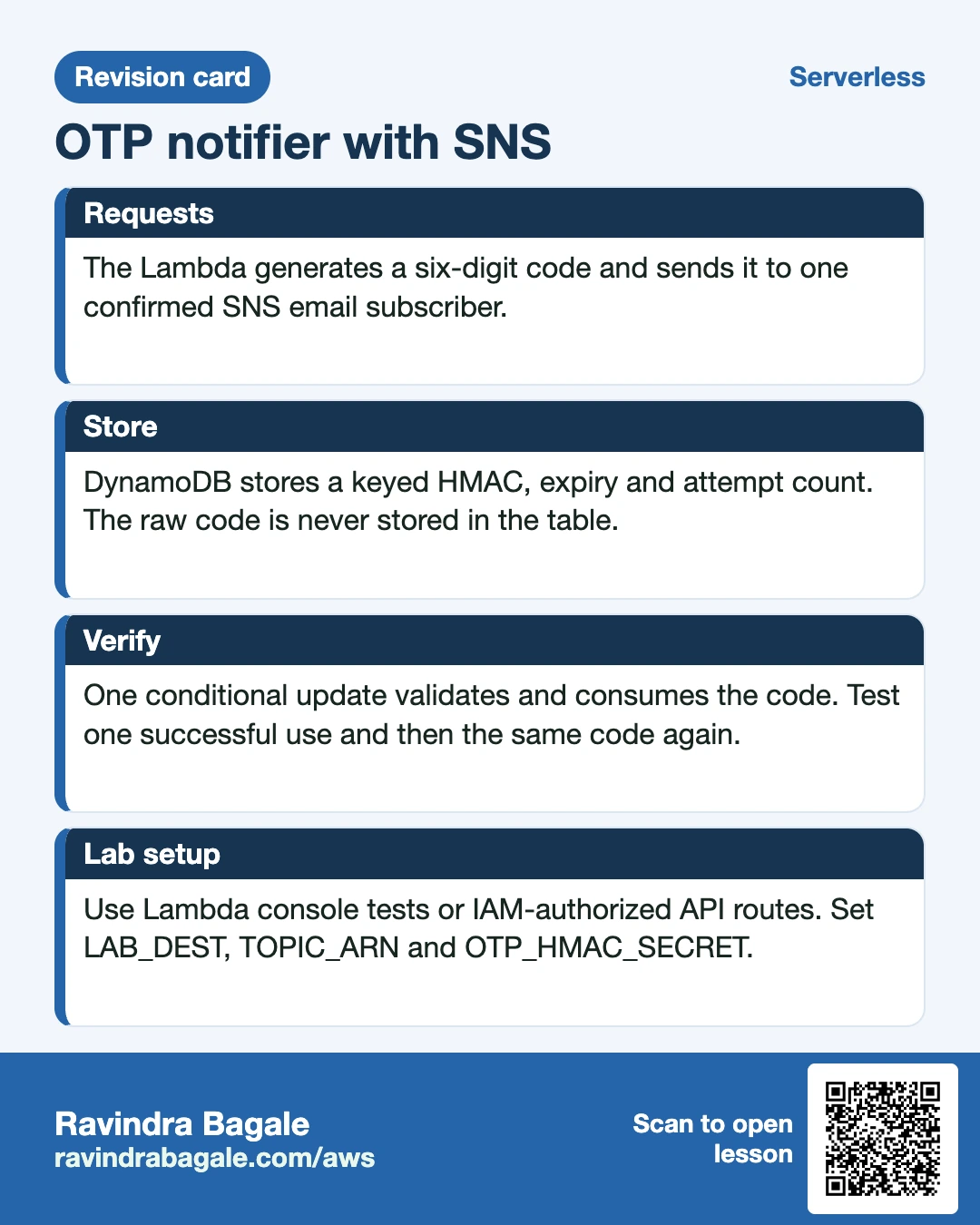
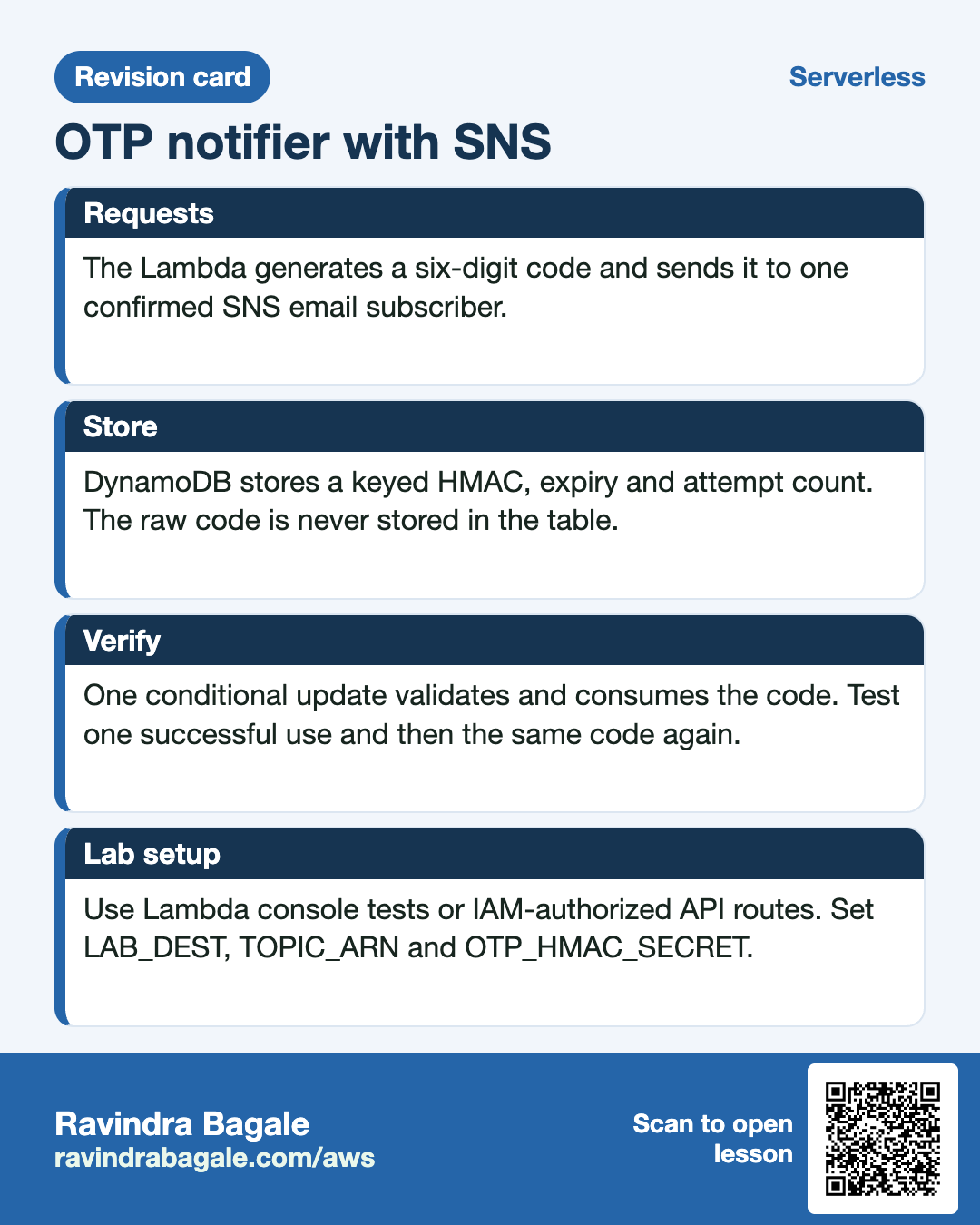
UPI and banking apps send a one-time password. You will build a lab OTP API: store a keyed HMAC in DynamoDB and send the code by SNS email to one confirmed lab address.
In this chapter
- Request and verify OTP flows
- Hash + expiry in DynamoDB
- SNS email for one confirmed lab address
- Cost warnings and cleanup
1. Everyday example
Login without password for a minute: send 6 digits, user types them back. You must expire them fast and never store the raw OTP in plain text.
POST /otp/request and POST /otp/verify. Lambda makes a 6-digit code, stores a keyed HMAC with an expiry, then publishes to the classroom topic. The verifier consumes the code with a single conditional write.
Cost and sandbox
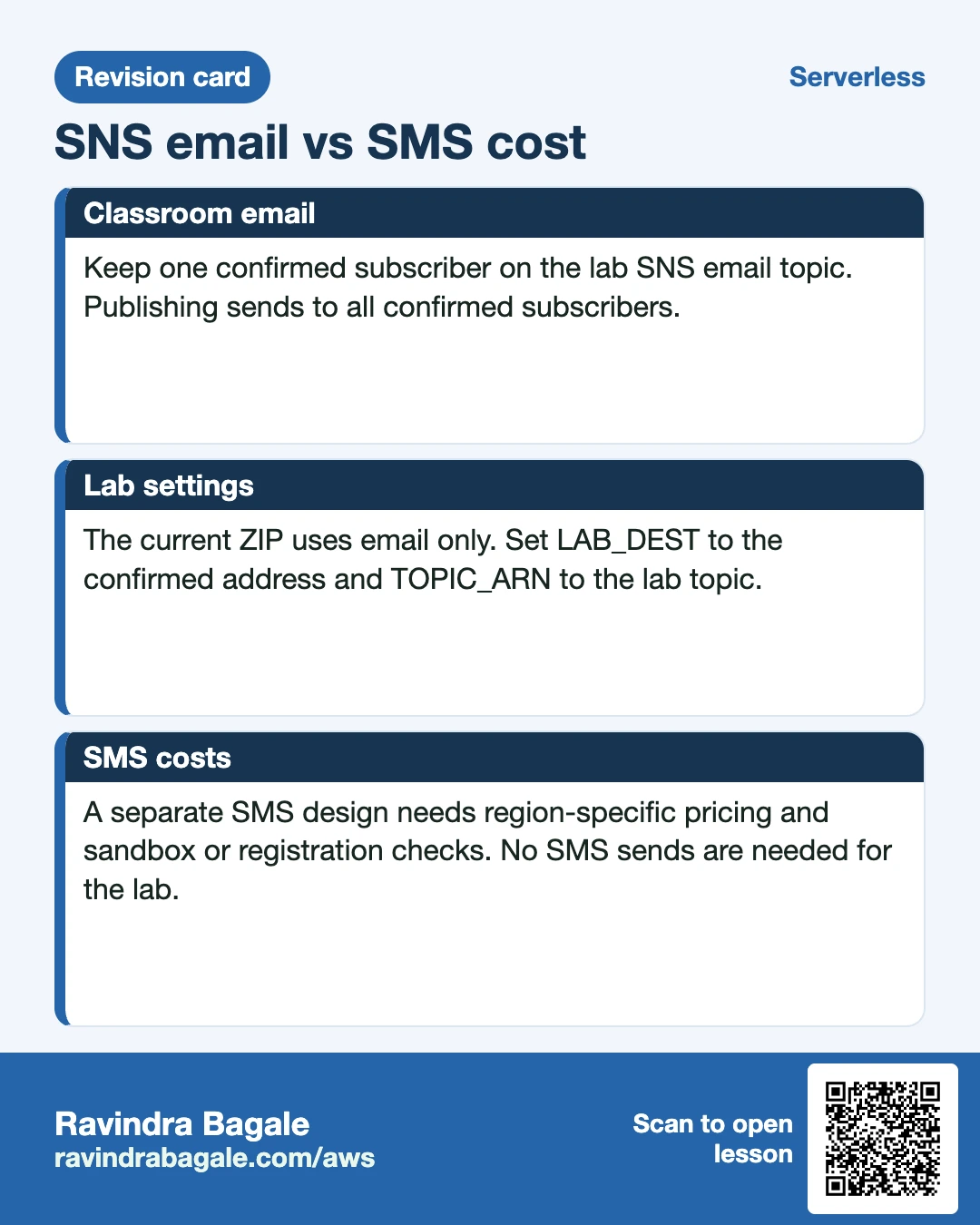
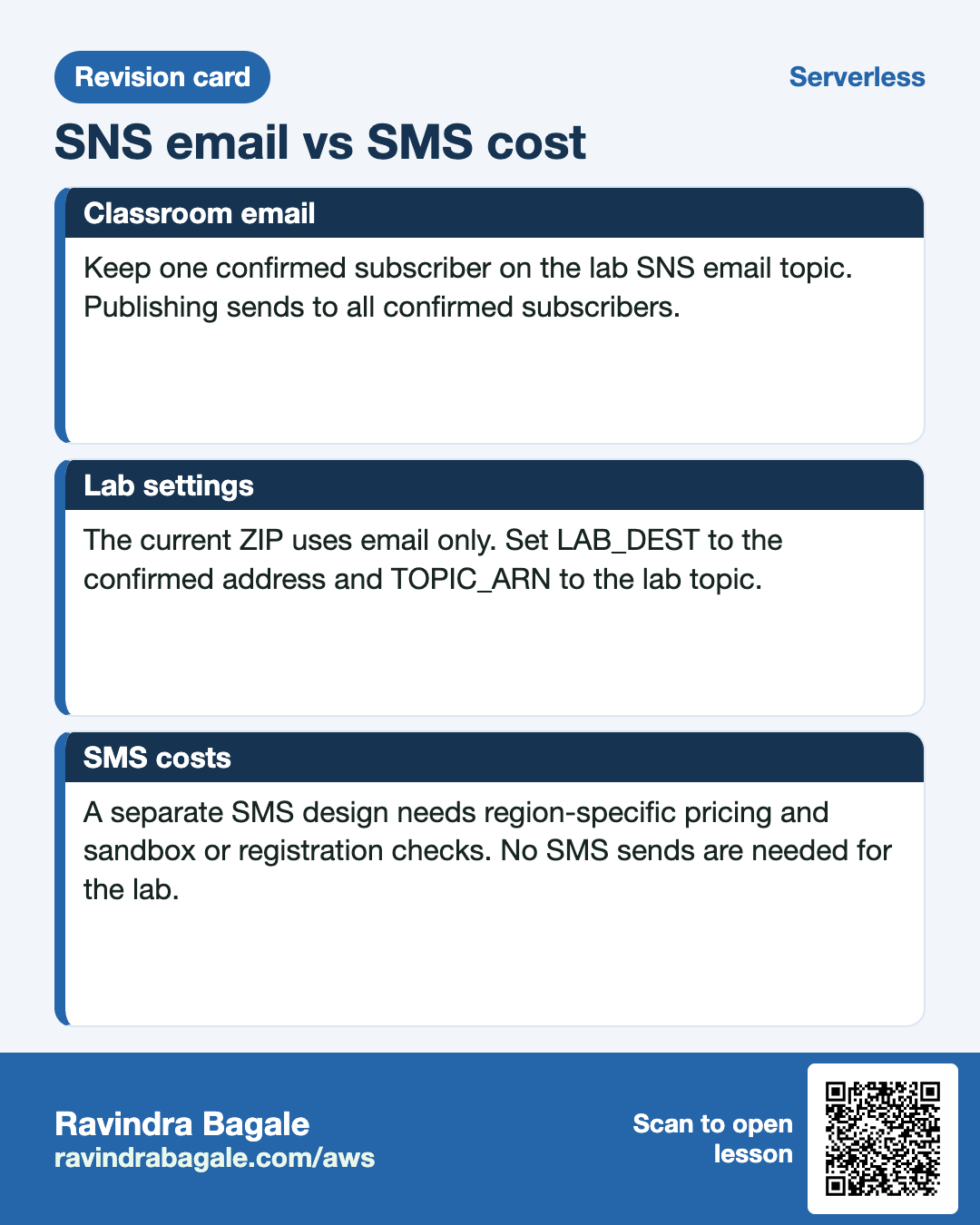
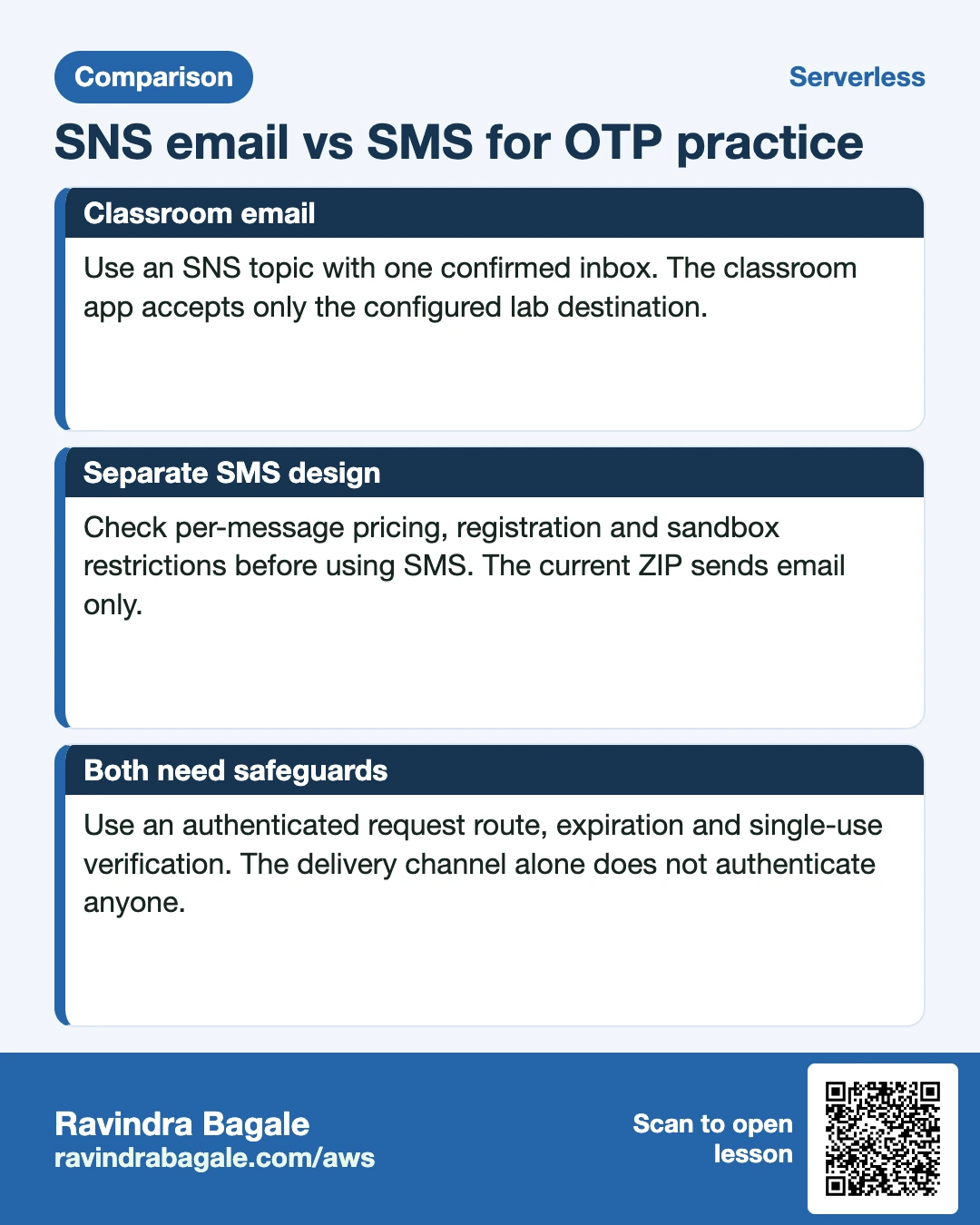
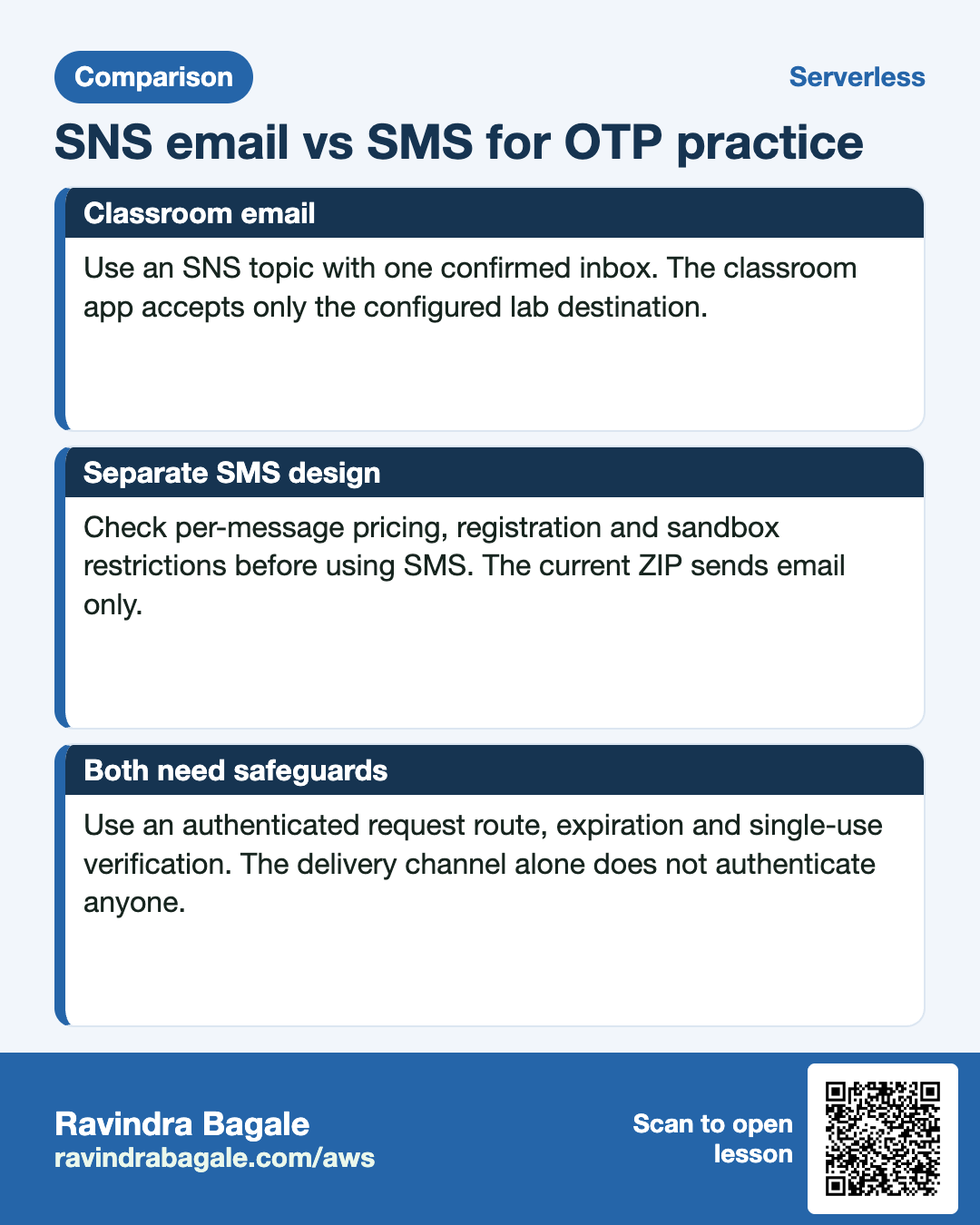
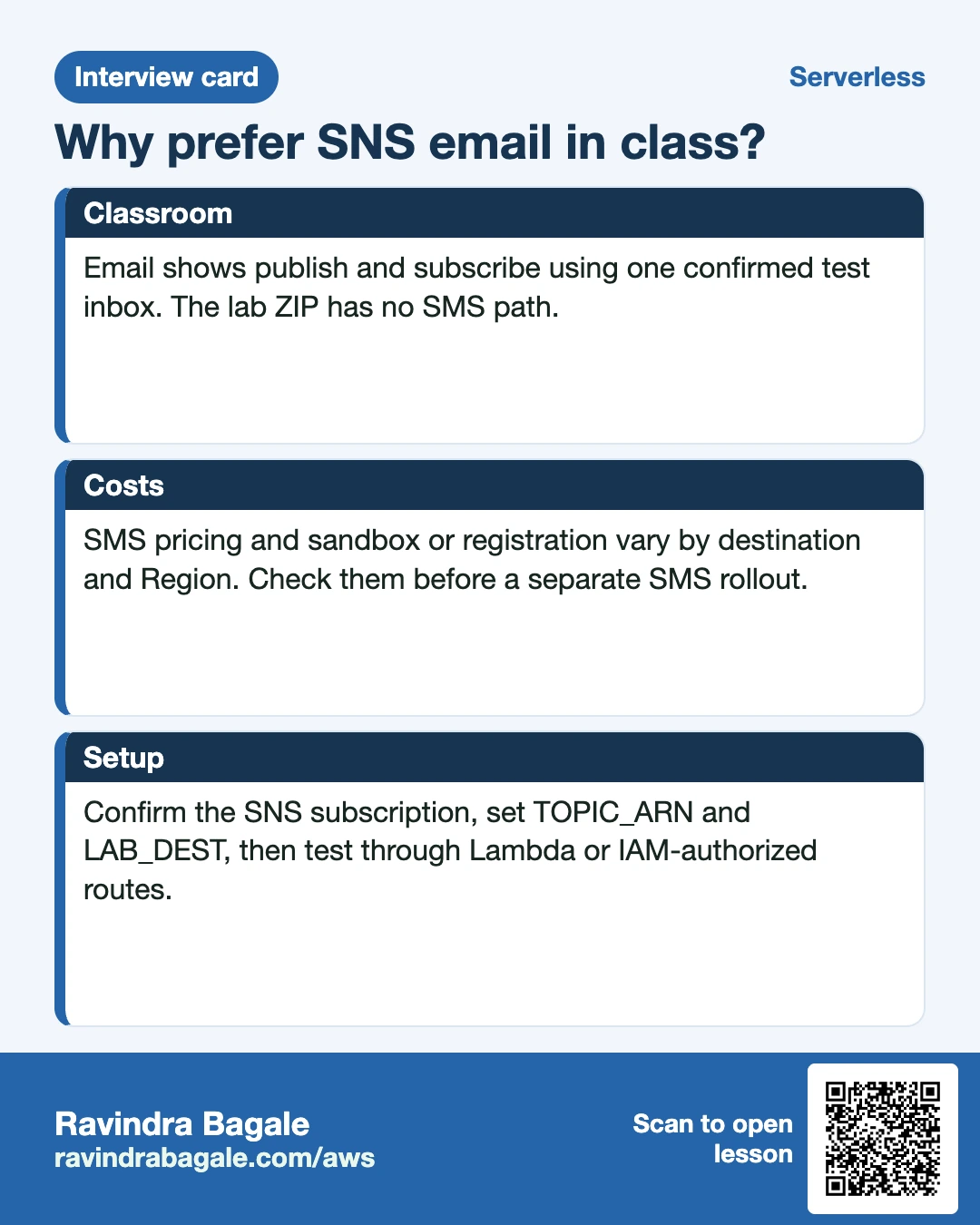
SNS SMS is billed per message and often starts in an SMS sandbox. This archive uses email only. Confirm one email subscription that you control. Remove extra subscribers before testing because SNS publishes to everyone subscribed to the topic.
Download: otp-notifier.zip
2. Lab
A. Table + topic
An OTP is a one-time password, usually a short code delivered to a user who must type it back. This classroom service uses one confirmed inbox so you can observe both requests without handling someone else’s mail. The DynamoDB item records the destination, a verification value, an expiry and state for one code. The inbox receives the digits. Avoid putting the digits or the secret in screenshots as you check the row.
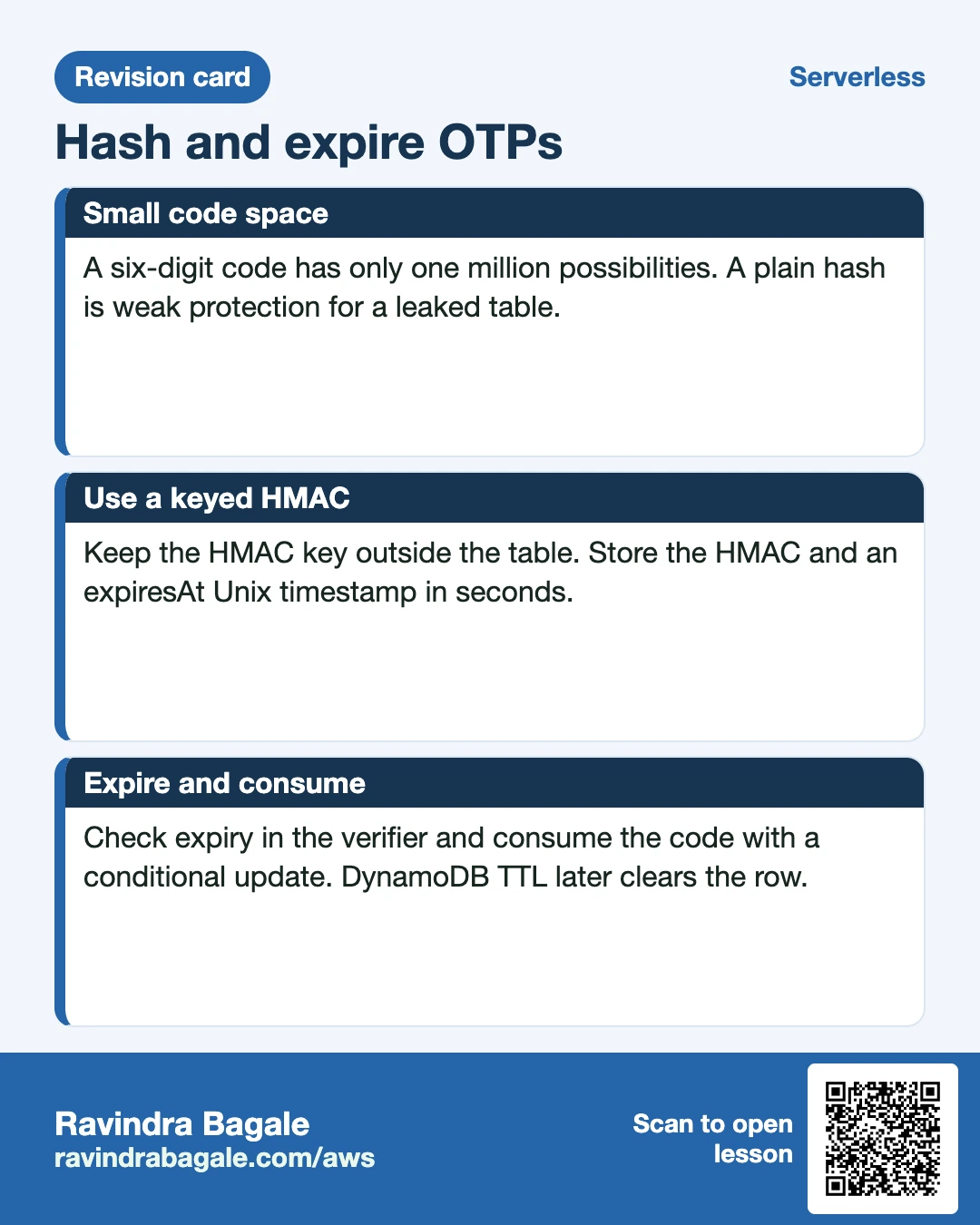
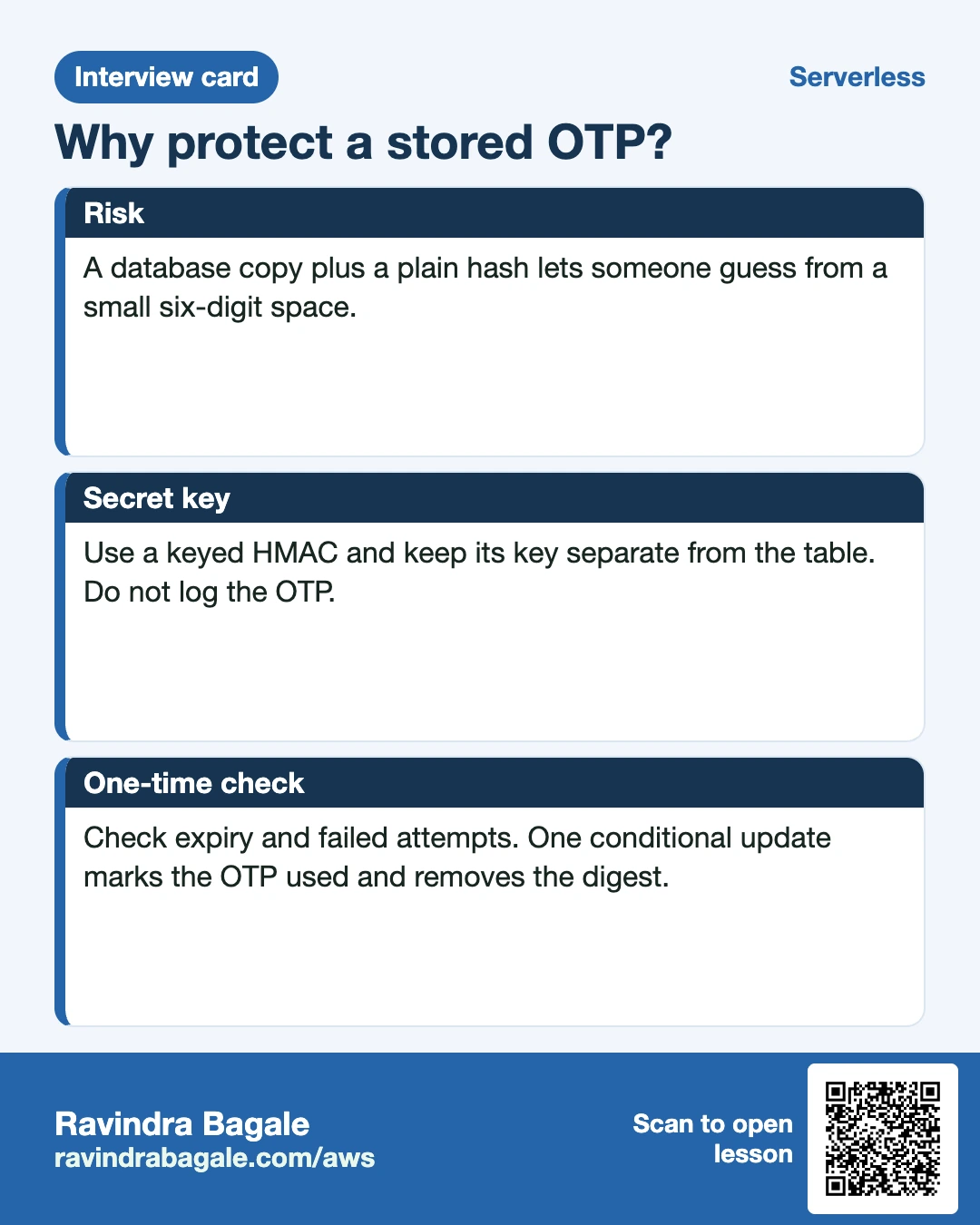
The verification value is an HMAC, a value computed from data and a secret key. The handler can compute it again from a submitted code and compare it with the stored value. Someone holding only a copy of the table cannot repeat that same computation without the key. The short code still needs a time limit and a limit on wrong guesses.
- DynamoDB
yourname-otps, PKdestString. - SNS topic + email subscription (confirm). Copy TOPIC_ARN.
B. Lambda + API
Follow one successful verification. Request a code and read it only in the configured lab inbox. Submit it once before expiry. The conditional table update verifies it is still valid and unused, then marks it used in the same write. If two requests arrive together with that same code, only the first one that satisfies the condition can consume it. The second receives the unsuccessful response even if it submitted the right digits.
Test the difference between expiry and cleanup by using one synthetic expired test case. The code must be rejected at verification even while its row remains. DynamoDB TTL means Time to Live. It removes expired items later. The application’s expiry check enforces the deadline when someone tries the code.
- Role: logs,
dynamodb:PutItemanddynamodb:UpdateItemon the lab table, andsns:Publishon the lab topic. - Use
handler.lambda_handler. SetTABLE_NAME,TOPIC_ARN,LAB_DESTto the confirmed email address, andOTP_HMAC_SECRETto at least 32 bytes of randomly generated text. Keep this value out of code, logs and screenshots. - Test both paths with Lambda console events. If you add the HTTP API, use payload format 2.0 and
AWS_IAMauthorization on both POST routes and invoke with an authorized SigV4 client.
Use this Lambda console event with your own configured lab address. For the verify event, set rawPath to /otp/verify and add the emailed six-digit code to the body as otp.
{
  "requestContext": {
    "http": {
      "method": "POST"
    }
  },
  "rawPath": "/otp/request",
  "body": "{\"dest\":\"you@example.com\"}"
}
Cleanup
- Delete API, Lambda, table, topic, role. Delete OTP rows if any remain.
- Delete the lab's CloudWatch log group after saving any required non-secret test evidence.
3. Interview
Q. Why hash the OTP?
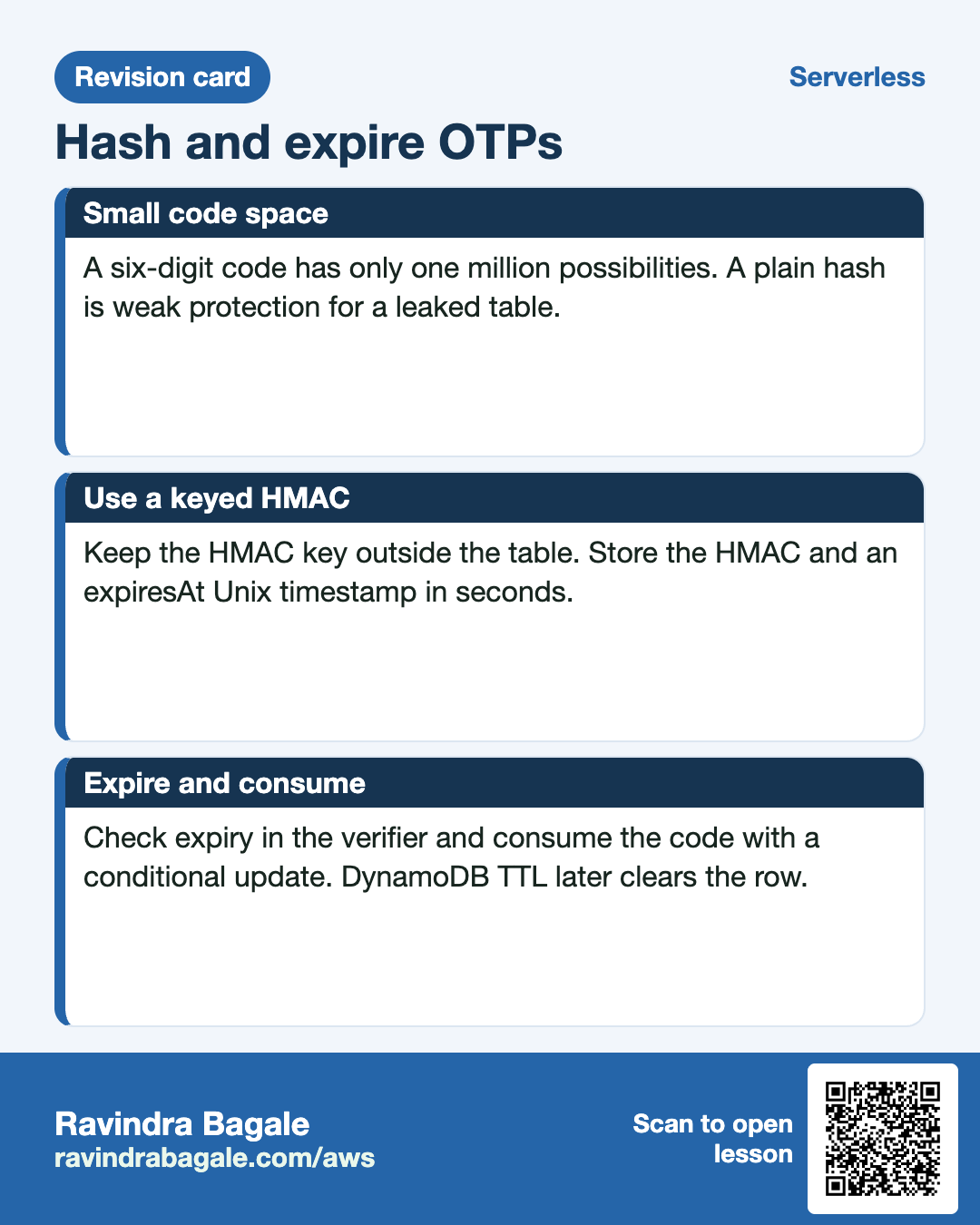
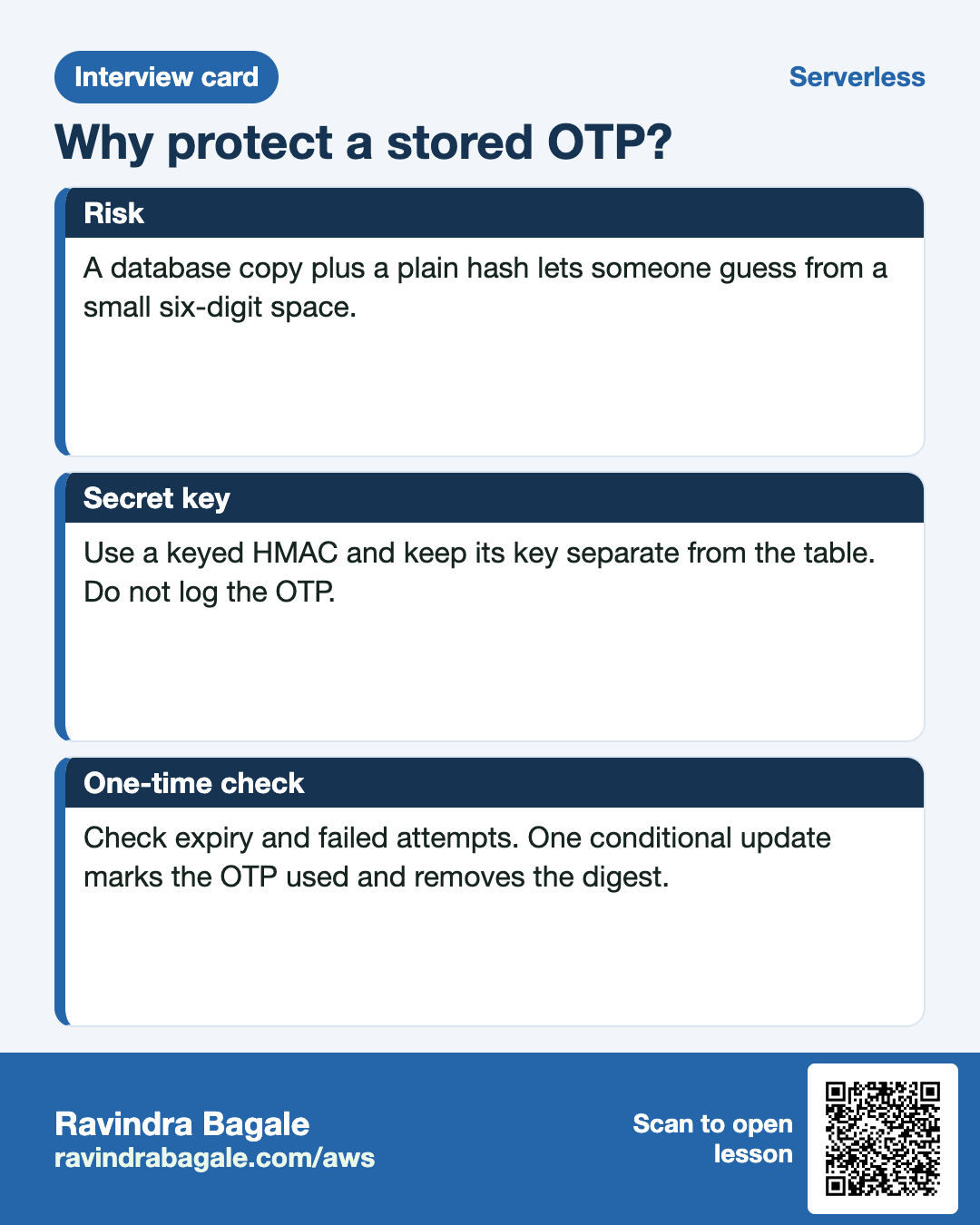
Six-digit values are too small to protect with an unkeyed hash alone. A keyed HMAC makes checking guesses against only the leaked table harder. Keep its key separate from the table.
Q. Why expiry?
OTPs are short-lived secrets; 5 minutes is common.
Q. SMS vs email lab?
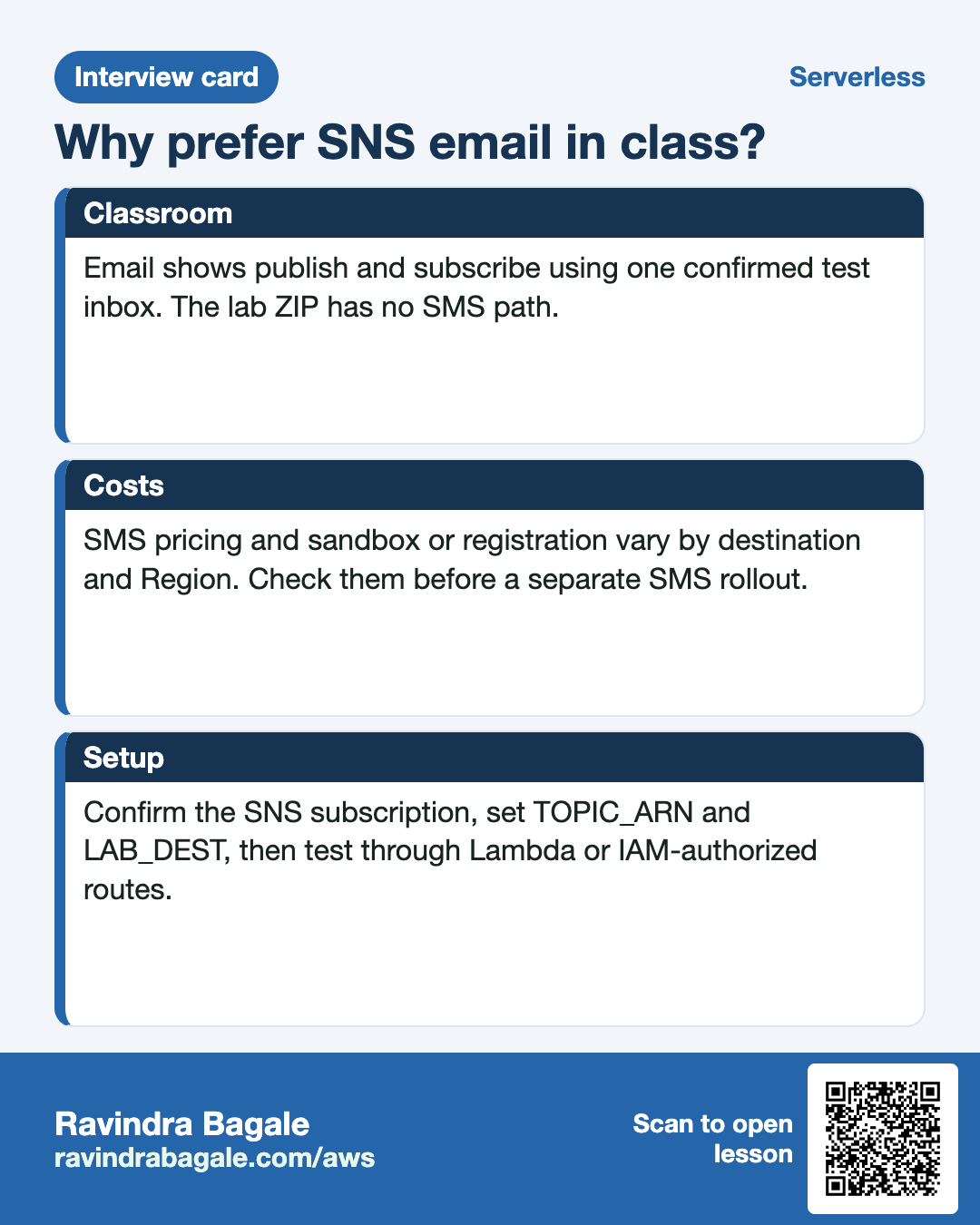
Email SNS avoids SMS cost/sandbox for learning the flow.
Q. Rate limiting?
This lab gates the routes with IAM, requires a single configured destination, waits 30 seconds between requests, and caps failed guesses at five per active code. Runtime expiry still applies before TTL deletes a row.
Q. Cleanup?
API, Lambda, table, topic.
Try at home
- Verify that five failed guesses block further verification attempts for the same code.
- Use DynamoDB TTL on expiresAt.
In short
- OTP API = request + verify + hash + SNS.
- Prefer email in class.
- Never log raw OTP.
- Clean up.
Prove the code works only once
Use one confirmed email subscriber and test both routes in Lambda console events or behind AWS_IAM. Request a six-digit code for LAB_DEST, verify it once, then submit it again. Expect 200 and 400. Repeat with an expired code and a different destination. The archive enforces expiry in the conditional write, limits failed attempts and retains the consumed row for the 30-second request cooldown.
Interview check What prevents two simultaneous successful verify requests?
One conditional UpdateItem checks the digest, expiry, attempts and used state before removing the digest and setting used=true. Only one writer wins. TTL later removes the row. A keyed HMAC helps keep a table-only disclosure from exposing six-digit verifier values.
Practise this chapter
Check your understanding
Choose an answer, then compare your reasoning with the explanation.
Practice Tasks
Practice checks run in your browser. They check the answer for this exercise; they do not create resources or connect to your AWS account.
About this scenarioStockholm Games is a gaming business in Stockholm. Erik Lindqvist looks after its IT and cloud work. They count money in SEK and run their AWS resources in the eu-north-1 Region. In the tasks below you do real jobs for them using what this lesson teaches. All names, account IDs, IP addresses and numbers are made up for practice.
0 / 12
Easy List functions
See which functions exist in this Region.
List the Lambda functions in eu-north-1.
- Read the task and decide which AWS service it is about.
- Write aws, then the service name, then the operation (the action word).
- Add each needed flag (--name) followed by its value from the task.
- Flags can be in any order. Click Check answer.
Medium Invoke a function
Invoke runs the function now and saves its answer in a file.
Invoke sthlmgames-orders-fn and save the response to out.json.
- Read the task and decide which AWS service it is about.
- Write aws, then the service name, then the operation (the action word).
- Add each needed flag (--name) followed by its value from the task.
- Flags can be in any order. Click Check answer.
Medium Trust policy for a Lambda role
The trust policy says WHO may take the role.
Write a trust policy that lets lambda.amazonaws.com assume the role.
- Start with { "Version": "2012-10-17", "Statement": [ ... ] }.
- In each statement write Effect, Action and Resource.
- Give only what the task needs (least privilege).
- Use double quotes and commas correctly. Click Check answer.
Medium Put an item
DynamoDB JSON shows the type of each value: S for string, N for number.
Put an item into sthlmgames-orders with orderId "o-101" (string) and amount 2500 (number).
- Read the task and decide which AWS service it is about.
- Write aws, then the service name, then the operation (the action word).
- Add each needed flag (--name) followed by its value from the task.
- Flags can be in any order. Click Check answer.
Medium Change timeout and memory
More memory also gives more CPU; timeout stops runaway runs.
Set sthlmgames-orders-fn to timeout 30 seconds and memory 512 MB.
- Read the task and decide which AWS service it is about.
- Write aws, then the service name, then the operation (the action word).
- Add each needed flag (--name) followed by its value from the task.
- Flags can be in any order. Click Check answer.
Medium Let a function write logs
Without these actions, Lambda logs never appear in CloudWatch.
Allow logs:CreateLogGroup, logs:CreateLogStream, logs:PutLogEvents on arn:aws:logs:*:*:* only.
- Start with { "Version": "2012-10-17", "Statement": [ ... ] }.
- In each statement write Effect, Action and Resource.
- Give only what the task needs (least privilege).
- Use double quotes and commas correctly. Click Check answer.
Hard Create a Lambda function
Lambda needs the code zip, a runtime, a handler name and an execution role.
Create function sthlmgames-orders-fn: runtime python3.12, handler app.handler, role arn:aws:iam::124495484726:role/lambda-basic, code in function.zip.
- Read the task and decide which AWS service it is about.
- Write aws, then the service name, then the operation (the action word).
- Add each needed flag (--name) followed by its value from the task.
- Flags can be in any order. Click Check answer.
Hard Set environment variables
Keep settings like table names out of the code.
Set the environment variable TABLE=sthlmgames-orders on sthlmgames-orders-fn.
- Read the task and decide which AWS service it is about.
- Write aws, then the service name, then the operation (the action word).
- Add each needed flag (--name) followed by its value from the task.
- Flags can be in any order. Click Check answer.
Hard Invoke with a JSON payload
In CLI v2, raw JSON needs --cli-binary-format raw-in-base64-out.
Invoke sthlmgames-orders-fn with payload {"orderId":"o-101"} (raw JSON) and save the reply in out.json.
- Read the task and decide which AWS service it is about.
- Write aws, then the service name, then the operation (the action word).
- Add each needed flag (--name) followed by its value from the task.
- Flags can be in any order. Click Check answer.
Hard Lambda GB-seconds
Lambda bills memory × time.
1,000,000 invocations, 512 MB memory, 200 ms each. How many GB-seconds?
- Write down the numbers the task gives you.
- Work it out step by step on paper.
- Type only the final answer in the box.
- Click Check answer.
Hard Connect an SQS queue to Lambda
An event source mapping makes Lambda poll the queue and process messages in batches.
Create an event source mapping from queue arn:aws:sqs:eu-north-1:124495484726:sthlmgames-orders to sthlmgames-orders-fn with batch size 10.
- Read the task and decide which AWS service it is about.
- Write aws, then the service name, then the operation (the action word).
- Add each needed flag (--name) followed by its value from the task.
- Flags can be in any order. Click Check answer.
Hard Let S3 call your function
A resource-based permission is needed before S3 can invoke the function.
Add permission statement s3invoke to sthlmgames-orders-fn so s3.amazonaws.com can call lambda:InvokeFunction from bucket arn:aws:s3:::sthlmgames-uploads.
- Read the task and decide which AWS service it is about.
- Write aws, then the service name, then the operation (the action word).
- Add each needed flag (--name) followed by its value from the task.
- Flags can be in any order. Click Check answer.
Revision, comparison and interview cards
Revise this lesson in a few minutes. Save the cards on your phone or download them as PNG files. The QR code on each card opens this lesson.
More cards: Ravi Sir's Cards.