S3 Bucket Policy Project 1: Public Read-Only Static Website
Priya Deshmukh runs a Pune bakery site on S3. Marketing wants anyone to open the menu URL, but nobody on the internet should upload or delete. That is a public read-only static website bucket policy — with Block Public Access set carefully.
In this chapter
- Why public read-only websites need a tight GetObject allow
- What the full bucket policy JSON means line by line
- How to apply with CLI, prove allow and deny, then cleanup
- BPA pitfalls and AccessDenied debugging
- Interview answers for this pattern
1. Everyday project story
Jaipur travel founder Ananya Sharma and Berlin curator Lukas Weber both host static HTML. They need Principal "*" GetObject on objects, while Put/Delete stay with admin IAM only. Deeper than a one-line example — you ship, test, and tear down.
Related survey (short examples): S3 bucket policy examples. This chapter is the full project lab.
2. Why this policy?
Static files need a public read path without opening write. Mixing private PII in the same bucket is how leaks happen — use a dedicated public assets bucket.
- Anyone can GET objects (browser, curl, CDN later)
- Nobody anonymous can PUT/DELETE
- Admins still manage files via IAM roles
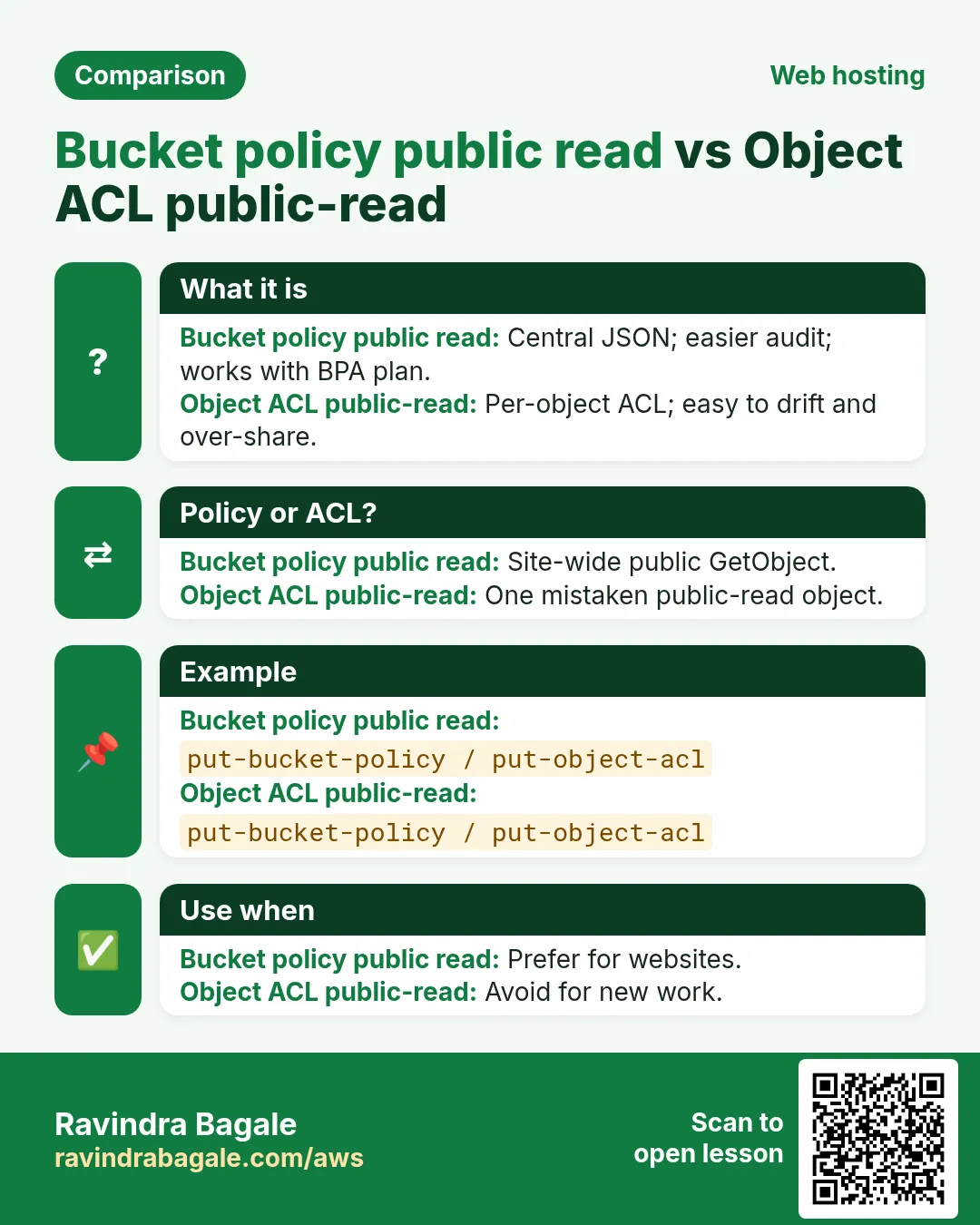
- BPA must allow the public policy without opening ACLs if possible
3. What is the policy?
Write the one capability a bakery visitor needs
Follow one request for menu.html. An anonymous visitor needs to read that object. s3:GetObject addresses a key inside the bucket, so the resource includes the object path or object wildcard. s3:ListBucket addresses the bucket itself and exposes available keys if granted. It is a different capability from opening a link to a known object.
Keep the demonstrator bucket separate and use only sample material meant to be public. Review both the account and bucket public-access controls before the lab. If the account enforces a restriction, use a separate authorized teaching environment or the CloudFront private-origin exercise. A bucket setting cannot override the stricter account control.
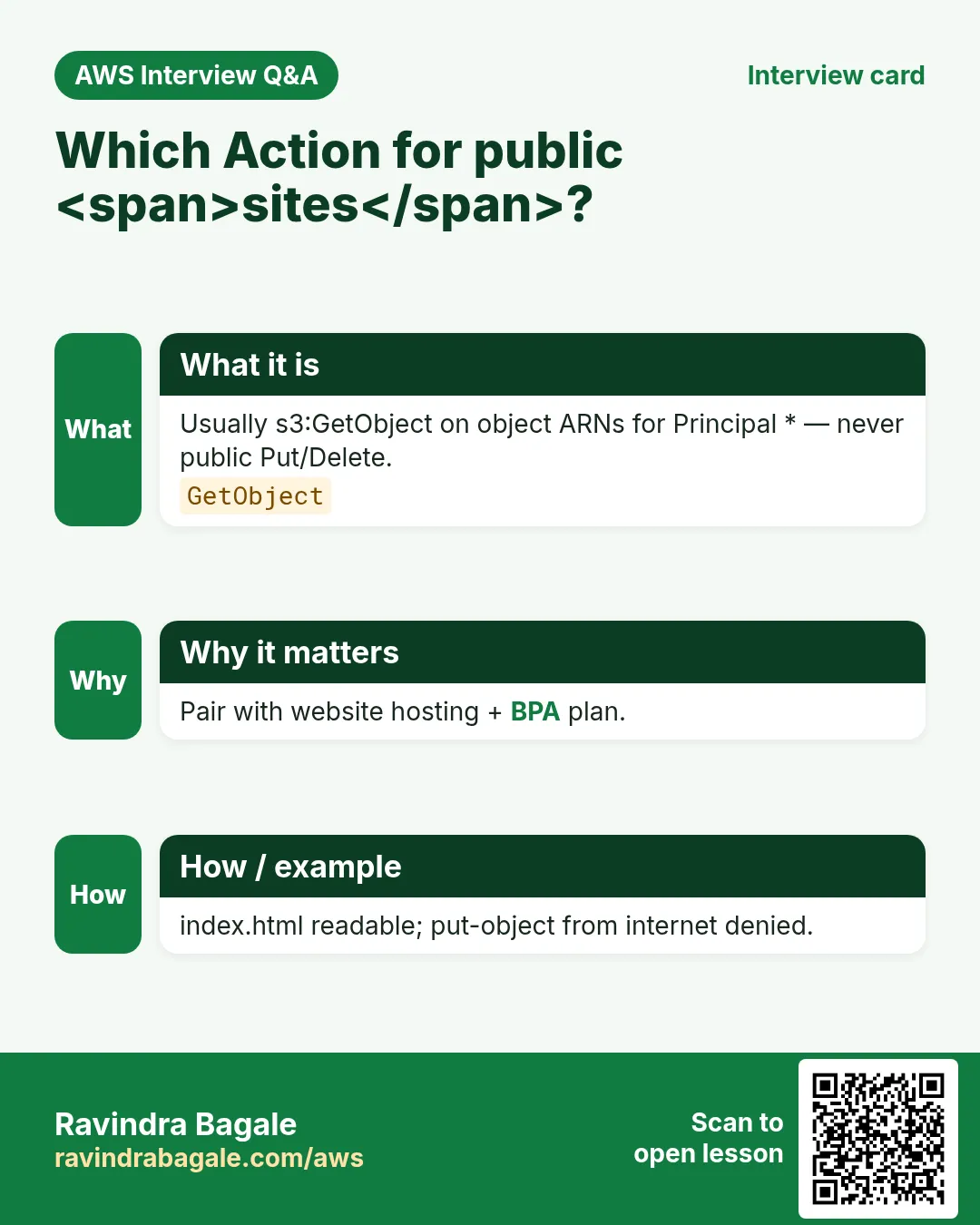
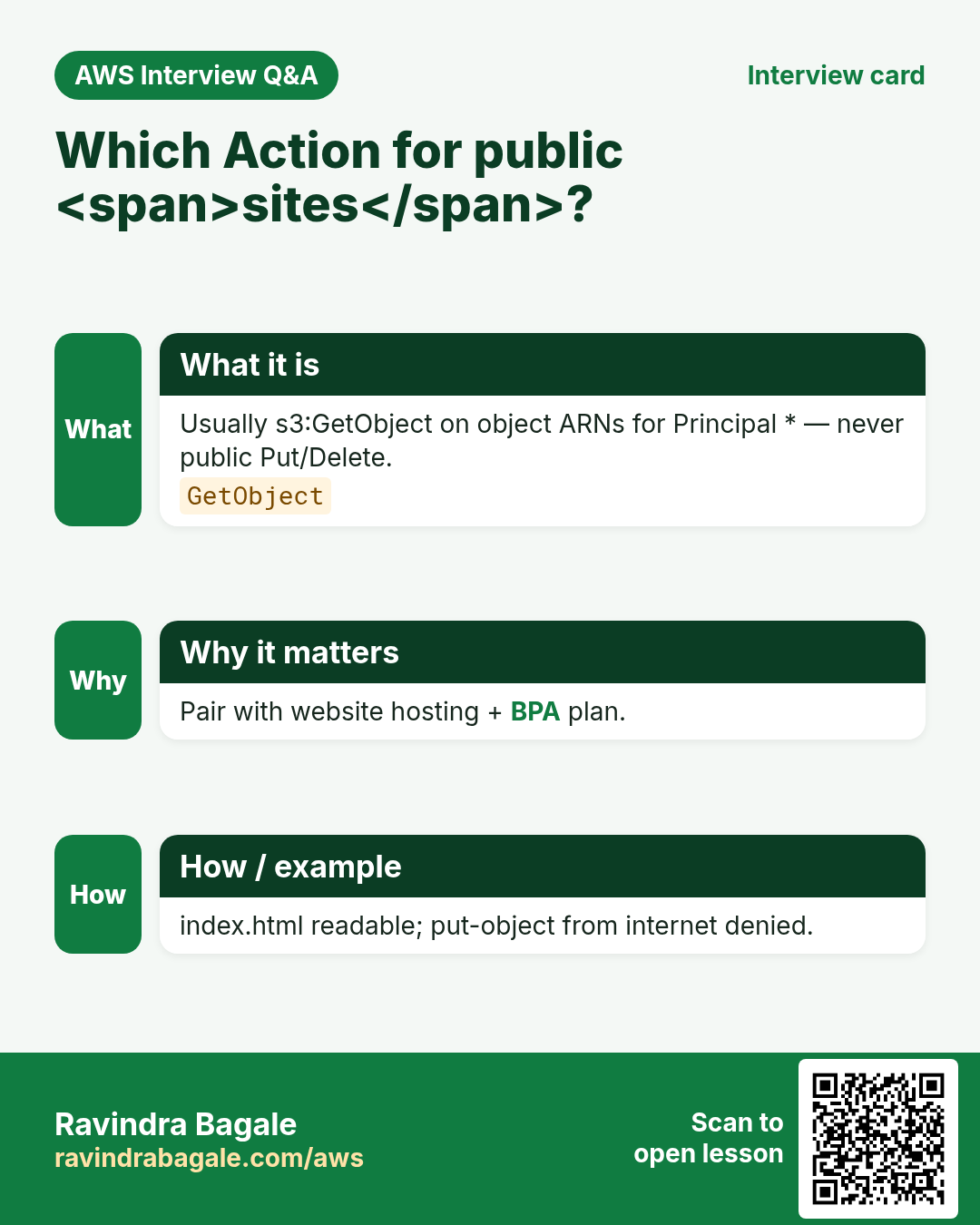
A resource-based policy on the bucket. One Allow statement: Principal *, Action s3:GetObject, Resource arn:aws:s3:::BUCKET/*.
{
  "Version": "2012-10-17",
  "Statement": [
    {
      "Sid": "PublicReadGetObject",
      "Effect": "Allow",
      "Principal": "*",
      "Action": "s3:GetObject",
      "Resource": "arn:aws:s3:::rb-bakery-site-ap-south-1/*"
    }
  ]
}
Line-by-line
- Version 2012-10-17 — current policy language.
- Sid PublicReadGetObject — label for reviews.
- Effect Allow — grant this statement.
- Principal * — anonymous and signed callers for this action.
- Action s3:GetObject — read object bytes only (not ListBucket, not PutObject).
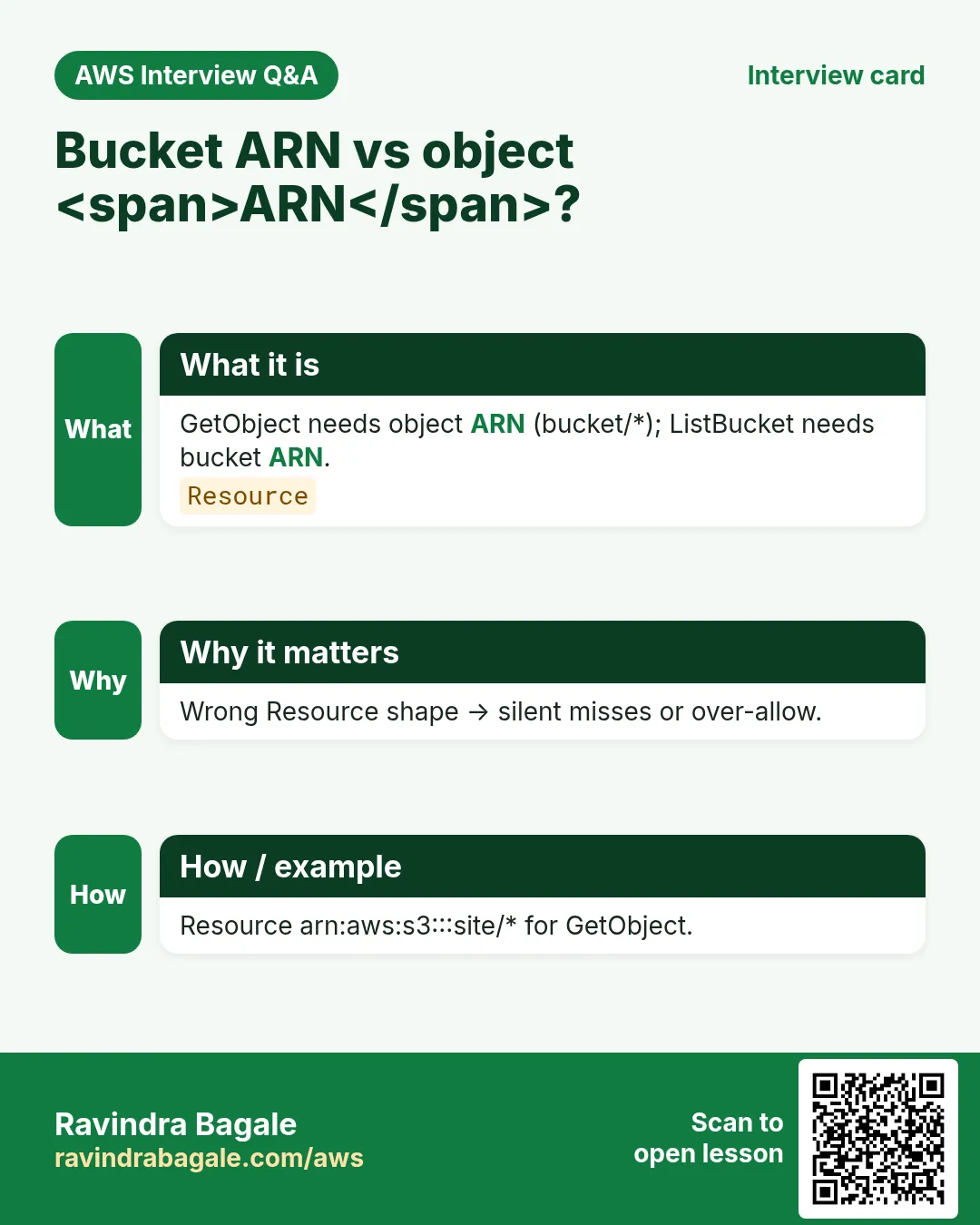
- Resource .../bucket/* — all objects; GetObject never uses the bare bucket ARN.
4. How to do it (CLI with output)
# Create bucket in Mumbai
aws s3api create-bucket --bucket rb-bakery-site-ap-south-1 --region ap-south-1 \
  --create-bucket-configuration LocationConstraint=ap-south-1
# {"Location": "http://rb-bakery-site-ap-south-1.s3.amazonaws.com/"}

# BPA: allow public policy; keep ACL blocks on
aws s3api put-public-access-block --bucket rb-bakery-site-ap-south-1 --public-access-block-configuration \
  BlockPublicAcls=true,IgnorePublicAcls=true,BlockPublicPolicy=false,RestrictPublicBuckets=false

aws s3api put-bucket-policy --bucket rb-bakery-site-ap-south-1 --policy file://public-read.json
# (empty success)

echo "<h1>Menu - Priya Bakery Pune</h1>" > index.html
aws s3 cp index.html s3://rb-bakery-site-ap-south-1/index.html --content-type text/html
aws s3 website s3://rb-bakery-site-ap-south-1/ --index-document index.html --error-document index.html
5. Test: allowed and denied
# ALLOW — anonymous GET
curl -s -o /dev/null -w "%{http_code}\n" \
  https://rb-bakery-site-ap-south-1.s3.ap-south-1.amazonaws.com/index.html
# 200

# DENY — anonymous PUT
curl -s -o /dev/null -w "%{http_code}\n" -X PUT --data hack \
  https://rb-bakery-site-ap-south-1.s3.ap-south-1.amazonaws.com/hack.txt
# 403
Security note
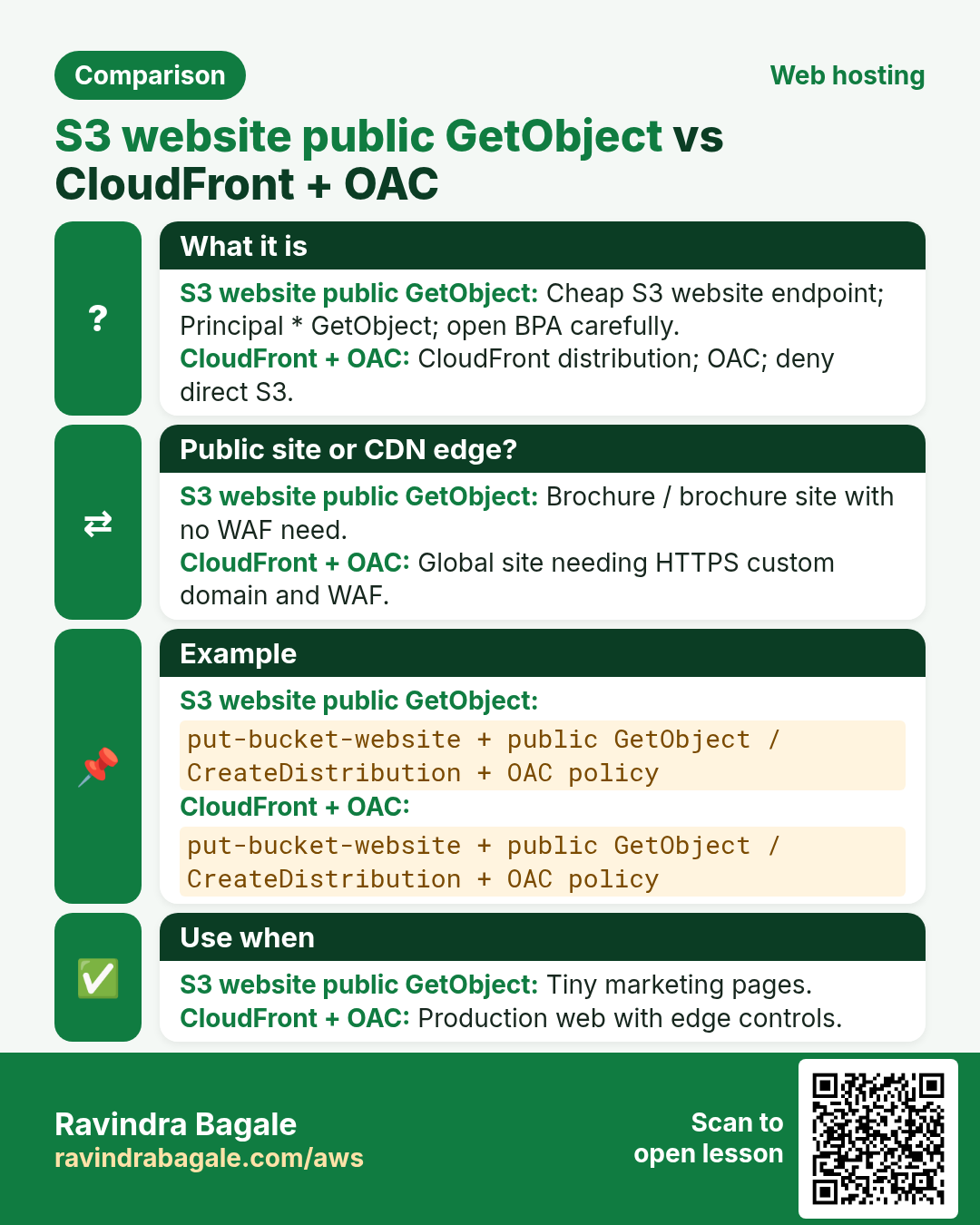
Do not allow s3:ListBucket to the world — listing leaks keys. Prefer CloudFront + OAC (project 2) for production HTTPS.
6. Multi-industry
Ecommerce menus (Pune — Priya Deshmukh), NGO pages (Nairobi — Amina Okello), school timetables (Nagpur — Rohan Patil), museum catalogues (Berlin — Lukas Weber), QR menus (Chennai — Meera Iyer).
7. Security checklist
- Dedicated public bucket; zero PII/secrets
- Only GetObject public; no ListBucket public
- Keep BlockPublicAcls true when possible
- Add CloudFront later for HTTPS custom domain
8. AccessDenied debugging and Policy Simulator
When S3 returns AccessDenied, check in order: (1) Block Public Access, (2) matching bucket policy Deny, (3) missing IAM Allow, (4) KMS key policy, (5) VPC endpoint policy, (6) legacy ACL. IAM Policy Simulator can miss BPA/VPC/KMS — always re-test with real CLI from the real network path.
# Decode
aws s3api get-bucket-policy --bucket BUCKET --query Policy --output text | python3 -m json.tool
aws s3api get-public-access-block --bucket BUCKET
aws iam simulate-principal-policy --policy-source-arn ARN \
  --action-names s3:GetObject --resource-arns arn:aws:s3:::BUCKET/key.txt
aws cloudtrail lookup-events --lookup-attributes AttributeKey=EventName,AttributeValue=GetObject --max-items 5
9. Industries and roles
- Frontend: marketing sites without EC2
- DevOps: BPA + policy as code
- Security: review Principal * every quarter
10. Lab: public read-only bakery site
Prove the narrow public permission with separate results
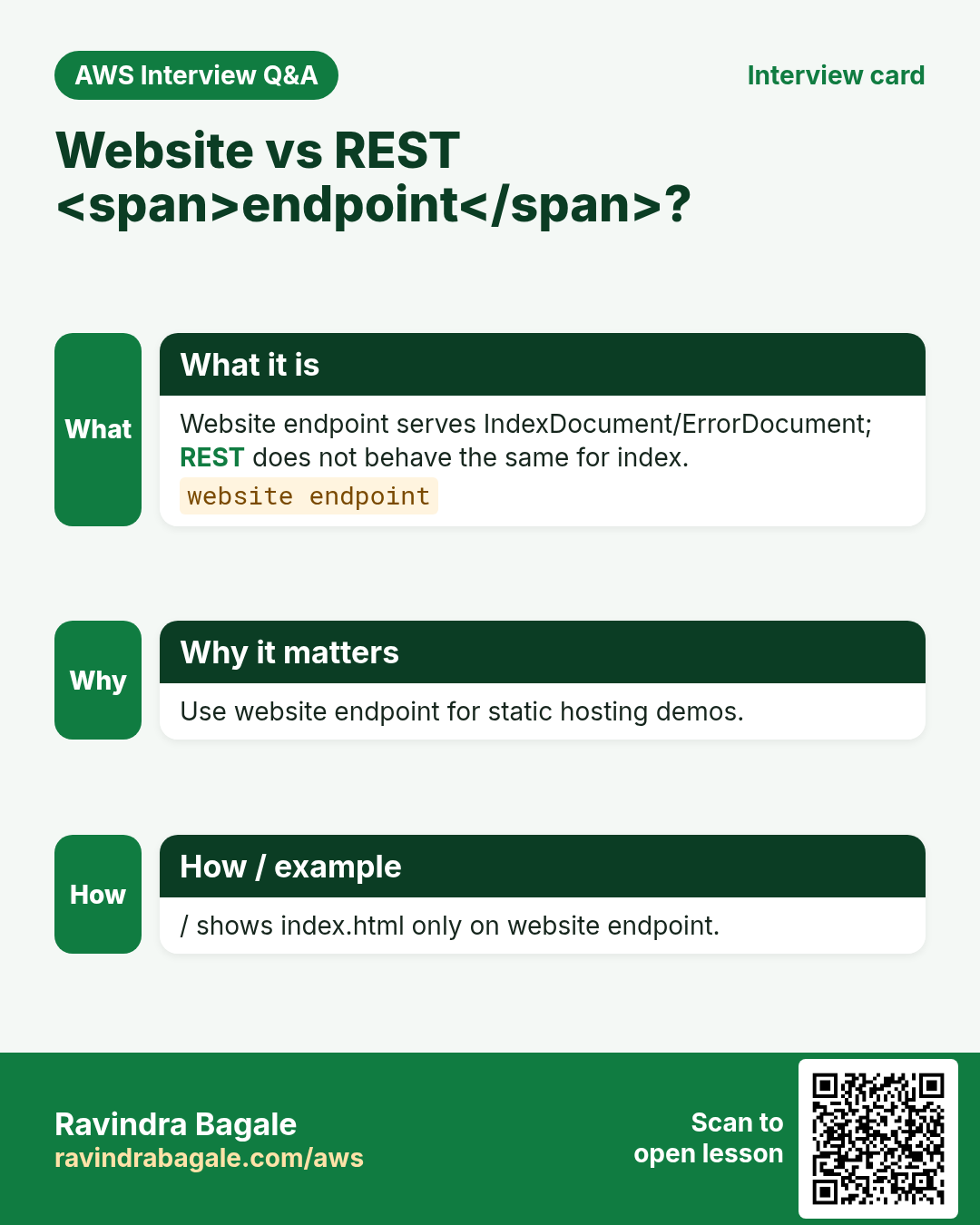
Record the sample bucket, exact key and anonymous browser before testing. The expected result for the menu object is 200 from the configured website endpoint. An anonymous write or bucket listing should fail under this read-only design. When a read fails too, check whether you used the website endpoint, whether the key exists and whether effective Block Public Access prevents that policy.
Write the observed results for read, list and write separately. A working page alone does not prove the other operations are refused. Remove the public policy and the temporary website content after the exercise.
Do this in ap-south-1 (Mumbai) unless your org forbids it. Set a budget alert first.
- Create rb-bakery-site-ap-south-1 in ap-south-1.
- Tune BPA; put PublicReadGetObject policy; upload index.html.
- curl GET → 200; curl PUT → 403; save both outputs.
- Enable static website hosting; open website endpoint.
Cleanup (stop billing)
- Delete objects, delete bucket policy, delete bucket.
- Restore account BPA if you changed it.
11. Common errors and fixes
Each row is a real mistake students and juniors hit. Read the fix before you panic.
| Error / symptom | Fix |
|---|---|
| AccessDenied but IAM Allow looks fine | Find explicit Deny in bucket policy or BPA blocking public. |
| Policy JSON rejected on put | Validate with python3 -m json.tool; no smart quotes; use file://. |
| Policy Simulator Allow, CLI Deny | Simulator skips some layers; retest with real CLI/role/network. |
| Wrong Resource ARN shape | GetObject needs arn:...:bucket/* ; ListBucket needs bare bucket ARN. |
| Condition key typo or wrong case | Keys like aws:SourceIp are case-sensitive. |
| Missing Principal on bucket policy | Resource-based policies require Principal; identity policies must omit it. |
| Account-level BPA overrides bucket | Account Block Public Access can still block public grants. |
| Encrypted object / KMS forgotten | SSE-KMS needs key policy + kms:Decrypt/GenerateDataKey. |
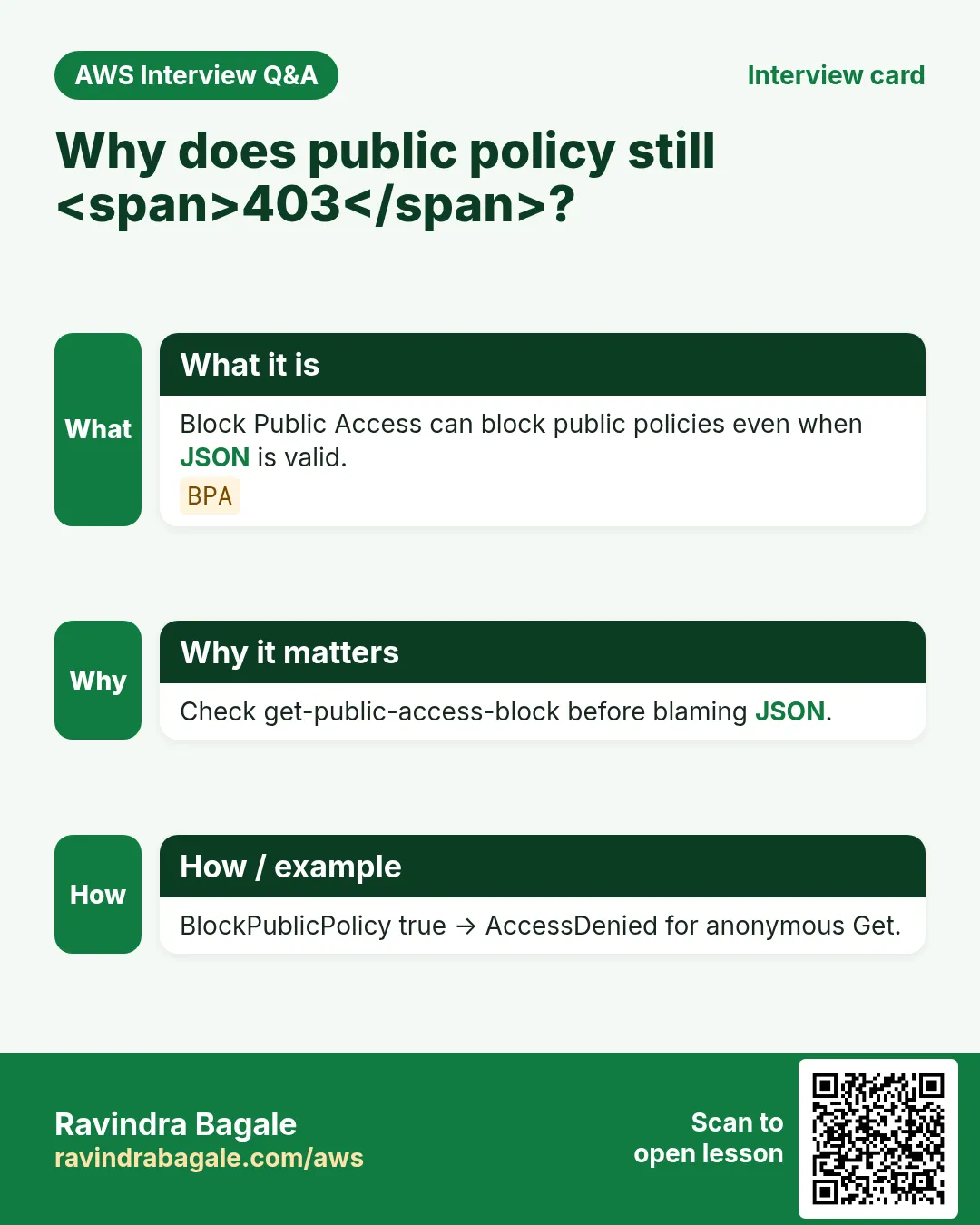
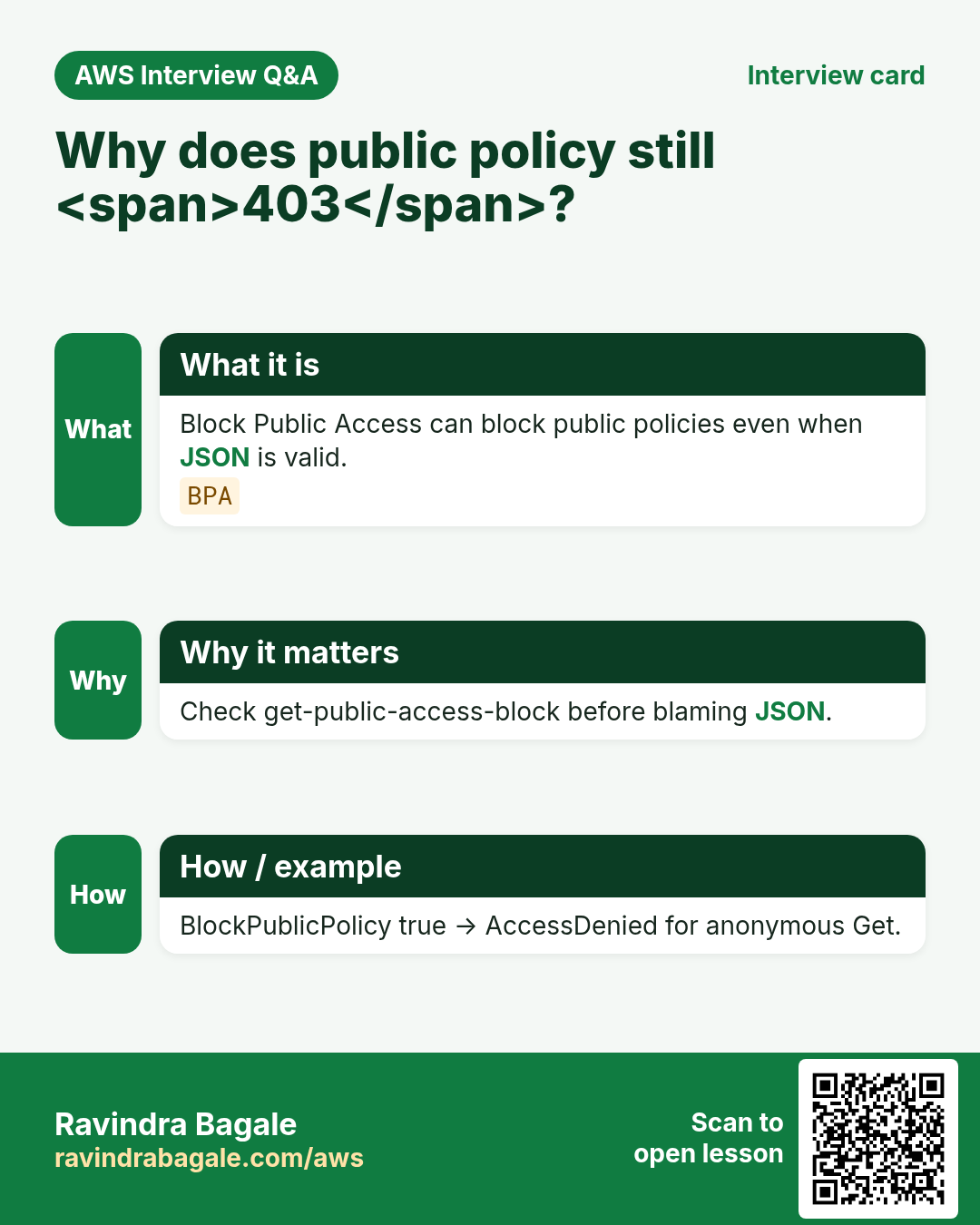
| Website 403 after policy | BPA BlockPublicPolicy still true, or wrong object key. |
| ListBucket * opened by mistake | Remove it; fix 404s with correct keys or CloudFront. |
12. Troubleshooting checklist
- Confirm region and endpoint hostname for the bucket.
- Print get-bucket-policy and get-public-access-block.
- Reproduce with a least-privilege lab IAM user.
- Binary-search Denies by commenting one Sid at a time in lab.
- Read CloudTrail errorCode and additionalEventData.
- If KMS involved, test key permissions separately.
- From VPC path: route to gateway prefix list + endpoint policy.
- Cleanup versioning/Object Lock labs carefully.
13. FAQ
Q. Is a bucket policy the same as an IAM policy?
No. Bucket policy is resource-based on the bucket; IAM is identity-based. For same-account, either can Allow; explicit Deny wins; cross-account needs both.
Q. Do I still need ACLs in 2026?
Prefer Bucket owner enforced (ACLs off) + bucket policy. Some log deliveries still need canned ACL on Put.
Q. What is Block Public Access?
Switches that block public ACLs/policies at account or bucket. Disable only the minimum for a deliberate public design.
Q. How do you debug AccessDenied fast?
BPA → bucket policy → IAM → KMS → VPCe → CloudTrail. Never “fix” with Action *.
Q. Is Principal * required for websites?
For true anonymous browser access yes — or use CloudFront OAC with a private bucket (better).
Q. Does the S3 website endpoint give HTTPS?
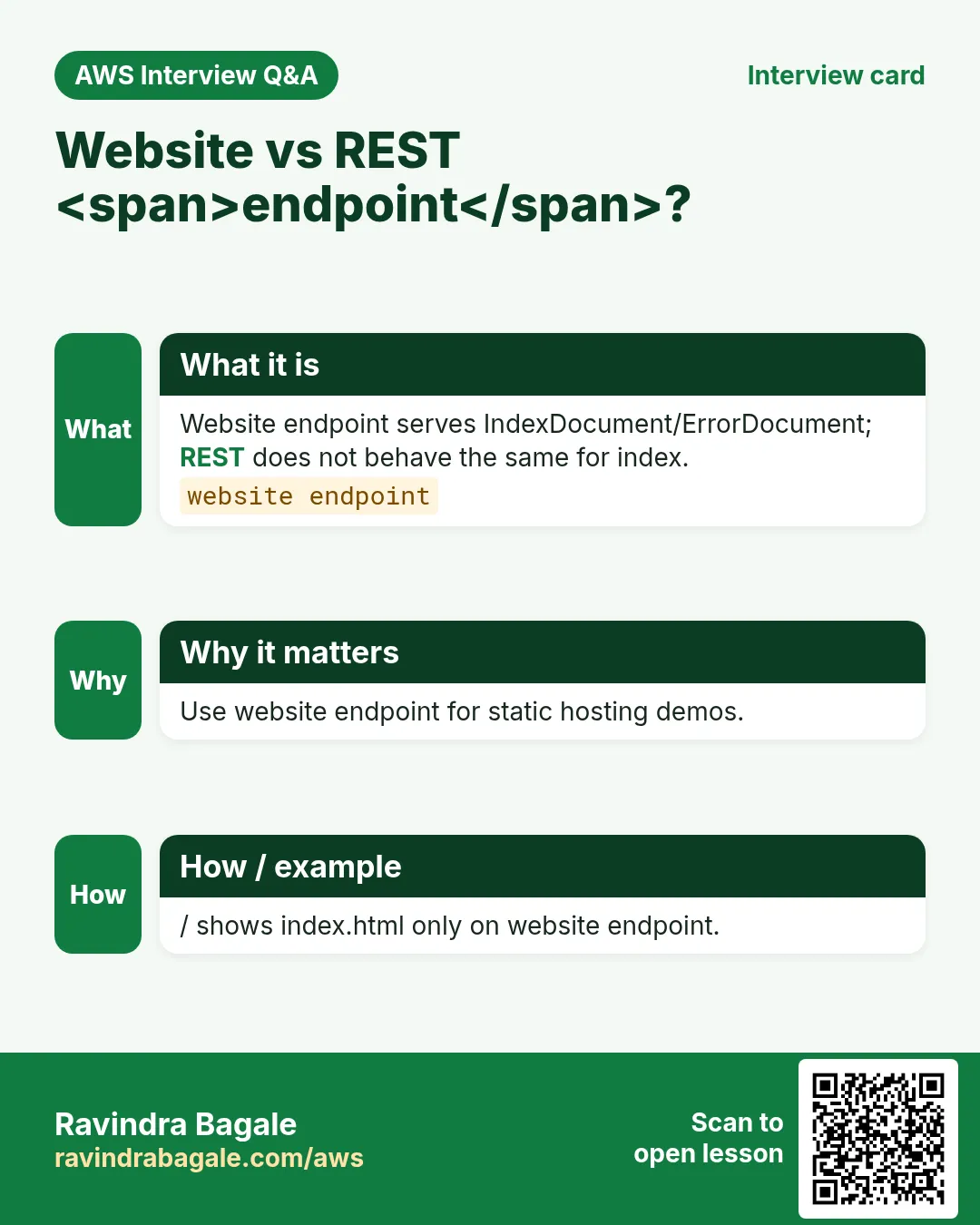
No — HTTP. Use CloudFront for HTTPS.
Q. Can Resource be only index.html?
Yes — pin specific keys/prefixes.
Q. Fast revoke of public access?
Delete bucket policy or enable RestrictPublicBuckets.
14. Interview Q&A
Q. Why Resource .../* for GetObject?
GetObject is object-level; bare bucket ARN is for bucket actions like ListBucket.
Q. Which BPA flag blocks public policies?
BlockPublicPolicy.
Q. Is opening ListBucket to * OK?
No — it leaks object keys.
Q. Safest public-site pattern today?
Private bucket + CloudFront OAC (next project).
Q. How do you prove the policy works?
Anonymous GET 200 and anonymous PUT 403.
Q. Who wins: IAM Allow vs bucket Deny?
Explicit Deny always wins.
15. Tips in English, Marathi and Hindi
Ravindra Bagale's Tip (EN)
Ship public assets in their own bucket. Treat Principal * like a fire alarm — rare and reviewed.
Ravindra Bagale's Tip (MR)
Public assets वेगळ्या bucket मध्ये. Principal * = fire alarm — दुर्मिळ व review.
Tip (HI)
Public assets अलग bucket में रखें। Principal * को तिमाही review करें.
Try at home
- Apply this policy on a lab bucket; capture 200 and 403.
- Change Resource to a single key; confirm other keys 403.
- Explain BPA flags in 60 seconds.
In short
- Public site policy = Allow GetObject for *.
- Tune BPA; prefer ACL blocks on.
- Always test allow and deny.
- Production prefers CloudFront OAC (next project).
- Never mix PII into a public bucket.
16. Policy design checklist before you save
- Write the business rule in one sentence (who can do what from where).
- Choose Allow vs Deny-unless consciously; remember explicit Deny wins.
- List every Resource ARN shape you need (bucket vs bucket/*).
- Name every Condition key exactly (case-sensitive).
- Decide BPA settings before put-bucket-policy.
- Plan the allow test and the deny test with expected HTTP/CLI codes.
- Plan cleanup (versioning, Object Lock, KMS schedules).
- Paste JSON through python3 -m json.tool before apply.
17. Policy Simulator walkthrough
IAM Policy Simulator is great for identity policies and a first pass on resource policies, but it can miss Block Public Access, VPC endpoint policies, and some KMS denials. Use it to catch typos, then always re-test with AWS CLI from the real network path (office IP, VPC, or CloudFront).
- Open IAM → Policy simulator → pick the user/role.
- Add action s3:GetObject / PutObject and the object ARN.
- If you use resource policies, include the bucket policy text where the tool allows.
- Note Allow/Deny; then run the matching CLI from the real path.
- If Simulator Allow but CLI Deny, check BPA, VPCe, KMS, and explicit Denies next.
18. Copy-paste runbook (print this)
# 0) Region + names
export AWS_REGION=ap-south-1
export BUCKET=rb-lab-$(date +%s)-ap-south-1

# 1) Create + show BPA
aws s3api create-bucket --bucket $BUCKET --region $AWS_REGION \
  --create-bucket-configuration LocationConstraint=$AWS_REGION
aws s3api get-public-access-block --bucket $BUCKET || true

# 2) Validate + apply policy
python3 -m json.tool policy.json >/dev/null
aws s3api put-bucket-policy --bucket $BUCKET --policy file://policy.json
aws s3api get-bucket-policy --bucket $BUCKET --query Policy --output text | python3 -m json.tool | head

# 3) Allow test + Deny test (fill per project)
# ... project-specific curls / aws s3 cp ...

# 4) Cleanup
aws s3 rm s3://$BUCKET --recursive || true
aws s3api delete-bucket-policy --bucket $BUCKET || true
aws s3api delete-bucket --bucket $BUCKET
19. Industry story bank (reuse the pattern)
Each project above uses one industry story. Use the same policy pattern in these other industries without rewriting the JSON from scratch — only change the bucket name, principal, and Condition values.
- Healthcare (Priya Nair, Apollo-style clinic): patient PDFs — prefer SSE-KMS + OrgID + MFA delete.
- Fintech (Arjun Mehta, UPI wallet): statements — office IP + SecureTransport + CloudFront OAC for the customer portal.
- EdTech (Sofia Alvarez, online course): course videos — CloudFront OAC only; never public ACLs.
- Logistics (Kenji Watanabe, fleet app): GPS dumps — VPC endpoint only from the private subnet runners.
- Media (Fatima Khan, newsroom): raw footage — Object Lock COMPLIANCE + deny delete.
- Retail (Lucas Meyer, D2C brand): product images — public read for /images/* only; deny everything else.
- SaaS (Ananya Iyer, B2B CRM): tenant exports — ${aws:username} or ${aws:PrincipalTag/tenant} prefixes.
- Government (Rahul Deshmukh, state portal): RTI archives — OrgID + MFA + Object Lock.
20. AccessDenied debugging flowchart
- Read the error code and the request ID. Save both.
- Confirm you are calling the right bucket and region.
- Check Block Public Access if the principal is * or a service that looks public.
- Decode the policy: is there an explicit Deny that matches? Deny wins.
- Check Condition keys: SecureTransport, SourceVpce, SourceIp, PrincipalOrgID, encryption headers.
- For KMS: does the key policy allow the caller? Bucket policy alone is not enough.
- For CloudFront: is OAC present and the distribution id matching?
- For VPC: are you really going through the endpoint (no public IP leak)?
- Simulate in IAM Policy Simulator, then re-test with CLI from the real path.
- Only then open a support case with the request id and a redacted policy.
21. What good looks like in a PR review
- Policy JSON validates and is indented.
- Every Statement has Sid, Effect, Action, Resource.
- No Principal:* with write actions unless BPA and a Deny fence exist.
- Allow test and Deny test are documented with expected output.
- Cleanup steps will not strand Object Lock or KMS keys.
Practise this chapter
Interview questions and answers
Why can an anonymous user read menu.html without listing the bucket?
A read of a known key is an object operation. Listing names is a separate bucket operation. Grant only the required read and compare both from a session without AWS credentials.
What does a 403 on a public website object tell you to check?
Check the exact website endpoint and key first, then whether the bucket policy’s object resource covers it and whether effective Block Public Access blocks the policy. Use a test object you own and verify the user context.
Check your understanding
Choose an answer, then compare your reasoning with the explanation.
Practice Tasks
Practice checks run in your browser. They check the answer for this exercise; they do not create resources or connect to your AWS account.
About this scenarioMaple Leaf Books is a bookselling business in Toronto. Emily Tremblay looks after its IT and cloud work. They count money in CAD and run their AWS resources in the ca-central-1 Region. In the tasks below you do real jobs for them using what this lesson teaches. All names, account IDs, IP addresses and numbers are made up for practice.
0 / 16
Easy List bucket objects
See site files.
List objects in s3://mapleleafbooks-web.
- Read the task and decide which AWS service it is about.
- Write aws, then the service name, then the operation (the action word).
- Add each needed flag (--name) followed by its value from the task.
- Flags can be in any order. Click Check answer.
Easy Get bucket policy
Read current policy.
Get bucket policy for mapleleafbooks-web.
- Read the task and decide which AWS service it is about.
- Write aws, then the service name, then the operation (the action word).
- Add each needed flag (--name) followed by its value from the task.
- Flags can be in any order. Click Check answer.
Easy Apply the lesson: scenario 3
Which S3 safety feature can prevent a public bucket policy from taking effect? Enter the feature name.
- Read the situation and identify what you need to decide.
- Work through the relevant concept or calculation.
- Enter only the requested term or number.
- Check your answer, then read the explanation.
Easy Apply the lesson: scenario 4
A deliberately public static website should let visitors read objects, not upload them. Which S3 action grants object reads?
- Read the situation and identify what you need to decide.
- Work through the relevant concept or calculation.
- Enter only the requested term or number.
- Check your answer, then read the explanation.
Easy Head bucket
Exists check.
Head bucket mapleleafbooks-web.
- Read the task and decide which AWS service it is about.
- Write aws, then the service name, then the operation (the action word).
- Add each needed flag (--name) followed by its value from the task.
- Flags can be in any order. Click Check answer.
Medium Put website config
Enable static hosting.
Put bucket website on mapleleafbooks-web with index index.html.
- Read the task and decide which AWS service it is about.
- Write aws, then the service name, then the operation (the action word).
- Add each needed flag (--name) followed by its value from the task.
- Flags can be in any order. Click Check answer.
Medium Get website config
Confirm hosting.
Get bucket website mapleleafbooks-web.
- Read the task and decide which AWS service it is about.
- Write aws, then the service name, then the operation (the action word).
- Add each needed flag (--name) followed by its value from the task.
- Flags can be in any order. Click Check answer.
Medium Get public access block
BPA gates public.
Get public access block mapleleafbooks-web.
- Read the task and decide which AWS service it is about.
- Write aws, then the service name, then the operation (the action word).
- Add each needed flag (--name) followed by its value from the task.
- Flags can be in any order. Click Check answer.
Medium Deny public PutObject
No public write.
Deny s3:PutObject for Principal * on arn:aws:s3:::mapleleafbooks-web/*.
- Start with { "Version": "2012-10-17", "Statement": [ ... ] }.
- In each statement write Effect, Action and Resource.
- Give only what the task needs (least privilege).
- Use double quotes and commas correctly. Click Check answer.
Medium Index suffix JSON
Website index.
JSON IndexDocument Suffix index.html.
- Start from the top-level keys the task names.
- Indent child keys with 2 spaces (no tabs).
- Fill in each property with the value from the task.
- Click Check answer. Key order does not matter.
Medium Apply the lesson: scenario 11
A configured S3 website endpoint receives a root-path request. Which website configuration field names the document it should serve?
- Read the situation and identify what you need to decide.
- Work through the relevant concept or calculation.
- Enter only the requested term or number.
- Check your answer, then read the explanation.
Medium AccessDenied HTTP code
Debug.
HTTP status for S3 AccessDenied (enter 403)?
- Write down the numbers the task gives you.
- Work it out step by step on paper.
- Type only the final answer in the box.
- Click Check answer.
Hard Put index object
Upload homepage.
Put object index.html into mapleleafbooks-web from ./index.html.
- Read the task and decide which AWS service it is about.
- Write aws, then the service name, then the operation (the action word).
- Add each needed flag (--name) followed by its value from the task.
- Flags can be in any order. Click Check answer.
Hard Allow public GetObject
Static site read.
Allow s3:GetObject for Principal * on arn:aws:s3:::mapleleafbooks-web/*.
- Start with { "Version": "2012-10-17", "Statement": [ ... ] }.
- In each statement write Effect, Action and Resource.
- Give only what the task needs (least privilege).
- Use double quotes and commas correctly. Click Check answer.
Hard Error document JSON
Custom 404.
JSON ErrorDocument Key error.html.
- Start from the top-level keys the task names.
- Indent child keys with 2 spaces (no tabs).
- Fill in each property with the value from the task.
- Click Check answer. Key order does not matter.
Hard Delete bucket policy
Cleanup.
Delete bucket policy on mapleleafbooks-web.
- Read the task and decide which AWS service it is about.
- Write aws, then the service name, then the operation (the action word).
- Add each needed flag (--name) followed by its value from the task.
- Flags can be in any order. Click Check answer.
Revision, interview and comparison cards
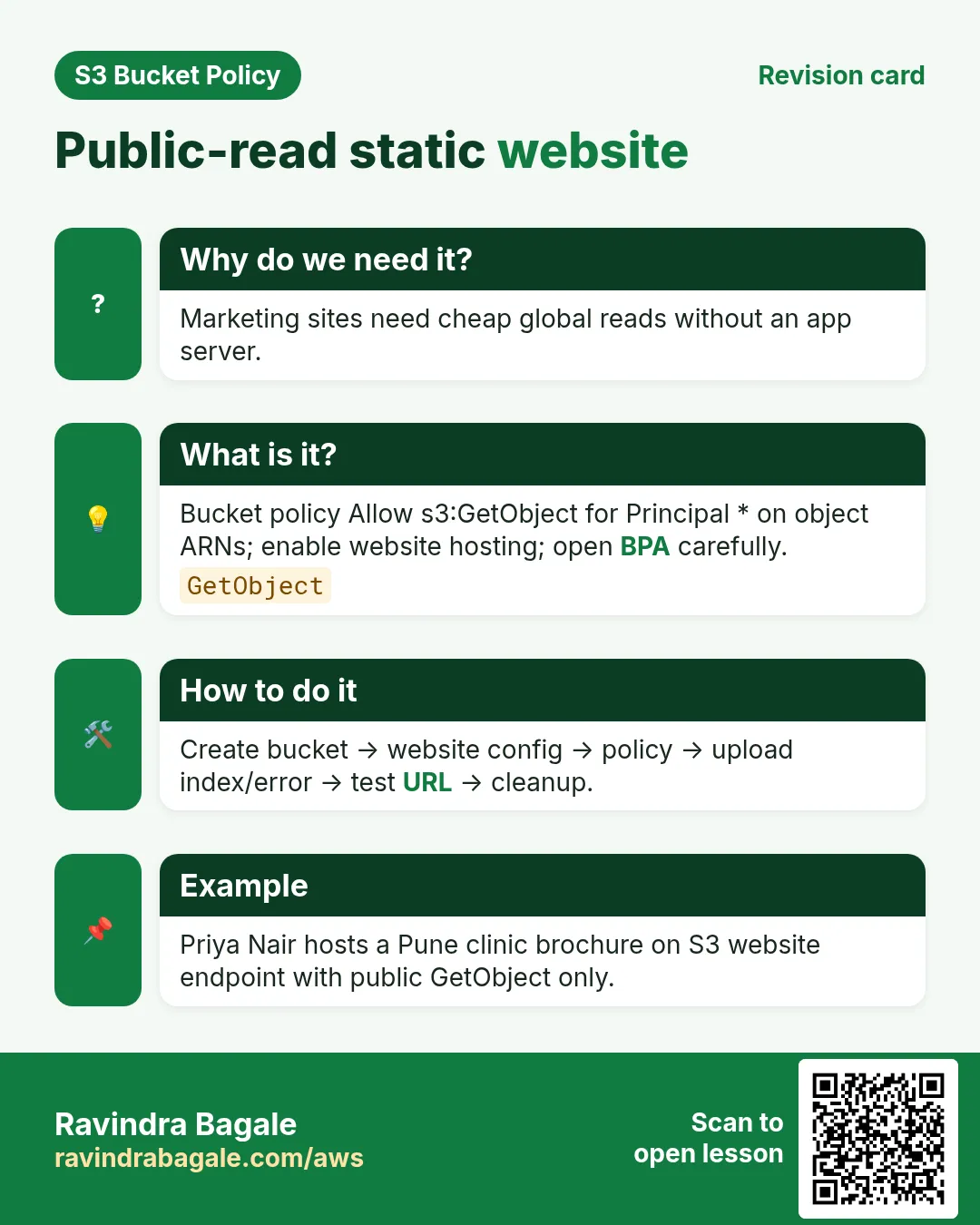
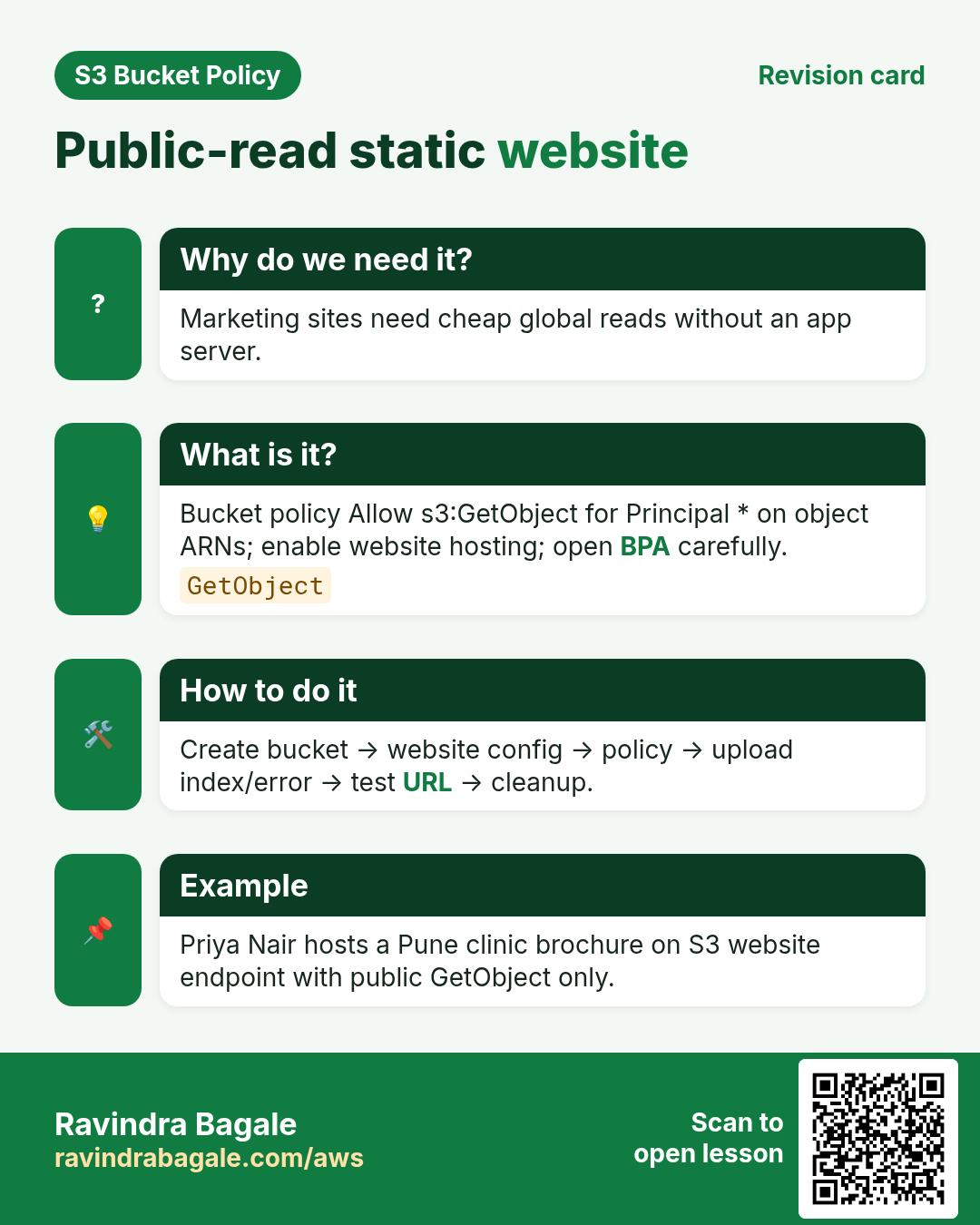
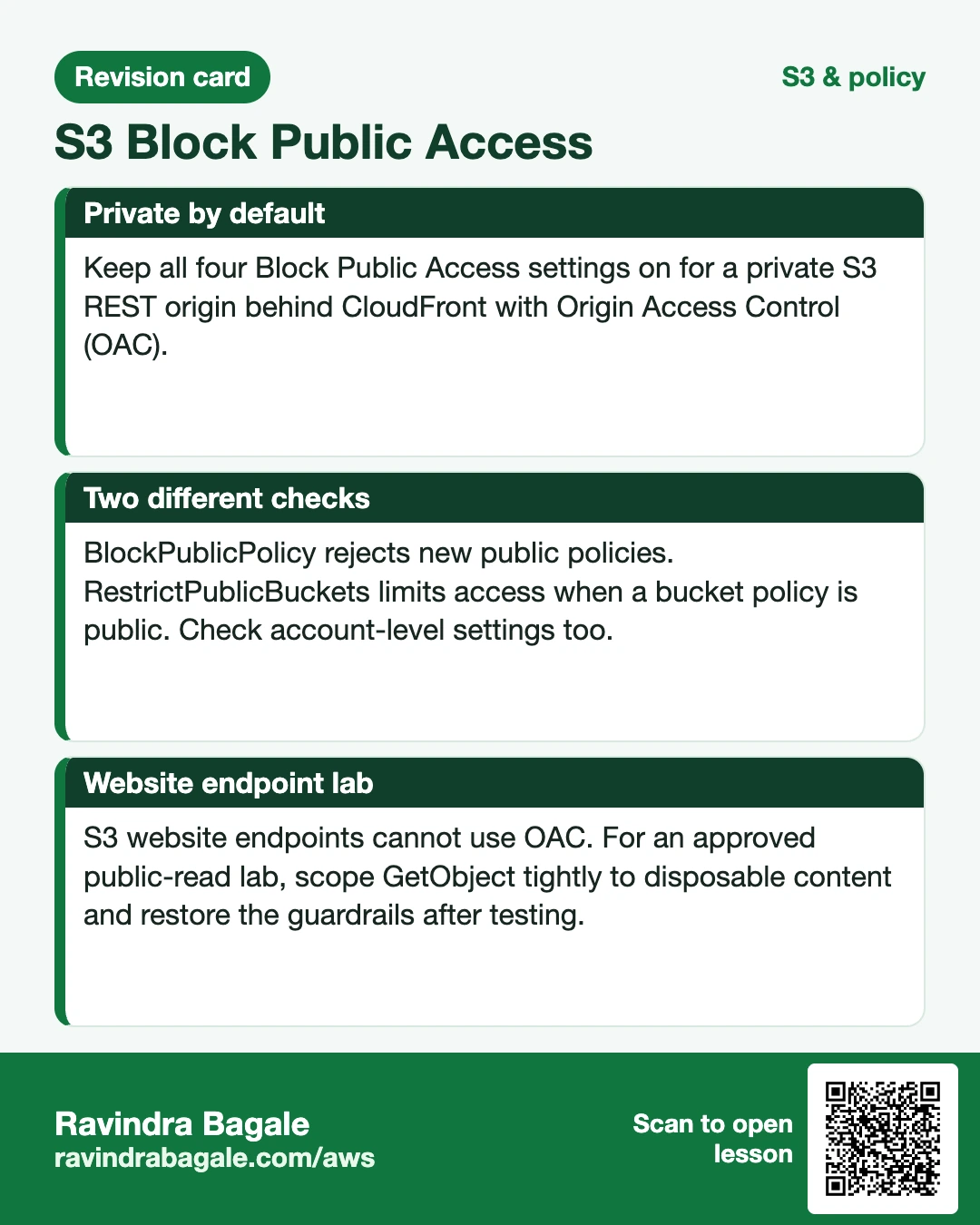
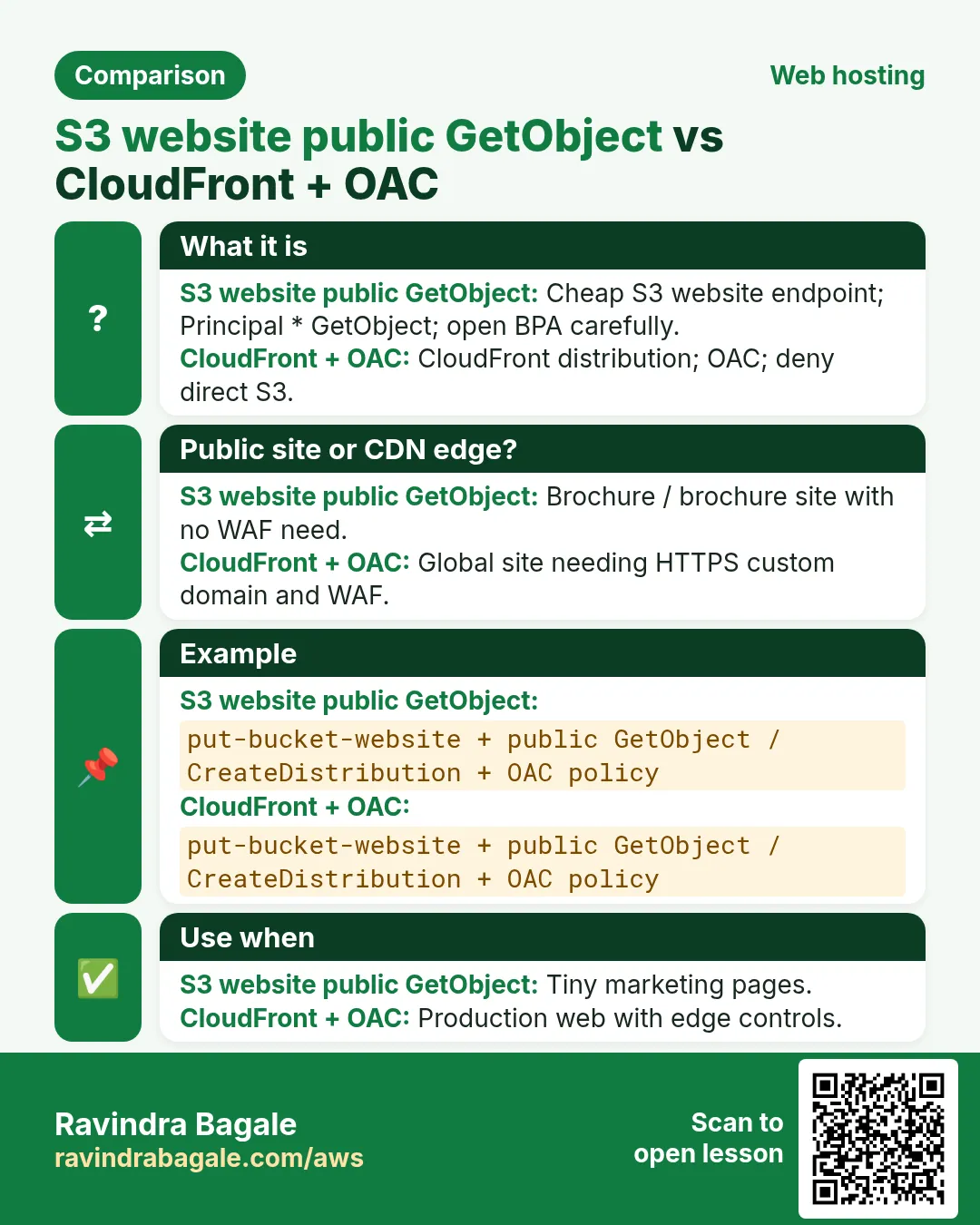
Revise this lesson in a few minutes. Save the cards on your phone or download them as PNG files. The QR code on each card opens this lesson.

More cards: Ravi Sir's Cards.