AWS SDK SQS Examples: Send, Receive, Delete Messages and DLQs (Python, PHP, Node.js)
SQS is a queue that sits between the part of your app that makes work and the part that does it. We create a standard queue and a FIFO queue, send, receive and delete messages from Python, PHP and Node.js, and add a dead-letter queue. The example: order tickets for a bakery chain with Chloé in Lyon and Rohan in Pune.
In this chapter
- Create standard and FIFO queues
- Send single and batch messages
- Long-poll, process and delete
- Understand visibility timeout
- Add a dead-letter queue
1. The big picture: the order spike at a bakery
At the counter, the cashier writes each order on a slip and pins it on a rail. The bakers take slips when they are free. If a baker drops a slip, it comes back to the rail after a while. That rail is SQS: the cashier never waits for the oven.
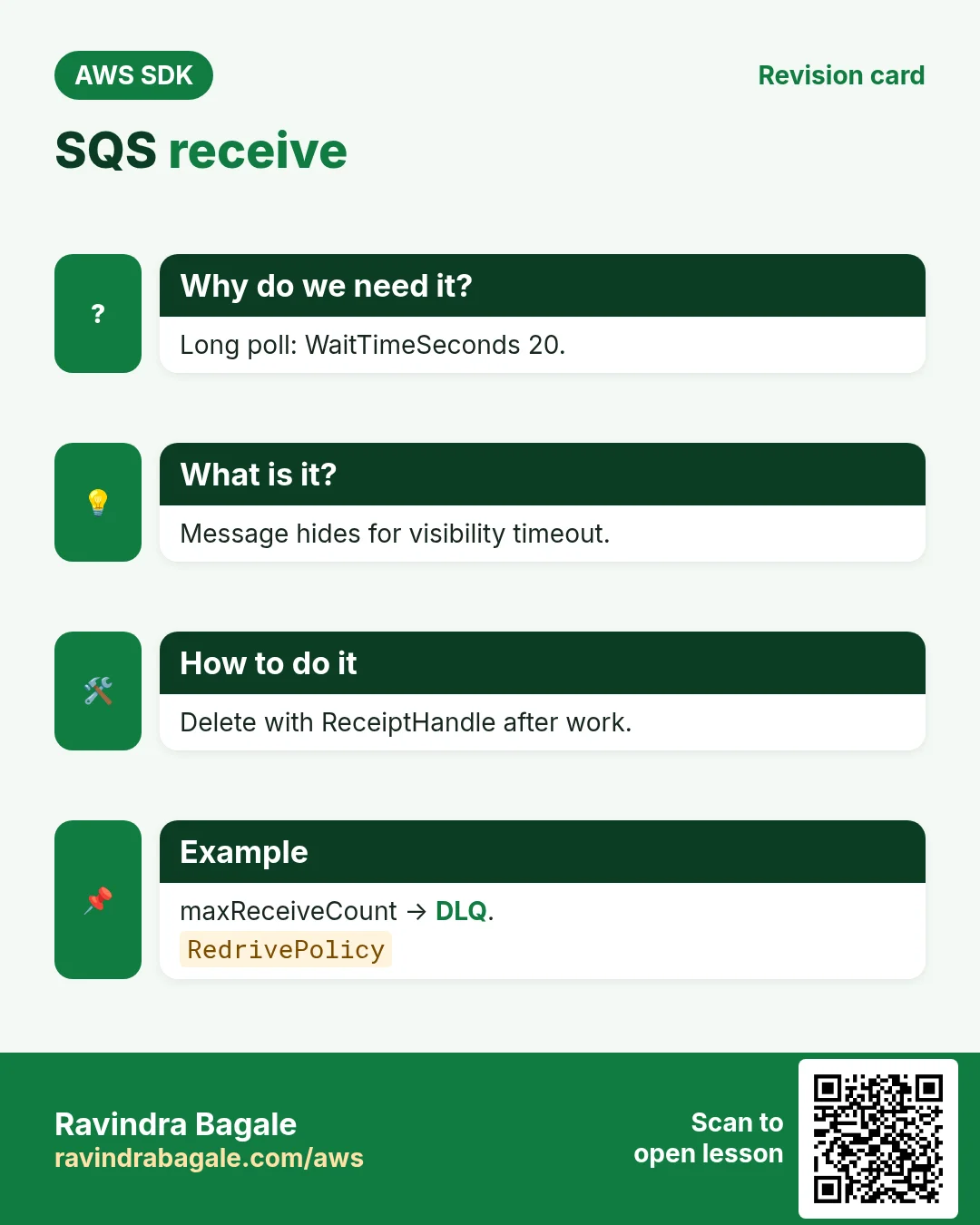
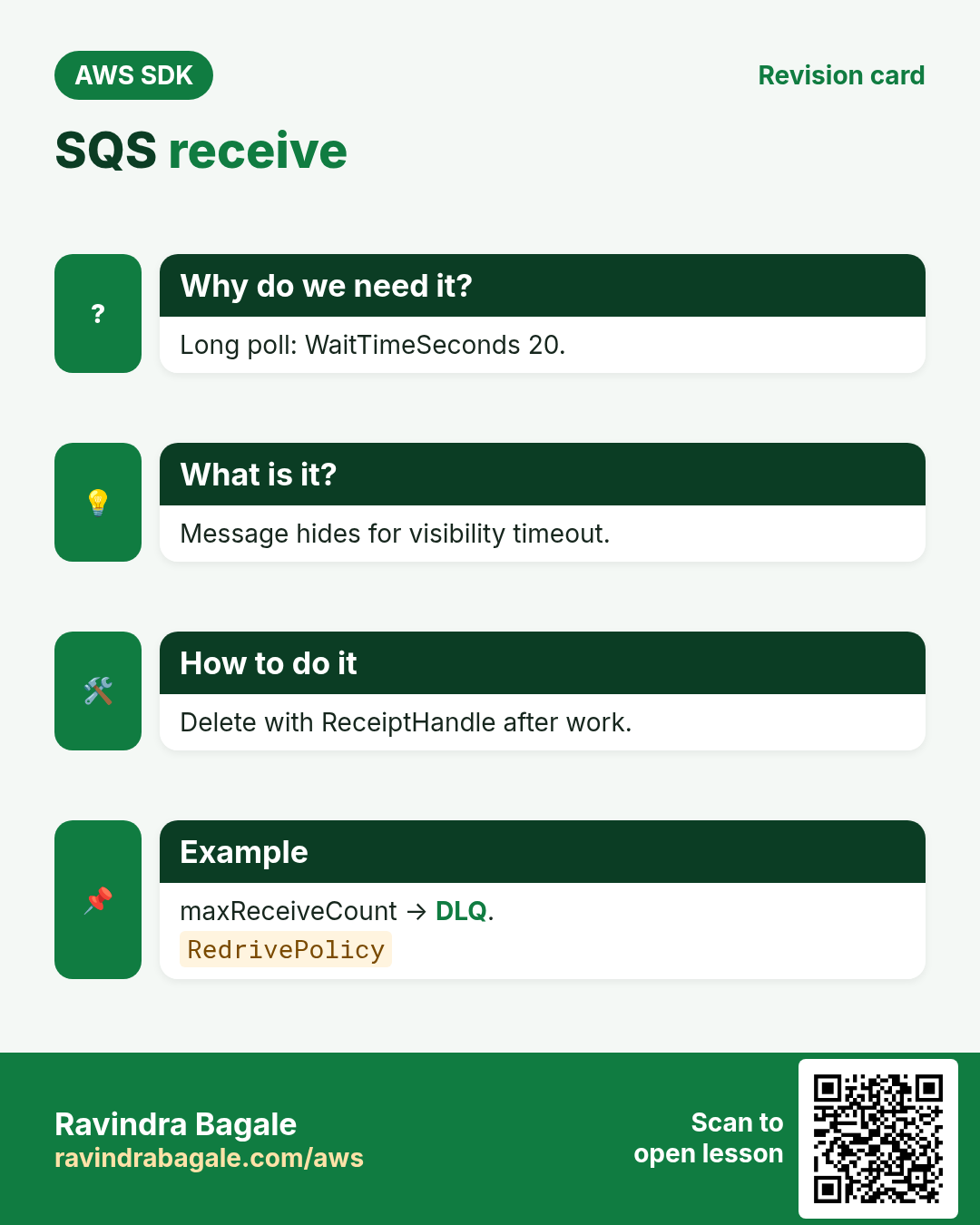
A received message is hidden for the visibility timeout. If you do not delete it with its ReceiptHandle before then, it becomes visible again. After maxReceiveCount tries it moves to the DLQ.
2. Create the queues
Chloé needs one queue for all orders, and Rohan needs a FIFO queue so payments for one customer happen in order.
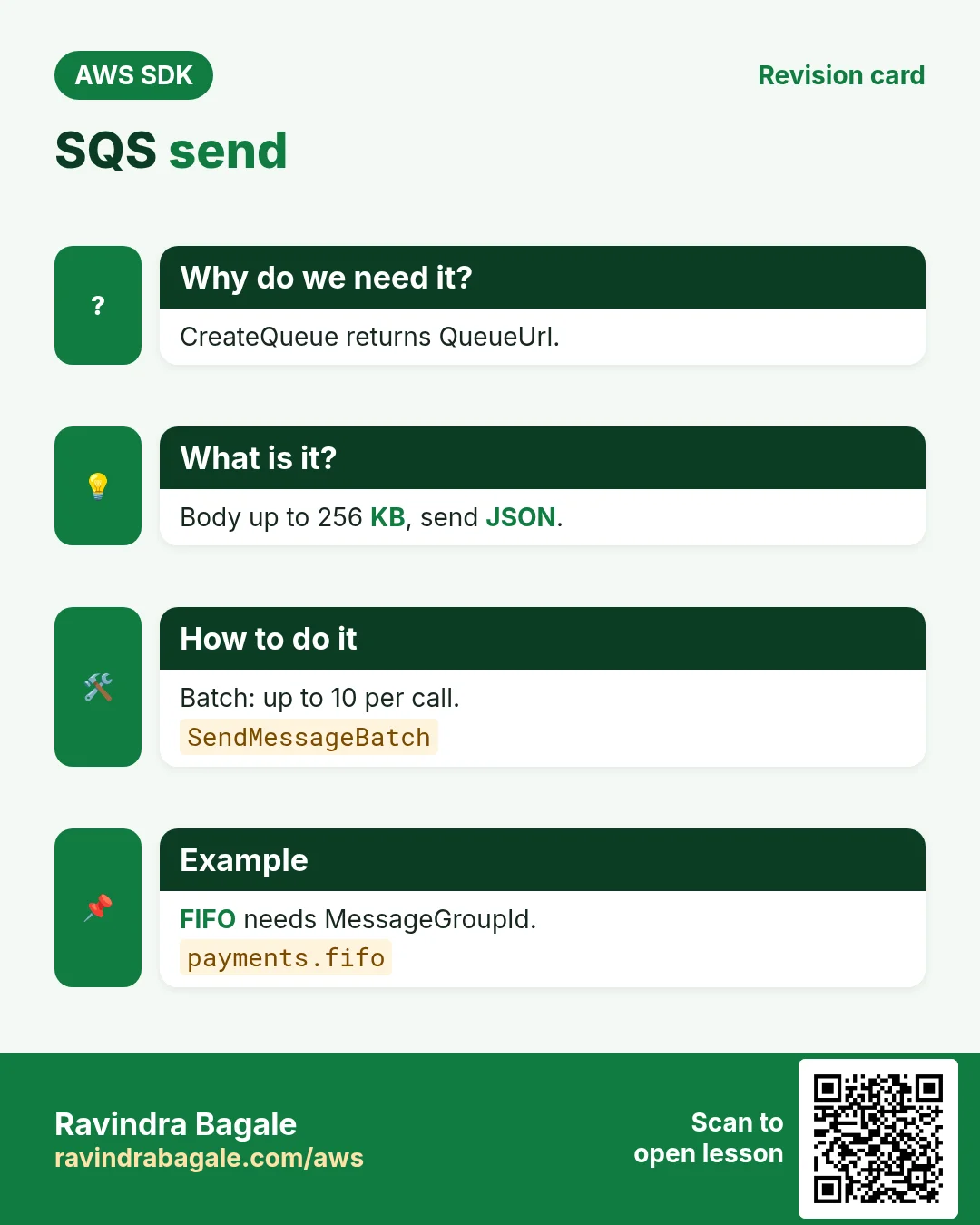
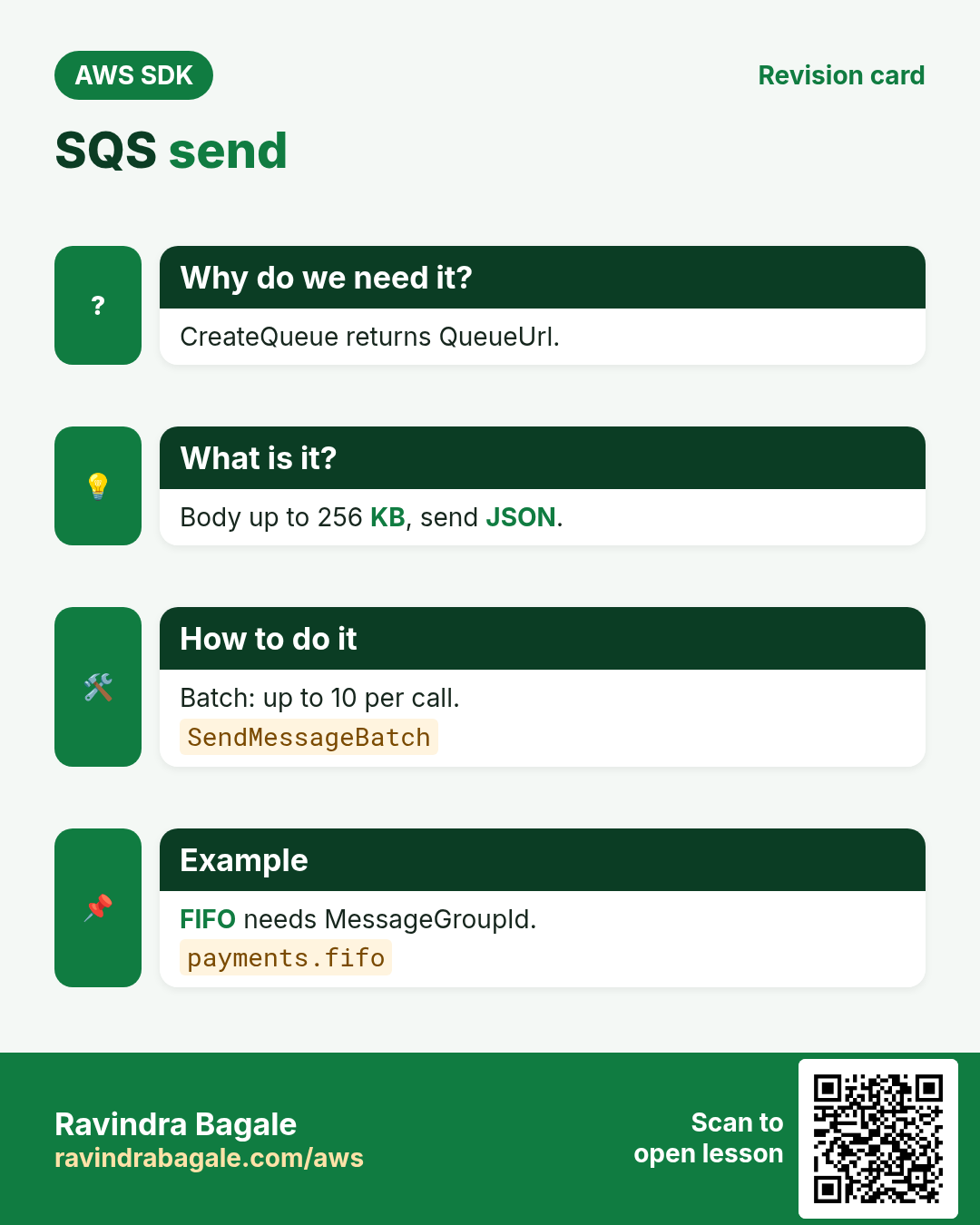
CreateQueue returns a QueueUrl that every later call uses. FIFO names must end in .fifo.
- Python (boto3): create a standard queue with long polling on.
import boto3
sqs = boto3.client("sqs", region_name="eu-west-3")
url = sqs.create_queue(QueueName="bakery-orders",
    Attributes={"ReceiveMessageWaitTimeSeconds": "20", "VisibilityTimeout": "60"})["QueueUrl"]
print(url)
Expected output:
https://sqs.eu-west-3.amazonaws.com/123456789012/bakery-orders- Node.js (v3): create a FIFO queue.
import { SQSClient, CreateQueueCommand } from "@aws-sdk/client-sqs";
const sqs = new SQSClient({ region: "ap-south-1" });
const { QueueUrl } = await sqs.send(new CreateQueueCommand({
  QueueName: "payments.fifo",
  Attributes: { FifoQueue: "true", ContentBasedDeduplication: "true" },
}));
console.log(QueueUrl);
Expected output:
https://sqs.ap-south-1.amazonaws.com/123456789012/payments.fifo- PHP (v3): look up a queue URL by name.
<?php
require "vendor/autoload.php";
$sqs = new Aws\Sqs\SqsClient(["region" => "eu-west-3"]);
$url = $sqs->getQueueUrl(["QueueName" => "bakery-orders"])["QueueUrl"];
echo $url, PHP_EOL;
Expected output:
https://sqs.eu-west-3.amazonaws.com/123456789012/bakery-orders- Verify: list queues with the prefix.
aws sqs list-queues --queue-name-prefix bakery --region eu-west-3 --query "QueueUrls" --output textExpected output:
https://sqs.eu-west-3.amazonaws.com/123456789012/bakery-orders3. Send messages
Each croissant order from Lyon and each ₹450 cake order from Pune becomes one message.
Bodies are text up to 256 KB; send JSON. SendMessageBatch sends up to 10 at once. FIFO needs a MessageGroupId.
- Python: send one order with an attribute.
import json
r = sqs.send_message(QueueUrl=url,
    MessageBody=json.dumps({"order": "LY-101", "item": "croissant", "qty": 12, "total": "€18.00"}),
    MessageAttributes={"shop": {"DataType": "String", "StringValue": "lyon"}})
print(r["MessageId"])
Expected output:
5fea7756-0ea4-451a-a703-a558b933e274- Node.js: send a FIFO payment for one customer.
import { SendMessageCommand } from "@aws-sdk/client-sqs";
const r = await sqs.send(new SendMessageCommand({
  QueueUrl, MessageGroupId: "cust-rohan",
  MessageBody: JSON.stringify({ order: "PN-77", amount: "₹450" }),
}));
console.log(r.MessageId, r.SequenceNumber);
Expected output:
b1c2d3e4-... 18872039482910000000- PHP: batch send three orders.
<?php
$entries = [];
foreach (["LY-102", "LY-103", "LY-104"] as $i => $id) {
    $entries[] = ["Id" => "m$i", "MessageBody" => json_encode(["order" => $id])];
}
$r = $sqs->sendMessageBatch(["QueueUrl" => $url, "Entries" => $entries]);
echo count($r["Successful"]), " sent, ", count($r["Failed"] ?? []), " failed", PHP_EOL;
Expected output:
3 sent, 0 failed- Verify: approximate count of waiting messages.
aws sqs get-queue-attributes --queue-url $URL --attribute-names ApproximateNumberOfMessages --query Attributes.ApproximateNumberOfMessages --output textExpected output:
44. Receive, process and delete
Follow a synthetic job from the bakery-orders queue. The SDK makes a receive request against its queue URL. It may return an empty list if no message is currently available. If a message is returned, its body describes the work, its message ID identifies the queued record, and its receipt handle represents the current delivery. Parse the body and validate the fields before marking the operation complete.
On the first run, let the mock work finish and delete the message using that receive’s handle. On the second, stop before deletion and wait for visibility to expire. The same logical order can return with a different handle. Compare the stable order identifier in its body and use the newest handle after completing the synthetic work. This is the same reliability boundary the ZIP order project demonstrates at the service level.
The baker app in Lyon should take up to 10 slips, bake, and remove only the finished ones.
ReceiveMessage with WaitTimeSeconds=20 is long polling: fewer empty calls, lower cost. Delete with the ReceiptHandle of this receive.
- Python: a worker loop.
while True:
    msgs = sqs.receive_message(QueueUrl=url, MaxNumberOfMessages=10,
        WaitTimeSeconds=20, MessageAttributeNames=["All"]).get("Messages", [])
    if not msgs: break
    for m in msgs:
        body = json.loads(m["Body"])
        print("baking", body["order"])
        sqs.delete_message(QueueUrl=url, ReceiptHandle=m["ReceiptHandle"])
Expected output:
baking LY-101
baking LY-102
baking LY-103
baking LY-104- Node.js: receive and delete in a batch.
import { ReceiveMessageCommand, DeleteMessageBatchCommand } from "@aws-sdk/client-sqs";
const { Messages = [] } = await sqs.send(new ReceiveMessageCommand({ QueueUrl, MaxNumberOfMessages: 10, WaitTimeSeconds: 20 }));
for (const m of Messages) console.log("paid", JSON.parse(m.Body).order);
if (Messages.length) await sqs.send(new DeleteMessageBatchCommand({ QueueUrl,
  Entries: Messages.map((m, i) => ({ Id: String(i), ReceiptHandle: m.ReceiptHandle })) }));
Expected output:
paid PN-77- PHP: extend the visibility timeout for slow work.
<?php
$r = $sqs->receiveMessage(["QueueUrl" => $url, "WaitTimeSeconds" => 20]);
foreach ($r["Messages"] ?? [] as $m) {
    $sqs->changeMessageVisibility(["QueueUrl" => $url,
        "ReceiptHandle" => $m["ReceiptHandle"], "VisibilityTimeout" => 300]);
    echo "long job ", json_decode($m["Body"])->order, PHP_EOL;
    $sqs->deleteMessage(["QueueUrl" => $url, "ReceiptHandle" => $m["ReceiptHandle"]]);
}
Expected output:
long job LY-105- Verify: the queue is empty.
aws sqs get-queue-attributes --queue-url $URL --attribute-names ApproximateNumberOfMessages ApproximateNumberOfMessagesNotVisible --output jsonExpected output:
{"Attributes": {"ApproximateNumberOfMessages": "0", "ApproximateNumberOfMessagesNotVisible": "0"}}5. Dead-letter queue for bad messages
A dead-letter queue holds messages that the configured source queue tried too many times. Moving a message there keeps unrelated work flowing and gives the operator a record to inspect. In the lab, send one synthetic message designed to fail your mock worker. Leave it unacknowledged. Receive attempts can increase after each visibility period until the source queue’s redrive policy takes effect.
Inspect the dead-letter queue for the expected sample. Before redriving, which means sending the message back to a source or chosen destination, fix the handler or data problem in a disposable setup. Redriving unchanged may return the message to the same failure. Check that normal messages still finish and use the latest receipt handle to delete work that succeeded.
One order from Toronto has a broken JSON body and crashes the worker every time. It should not block the rail forever.
Create a second queue and set a RedrivePolicy on the main queue with maxReceiveCount. Inspect the DLQ, then redrive after fixing.
- Python: create the DLQ and attach it.
dlq = sqs.create_queue(QueueName="bakery-orders-dlq")["QueueUrl"]
arn = sqs.get_queue_attributes(QueueUrl=dlq, AttributeNames=["QueueArn"])["Attributes"]["QueueArn"]
sqs.set_queue_attributes(QueueUrl=url, Attributes={"RedrivePolicy": json.dumps(
    {"deadLetterTargetArn": arn, "maxReceiveCount": "3"})})
print("dlq", arn)
Expected output:
dlq arn:aws:sqs:eu-west-3:123456789012:bakery-orders-dlq- Node.js: read messages that landed in the DLQ.
const dlqUrl = QueueUrl.replace("payments.fifo", "bakery-orders-dlq");
const r = await sqs.send(new ReceiveMessageCommand({ QueueUrl: dlqUrl, MessageAttributeNames: ["All"], AttributeNames: ["ApproximateReceiveCount"] }));
for (const m of r.Messages ?? []) console.log(m.Attributes.ApproximateReceiveCount, m.Body);
Expected output:
4 {order: "TO-9", total: "$12.50"- PHP: start a redrive back to the source queue.
<?php
$r = $sqs->startMessageMoveTask([
    "SourceArn" => "arn:aws:sqs:eu-west-3:123456789012:bakery-orders-dlq"]);
echo $r["TaskHandle"] ? "redrive started" : "no task", PHP_EOL;
Expected output:
redrive started- Verify: check the redrive policy.
aws sqs get-queue-attributes --queue-url $URL --attribute-names RedrivePolicy --query Attributes.RedrivePolicy --output textExpected output:
{"deadLetterTargetArn":"arn:aws:sqs:eu-west-3:123456789012:bakery-orders-dlq","maxReceiveCount":"3"}6. The same call in Java, Go, .NET and the CLI
Teams often mix languages. Once you know the call in Python, PHP and Node.js, the other SDKs are the same API with different syntax.
All of them call the SendMessage API. Use the CLI line to test it quickly from a terminal.
| Stack | Code |
|---|---|
| AWS CLI | aws sqs send-message --queue-url $URL --message-body '{"order":"LY-101"}' |
| Java v2 | sqs.sendMessage(b -> b.queueUrl(url).messageBody("{\"order\":\"LY-101\"}")); |
| Go v2 | client.SendMessage(ctx, &sqs.SendMessageInput{QueueUrl: aws.String(url), MessageBody: aws.String(body)}) |
| .NET | await sqs.SendMessageAsync(new SendMessageRequest { QueueUrl = url, MessageBody = body }); |
7. Clean up so nothing keeps costing
Lab resources left running cost money and can be a security risk.
Delete in reverse order: children first, then parents.
- Delete both queues.
aws sqs delete-queue --queue-url $URL --region eu-west-3
aws sqs delete-queue --queue-url $DLQ_URL --region eu-west-3
Expected output:
(no output means success)Ravindra Bagale's Tip
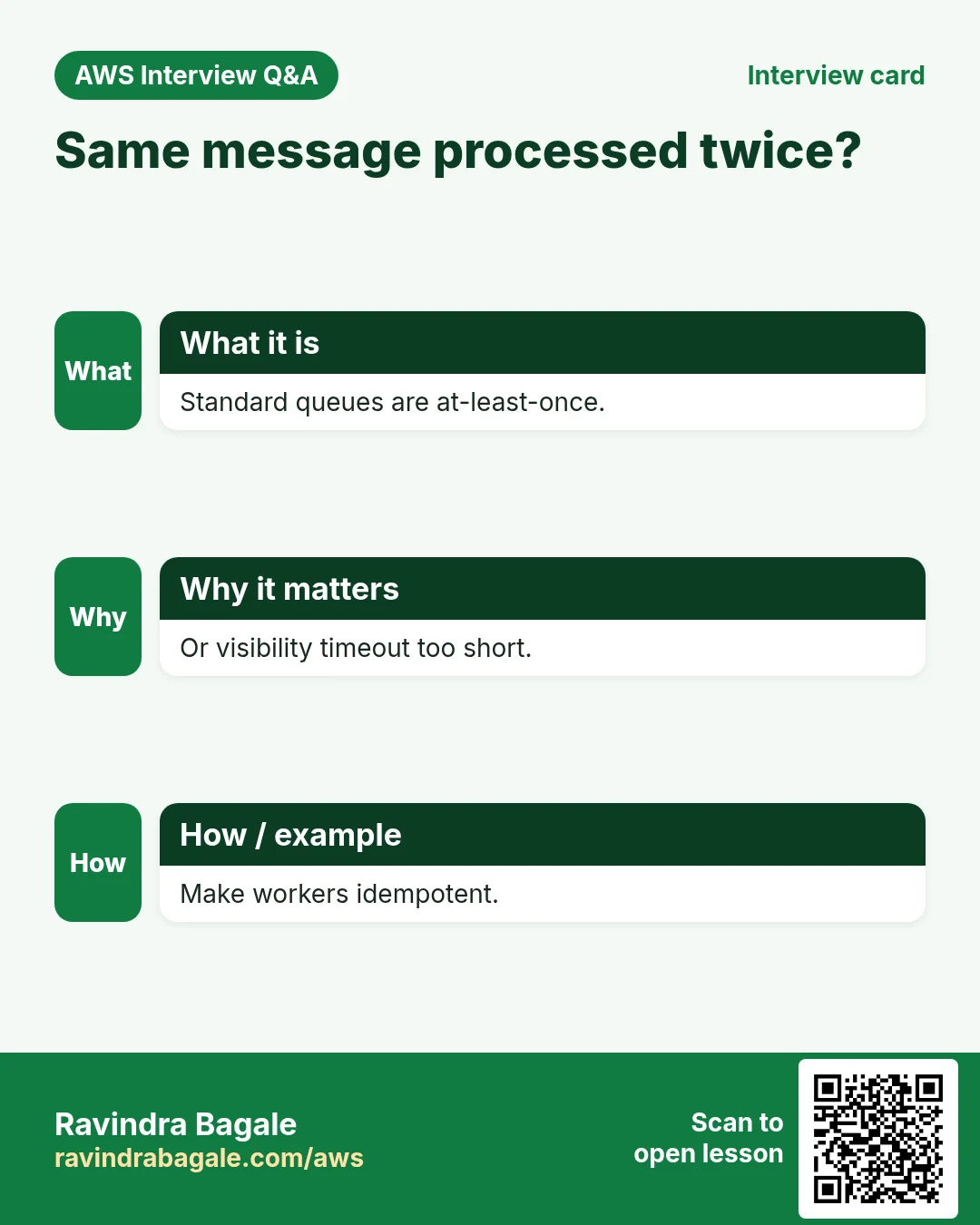
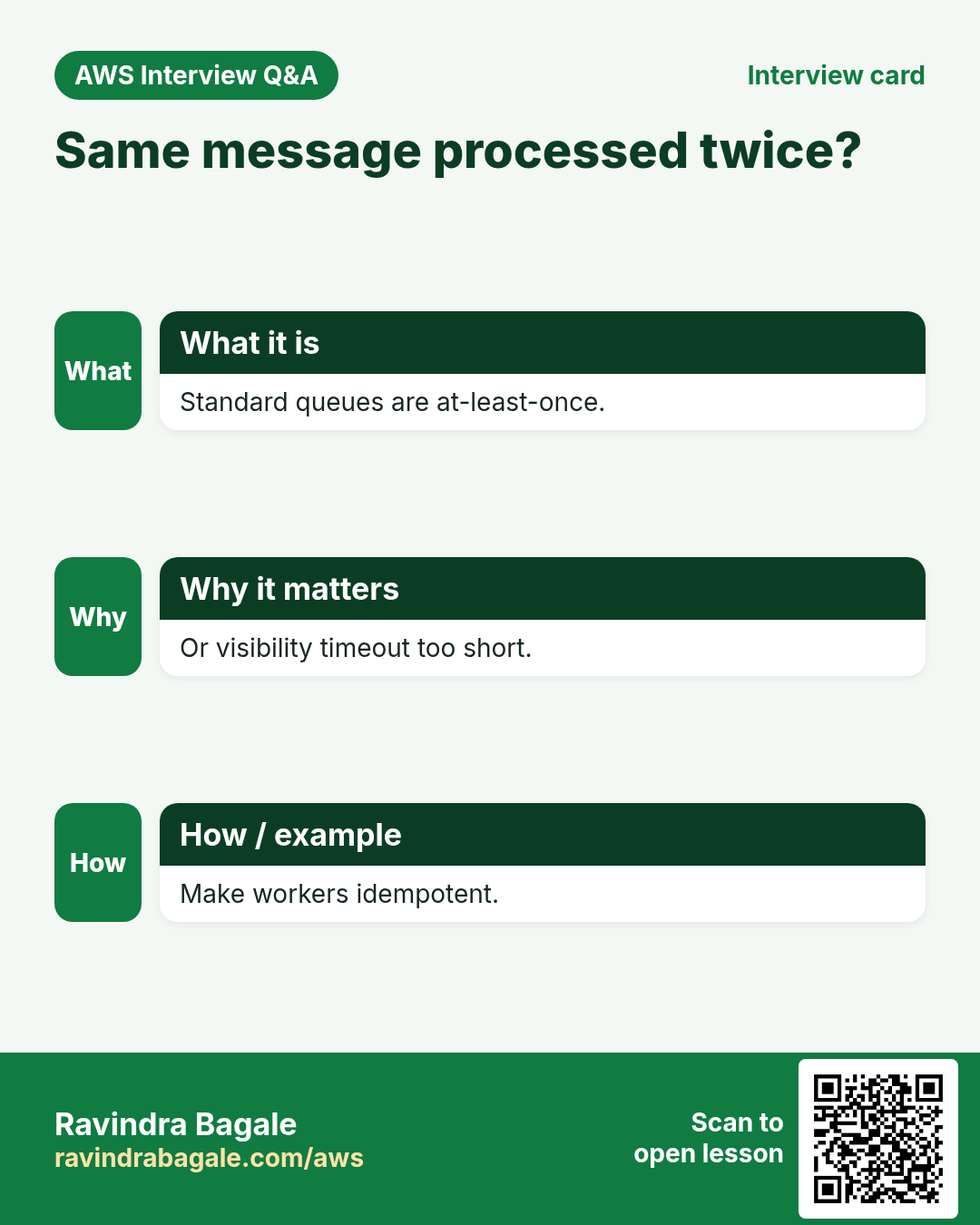
Make your worker idempotent: standard queues deliver at least once, so the same order can arrive twice.
8. Interview questions and answers
Q. What is the visibility timeout?
How long a received message stays hidden from other consumers before it reappears.
Q. Why long polling?
WaitTimeSeconds up to 20 cuts empty responses and cost.
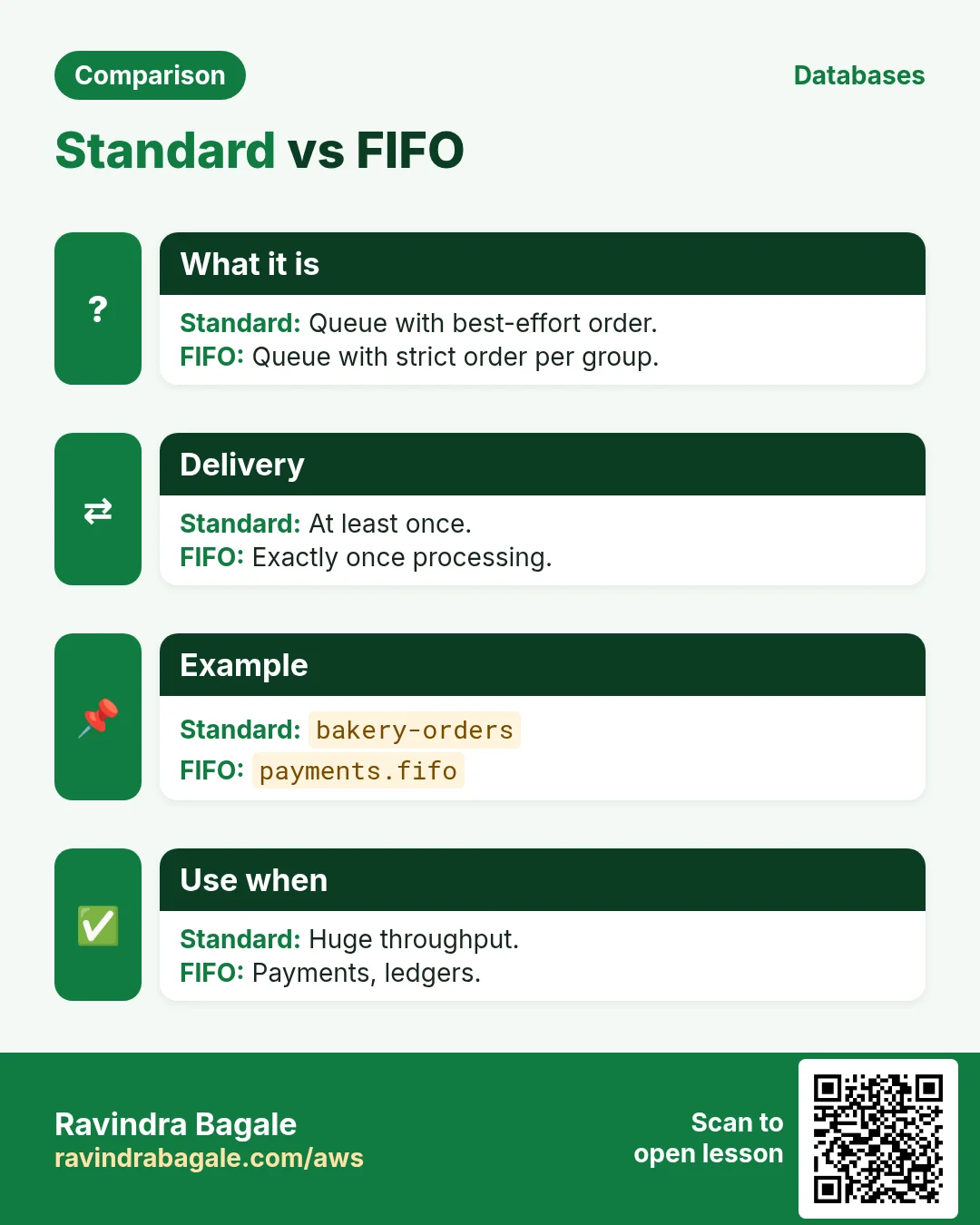
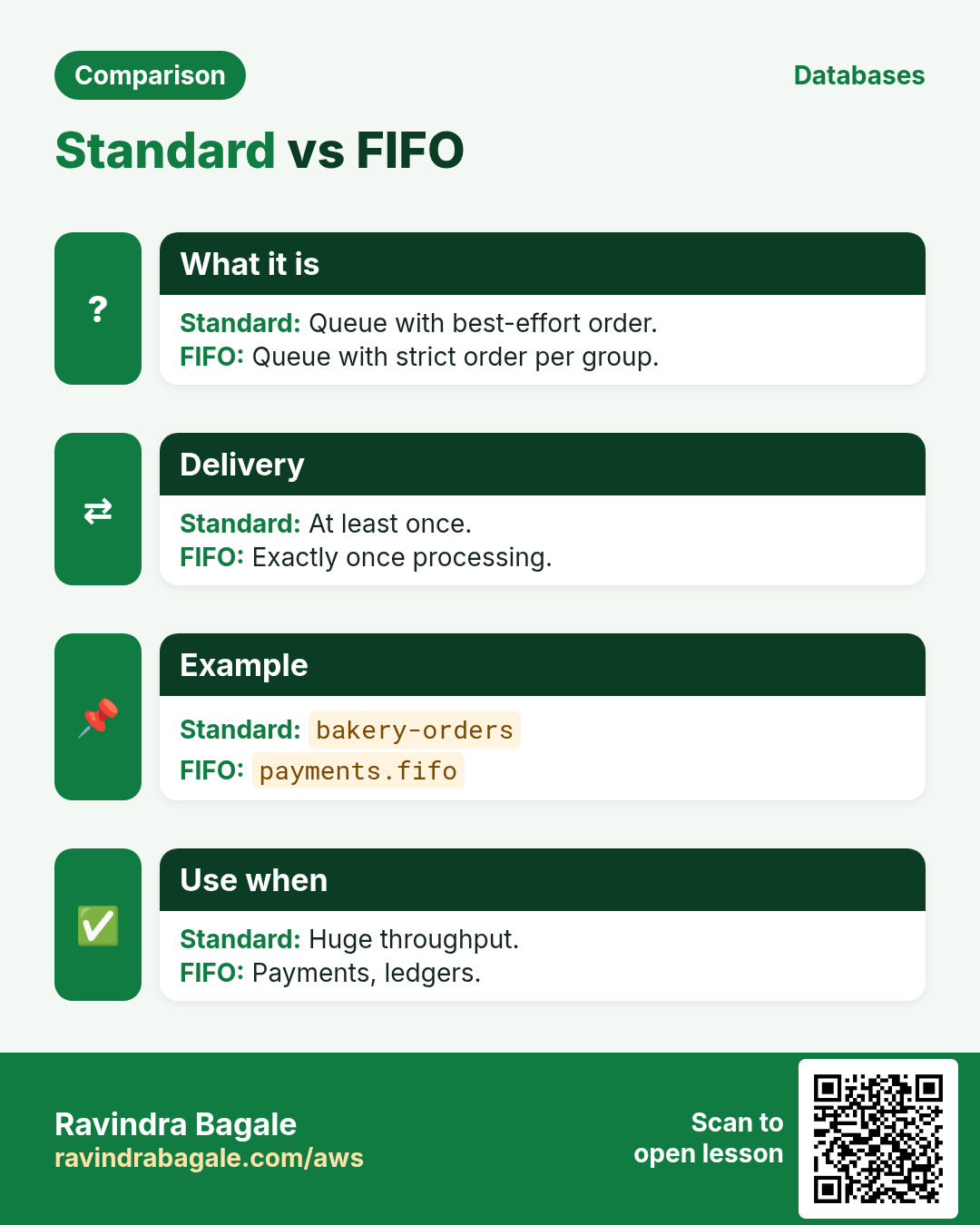
Q. Standard vs FIFO?
Standard: at-least-once, best-effort order, huge throughput. FIFO: exactly-once processing and order per MessageGroupId.
Q. What deletes a message?
DeleteMessage with the ReceiptHandle from the receive.
Q. When does a message go to a DLQ?
After it is received more than maxReceiveCount times without being deleted.
Try at home
- Write a Node.js worker that processes bakery-orders and fails on qty > 100; watch it reach the DLQ.
- Send 25 messages from PHP in batches of 10.
In short
- CreateQueue → QueueUrl.
- Send / SendMessageBatch (10).
- Receive with long polling.
- Delete by ReceiptHandle.
- RedrivePolicy → DLQ.
Process, acknowledge and redrive deliberately
Use a dedicated queue. Receive a disposable message, simulate a failed handler once and inspect the next receive count. Delete only after the mock work succeeded using the current receipt handle. Verify DLQ routing separately.
Interview check What protects the user from repeated side effects after receiving the same record?
An idempotent design keyed to the business event. Visibility timeout hides messages temporarily but does not guarantee exactly-once processing.
Practise this chapter
Interview questions and answers
What do you do when one SQS payload keeps failing processing?
I check the handler error and the payload’s stable business identifier. I expect the source queue’s configured redrive behavior to isolate it after repeated failures. After fixing the cause, I would test replay in a disposable setup and confirm that other messages are still handled normally.
Check your understanding
Choose an answer, then compare your reasoning with the explanation.
Practice Tasks
Practice checks run in your browser. They check the answer for this exercise; they do not create resources or connect to your AWS account.
About this scenarioSão Paulo Coffee is a coffee trading business in São Paulo. Ana Souza looks after its IT and cloud work. They count money in BRL and run their AWS resources in the sa-east-1 Region. In the tasks below you do real jobs for them using what this lesson teaches. All names, account IDs, IP addresses and numbers are made up for practice.
0 / 12
Easy Create a queue
A queue holds work safely until a worker is ready.
Create queue spcoffee-orders.
- Read the task and decide which AWS service it is about.
- Write aws, then the service name, then the operation (the action word).
- Add each needed flag (--name) followed by its value from the task.
- Flags can be in any order. Click Check answer.
Easy Send a message
The producer puts the job in the queue and moves on.
Send the body {"orderId":"o-101"} to https://sqs.sa-east-1.amazonaws.com/117860693118/spcoffee-orders.
- Read the task and decide which AWS service it is about.
- Write aws, then the service name, then the operation (the action word).
- Add each needed flag (--name) followed by its value from the task.
- Flags can be in any order. Click Check answer.
Easy Find a queue URL
Most SQS commands need the URL, not the name.
Get the URL of queue spcoffee-orders.
- Read the task and decide which AWS service it is about.
- Write aws, then the service name, then the operation (the action word).
- Add each needed flag (--name) followed by its value from the task.
- Flags can be in any order. Click Check answer.
Easy Invoke one function
A caller should invoke only the function it needs.
Allow lambda:InvokeFunction on arn:aws:lambda:sa-east-1:117860693118:function:spcoffee-orders-fn only.
- Start with { "Version": "2012-10-17", "Statement": [ ... ] }.
- In each statement write Effect, Action and Resource.
- Give only what the task needs (least privilege).
- Use double quotes and commas correctly. Click Check answer.
Medium Producer may only send
The web app should add jobs but never read or delete them.
Allow sqs:SendMessage on arn:aws:sqs:sa-east-1:117860693118:spcoffee-orders only.
- Start with { "Version": "2012-10-17", "Statement": [ ... ] }.
- In each statement write Effect, Action and Resource.
- Give only what the task needs (least privilege).
- Use double quotes and commas correctly. Click Check answer.
Medium Delete a processed message
If you do not delete it, the message comes back after the visibility timeout.
Delete the message with receipt handle stored in $RH from https://sqs.sa-east-1.amazonaws.com/117860693118/spcoffee-orders.
- Read the task and decide which AWS service it is about.
- Write aws, then the service name, then the operation (the action word).
- Add each needed flag (--name) followed by its value from the task.
- Flags can be in any order. Click Check answer.
Medium Receive messages with long polling
Long polling waits for messages, so you make fewer empty calls and pay less.
Receive up to 10 messages from https://sqs.sa-east-1.amazonaws.com/117860693118/spcoffee-orders, waiting up to 20 seconds.
- Read the task and decide which AWS service it is about.
- Write aws, then the service name, then the operation (the action word).
- Add each needed flag (--name) followed by its value from the task.
- Flags can be in any order. Click Check answer.
Medium Empty a test queue
Purge removes all messages at once, useful only for test queues.
Purge the queue https://sqs.sa-east-1.amazonaws.com/117860693118/spcoffee-test.
- Read the task and decide which AWS service it is about.
- Write aws, then the service name, then the operation (the action word).
- Add each needed flag (--name) followed by its value from the task.
- Flags can be in any order. Click Check answer.
Hard Attach a dead-letter queue
After a few failed tries, bad messages move to a DLQ instead of blocking the queue.
Set the attributes in attrs.json (a RedrivePolicy) on https://sqs.sa-east-1.amazonaws.com/117860693118/spcoffee-orders.
- Read the task and decide which AWS service it is about.
- Write aws, then the service name, then the operation (the action word).
- Add each needed flag (--name) followed by its value from the task.
- Flags can be in any order. Click Check answer.
Hard Create a FIFO queue
FIFO queues keep order and remove duplicates, e.g. for payments.
Create a FIFO queue named spcoffee-payments.fifo with FifoQueue=true.
- Read the task and decide which AWS service it is about.
- Write aws, then the service name, then the operation (the action word).
- Add each needed flag (--name) followed by its value from the task.
- Flags can be in any order. Click Check answer.
Hard Connect an SQS queue to Lambda
An event source mapping makes Lambda poll the queue and process messages in batches.
Create an event source mapping from queue arn:aws:sqs:sa-east-1:117860693118:spcoffee-orders to spcoffee-orders-fn with batch size 10.
- Read the task and decide which AWS service it is about.
- Write aws, then the service name, then the operation (the action word).
- Add each needed flag (--name) followed by its value from the task.
- Flags can be in any order. Click Check answer.
Hard Lambda GB-seconds
Lambda bills memory × time.
1,000,000 invocations, 512 MB memory, 200 ms each. How many GB-seconds?
- Write down the numbers the task gives you.
- Work it out step by step on paper.
- Type only the final answer in the box.
- Click Check answer.
Revision, comparison and interview cards
Revise this lesson in a few minutes. Save the cards on your phone or download them as PNG files. The QR code on each card opens this lesson.
More cards: Ravi Sir's Cards.