Build a REST API with API Gateway and Lambda Step by Step
In What Is Amazon API Gateway? you chose a product. Now you build: a Lambda backend, GET and POST routes, path and query parameters, CORS (and why the browser blocks you), API keys with a usage plan, throttling, and a custom domain sketch with ACM.
In this chapter
- Build GET and POST with Lambda proxy
- Path params and query strings
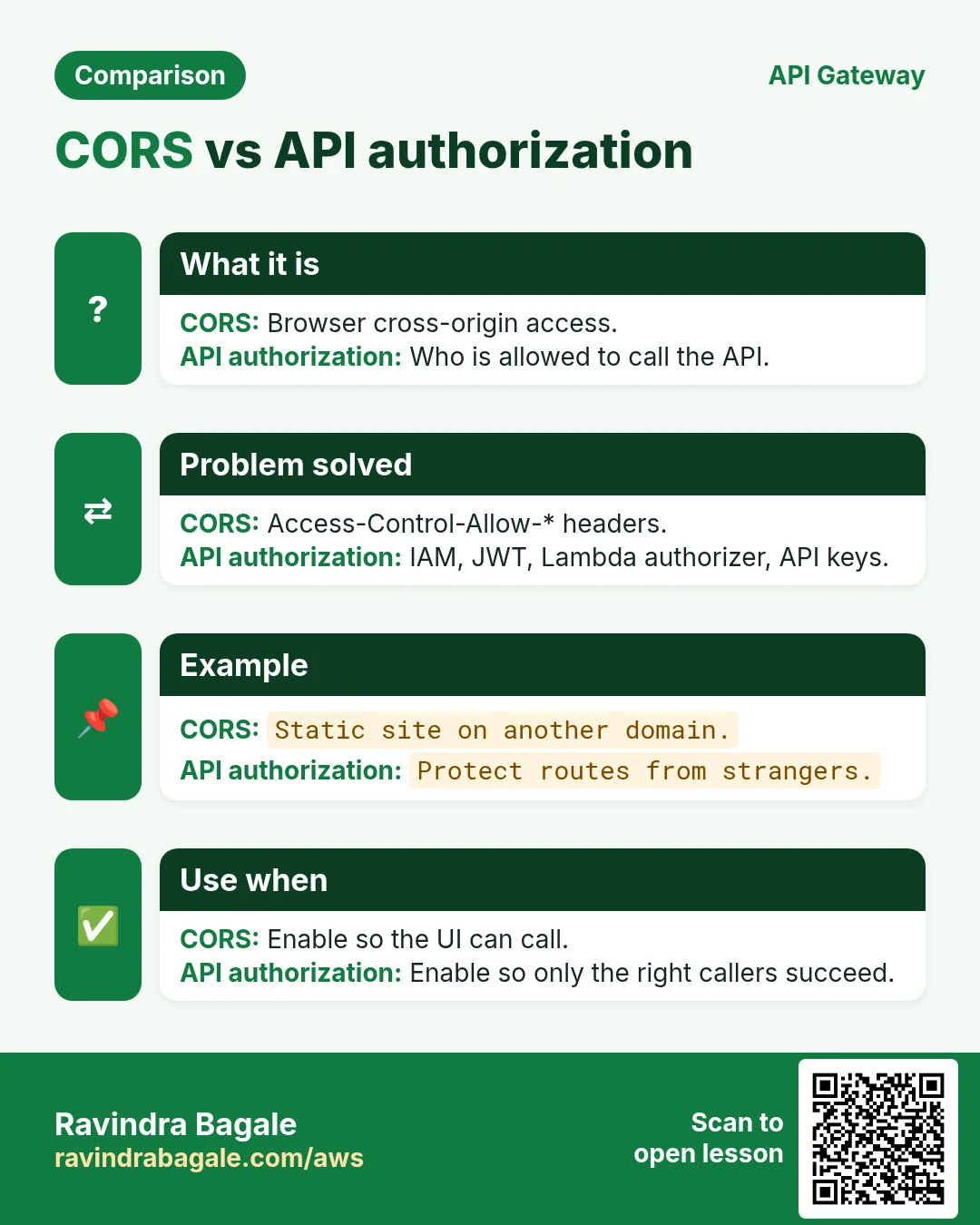
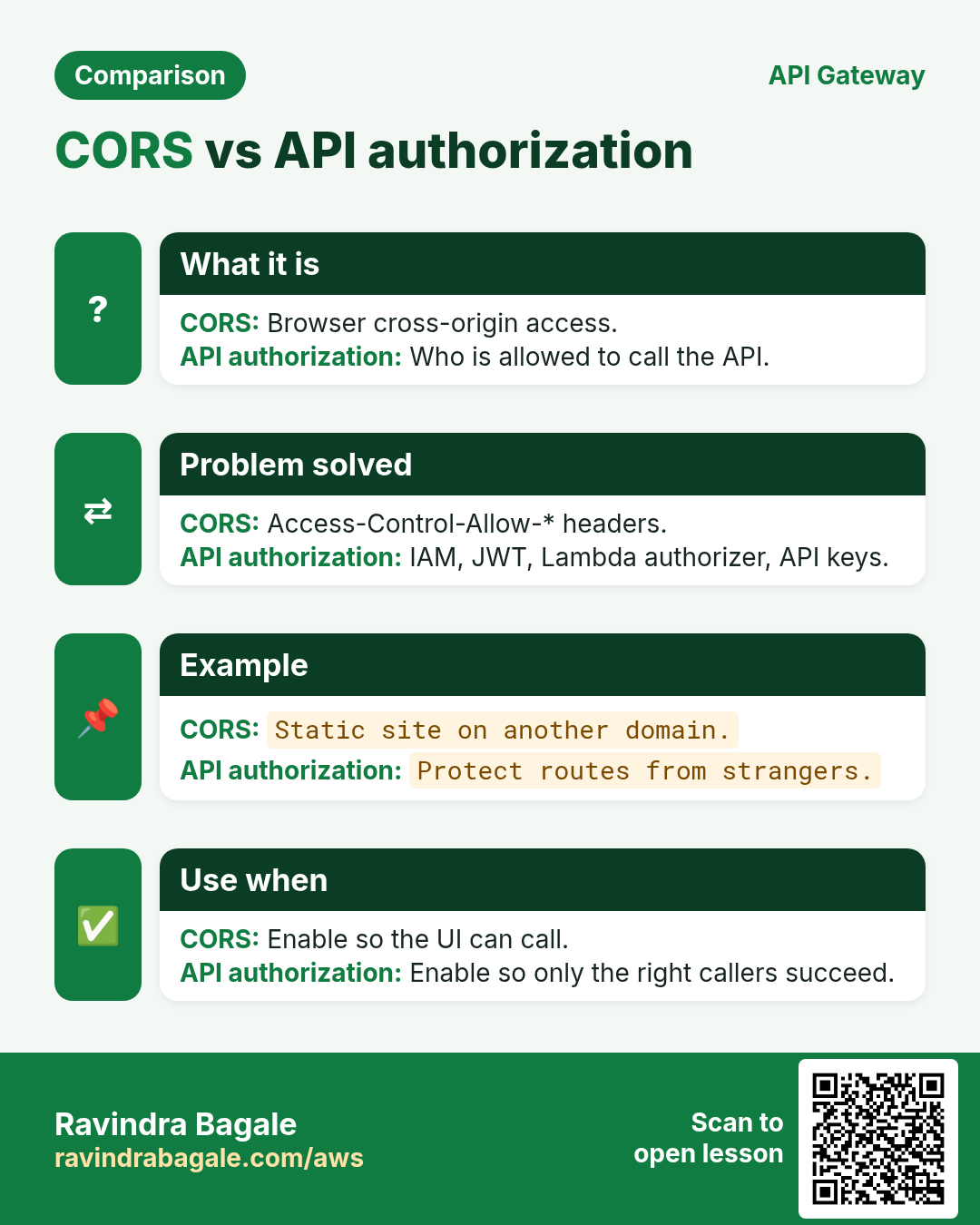
- CORS — why and how
- API keys, usage plans, throttling (REST)
- Custom domain + ACM outline
1. A story: notes API for a class app
Students' React app on https://notes.campus.test must list and create notes. The API will live at https://api.campus.test. Without CORS headers, the browser blocks the call even if curl works.
2. Lab: HTTP API + Lambda (GET and POST)
Trace one create request and one read
Use one synthetic note called first class. Send the JSON body to the lab’s POST route and record the response status and note ID. Then request that exact ID with GET. A Lambda proxy event provides fields such as the method, path parameters and body according to its payload format. The handler reads them and returns the API’s response.
If the POST succeeds but the later GET cannot find the note, check the storage behavior of the lab. Data left only in one Lambda execution environment may not be there on another. A durable version stores the note in a managed data service before it returns success.
We use an HTTP API for the happy path (cheap, simple). A short REST section later shows API keys. Region ap-south-1.
1. Lambda function
- Create function
notes-api-lab, Python 3.12, basic execution role. - Paste:
import json, urllib.parse
NOTES = [{"id": "1", "text": "Buy milk"}]  # lab memory only
def lambda_handler(event, context):
    method = event.get("requestContext", {}).get("http", {}).get("method") or event.get("httpMethod")
    path = event.get("rawPath") or event.get("path") or "/"
    headers = {"content-type": "application/json", "access-control-allow-origin": "*"}
    if method == "GET" and path.endswith("/notes"):
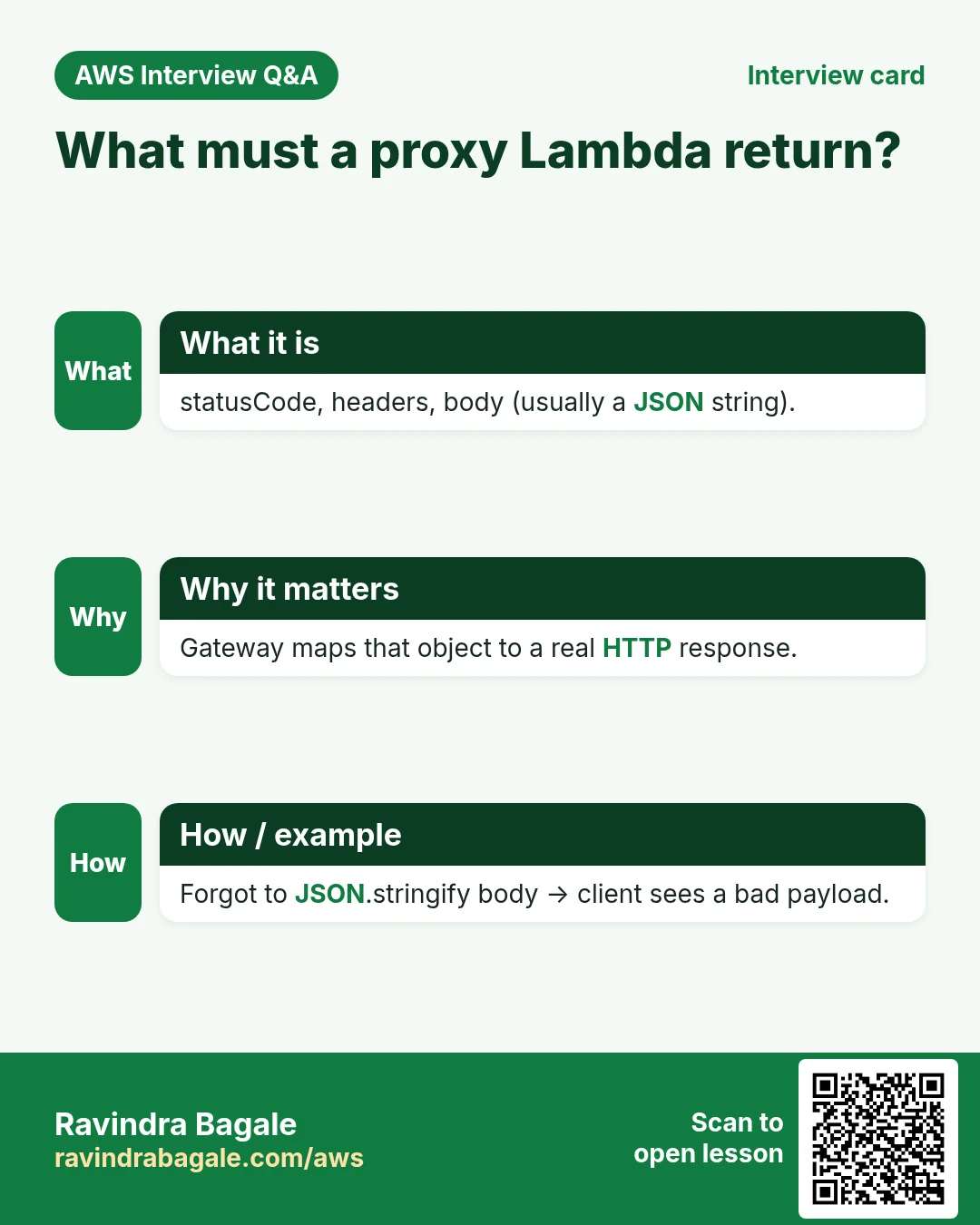
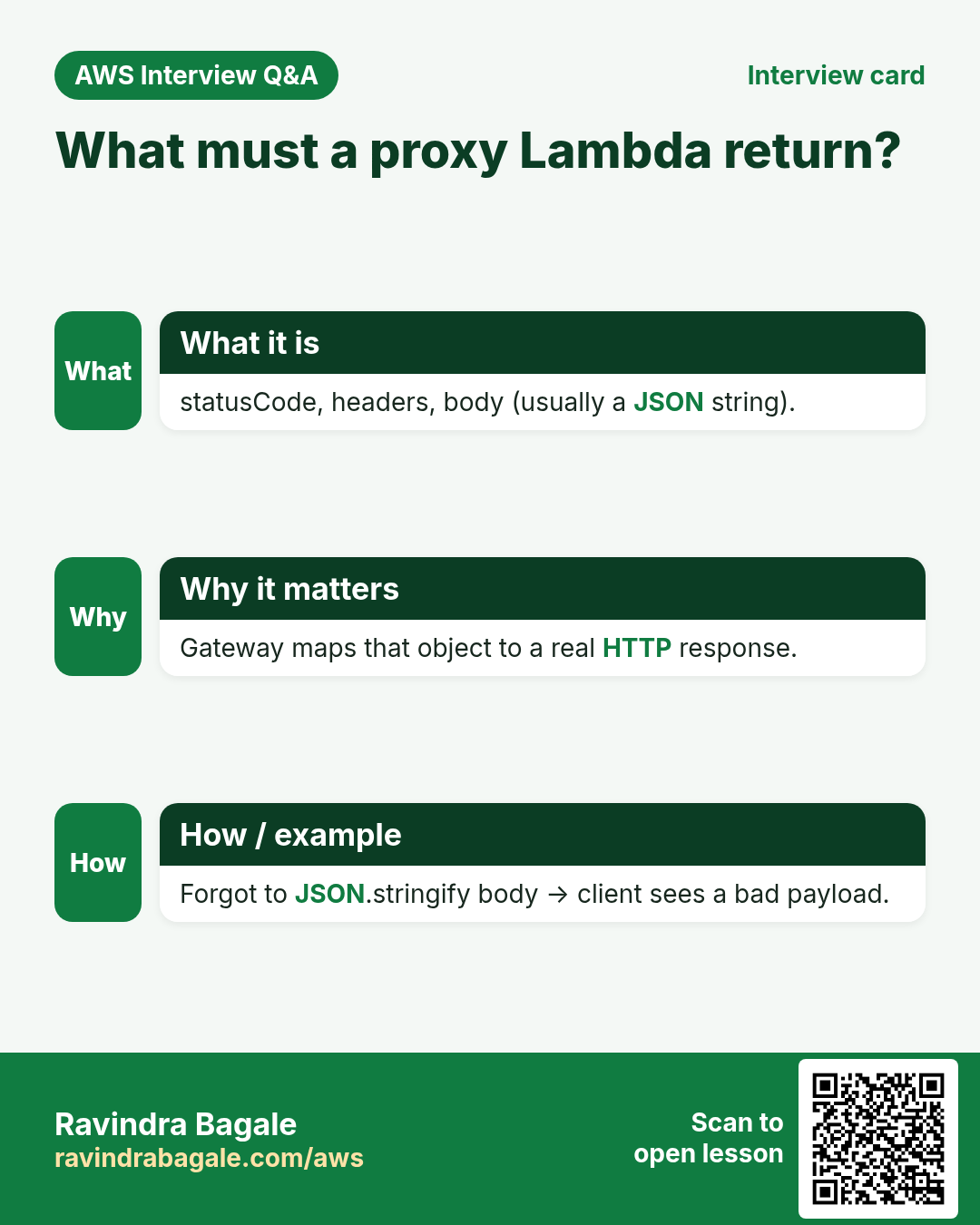
        return {"statusCode": 200, "headers": headers, "body": json.dumps(NOTES)}
    if method == "GET" and "/notes/" in path:
        nid = path.rstrip("/").split("/")[-1]
        hit = next((n for n in NOTES if n["id"] == nid), None)
        return {"statusCode": 200 if hit else 404, "headers": headers, "body": json.dumps(hit or {"error": "missing"})}
    if method == "POST" and path.endswith("/notes"):
        body = json.loads(event.get("body") or "{}")
        item = {"id": str(len(NOTES) + 1), "text": body.get("text", "")}
        NOTES.append(item)
        return {"statusCode": 201, "headers": headers, "body": json.dumps(item)}
return {"statusCode": 404, "headers": headers, "body": json.dumps({"error": "no route"})}- Deploy. Why
access-control-allow-origin: *: so a browser on another origin can read the response in this lab. Lock it to your real domain in production.
2. HTTP API
- API Gateway → Create API → HTTP API → Build. Name:
notes-http. - Add integration → Lambda → select
notes-api-lab. - Routes: Add
GET /notes,POST /notes,GET /notes/{id}. Attach each to the Lambda integration. - Stages: keep
$defaultwith auto-deploy. Create. - Copy the Invoke URL, like
https://abc123.execute-api.ap-south-1.amazonaws.com.
3. Test with curl
BASE=https://abc123.execute-api.ap-south-1.amazonaws.com
curl -s $BASE/notes
curl -s -X POST $BASE/notes -H 'content-type: application/json' -d '{"text":"Ship lab"}'
curl -s $BASE/notes/1
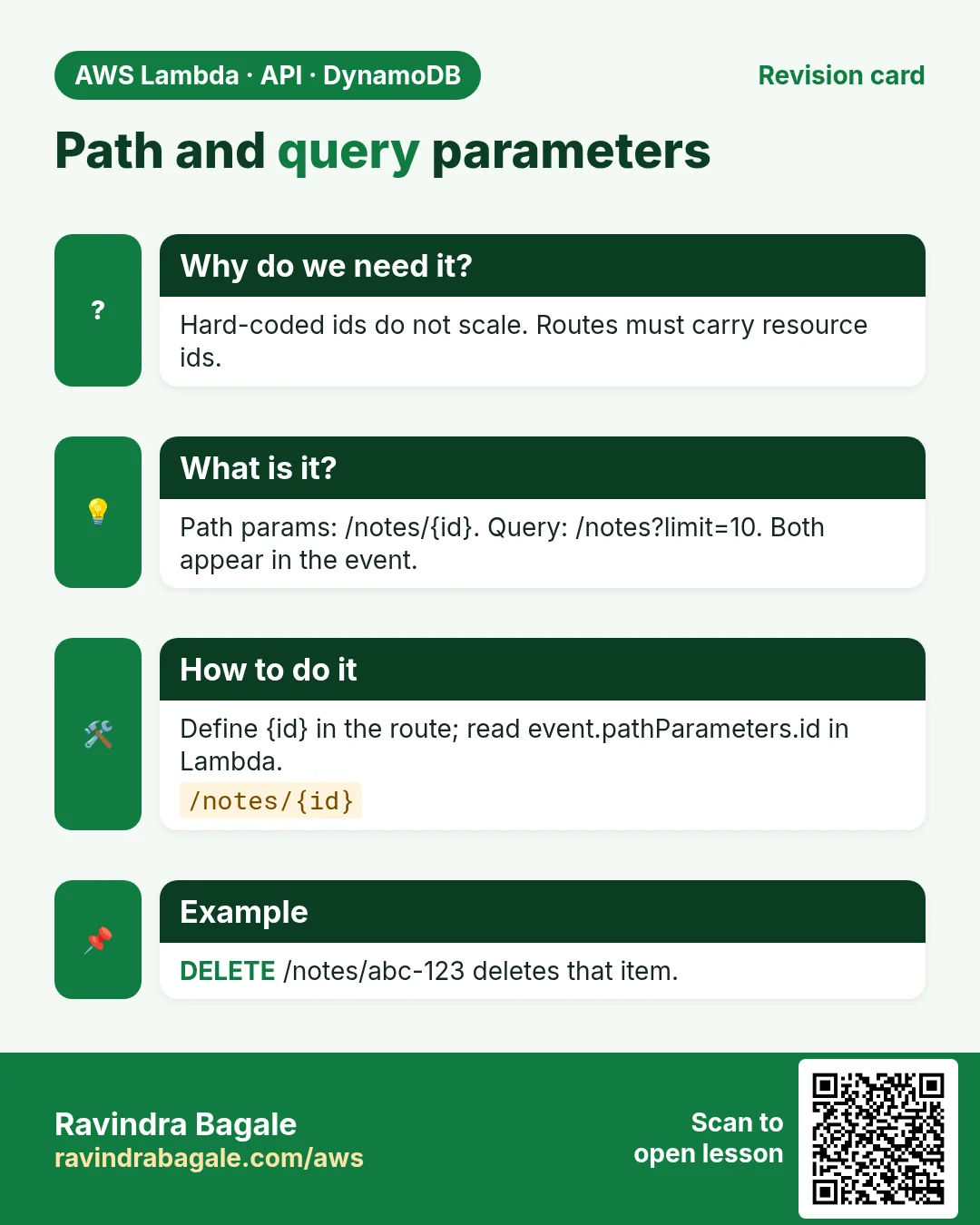
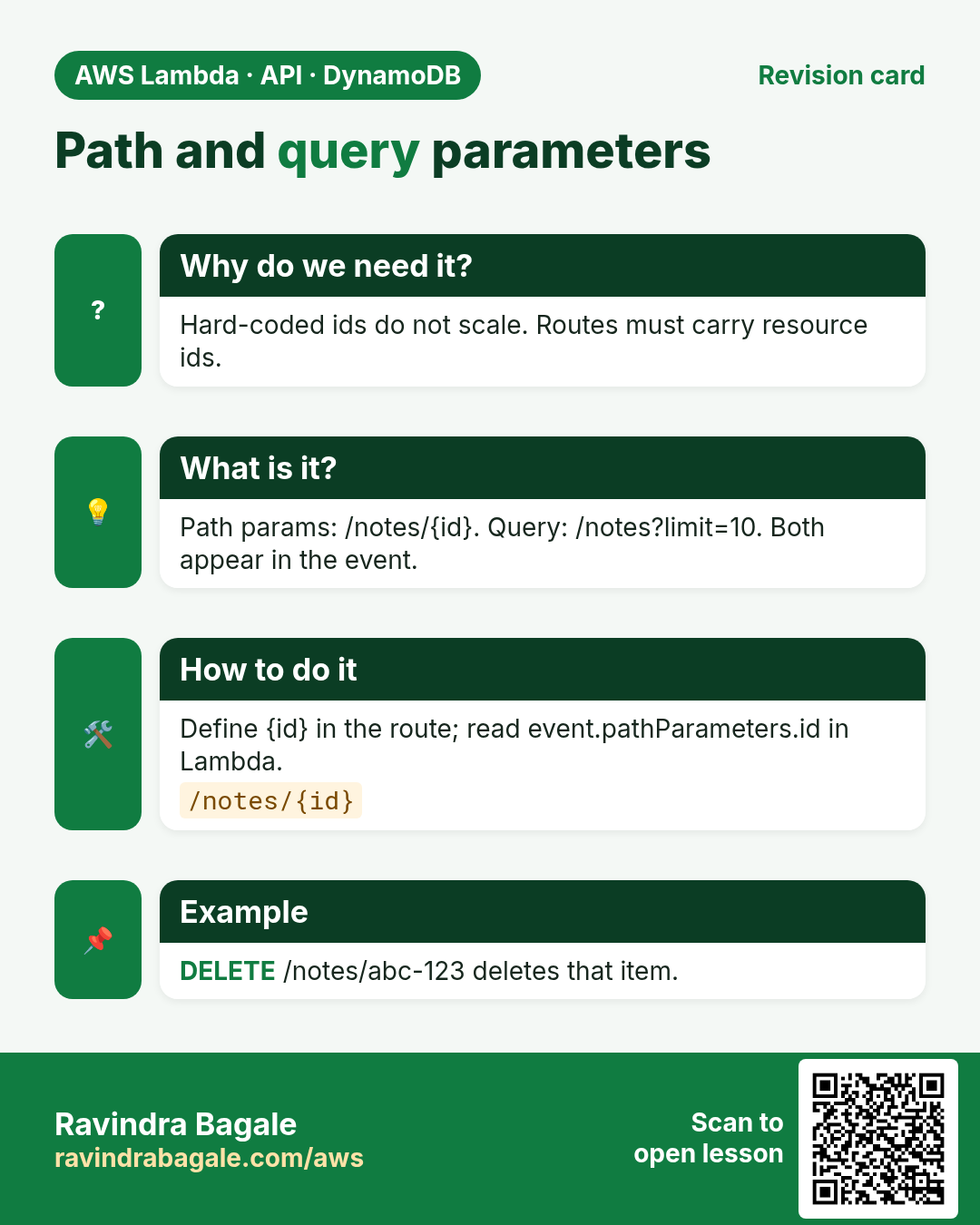
Expected: JSON list, then a 201 body with new id, then one note. Path param {id} lands in the path; query strings appear in event.queryStringParameters (try /notes?limit=1 after you add reading of that field).
3. CORS — why the browser blocks you
Separate preflight from the API request that changes data
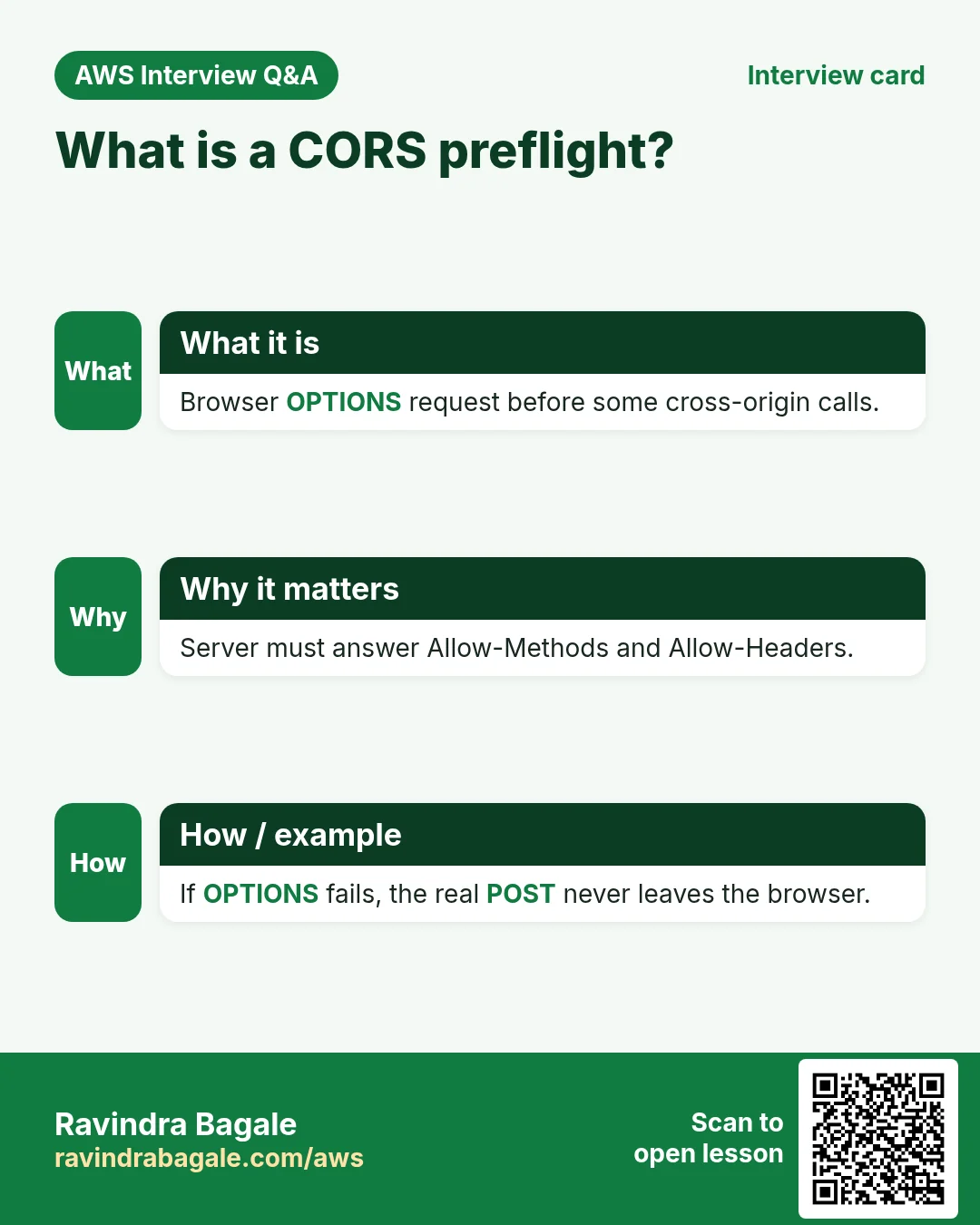
Suppose the browser front end is on one origin and calls a notes API on another with JSON. Before some cross-origin requests, the browser sends an OPTIONS preflight to ask which methods and headers it may use. If that step fails, the browser can prevent the actual POST. A command-line request can still work because it does not enforce the browser’s CORS policy.
Record the browser’s origin, the preflight response and the actual request separately in DevTools. Test the same lab API with the intended authentication. Passing CORS means the browser is permitted to make/read that cross-origin call. It does not decide which user owns a note.
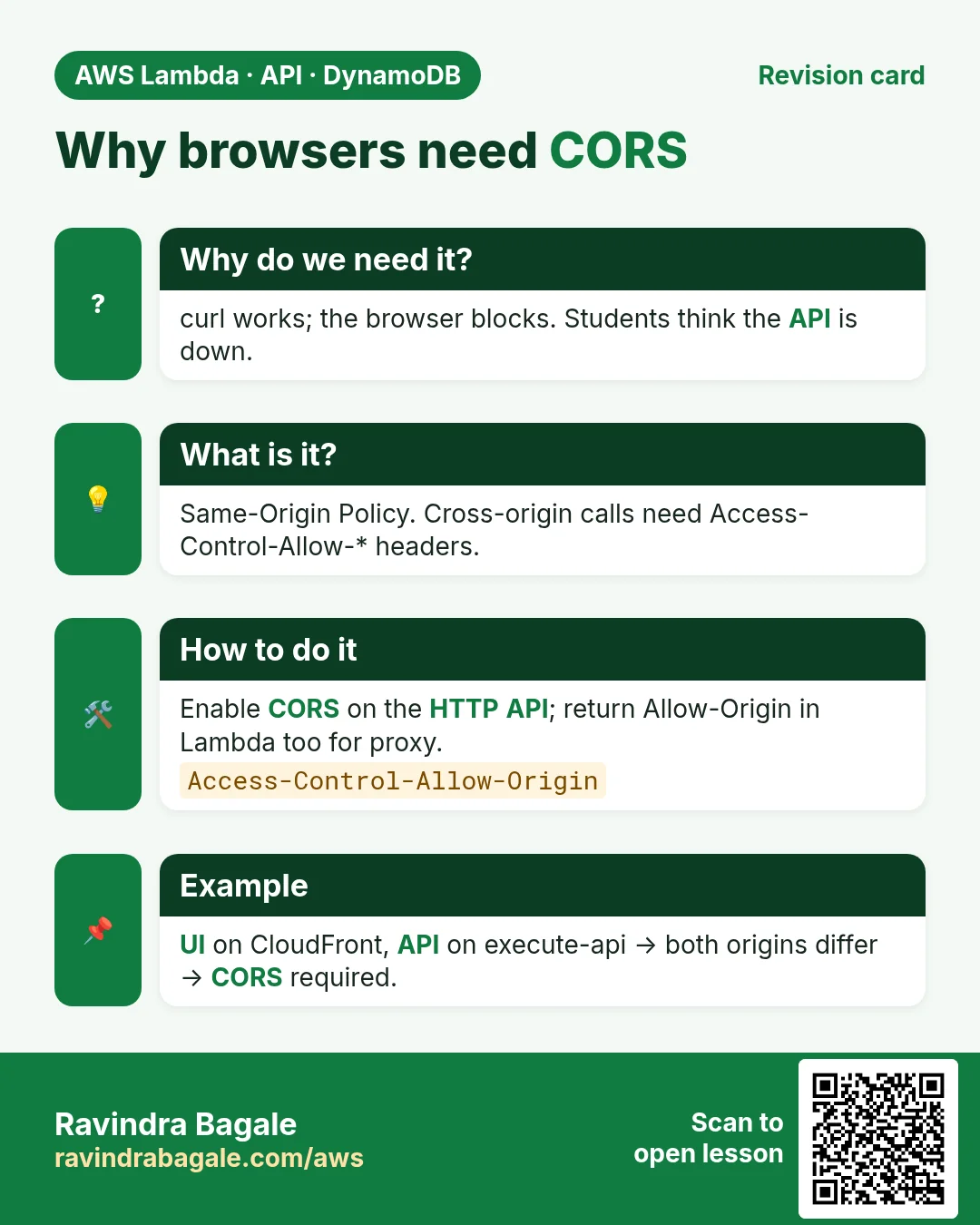
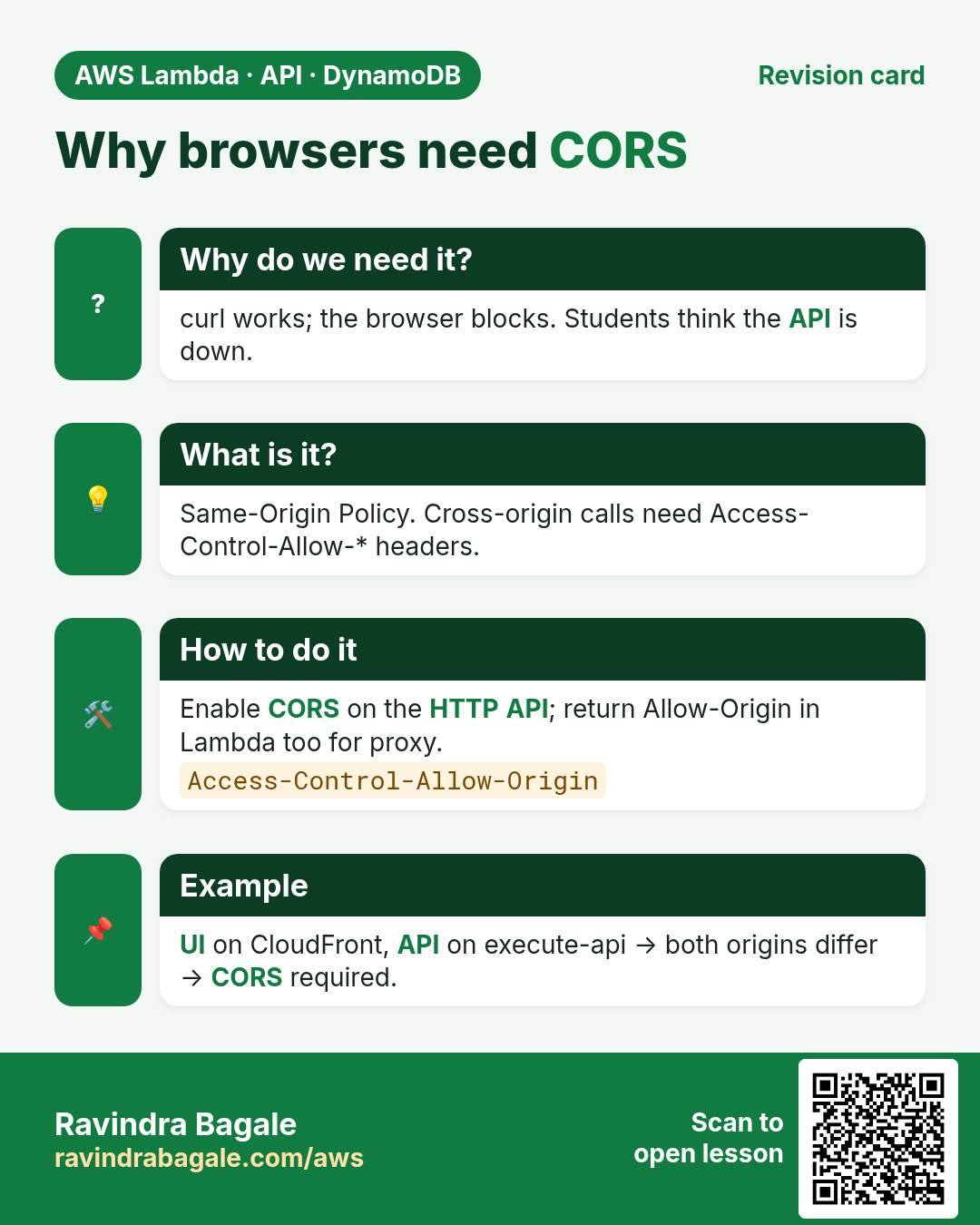
Browsers enforce the Same-Origin Policy. A page on https://app.example.com calling https://api.example.com is cross-origin. The browser hides the response unless the API says it is allowed.
CORS is that permission, via response headers such as Access-Control-Allow-Origin. For requests with special headers or methods, the browser first sends an OPTIONS preflight. Your API must answer OPTIONS with allow headers.
- In HTTP API → CORS → Configure. Allow origins:
https://notes.campus.test(or*for lab). Allow methods: GET, POST, OPTIONS. Allow headers: content-type, authorization. - Also return the same headers from Lambda (as in the lab code) so non-preflight responses work.
- Verify with browser DevTools → Network: failed calls show CORS errors; after fix, status 200.
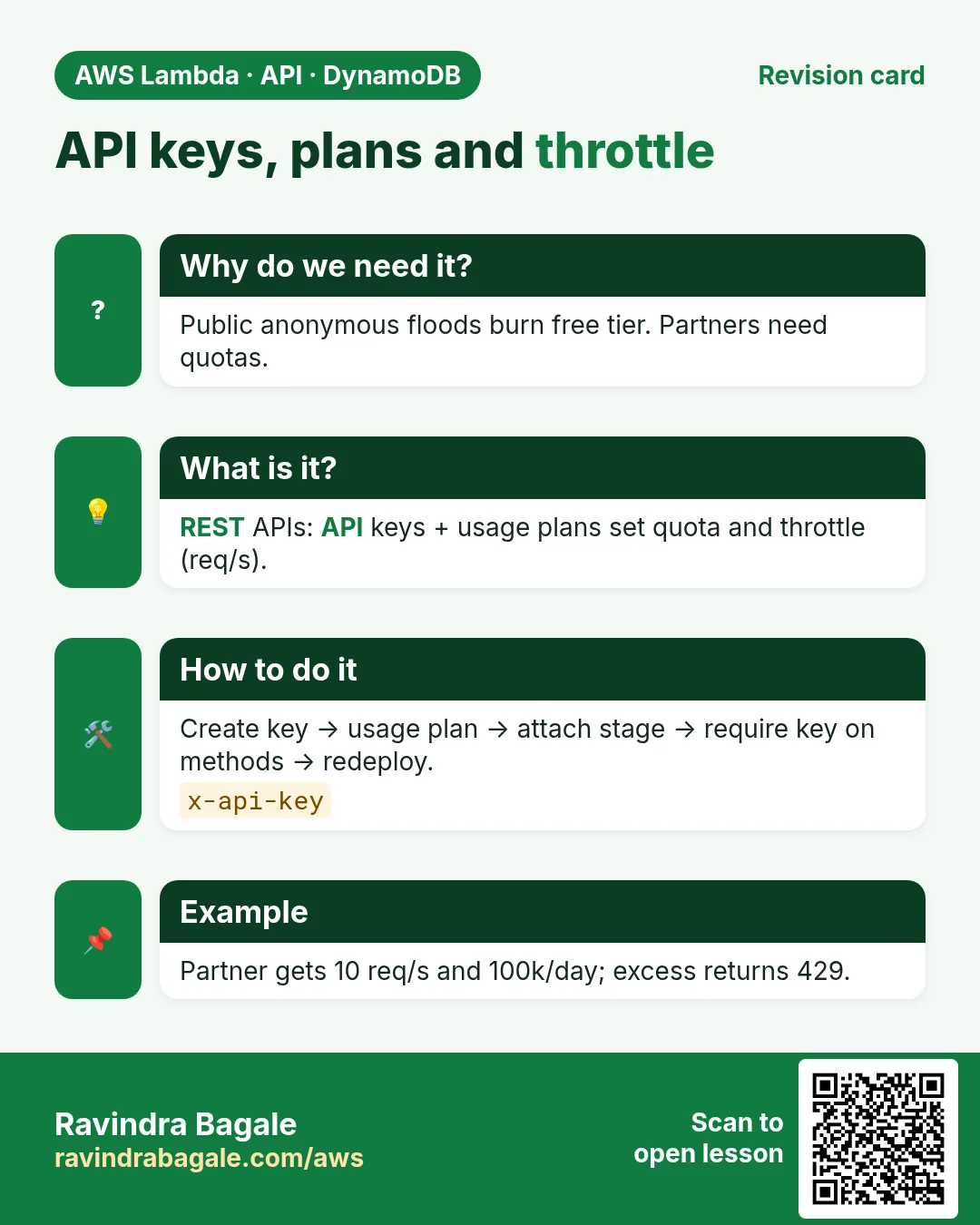
4. API keys, usage plans and throttling (REST)
Partners should not share one open URL. You want a key per partner and a rate limit so one client cannot melt your Lambda bill.
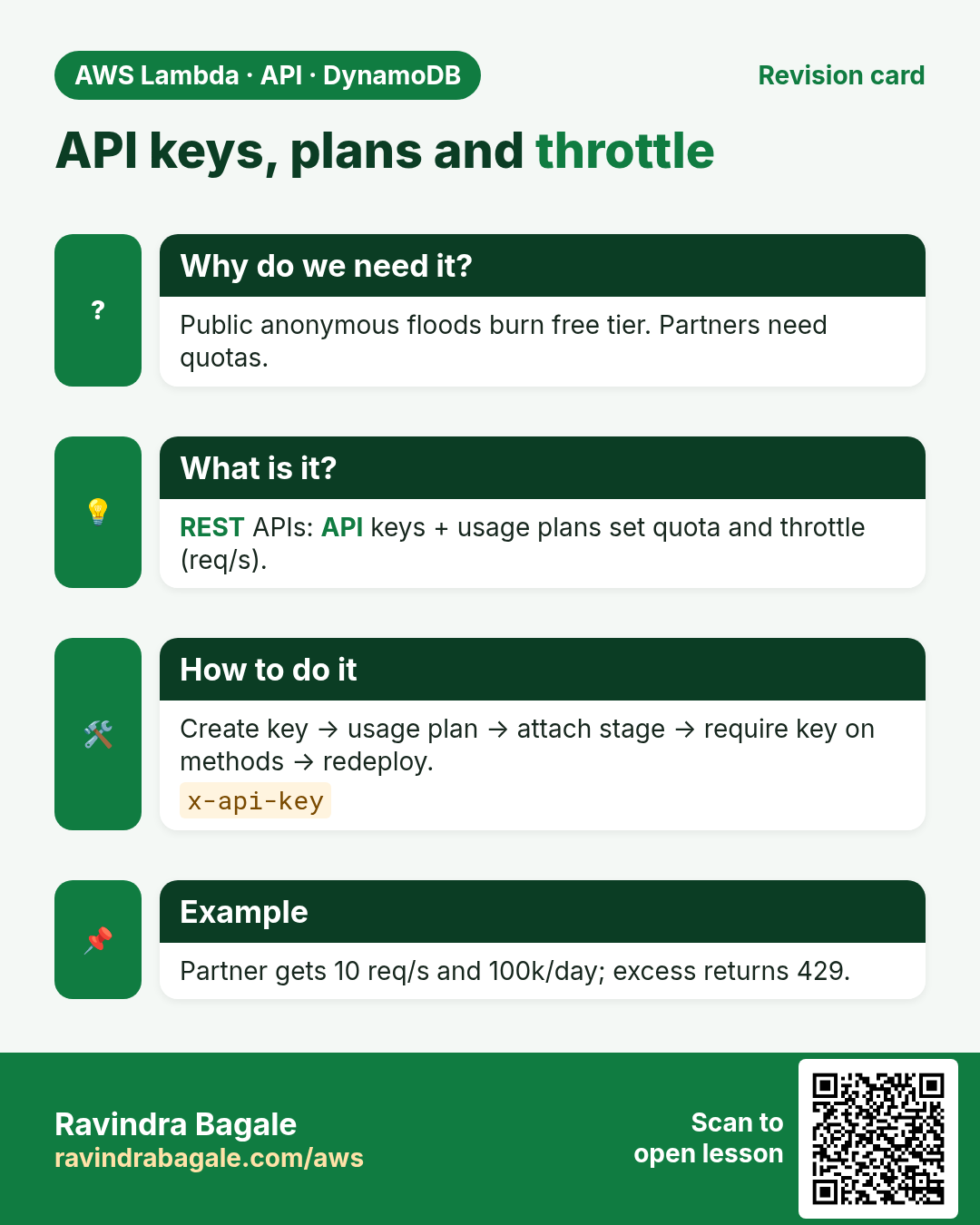
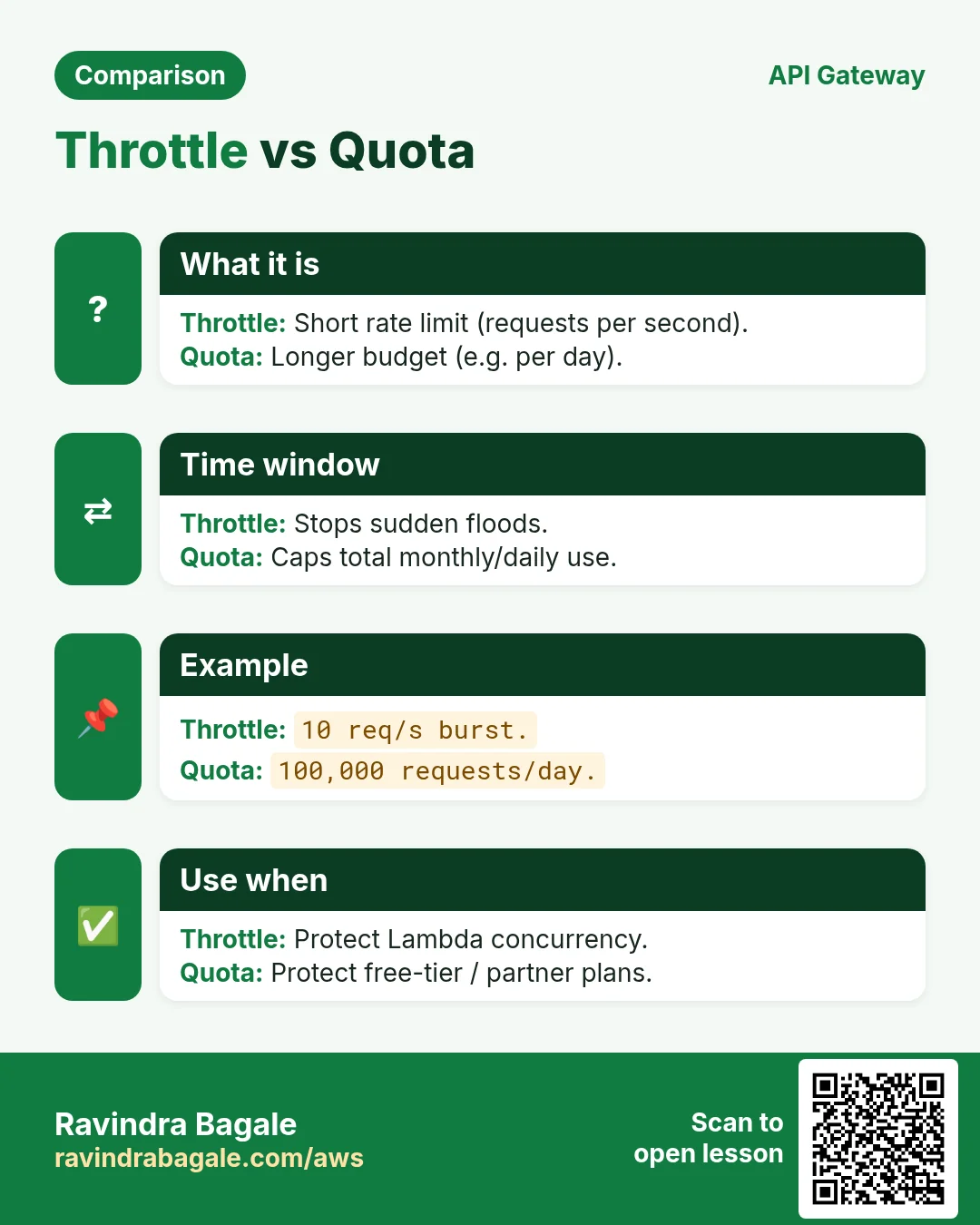
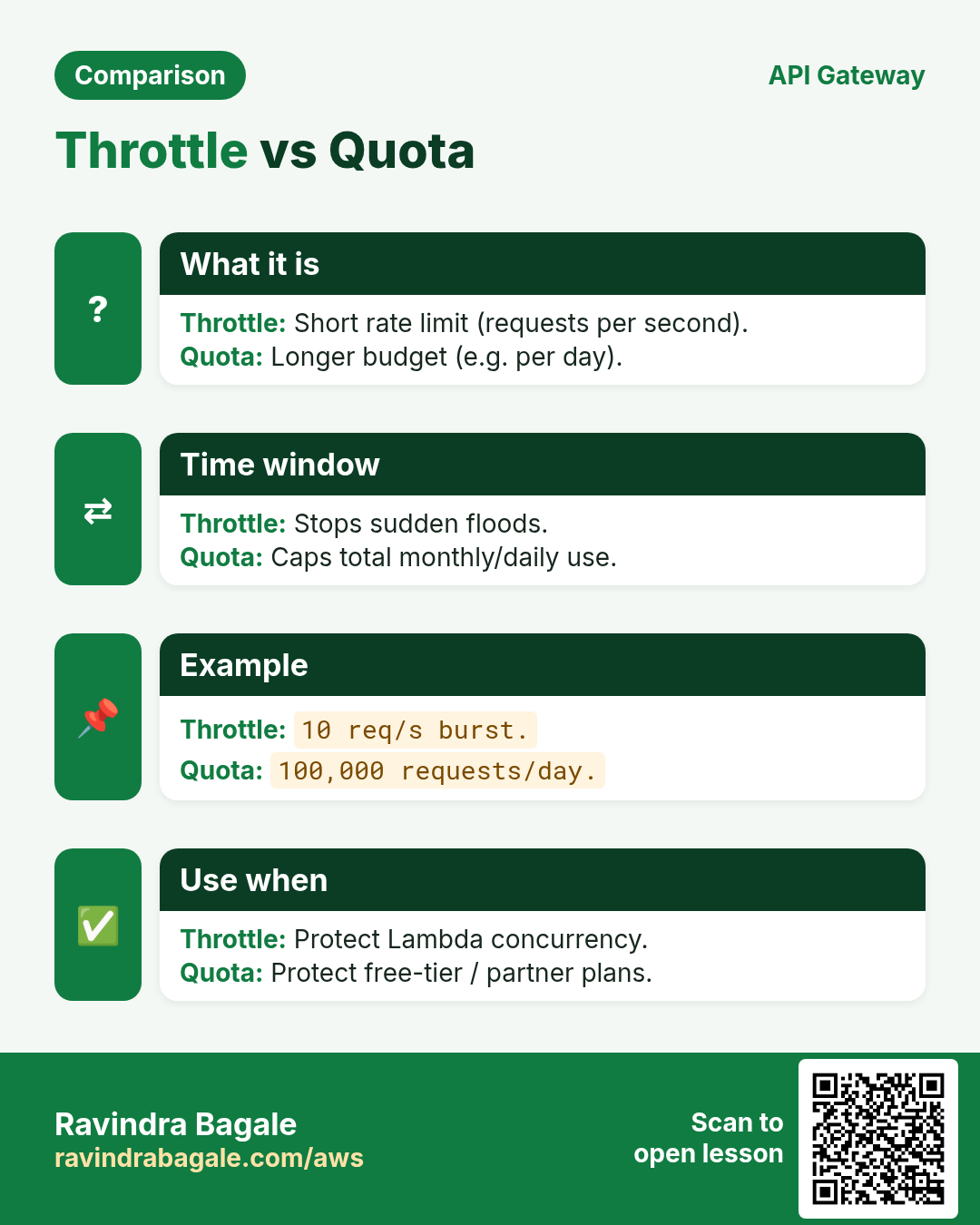
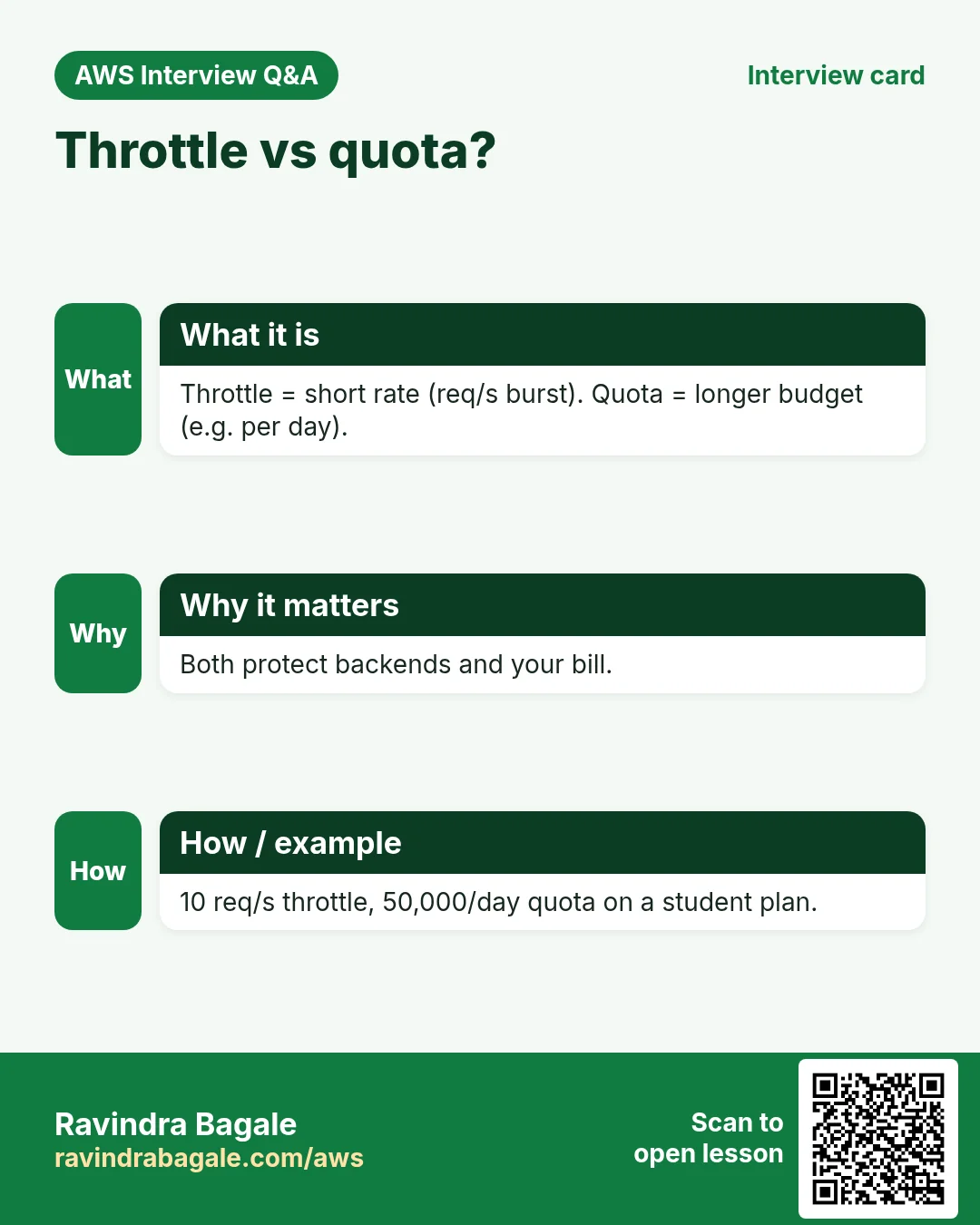
These features exist on REST APIs (not HTTP APIs). An API key is a secret string clients send in x-api-key. A usage plan ties keys to stages and sets throttle (requests/second) and quota (requests/day).
- Create a REST API → resources
/notes→ methods GET/POST with Lambda proxy. Deploy to stageprod. - API Keys → Create → show and copy the value once.
- Usage plans → Create → throttle e.g. 5 req/s, burst 10 → quota 1000/day → add stage
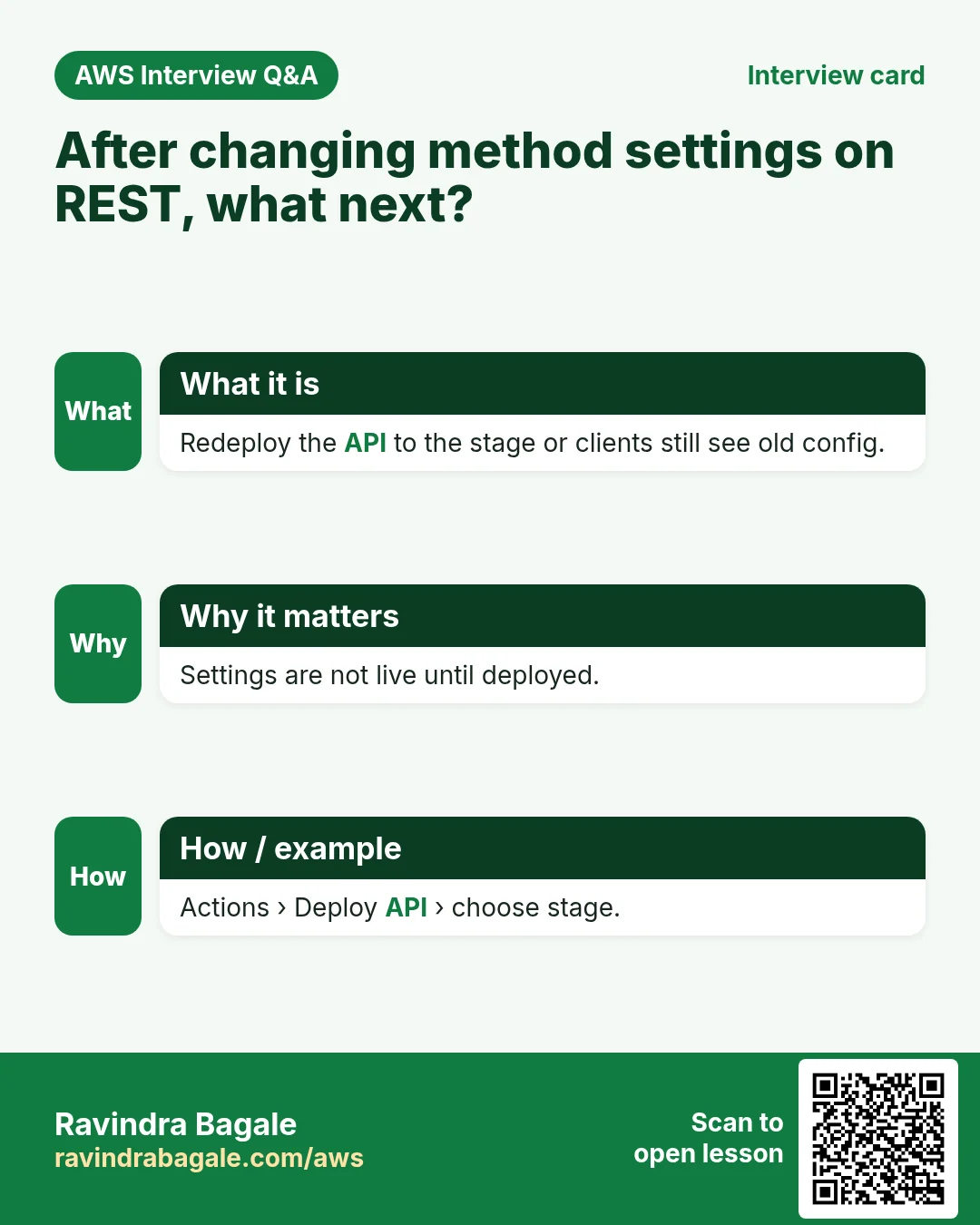
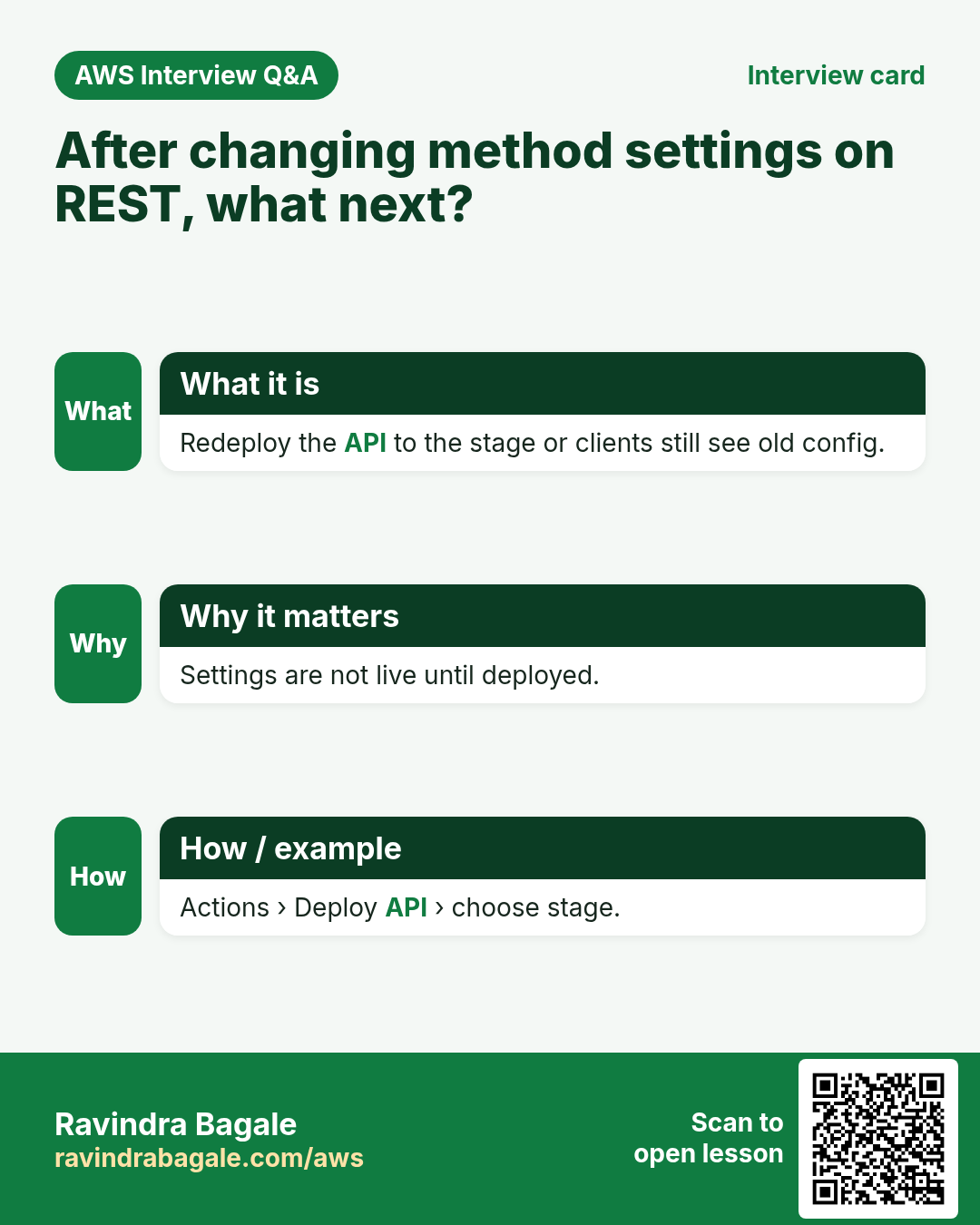
prod→ add the API key. - On each method: Method Request → API Key Required = true. Redeploy.
- Call with
curl -H "x-api-key: YOURKEY" https://.../prod/notes. Without the header: 403.
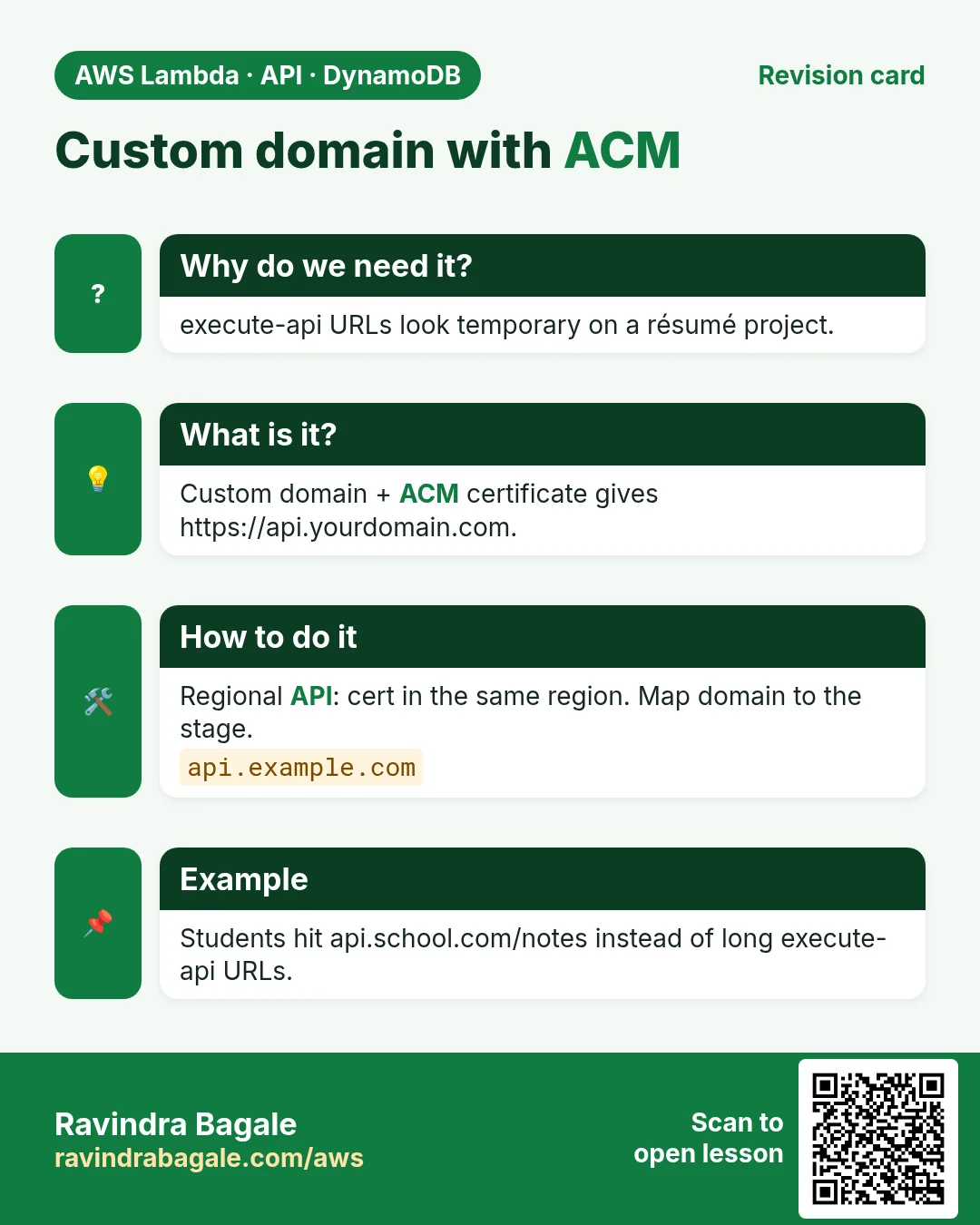
5. Custom domain + ACM (outline)
- Request an ACM public certificate for
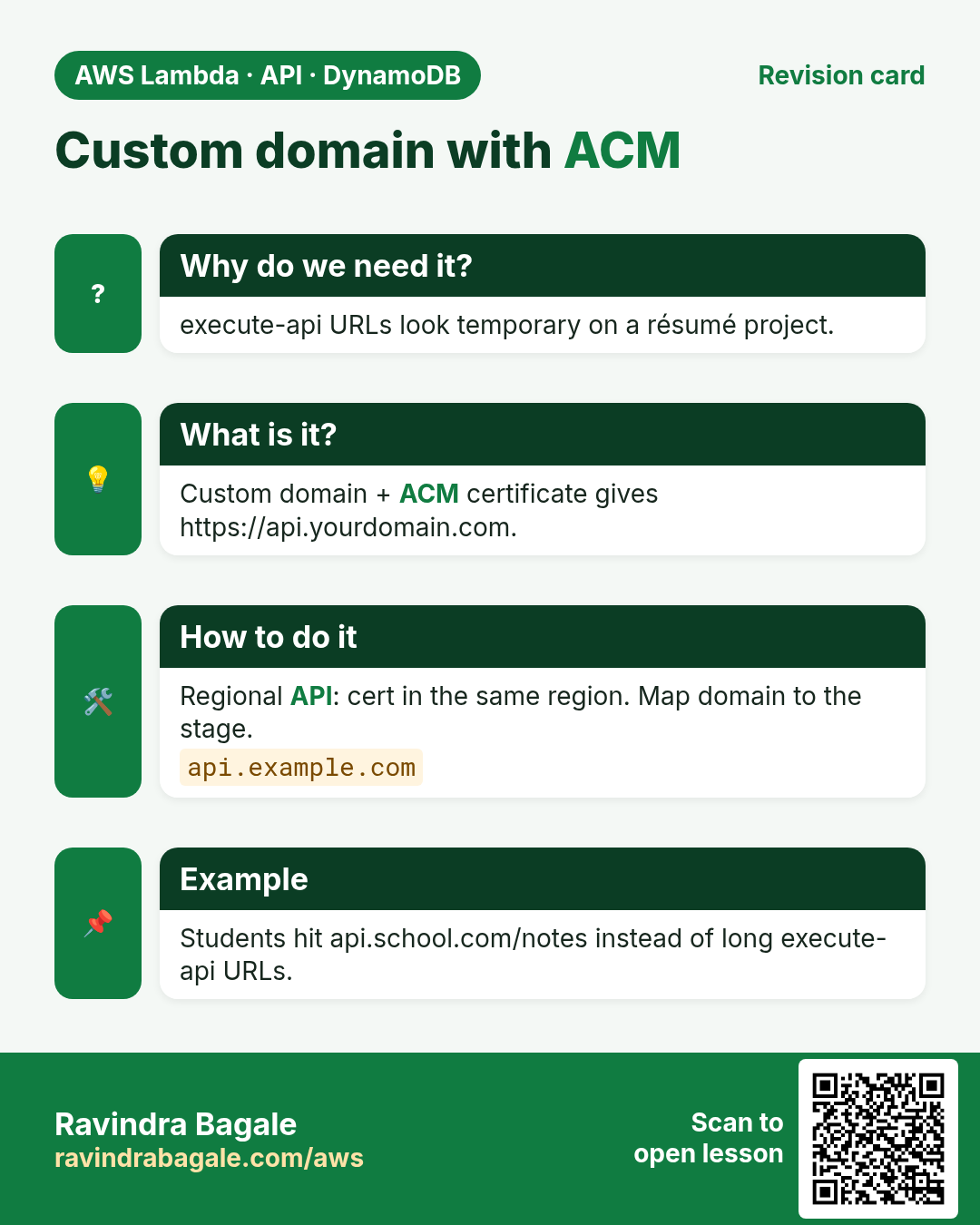
api.yourdomain.comin the same region as the API (for Regional endpoints). Validate via DNS. - API Gateway → Custom domain names → Create → TLS 1.2 → attach certificate → map path `/` to your API stage.
- Route 53 (or your DNS): alias/CNAME to the Gateway domain target shown in the console. Why: browsers need a name that resolves to Gateway.
- Wait for Available, then call
https://api.yourdomain.com/notes.
Cleanup
- Delete HTTP/REST APIs, custom domains, Lambda
notes-api-lab, unused API keys and usage plans. - Leave ACM cert only if other labs use it.
Common errors and fixes
These are synthetic practice situations. Diagnose the signal before changing a resource; no infrastructure changes are needed to read this guide.
Notes disappear or different requests show different lists.
The example explicitly uses lab memory, not a database. Warm reuse can make a list appear persistent until another environment or reset is used. Do not put real shared or private notes in this demo. Durable data and user-specific access need a separate application design.
Backend CORS edits do not change an HTTP API response.
When HTTP API CORS is configured, API Gateway applies that configuration and ignores CORS headers from the backend integration. Inspect the API’s CORS configuration, the request Origin and preflight method/headers. Changing only the Lambda header can leave the effective response unchanged.
A daily usage quota is treated as a guaranteed bill cap.
API Gateway usage-plan quotas and throttling are best-effort, not hard limits. Clients can exceed them. Monitor costs and review service-level controls separately; do not promise a fixed maximum bill from a usage-plan number.
Practical FAQ: decisions during real work
Why does a console test with a small JSON object differ from an HTTP request?
API Gateway wraps the HTTP request in an integration event. Payload format 1.0 and 2.0 have different fields, including how method, path and cookies are represented. Test the configured integration format, not just an arbitrary direct-Lambda payload.
Does a green preflight prove that POST created a note?
No. OPTIONS checks browser permission for a proposed request; it does not run the intended POST business operation. Inspect the actual POST response and the stored result separately. A browser permission check and a successful write are different outcomes.
Where should I look when the invoke URL works but the custom domain does not?
Compare the domain’s API mapping, stage and requested path first, then certificate and DNS details as needed. The default execute-api URL and the custom-domain path can differ. Keep the HTTP method and payload constant so the comparison identifies a routing difference rather than a different request.
6. Interview questions
Q. How do path parameters reach Lambda?
In proxy mode they are part of the path; HTTP APIs also expose them under pathParameters.
Q. Why CORS if curl works?
curl is not a browser. Browsers enforce Same-Origin Policy and need Allow-Origin headers.
Q. API key vs IAM auth?
API key identifies a client app for quotas; easy to share, not end-user identity. IAM signs requests as an AWS principal.
Q. Throttle vs quota?
Throttle = short-rate (req/s). Quota = longer budget (req/day).
Q. Why regional ACM for API Gateway?
Regional custom domains need the certificate in the API region. (CloudFront is the service that needs us-east-1.)
Try at home
- Add query param limit to GET /notes and slice the list.
- Put a React or simple HTML page on S3/CloudFront and call your API with fetch; fix CORS until it works.
In short
- HTTP API + Lambda proxy is the fast path for GET/POST.
- CORS headers (and OPTIONS) unlock browser calls.
- API keys + usage plans on REST APIs control partners.
- Custom domain = ACM cert + Gateway mapping + DNS.
Practise this chapter
Check your understanding
Choose an answer, then compare your reasoning with the explanation.
Practice Tasks
Practice checks run in your browser. They check the answer for this exercise; they do not create resources or connect to your AWS account.
About this scenarioTexas Solar Co is a solar energy business in Austin. Carlos Ramirez looks after its IT and cloud work. They count money in USD and run their AWS resources in the us-east-2 Region. In the tasks below you do real jobs for them using what this lesson teaches. All names, account IDs, IP addresses and numbers are made up for practice.
0 / 12
Easy List functions
See which functions exist in this Region.
List the Lambda functions in us-east-2.
- Read the task and decide which AWS service it is about.
- Write aws, then the service name, then the operation (the action word).
- Add each needed flag (--name) followed by its value from the task.
- Flags can be in any order. Click Check answer.
Medium Invoke a function
Invoke runs the function now and saves its answer in a file.
Invoke texassolar-orders-fn and save the response to out.json.
- Read the task and decide which AWS service it is about.
- Write aws, then the service name, then the operation (the action word).
- Add each needed flag (--name) followed by its value from the task.
- Flags can be in any order. Click Check answer.
Medium Trust policy for a Lambda role
The trust policy says WHO may take the role.
Write a trust policy that lets lambda.amazonaws.com assume the role.
- Start with { "Version": "2012-10-17", "Statement": [ ... ] }.
- In each statement write Effect, Action and Resource.
- Give only what the task needs (least privilege).
- Use double quotes and commas correctly. Click Check answer.
Medium Change timeout and memory
More memory also gives more CPU; timeout stops runaway runs.
Set texassolar-orders-fn to timeout 30 seconds and memory 512 MB.
- Read the task and decide which AWS service it is about.
- Write aws, then the service name, then the operation (the action word).
- Add each needed flag (--name) followed by its value from the task.
- Flags can be in any order. Click Check answer.
Medium Let a function write logs
Without these actions, Lambda logs never appear in CloudWatch.
Allow logs:CreateLogGroup, logs:CreateLogStream, logs:PutLogEvents on arn:aws:logs:*:*:* only.
- Start with { "Version": "2012-10-17", "Statement": [ ... ] }.
- In each statement write Effect, Action and Resource.
- Give only what the task needs (least privilege).
- Use double quotes and commas correctly. Click Check answer.
Hard Let S3 call your function
A resource-based permission is needed before S3 can invoke the function.
Add permission statement s3invoke to texassolar-orders-fn so s3.amazonaws.com can call lambda:InvokeFunction from bucket arn:aws:s3:::texassolar-uploads.
- Read the task and decide which AWS service it is about.
- Write aws, then the service name, then the operation (the action word).
- Add each needed flag (--name) followed by its value from the task.
- Flags can be in any order. Click Check answer.
Hard Create a Lambda function
Lambda needs the code zip, a runtime, a handler name and an execution role.
Create function texassolar-orders-fn: runtime python3.12, handler app.handler, role arn:aws:iam::111225901510:role/lambda-basic, code in function.zip.
- Read the task and decide which AWS service it is about.
- Write aws, then the service name, then the operation (the action word).
- Add each needed flag (--name) followed by its value from the task.
- Flags can be in any order. Click Check answer.
Hard Set environment variables
Keep settings like table names out of the code.
Set the environment variable TABLE=texassolar-orders on texassolar-orders-fn.
- Read the task and decide which AWS service it is about.
- Write aws, then the service name, then the operation (the action word).
- Add each needed flag (--name) followed by its value from the task.
- Flags can be in any order. Click Check answer.
Hard Invoke with a JSON payload
In CLI v2, raw JSON needs --cli-binary-format raw-in-base64-out.
Invoke texassolar-orders-fn with payload {"orderId":"o-101"} (raw JSON) and save the reply in out.json.
- Read the task and decide which AWS service it is about.
- Write aws, then the service name, then the operation (the action word).
- Add each needed flag (--name) followed by its value from the task.
- Flags can be in any order. Click Check answer.
Hard Lambda GB-seconds
Lambda bills memory × time.
1,000,000 invocations, 512 MB memory, 200 ms each. How many GB-seconds?
- Write down the numbers the task gives you.
- Work it out step by step on paper.
- Type only the final answer in the box.
- Click Check answer.
Hard Quick-create an HTTP API for Lambda
Quick create builds an HTTP API, a default route and stage pointing at your function.
Create an HTTP API named texassolar-api whose target is arn:aws:lambda:us-east-2:111225901510:function:texassolar-orders-fn.
- Read the task and decide which AWS service it is about.
- Write aws, then the service name, then the operation (the action word).
- Add each needed flag (--name) followed by its value from the task.
- Flags can be in any order. Click Check answer.
Hard Connect an SQS queue to Lambda
An event source mapping makes Lambda poll the queue and process messages in batches.
Create an event source mapping from queue arn:aws:sqs:us-east-2:111225901510:texassolar-orders to texassolar-orders-fn with batch size 10.
- Read the task and decide which AWS service it is about.
- Write aws, then the service name, then the operation (the action word).
- Add each needed flag (--name) followed by its value from the task.
- Flags can be in any order. Click Check answer.
Revision, comparison and interview cards
Revise this lesson in a few minutes. Save the cards on your phone or download them as PNG files. The QR code on each card opens this lesson.
More cards: Ravi Sir's Cards.