Ravi Sir's Cards › AWS › S3 VPC endpoint and source IP
Amazon S3 bucket policies: VPC endpoints and office source IP
This page keeps the next S3 bucket-policy cards on one topic page, after the public website and CloudFront OAC page. It has the eight cards from “S3 bucket policy project 3: restrict access to a VPC endpoint” and the eight cards from “S3 bucket policy project 4: restrict by office source IP”. Those packs are about where a request may come from. Later projects (HTTPS, SSE-KMS, cross-account logs, and so on) can be their own topic pages later.
Each card still has its image and its original text. Under each group you will also find a short Why, What, How example, and an exam tip, in easy English. The names, bucket names, CIDRs and endpoint ids in the stories are made up for learning.
Restrict access to a VPC endpoint
Why this matters
Private data should not leave the VPC path to the public S3 endpoint. If an ETL job in a private subnet can still reach S3 through NAT, the traffic is no longer only on the VPC endpoint you planned.
What it is
A common bucket policy pattern is to Deny s3:* unless aws:SourceVpce matches your endpoint id. Align the bucket policy with the endpoint policy, and put routes to the S3 prefix list in the subnet route tables. For most private S3 access, a gateway endpoint is the default (prefix-list routes, no ENI charge pattern). An interface endpoint uses ENIs and security groups, with more control and more cost, and is for special DNS or security-group needs. A public path through NAT will be denied by a SourceVpce fence — that is the point of the deny test.
How it works — a real example
Suppose Lucas Meyer’s ETL in private subnets must read a bucket only via vpce-…. He creates a gateway endpoint, associates the routes, and puts a Deny-unless SourceVpce policy on the bucket. From a bastion in the VPC the read is allowed. From a laptop on the internet it is denied. Ananya Iyer debugs a miss by checking the route table association first, not only the JSON. The names and endpoint id are made up for learning.
Common mistake / exam tip
Bucket policy alone is not the whole story — endpoint policies apply too. Confirm there is no NAT leak when you test the deny. Use a gateway endpoint for ordinary private S3 access unless you have a clear reason for an interface endpoint.
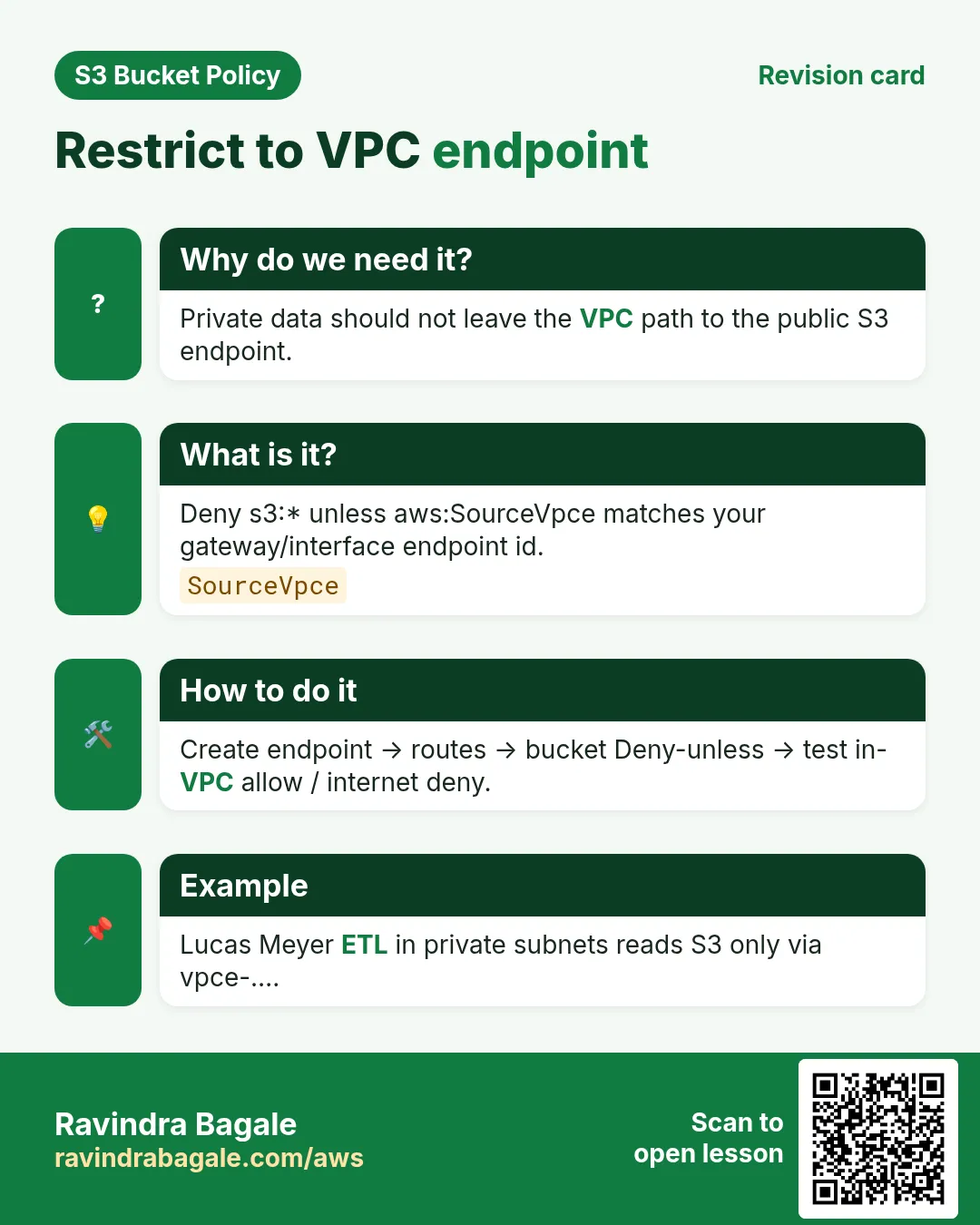
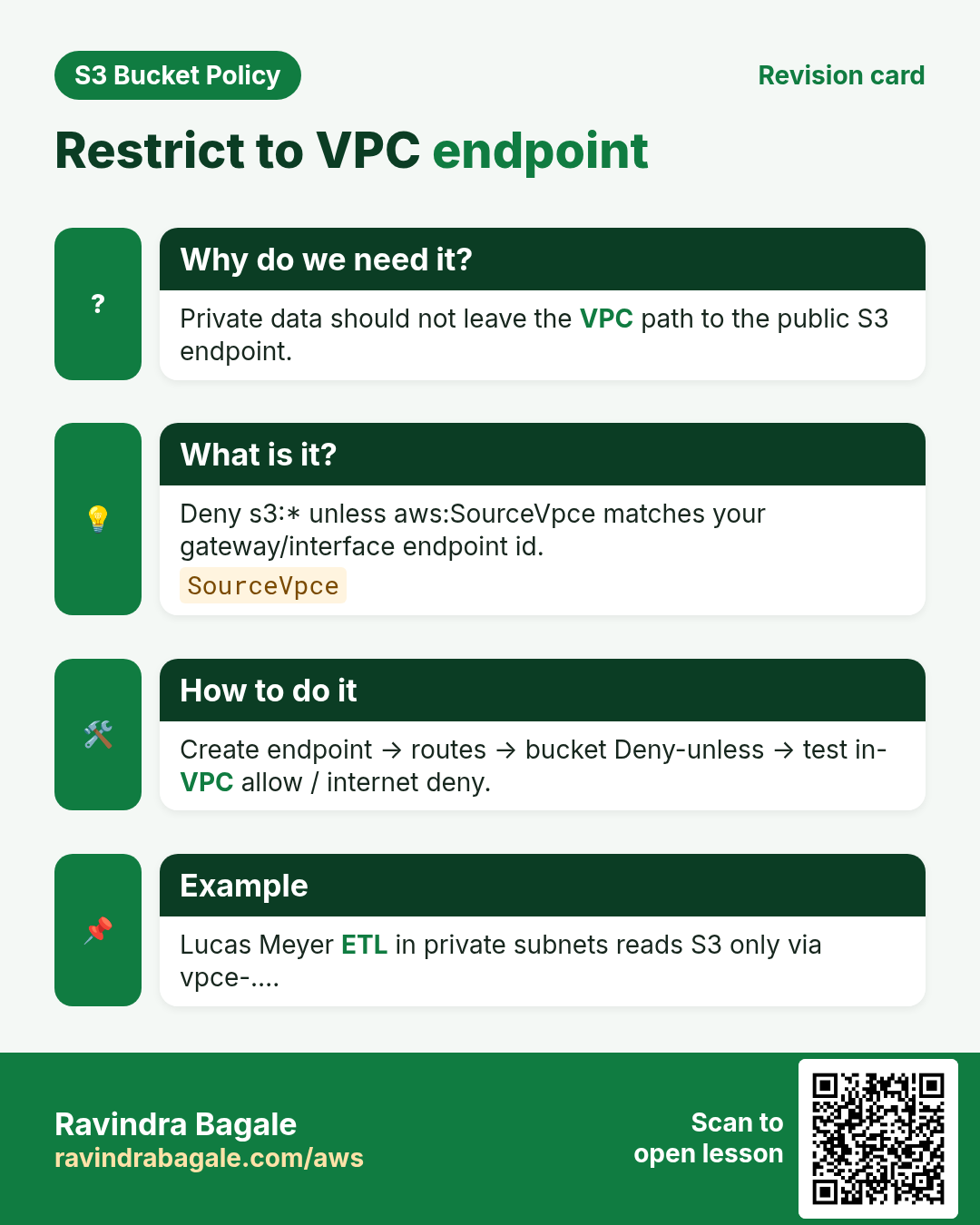
Restrict to VPC endpoint
Read card text
What this card says
Why do we need it?
Private data should not leave the VPC path to the public S3 endpoint.
What is it?
Deny s3:* unless aws:SourceVpce matches your gateway/interface endpoint id. SourceVpce
How to do it
Create endpoint → routes → bucket Deny-unless → test in-VPC allow / internet deny.
Example
Lucas Meyer ETL in private subnets reads S3 only via vpce-….
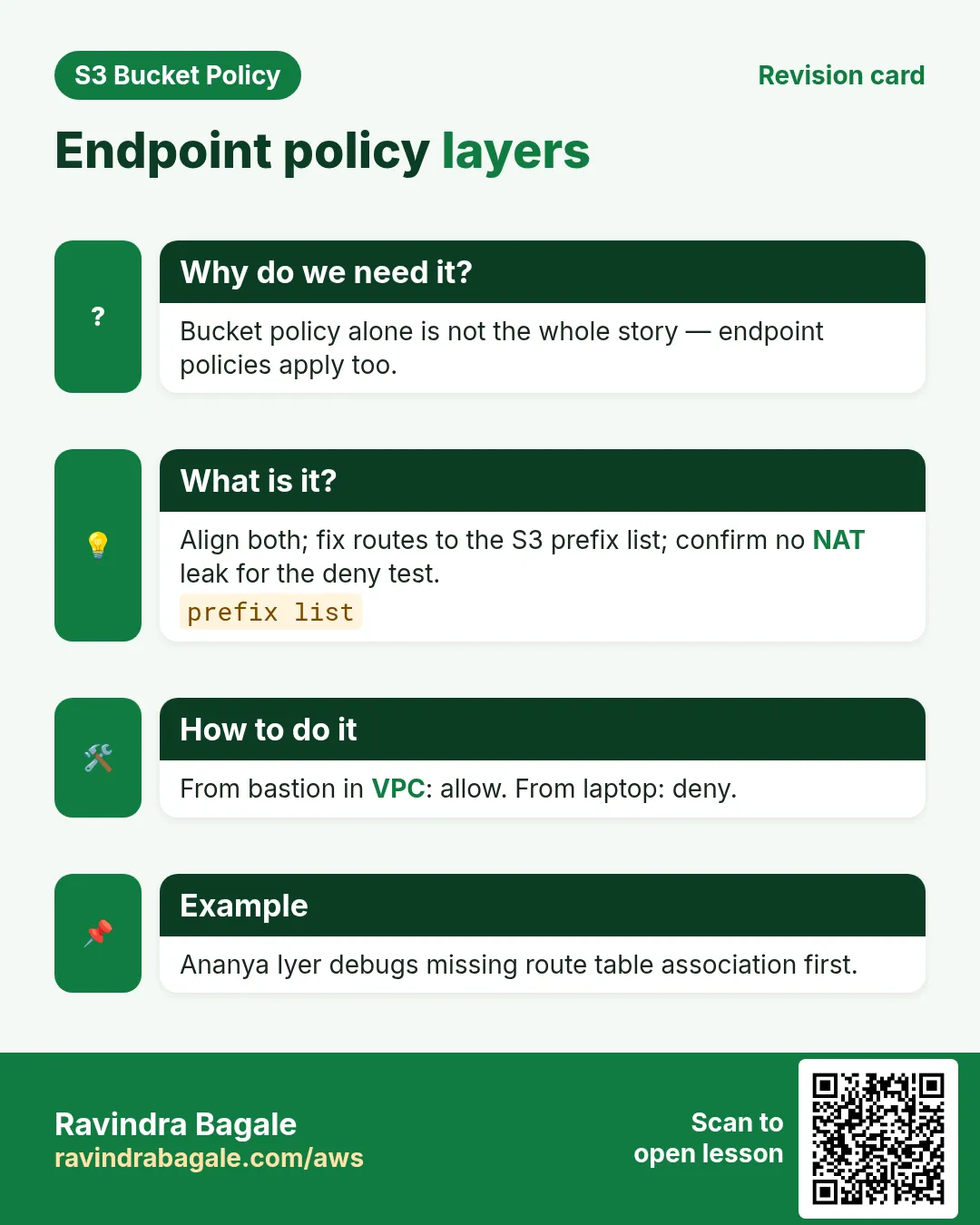
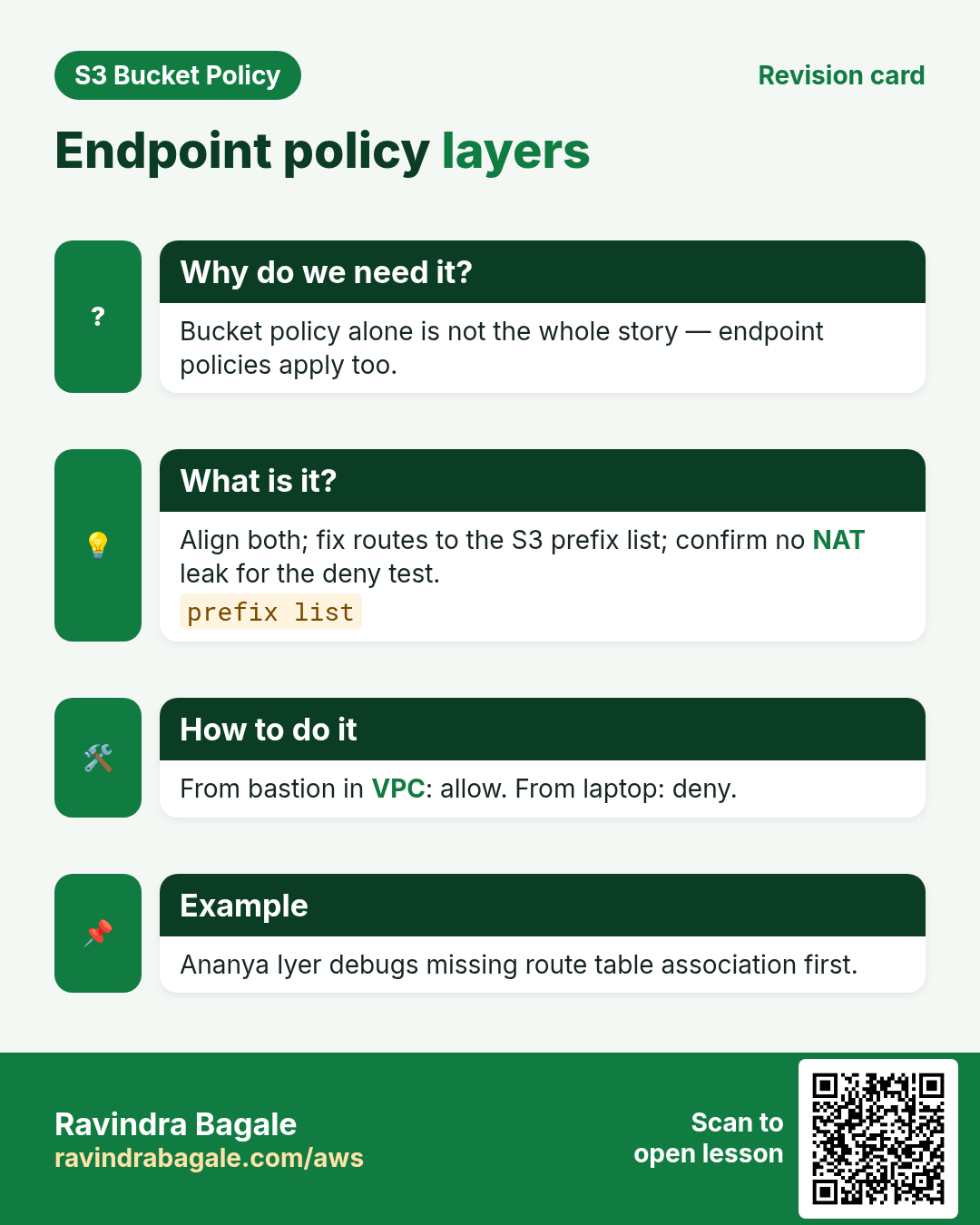
Endpoint policy layers
Read card text
What this card says
Why do we need it?
Bucket policy alone is not the whole story — endpoint policies apply too.
What is it?
Align both; fix routes to the S3 prefix list; confirm no NAT leak for the deny test. prefix list
How to do it
From bastion in VPC: allow. From laptop: deny.
Example
Ananya Iyer debugs missing route table association first.
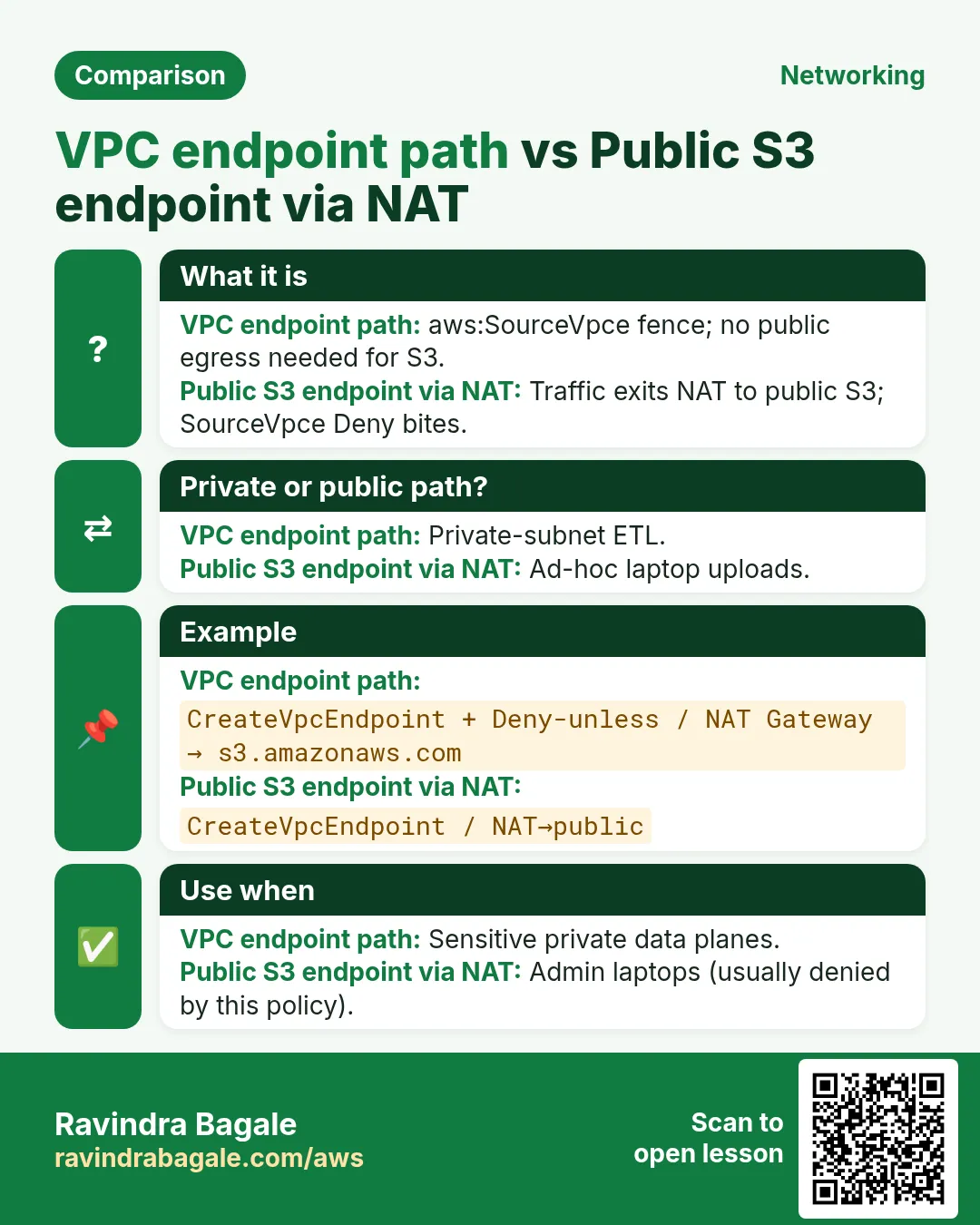
Comparison: Private or public path?
Read card text
What this card says
VPC endpoint path
aws:SourceVpce fence; no public egress needed for S3.
Public S3 endpoint via NAT
Traffic exits NAT to public S3; SourceVpce Deny bites.
Key points
Private-subnet ETL. Ad-hoc laptop uploads.
Example
CreateVpcEndpoint + Deny-unless / NAT Gateway → s3.amazonaws.com
Use when
Sensitive private data planes. Admin laptops (usually denied by this policy).
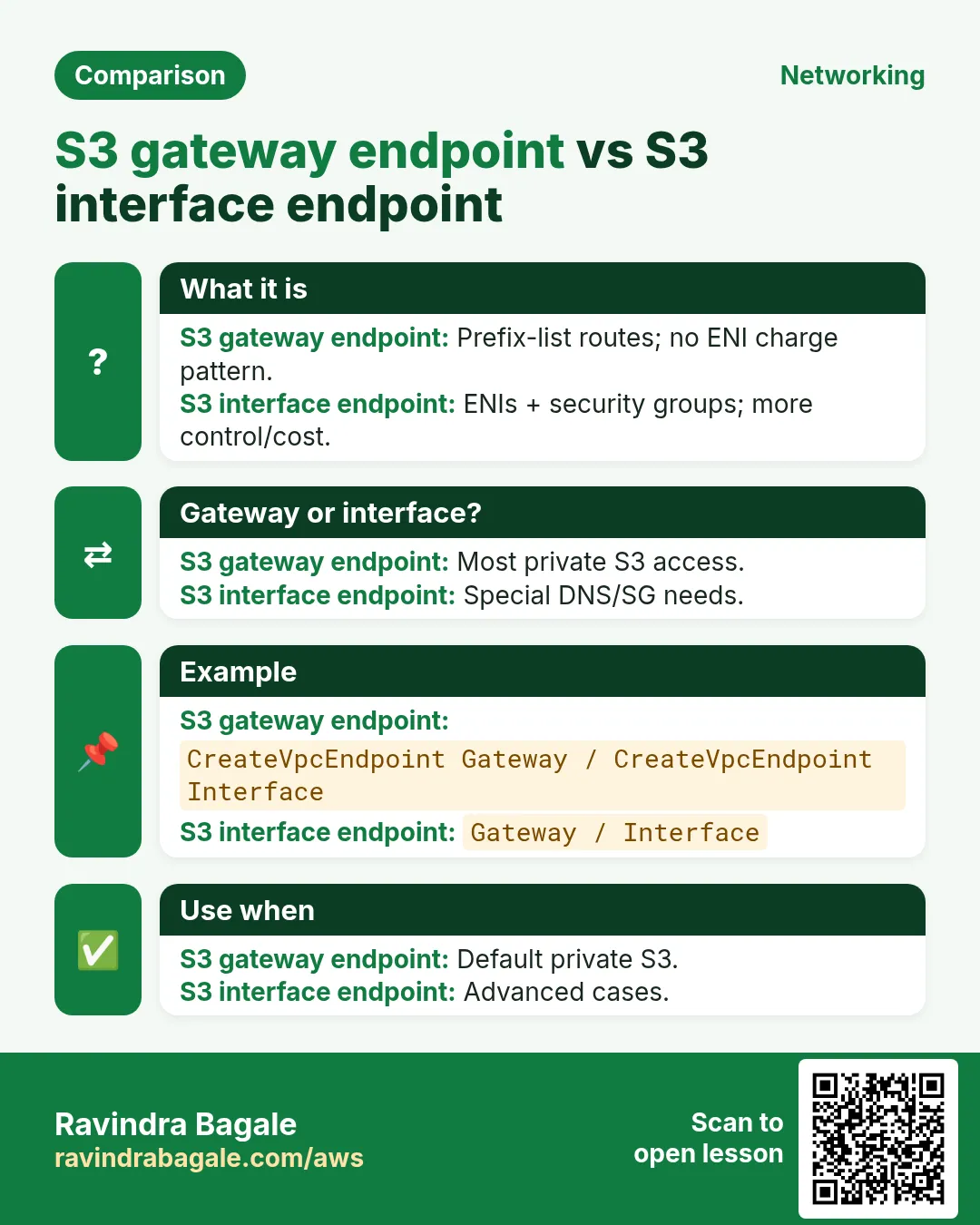
Comparison: Gateway or interface?
Read card text
What this card says
S3 gateway endpoint
Prefix-list routes; no ENI charge pattern.
S3 interface endpoint
ENIs + security groups; more control/cost.
Key points
Most private S3 access. Special DNS/SG needs.
Example
CreateVpcEndpoint Gateway / CreateVpcEndpoint Interface
Use when
Default private S3. Advanced cases.
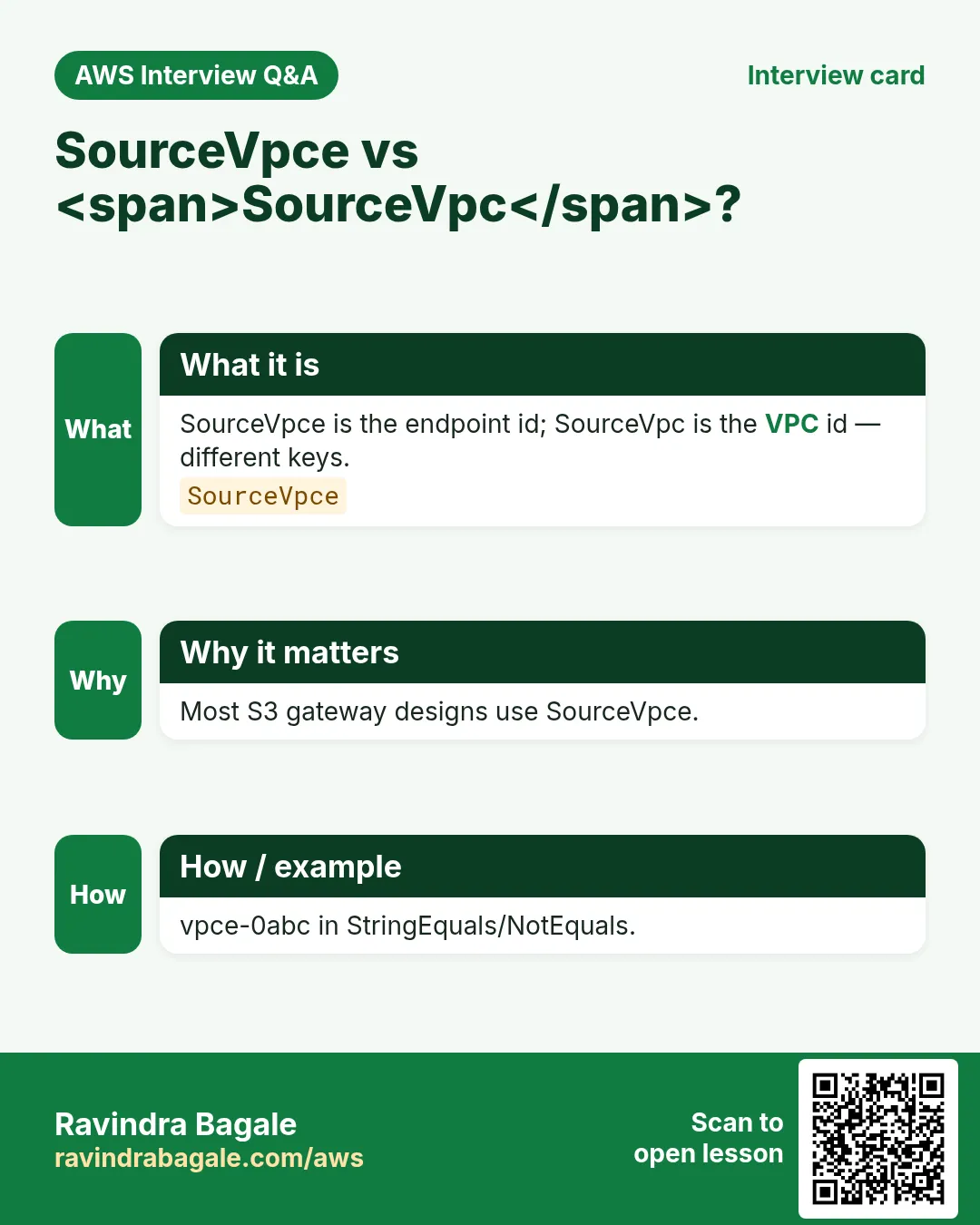
Interview: SourceVpce vs SourceVpc?
Read card text
What this card says
What it is
SourceVpce is the endpoint id; SourceVpc is the VPC id — different keys. SourceVpce
Why it matters
Most S3 gateway designs use SourceVpce.
How / example
vpce-0abc in StringEquals/NotEquals.
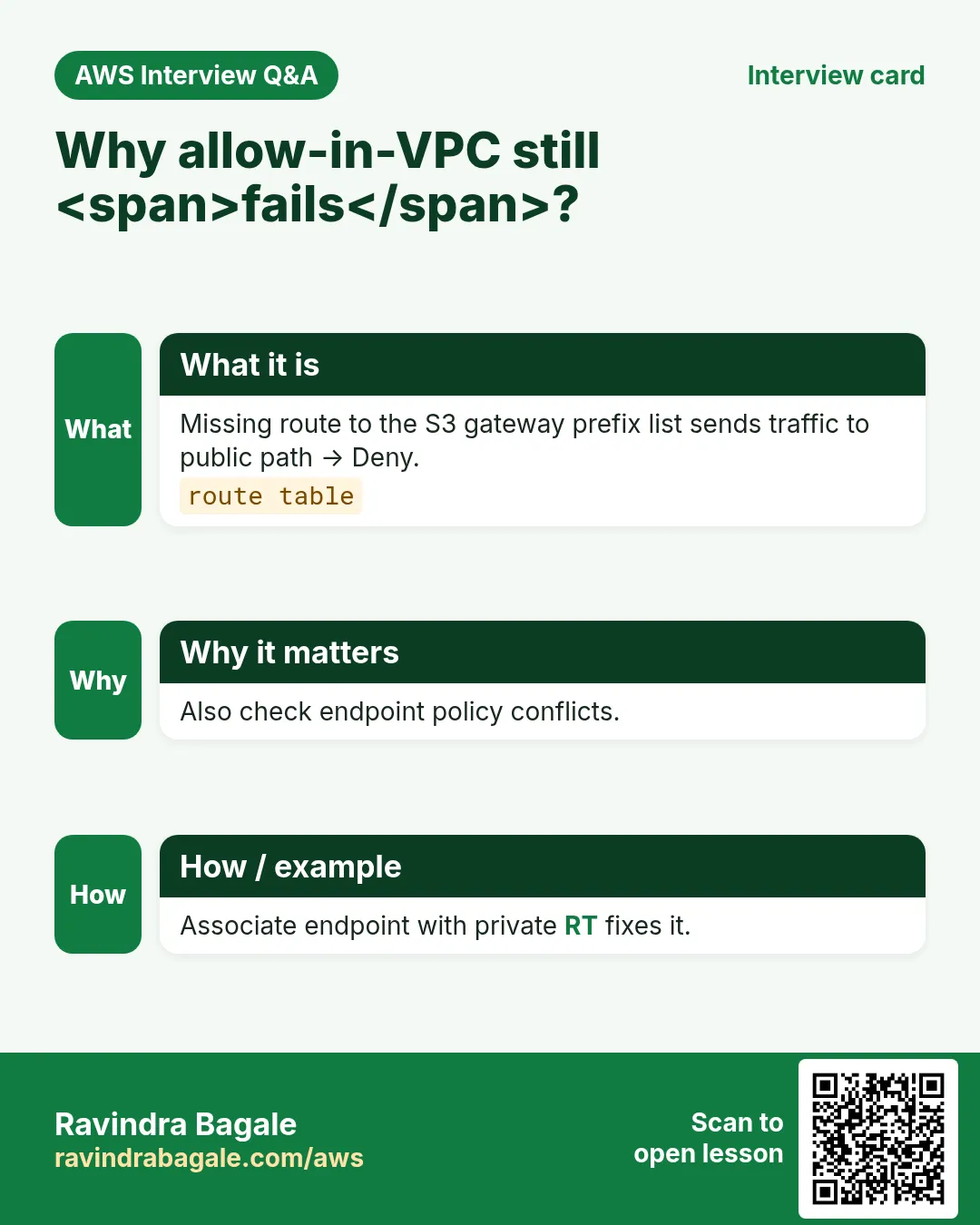
Interview: Why allow-in-VPC still fails?
Read card text
What this card says
What it is
Missing route to the S3 gateway prefix list sends traffic to public path → Deny. route table
Why it matters
Also check endpoint policy conflicts.
How / example
Associate endpoint with private RT fixes it.
Interview: Why Deny-unless pattern?
Read card text
What this card says
What it is
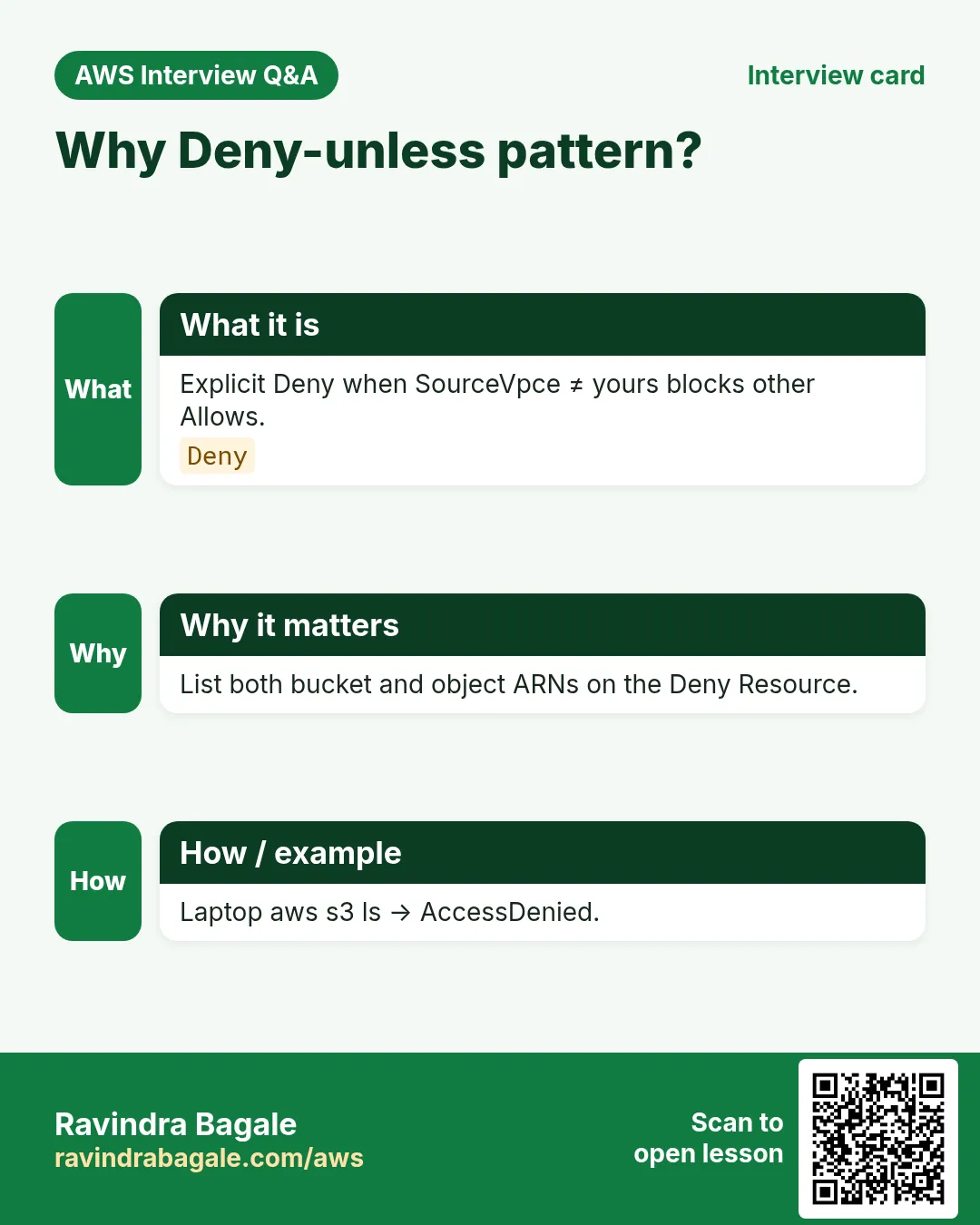
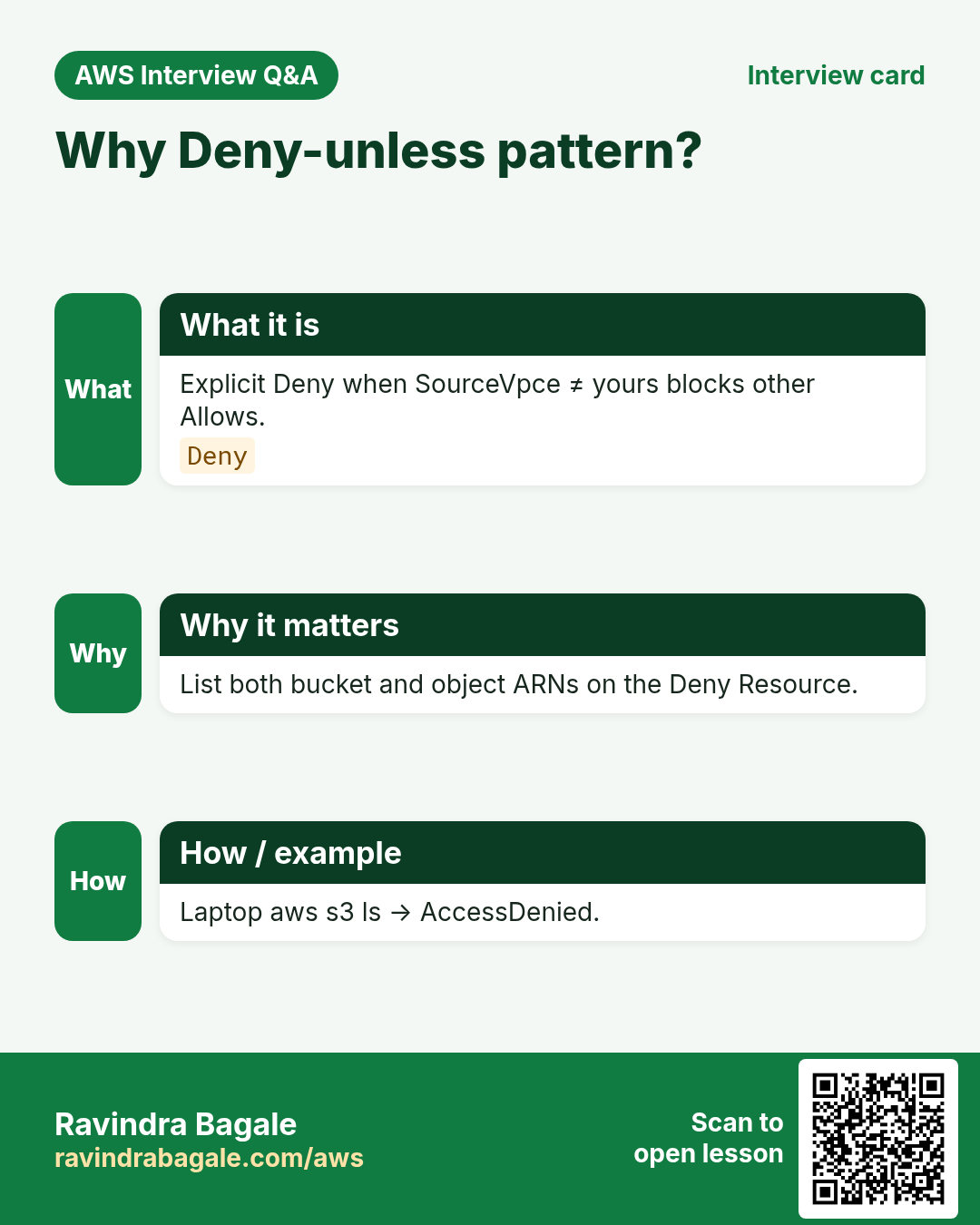
Explicit Deny when SourceVpce ≠ yours blocks other Allows. Deny
Why it matters
List both bucket and object ARNs on the Deny Resource.
How / example
Laptop aws s3 ls → AccessDenied.
Interview: Gateway or interface for S3?
Read card text
What this card says
What it is
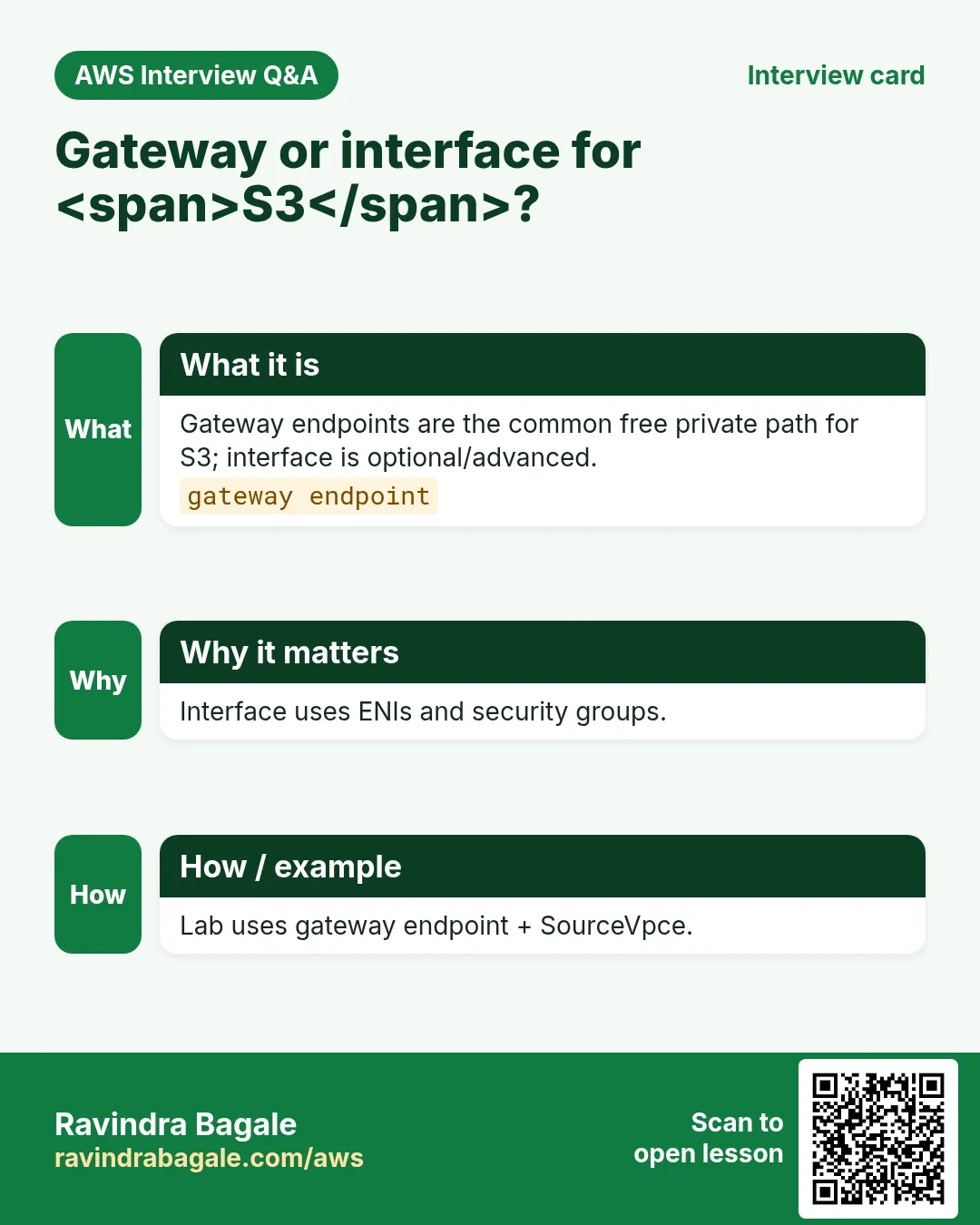
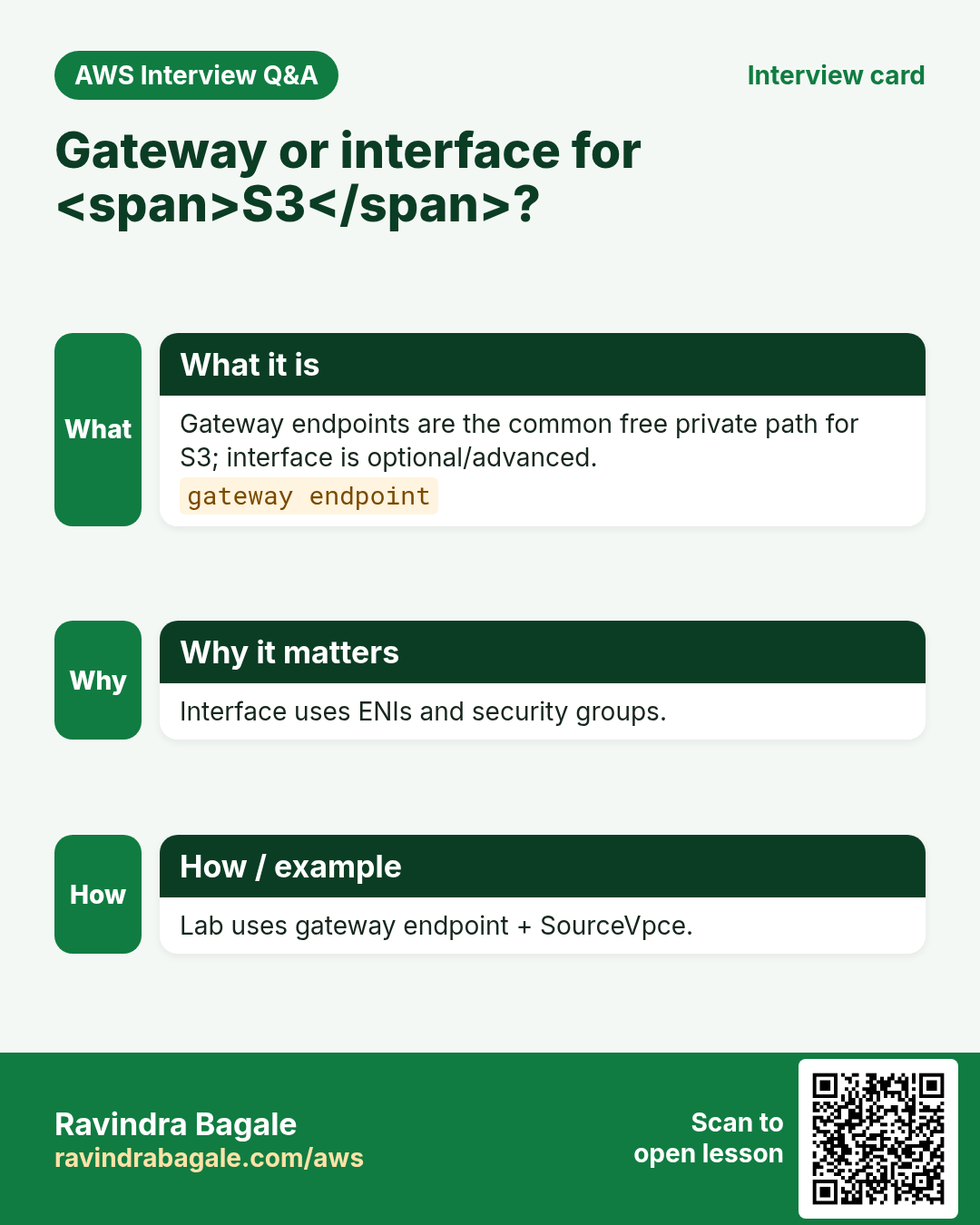
Gateway endpoints are the common free private path for S3; interface is optional/advanced. gateway endpoint
Why it matters
Interface uses ENIs and security groups.
How / example
Lab uses gateway endpoint + SourceVpce.
Restrict by office source IP
Why this matters
Finance exports should not download from coffee-shop Wi-Fi. A stolen access key used off-network should fail if you also fence the source IP.
What it is
A common pattern is to Deny s3:* unless aws:SourceIp is in the office or NAT CIDRs, with IpAddress or NotIpAddress operators (not a casual StringEquals on a CIDR). S3 sees the public egress address after NAT, not the private 10.x address, so you allowlist the NAT or firewall egress /32 or ranges, and you update the policy when the ISP changes. VPN users must egress via an IP that is on the list, or they are denied. You can combine this with a TLS Deny (aws:SecureTransport) for defense in depth. A SourceIp fence is about where the caller is; identity-only IAM is about who the caller is. Break-glass admins may need access from anywhere with MFA, which is a different pattern.
How it works — a real example
Suppose Arjun Mehta allows only 203.0.113.0/24 to a statements bucket. Office desktops work. A phone hotspot is denied. Rahul Deshmukh later updates the policy after the office ISP renumbers the NAT. A home VPN whose egress IP is not in the list also gets AccessDenied. The names and CIDRs are made up for learning.
Common mistake / exam tip
Do not allowlist private RFC1918 addresses for S3 SourceIp — S3 never sees 10.x after NAT. Document split-tunnel VPN surprises. Test with curl from the office and from a hotspot. Keep a written break-glass path if you must reach the bucket from outside the office CIDR.
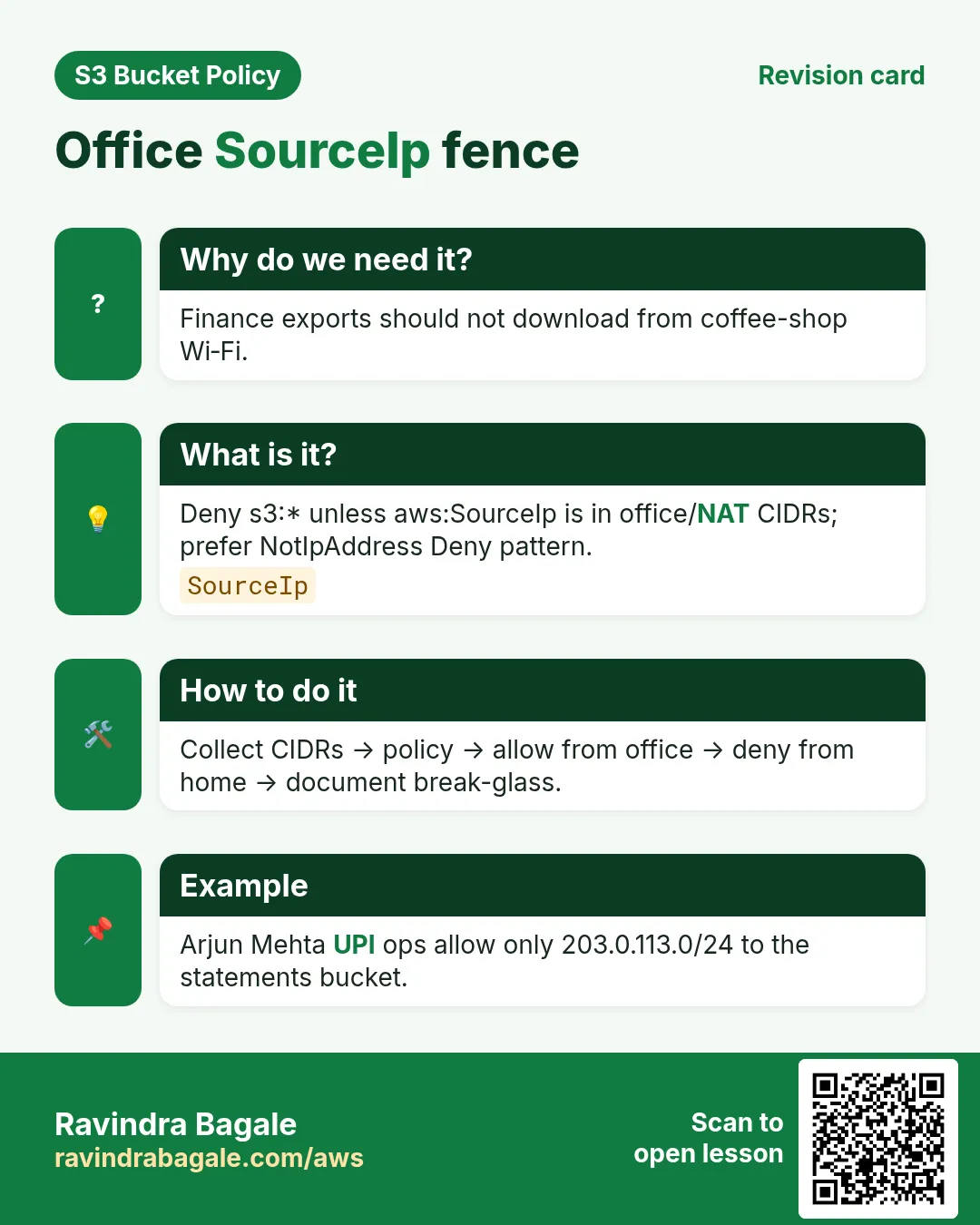
Office SourceIp fence
Read card text
What this card says
Why do we need it?
Finance exports should not download from coffee-shop Wi‑Fi.
What is it?
Deny s3:* unless aws:SourceIp is in office/NAT CIDRs; prefer NotIpAddress Deny pattern. SourceIp
How to do it
Collect CIDRs → policy → allow from office → deny from home → document break-glass.
Example
Arjun Mehta UPI ops allow only 203.0.113.0/24 to the statements bucket.
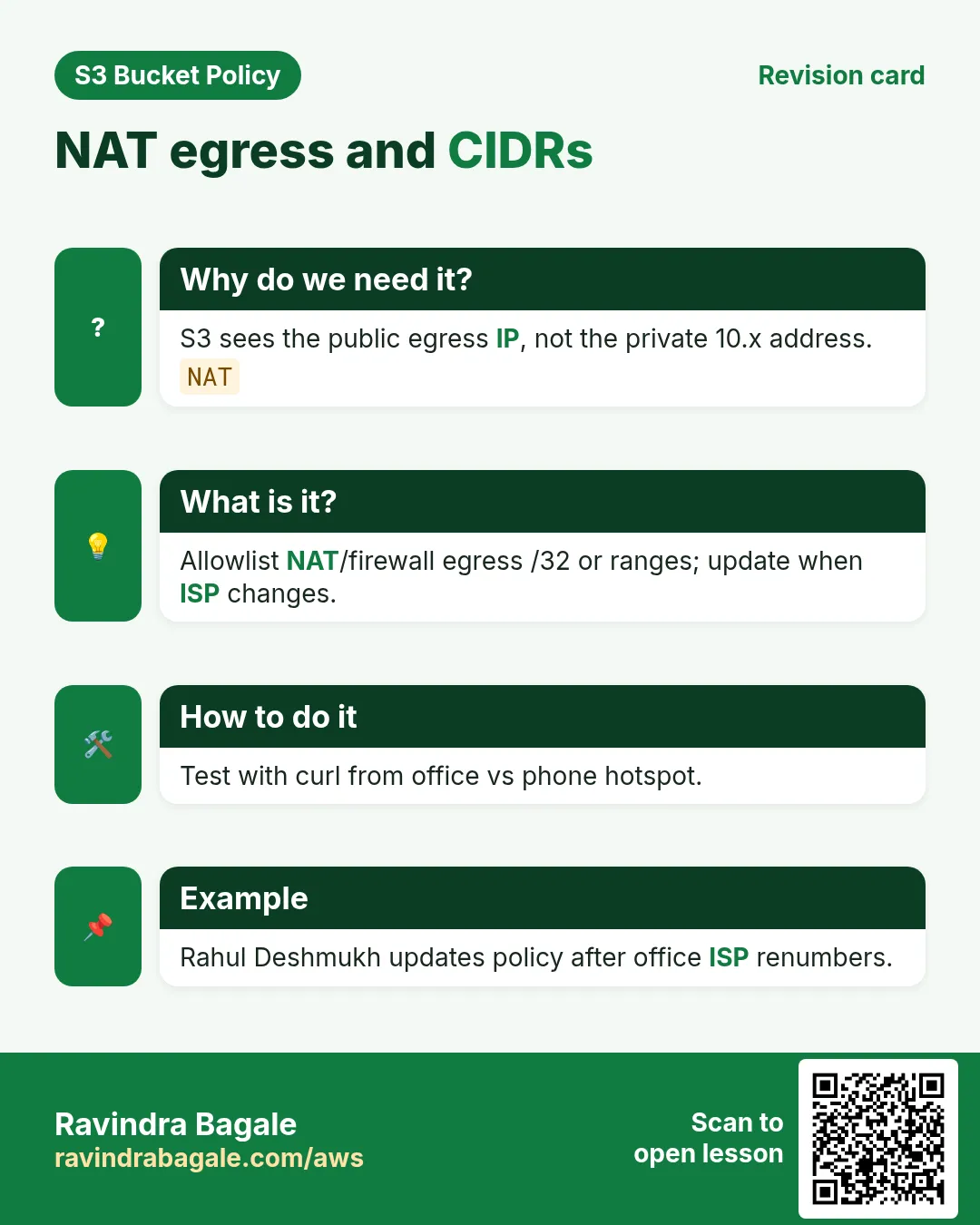
NAT egress and CIDRs
Read card text
What this card says
Why do we need it?
S3 sees the public egress IP, not the private 10.x address. NAT
What is it?
Allowlist NAT/firewall egress /32 or ranges; update when ISP changes.
How to do it
Test with curl from office vs phone hotspot.
Example
Rahul Deshmukh updates policy after office ISP renumbers.
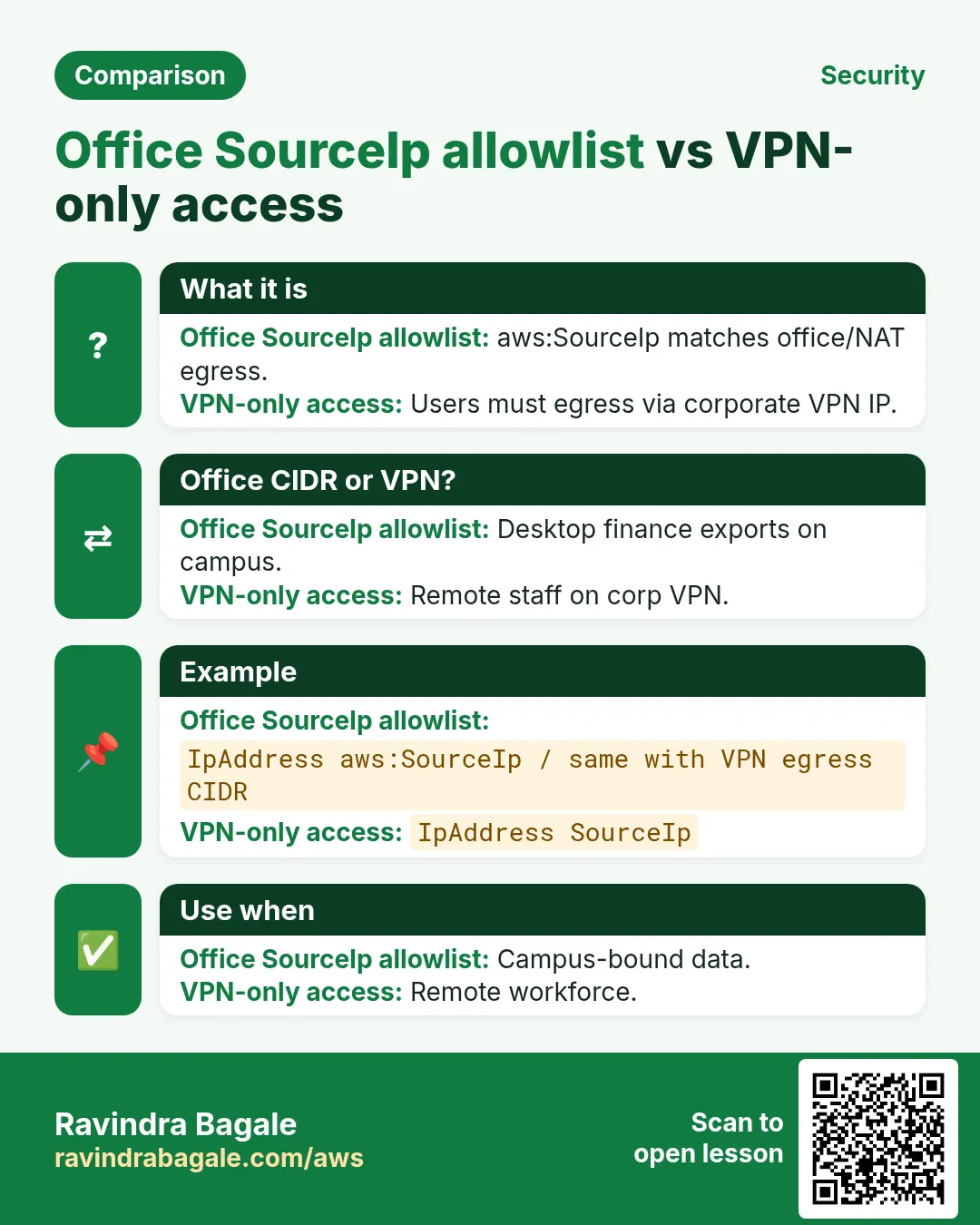
Comparison: Office CIDR or VPN?
Read card text
What this card says
Office SourceIp allowlist
aws:SourceIp matches office/NAT egress.
VPN-only access
Users must egress via corporate VPN IP.
Key points
Desktop finance exports on campus. Remote staff on corp VPN.
Example
IpAddress aws:SourceIp / same with VPN egress CIDR
Use when
Campus-bound data. Remote workforce.
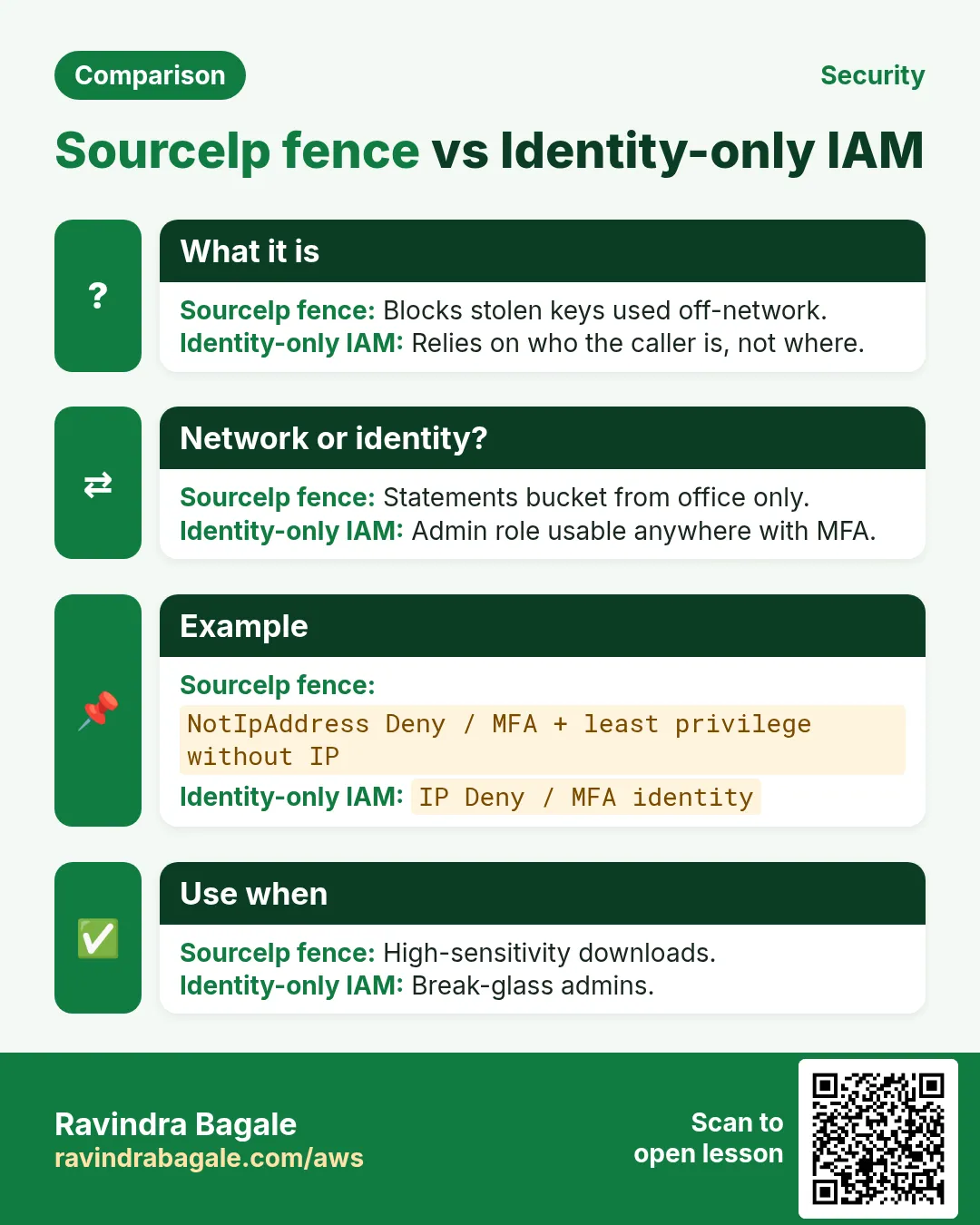
Comparison: Network or identity?
Read card text
What this card says
SourceIp fence
Blocks stolen keys used off-network.
Identity-only IAM
Relies on who the caller is, not where.
Key points
Statements bucket from office only. Admin role usable anywhere with MFA.
Example
NotIpAddress Deny / MFA + least privilege without IP
Use when
High-sensitivity downloads. Break-glass admins.
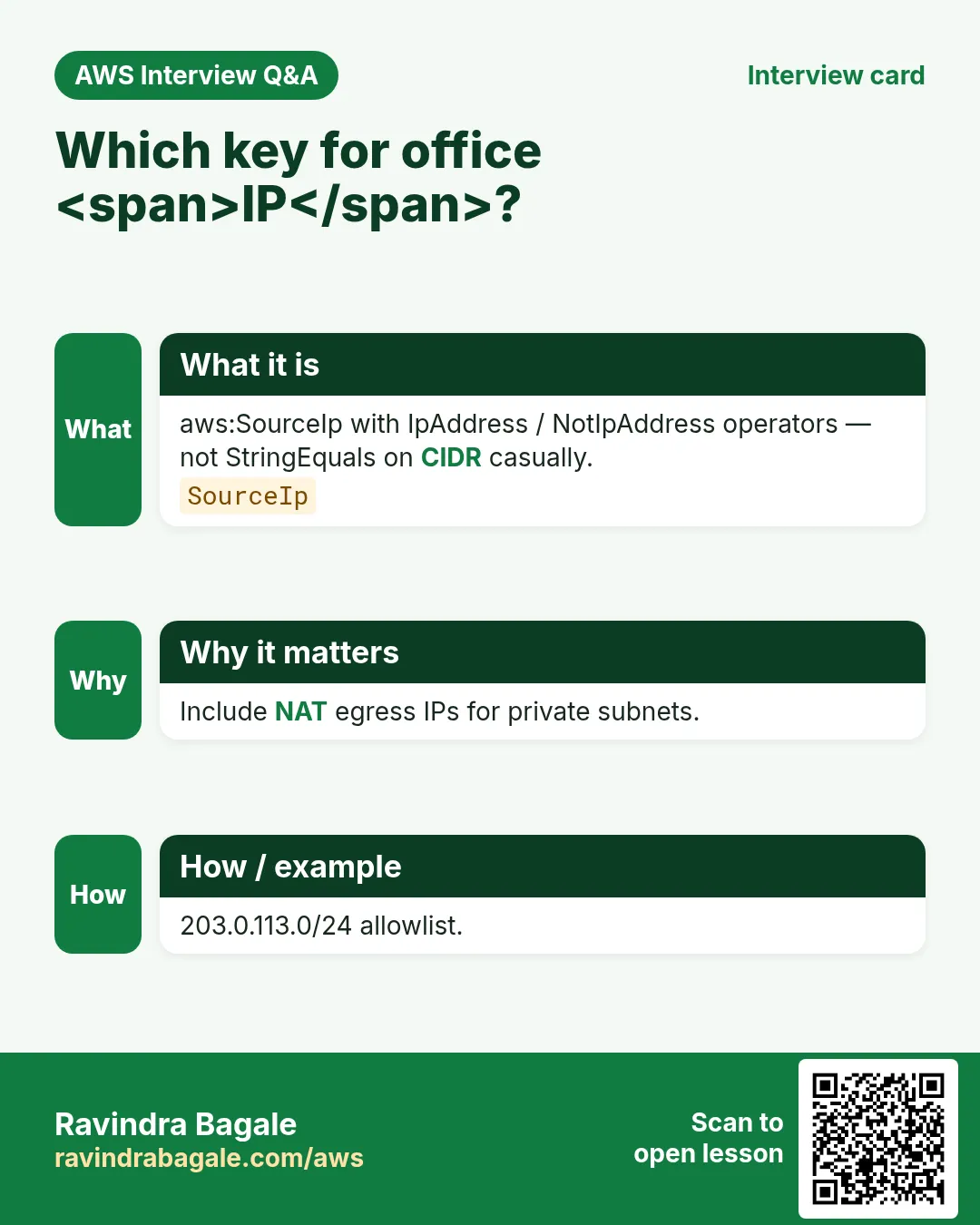
Interview: Which key for office IP?
Read card text
What this card says
What it is
aws:SourceIp with IpAddress / NotIpAddress operators — not StringEquals on CIDR casually. SourceIp
Why it matters
Include NAT egress IPs for private subnets.
How / example
203.0.113.0/24 allowlist.
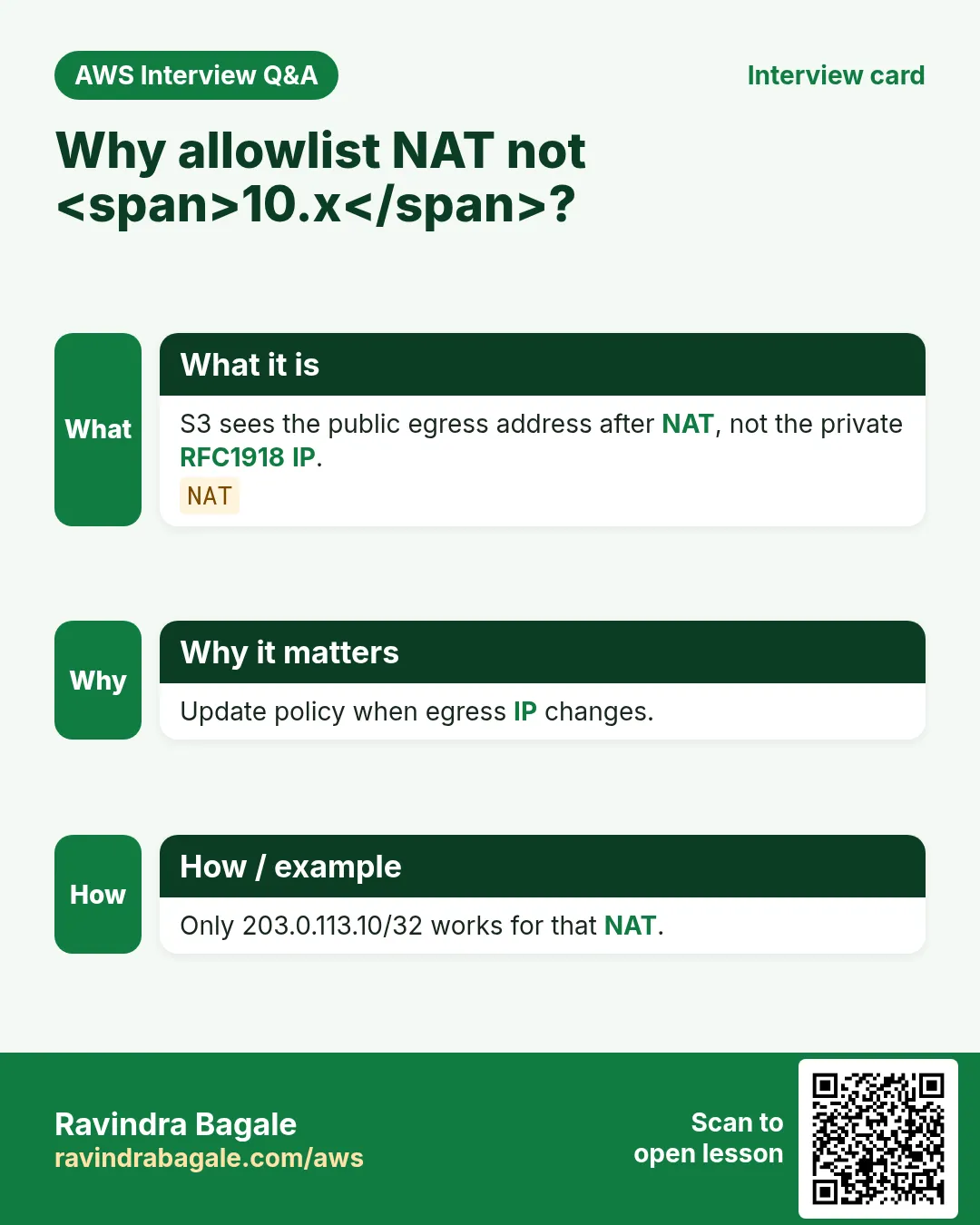
Interview: Why allowlist NAT not 10.x?
Read card text
What this card says
What it is
S3 sees the public egress address after NAT, not the private RFC1918 IP. NAT
Why it matters
Update policy when egress IP changes.
How / example
Only 203.0.113.10/32 works for that NAT.
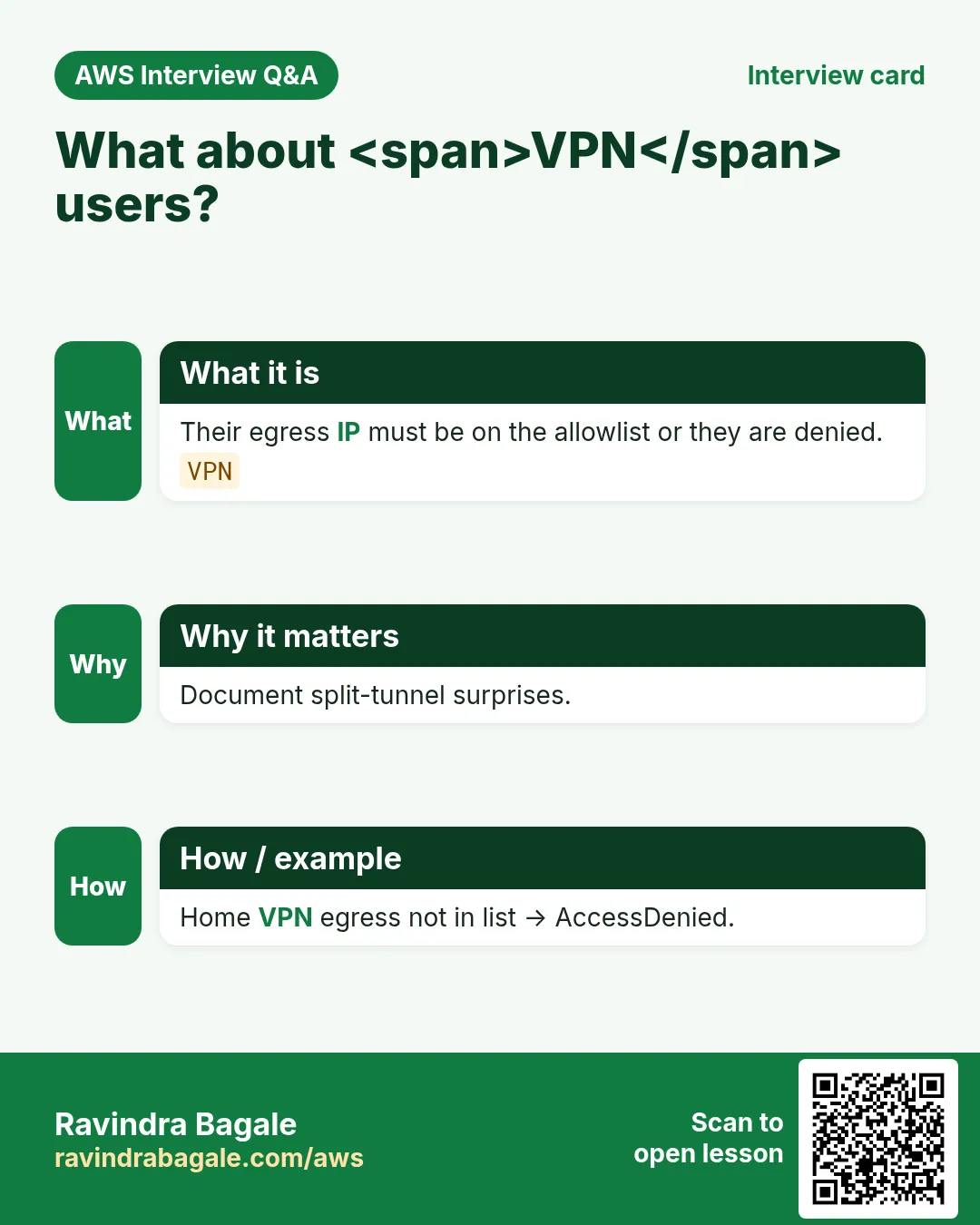
Interview: What about VPN users?
Read card text
What this card says
What it is
Their egress IP must be on the allowlist or they are denied. VPN
Why it matters
Document split-tunnel surprises.
How / example
Home VPN egress not in list → AccessDenied.
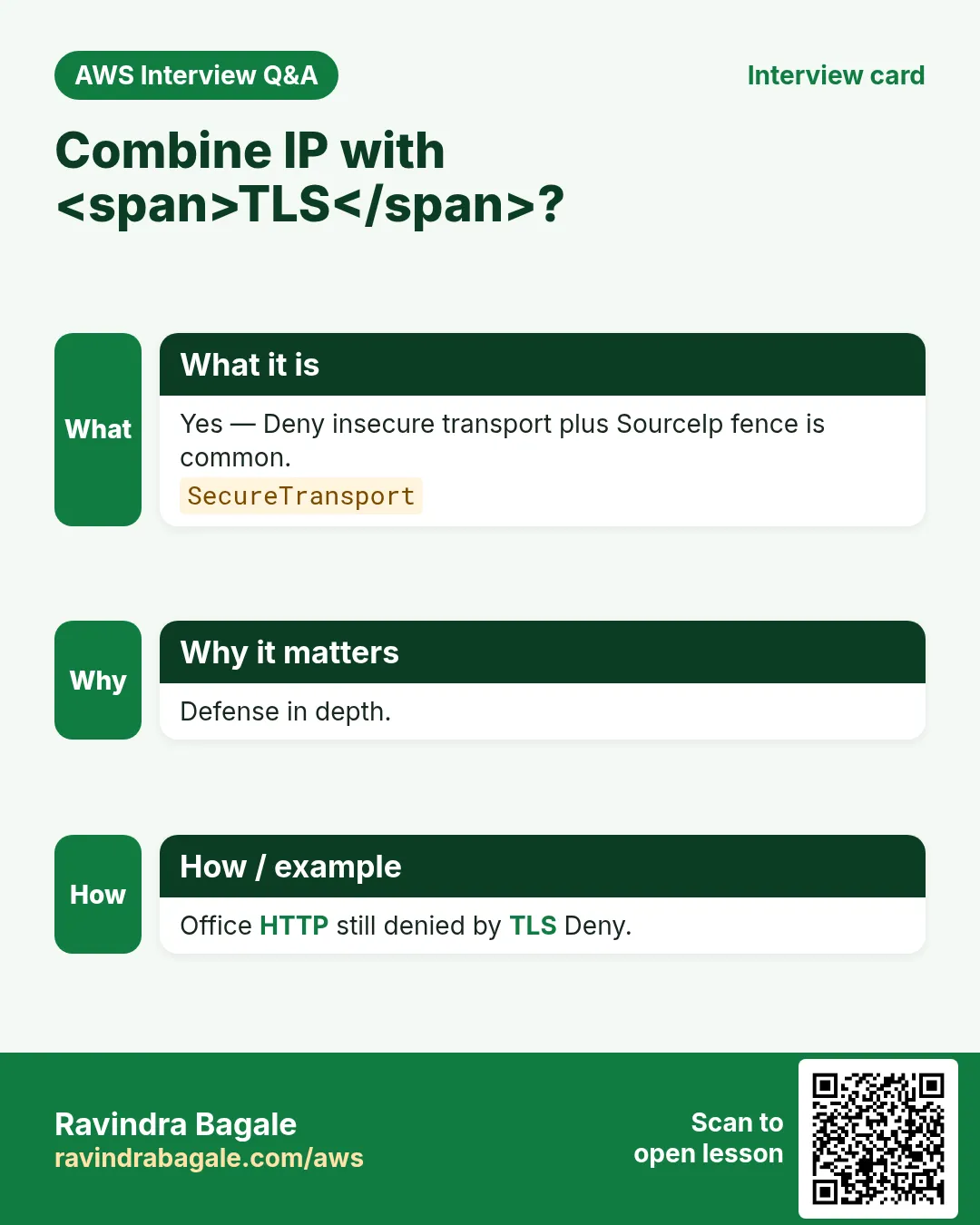
Interview: Combine IP with TLS?
Read card text
What this card says
What it is
Yes — Deny insecure transport plus SourceIp fence is common. SecureTransport
Why it matters
Defense in depth.
How / example
Office HTTP still denied by TLS Deny.
FAQ
What condition key restricts a bucket to a VPC endpoint?
aws:SourceVpce, usually in a Deny-unless pattern that matches your gateway or interface endpoint id.
Why can a correct bucket policy still fail from inside the VPC?
The subnet may be missing the route to the S3 prefix list, or the endpoint policy may not allow the call. Align both policies, then test from a host in the VPC and from the internet.
Should I use a gateway endpoint or an interface endpoint for S3?
These cards treat a gateway endpoint as the default for most private S3 access. Use an interface endpoint when you need ENIs, security groups, or special DNS. Interface endpoints cost more.
What happens to laptop or NAT uploads when SourceVpce Deny is on?
Traffic that goes out through NAT to the public S3 endpoint does not present your SourceVpce. The deny test should reject it. Admin laptops on the internet are usually denied by this policy.
Which condition key fences office IP addresses?
aws:SourceIp with IpAddress or NotIpAddress. Allowlist the public egress CIDRs, including NAT or firewall addresses, not the private 10.x addresses.
Why must I allowlist the NAT IP instead of 10.x?
S3 sees the public address after NAT, not the private RFC1918 IP. If the ISP changes the egress IP, update the policy.
What about staff on VPN?
Their egress IP must be on the allowlist, or they are denied. Split-tunnel VPNs often surprise people because home ISP IPs are not in the list.
Can I combine a source IP fence with HTTPS?
Yes. A Deny for insecure transport (aws:SecureTransport) plus a SourceIp fence is a common defense-in-depth pattern. Office HTTP can still be denied by the TLS rule.
Related lessons
These chapter pages are already on the site (checked live, HTTP 200, on 19 Nov 2026):