Ravi Sir's Cards › AWS › IAM roles and policies
AWS IAM roles and policies: trust, temporary credentials and explicit Deny
This page keeps the related IAM cards on one topic page, so you can revise roles, trust, and policies in one sitting. It has the six cards from “What is an AWS IAM role and when to use it”, the eight cards from “AWS IAM roles: 10 practical examples”, and the six cards from “AWS IAM policies: JSON, managed, inline and conditions”.
Each card still has its image and its original text. Under each group you will also find a short Why, What, How example, and an exam tip, in easy English. The names, account IDs, bucket names and amounts in the stories are made up for learning.
What is an IAM role, and when to use it
Why this matters
A named IAM user with a long-lived access key is like a lifelong office badge. If that key lands in Git, on a laptop, or inside an AMI, anyone who finds it can keep using it until you delete it. Compute in AWS needs a different pattern: a time-bound pass for one job.
What it is
An IAM role is an identity with no long-lived password or access key. A caller assumes the role, and AWS STS returns temporary credentials. Two policies sit on the role and do different jobs. The trust policy (resource-based on the role) lists who may call sts:AssumeRole. The permissions policy lists the Actions and Resources that session may use. Prefer roles for EC2, Lambda, cross-account access, and humans who sign in through IAM Identity Center. Keep IAM users only for rare break-glass or old tools.
How it works — a real example
Suppose we are in a Pune lab and an EC2 instance must read one bucket, lab-bucket. We create a role, set trust Principal to the EC2 service, attach a permissions policy that allows only s3:GetObject on that bucket's objects, and attach the role with an instance profile. On the instance, aws sts get-caller-identity shows an assumed-role session, and the keys come from the metadata service — nothing is stored in ~/.aws/credentials. The names and account details are made up for learning.
Common mistake / exam tip
A perfect S3 permissions policy still fails if the trust Principal does not include the caller. When a lab returns AccessDenied, read the trust policy first, then the permissions policy. Do not mix “who may wear the jacket” with “what the jacket allows”.
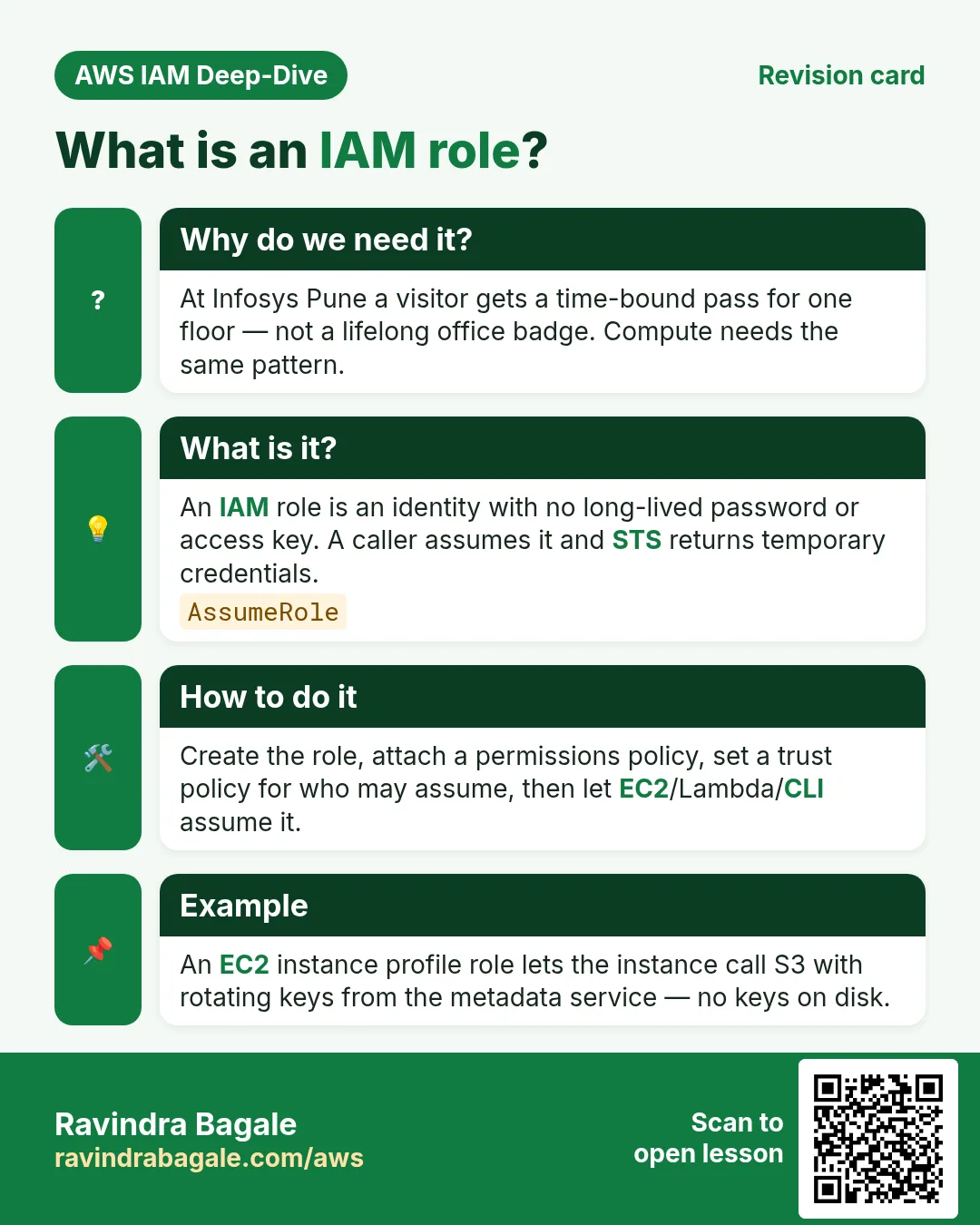
What is an IAM role?
Read card text
What this card says
Why do we need it?
At Infosys Pune a visitor gets a time-bound pass for one floor — not a lifelong office badge. Compute needs the same pattern.
What is it?
An IAM role is an identity with no long-lived password or access key. A caller assumes it and STS returns temporary credentials. AssumeRole
How to do it
Create the role, attach a permissions policy, set a trust policy for who may assume, then let EC2/Lambda/CLI assume it.
Example
An EC2 instance profile role lets the instance call S3 with rotating keys from the metadata service — no keys on disk.
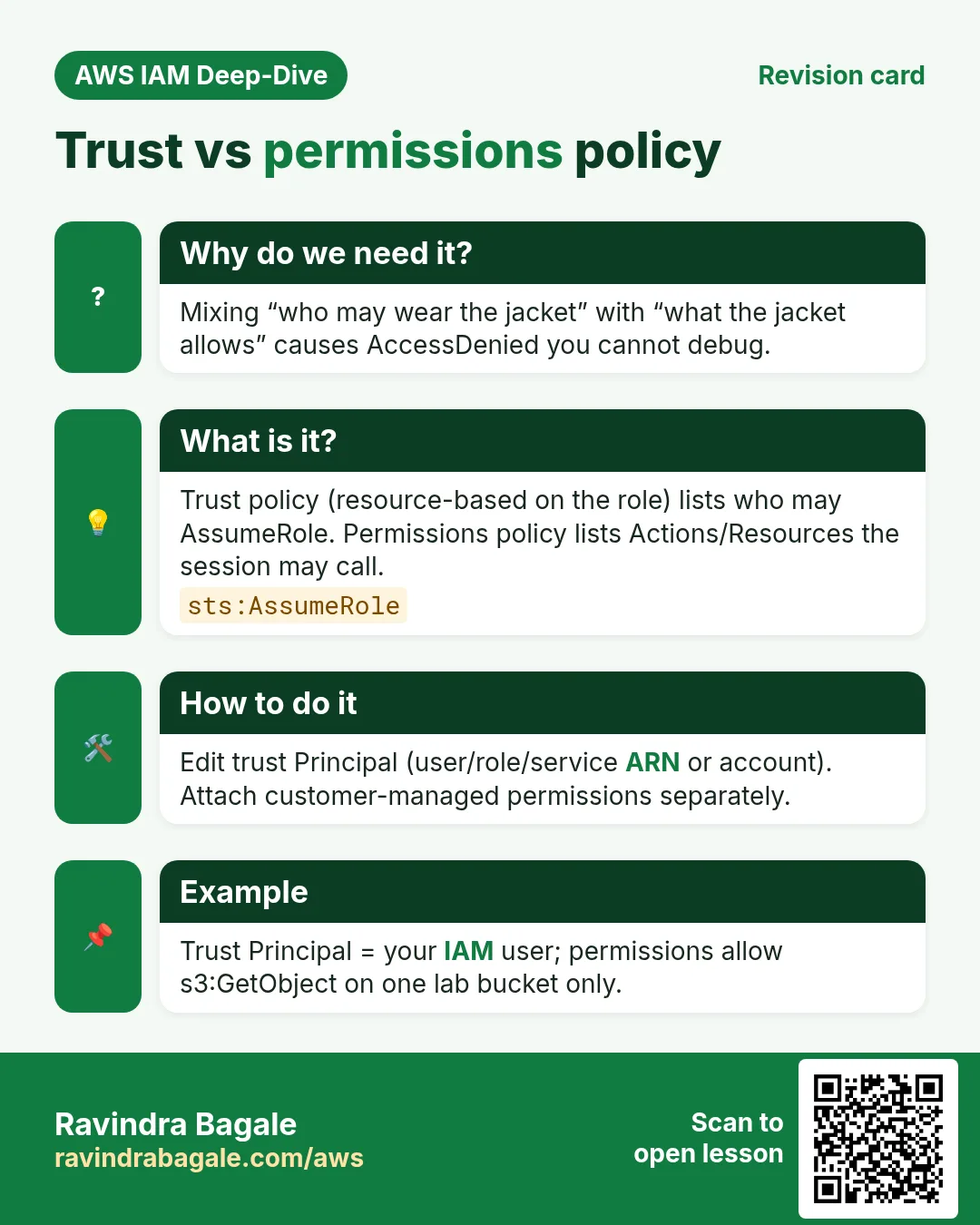
Trust vs permissions policy
Read card text
What this card says
Why do we need it?
Mixing “who may wear the jacket” with “what the jacket allows” causes AccessDenied you cannot debug.
What is it?
Trust policy (resource-based on the role) lists who may AssumeRole. Permissions policy lists Actions/Resources the session may call. sts:AssumeRole
How to do it
Edit trust Principal (user/role/service ARN or account). Attach customer-managed permissions separately.
Example
Trust Principal = your IAM user; permissions allow s3:GetObject on one lab bucket only.
When to use a role
Read card text
What this card says
Why do we need it?
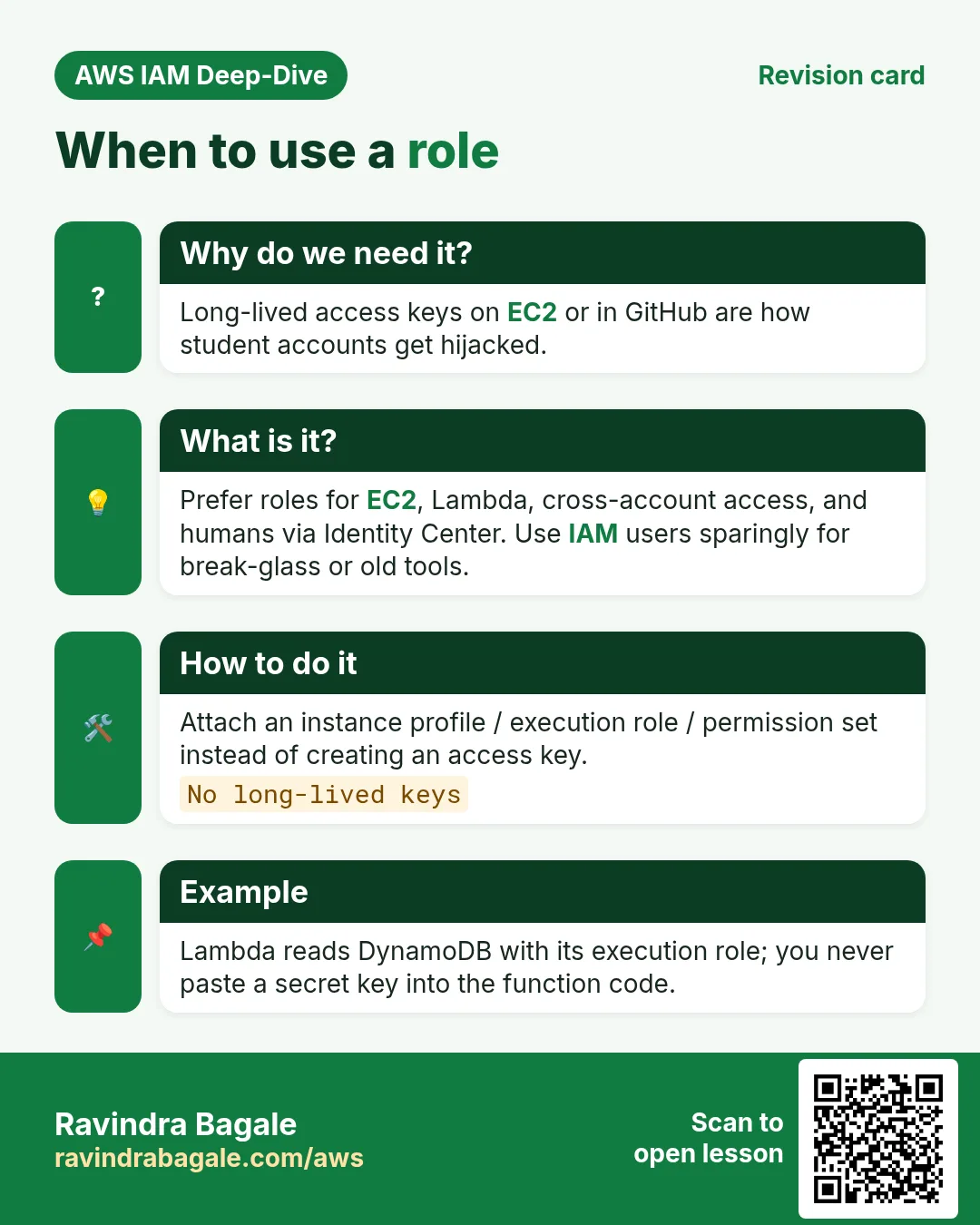
Long-lived access keys on EC2 or in GitHub are how student accounts get hijacked.
What is it?
Prefer roles for EC2, Lambda, cross-account access, and humans via Identity Center. Use IAM users sparingly for break-glass or old tools.
How to do it
Attach an instance profile / execution role / permission set instead of creating an access key. No long-lived keys
Example
Lambda reads DynamoDB with its execution role; you never paste a secret key into the function code.
Comparison: Identity style
Read card text
What this card says
IAM role
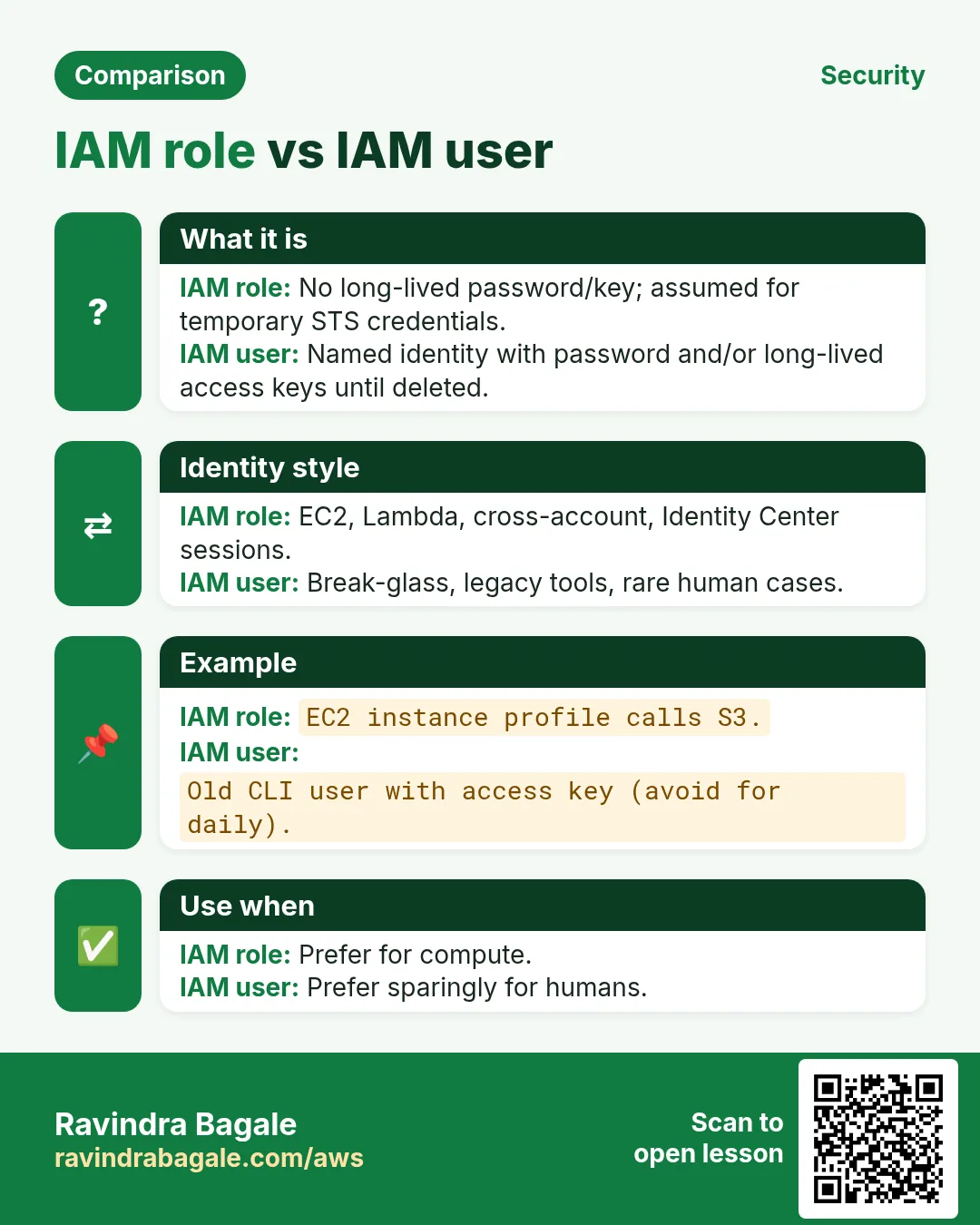
No long-lived password/key; assumed for temporary STS credentials.
IAM user
Named identity with password and/or long-lived access keys until deleted.
Key points
EC2, Lambda, cross-account, Identity Center sessions. Break-glass, legacy tools, rare human cases.
Example
EC2 instance profile calls S3.
Use when
Prefer for compute. Prefer sparingly for humans.
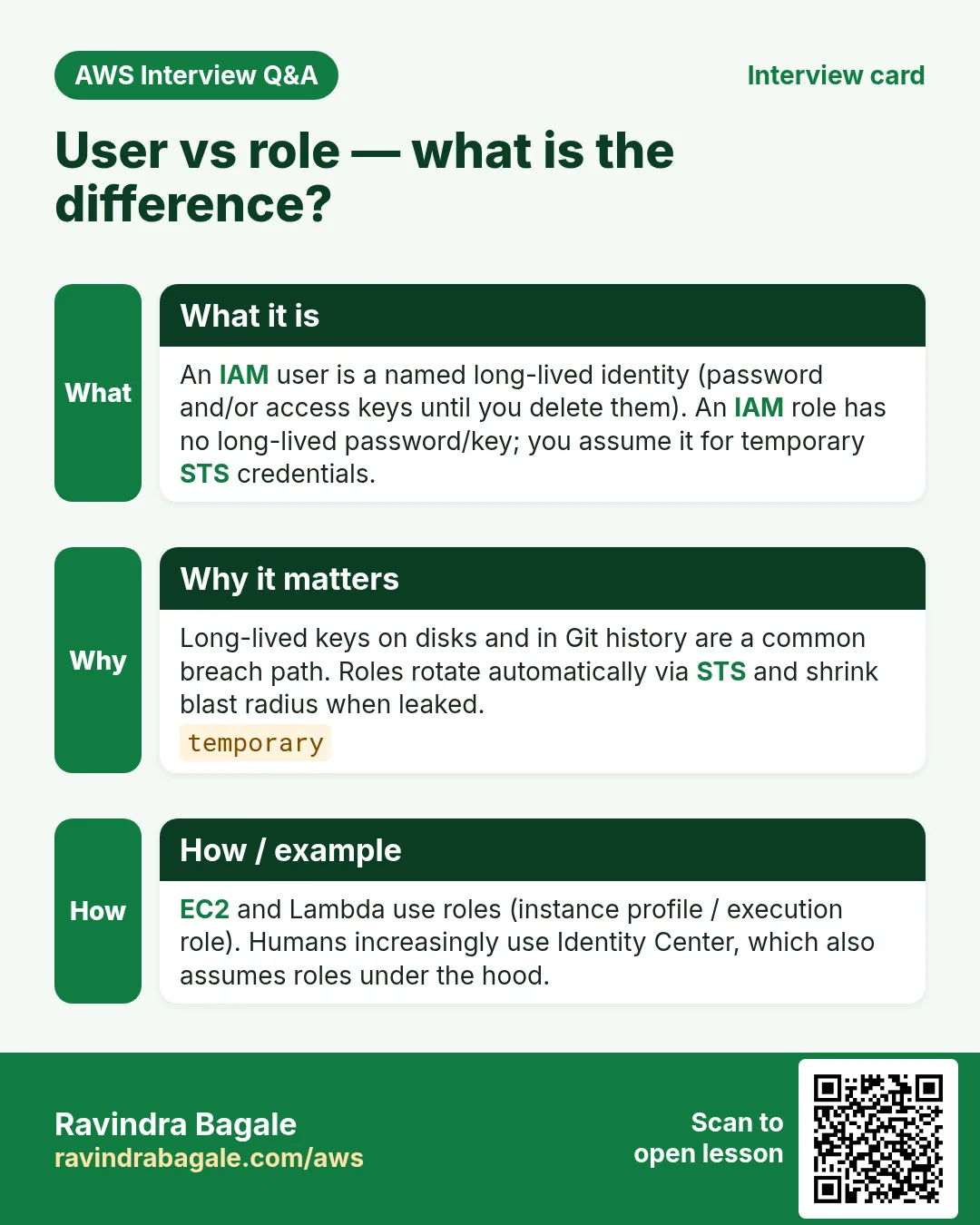
Interview: User vs role — what is the difference?
Read card text
What this card says
What it is
An IAM user is a named long-lived identity (password and/or access keys until you delete them). An IAM role has no long-lived password/key; you assume it for temporary STS credentials.
Why it matters
Long-lived keys on disks and in Git history are a common breach path. Roles rotate automatically via STS and shrink blast radius when leaked. temporary
How / example
EC2 and Lambda use roles (instance profile / execution role). Humans increasingly use Identity Center, which also assumes roles under the hood.
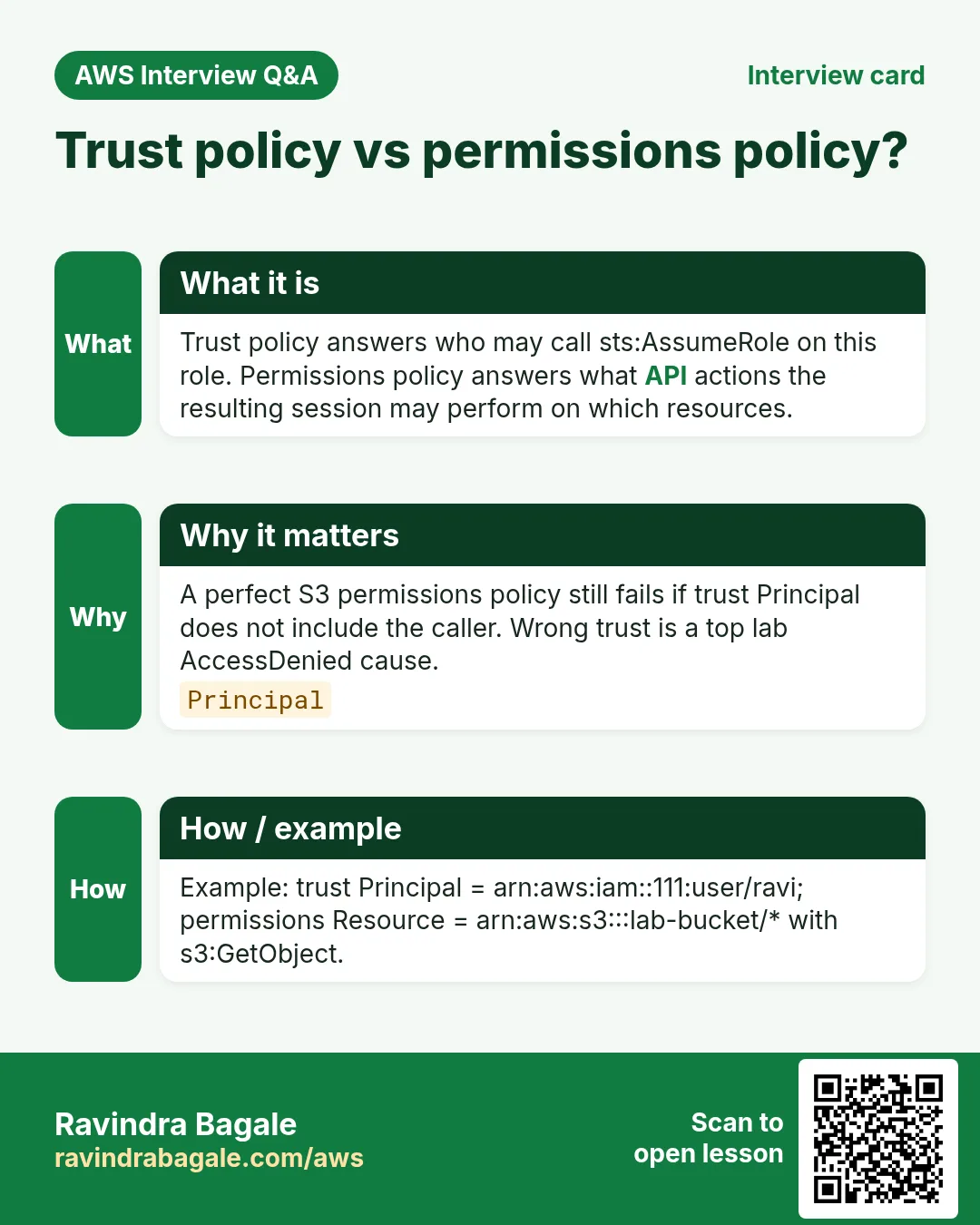
Interview: Trust policy vs permissions policy?
Read card text
What this card says
What it is
Trust policy answers who may call sts:AssumeRole on this role. Permissions policy answers what API actions the resulting session may perform on which resources.
Why it matters
A perfect S3 permissions policy still fails if trust Principal does not include the caller. Wrong trust is a top lab AccessDenied cause. Principal
How / example
Example: trust Principal = arn:aws:iam::111:user/ravi; permissions Resource = arn:aws:s3:::lab-bucket/* with s3:GetObject.
Practical role examples: EC2, ECS, GitHub OIDC
Why this matters
The same idea shows up in every service, but the names change, and students paste long-lived keys “just to make it work”. Keys on a server, in GitHub secrets, or in function code are a common way student accounts get hijacked.
What it is
An EC2 instance profile wraps a role; the instance gets rotating keys from the metadata service. ECS needs two roles with trust for ecs-tasks.amazonaws.com: the execution role is for the ECS agent (ECR pull and logs), and the task role is for your container code (DynamoDB, S3). GitHub Actions can assume a role with OIDC (AssumeRoleWithWebIdentity) instead of storing AWS keys in GitHub secrets. A service-linked role (name starts with AWSServiceRoleFor…) is created and owned by an AWS service; you cannot edit its trust or policy. For a vendor in another account, an ExternalId in the trust policy stops the confused deputy problem.
How it works — a real example
Suppose Priya's GitHub repo must upload a build to S3. We add an OIDC provider for token.actions.githubusercontent.com, put a sub condition such as repo:org/repo:ref:refs/heads/main on the role trust, and in the workflow set permissions id-token: write with aws-actions/configure-aws-credentials and role-to-assume. No long-lived AKIA… key is stored in the repo. The repo name is made up for learning.
Common mistake / exam tip
The AWS SDK and CLI search credentials in a fixed order: environment variables, then shared config or profile, then web identity, then container, then EC2 metadata. An old AWS_ACCESS_KEY_ID in the environment silently beats the role, and you may think you are in the wrong account. Unset env keys, then run aws sts get-caller-identity. On ECS, CannotPullContainerError is the execution role; AccessDenied from app code is the task role.
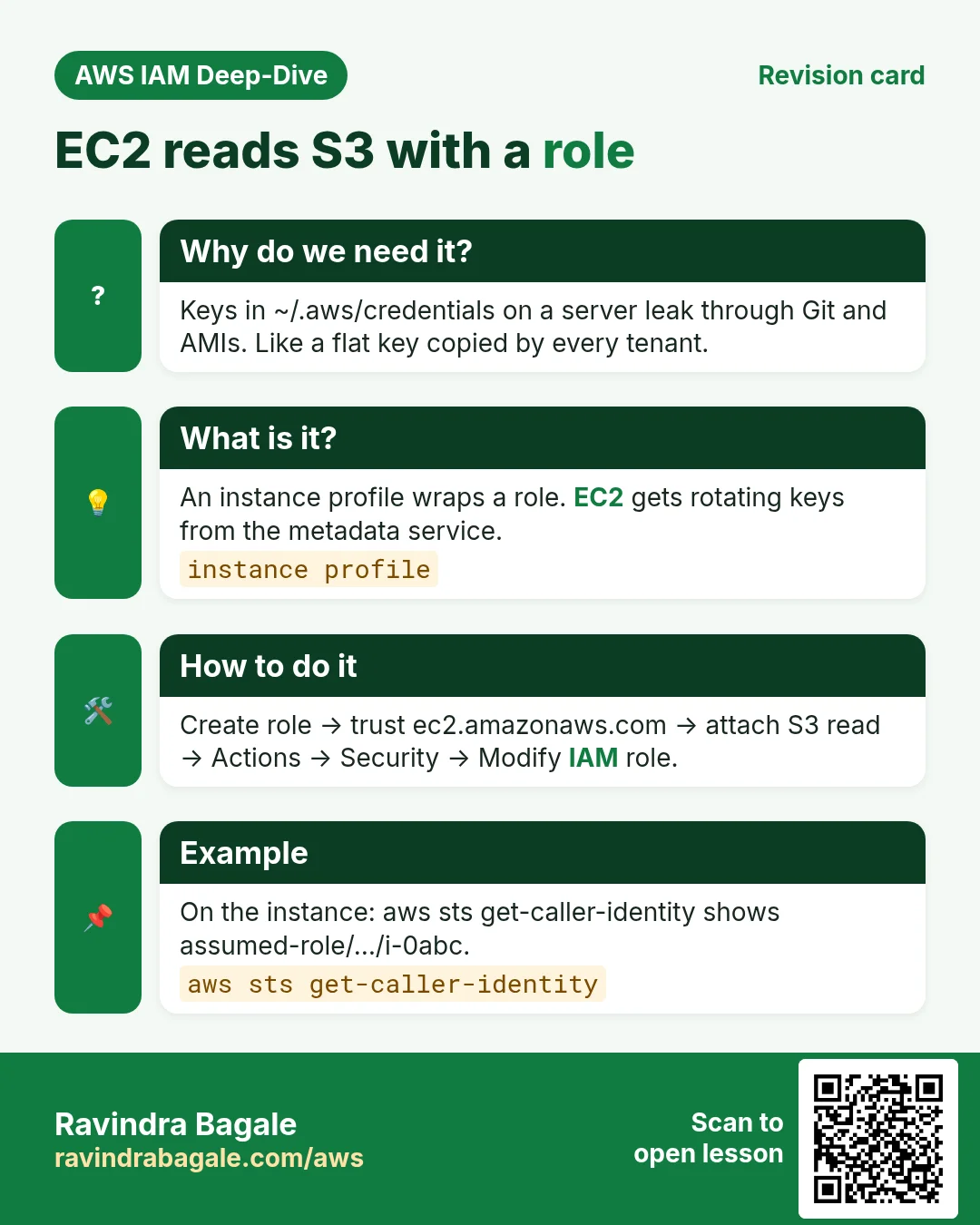
EC2 reads S3 with a role
Read card text
What this card says
Why do we need it?
Keys in ~/.aws/credentials on a server leak through Git and AMIs. Like a flat key copied by every tenant.
What is it?
An instance profile wraps a role. EC2 gets rotating keys from the metadata service. instance profile
How to do it
Create role → trust ec2.amazonaws.com → attach S3 read → Actions → Security → Modify IAM role.
Example
On the instance: aws sts get-caller-identity shows assumed-role/…/i-0abc. aws sts get-caller-identity
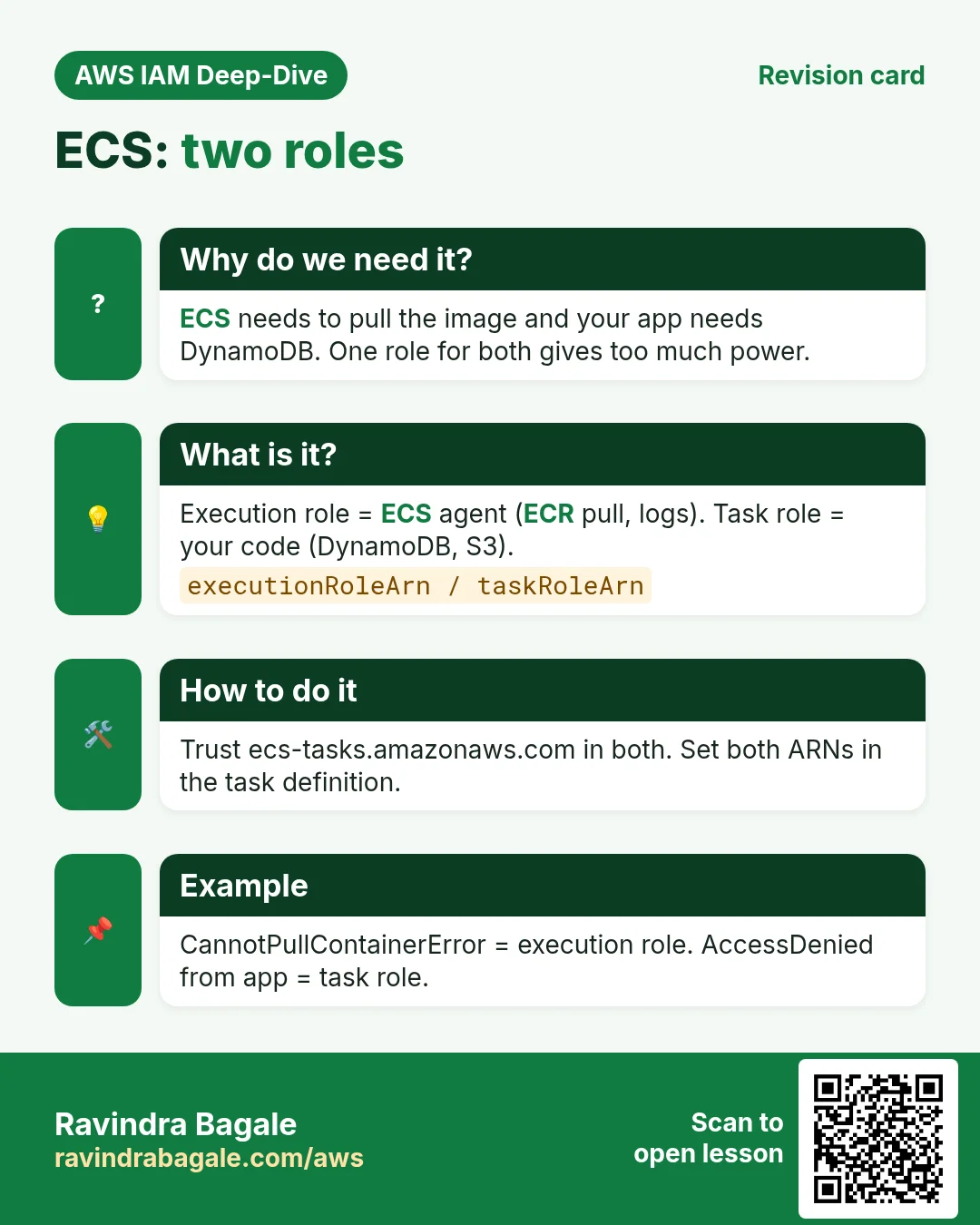
ECS: two roles
Read card text
What this card says
Why do we need it?
ECS needs to pull the image and your app needs DynamoDB. One role for both gives too much power.
What is it?
Execution role = ECS agent (ECR pull, logs). Task role = your code (DynamoDB, S3). executionRoleArn / taskRoleArn
How to do it
Trust ecs-tasks.amazonaws.com in both. Set both ARNs in the task definition.
Example
CannotPullContainerError = execution role. AccessDenied from app = task role.
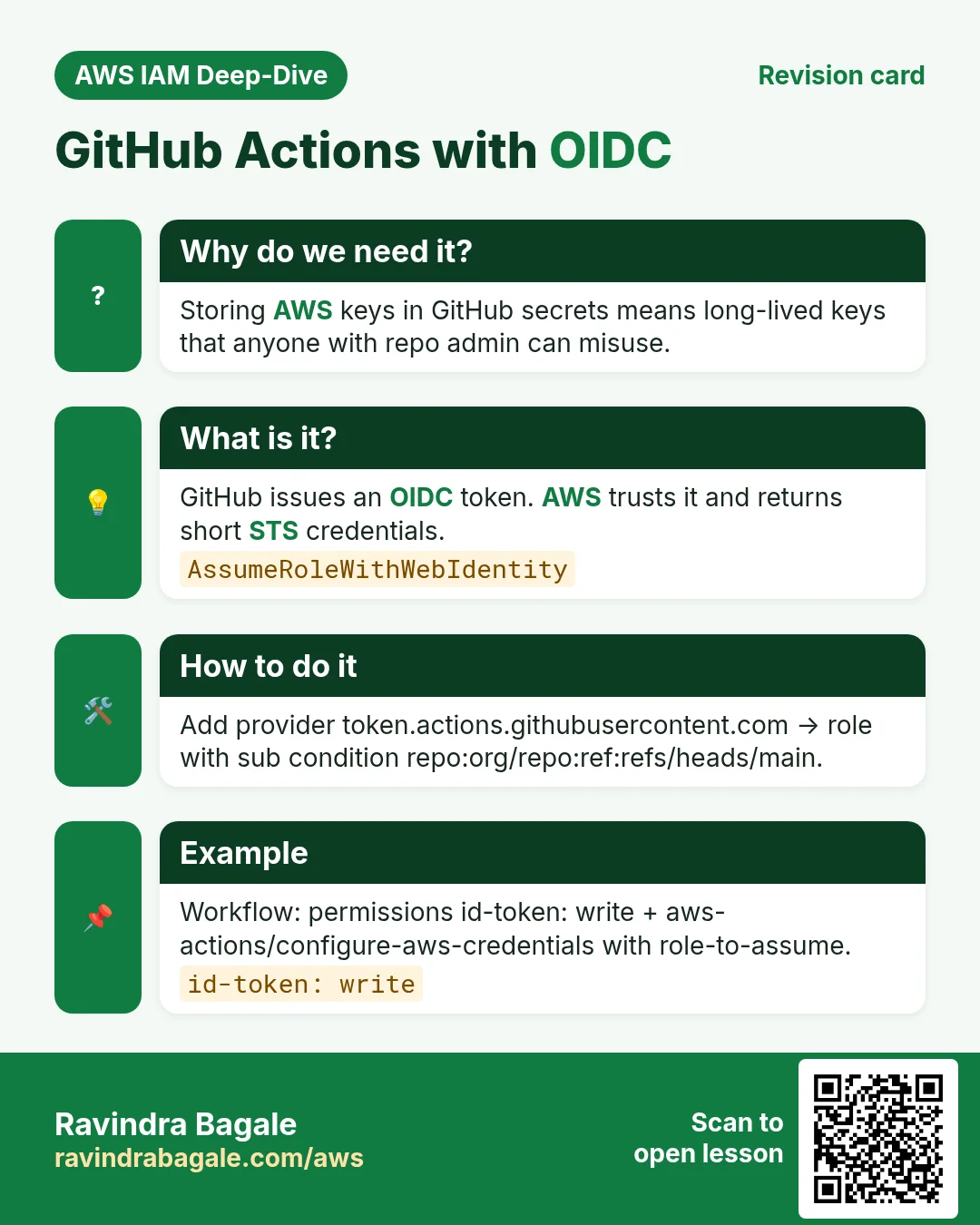
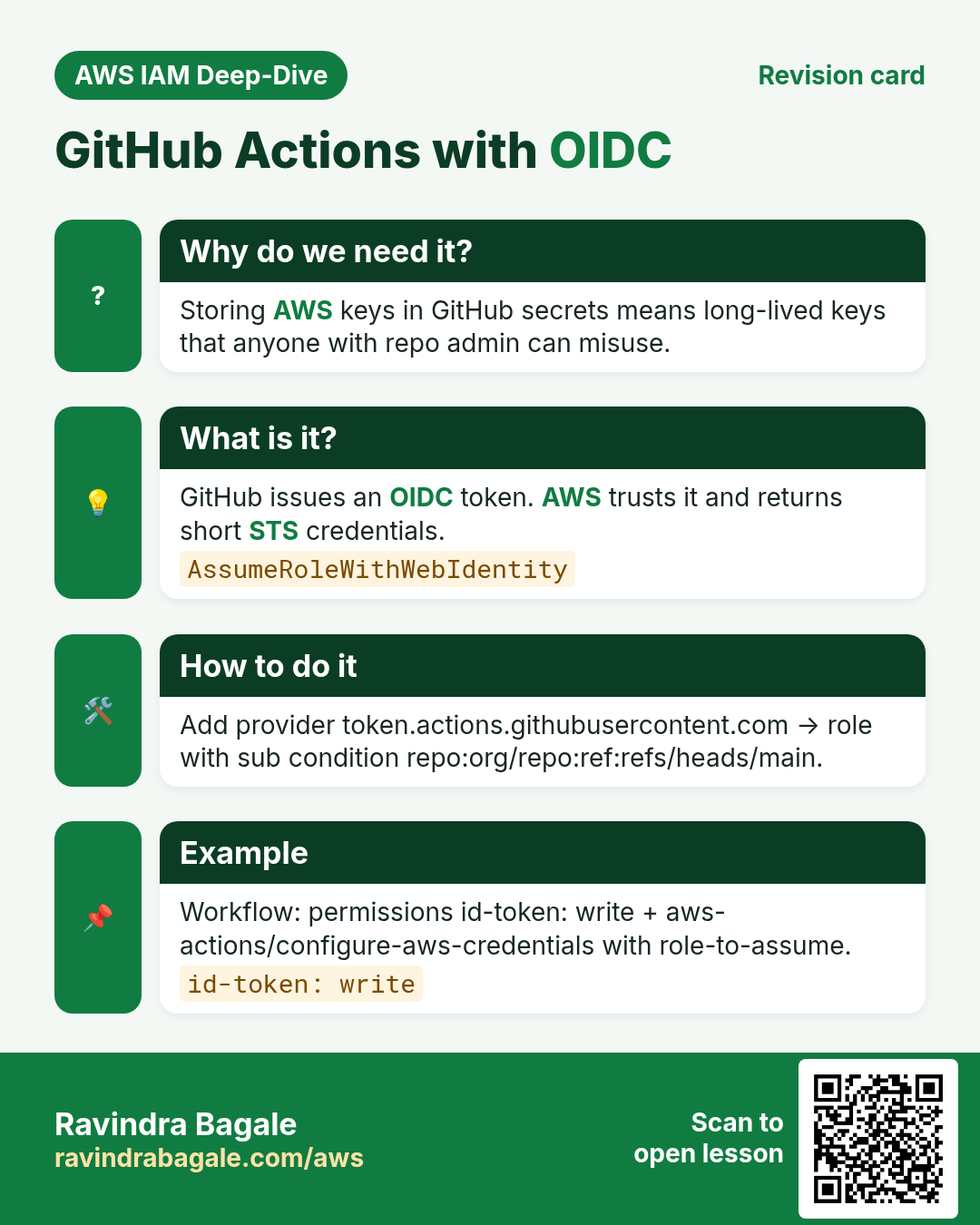
GitHub Actions with OIDC
Read card text
What this card says
Why do we need it?
Storing AWS keys in GitHub secrets means long-lived keys that anyone with repo admin can misuse.
What is it?
GitHub issues an OIDC token. AWS trusts it and returns short STS credentials. AssumeRoleWithWebIdentity
How to do it
Add provider token.actions.githubusercontent.com → role with sub condition repo:org/repo:ref:refs/heads/main.
Example
Workflow: permissions id-token: write + aws-actions/configure-aws-credentials with role-to-assume. id-token: write
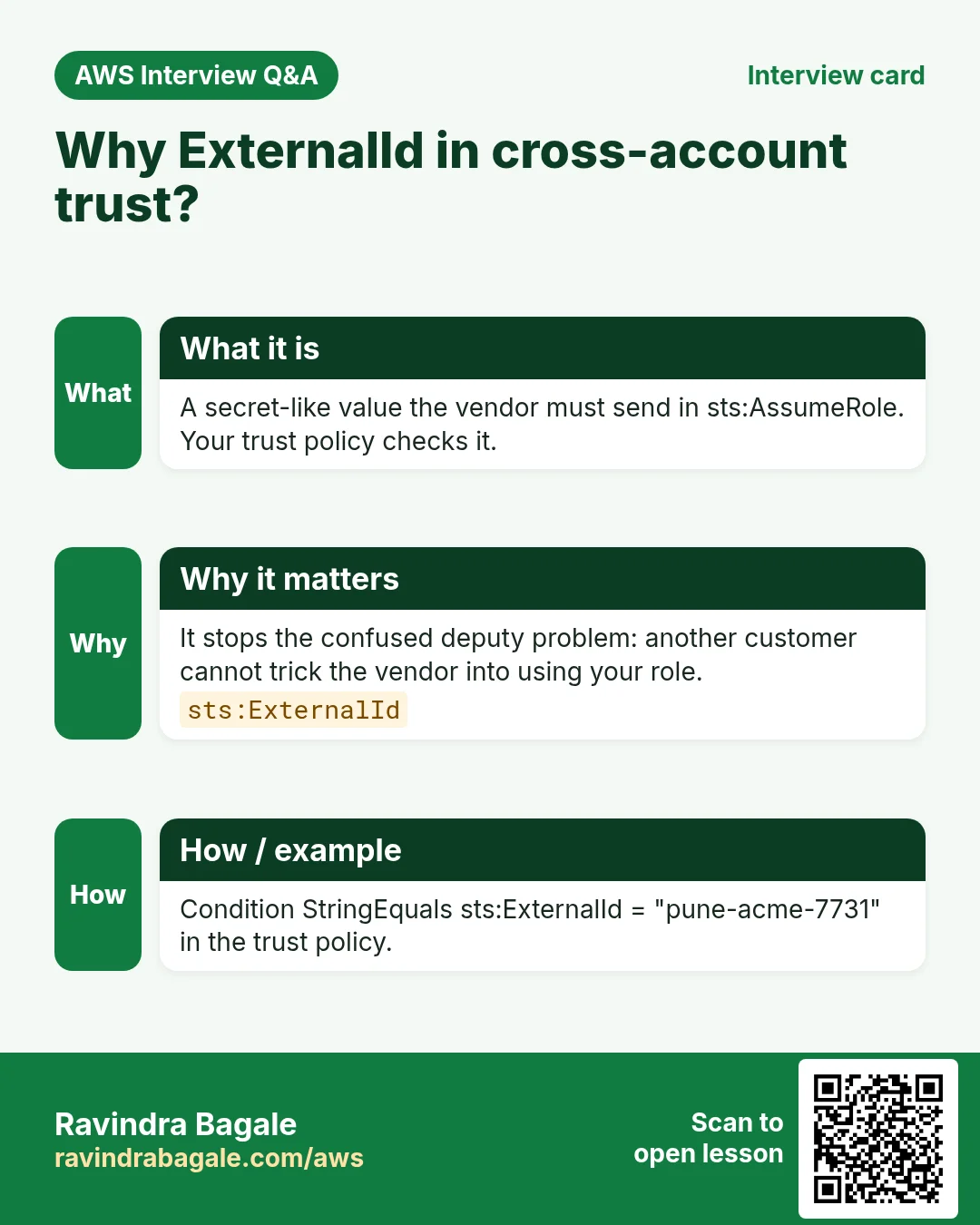
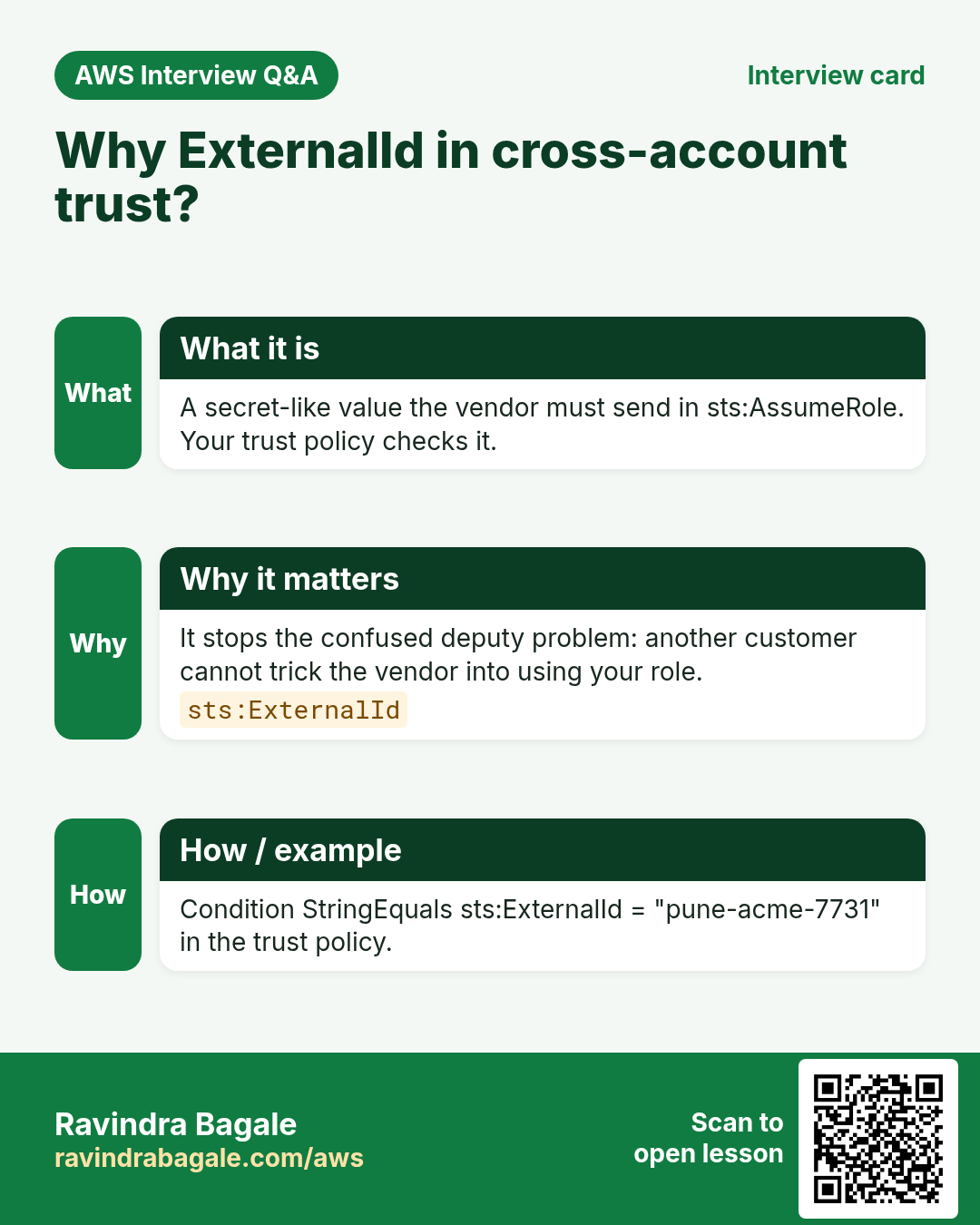
Interview: Why ExternalId in cross-account trust?
Read card text
What this card says
What it is
A secret-like value the vendor must send in sts:AssumeRole. Your trust policy checks it.
Why it matters
It stops the confused deputy problem: another customer cannot trick the vendor into using your role. sts:ExternalId
How / example
Condition StringEquals sts:ExternalId = "pune-acme-7731" in the trust policy.
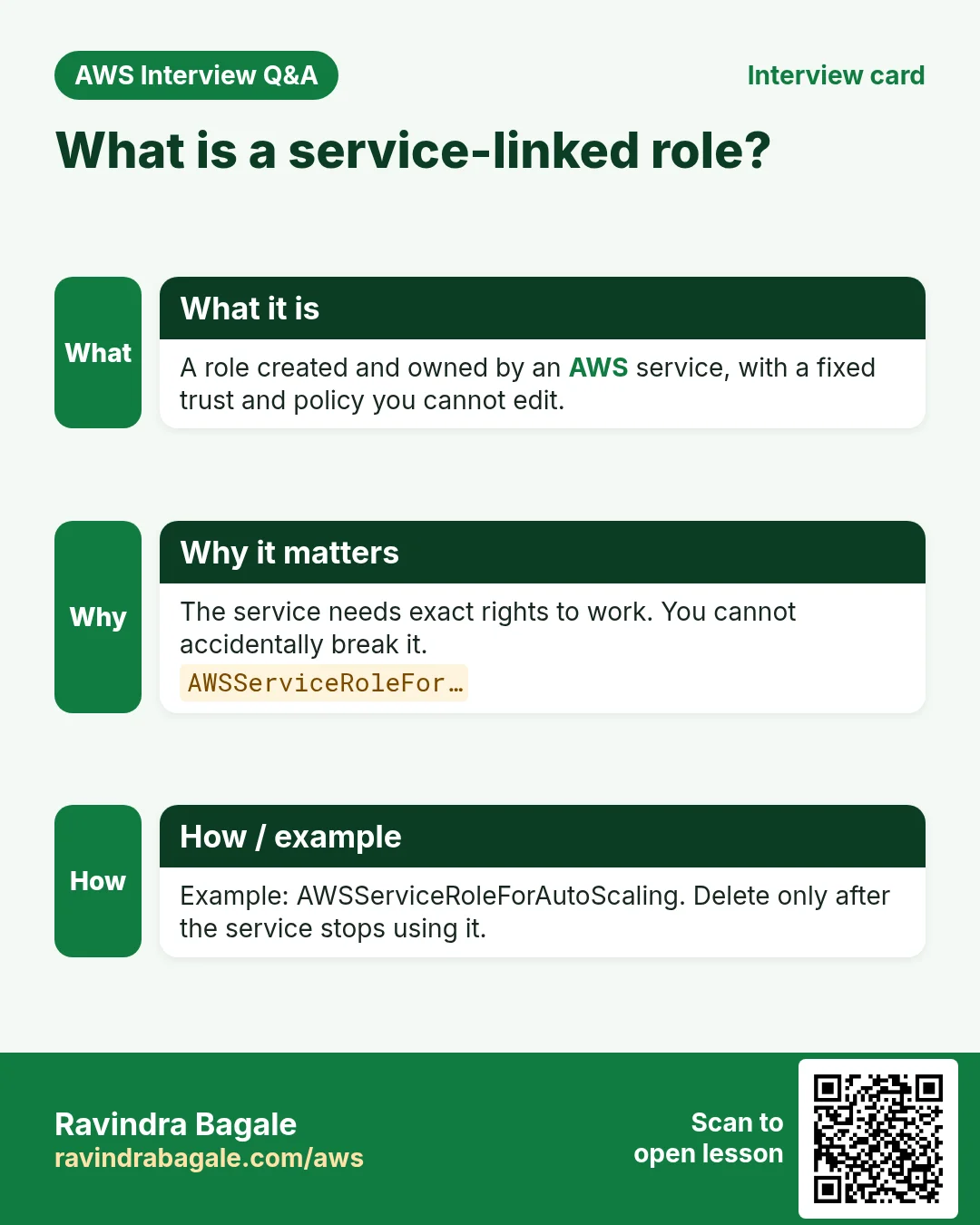
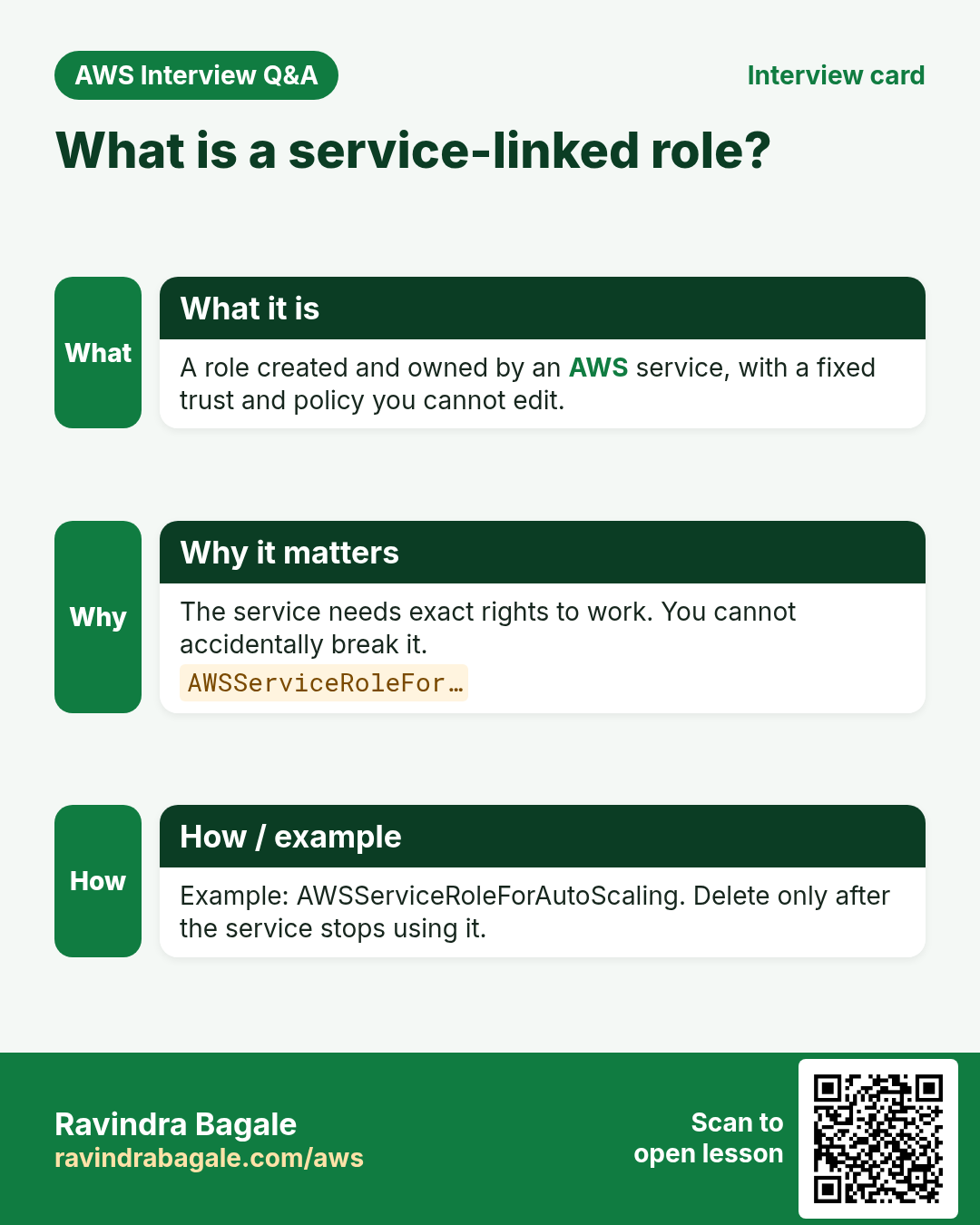
Interview: What is a service-linked role?
Read card text
What this card says
What it is
A role created and owned by an AWS service, with a fixed trust and policy you cannot edit.
Why it matters
The service needs exact rights to work. You cannot accidentally break it. AWSServiceRoleFor…
How / example
Example: AWSServiceRoleForAutoScaling. Delete only after the service stops using it.
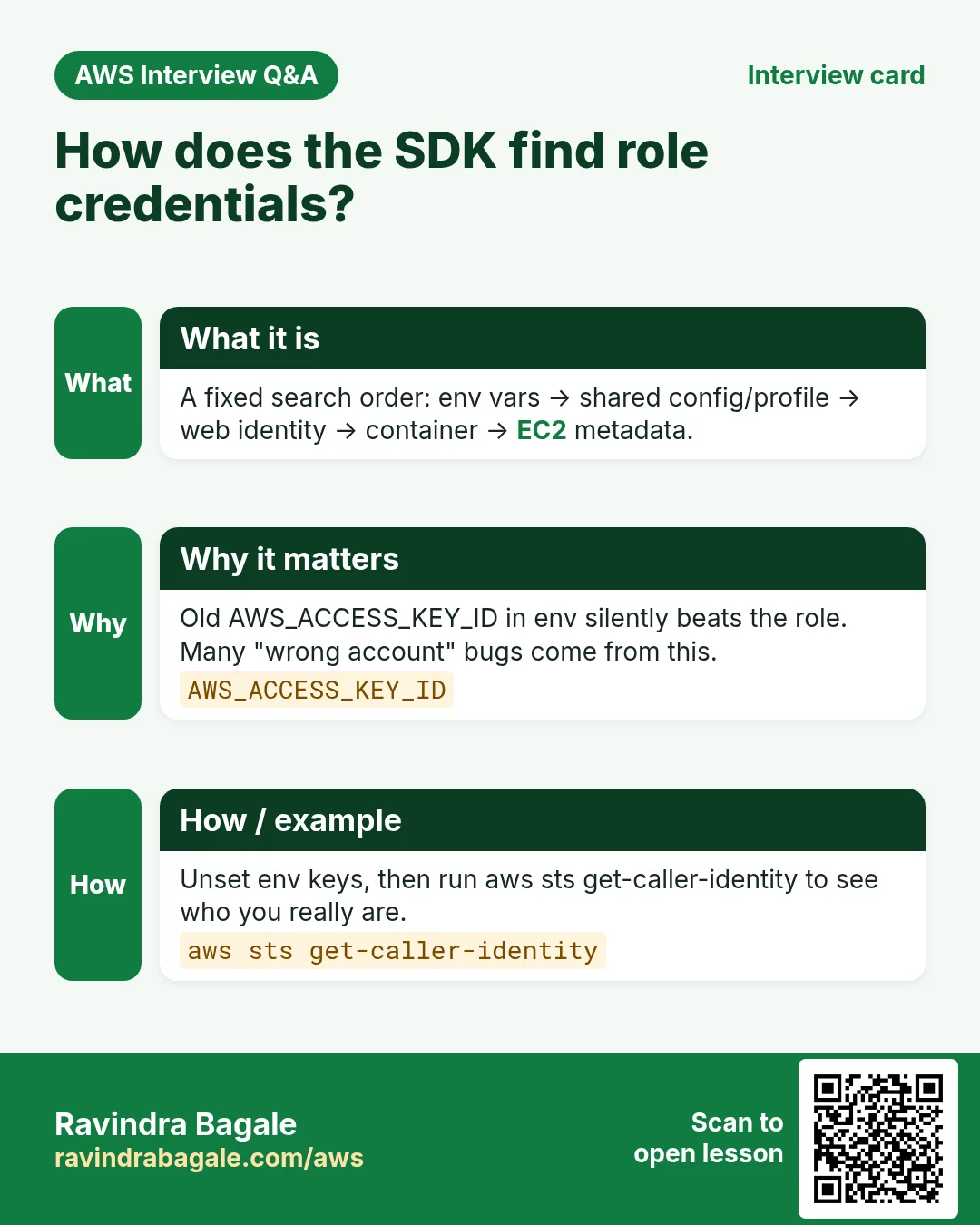
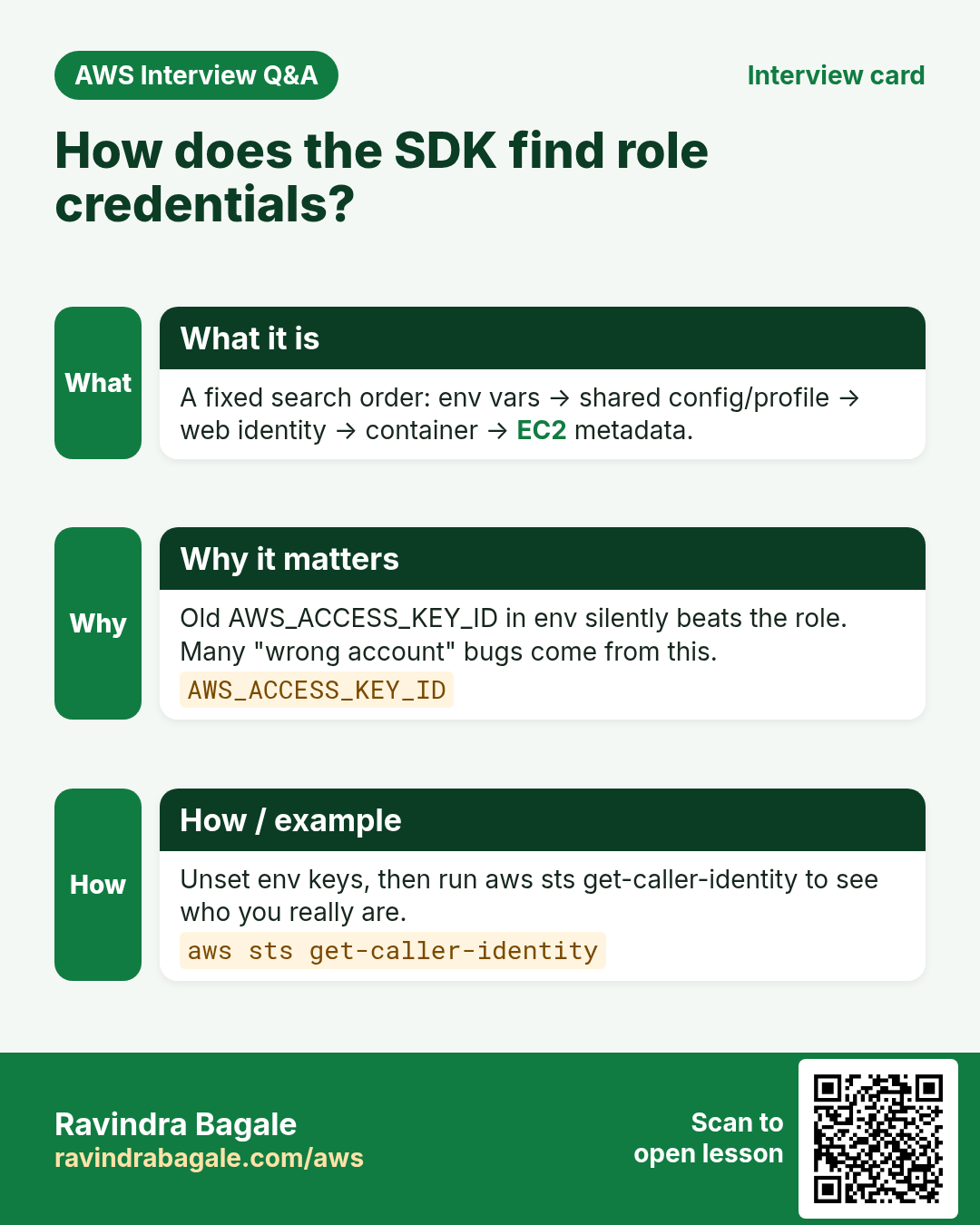
Interview: How does the SDK find role credentials?
Read card text
What this card says
What it is
A fixed search order: env vars → shared config/profile → web identity → container → EC2 metadata.
Why it matters
Old AWS_ACCESS_KEY_ID in env silently beats the role. Many "wrong account" bugs come from this. AWS_ACCESS_KEY_ID
How / example
Unset env keys, then run aws sts get-caller-identity to see who you really are. aws sts get-caller-identity
Comparison: Credentials
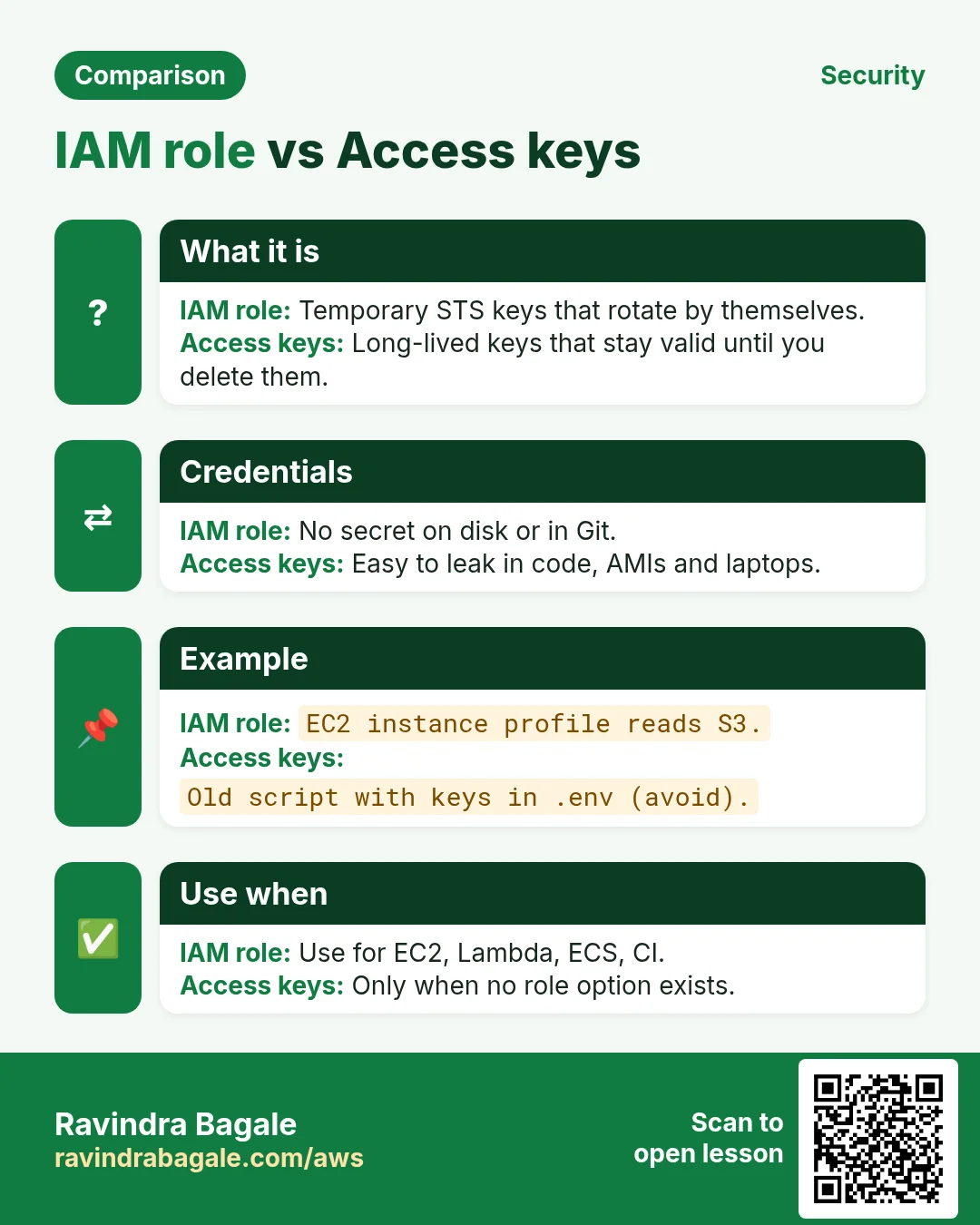
Read card text
What this card says
IAM role
Temporary STS keys that rotate by themselves.
Access keys
Long-lived keys that stay valid until you delete them.
Key points
No secret on disk or in Git. Easy to leak in code, AMIs and laptops.
Example
EC2 instance profile reads S3.
Use when
Use for EC2, Lambda, ECS, CI. Only when no role option exists.
Comparison: Who uses it
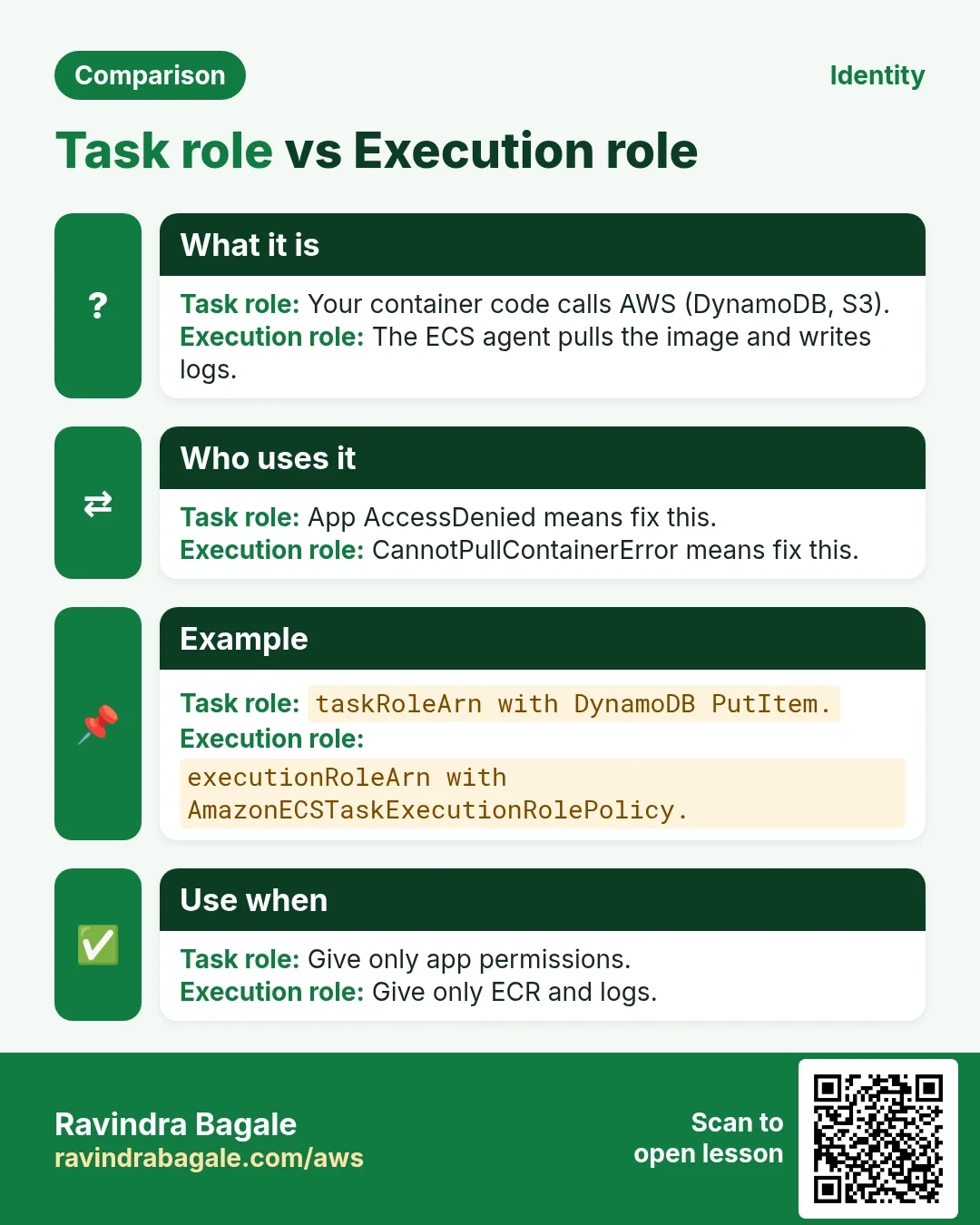
Read card text
What this card says
Task role
Your container code calls AWS (DynamoDB, S3).
Execution role
The ECS agent pulls the image and writes logs.
Key points
App AccessDenied means fix this. CannotPullContainerError means fix this.
Example
taskRoleArn with DynamoDB PutItem.
Use when
Give only app permissions. Give only ECR and logs.
IAM policy JSON, managed vs inline, and explicit Deny
Why this matters
If every role has its own copy-pasted inline policy, you cannot fix one S3-read rule in one place. Students also think “I attached AdministratorAccess, so a Deny cannot matter” — then an explicit Deny or an SCP still blocks them.
What it is
A policy is JSON with Version, Statement, Effect, Action, Resource, and an optional Condition. Use Version 2012-10-17 for modern conditions. There are three kinds of identity policy you will meet: AWS managed (AWS-maintained, often broad), customer managed (your reusable JSON, attached to many users, roles or groups), and inline (glued to one identity). Evaluation starts from default deny (no Allow). An explicit Deny overrides any Allow, and AWS checks all applicable policies, including SCPs and permissions boundaries.
How it works — a real example
Suppose two lab roles both need to read lab-bucket. We write one customer-managed policy, ReadLabBucket, that allows s3:GetObject on arn:aws:s3:::lab-bucket/*, and attach it to both roles. Edit once, both roles update. If we later must block deletes even if someone attaches a broad Allow, we add an explicit Deny for s3:DeleteObject. Deny wins. The names are made up for learning.
Common mistake / exam tip
Prefer customer-managed policies for labs and apps. Use AWS managed policies carefully, because they are often broader than you need. Use inline policies only for a rare one-off exception. Remember: default deny means “no Allow was found”. Explicit Deny means “this is blocked even if an Allow exists”.
IAM policy JSON fields
Read card text
What this card says
Why do we need it?
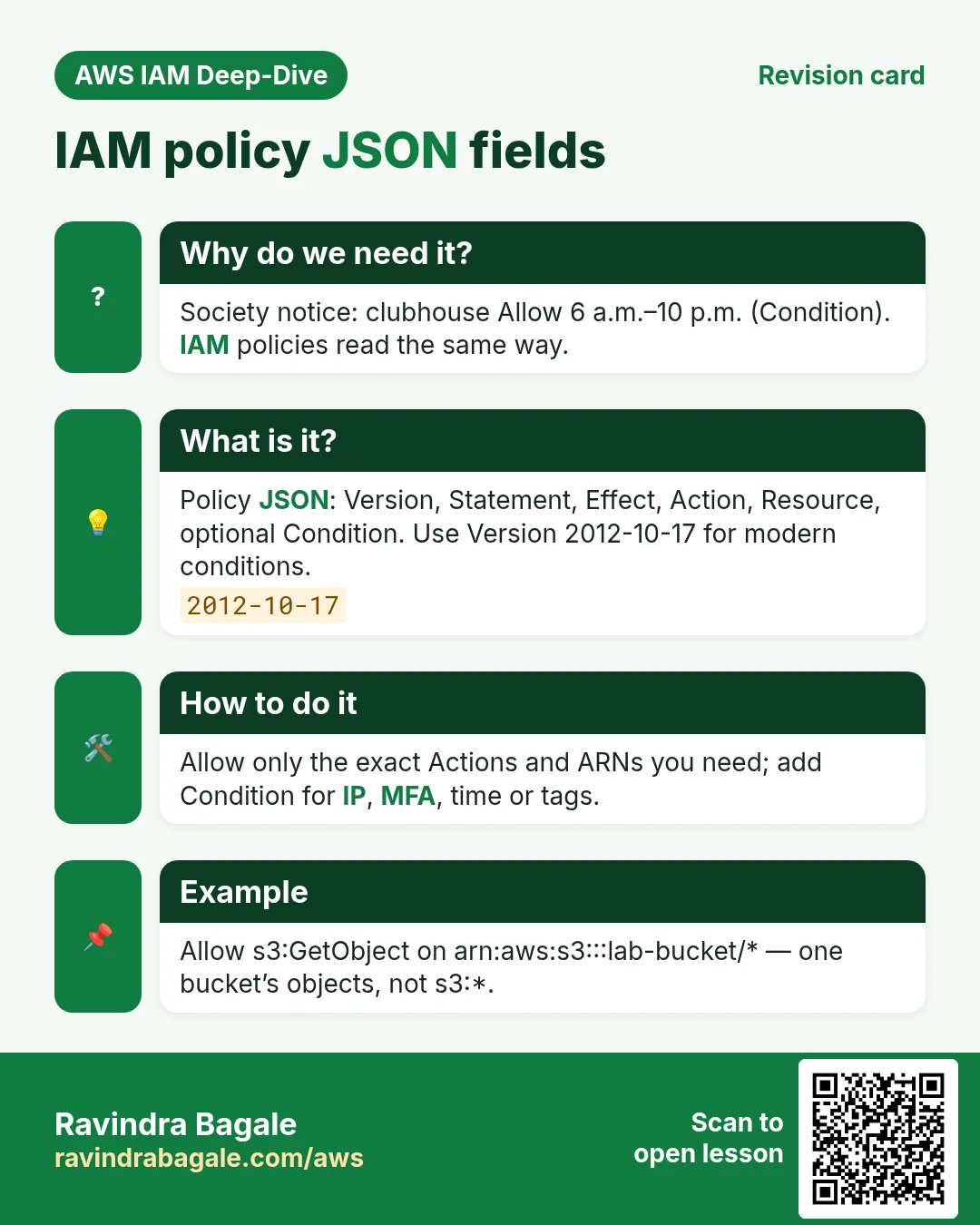
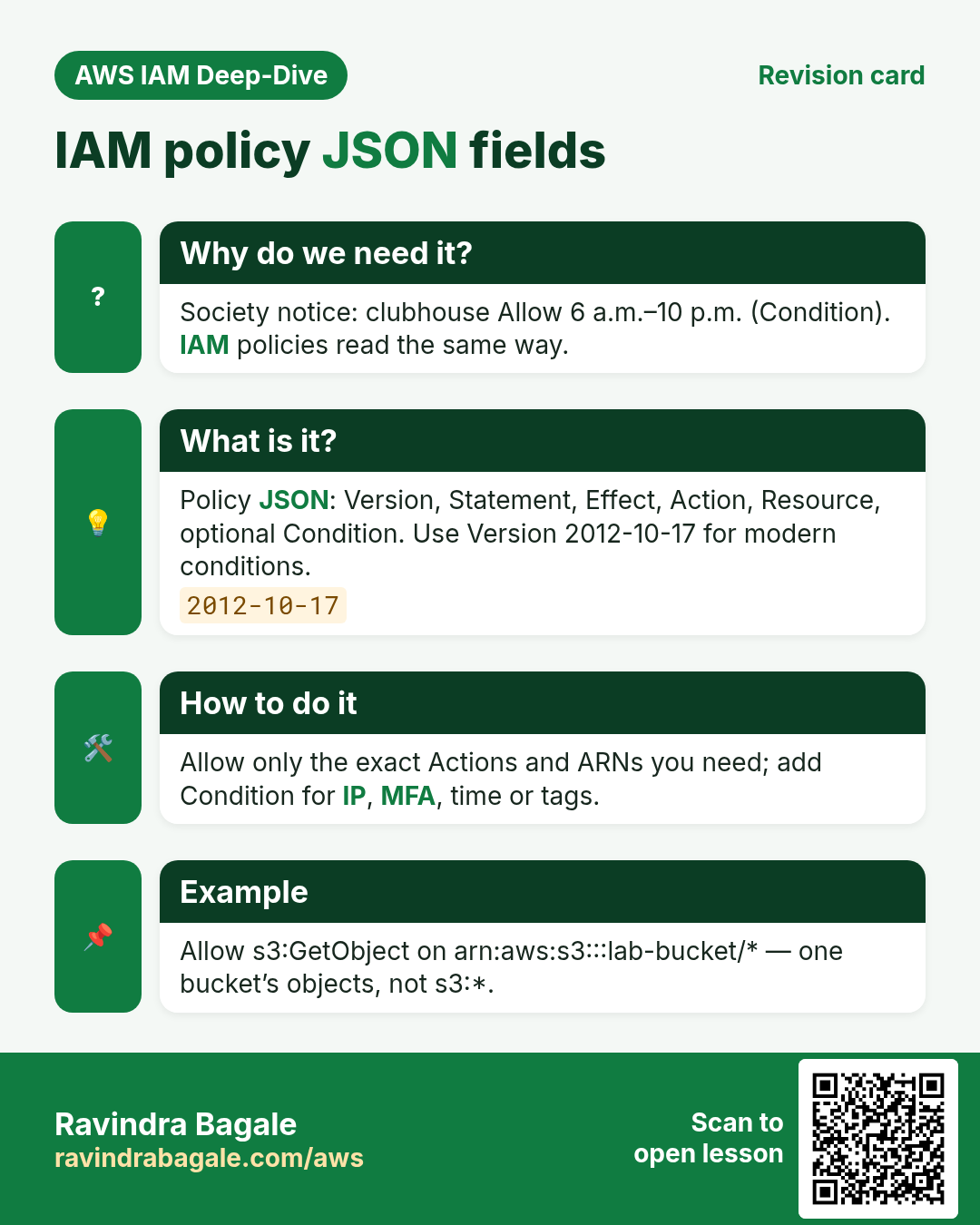
Society notice: clubhouse Allow 6 a.m.–10 p.m. (Condition). IAM policies read the same way.
What is it?
Policy JSON: Version, Statement, Effect, Action, Resource, optional Condition. Use Version 2012-10-17 for modern conditions. 2012-10-17
How to do it
Allow only the exact Actions and ARNs you need; add Condition for IP, MFA, time or tags.
Example
Allow s3:GetObject on arn:aws:s3:::lab-bucket/* — one bucket’s objects, not s3:*.
Managed vs inline policies
Read card text
What this card says
Why do we need it?
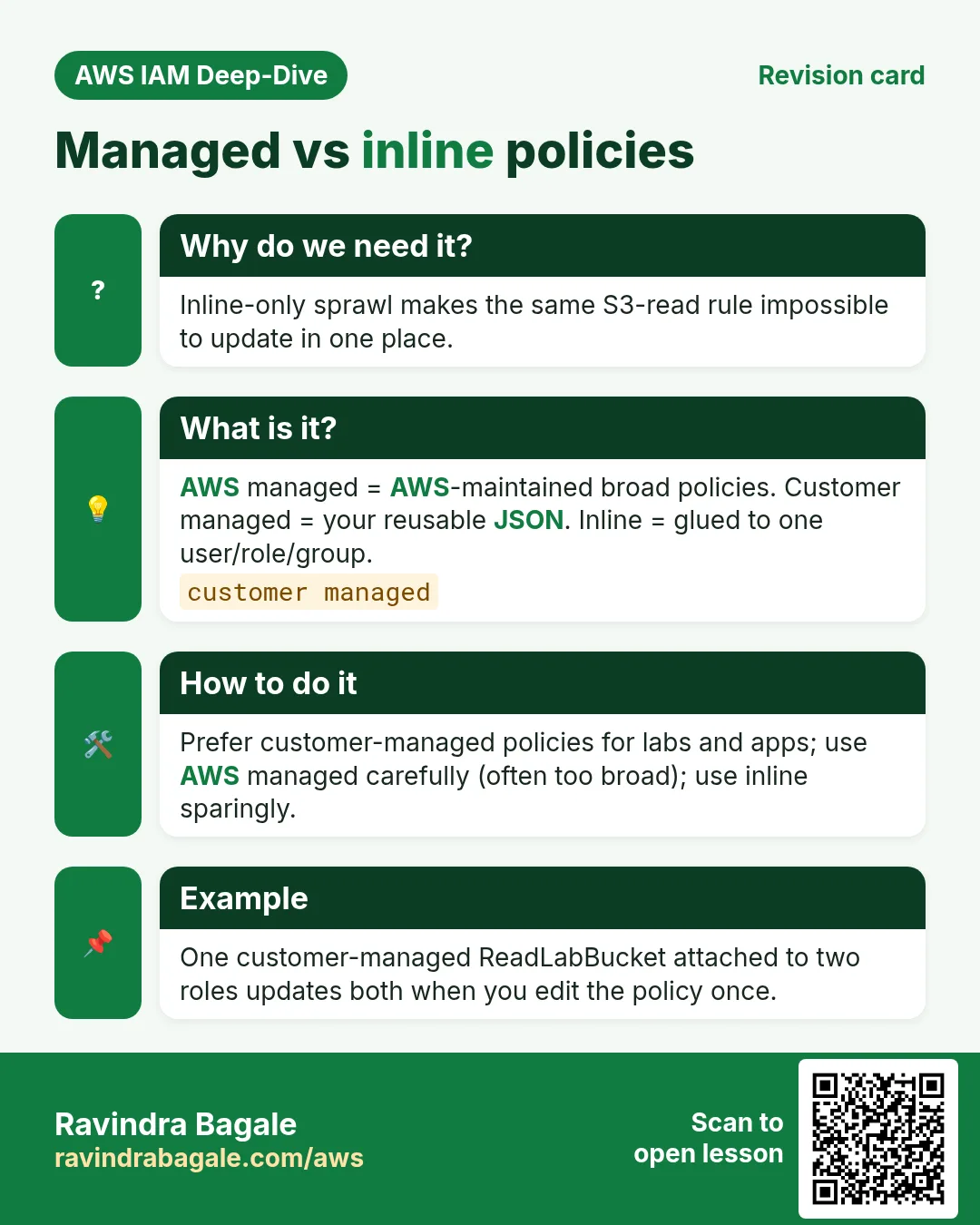
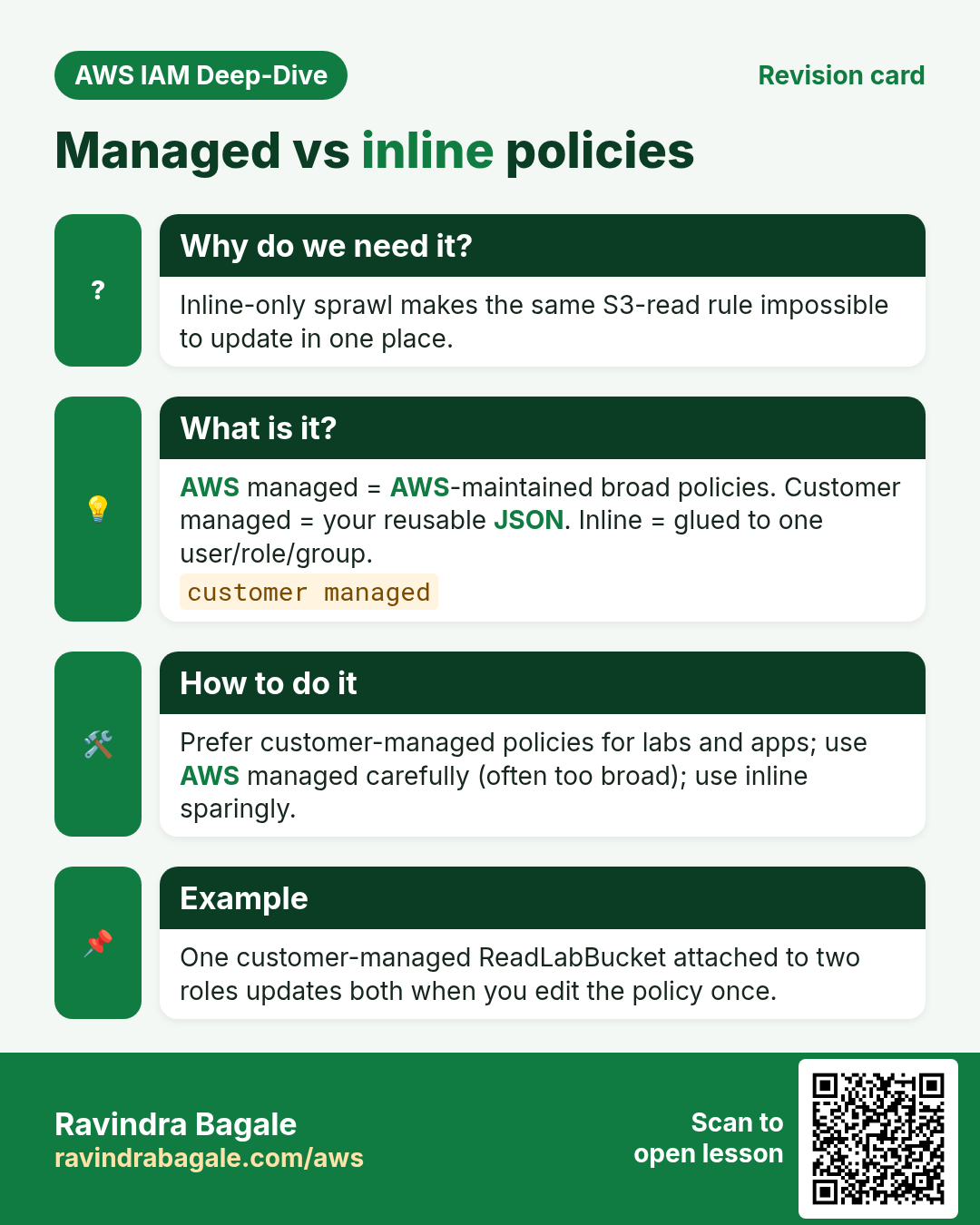
Inline-only sprawl makes the same S3-read rule impossible to update in one place.
What is it?
AWS managed = AWS-maintained broad policies. Customer managed = your reusable JSON. Inline = glued to one user/role/group. customer managed
How to do it
Prefer customer-managed policies for labs and apps; use AWS managed carefully (often too broad); use inline sparingly.
Example
One customer-managed ReadLabBucket attached to two roles updates both when you edit the policy once.
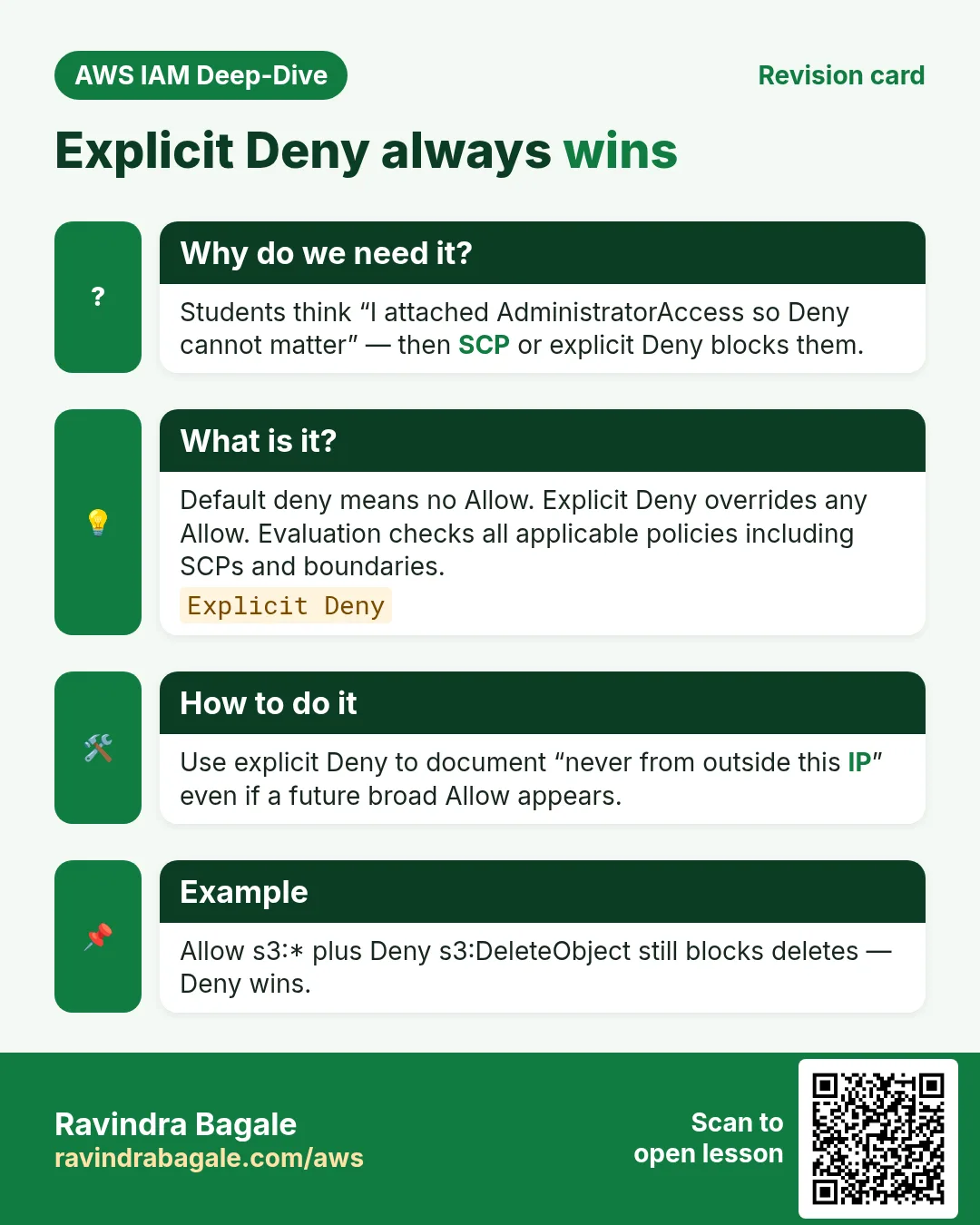
Explicit Deny always wins
Read card text
What this card says
Why do we need it?
Students think “I attached AdministratorAccess so Deny cannot matter” — then SCP or explicit Deny blocks them.
What is it?
Default deny means no Allow. Explicit Deny overrides any Allow. Evaluation checks all applicable policies including SCPs and boundaries. Explicit Deny
How to do it
Use explicit Deny to document “never from outside this IP” even if a future broad Allow appears.
Example
Allow s3:* plus Deny s3:DeleteObject still blocks deletes — Deny wins.
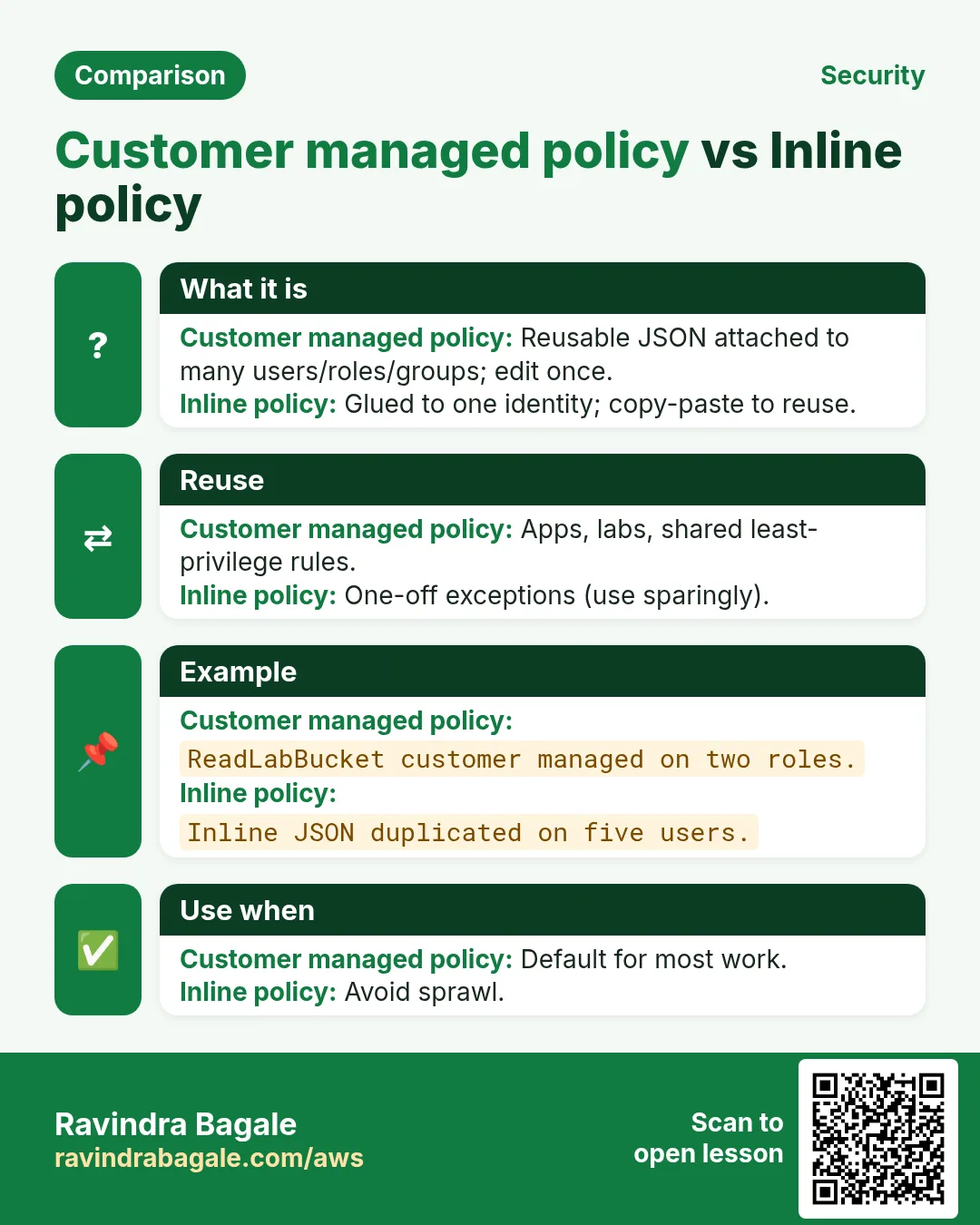
Comparison: Reuse
Read card text
What this card says
Customer managed policy
Reusable JSON attached to many users/roles/groups; edit once.
Inline policy
Glued to one identity; copy-paste to reuse.
Key points
Apps, labs, shared least-privilege rules. One-off exceptions (use sparingly).
Example
ReadLabBucket customer managed on two roles.
Use when
Default for most work. Avoid sprawl.
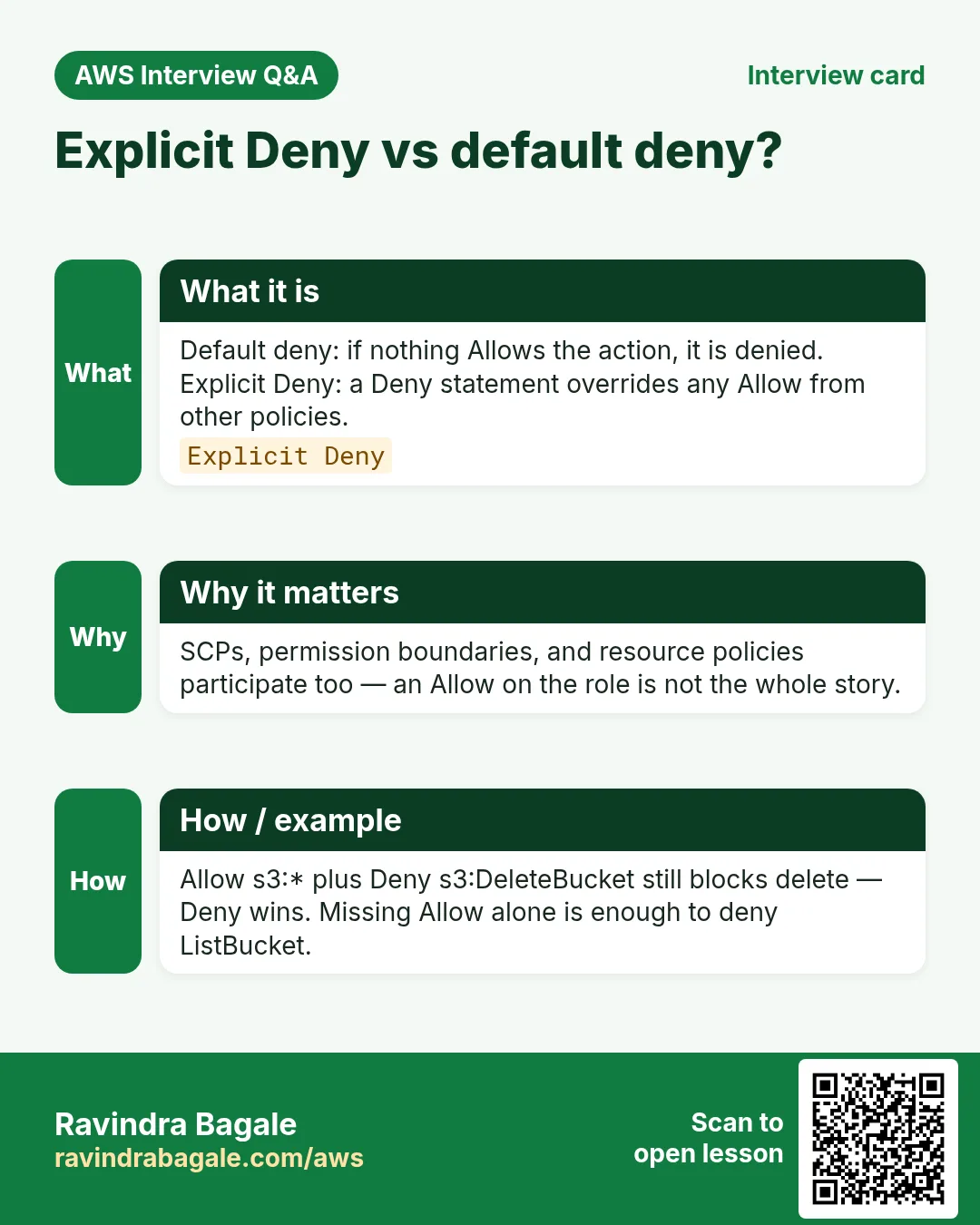
Interview: Explicit Deny vs default deny?
Read card text
What this card says
What it is
Default deny: if nothing Allows the action, it is denied. Explicit Deny: a Deny statement overrides any Allow from other policies. Explicit Deny
Why it matters
SCPs, permission boundaries, and resource policies participate too — an Allow on the role is not the whole story.
How / example
Allow s3:* plus Deny s3:DeleteBucket still blocks delete — Deny wins. Missing Allow alone is enough to deny ListBucket.
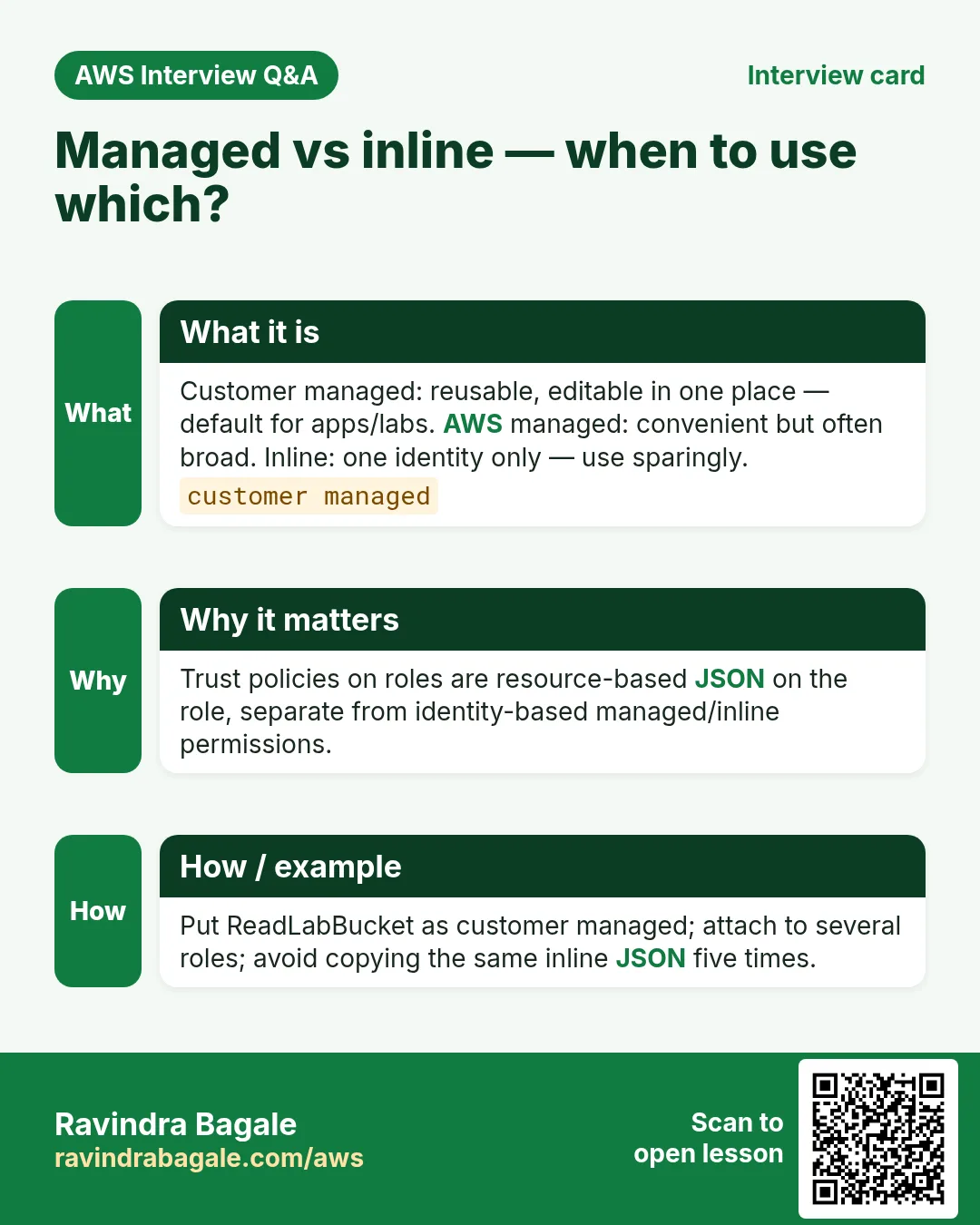
Interview: Managed vs inline — when to use which?
Read card text
What this card says
What it is
Customer managed: reusable, editable in one place — default for apps/labs. AWS managed: convenient but often broad. Inline: one identity only — use sparingly. customer managed
Why it matters
Trust policies on roles are resource-based JSON on the role, separate from identity-based managed/inline permissions.
How / example
Put ReadLabBucket as customer managed; attach to several roles; avoid copying the same inline JSON five times.
FAQ
What is the difference between an IAM user and an IAM role?
An IAM user is a named, long-lived identity with a password and/or access keys until you delete them. An IAM role has no long-lived password or access key. A caller assumes it, and STS returns temporary credentials.
What is the difference between a trust policy and a permissions policy?
The trust policy answers who may call sts:AssumeRole on this role. The permissions policy answers what API actions the resulting session may perform on which resources.
Why should compute use a role instead of access keys?
Role credentials rotate by themselves and need not sit on disk or in Git. Long-lived access keys stay valid until you delete them, and they are easy to leak in code, AMIs and laptops.
Why does ECS need two roles?
The execution role is for the ECS agent (pull the image from ECR, write logs). The task role is for your container code (for example DynamoDB or S3). One role for both gives too much power, and it makes AccessDenied harder to debug.
What is GitHub OIDC used for here?
GitHub issues an OIDC token. AWS trusts that token and returns short STS credentials with AssumeRoleWithWebIdentity, so you do not store long-lived AWS keys in GitHub secrets.
What is an ExternalId?
A secret-like value the vendor must send in sts:AssumeRole. Your trust policy checks sts:ExternalId. This stops the confused deputy problem: another customer cannot trick the vendor into using your role.
Does an explicit Deny beat AdministratorAccess?
Yes. Explicit Deny overrides any Allow. AWS also starts from default deny when no Allow is found. SCPs and permissions boundaries are part of the same evaluation.
When should I use a customer-managed policy instead of an inline policy?
Use a customer-managed policy as the default, so you can attach the same JSON to many identities and edit it once. Use an inline policy only for a rare one-off exception, so you do not get copy-paste sprawl.
Related lessons
These chapter pages are already on the site (checked live, HTTP 200, on 19 Nov 2026):