25.14 Deployment Pipelines
Start with a problem
Raja publishes untested changes straight to the workspace managers use.
Explain simply
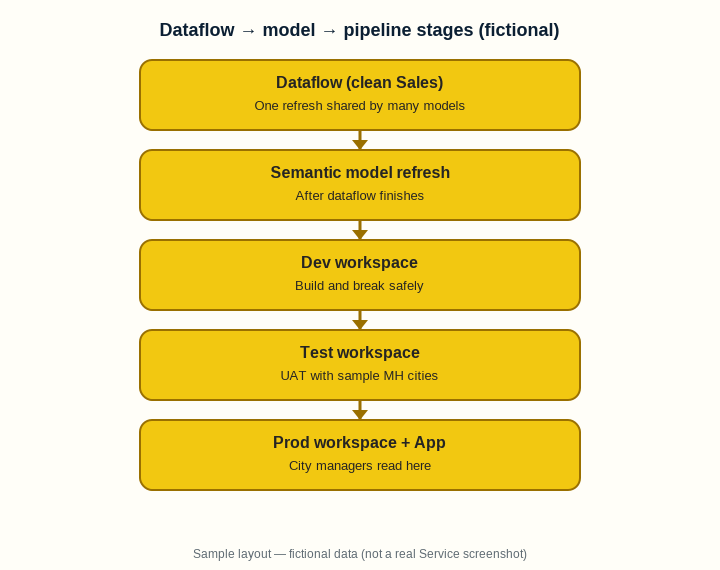
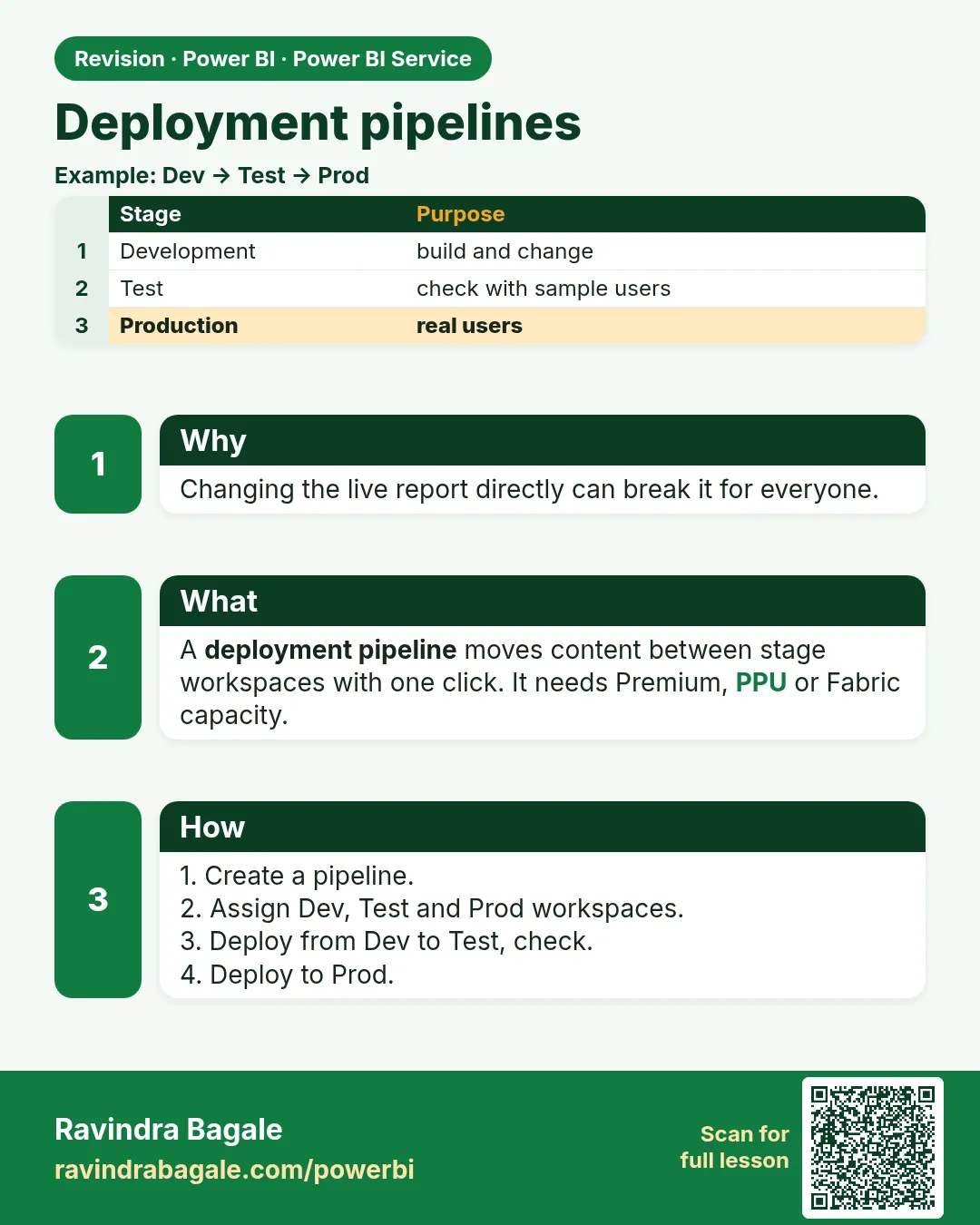
Deployment pipelines move content through Development, then Test, then Production workspaces with rules for different data sources.
Show the data
| Stage | Workspace | Who |
|---|---|---|
| Development | Sales [Dev] | Raja |
| Test | Sales [Test] | Shraddha |
| Production | Sales | Store managers |
About this data: This table uses columns: Stage, Workspace, Who. This table uses columns: Stage, Card. This table uses columns: Wrong result, Reason, Correction. Values shown are the lesson examples already on this page (not a new dataset).
Fictional sample data. Practice file: visuals_orders_apr_may_2026.csv (source: src/practice/).
Demonstrate
- Deployment pipelines › Create pipeline.
- Assign Dev, Test and Prod workspaces.
- Deploy Dev, then Test; Shraddha tests.
- Deploy Test, then Prod.
Show the result
Your result should look like this (fictional sample):
| Stage | Card |
|---|---|
| Dev | ₹2,100 (test data) |
| Prod | Real data |
Explain what happened
Deployment copies items forward; rules switch sources per stage.
Explore further
- Needs Premium/Fabric capacity or PPU (check current licensing).
Detailed reference for this lesson:
Dev, test, production. Tine workspace. Pipeline tyanna jodto. Ha capacity feature aahe.
A deployment pipeline promotes content from Development to Test to Production. It needs a capacity that includes pipelines (Premium Per User, or a Fabric capacity; the licence names change). Section 25.3 already said to keep separate workspaces. The pipeline is the button that copies the reports and models forward instead of you downloading a PBIX and re-uploading it.
Steps
- Create three workspaces:
MH QC Dev,MH QC Test,MH QC Prod. - Deployment pipelines › New pipeline. Assign the three workspaces to the three stages.
- Build in Dev. Deploy to Test. Compare. Then deploy to Prod.
- Use rules on the dataset parameters (server name, section 10.4) so Test does not point at the production database after a deploy.
Deploy copies metadata. It does not excuse an untested measure. RLS roles deploy; the members of those roles in the Service do not always follow the way you expect. Re-check Security on the production semantic model after the first deploy.
Worked example. Dev uses the fictional sample. Test uses a copy of that sample so Shraddha can click through Kolhapur. Prod will later use the real server, which is outside this course. A parameter rule on ServerName is what stops Test from reading Prod after you deploy. Check the parameter in the Test model settings before you invite Rani.
Ravindra Bagale's Tip
Many students deploy Dev straight to Prod in the first week, with no rules, and the production refresh hits the wrong server. Do not skip the Test stage. Check the parameter rule. Pay attention!
Ravindra Bagale's Tip – मराठी
बरेच students पहिल्याच आठवड्यात कोणतेही rules न ठेवता Dev सरळ Prod ला deploy करतात, आणि production refresh चुकीच्या server वर जातो. Test stage skip करू नका. Parameter rule बघा. लक्षात ठेवा!
Ravindra Bagale's Tip – हिंदी
बहुत से students पहले ही हफ़्ते बिना किसी rule के Dev सीधे Prod पर deploy कर देते हैं, और production refresh ग़लत server पर जाता है. Test stage skip मत करो. Parameter rule देखो. ध्यान रखो!
Fix common mistakes
| Wrong result | Reason | Correction |
|---|---|---|
| Prod shows test data | No deployment rule | Add data source rule |
| Users see unfinished pages | Editing in Prod | Edit in Dev |
| Pipeline missing | Licence | Check capacity |
Practise independently
Practice task
Where should Raja test a new measure?
Hints
- Not production.
Solution
In Dev, then Test before Prod.
Think like a professional
Dev/Test/Prod discipline is expected in enterprise roles.
Deepen this topic (Why / What / How)
Fictional Maharashtra example. Numbers and workspace names below are practice data only.
Why: Editing Prod directly is how Friday night rollbacks happen.
What: Deployment pipelines promote content Dev, then Test, then Prod with rules.
How — respect Dev / Test / Prod:
Vertical steps (one under another)
- Keep a Dev workspace for experiments.
- Promote only after Test sign-off.
- Never hotfix only in Prod without a path back.
- Combine with naming standards from Ch 34.
- Details and lineage habits in Ch 41.
Tiny example: Fictional: MH Ops Lab, then MH Ops Test, then MH Ops Prod pipeline.
Ravindra Bagale's Tip
Friends, pipelines are seatbelts — boring until the day they save you.
Ravindra Bagale's Tip – मराठी
मित्रांनो, pipelines = seatbelt; कंटाळवाणे पण वाचवतात.
Ravindra Bagale's Tip – हिंदी
दोस्तों, pipelines = seatbelt; उबाऊ पर बचाते हैं।
Go deeper next
This Chapter 25 page is the overview. For the full Service deep lesson, open Ch 41 · Dataflows, Pipelines, Lineage and Usage. Chapters 37–44 are the deep Service series; Chapter 44 is the publish–secure–refresh–share capstone.
Quiz (5 questions)
1. Deployment pipelines promote:
2. Editing Prod directly is:
3. Naming standards help pipelines because:
4. Deep chapter:
5. Ch 34 helps pipelines by teaching:
Practice tasks (12) — hints only, no full answers
- Task. Write the business question this 25 14 deployment pipelines page answers in one sentence.
Hint: Name the user and the decision. - Task. List three mistakes learners make with 25 14 deployment pipelines.
Hint: Use Fix common mistakes as a seed. - Task. Draw a 5-box flow on paper for 25 14 deployment pipelines (fictional MH Ops).
Hint: Photo counts as artefact. - Task. Explain 25 14 deployment pipelines to a friend in 60 seconds using Why/What/How.
Hint: Record voice memo if you can. - Task. Open the linked deep chapter and write three new facts not on this overview page.
Hint: Cite section titles only. - Task. Create a checklist of 7 ticks before you call 25 14 deployment pipelines “done”.
Hint: Include a verify step. - Task. Invent fictional refresh/share/role data that fits 25 14 deployment pipelines.
Hint: Keep IST times. - Task. Map who is Admin / Member / Contributor / Viewer for a fictional workspace using 25 14 deployment pipelines.
Hint: Least privilege. - Task. Write an interview STAR story that uses 25 14 deployment pipelines.
Hint: 45–60 seconds. - Task. Find one unused habit you will stop (e.g. My workspace for team content) related to 25 14 deployment pipelines.
Hint: Be specific. - Task. Link 25 14 deployment pipelines forward to the correct Ch 37–44 lesson and say why.
Hint: One sentence why. - Task. Teach 25 14 deployment pipelines back using Marathi or Hindi tip language once.
Hint: Keep English terms for product UI.
 Revision card