Chapter 15: Kubernetes Introduction
15.9 Config and secrets — concepts only
Why: the problem
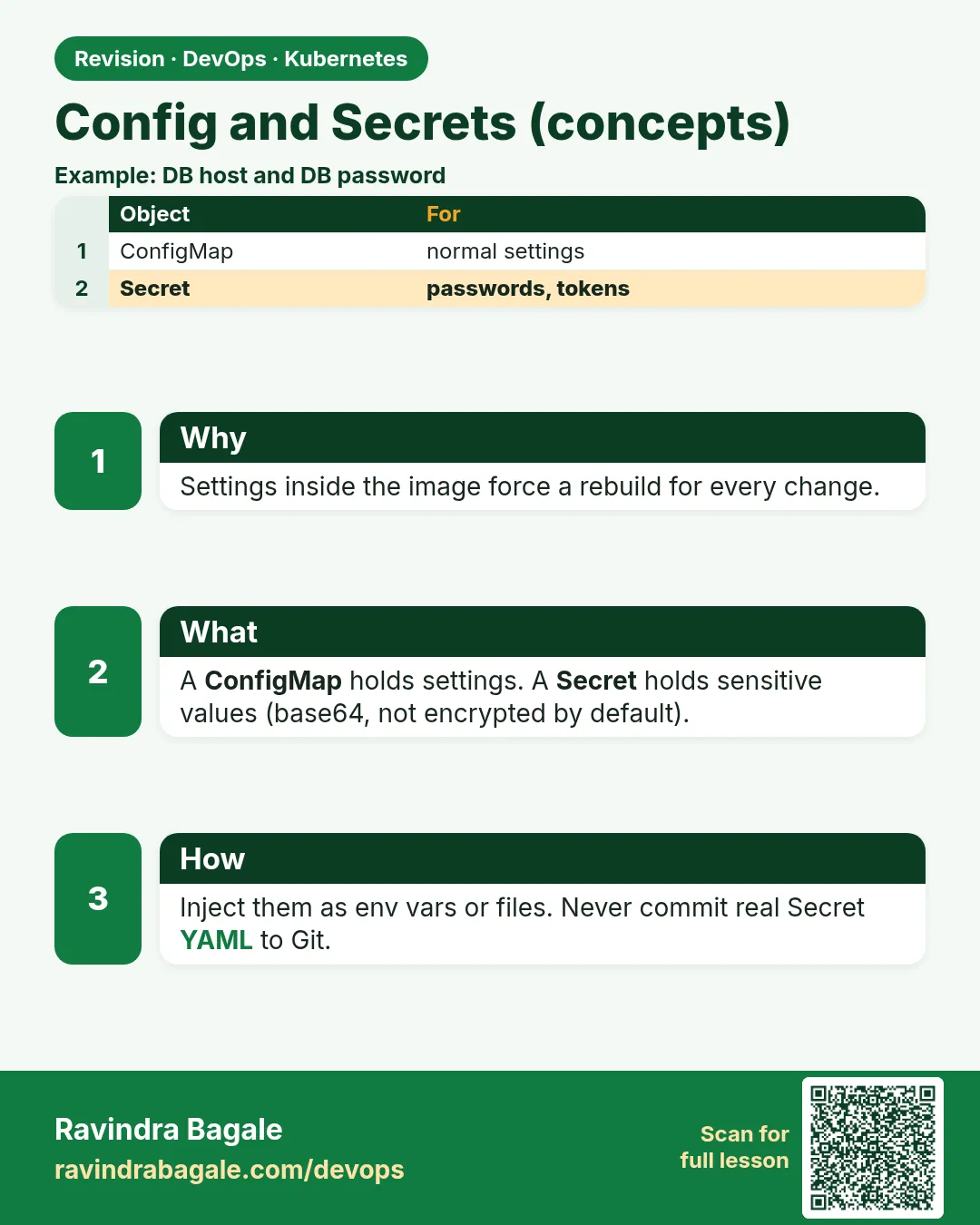
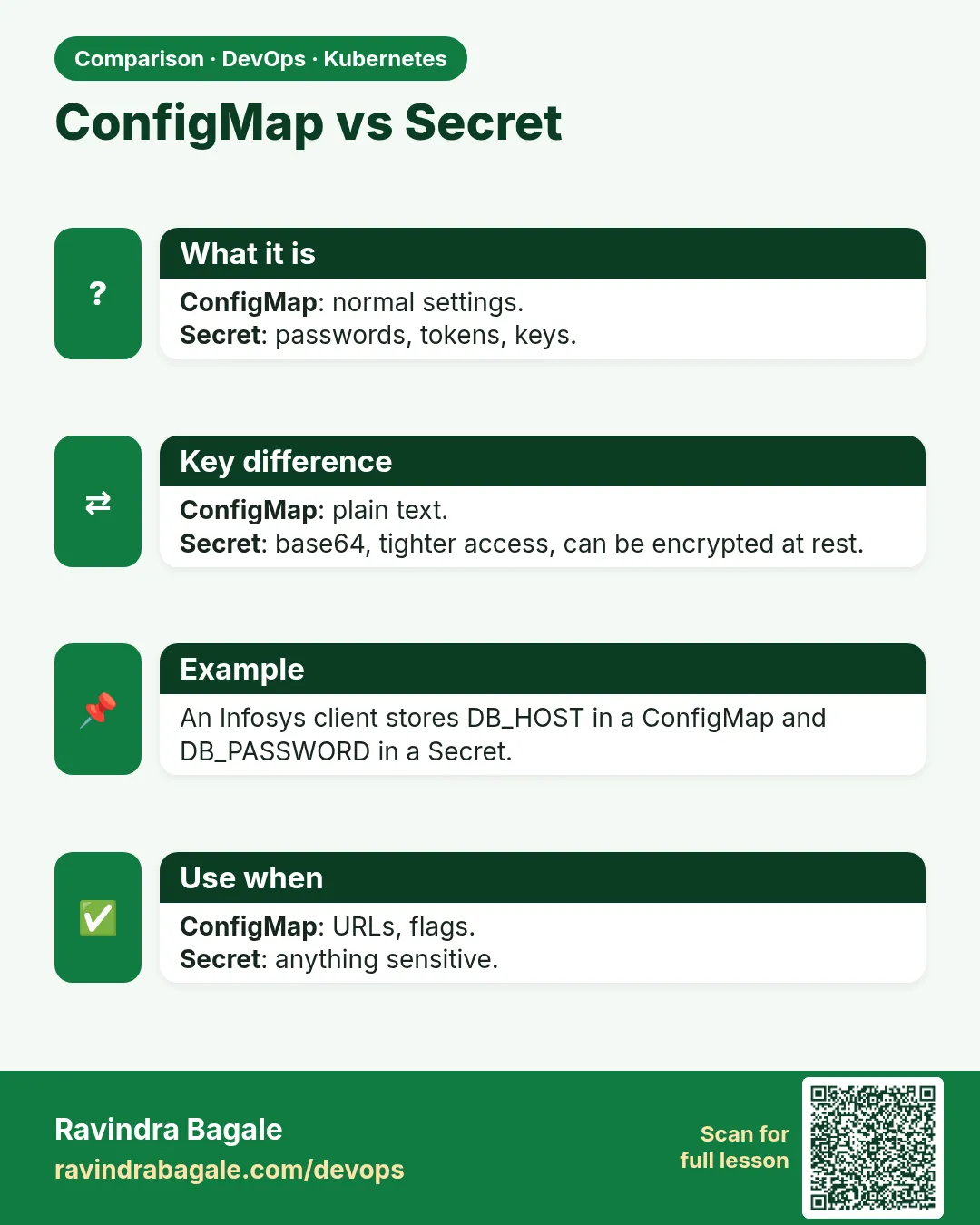
Suppose we are on the Infosys team and the badge API must run in dev and prod with different settings. If we bake settings into the image, we need a new image for every place. And if we put a password in the YAML in Git, everyone who can read Git can read the password. ConfigMaps hold normal settings. Secrets hold sensitive values. Both are given to the Pod from outside the image.
What we will build
You will create a ConfigMap with APP_VERSION and LOG_LEVEL, and a Secret with a lab-only placeholder token, then use them in all three stacks. No real secret is used anywhere.
What: every term in plain English
- ConfigMap — An object that stores plain settings as key=value.
- Secret — An object for sensitive values. Stored base64, which is not encryption.
- envFrom — Loads every key of a ConfigMap as environment variables.
- secretKeyRef — Loads one key of a Secret into one variable.
- base64 — A way of writing bytes as text. Anyone can decode it.
- Encryption at rest — A cluster setting that encrypts Secrets in etcd.
How: step by step
-
Create the ConfigMap
kubectl create configmap badge-config --from-literal=APP_VERSION=1.0 --from-literal=LOG_LEVEL=infoWhat it does: Plain settings for the app.
Output
configmap/badge-config created -
Create the Secret from a local file
printf "lab-only-placeholder" > token.txt
kubectl create secret generic badge-secret --from-file=API_TOKEN=token.txt
rm token.txt
What it does: The value never goes into Git or shell history.
Output
secret/badge-secret created -
Look at the ConfigMap
kubectl get configmap badge-config -o yaml | tail -3What it does: Values are plain text.
Output
data: APP_VERSION: "1.0" LOG_LEVEL: info -
See that a Secret is only base64
kubectl get secret badge-secret -o jsonpath="{.data.API_TOKEN}"What it does: Encoded, not encrypted. Limit who can read Secrets.
Output
bGFiLW9ubHktcGxhY2Vob2xkZXI= -
Apply the Deployment that uses them
kubectl apply -f k8s/badge-node.yamlWhat it does: Pods get the values as env vars.
Output
deployment.apps/badge-node configured -
Check inside the Pod
kubectl exec deploy/badge-node -- printenv APP_VERSION LOG_LEVELWhat it does: Shows the values arrived. We do not print the token.
Output
1.0 info -
Change config and restart
kubectl create configmap badge-config --from-literal=APP_VERSION=1.2 --from-literal=LOG_LEVEL=info --dry-run=client -o yaml | kubectl apply -f -
kubectl rollout restart deploy/badge-node
What it does: Env vars are read at start, so restart.
Output
configmap/badge-config configured
deployment.apps/badge-node restarted
Example 1: Node
Stack. Node.js 20, Express, kind
Goal. Node.js: badge-node reads settings from a ConfigMap and a token from a Secret.
server.js
// server.js - badge API (Node.js + Express)
const express = require("express");
const os = require("os");
const app = express();
app.get("/health", (req, res) => res.json({ status: "ok" }));
app.get("/badge/:user", (req, res) => {
  const user = req.params.user;
  if (!/^[a-z0-9_]{3,30}$/.test(user)) return res.status(400).json({ error: "invalid username" });
  res.json({ user, badge: "verified-learner", pod: os.hostname(), version: process.env.APP_VERSION || "1.0" });
});
app.listen(process.env.PORT || 3000, () => console.log("badge-node listening on 3000"));
Dockerfile
# Dockerfile - Node badge API
FROM node:20-alpine
WORKDIR /app
COPY package*.json ./
RUN npm ci --omit=dev
COPY server.js .
USER node
EXPOSE 3000
CMD ["node", "server.js"]
k8s/badge-node.yaml
apiVersion: apps/v1
kind: Deployment
metadata:
  name: badge-node
  namespace: badge-api
  labels: { app: badge-node }
spec:
  replicas: 2
  selector:
    matchLabels: { app: badge-node }
  template:
    metadata:
      labels: { app: badge-node }
    spec:
      containers:
        - name: api
          image: badge-node:1.0
          ports:
            - containerPort: 3000
          envFrom:
            - configMapRef: { name: badge-config }
          env:
            - name: API_TOKEN
              valueFrom:
                secretKeyRef: { name: badge-secret, key: API_TOKEN }
---
apiVersion: v1
kind: Service
metadata:
  name: badge-node
  namespace: badge-api
spec:
  type: ClusterIP
  selector: { app: badge-node }
  ports:
    - port: 80
      targetPort: 3000
What each line does
kind: Deployment— Tells Kubernetes: keep this many copies of the Pod running all the time.replicas: 2— Two Pods. If one dies, Kubernetes makes a new one.selector.matchLabels— The Deployment owns Pods that carry this label.image: ...:1.0— A fixed tag. Never use latest, because you cannot tell what is running.kind: Service / type: ClusterIP— One stable name and IP inside the cluster in front of all matching Pods.port: 80 / targetPort— Callers use port 80. The Service sends traffic to the app port inside the Pod.envFrom: configMapRef— All ConfigMap keys become env vars.secretKeyRef— Only API_TOKEN is taken from the Secret.
Green output
$ kubectl -n badge-api get pods -l app=badge-node
NAME                          READY   STATUS    RESTARTS   AGE
badge-node-6d9f7c8b5-4kq2x     1/1     Running   0          40s
badge-node-6d9f7c8b5-r7m9t     1/1     Running   0          40s
$ curl -s localhost:8080/badge/ravi
{"user":"ravi","badge":"verified-learner","pod":"badge-node-6d9f7c8b5-4kq2x","version":"1.0"}
Expected result. curl shows version from the ConfigMap for Node.js; the token is present but never printed.
Example 2: Python: badge-py reads settings from a ConfigMap and a token from a Secret
Stack. Python 3.12, Flask, gunicorn, kind
Goal. Python: badge-py reads settings from a ConfigMap and a token from a Secret.
app.py
# app.py - badge API (Python + Flask)
import os, re, socket
from flask import Flask, jsonify
app = Flask(__name__)

@app.get("/health")
def health():
    return jsonify(status="ok")

@app.get("/badge/<user>")
def badge(user):
    if not re.fullmatch(r"[a-z0-9_]{3,30}", user):
        return jsonify(error="invalid username"), 400
    return jsonify(user=user, badge="verified-learner", pod=socket.gethostname(),
                   version=os.environ.get("APP_VERSION", "1.0"))
Dockerfile
# Dockerfile - Python badge API
FROM python:3.12-slim
WORKDIR /app
COPY requirements.txt .
RUN pip install --no-cache-dir -r requirements.txt   # flask, gunicorn
COPY app.py .
RUN useradd -u 10001 app
USER 10001
EXPOSE 5000
CMD ["gunicorn", "-b", "0.0.0.0:5000", "app:app"]
k8s/badge-py.yaml
apiVersion: apps/v1
kind: Deployment
metadata:
  name: badge-py
  namespace: badge-api
  labels: { app: badge-py }
spec:
  replicas: 2
  selector:
    matchLabels: { app: badge-py }
  template:
    metadata:
      labels: { app: badge-py }
    spec:
      containers:
        - name: api
          image: badge-py:1.0
          ports:
            - containerPort: 5000
          envFrom:
            - configMapRef: { name: badge-config }
          env:
            - name: API_TOKEN
              valueFrom:
                secretKeyRef: { name: badge-secret, key: API_TOKEN }
---
apiVersion: v1
kind: Service
metadata:
  name: badge-py
  namespace: badge-api
spec:
  type: ClusterIP
  selector: { app: badge-py }
  ports:
    - port: 80
      targetPort: 5000
What each line does
kind: Deployment— Tells Kubernetes: keep this many copies of the Pod running all the time.replicas: 2— Two Pods. If one dies, Kubernetes makes a new one.selector.matchLabels— The Deployment owns Pods that carry this label.image: ...:1.0— A fixed tag. Never use latest, because you cannot tell what is running.kind: Service / type: ClusterIP— One stable name and IP inside the cluster in front of all matching Pods.port: 80 / targetPort— Callers use port 80. The Service sends traffic to the app port inside the Pod.envFrom: configMapRef— All ConfigMap keys become env vars.secretKeyRef— Only API_TOKEN is taken from the Secret.
Green output
$ kubectl -n badge-api get pods -l app=badge-py
NAME                          READY   STATUS    RESTARTS   AGE
badge-py-6d9f7c8b5-4kq2x     1/1     Running   0          40s
badge-py-6d9f7c8b5-r7m9t     1/1     Running   0          40s
$ curl -s localhost:8080/badge/ravi
{"user":"ravi","badge":"verified-learner","pod":"badge-py-6d9f7c8b5-4kq2x","version":"1.0"}
Expected result. curl shows version from the ConfigMap for Python; the token is present but never printed.
Example 3: Java: badge-java reads settings from a ConfigMap and a token from a Secret
Stack. Java 21, Spring Boot, kind
Goal. Java: badge-java reads settings from a ConfigMap and a token from a Secret.
BadgeController.java
// src/main/java/com/shipit/BadgeController.java - badge API (Java + Spring Boot)
package com.shipit;
import org.springframework.web.bind.annotation.*;
import java.net.InetAddress;
import java.util.Map;

@RestController
public class BadgeController {
  @GetMapping("/health")
  public Map<String, String> health() { return Map.of("status", "ok"); }

  @GetMapping("/badge/{user}")
  public Map<String, String> badge(@PathVariable String user) throws Exception {
    if (!user.matches("[a-z0-9_]{3,30}")) throw new IllegalArgumentException("invalid username");
    String v = System.getenv().getOrDefault("APP_VERSION", "1.0");
    return Map.of("user", user, "badge", "verified-learner",
                  "pod", InetAddress.getLocalHost().getHostName(), "version", v);
  }
}
Dockerfile
# Dockerfile - Java badge API (two stages: build, then run)
FROM maven:3.9-eclipse-temurin-21 AS build
WORKDIR /src
COPY pom.xml .
COPY src ./src
RUN mvn -B -q package -DskipTests

FROM eclipse-temurin:21-jre
WORKDIR /app
COPY --from=build /src/target/badge-api.jar app.jar
RUN useradd -u 10001 app
USER 10001
EXPOSE 8080
CMD ["java", "-jar", "app.jar"]
k8s/badge-java.yaml
apiVersion: apps/v1
kind: Deployment
metadata:
  name: badge-java
  namespace: badge-api
  labels: { app: badge-java }
spec:
  replicas: 2
  selector:
    matchLabels: { app: badge-java }
  template:
    metadata:
      labels: { app: badge-java }
    spec:
      containers:
        - name: api
          image: badge-java:1.0
          ports:
            - containerPort: 8080
          envFrom:
            - configMapRef: { name: badge-config }
          env:
            - name: API_TOKEN
              valueFrom:
                secretKeyRef: { name: badge-secret, key: API_TOKEN }
---
apiVersion: v1
kind: Service
metadata:
  name: badge-java
  namespace: badge-api
spec:
  type: ClusterIP
  selector: { app: badge-java }
  ports:
    - port: 80
      targetPort: 8080
What each line does
kind: Deployment— Tells Kubernetes: keep this many copies of the Pod running all the time.replicas: 2— Two Pods. If one dies, Kubernetes makes a new one.selector.matchLabels— The Deployment owns Pods that carry this label.image: ...:1.0— A fixed tag. Never use latest, because you cannot tell what is running.kind: Service / type: ClusterIP— One stable name and IP inside the cluster in front of all matching Pods.port: 80 / targetPort— Callers use port 80. The Service sends traffic to the app port inside the Pod.envFrom: configMapRef— All ConfigMap keys become env vars.secretKeyRef— Only API_TOKEN is taken from the Secret.
Green output
$ kubectl -n badge-api get pods -l app=badge-java
NAME                          READY   STATUS    RESTARTS   AGE
badge-java-6d9f7c8b5-4kq2x     1/1     Running   0          40s
badge-java-6d9f7c8b5-r7m9t     1/1     Running   0          40s
$ curl -s localhost:8080/badge/ravi
{"user":"ravi","badge":"verified-learner","pod":"badge-java-6d9f7c8b5-4kq2x","version":"1.0"}
Expected result. curl shows version from the ConfigMap for Java; the token is present but never printed.
Verify: did it work?
-
List everything in the namespace
kubectl -n badge-api get allWhat it does: Shows Deployments, ReplicaSets, Pods and Services together.
Output
NAME READY STATUS RESTARTS AGE pod/badge-node-6d9f7c8b5-4kq2x 1/1 Running 0 2m NAME TYPE CLUSTER-IP PORT(S) service/badge-node ClusterIP 10.96.41.12 80/TCP -
Check that the Service found the Pods
kubectl -n badge-api get endpoints badge-nodeWhat it does: Endpoints are the Pod IPs behind the Service. Empty means the labels do not match.
Output
NAME ENDPOINTS AGE badge-node 10.244.0.5:3000,10.244.0.6:3000 2m -
Call the app through the Service
kubectl -n badge-api port-forward svc/badge-node 8080:80 &
curl -s localhost:8080/health
What it does: Opens a tunnel from your laptop to the Service, then calls it.
Output
Forwarding from 127.0.0.1:8080 -> 3000
{"status":"ok"}
When it is red 1
Error: couldn't find key API_TOKEN in Secret badge-api/badge-secret
Cause. The key name in the Secret differs from the YAML.
Fix, step by step
- Run kubectl describe secret badge-secret and read the key names.
- Fix the key in secretKeyRef.
- Apply again.
When it is red 2
CreateContainerConfigError: configmap "badge-config" not found
Cause. The ConfigMap was not created in this namespace.
Fix, step by step
- Run kubectl get configmap -n badge-api.
- Create it in the right namespace.
- The Pod starts by itself.
When it is red 3
$ kubectl -n badge-api get endpoints badge-java
NAME         ENDPOINTS   AGE
badge-java   <none>      5m
Cause. The Service selector does not match the Pod labels, so the Service has no Pods behind it.
Fix, step by step
- Run kubectl get pods --show-labels.
- Compare the label with spec.selector in the Service.
- Fix the typo and apply again. Endpoints should now list Pod IPs.
Cleanup
-
Stop the port-forward
kill %1What it does: Ends the background tunnel.
Output
[1]+ Terminated kubectl port-forward svc/badge-node 8080:80 -
Delete the lesson objects
kubectl delete -f k8s/What it does: Removes what you applied. The cluster stays for the next lesson.
Output
deployment.apps "badge-node" deleted service "badge-node" deleted -
Delete the cluster at the end of the day
kind delete cluster --name badge-apiWhat it does: Removes the kind node container and frees memory.
Output
Deleting cluster "badge-api" ...
Deleted nodes: ["badge-api-control-plane"]
Practice tasks
Easy Decode a Secret
Why: See why access control matters.
What to do: Decode the base64 value in a lab cluster.
- kubectl get secret ... | base64 -d
Check: You understand base64 is not safe.
Medium Mount as a file
Why: Some apps read files.
What to do: Mount the ConfigMap as a volume.
- Add volumes and volumeMounts.
- kubectl exec ls /config
Check: Files exist per key.
Medium Use a different value per env
Why: Same image everywhere.
What to do: Run dev and prod namespaces with different ConfigMaps.
- Create two namespaces.
- Apply same Deployment.
Check: Each shows its own LOG_LEVEL.
Easy Say ConfigMaps and Secrets in two lines
Why: If you can say it simply, you understand it.
What to do: Write two short lines about ConfigMaps and Secrets for a fresher.
- Write the problem it solves.
- Write the one command or field you use.
Check: A friend who never used Kubernetes understands your lines.
Easy Rebuild the kind cluster from zero
Why: Labs break. Starting fresh must feel easy.
What to do: Delete and create the badge-api kind cluster again.
- kind delete cluster --name badge-api
- kind create cluster --name badge-api
- kubectl get nodes
Check: The node shows Ready in under two minutes.
Medium Do it for the second stack
Why: The same Kubernetes idea works for every language.
What to do: Repeat this lesson with the Python app if you used Node, or Java if you used Python.
- Build the image with a 1.0 tag.
- kind load docker-image the image.
- Apply the YAML and curl it.
Check: curl returns JSON from the second stack.
Medium Break it and read describe
Why: Real work is mostly reading errors.
What to do: Put a wrong image tag in the YAML and apply it.
- Change the tag to 9.9.
- kubectl apply -f the file.
- kubectl describe pod on the new Pod and read Events.
Check: You can point to the exact Events line that names the problem.
Medium Write the cleanup in one go
Why: Old labs fill the laptop disk.
What to do: Write the commands that remove everything this lesson made.
- kubectl delete -f k8s/
- kubectl get all -n badge-api
- docker image prune
Check: kubectl get all -n badge-api shows no resources.
Hard Explain it like an interview
Why: Interviewers ask what you did, not what you read.
What to do: Record a 60 second answer about this lesson.
- Say the problem.
- Say the YAML field or command.
- Say one error you hit and how you fixed it.
Check: Your answer has a real command and a real error in it.
Hard Draw the flow top to bottom
Why: A drawing shows if you know the order of things.
What to do: Draw this lesson as boxes from top to bottom on paper.
- Start from the user curl.
- Go through Service, Pod, container.
- Mark where your error happened.
Check: Every arrow on your drawing matches a real object in kubectl get all.
Homework: try at home
Try at home
At home, make two ConfigMaps, dev and prod, with different LOG_LEVEL, and switch the Python Deployment between them.
Recap
- ConfigMaps hold settings, Secrets hold sensitive values.
- Both keep the image the same everywhere.
- base64 is not encryption.
- Never put real secrets in Git or logs.
- Restart Pods after changing env-based config.
FAQ
How do teams store Secrets in Git safely?
With tools like Sealed Secrets or an external secret manager. Covered later.
Can I see a Secret in describe?
describe shows only sizes, not values.
Max ConfigMap size?
About 1 MiB.
File or env?
Files can update without restart; env vars need restart.
Who can read Secrets?
Anyone with RBAC get on secrets in that namespace. Keep it small.
Interview questions
-
ConfigMap vs Secret?
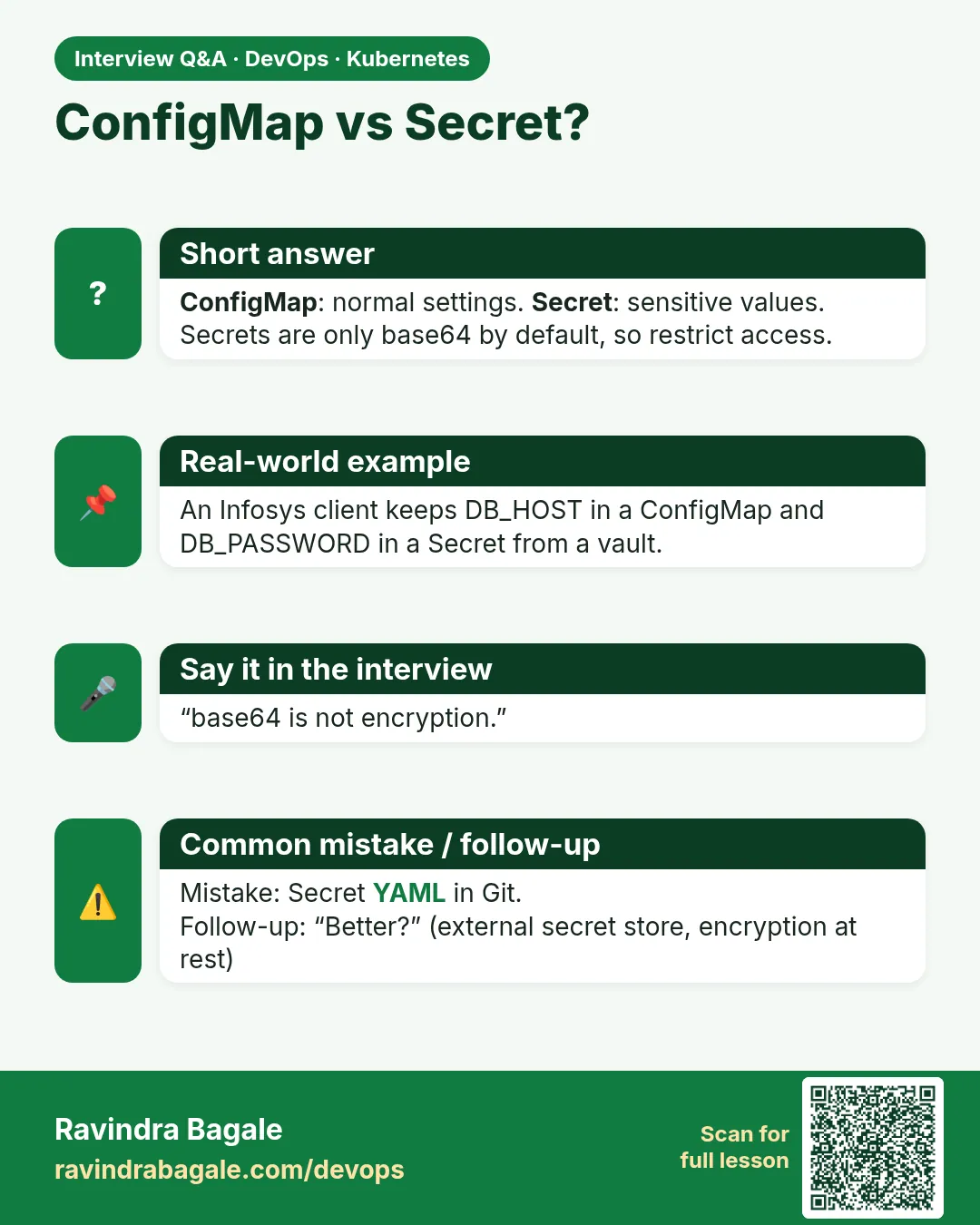
Both hold key-values; Secrets are for sensitive data with tighter handling, but only base64 by default.
-
How do you make Secrets safer?
RBAC, encryption at rest, external secret managers.
-
How do Pods use them?
env, envFrom or volume mounts.
-
Why not bake config into the image?
You would need a different image per environment.
-
Do changes apply live?
Mounted files update; env vars need a restart.
Quick quiz
Q1. Where do plain settings go?
ConfigMap.
Q2. Is base64 encryption?
No.
Q3. Do env vars update without restart?
No, restart the Pods.
Q4. Should Secret YAML go into Git?
No, not plain Secrets.
Q5. Which field loads one secret key?
secretKeyRef.
Did you understand? Let us try it once more.
 Revision card
 Interview card
 Comparison card