Chapter 15: Kubernetes Introduction
15.12e Namespaces and who can break what
Why: the problem
Suppose we are on the Amazon India team with ten teams in one cluster. A junior on the reels team runs kubectl delete pods --all and the payments app dies. Namespaces split the cluster into rooms. With RBAC, each team gets keys only to its own room. With quotas, no room can take all the space.
What we will build
You will make dev and prod namespaces, a Role that can only read Pods in dev, and a ResourceQuota, then test them with kubectl auth can-i.
What: every term in plain English
- Namespace — A room in the cluster for one team or environment.
- Role — A list of allowed actions inside one namespace.
- RoleBinding — Gives a Role to a user or service account.
- ClusterRole — Like a Role, but for the whole cluster.
- ResourceQuota — Total limits for a namespace.
- ServiceAccount — An identity for apps or bots.
How: step by step
-
Create two namespaces
kubectl create namespace badge-dev
kubectl create namespace badge-prod
What it does: Two rooms.
Output
namespace/badge-dev created namespace/badge-prod created -
Deploy into dev
sed "s/namespace: badge-api/namespace: badge-dev/" k8s/badge-node.yaml | kubectl apply -f -What it does: Same YAML, new namespace.
Output
deployment.apps/badge-node created -
Make a service account
kubectl -n badge-dev create serviceaccount juniorWhat it does: An identity to test with.
Output
serviceaccount/junior created -
Give read-only Pod access
kubectl -n badge-dev create role pod-reader --verb=get,list,watch --resource=pods
kubectl -n badge-dev create rolebinding junior-read --role=pod-reader --serviceaccount=badge-dev:junior
What it does: junior can read Pods in dev only.
Output
role.rbac.authorization.k8s.io/pod-reader created rolebinding.rbac.authorization.k8s.io/junior-read created -
Test allowed
kubectl auth can-i list pods -n badge-dev --as=system:serviceaccount:badge-dev:juniorWhat it does: Allowed.
Output
yes -
Test blocked
kubectl auth can-i delete pods -n badge-prod --as=system:serviceaccount:badge-dev:juniorWhat it does: Blocked.
Output
no -
Add a quota
kubectl -n badge-dev create quota dev-quota --hard=pods=10,requests.memory=2GiWhat it does: Dev cannot take the whole cluster.
Output
resourcequota/dev-quota created
Example 1: Node
Stack. Node.js 20, Express, kind
Goal. Node.js: badge-node in its own namespace badge-dev.
server.js
// server.js - badge API (Node.js + Express)
const express = require("express");
const os = require("os");
const app = express();
app.get("/health", (req, res) => res.json({ status: "ok" }));
app.get("/badge/:user", (req, res) => {
  const user = req.params.user;
  if (!/^[a-z0-9_]{3,30}$/.test(user)) return res.status(400).json({ error: "invalid username" });
  res.json({ user, badge: "verified-learner", pod: os.hostname(), version: process.env.APP_VERSION || "1.0" });
});
app.listen(process.env.PORT || 3000, () => console.log("badge-node listening on 3000"));
Dockerfile
# Dockerfile - Node badge API
FROM node:20-alpine
WORKDIR /app
COPY package*.json ./
RUN npm ci --omit=dev
COPY server.js .
USER node
EXPOSE 3000
CMD ["node", "server.js"]
k8s/badge-node.yaml
apiVersion: apps/v1
kind: Deployment
metadata:
  name: badge-node
  namespace: badge-dev
  labels: { app: badge-node }
spec:
  replicas: 2
  selector:
    matchLabels: { app: badge-node }
  template:
    metadata:
      labels: { app: badge-node }
    spec:
      containers:
        - name: api
          image: badge-node:1.0
          ports:
            - containerPort: 3000
          resources:
            requests: { cpu: "100m", memory: "128Mi" }
            limits:   { cpu: "500m", memory: "256Mi" }
---
apiVersion: v1
kind: Service
metadata:
  name: badge-node
  namespace: badge-dev
spec:
  type: ClusterIP
  selector: { app: badge-node }
  ports:
    - port: 80
      targetPort: 3000
What each line does
kind: Deployment— Tells Kubernetes: keep this many copies of the Pod running all the time.replicas: 2— Two Pods. If one dies, Kubernetes makes a new one.selector.matchLabels— The Deployment owns Pods that carry this label.image: ...:1.0— A fixed tag. Never use latest, because you cannot tell what is running.kind: Service / type: ClusterIP— One stable name and IP inside the cluster in front of all matching Pods.port: 80 / targetPort— Callers use port 80. The Service sends traffic to the app port inside the Pod.namespace: badge-dev— The object lives in the dev room.
Green output
$ kubectl -n badge-api get pods -l app=badge-node
NAME                          READY   STATUS    RESTARTS   AGE
badge-node-6d9f7c8b5-4kq2x     1/1     Running   0          40s
badge-node-6d9f7c8b5-r7m9t     1/1     Running   0          40s
$ curl -s localhost:8080/badge/ravi
{"user":"ravi","badge":"verified-learner","pod":"badge-node-6d9f7c8b5-4kq2x","version":"1.0"}
Expected result. Node.js runs in badge-dev and the junior account can read but not delete it.
Example 2: Python: badge-py in its own namespace badge-dev
Stack. Python 3.12, Flask, gunicorn, kind
Goal. Python: badge-py in its own namespace badge-dev.
app.py
# app.py - badge API (Python + Flask)
import os, re, socket
from flask import Flask, jsonify
app = Flask(__name__)

@app.get("/health")
def health():
    return jsonify(status="ok")

@app.get("/badge/<user>")
def badge(user):
    if not re.fullmatch(r"[a-z0-9_]{3,30}", user):
        return jsonify(error="invalid username"), 400
    return jsonify(user=user, badge="verified-learner", pod=socket.gethostname(),
                   version=os.environ.get("APP_VERSION", "1.0"))
Dockerfile
# Dockerfile - Python badge API
FROM python:3.12-slim
WORKDIR /app
COPY requirements.txt .
RUN pip install --no-cache-dir -r requirements.txt   # flask, gunicorn
COPY app.py .
RUN useradd -u 10001 app
USER 10001
EXPOSE 5000
CMD ["gunicorn", "-b", "0.0.0.0:5000", "app:app"]
k8s/badge-py.yaml
apiVersion: apps/v1
kind: Deployment
metadata:
  name: badge-py
  namespace: badge-dev
  labels: { app: badge-py }
spec:
  replicas: 2
  selector:
    matchLabels: { app: badge-py }
  template:
    metadata:
      labels: { app: badge-py }
    spec:
      containers:
        - name: api
          image: badge-py:1.0
          ports:
            - containerPort: 5000
          resources:
            requests: { cpu: "100m", memory: "128Mi" }
            limits:   { cpu: "500m", memory: "256Mi" }
---
apiVersion: v1
kind: Service
metadata:
  name: badge-py
  namespace: badge-dev
spec:
  type: ClusterIP
  selector: { app: badge-py }
  ports:
    - port: 80
      targetPort: 5000
What each line does
kind: Deployment— Tells Kubernetes: keep this many copies of the Pod running all the time.replicas: 2— Two Pods. If one dies, Kubernetes makes a new one.selector.matchLabels— The Deployment owns Pods that carry this label.image: ...:1.0— A fixed tag. Never use latest, because you cannot tell what is running.kind: Service / type: ClusterIP— One stable name and IP inside the cluster in front of all matching Pods.port: 80 / targetPort— Callers use port 80. The Service sends traffic to the app port inside the Pod.namespace: badge-dev— The object lives in the dev room.
Green output
$ kubectl -n badge-api get pods -l app=badge-py
NAME                          READY   STATUS    RESTARTS   AGE
badge-py-6d9f7c8b5-4kq2x     1/1     Running   0          40s
badge-py-6d9f7c8b5-r7m9t     1/1     Running   0          40s
$ curl -s localhost:8080/badge/ravi
{"user":"ravi","badge":"verified-learner","pod":"badge-py-6d9f7c8b5-4kq2x","version":"1.0"}
Expected result. Python runs in badge-dev and the junior account can read but not delete it.
Example 3: Java: badge-java in its own namespace badge-dev
Stack. Java 21, Spring Boot, kind
Goal. Java: badge-java in its own namespace badge-dev.
BadgeController.java
// src/main/java/com/shipit/BadgeController.java - badge API (Java + Spring Boot)
package com.shipit;
import org.springframework.web.bind.annotation.*;
import java.net.InetAddress;
import java.util.Map;

@RestController
public class BadgeController {
  @GetMapping("/health")
  public Map<String, String> health() { return Map.of("status", "ok"); }

  @GetMapping("/badge/{user}")
  public Map<String, String> badge(@PathVariable String user) throws Exception {
    if (!user.matches("[a-z0-9_]{3,30}")) throw new IllegalArgumentException("invalid username");
    String v = System.getenv().getOrDefault("APP_VERSION", "1.0");
    return Map.of("user", user, "badge", "verified-learner",
                  "pod", InetAddress.getLocalHost().getHostName(), "version", v);
  }
}
Dockerfile
# Dockerfile - Java badge API (two stages: build, then run)
FROM maven:3.9-eclipse-temurin-21 AS build
WORKDIR /src
COPY pom.xml .
COPY src ./src
RUN mvn -B -q package -DskipTests

FROM eclipse-temurin:21-jre
WORKDIR /app
COPY --from=build /src/target/badge-api.jar app.jar
RUN useradd -u 10001 app
USER 10001
EXPOSE 8080
CMD ["java", "-jar", "app.jar"]
k8s/badge-java.yaml
apiVersion: apps/v1
kind: Deployment
metadata:
  name: badge-java
  namespace: badge-dev
  labels: { app: badge-java }
spec:
  replicas: 2
  selector:
    matchLabels: { app: badge-java }
  template:
    metadata:
      labels: { app: badge-java }
    spec:
      containers:
        - name: api
          image: badge-java:1.0
          ports:
            - containerPort: 8080
          resources:
            requests: { cpu: "100m", memory: "128Mi" }
            limits:   { cpu: "500m", memory: "256Mi" }
---
apiVersion: v1
kind: Service
metadata:
  name: badge-java
  namespace: badge-dev
spec:
  type: ClusterIP
  selector: { app: badge-java }
  ports:
    - port: 80
      targetPort: 8080
What each line does
kind: Deployment— Tells Kubernetes: keep this many copies of the Pod running all the time.replicas: 2— Two Pods. If one dies, Kubernetes makes a new one.selector.matchLabels— The Deployment owns Pods that carry this label.image: ...:1.0— A fixed tag. Never use latest, because you cannot tell what is running.kind: Service / type: ClusterIP— One stable name and IP inside the cluster in front of all matching Pods.port: 80 / targetPort— Callers use port 80. The Service sends traffic to the app port inside the Pod.namespace: badge-dev— The object lives in the dev room.
Green output
$ kubectl -n badge-api get pods -l app=badge-java
NAME                          READY   STATUS    RESTARTS   AGE
badge-java-6d9f7c8b5-4kq2x     1/1     Running   0          40s
badge-java-6d9f7c8b5-r7m9t     1/1     Running   0          40s
$ curl -s localhost:8080/badge/ravi
{"user":"ravi","badge":"verified-learner","pod":"badge-java-6d9f7c8b5-4kq2x","version":"1.0"}
Expected result. Java runs in badge-dev and the junior account can read but not delete it.
Verify: did it work?
-
List everything in the namespace
kubectl -n badge-api get allWhat it does: Shows Deployments, ReplicaSets, Pods and Services together.
Output
NAME READY STATUS RESTARTS AGE pod/badge-node-6d9f7c8b5-4kq2x 1/1 Running 0 2m NAME TYPE CLUSTER-IP PORT(S) service/badge-node ClusterIP 10.96.41.12 80/TCP -
Check that the Service found the Pods
kubectl -n badge-api get endpoints badge-nodeWhat it does: Endpoints are the Pod IPs behind the Service. Empty means the labels do not match.
Output
NAME ENDPOINTS AGE badge-node 10.244.0.5:3000,10.244.0.6:3000 2m -
Call the app through the Service
kubectl -n badge-api port-forward svc/badge-node 8080:80 &
curl -s localhost:8080/health
What it does: Opens a tunnel from your laptop to the Service, then calls it.
Output
Forwarding from 127.0.0.1:8080 -> 3000
{"status":"ok"}
When it is red 1
Error from server (Forbidden): pods is forbidden: User "system:serviceaccount:badge-dev:junior" cannot delete resource "pods" in API group "" in the namespace "badge-prod"
Cause. RBAC working as designed.
Fix, step by step
- This is correct behaviour.
- If access is needed, add a reviewed RoleBinding.
When it is red 2
Error from server (Forbidden): pods "x" is forbidden: exceeded quota: dev-quota, requested: pods=1, used: pods=10, limited: pods=10
Cause. Namespace quota reached.
Fix, step by step
- Delete unused Pods or raise the quota after review.
When it is red 3
No resources found in default namespace.
Cause. You forgot -n; objects are in another namespace.
Fix, step by step
- Add -n badge-dev.
- Or set the context namespace.
Cleanup
-
Stop the port-forward
kill %1What it does: Ends the background tunnel.
Output
[1]+ Terminated kubectl port-forward svc/badge-node 8080:80 -
Delete the lesson objects
kubectl delete -f k8s/What it does: Removes what you applied. The cluster stays for the next lesson.
Output
deployment.apps "badge-node" deleted service "badge-node" deleted -
Delete the cluster at the end of the day
kind delete cluster --name badge-apiWhat it does: Removes the kind node container and frees memory.
Output
Deleting cluster "badge-api" ...
Deleted nodes: ["badge-api-control-plane"]
Practice tasks
Easy List namespaces
Why: Know the rooms.
What to do: Run kubectl get ns.
- Read names.
Check: You see badge-dev and badge-prod.
Medium Call across namespaces
Why: DNS works across rooms.
What to do: Curl badge-node.badge-dev from prod.
- kubectl -n badge-prod run tmp --rm -it --image=curlimages/curl --restart=Never -- curl -s badge-node.badge-dev/health
Check: ok returned.
Hard Block with NetworkPolicy
Why: Namespaces alone do not block traffic.
What to do: Add a deny-all ingress policy in dev.
- Apply a NetworkPolicy.
- Note: kind default CNI may not enforce it.
Check: You can explain why enforcement depends on CNI.
Easy Say namespaces and RBAC in two lines
Why: If you can say it simply, you understand it.
What to do: Write two short lines about namespaces and RBAC for a fresher.
- Write the problem it solves.
- Write the one command or field you use.
Check: A friend who never used Kubernetes understands your lines.
Easy Rebuild the kind cluster from zero
Why: Labs break. Starting fresh must feel easy.
What to do: Delete and create the badge-api kind cluster again.
- kind delete cluster --name badge-api
- kind create cluster --name badge-api
- kubectl get nodes
Check: The node shows Ready in under two minutes.
Medium Do it for the second stack
Why: The same Kubernetes idea works for every language.
What to do: Repeat this lesson with the Python app if you used Node, or Java if you used Python.
- Build the image with a 1.0 tag.
- kind load docker-image the image.
- Apply the YAML and curl it.
Check: curl returns JSON from the second stack.
Medium Break it and read describe
Why: Real work is mostly reading errors.
What to do: Put a wrong image tag in the YAML and apply it.
- Change the tag to 9.9.
- kubectl apply -f the file.
- kubectl describe pod on the new Pod and read Events.
Check: You can point to the exact Events line that names the problem.
Medium Write the cleanup in one go
Why: Old labs fill the laptop disk.
What to do: Write the commands that remove everything this lesson made.
- kubectl delete -f k8s/
- kubectl get all -n badge-api
- docker image prune
Check: kubectl get all -n badge-api shows no resources.
Hard Explain it like an interview
Why: Interviewers ask what you did, not what you read.
What to do: Record a 60 second answer about this lesson.
- Say the problem.
- Say the YAML field or command.
- Say one error you hit and how you fixed it.
Check: Your answer has a real command and a real error in it.
Hard Draw the flow top to bottom
Why: A drawing shows if you know the order of things.
What to do: Draw this lesson as boxes from top to bottom on paper.
- Start from the user curl.
- Go through Service, Pod, container.
- Mark where your error happened.
Check: Every arrow on your drawing matches a real object in kubectl get all.
Homework: try at home
Try at home
At home, give a service account edit access in badge-dev only and prove it cannot see Secrets in badge-prod.
Recap
- Namespaces split a cluster into rooms.
- RBAC gives each identity only needed actions.
- Quotas cap total use.
- Test access with kubectl auth can-i.
- Namespaces do not block network traffic by themselves.
FAQ
Are namespaces a security wall?
Partly. Add RBAC, quotas and NetworkPolicy.
Which objects are not namespaced?
Nodes, PersistentVolumes, ClusterRoles, Namespaces.
Can I delete a namespace?
Yes, and everything inside it goes too. Be careful.
One namespace per environment?
Common in small teams; large teams use separate clusters for prod.
What is kube-system?
The namespace for cluster components.
Interview questions
-
What is RBAC in Kubernetes?
Roles and ClusterRoles grant verbs on resources; bindings attach them to subjects.
-
How do you limit a team?
Namespace, RoleBinding, ResourceQuota, LimitRange, NetworkPolicy.
-
Do namespaces isolate network?
No, NetworkPolicy does with a supporting CNI.
-
How to check permissions as someone else?
kubectl auth can-i VERB RESOURCE --as=SUBJECT.
-
What is least privilege?
Give only the access needed.
Quick quiz
Q1. What does a namespace separate?
Objects, access and quotas.
Q2. Role vs ClusterRole?
Namespace vs cluster wide.
Q3. How to test access?
kubectl auth can-i --as.
Q4. What stops a namespace using everything?
ResourceQuota.
Q5. Can Services talk across namespaces?
Yes, by name.namespace, unless NetworkPolicy blocks.
Did you understand? Let us try it once more.
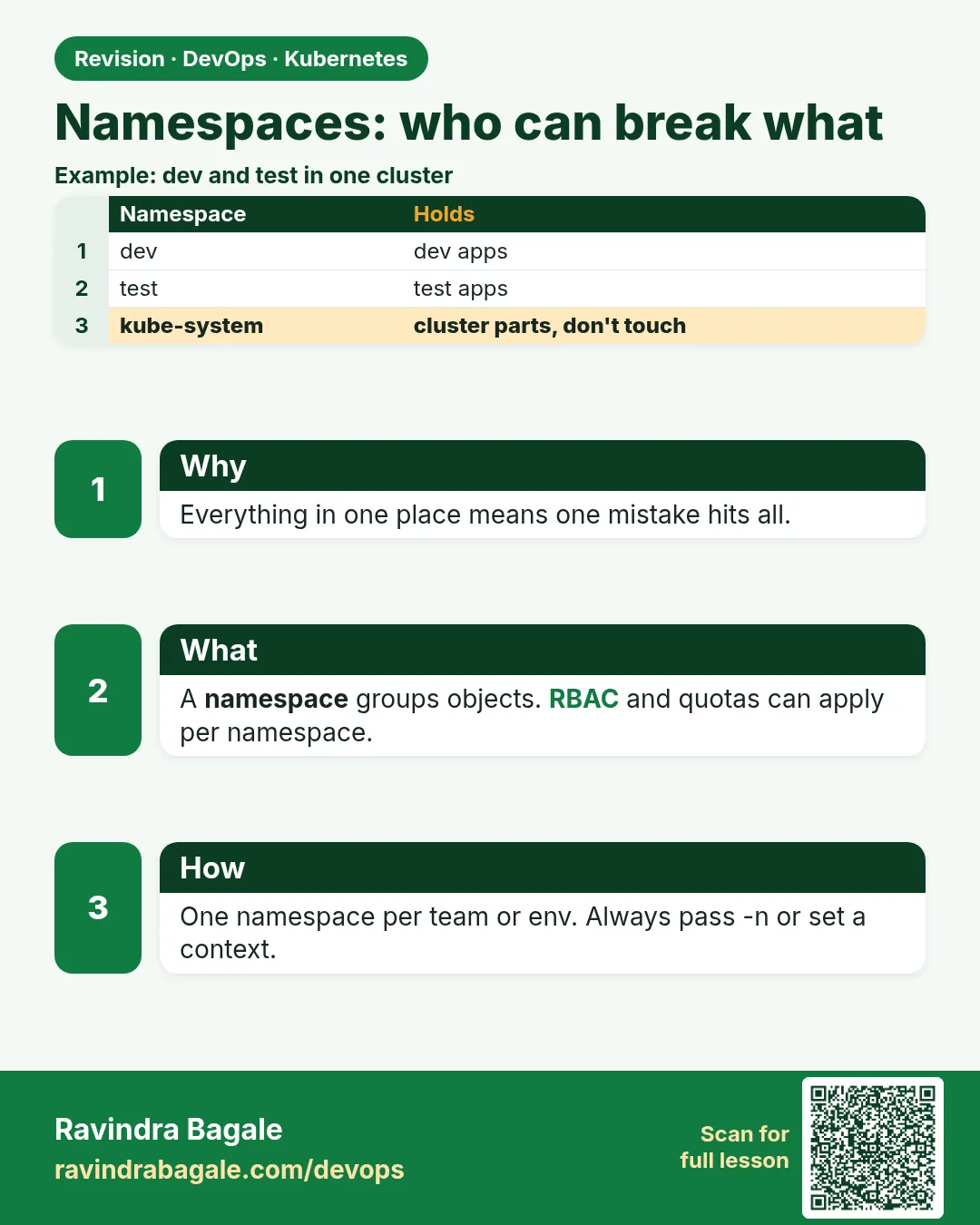 Revision card
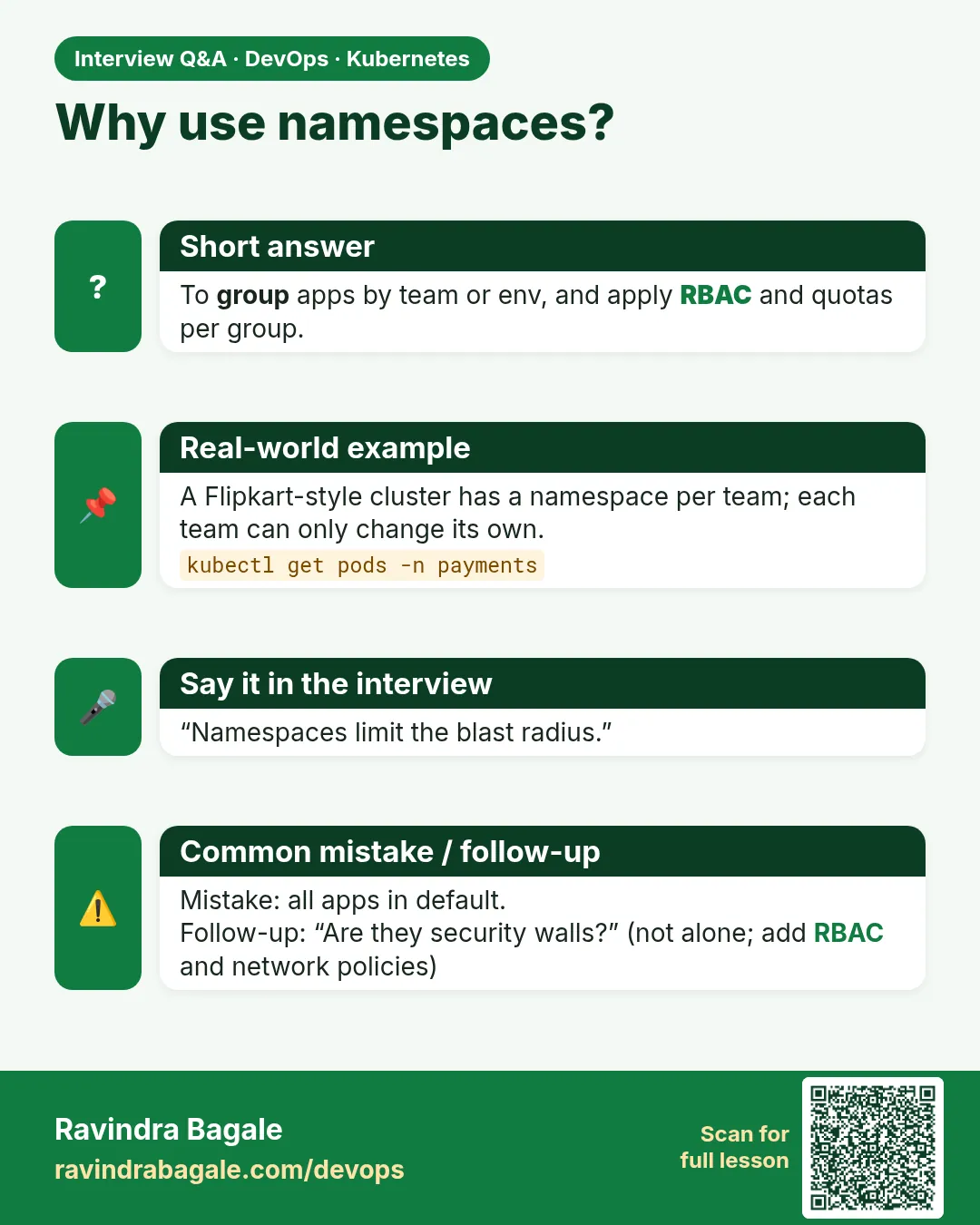 Interview card