Chapter 15: Kubernetes Introduction
15.12c Resource requests (awareness)
Why: the problem
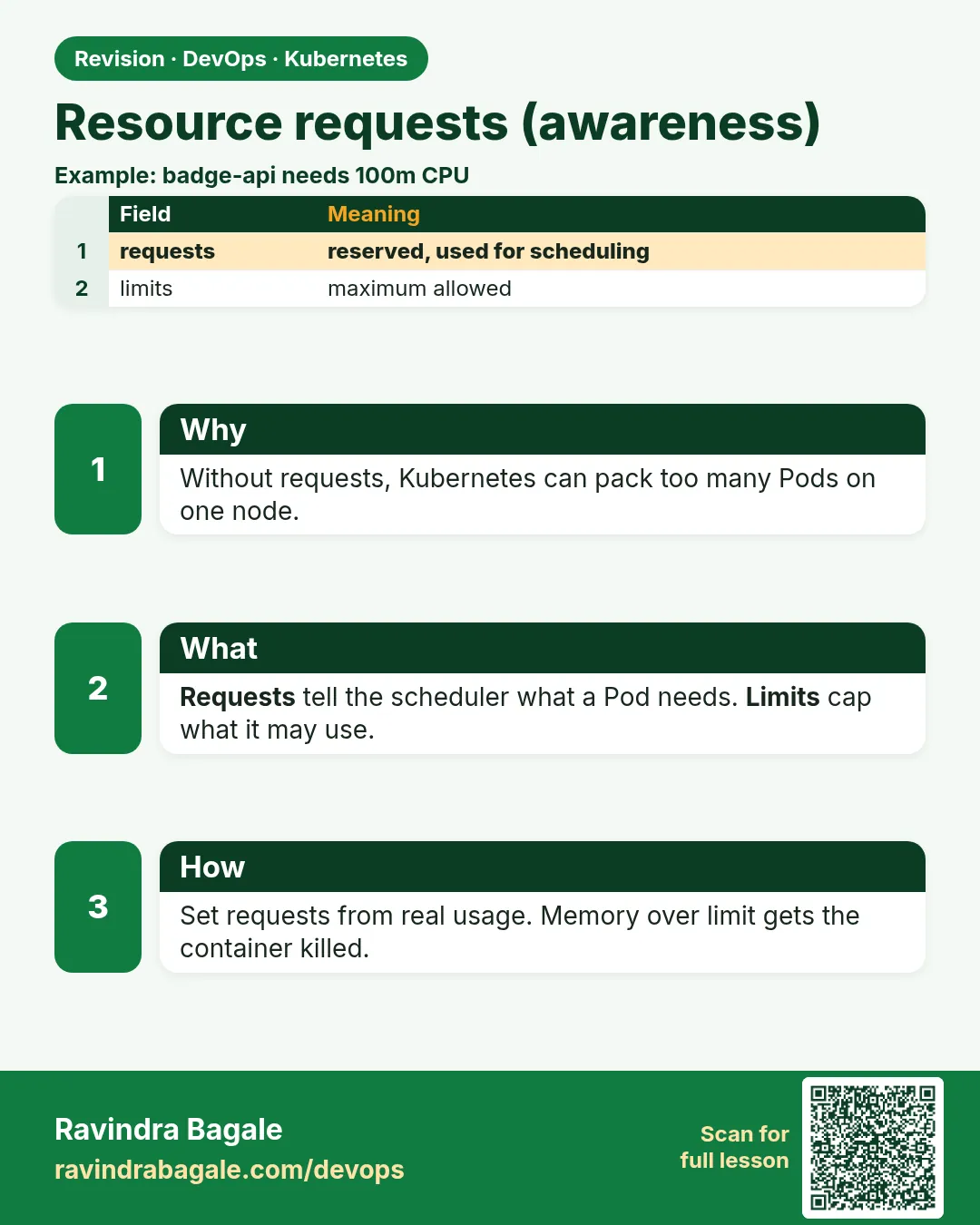
Suppose we are on the BookMyShow team. On a big movie release night, one Java Pod uses all the memory on a node, and the other apps on that node die. Kubernetes did not know how much each app needs. Requests tell the scheduler what an app needs. Limits say the most it may use.
What we will build
You will set requests and limits for all three stacks, see them in node usage, and cause an OOMKilled on purpose.
What: every term in plain English
- Request — The amount of CPU or memory reserved for the container. Used for scheduling.
- Limit — The maximum. CPU is slowed above it; memory over it is killed.
- m (millicores) — 1000m is one CPU core. 100m is one tenth.
- Mi — Mebibytes of memory. 128Mi is about 134 MB.
- QoS class — Guaranteed, Burstable or BestEffort, based on requests and limits.
- metrics-server — An add-on that gives kubectl top.
How: step by step
-
Install metrics-server in kind
kubectl apply -f metrics-server.yaml   # components.yaml saved from the official metrics-server docs
kubectl -n kube-system patch deploy metrics-server --type=json -p='[{"op":"add","path":"/spec/template/spec/containers/0/args/-","value":"--kubelet-insecure-tls"}]'
What it does: Gives CPU and memory numbers. The flag is for kind labs only.
Output
deployment.apps/metrics-server patched -
Apply with resources
kubectl apply -f k8s/badge-node.yamlWhat it does: Pods now have requests and limits.
Output
deployment.apps/badge-node configured -
See usage
kubectl top podsWhat it does: Real use next to your numbers.
Output
NAME CPU(cores) MEMORY(bytes) badge-node-6d9f7c8b5-4kq2x 2m 38Mi -
See the QoS class
kubectl get pod -l app=badge-node -o jsonpath="{.items[0].status.qosClass}"What it does: Requests less than limits gives Burstable.
Output
Burstable -
See node allocation
kubectl describe node badge-api-worker | grep -A6 "Allocated resources"What it does: How much is reserved on the node.
Output
cpu 300m (3%) memory 384Mi (4%) -
Cause OOMKilled
kubectl set resources deploy/badge-java --limits=memory=64MiWhat it does: Java needs more than 64Mi.
Output
deployment.apps/badge-java resource requirements updated -
Read the reason
kubectl describe pod -l app=badge-java | grep -A2 "Last State"What it does: Proof of the memory kill.
Output
Last State:  Terminated
  Reason:     OOMKilled
  Exit Code:  137
Example 1: Node
Stack. Node.js 20, Express, kind
Goal. Node.js: badge-node with requests and limits sized for a small API.
server.js
// server.js - badge API (Node.js + Express)
const express = require("express");
const os = require("os");
const app = express();
app.get("/health", (req, res) => res.json({ status: "ok" }));
app.get("/badge/:user", (req, res) => {
  const user = req.params.user;
  if (!/^[a-z0-9_]{3,30}$/.test(user)) return res.status(400).json({ error: "invalid username" });
  res.json({ user, badge: "verified-learner", pod: os.hostname(), version: process.env.APP_VERSION || "1.0" });
});
app.listen(process.env.PORT || 3000, () => console.log("badge-node listening on 3000"));
Dockerfile
# Dockerfile - Node badge API
FROM node:20-alpine
WORKDIR /app
COPY package*.json ./
RUN npm ci --omit=dev
COPY server.js .
USER node
EXPOSE 3000
CMD ["node", "server.js"]
k8s/badge-node.yaml
apiVersion: apps/v1
kind: Deployment
metadata:
  name: badge-node
  namespace: badge-api
  labels: { app: badge-node }
spec:
  replicas: 2
  selector:
    matchLabels: { app: badge-node }
  template:
    metadata:
      labels: { app: badge-node }
    spec:
      containers:
        - name: api
          image: badge-node:1.0
          ports:
            - containerPort: 3000
          resources:
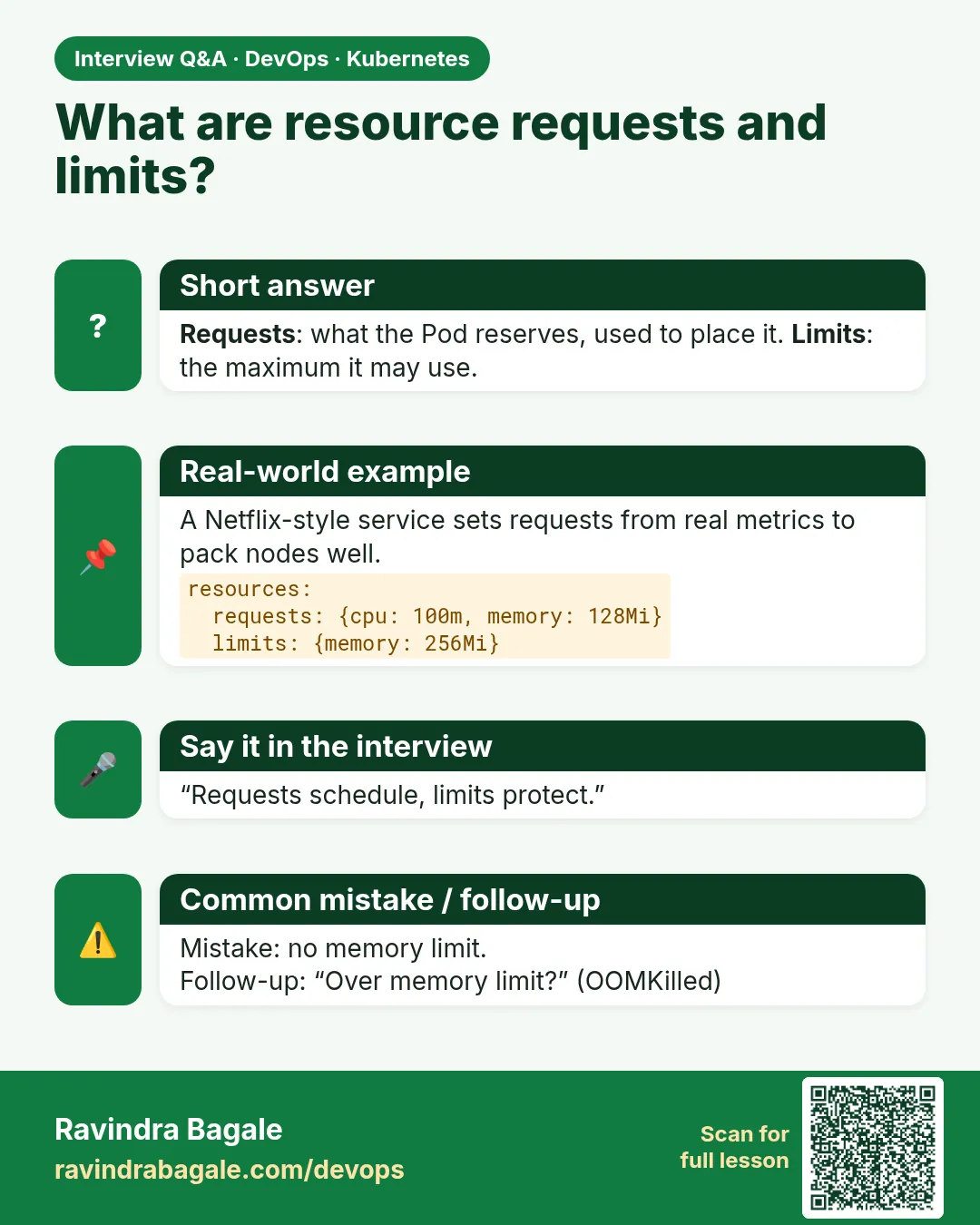
            requests: { cpu: "100m", memory: "128Mi" }
            limits:   { cpu: "500m", memory: "256Mi" }
---
apiVersion: v1
kind: Service
metadata:
  name: badge-node
  namespace: badge-api
spec:
  type: ClusterIP
  selector: { app: badge-node }
  ports:
    - port: 80
      targetPort: 3000
What each line does
kind: Deployment— Tells Kubernetes: keep this many copies of the Pod running all the time.replicas: 2— Two Pods. If one dies, Kubernetes makes a new one.selector.matchLabels— The Deployment owns Pods that carry this label.image: ...:1.0— A fixed tag. Never use latest, because you cannot tell what is running.kind: Service / type: ClusterIP— One stable name and IP inside the cluster in front of all matching Pods.port: 80 / targetPort— Callers use port 80. The Service sends traffic to the app port inside the Pod.requests cpu 100m memory 128Mi— Scheduler reserves this.limits cpu 500m memory 256Mi— Hard maximum. Over memory means OOMKilled.
Green output
$ kubectl -n badge-api get pods -l app=badge-node
NAME                          READY   STATUS    RESTARTS   AGE
badge-node-6d9f7c8b5-4kq2x     1/1     Running   0          40s
badge-node-6d9f7c8b5-r7m9t     1/1     Running   0          40s
$ curl -s localhost:8080/badge/ravi
{"user":"ravi","badge":"verified-learner","pod":"badge-node-6d9f7c8b5-4kq2x","version":"1.0"}
Expected result. kubectl top shows Node.js below its limits and the Pod is Burstable.
Example 2: Python: badge-py with requests and limits sized for a small API
Stack. Python 3.12, Flask, gunicorn, kind
Goal. Python: badge-py with requests and limits sized for a small API.
app.py
# app.py - badge API (Python + Flask)
import os, re, socket
from flask import Flask, jsonify
app = Flask(__name__)

@app.get("/health")
def health():
    return jsonify(status="ok")

@app.get("/badge/<user>")
def badge(user):
    if not re.fullmatch(r"[a-z0-9_]{3,30}", user):
        return jsonify(error="invalid username"), 400
    return jsonify(user=user, badge="verified-learner", pod=socket.gethostname(),
                   version=os.environ.get("APP_VERSION", "1.0"))
Dockerfile
# Dockerfile - Python badge API
FROM python:3.12-slim
WORKDIR /app
COPY requirements.txt .
RUN pip install --no-cache-dir -r requirements.txt   # flask, gunicorn
COPY app.py .
RUN useradd -u 10001 app
USER 10001
EXPOSE 5000
CMD ["gunicorn", "-b", "0.0.0.0:5000", "app:app"]
k8s/badge-py.yaml
apiVersion: apps/v1
kind: Deployment
metadata:
  name: badge-py
  namespace: badge-api
  labels: { app: badge-py }
spec:
  replicas: 2
  selector:
    matchLabels: { app: badge-py }
  template:
    metadata:
      labels: { app: badge-py }
    spec:
      containers:
        - name: api
          image: badge-py:1.0
          ports:
            - containerPort: 5000
          resources:
            requests: { cpu: "100m", memory: "128Mi" }
            limits:   { cpu: "500m", memory: "256Mi" }
---
apiVersion: v1
kind: Service
metadata:
  name: badge-py
  namespace: badge-api
spec:
  type: ClusterIP
  selector: { app: badge-py }
  ports:
    - port: 80
      targetPort: 5000
What each line does
kind: Deployment— Tells Kubernetes: keep this many copies of the Pod running all the time.replicas: 2— Two Pods. If one dies, Kubernetes makes a new one.selector.matchLabels— The Deployment owns Pods that carry this label.image: ...:1.0— A fixed tag. Never use latest, because you cannot tell what is running.kind: Service / type: ClusterIP— One stable name and IP inside the cluster in front of all matching Pods.port: 80 / targetPort— Callers use port 80. The Service sends traffic to the app port inside the Pod.requests cpu 100m memory 128Mi— Scheduler reserves this.limits cpu 500m memory 256Mi— Hard maximum. Over memory means OOMKilled.
Green output
$ kubectl -n badge-api get pods -l app=badge-py
NAME                          READY   STATUS    RESTARTS   AGE
badge-py-6d9f7c8b5-4kq2x     1/1     Running   0          40s
badge-py-6d9f7c8b5-r7m9t     1/1     Running   0          40s
$ curl -s localhost:8080/badge/ravi
{"user":"ravi","badge":"verified-learner","pod":"badge-py-6d9f7c8b5-4kq2x","version":"1.0"}
Expected result. kubectl top shows Python below its limits and the Pod is Burstable.
Example 3: Java: badge-java with requests and limits sized for a small API
Stack. Java 21, Spring Boot, kind
Goal. Java: badge-java with requests and limits sized for a small API.
BadgeController.java
// src/main/java/com/shipit/BadgeController.java - badge API (Java + Spring Boot)
package com.shipit;
import org.springframework.web.bind.annotation.*;
import java.net.InetAddress;
import java.util.Map;

@RestController
public class BadgeController {
  @GetMapping("/health")
  public Map<String, String> health() { return Map.of("status", "ok"); }

  @GetMapping("/badge/{user}")
  public Map<String, String> badge(@PathVariable String user) throws Exception {
    if (!user.matches("[a-z0-9_]{3,30}")) throw new IllegalArgumentException("invalid username");
    String v = System.getenv().getOrDefault("APP_VERSION", "1.0");
    return Map.of("user", user, "badge", "verified-learner",
                  "pod", InetAddress.getLocalHost().getHostName(), "version", v);
  }
}
Dockerfile
# Dockerfile - Java badge API (two stages: build, then run)
FROM maven:3.9-eclipse-temurin-21 AS build
WORKDIR /src
COPY pom.xml .
COPY src ./src
RUN mvn -B -q package -DskipTests

FROM eclipse-temurin:21-jre
WORKDIR /app
COPY --from=build /src/target/badge-api.jar app.jar
RUN useradd -u 10001 app
USER 10001
EXPOSE 8080
CMD ["java", "-jar", "app.jar"]
k8s/badge-java.yaml
apiVersion: apps/v1
kind: Deployment
metadata:
  name: badge-java
  namespace: badge-api
  labels: { app: badge-java }
spec:
  replicas: 2
  selector:
    matchLabels: { app: badge-java }
  template:
    metadata:
      labels: { app: badge-java }
    spec:
      containers:
        - name: api
          image: badge-java:1.0
          ports:
            - containerPort: 8080
          resources:
            requests: { cpu: "100m", memory: "128Mi" }
            limits:   { cpu: "500m", memory: "256Mi" }
---
apiVersion: v1
kind: Service
metadata:
  name: badge-java
  namespace: badge-api
spec:
  type: ClusterIP
  selector: { app: badge-java }
  ports:
    - port: 80
      targetPort: 8080
What each line does
kind: Deployment— Tells Kubernetes: keep this many copies of the Pod running all the time.replicas: 2— Two Pods. If one dies, Kubernetes makes a new one.selector.matchLabels— The Deployment owns Pods that carry this label.image: ...:1.0— A fixed tag. Never use latest, because you cannot tell what is running.kind: Service / type: ClusterIP— One stable name and IP inside the cluster in front of all matching Pods.port: 80 / targetPort— Callers use port 80. The Service sends traffic to the app port inside the Pod.requests cpu 100m memory 128Mi— Scheduler reserves this.limits cpu 500m memory 256Mi— Hard maximum. Over memory means OOMKilled.
Green output
$ kubectl -n badge-api get pods -l app=badge-java
NAME                          READY   STATUS    RESTARTS   AGE
badge-java-6d9f7c8b5-4kq2x     1/1     Running   0          40s
badge-java-6d9f7c8b5-r7m9t     1/1     Running   0          40s
$ curl -s localhost:8080/badge/ravi
{"user":"ravi","badge":"verified-learner","pod":"badge-java-6d9f7c8b5-4kq2x","version":"1.0"}
Expected result. kubectl top shows Java below its limits and the Pod is Burstable.
Verify: did it work?
-
List everything in the namespace
kubectl -n badge-api get allWhat it does: Shows Deployments, ReplicaSets, Pods and Services together.
Output
NAME READY STATUS RESTARTS AGE pod/badge-node-6d9f7c8b5-4kq2x 1/1 Running 0 2m NAME TYPE CLUSTER-IP PORT(S) service/badge-node ClusterIP 10.96.41.12 80/TCP -
Check that the Service found the Pods
kubectl -n badge-api get endpoints badge-nodeWhat it does: Endpoints are the Pod IPs behind the Service. Empty means the labels do not match.
Output
NAME ENDPOINTS AGE badge-node 10.244.0.5:3000,10.244.0.6:3000 2m -
Call the app through the Service
kubectl -n badge-api port-forward svc/badge-node 8080:80 &
curl -s localhost:8080/health
What it does: Opens a tunnel from your laptop to the Service, then calls it.
Output
Forwarding from 127.0.0.1:8080 -> 3000
{"status":"ok"}
When it is red 1
error: Metrics API not available
Cause. metrics-server is not running.
Fix, step by step
- Install it as in step 1.
- Wait one minute.
- Run kubectl top pods again.
When it is red 2
Last State: Terminated Reason: OOMKilled Exit Code: 137
Cause. Memory limit too small.
Fix, step by step
- Raise limits.memory.
- For Java, set JAVA_TOOL_OPTIONS=-XX:MaxRAMPercentage=75.
When it is red 3
0/3 nodes are available: 3 Insufficient cpu.
Cause. Requests are larger than free CPU.
Fix, step by step
- Lower requests.cpu.
- Or remove other workloads.
Cleanup
-
Stop the port-forward
kill %1What it does: Ends the background tunnel.
Output
[1]+ Terminated kubectl port-forward svc/badge-node 8080:80 -
Delete the lesson objects
kubectl delete -f k8s/What it does: Removes what you applied. The cluster stays for the next lesson.
Output
deployment.apps "badge-node" deleted service "badge-node" deleted -
Delete the cluster at the end of the day
kind delete cluster --name badge-apiWhat it does: Removes the kind node container and frees memory.
Output
Deleting cluster "badge-api" ...
Deleted nodes: ["badge-api-control-plane"]
Practice tasks
Easy Read kubectl top
Why: Know real use.
What to do: Run kubectl top pods.
- Note CPU and memory.
Check: You have numbers per stack.
Medium Make Guaranteed QoS
Why: Learn QoS.
What to do: Set requests equal to limits.
- Edit YAML.
- Read qosClass.
Check: Guaranteed.
Hard Add a LimitRange
Why: Defaults for the namespace.
What to do: Create a LimitRange with default limits.
- kubectl apply a LimitRange YAML.
- Create a Pod with no resources.
Check: Pod gets the defaults.
Easy Say requests and limits in two lines
Why: If you can say it simply, you understand it.
What to do: Write two short lines about requests and limits for a fresher.
- Write the problem it solves.
- Write the one command or field you use.
Check: A friend who never used Kubernetes understands your lines.
Easy Rebuild the kind cluster from zero
Why: Labs break. Starting fresh must feel easy.
What to do: Delete and create the badge-api kind cluster again.
- kind delete cluster --name badge-api
- kind create cluster --name badge-api
- kubectl get nodes
Check: The node shows Ready in under two minutes.
Medium Do it for the second stack
Why: The same Kubernetes idea works for every language.
What to do: Repeat this lesson with the Python app if you used Node, or Java if you used Python.
- Build the image with a 1.0 tag.
- kind load docker-image the image.
- Apply the YAML and curl it.
Check: curl returns JSON from the second stack.
Medium Break it and read describe
Why: Real work is mostly reading errors.
What to do: Put a wrong image tag in the YAML and apply it.
- Change the tag to 9.9.
- kubectl apply -f the file.
- kubectl describe pod on the new Pod and read Events.
Check: You can point to the exact Events line that names the problem.
Medium Write the cleanup in one go
Why: Old labs fill the laptop disk.
What to do: Write the commands that remove everything this lesson made.
- kubectl delete -f k8s/
- kubectl get all -n badge-api
- docker image prune
Check: kubectl get all -n badge-api shows no resources.
Hard Explain it like an interview
Why: Interviewers ask what you did, not what you read.
What to do: Record a 60 second answer about this lesson.
- Say the problem.
- Say the YAML field or command.
- Say one error you hit and how you fixed it.
Check: Your answer has a real command and a real error in it.
Hard Draw the flow top to bottom
Why: A drawing shows if you know the order of things.
What to do: Draw this lesson as boxes from top to bottom on paper.
- Start from the user curl.
- Go through Service, Pod, container.
- Mark where your error happened.
Check: Every arrow on your drawing matches a real object in kubectl get all.
Homework: try at home
Try at home
At home, measure each stack with kubectl top at idle and under 100 curls, then set requests a bit above idle and limits about twice peak.
Recap
- Requests are for scheduling.
- Limits are a hard cap.
- Memory over limit kills; CPU over limit throttles.
- Measure with kubectl top before choosing numbers.
- Java usually needs more memory than Node or Python.
FAQ
Should I set CPU limits?
Many teams set requests always and CPU limits with care, since throttling can slow apps.
How do I pick numbers?
Measure, then add headroom.
Why is Java bigger?
The JVM reserves heap and metaspace.
What is a ResourceQuota?
A total cap for a namespace.
Does kind enforce limits?
Yes, it uses real cgroups.
Interview questions
-
Requests vs limits?
Requests reserve capacity for scheduling; limits cap usage.
-
What is OOMKilled?
The container passed its memory limit and was killed, exit code 137.
-
QoS classes?
Guaranteed, Burstable, BestEffort.
-
What is CPU throttling?
Slowing a container that uses more CPU than its limit.
-
LimitRange vs ResourceQuota?
LimitRange sets per-container defaults and bounds; ResourceQuota caps namespace totals.
Quick quiz
Q1. What does the scheduler use?
Requests.
Q2. What happens above the memory limit?
OOMKilled.
Q3. What happens above the CPU limit?
The container is slowed (throttled).
Q4. What is 250m?
A quarter of one CPU core.
Q5. Which QoS when requests equal limits?
Guaranteed.
Did you understand? Let us try it once more.
 Revision card
 Interview card