Chapter 15: Kubernetes Introduction
15.12d Loading a local image into kind (common lab snag)
Why: the problem
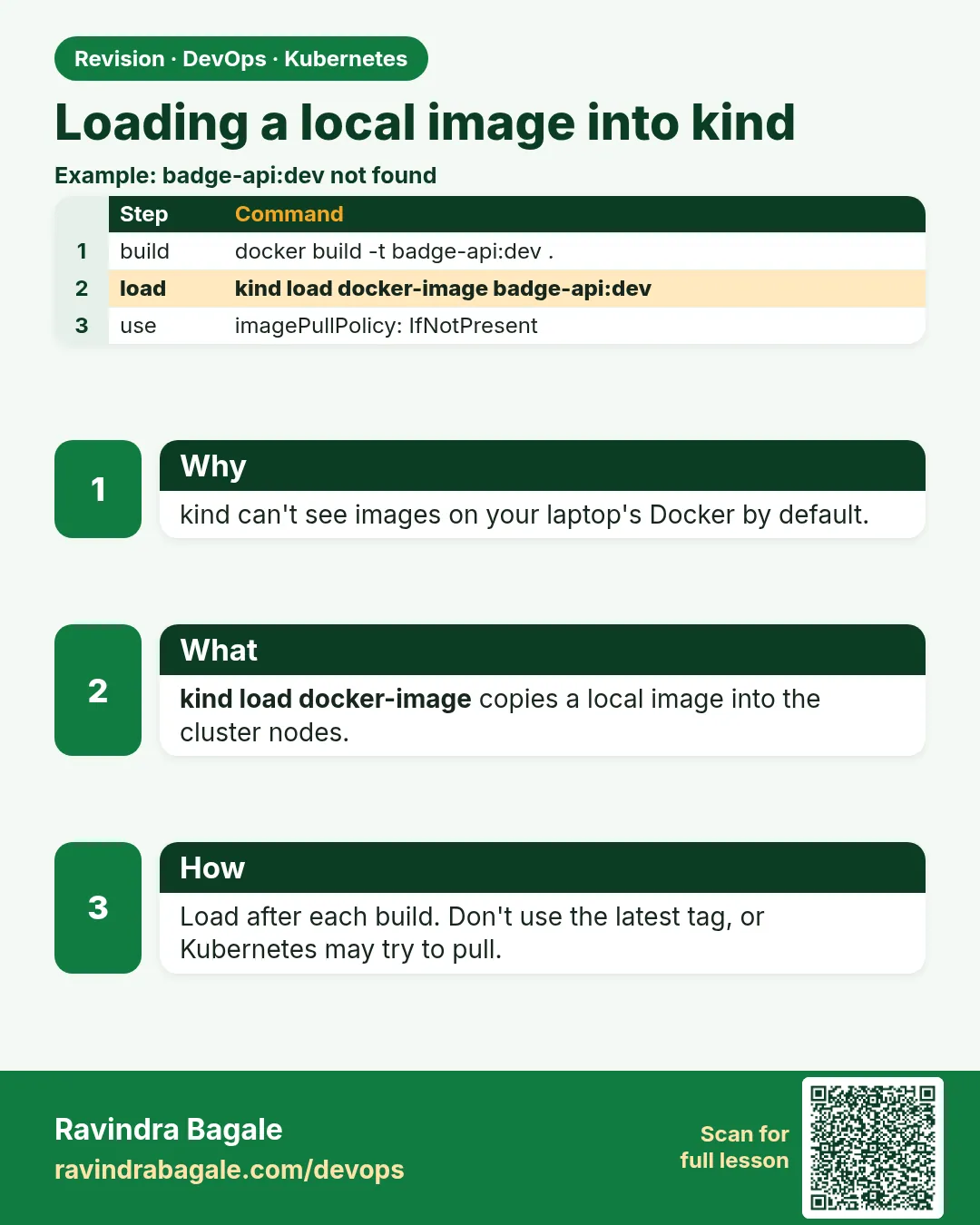
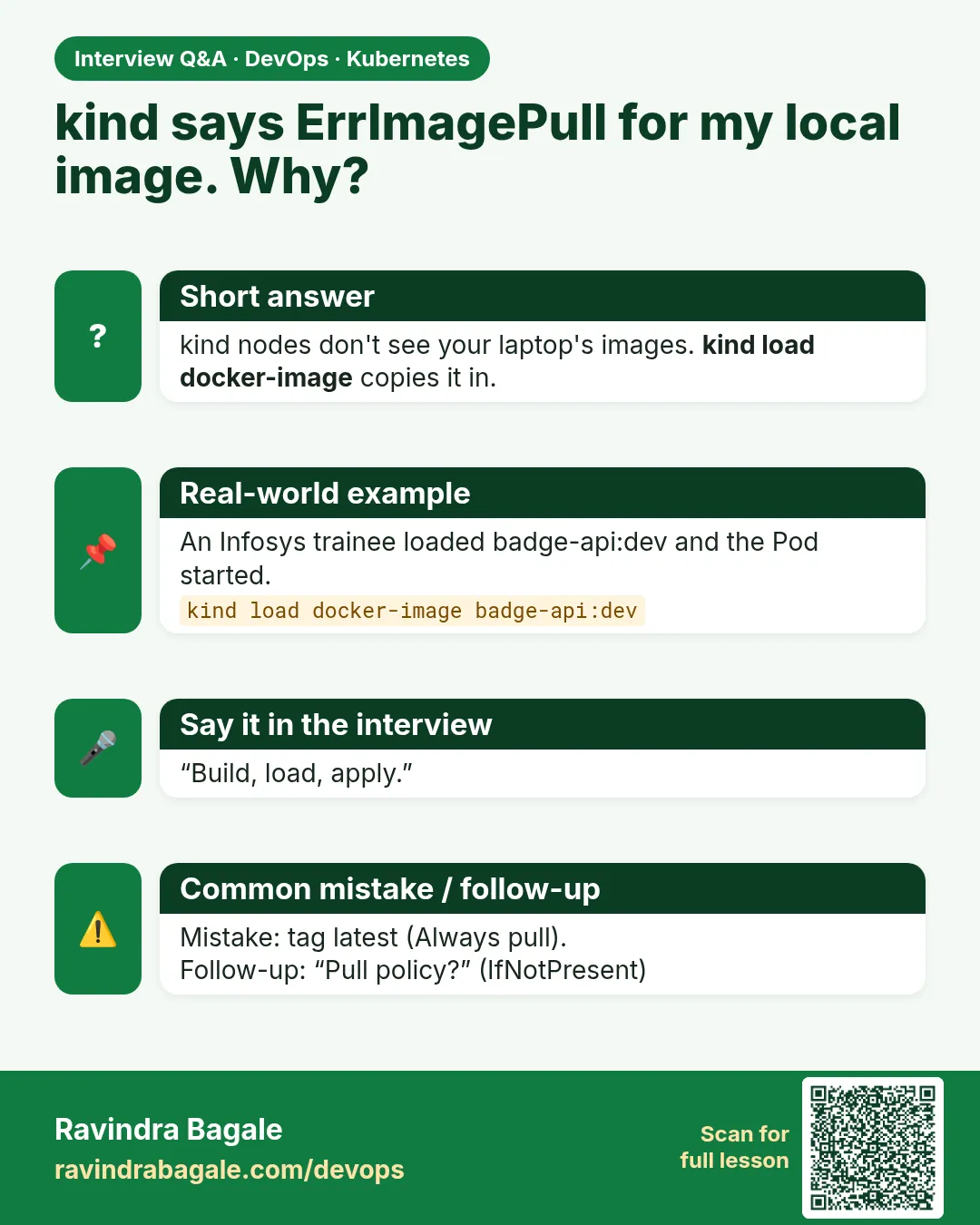
Suppose we just built badge-node:1.0 on our laptop and applied the YAML to kind. The Pod says ErrImageNeverPull or ImagePullBackOff. But docker images shows the image! The reason: kind nodes are separate containers with their own image store. They cannot see your laptop images. You must load the image into kind, or push it to a registry.
What we will build
You will hit this error for each stack, load the image with kind load, and also try a local registry option.
What: every term in plain English
- Image store — Where a node keeps its images. Each kind node has its own.
- kind load docker-image — Copies a local image into kind nodes.
- imagePullPolicy — When to pull: Always, IfNotPresent, Never.
- Registry — A server that stores images, such as Docker Hub or ECR.
- crictl — A tool inside the node to list images.
How: step by step
-
Build the image
docker build -t badge-node:1.0 .What it does: Image exists on your laptop only.
Output
naming to docker.io/library/badge-node:1.0 done -
Apply and see the error
kubectl apply -f k8s/badge-node.yaml
kubectl get pods
What it does: Node cannot find the image.
Output
badge-node-6d9f7c8b5-4kq2x 0/1 ErrImagePull 0 10s -
Look inside the node
docker exec badge-api-control-plane crictl images | grep badgeWhat it does: Empty: the node does not have it.
Output
(no output) -
Load the image
kind load docker-image badge-node:1.0 --name badge-apiWhat it does: Copies it into every node.
Output
Image: "badge-node:1.0" with ID "sha256:3f1a..." not yet present on node "badge-api-worker", loading... -
Check inside the node again
docker exec badge-api-control-plane crictl images | grep badgeWhat it does: Now it is there.
Output
docker.io/library/badge-node 1.0 3f1a2b4c5d6e 48MB -
Restart the rollout
kubectl rollout restart deploy/badge-nodeWhat it does: New Pods find the image.
Output
deployment.apps/badge-node restarted -
Confirm
kubectl get podsWhat it does: Running.
Output
badge-node-7a8b9c0d1-k2l3m 1/1 Running 0 8s
Example 1: Node
Stack. Node.js 20, Express, kind
Goal. Node.js: build badge-node:1.0, load it into kind and run it with imagePullPolicy IfNotPresent.
server.js
// server.js - badge API (Node.js + Express)
const express = require("express");
const os = require("os");
const app = express();
app.get("/health", (req, res) => res.json({ status: "ok" }));
app.get("/badge/:user", (req, res) => {
  const user = req.params.user;
  if (!/^[a-z0-9_]{3,30}$/.test(user)) return res.status(400).json({ error: "invalid username" });
  res.json({ user, badge: "verified-learner", pod: os.hostname(), version: process.env.APP_VERSION || "1.0" });
});
app.listen(process.env.PORT || 3000, () => console.log("badge-node listening on 3000"));
Dockerfile
# Dockerfile - Node badge API
FROM node:20-alpine
WORKDIR /app
COPY package*.json ./
RUN npm ci --omit=dev
COPY server.js .
USER node
EXPOSE 3000
CMD ["node", "server.js"]
k8s/badge-node.yaml
apiVersion: apps/v1
kind: Deployment
metadata:
  name: badge-node
  namespace: badge-api
  labels: { app: badge-node }
spec:
  replicas: 2
  selector:
    matchLabels: { app: badge-node }
  template:
    metadata:
      labels: { app: badge-node }
    spec:
      containers:
        - name: api
          image: badge-node:1.0
          imagePullPolicy: IfNotPresent
          ports:
            - containerPort: 3000
---
apiVersion: v1
kind: Service
metadata:
  name: badge-node
  namespace: badge-api
spec:
  type: ClusterIP
  selector: { app: badge-node }
  ports:
    - port: 80
      targetPort: 3000
What each line does
kind: Deployment— Tells Kubernetes: keep this many copies of the Pod running all the time.replicas: 2— Two Pods. If one dies, Kubernetes makes a new one.selector.matchLabels— The Deployment owns Pods that carry this label.image: ...:1.0— A fixed tag. Never use latest, because you cannot tell what is running.kind: Service / type: ClusterIP— One stable name and IP inside the cluster in front of all matching Pods.port: 80 / targetPort— Callers use port 80. The Service sends traffic to the app port inside the Pod.imagePullPolicy: IfNotPresent— Use the loaded image; do not try the internet.
Green output
$ kubectl -n badge-api get pods -l app=badge-node
NAME                          READY   STATUS    RESTARTS   AGE
badge-node-6d9f7c8b5-4kq2x     1/1     Running   0          40s
badge-node-6d9f7c8b5-r7m9t     1/1     Running   0          40s
$ curl -s localhost:8080/badge/ravi
{"user":"ravi","badge":"verified-learner","pod":"badge-node-6d9f7c8b5-4kq2x","version":"1.0"}
Expected result. Node.js Pod Running from the loaded image.
Example 2: Python: build badge-py:1
Stack. Python 3.12, Flask, gunicorn, kind
Goal. Python: build badge-py:1.0, load it into kind and run it with imagePullPolicy IfNotPresent.
app.py
# app.py - badge API (Python + Flask)
import os, re, socket
from flask import Flask, jsonify
app = Flask(__name__)

@app.get("/health")
def health():
    return jsonify(status="ok")

@app.get("/badge/<user>")
def badge(user):
    if not re.fullmatch(r"[a-z0-9_]{3,30}", user):
        return jsonify(error="invalid username"), 400
    return jsonify(user=user, badge="verified-learner", pod=socket.gethostname(),
                   version=os.environ.get("APP_VERSION", "1.0"))
Dockerfile
# Dockerfile - Python badge API
FROM python:3.12-slim
WORKDIR /app
COPY requirements.txt .
RUN pip install --no-cache-dir -r requirements.txt   # flask, gunicorn
COPY app.py .
RUN useradd -u 10001 app
USER 10001
EXPOSE 5000
CMD ["gunicorn", "-b", "0.0.0.0:5000", "app:app"]
k8s/badge-py.yaml
apiVersion: apps/v1
kind: Deployment
metadata:
  name: badge-py
  namespace: badge-api
  labels: { app: badge-py }
spec:
  replicas: 2
  selector:
    matchLabels: { app: badge-py }
  template:
    metadata:
      labels: { app: badge-py }
    spec:
      containers:
        - name: api
          image: badge-py:1.0
          imagePullPolicy: IfNotPresent
          ports:
            - containerPort: 5000
---
apiVersion: v1
kind: Service
metadata:
  name: badge-py
  namespace: badge-api
spec:
  type: ClusterIP
  selector: { app: badge-py }
  ports:
    - port: 80
      targetPort: 5000
What each line does
kind: Deployment— Tells Kubernetes: keep this many copies of the Pod running all the time.replicas: 2— Two Pods. If one dies, Kubernetes makes a new one.selector.matchLabels— The Deployment owns Pods that carry this label.image: ...:1.0— A fixed tag. Never use latest, because you cannot tell what is running.kind: Service / type: ClusterIP— One stable name and IP inside the cluster in front of all matching Pods.port: 80 / targetPort— Callers use port 80. The Service sends traffic to the app port inside the Pod.imagePullPolicy: IfNotPresent— Use the loaded image; do not try the internet.
Green output
$ kubectl -n badge-api get pods -l app=badge-py
NAME                          READY   STATUS    RESTARTS   AGE
badge-py-6d9f7c8b5-4kq2x     1/1     Running   0          40s
badge-py-6d9f7c8b5-r7m9t     1/1     Running   0          40s
$ curl -s localhost:8080/badge/ravi
{"user":"ravi","badge":"verified-learner","pod":"badge-py-6d9f7c8b5-4kq2x","version":"1.0"}
Expected result. Python Pod Running from the loaded image.
Example 3: Java: build badge-java:1
Stack. Java 21, Spring Boot, kind
Goal. Java: build badge-java:1.0, load it into kind and run it with imagePullPolicy IfNotPresent.
BadgeController.java
// src/main/java/com/shipit/BadgeController.java - badge API (Java + Spring Boot)
package com.shipit;
import org.springframework.web.bind.annotation.*;
import java.net.InetAddress;
import java.util.Map;

@RestController
public class BadgeController {
  @GetMapping("/health")
  public Map<String, String> health() { return Map.of("status", "ok"); }

  @GetMapping("/badge/{user}")
  public Map<String, String> badge(@PathVariable String user) throws Exception {
    if (!user.matches("[a-z0-9_]{3,30}")) throw new IllegalArgumentException("invalid username");
    String v = System.getenv().getOrDefault("APP_VERSION", "1.0");
    return Map.of("user", user, "badge", "verified-learner",
                  "pod", InetAddress.getLocalHost().getHostName(), "version", v);
  }
}
Dockerfile
# Dockerfile - Java badge API (two stages: build, then run)
FROM maven:3.9-eclipse-temurin-21 AS build
WORKDIR /src
COPY pom.xml .
COPY src ./src
RUN mvn -B -q package -DskipTests

FROM eclipse-temurin:21-jre
WORKDIR /app
COPY --from=build /src/target/badge-api.jar app.jar
RUN useradd -u 10001 app
USER 10001
EXPOSE 8080
CMD ["java", "-jar", "app.jar"]
k8s/badge-java.yaml
apiVersion: apps/v1
kind: Deployment
metadata:
  name: badge-java
  namespace: badge-api
  labels: { app: badge-java }
spec:
  replicas: 2
  selector:
    matchLabels: { app: badge-java }
  template:
    metadata:
      labels: { app: badge-java }
    spec:
      containers:
        - name: api
          image: badge-java:1.0
          imagePullPolicy: IfNotPresent
          ports:
            - containerPort: 8080
---
apiVersion: v1
kind: Service
metadata:
  name: badge-java
  namespace: badge-api
spec:
  type: ClusterIP
  selector: { app: badge-java }
  ports:
    - port: 80
      targetPort: 8080
What each line does
kind: Deployment— Tells Kubernetes: keep this many copies of the Pod running all the time.replicas: 2— Two Pods. If one dies, Kubernetes makes a new one.selector.matchLabels— The Deployment owns Pods that carry this label.image: ...:1.0— A fixed tag. Never use latest, because you cannot tell what is running.kind: Service / type: ClusterIP— One stable name and IP inside the cluster in front of all matching Pods.port: 80 / targetPort— Callers use port 80. The Service sends traffic to the app port inside the Pod.imagePullPolicy: IfNotPresent— Use the loaded image; do not try the internet.
Green output
$ kubectl -n badge-api get pods -l app=badge-java
NAME                          READY   STATUS    RESTARTS   AGE
badge-java-6d9f7c8b5-4kq2x     1/1     Running   0          40s
badge-java-6d9f7c8b5-r7m9t     1/1     Running   0          40s
$ curl -s localhost:8080/badge/ravi
{"user":"ravi","badge":"verified-learner","pod":"badge-java-6d9f7c8b5-4kq2x","version":"1.0"}
Expected result. Java Pod Running from the loaded image.
Verify: did it work?
-
List everything in the namespace
kubectl -n badge-api get allWhat it does: Shows Deployments, ReplicaSets, Pods and Services together.
Output
NAME READY STATUS RESTARTS AGE pod/badge-node-6d9f7c8b5-4kq2x 1/1 Running 0 2m NAME TYPE CLUSTER-IP PORT(S) service/badge-node ClusterIP 10.96.41.12 80/TCP -
Check that the Service found the Pods
kubectl -n badge-api get endpoints badge-nodeWhat it does: Endpoints are the Pod IPs behind the Service. Empty means the labels do not match.
Output
NAME ENDPOINTS AGE badge-node 10.244.0.5:3000,10.244.0.6:3000 2m -
Call the app through the Service
kubectl -n badge-api port-forward svc/badge-node 8080:80 &
curl -s localhost:8080/health
What it does: Opens a tunnel from your laptop to the Service, then calls it.
Output
Forwarding from 127.0.0.1:8080 -> 3000
{"status":"ok"}
When it is red 1
NAME                          READY   STATUS             RESTARTS   AGE
badge-node-7c9d8f6b4-x2k8p    0/1     ImagePullBackOff   0          1m
Cause. The node cannot find the image. In kind, images on your laptop are not inside the cluster until you load them.
Fix, step by step
- Run kubectl describe pod and read the Events at the bottom.
- Check the tag in the YAML matches docker images.
- Run kind load docker-image badge-node:1.0 --name badge-api.
- Run kubectl rollout restart deployment/badge-node -n badge-api.
When it is red 2
Failed to pull image "badge-node:latest": ... pull access denied
Cause. Tag latest makes the default pull policy Always, so the node tries Docker Hub.
Fix, step by step
- Use a fixed tag like 1.0.
- Load that tag with kind load.
When it is red 3
ERROR: image: "badge-py:1.0" not present locally
Cause. You load an image you did not build.
Fix, step by step
- Run docker images | grep badge-py.
- Build it, then load it.
Cleanup
-
Stop the port-forward
kill %1What it does: Ends the background tunnel.
Output
[1]+ Terminated kubectl port-forward svc/badge-node 8080:80 -
Delete the lesson objects
kubectl delete -f k8s/What it does: Removes what you applied. The cluster stays for the next lesson.
Output
deployment.apps "badge-node" deleted service "badge-node" deleted -
Delete the cluster at the end of the day
kind delete cluster --name badge-apiWhat it does: Removes the kind node container and frees memory.
Output
Deleting cluster "badge-api" ...
Deleted nodes: ["badge-api-control-plane"]
Practice tasks
Easy List node images
Why: See the node store.
What to do: Use crictl in the node.
- docker exec badge-api-worker crictl images
Check: You see loaded images.
Medium Load all three
Why: Every stack.
What to do: Load node, py and java images.
- kind load docker-image badge-node:1.0 badge-py:1.0 badge-java:1.0 --name badge-api
Check: All three present.
Hard Use a local registry
Why: Closer to real life.
What to do: Run registry:2 and push to it.
- docker run -d -p 5001:5000 --name kind-registry registry:2
- Follow the kind local registry guide.
Check: Pod pulls from the registry.
Easy Say loading images into kind in two lines
Why: If you can say it simply, you understand it.
What to do: Write two short lines about loading images into kind for a fresher.
- Write the problem it solves.
- Write the one command or field you use.
Check: A friend who never used Kubernetes understands your lines.
Easy Rebuild the kind cluster from zero
Why: Labs break. Starting fresh must feel easy.
What to do: Delete and create the badge-api kind cluster again.
- kind delete cluster --name badge-api
- kind create cluster --name badge-api
- kubectl get nodes
Check: The node shows Ready in under two minutes.
Medium Do it for the second stack
Why: The same Kubernetes idea works for every language.
What to do: Repeat this lesson with the Python app if you used Node, or Java if you used Python.
- Build the image with a 1.0 tag.
- kind load docker-image the image.
- Apply the YAML and curl it.
Check: curl returns JSON from the second stack.
Medium Break it and read describe
Why: Real work is mostly reading errors.
What to do: Put a wrong image tag in the YAML and apply it.
- Change the tag to 9.9.
- kubectl apply -f the file.
- kubectl describe pod on the new Pod and read Events.
Check: You can point to the exact Events line that names the problem.
Medium Write the cleanup in one go
Why: Old labs fill the laptop disk.
What to do: Write the commands that remove everything this lesson made.
- kubectl delete -f k8s/
- kubectl get all -n badge-api
- docker image prune
Check: kubectl get all -n badge-api shows no resources.
Hard Explain it like an interview
Why: Interviewers ask what you did, not what you read.
What to do: Record a 60 second answer about this lesson.
- Say the problem.
- Say the YAML field or command.
- Say one error you hit and how you fixed it.
Check: Your answer has a real command and a real error in it.
Hard Draw the flow top to bottom
Why: A drawing shows if you know the order of things.
What to do: Draw this lesson as boxes from top to bottom on paper.
- Start from the user curl.
- Go through Service, Pod, container.
- Mark where your error happened.
Check: Every arrow on your drawing matches a real object in kubectl get all.
Homework: try at home
Try at home
At home, build 1.1 of the Java image, forget to load it, set it in the Deployment, read the error, then fix it.
Recap
- kind nodes have their own image store.
- Load local images with kind load docker-image.
- Use fixed tags with IfNotPresent.
- latest forces pulls from the internet.
- Production uses a registry.
FAQ
Do I load after every build?
Yes, for each new tag.
Is loading slow?
Large Java images take longer. Keep images small.
Does minikube have the same issue?
Yes, with its own commands.
What about ECR?
In real clusters you push to ECR and nodes pull.
Why not Never?
Never fails if the image is not loaded; IfNotPresent is friendlier.
Interview questions
-
Why ErrImagePull in kind with a local image?
kind nodes do not share the host Docker image store.
-
Explain imagePullPolicy.
Always pulls every time; IfNotPresent uses cache; Never only uses local.
-
Default policy for latest?
Always.
-
How do clusters pull private images?
imagePullSecrets or node IAM roles for registries like ECR.
-
How to speed image pulls?
Small images, layer caching, pre-pulled images.
Quick quiz
Q1. Why can kind not see local images?
Each node has its own image store.
Q2. Which command copies it in?
kind load docker-image.
Q3. Why does latest cause pulls?
Default policy becomes Always.
Q4. How to list images in a node?
docker exec NODE crictl images.
Q5. What is the other option?
Push to a registry.
Did you understand? Let us try it once more.
 Revision card
 Interview card