Chapter 17: Interview Questions and Job Readiness
17.12 Phrases that help (and hurt)
Why: the problem
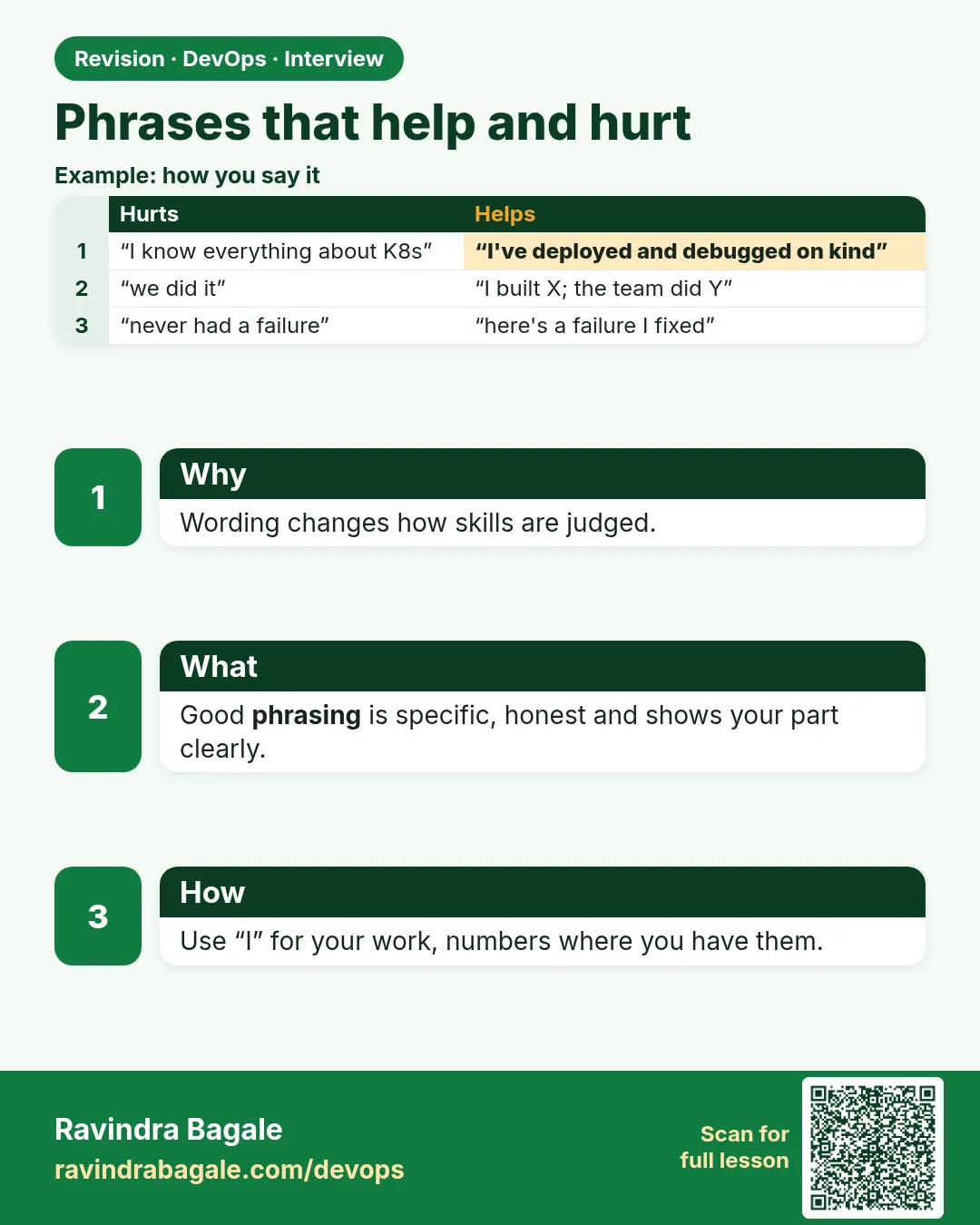
Two freshers know the same things. One gets the job. Often the difference is how they speak. One says "I don't know Kubernetes much, I just did a course". The other says "I have run Kubernetes on kind, deployed a three-tier app and debugged CrashLoopBackOff; I have not run EKS in production yet". Both are honest. The second one is specific. Panels at Wipro, Zoho or a startup listen for phrases that show ownership, evidence and calm. They also notice phrases that hurt: blaming others, guessing without saying so, or saying "we" when they ask what you did. In this lesson you will practise phrases the hands-on way: take real weak answers, rewrite them, run the command that backs the claim, and record both versions.
What we will build
You will build a phrase file with weak and strong pairs. You will write a small script that scans your written answers for weak phrases and suggests better ones. Then you will practise three hard moments: "I don't know", "you are wrong", and "what did YOU do".
What: every term in plain English
- Ownership phrase — A sentence that says what you did, like "I wrote the pipeline".
- Evidence phrase — A sentence with a command, number or file.
- Honest limit — Saying clearly what you have not done yet, then what you know nearby.
- Hedging — Too many "maybe", "I think", "sort of". Sounds unsure.
- Blame language — "The dev team broke it". Panels mark this down.
- Clarifying question — Asking one short question before answering, like "Is this on EC2 or Kubernetes?".
- Thinking aloud — Saying your steps as you go, so the panel can follow and help.
- Closing line — A short end like "That is how I would handle it. Shall I go deeper on any step?"
How: step by step
-
Make the folder
mkdir -p ~/iq/phrases && cd ~/iq/phrasesWhat it does: Files for this lesson.
Output
(no output) -
Create the phrase file
printf "basically|(delete it)\nI think maybe|I would first check\nI don't know|I have not used that yet. The nearest thing I used is\nwe did|I did\nthe dev team broke it|a change in the release caused it\nit will work|I tested it by running\nI am not sure but|My best guess, and how I would confirm it, is\njust restart it|restart to restore service, after saving logs\n" > phrases.txtWhat it does: Weak phrase on the left, strong one on the right.
Output
(no output) -
Write one practice answer
printf "Basically we did the pipeline. I think maybe the error was in Docker. I don't know Helm.\n" > answer1.txtWhat it does: A typical weak answer.
Output
(no output) -
Run the scanner from Example 1
python3 scan.py answer1.txtWhat it does: Shows weak phrases and the fix.
Output
"basically" -> (delete it) "I think maybe" -> I would first check "we did" -> I did "I don't know" -> I have not used that yet. The nearest thing I used is -
Rewrite and scan again
python3 scan.py answer2.txtWhat it does: After your rewrite.
Output
clean: no weak phrases found -
Back the claim with a command
docker images shop --format "{{.Tag}} {{.Size}}"What it does: If you say "I made the image small", show the number.
Output
slim 148MB
Example 1: A weak-phrase scanner for your written answers
Stack. Python
Goal. A weak-phrase scanner for your written answers.
scan.py
import sys
pairs = [l.rstrip("\n").split("|", 1) for l in open("phrases.txt") if "|" in l]
text = open(sys.argv[1]).read().lower()
hits = 0
for weak, strong in pairs:
    if weak.lower() in text:
        print(f'"{weak}" -> {strong}')
        hits += 1
words = len(text.split())
print("clean: no weak phrases found" if hits == 0 else f"{hits} weak phrases in {words} words")
What each line does
pairs— Reads weak and strong phrase pairs.text.lower()— Matches without caring about capital letters.weak in text— Simple search for each weak phrase.print the fix— Shows the better phrase to use.words— Lets you see answer length too.
Green output
4 weak phrases in 19 words
Expected result. A small tool that trains your ear for weak phrases.
Example 2: "I don't know": the honest, strong version
Stack. Kubernetes, Helm
Goal. "I don't know": the honest, strong version.
Weak vs strong
Q: Have you used Helm?

Weak:   "No, I don't know Helm."

Strong: "I have not used Helm in a project yet. I know it packages
         Kubernetes YAML into charts with values files. The nearest
         thing I did is writing Deployments and Services by hand and
         using kustomize overlays for dev and prod. I can show you."
Then show it
kubectl kustomize k8s/overlays/dev | head -12
helm create demo && ls demo        # 2 minutes to show you can learn fast
What each line does
Honest limit first— Never pretend. Panels check.Say what you know about it— One line of correct theory.Nearest experience— Bridges the gap with something real.Offer to show— Confident, practical close.helm create— Shows quick learning in the room if allowed.
Green output
apiVersion: apps/v1
kind: Deployment
...
Chart.yaml  charts  templates  values.yaml
Expected result. You turn a gap into a sign of honesty and fast learning.
Example 3: "You are wrong" and "What did YOU do": two hard moments
Stack. Kubernetes, Git
Goal. "You are wrong" and "What did YOU do": two hard moments.
When the panel disagrees
Panel: "No, a Service finds pods by name, not labels."
Weak:  "Oh, sorry, yes, you are right."   (when you know it is labels)
Strong:"I understood it uses the label selector. For example,
        kubectl get endpoints web was empty when my selector was
        app=website and pods had app=web. After I fixed the label,
        the endpoint appeared. Happy to show it."
When they ask what you did
Panel: "What was your role in that project?"
Weak:  "We built a CI/CD pipeline and we deployed to EKS."
Strong:"I wrote the GitHub Actions workflow, the Dockerfile and the
        Terraform for the EKS node group. My teammate wrote the app.
        I cut the build time from 9 to 4 minutes with layer caching."
Back it up
kubectl get endpoints web
git log --author="Ravi" --oneline -- ci/ infra/ | head -5
What each line does
Disagree politely with evidence— A command output is stronger than an opinion.Offer to show— Keeps it friendly.I, not we— Panels want your part.Name the files you owned— Specific and checkable.git log --author— Proof of your work in the repo.
Green output
web    10.244.0.7:80
a1c2d3e ci: add docker layer cache
b4e5f6a infra: eks node group
Expected result. Calm, specific and backed by commands.
Verify: did it work?
-
Scan all your answers
for f in answer*.txt; do echo "== $f"; python3 scan.py "$f"; doneWhat it does: Checks every file.
Output
== answer1.txt 4 weak phrases in 19 words == answer2.txt clean: no weak phrases found -
Count "I" vs "we"
grep -ow -i "we" answer2.txt | wc -lWhat it does: Lower is better when they ask about your role.
Output
0
When it is red 1
UnicodeDecodeError when scanning
Cause. The answer file has strange characters from copy and paste.
Fix, step by step
- Save it as UTF-8 text.
- Or open with errors="ignore".
When it is red 2
Scanner says clean but answer still sounds weak
Cause. No evidence in the answer.
Fix, step by step
- Add one command and one number.
- Re-record.
When it is red 3
You freeze when they disagree
Cause. No practice for that moment.
Fix, step by step
- Ask a friend to disagree on purpose.
- Practise "I understood it as..., for example..."
Cleanup
-
Keep the phrase file
ls ~/iq/phrasesWhat it does: Add new weak phrases as you notice them.
Output
answer1.txt answer2.txt phrases.txt scan.py
Ravindra Bagale's Tip
Do not say I do not know. Say I have not used it yet, but nearby I did this — honest and strong.
माहित नाही म्हणू नका. अजून वापरले नाही, पण जवळचं हे केलं आहे असं सांगा — प्रामाणिक आणि strong.
मालूम नहीं मत कहो. अभी इस्तेमाल नहीं किया, लेकिन पास में ये किया है — ऐसा कहो: ईमानदार और strong.
Practice tasks
Medium Ask a clarifying question
Why: Good engineers clarify before solving.
What to do: For five scenario questions, write one clarifying question each.
- Example: "Is this on EC2 or Kubernetes?"
Check: Each question changes how you would answer.
Hard Think aloud on a live lab
Why: Some panels share a terminal.
What to do: Solve lesson 17.3 Break 2 while speaking every step aloud.
- Record it.
- Count silent gaps over 10 seconds.
Check: No silent gap over 10 seconds.
Easy Say Interview phrases in two lines
Why: Interviewers cut you off after 30 seconds. The short version must come first.
What to do: Write a two line answer about Interview phrases for a fresher interview.
- Line 1: the problem it solves.
- Line 2: the one command or file you used.
- Say it aloud with a timer.
Check: You finish inside 30 seconds and you name one real command.
Easy Run the commands, not just read them
Why: An interviewer can tell if you only read. Typing the command once gives you the real output to talk about.
What to do: Run every command in the How part of this lesson on your own lab machine.
- Start a small Ubuntu VM, WSL or EC2 t3.micro.
- Run each step and save the output in notes.txt.
- Mark any output that looks different from the lesson.
Check: notes.txt has the real output of every step.
Medium Break it on purpose
Why: You must know the red error by face. In a live round there is no time to read slowly.
What to do: Cause one error from the "When it is red" part of this lesson and fix it.
- Follow the error section.
- Copy the exact message into your notes.
- Write the fix in one line.
Check: You fixed it using only your notes.
Medium Answer in the 4-line shape
Why: A clear shape makes any answer sound senior: Situation, Check, Fix, Prevent.
What to do: Pick one interview question from this lesson and answer in four lines.
- Situation: what broke.
- Check: the command you ran and what it showed.
- Fix: the change you made.
- Prevent: the alert, test or doc you added.
Check: Each of the four lines has a real noun, like a command, a file or a number.
Medium Mock round with a friend
Why: Speaking is a different skill from knowing. Practice it.
What to do: Let a friend ask you three questions from this lesson.
- Friend picks random questions.
- You answer, friend times you.
- Swap and repeat.
Check: You answer all three without saying "I am not sure" twice.
Hard Whiteboard it top to bottom
Why: Many panels say "draw it". A neat top-to-bottom drawing shows you see the whole flow.
What to do: Draw the main flow of this lesson as boxes from top to bottom.
- Start at the user or the trigger.
- Add each hop: server, container, pipeline, tool.
- Write the command you use to check each box beside it.
Check: Every box has one check command next to it.
Hard Write a mini runbook
Why: Good engineers leave notes for the next person. Interviewers love to hear that you do this.
What to do: Write a one page runbook for the main scenario in this lesson.
- Title, symptoms, first 3 checks, fix, how to confirm, how to undo.
Check: A teammate can follow it alone at 2 a.m.
Homework: try at home
Try at home
At home, write five answers from lesson 17.9 in a text file, scan them, rewrite, and record both versions. Ask a friend which one sounds like a hire.
Recap
- Specific beats general; evidence beats opinion.
- Say "I" for your work.
- Say honest limits plus nearest experience.
- Disagree politely with a real output.
- Close with an offer to go deeper.
FAQ
Is it rude to ask questions back?
No. One short clarifying question shows maturity.
Can I say "I will Google it"?
Say "I would check the official docs for the exact flag, but the idea is...".
What if I make a mistake mid answer?
Say "Let me correct that" and fix it. It shows care.
How formal should my English be?
Simple and polite. Short sentences are perfect.
Should I use jargon?
Only words you can explain if asked.
Interview questions
-
What did you do in your last project?
Name your files, tools, and one number you improved.
-
Have you used X tool?
Honest yes or no, what you know, nearest experience, offer to show.
-
How do you handle disagreement in a team?
Listen, test both options in a lab, decide with data, write it down.
-
How do you explain a technical issue to a manager?
Impact, cause in one line, what we did, what we will do, in plain words.
-
What do you do when you are stuck?
Time-box 30 minutes, check logs and docs, then ask with what I tried.
-
Why should we trust your estimate?
I break work into small tasks with times, and I flag risks early.
Quick quiz
Q1. Better phrase for "I don't know"?
"I have not used that yet; the nearest thing I used is..."
Q2. "We" or "I" for your role?
"I" for what you did.
Q3. How to disagree with a panel?
Politely, with an example or command output.
Q4. What is hedging?
Too many unsure words like maybe and sort of.
Q5. A good closing line?
"Shall I go deeper on any step?"
Did you understand? Let us try it once more.
 Revision card
 Interview card