Chapter 88: Amazon EKS for DevOps
88.11 Comparison, interview questions and revision
Comparison — EKS vs self-managed vs ECS (preview)
Use the card below (loads from your S3 cards bucket). Then read the short table.
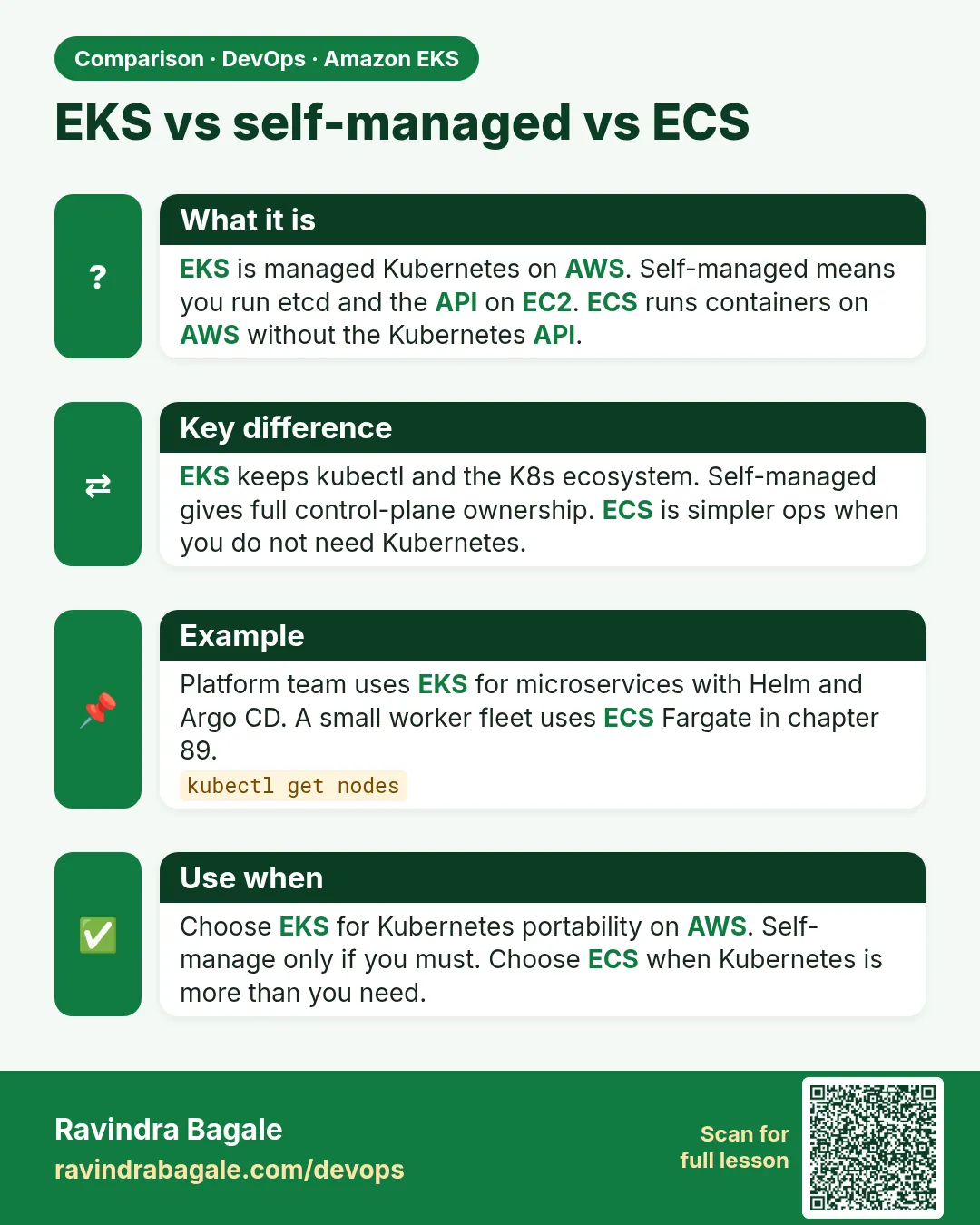
| Approach | Best when | Weak when |
|---|---|---|
| Amazon EKS | You want the Kubernetes API with a managed control plane on AWS | You must still design VPC, IAM, nodes and upgrades |
| Self-managed Kubernetes on EC2 | You need full control of etcd and API flags | You own every control-plane outage and patch |
| Amazon ECS (preview of chapter 89) | You want containers on AWS without Kubernetes concepts | You need multi-cloud Kubernetes portability and the K8s ecosystem |
Interview questions
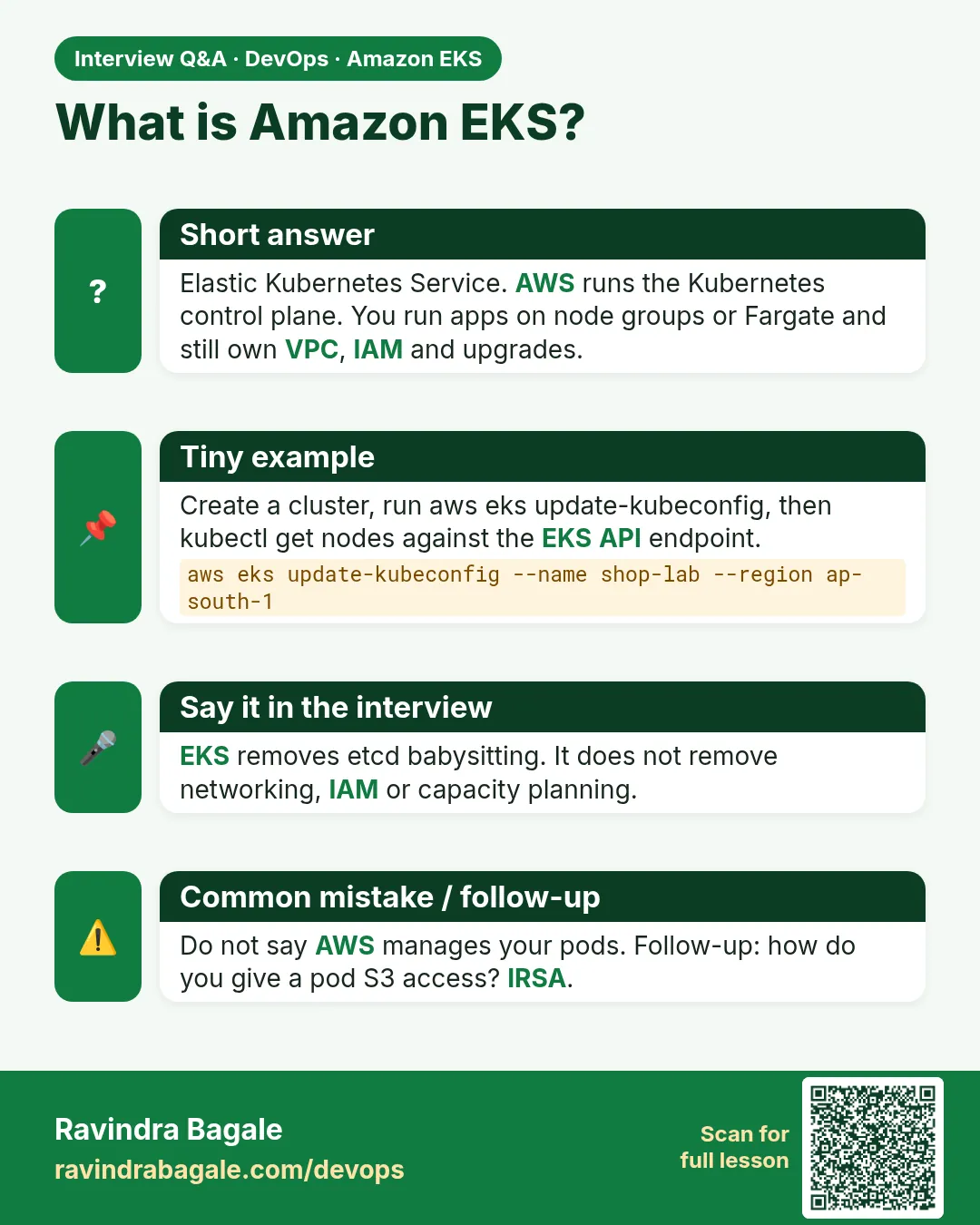
- What is EKS? — Managed Kubernetes control plane on AWS; you own the data plane and apps.
- eksctl vs Terraform? — eksctl is fast for labs; Terraform (chapter 78) for reviewed prod modules.
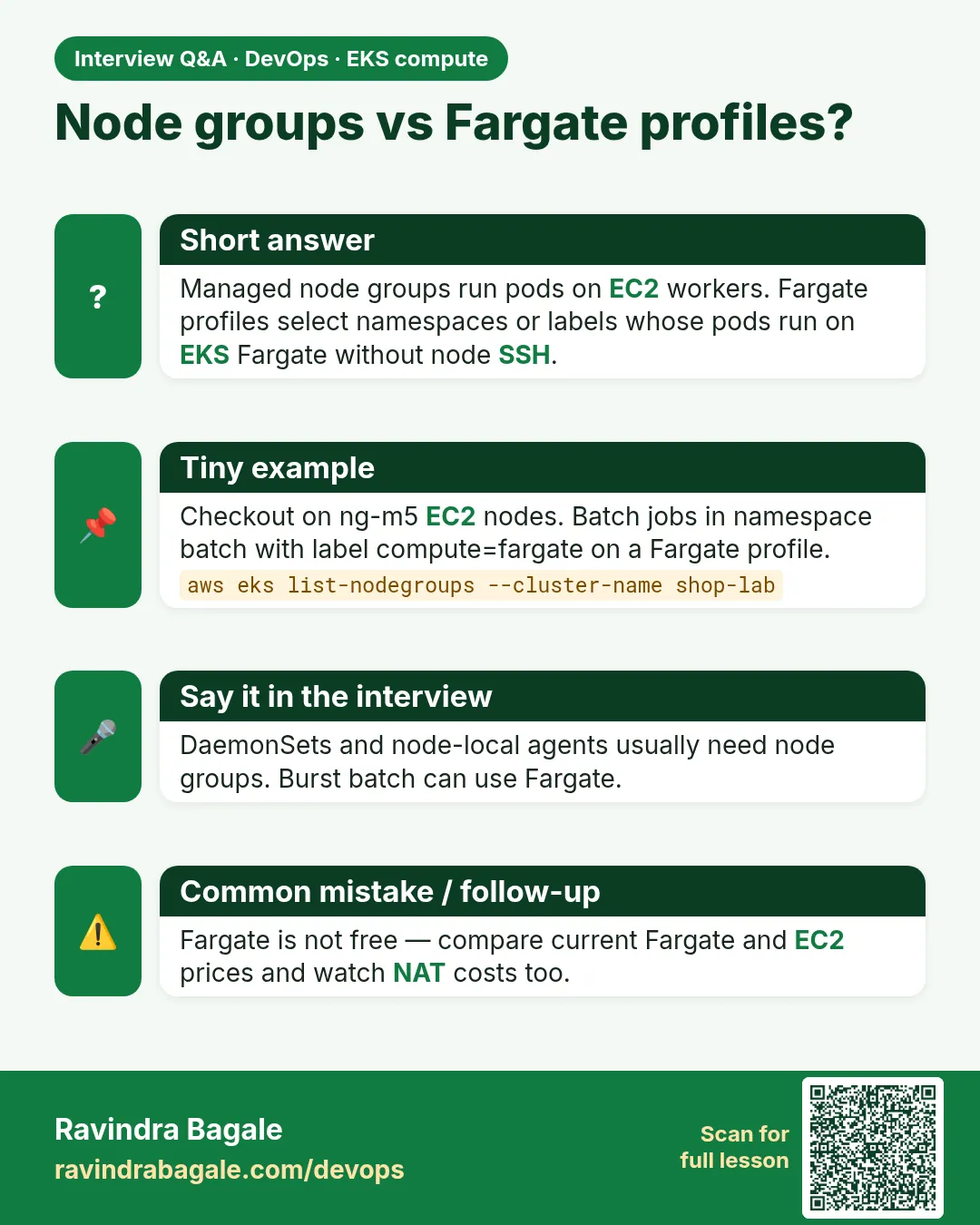
- Node group vs Fargate? — EC2 workers vs serverless pods selected by profile; DaemonSets need nodes.
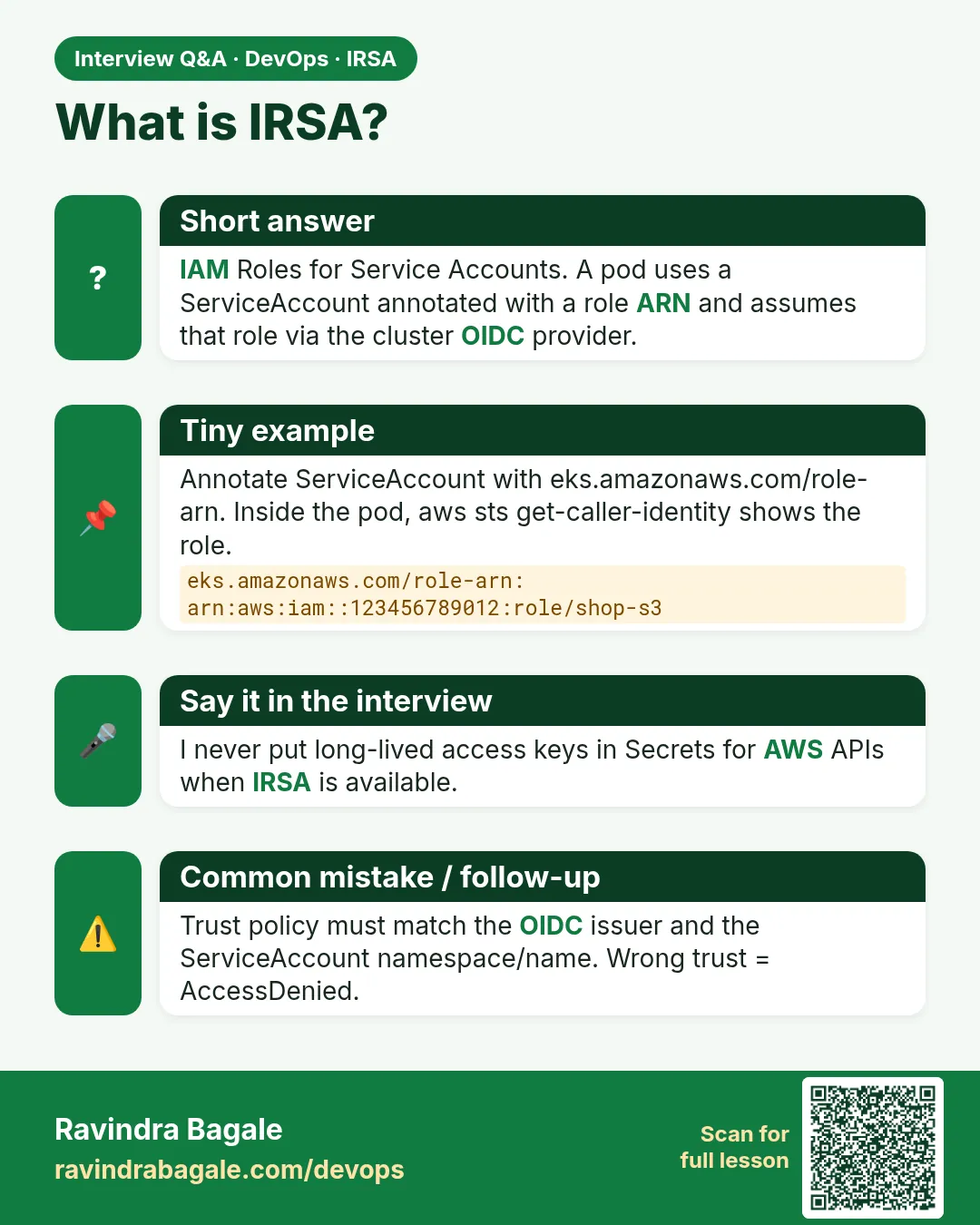
- What is IRSA? — IAM Roles for Service Accounts; pods assume roles without static keys.
- Access entry vs aws-auth? — Access entries are the newer EKS API mapping; aws-auth is the legacy ConfigMap.
- Why VPC CNI matters? — Pods use VPC IPs; IP exhaustion blocks scheduling.
- Upgrade order? — Control plane, drained node waves, add-ons; watch PDBs and error rate.
- Blast radius? — One cluster admin key or a wide IAM role can take down prod — least privilege always.
Revision checklist
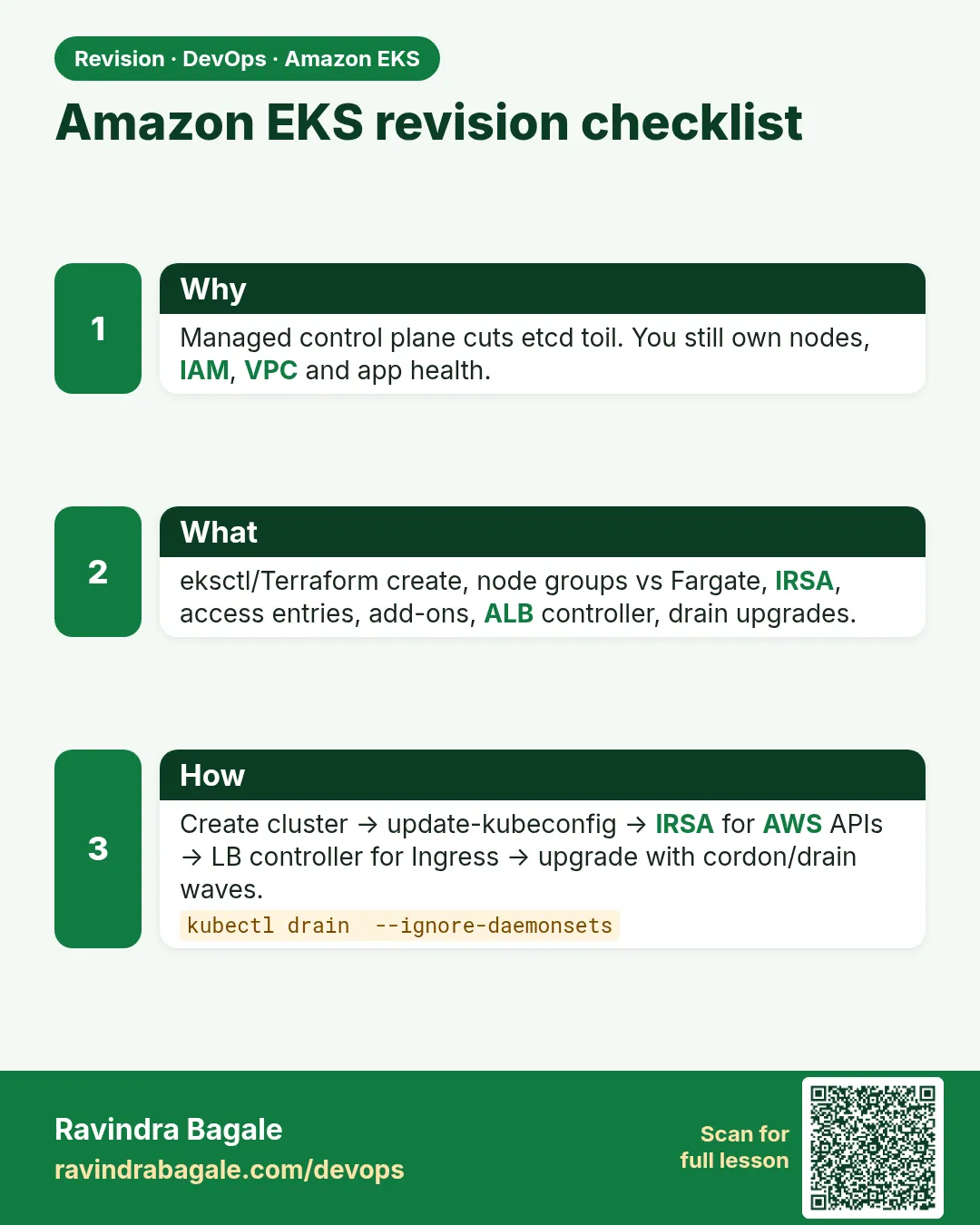
- [ ] I can explain why teams move from self-managed control planes to EKS.
- [ ] I can sketch eksctl vs Terraform create paths.
- [ ] I can compare node groups and Fargate profiles.
- [ ] I can describe IRSA and why static keys are worse.
- [ ] I know access entries exist and aws-auth is legacy.
- [ ] I can name CoreDNS, kube-proxy, VPC CNI and EBS CSI.
- [ ] I know the AWS Load Balancer Controller creates ALBs from Ingress.
- [ ] I can cordon and drain as part of an upgrade wave.
- [ ] I treat AWS prices as approximate and check official pricing.
- [ ] I think about blast radius: IAM, cluster admin and prod quotas.
Quick quiz
Q1. Name two cost levers on EKS.
Control plane hours, worker EC2 or Fargate, plus ALB/NAT and storage — verify current prices.
Q2. What is blast radius in this chapter?
How much damage one leaked key, bad IAM role or bad drain can cause.
Q3. What comes after EKS in this course path?
Chapter 89 — AWS ECS for DevOps.
Ravindra Bagale's Tip
In interviews, say why EKS, then what you still own (nodes, IAM, VPC), then how you upgrade with drain — finish with IRSA.
मुलाखतीत why EKS, नंतर तुम्ही काय own करता (nodes, IAM, VPC), नंतर drain ने upgrade — शेवटी IRSA.
इंटरव्यू में why EKS, फिर आप क्या own करते हैं (nodes, IAM, VPC), फिर drain से upgrade — अंत में IRSA.
In short
- EKS manages the control plane; you still own nodes, IAM, networking and apps.
- Create with eksctl for labs or Terraform for reviewed prod (chapter 78).
- Choose node groups and/or Fargate; use IRSA instead of static keys.
- Access entries map IAM into the cluster; keep add-ons and LB controller healthy.
- Upgrade with drain waves; watch cost and blast radius.
- Next teaching chapter: AWS ECS for DevOps (chapter 89).
Did you understand? Let us try it once more.