Chapter 96: Flux GitOps — Sources, Reconciliation and Safe Local Practice
96.19 Interview questions, revision and chapter quiz
Why
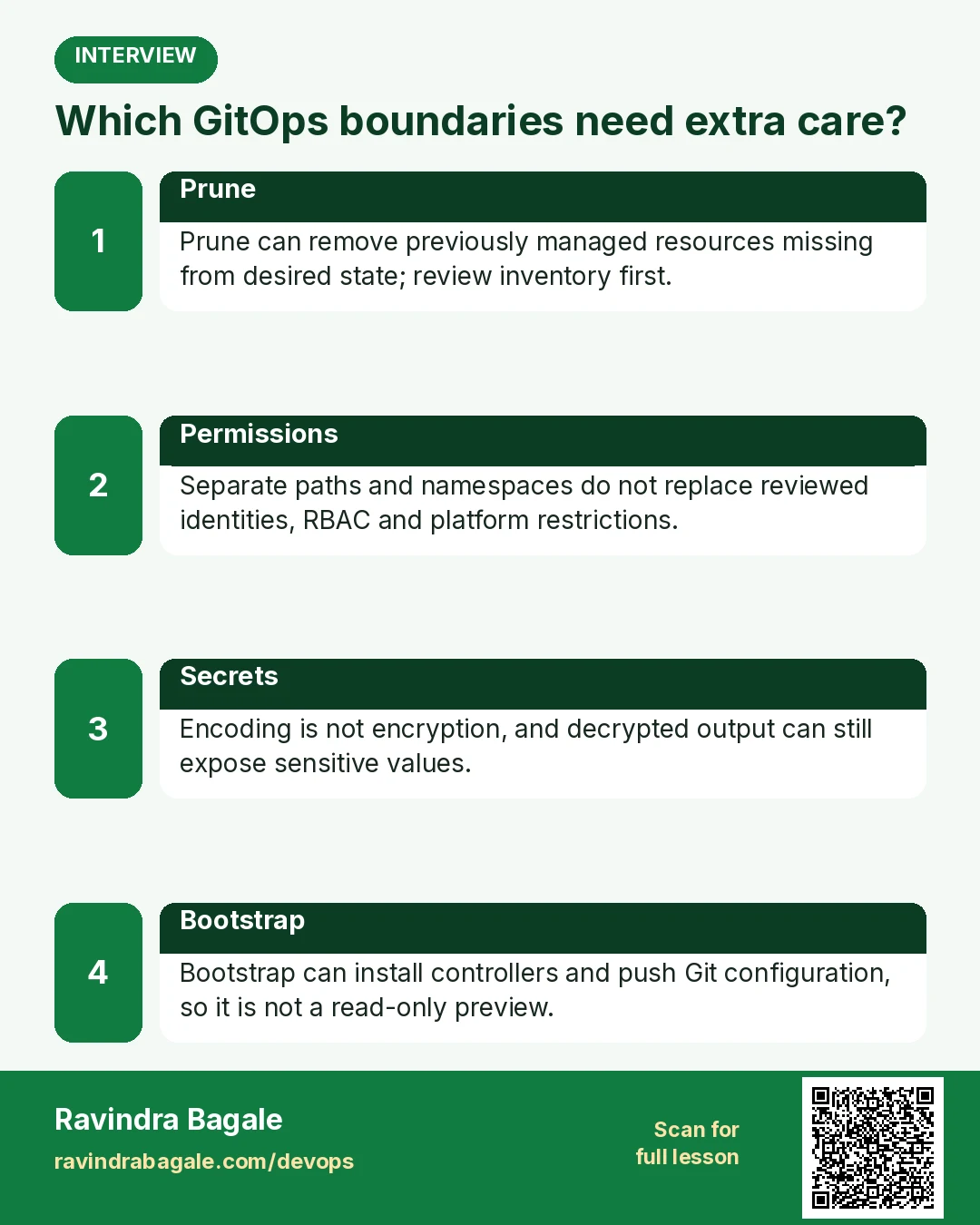
A strong answer states the controller, input, observed evidence and safety boundary.
What
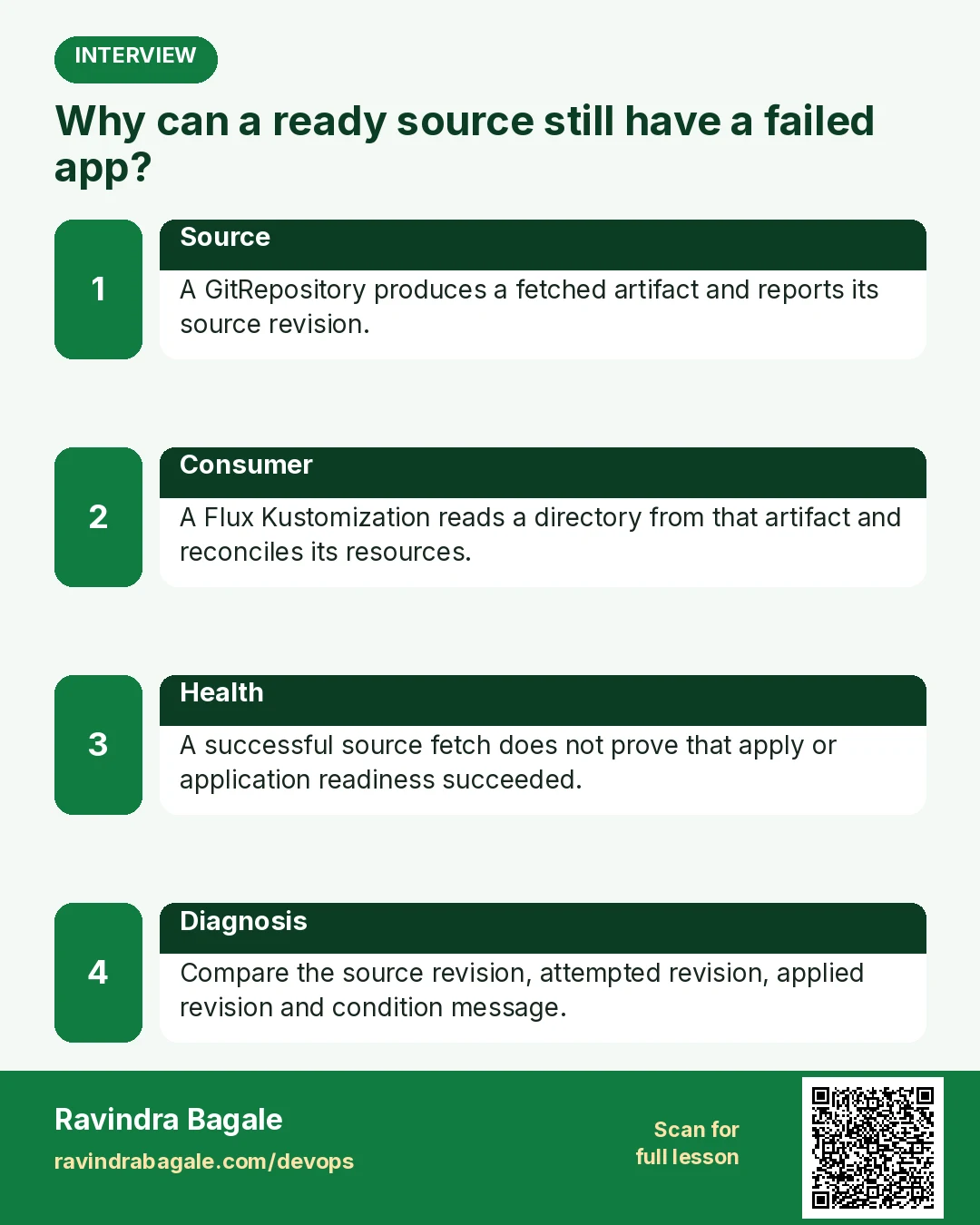
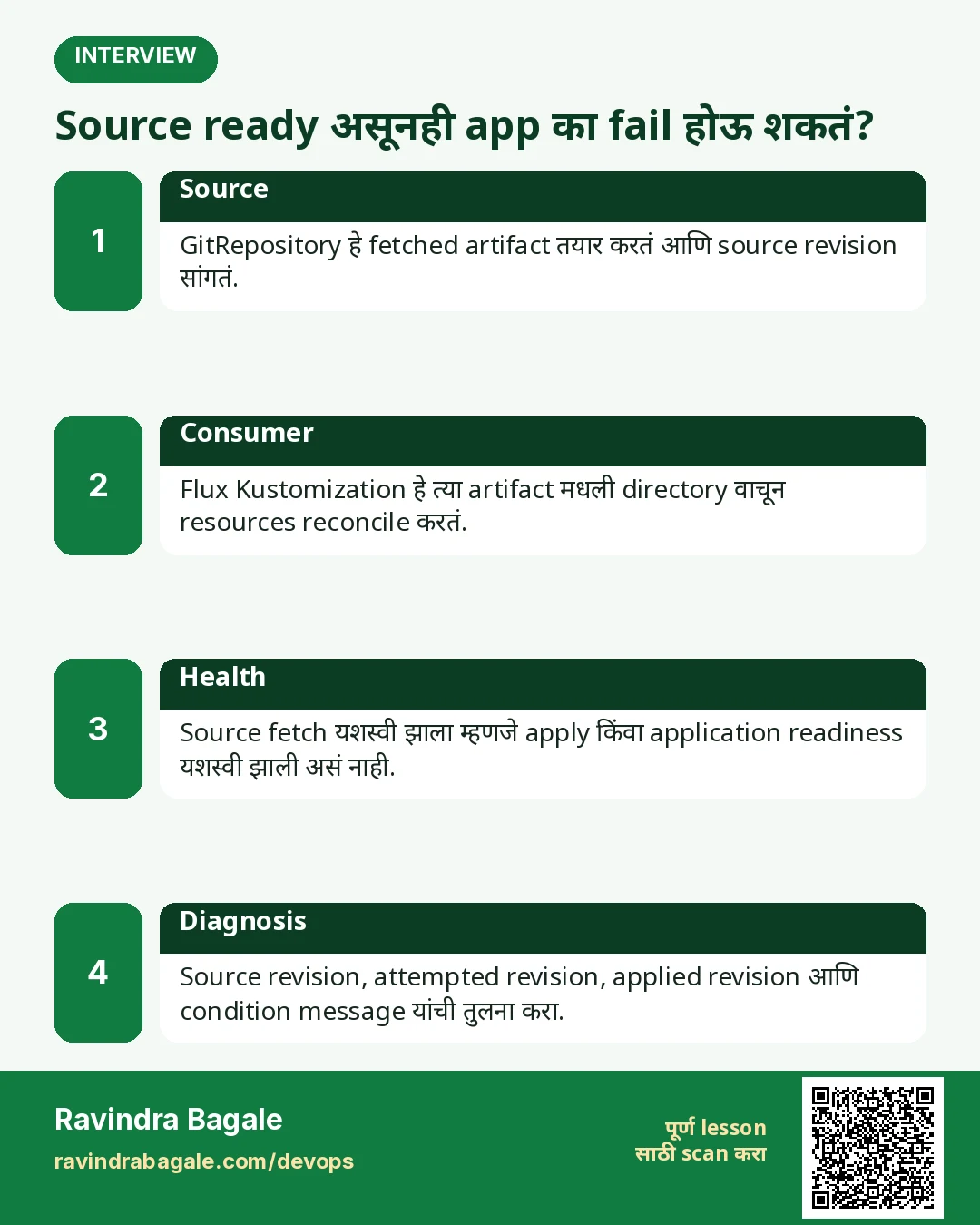
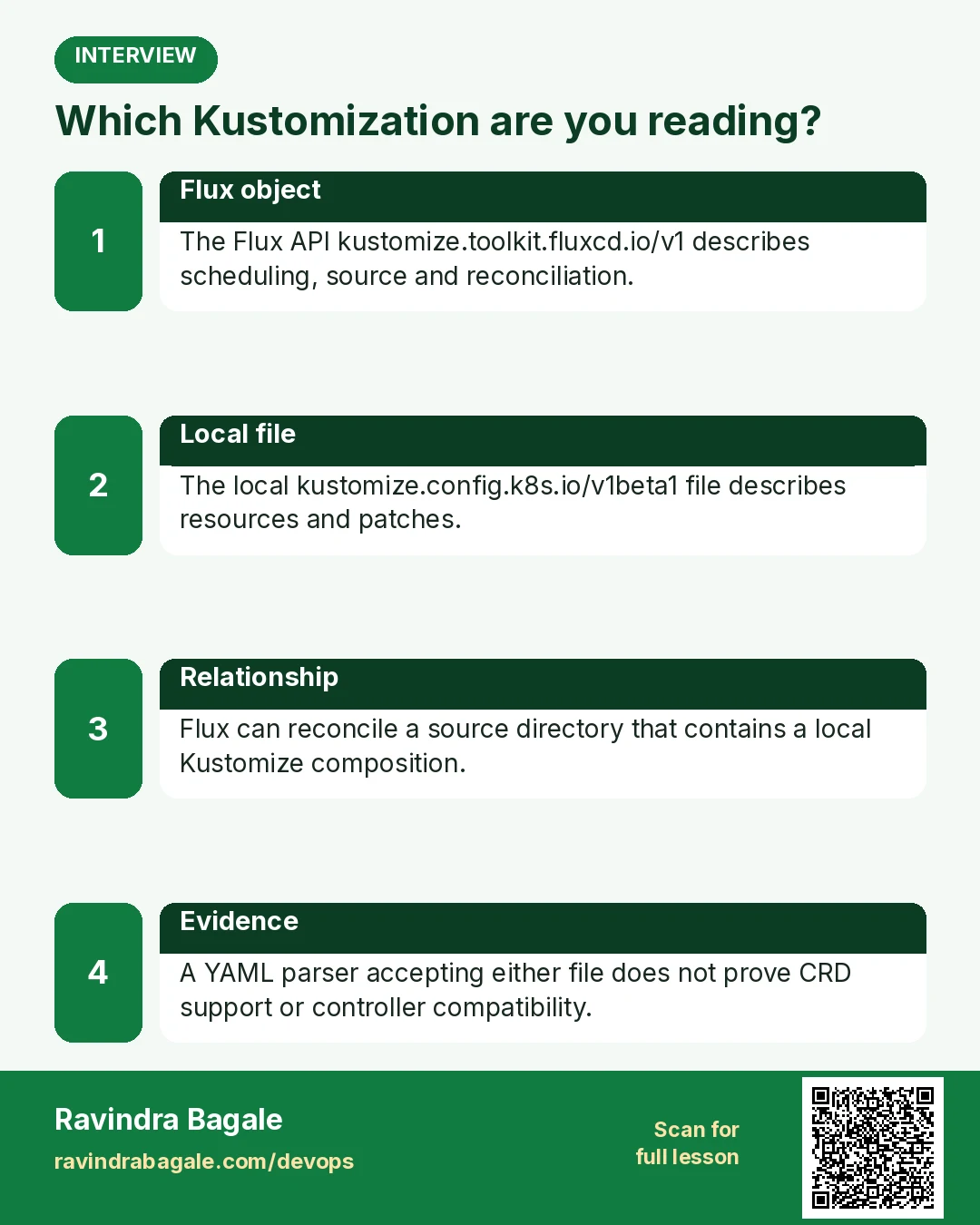
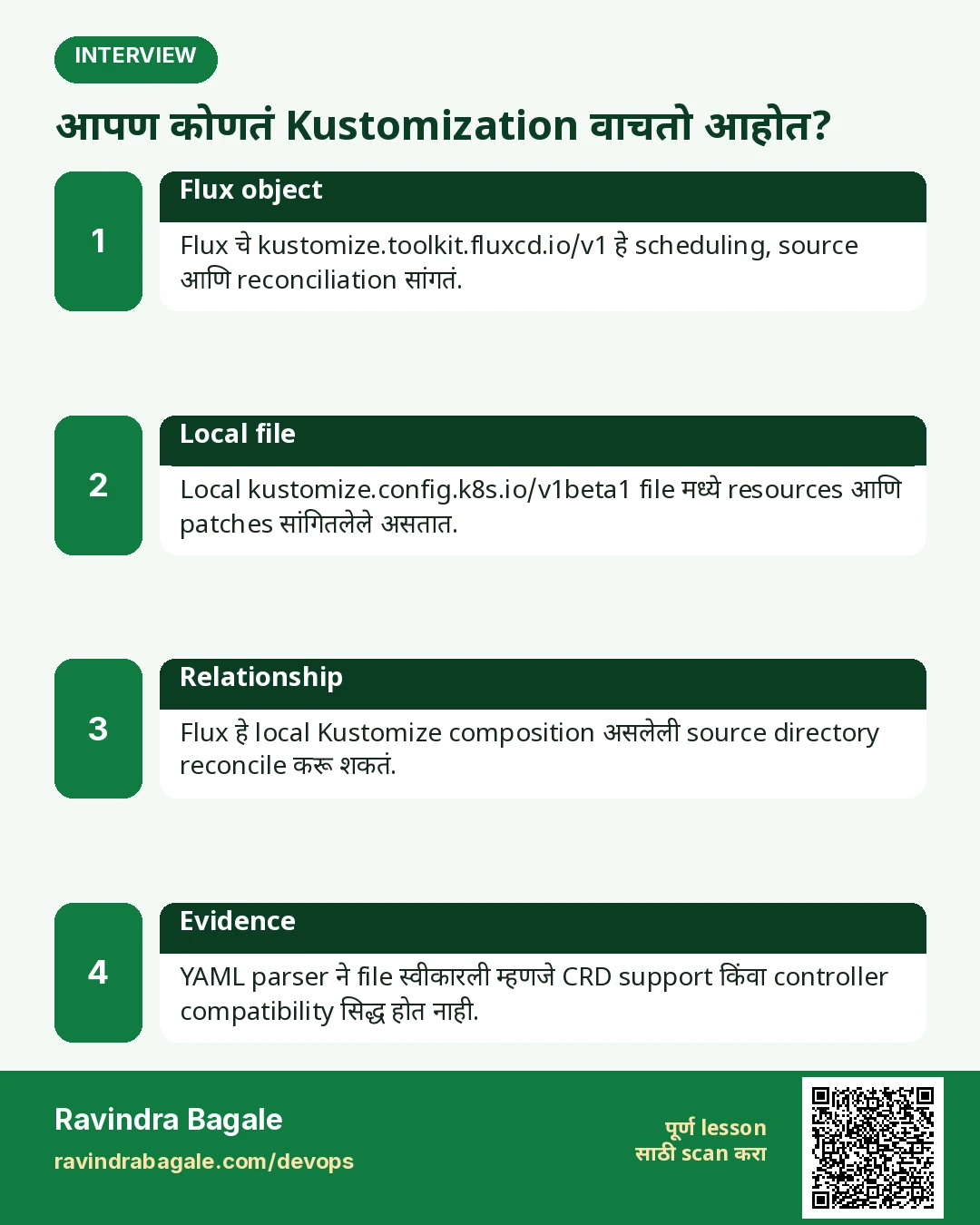
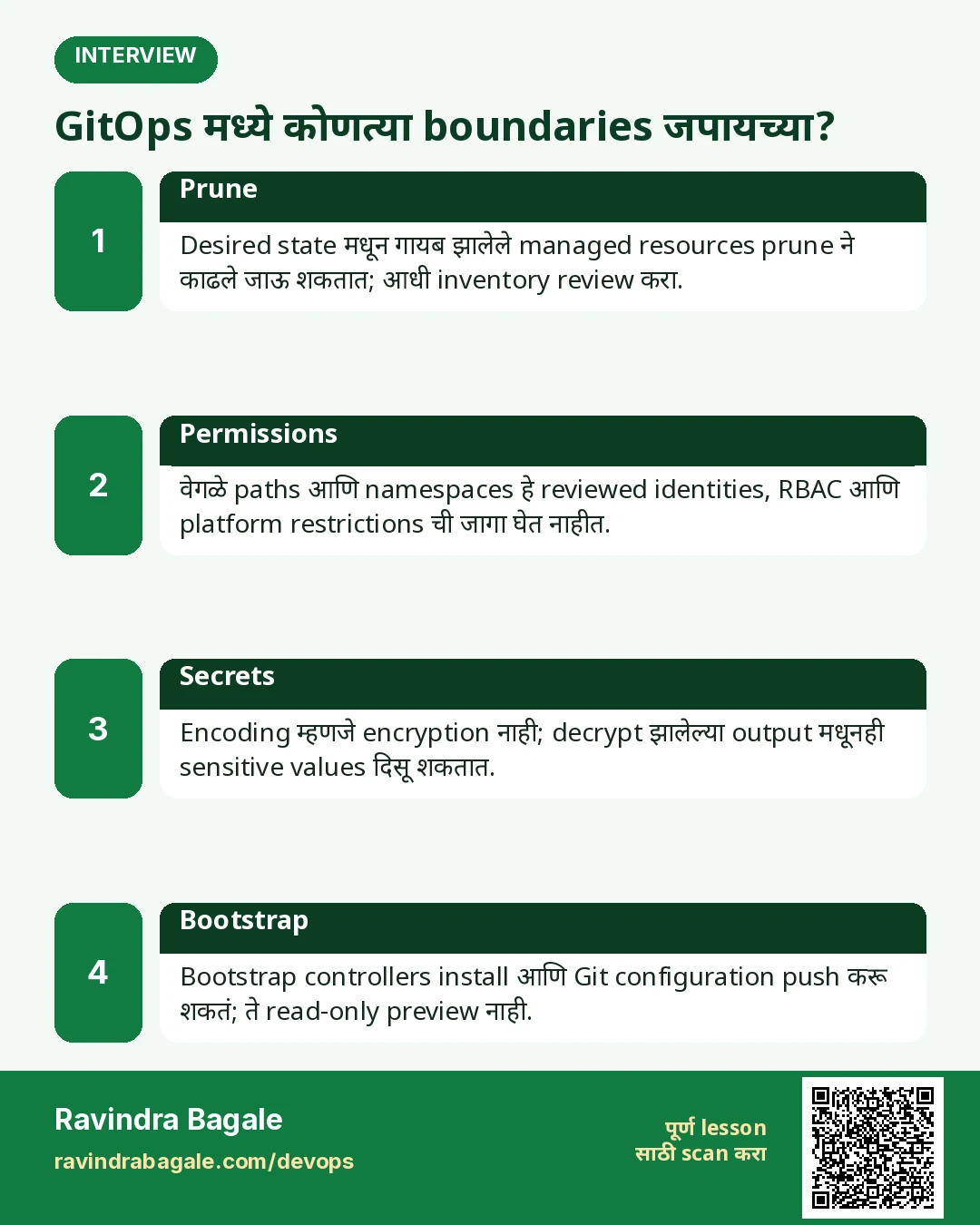
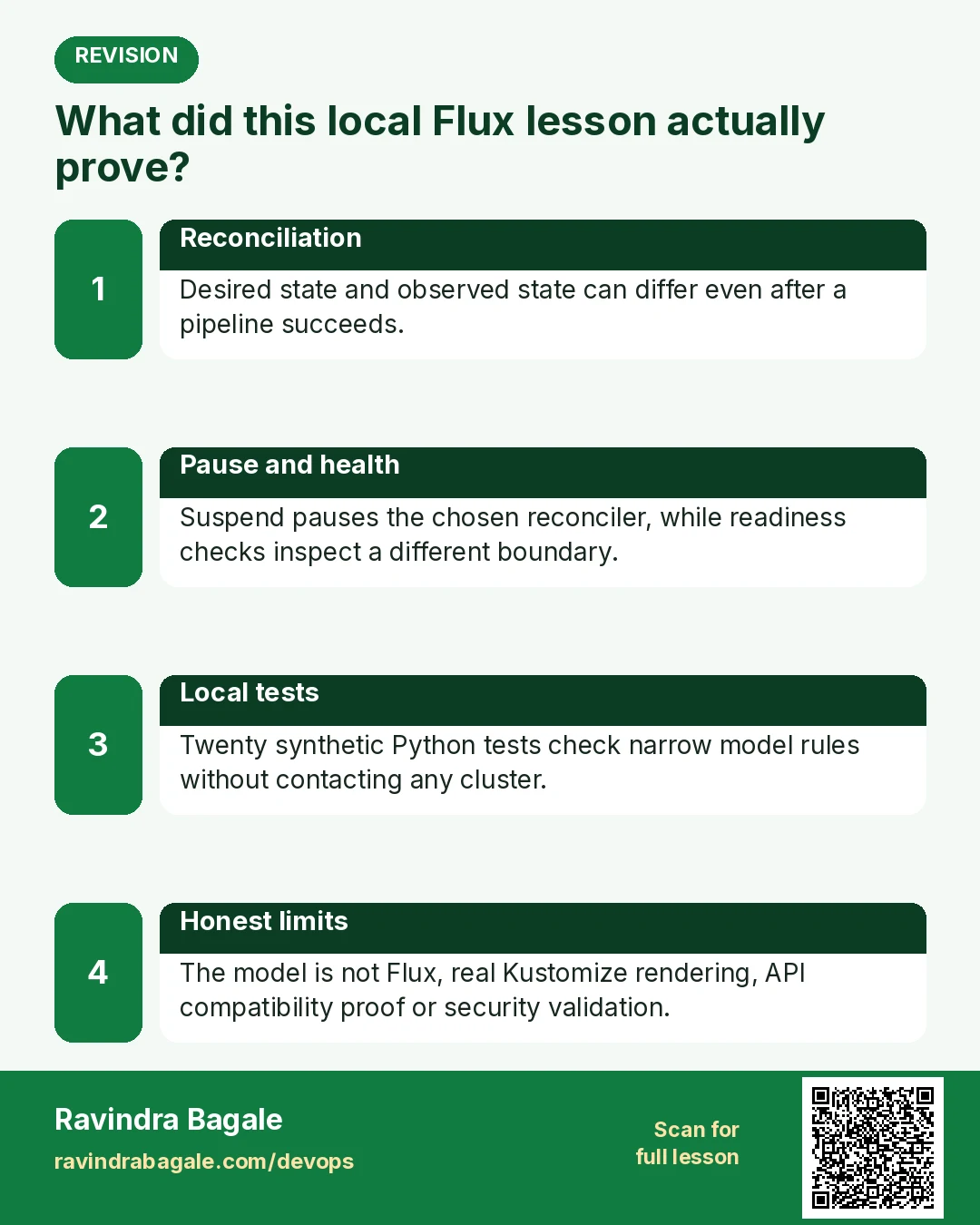
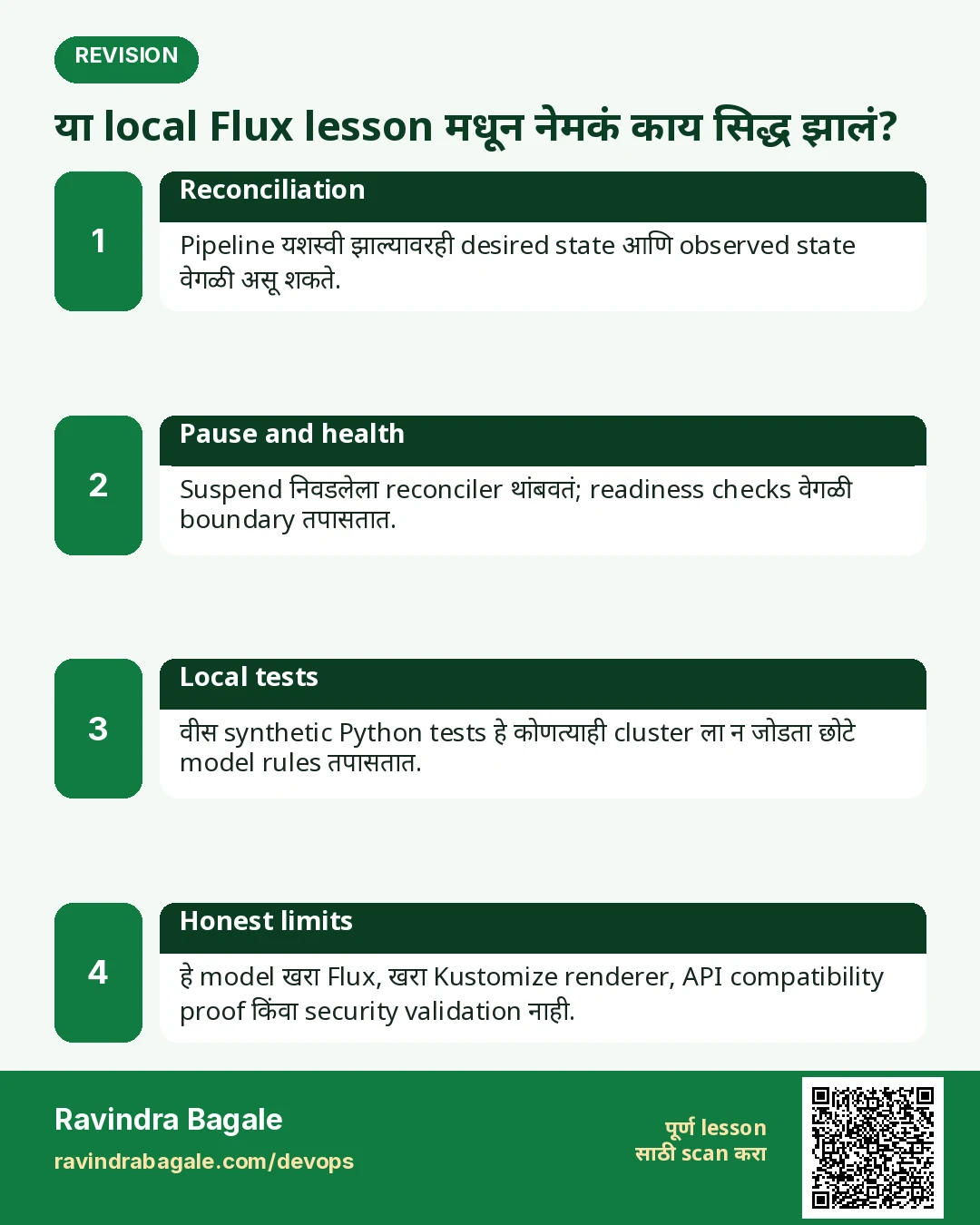
Use these standalone English and Marathi cards for full-sentence revision.
How
- Explain each answer aloud using one fictional example.
- Identify which evidence would require a real cluster and was not gathered here.
- Attempt the ten native questions before opening their answers.
Revision checklist
- I can distinguish a build pipeline from a continuous reconciliation loop.
- I can explain desired state, observed state, revision and drift with one harmless ConfigMap.
- I can distinguish a CRD, custom resource and running controller.
- I can explain why a ready GitRepository is not proof of a healthy application.
- I read apiVersion before confusing a Flux Kustomization with kustomization.yaml.
- I can explain a base, overlay and small patch without claiming a model is Kustomize.
- I know that intervals, event triggers, retries and suspend have different effects.
- I can distinguish dependsOn, health checking and business transaction testing.
- I can explain a HelmRelease without guessing a chart’s values or automatic rollback policy.
- I review prune inventory, field ownership, deletion boundaries and recovery plans.
- I know image automation can commit Git changes and requires reviewed write access.
- I do not confuse a namespace or path with complete authorization isolation.
- I keep real keys and decrypted values out of Git, examples and diagnostics.
- I know bootstrap changes a cluster and writes Git; nothing like that ran here.
- I can trace source, applied revision, attempted revision and readiness separately.
- I know exactly what the 20 local Python tests did and did not prove.
Ravindra Bagale's Tip
Explain what you observed and what remains untested.
काय observe केलं आणि काय अजून test केलेलं नाही हे स्पष्ट सांगा.
क्या observe किया और क्या test नहीं हुआ यह साफ बताओ.
Did you understand? Let us try it once more.
Quick quiz
Q1. Does a successful CI build prove the live cluster still matches Git?
No. A build result is not continuous reconciliation or application-health evidence.
Q2. What does a GitRepository artifact represent?
A fetched source snapshot with revision information; fetching it does not apply its manifests.
Q3. Are Flux Kustomization and local kustomization.yaml the same API?
No. Flux uses kustomize.toolkit.fluxcd.io/v1; the local Kustomize file uses kustomize.config.k8s.io/v1beta1 in these fetched examples.
Q4. What happens to drift correction when a Flux Kustomization is suspended?
Its reconciliation, including apply and drift correction, is paused; this does not automatically stop running workloads.
Q5. Does wait: true combine with healthChecks to select only the listed resources?
No. The fetched documentation says wait: true checks all reconciled resources and ignores the explicit healthChecks list.
Q6. May a HelmRelease use chart and chartRef together?
No. Choose one documented chart source form. Values are chart-specific, and remediation behaviour needs explicit review.
Q7. Does prune delete every object in a namespace?
No. It concerns previously managed inventory missing from desired state, subject to documented policies and exemptions. Unrelated objects are not automatically part of that inventory.
Q8. Do different Git folders prove tenant isolation?
No. Reviewed Kubernetes RBAC, identities and platform restrictions must enforce the intended boundary.
Q9. Is bootstrap a read-only local preview?
No. The documented process installs controllers and pushes configuration to Git. It was not executed here.
Q10. What do the 20 local Python tests prove?
Only the narrow deterministic model rules on synthetic input. They are not Flux execution, real Kustomize rendering, API compatibility proof or cluster security validation.
Did you understand? Let us try it once more.
Official sources opened for this chapter
Opened 6 November 2026. The YAML API forms shown above were checked against these fetched documents, not against an installed cluster. No product release number, runtime compatibility, cloud quota, price or security certification is invented. All cluster and Flux outputs are illustrative. Only the explicitly labelled local Python model and local text/YAML/media checks ran.